
Learning objectives / 学习目标
- 识别能量中的独立二次项,并在经典平衡条件下应用能量均分定理。
- 正确计数平动、转动和振动贡献,说明一个振动模为何经典地贡献两个二次项。
- 使用并解释归一化的 Maxwell–Boltzmann 速率分布,区分 \(v_p\)、\(\bar v\) 与 \(v_{\rm rms}\)。
- 区分扩散与逸出,使用随机游走、Graham 定律和 \(D\sim\lambda\bar v/3\) 的适用近似。
- 从量子“冻结”解释热容随温度出现台阶,而不把自由度当成任意开关。
- 对概率密度单位、归一化、极限与数值结果进行独立检查。
Prerequisites / 先修知识
- Ideal-Gas Model 中的 \(k_BT\)、\(v_{\rm rms}\) 与平均自由程;
- 概率密度、定积分、指数函数与无量纲变量;
- 刚体转动和简谐振子的动能、势能形式。
Scope and conventions / 范围与约定
默认稀薄、经典、非简并、热平衡气体;速率 \(v\ge0\) 是标量,速度 \(\mathbf v\) 是矢量。\(f(v)\) 定义为速率概率密度,满足 \(f(v)dv\) 无量纲。能量均分只对经典平衡分布中以二次形式出现且热可及的自由度成立;化学反应、电子激发、Bose–Einstein/Fermi–Dirac 统计和稠密流体输运不在本课范围。
Notation and modeling contract / 符号与建模契约
| Symbol | Meaning | SI unit / convention |
|---|---|---|
| \(f\) | number of active quadratic terms | dimensionless |
| \(C_V,C_p\) | molar heat capacities at fixed \(V,p\) | \(\mathrm{J\,mol^{-1}K^{-1}}\) |
| \(f(v)\) | speed probability density | \(\mathrm{s\,m^{-1}}\) |
| \(v_p,\bar v,v_{\rm rms}\) | most probable, mean, rms speeds | \(\mathrm{m\,s^{-1}}\) |
| \(J_N\) | number flux | \(\mathrm{m^{-2}s^{-1}}\) |
| \(D\) | diffusion coefficient | \(\mathrm{m^2\,s^{-1}}\) |
| \(\theta=h\nu/k_B\) | vibrational characteristic temperature | K |
\(f\)(自由度计数)与 \(f(v)\)(概率密度)只凭自变量和上下文区分;为避免歧义,推导中常把二次项数量写成 \(f_{\rm q}\)。
Knowledge 1 — Degrees of freedom and equipartition / 自由度与能量均分
Knowledge ID: P03-U02-L02-K01
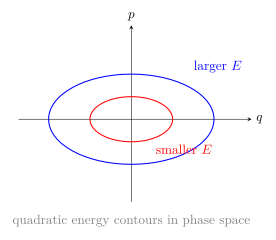
**自由度(degree of freedom)**是描述系统独立运动所需的广义坐标;但均分定理更精确地数的是哈密顿量中的独立二次项。若某项形如 \(a q^2\) 或 \(b p^2\),且能量间隔相对 \(k_BT\) 足够细,则其经典热平均贡献
\[\langle E_{\rm quadratic}\rangle=\frac12k_BT.\]
每摩尔含 \(f_{\rm q}\) 个活跃二次项时,
\[U_m=\frac{f_{\rm q}}{2}RT, \qquad C_V=\left(\frac{\partial U_m}{\partial T}\right)_V=\frac{f_{\rm q}}{2}R\]
仅在 \(f_{\rm q}\) 对温度近似不变时成立。
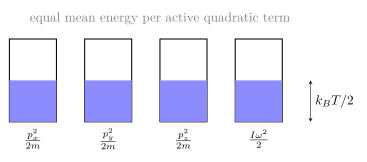
图中的等高柱不是说每个瞬间能量相等,而是长时间或系综平均相等。非二次势、强约束或量子冻结都会改变简单的 \(k_BT/2\) 结论。
Knowledge 2 — Translational, rotational, and vibrational modes / 平动、转动与振动模
Knowledge ID: P03-U02-L02-K02
单原子分子只有三项平动动能,经典地给 \(C_V=3R/2\)。线性双原子分子在常温附近通常还有绕垂直于键轴的两个转动二次项,故刚性转子近似给 \(C_V=5R/2\)。绕键轴转动的转动惯量极小,能级间隔较大,在常温未必热可及。
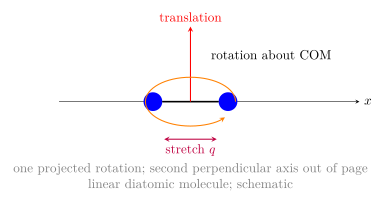
一个谐振动模含动能 \(p_q^2/(2\mu)\) 与势能 \(\kappa q^2/2\) 两个二次项,经典完全激活时每分子贡献 \(k_BT\),每摩尔向 \(C_V\) 贡献 \(R\)。
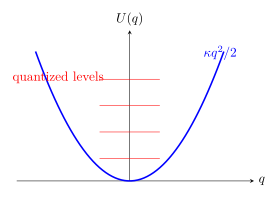
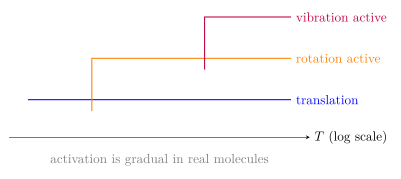
平动、转动、振动的能级间隔不同,因此随温度依次变得热可及。所谓“冻结”不是运动完全停止,而是激发概率很低,能量对温度的导数很小。
Knowledge 3 — Maxwell–Boltzmann speed distribution / 麦克斯韦—玻尔兹曼速率分布
Knowledge ID: P03-U02-L02-K03
平衡经典理想气体的速率概率密度为
\[f(v)=4\pi\left(\frac{m}{2\pi k_BT}\right)^{3/2}v^2 \exp\left(-\frac{mv^2}{2k_BT}\right),\qquad v\ge0,\]
并满足
\[\int_0^\infty f(v)\,dv=1, \qquad P(v_1<v<v_2)=\int_{v_1}^{v_2}f(v)\,dv.\]
\(f(v)\) 的单位是速率的倒数;“某分子速率恰好等于一个连续值”的概率为零,有限区间概率才有意义。
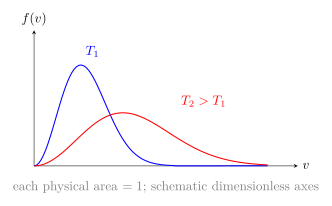
升温使分布变宽、峰降低并右移,但面积保持 1。三种常用速率为
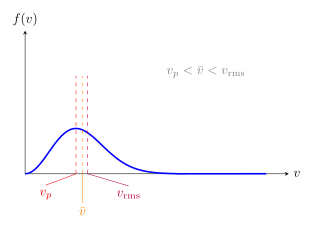
\[v_p=\sqrt{\frac{2k_BT}{m}},\qquad \bar v=\sqrt{\frac{8k_BT}{\pi m}},\qquad v_{\rm rms}=\sqrt{\frac{3k_BT}{m}},\]
且
\[v_p<\bar v<v_{\rm rms}.\]
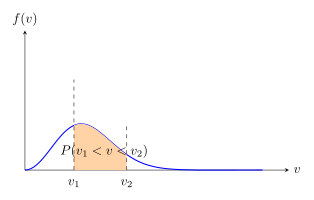
最后一图把“曲线高度”和“区间概率”分开:概率是面积,不是单点高度。
Knowledge 4 — Diffusion, effusion, and molecular transport / 扩散、逸出与分子输运
Knowledge ID: P03-U02-L02-K04
**扩散(diffusion)**是浓度不均匀在大量碰撞和随机游走下趋向均匀的输运过程。简单各向同性稀薄气体估算给
\[D\sim\frac13\lambda\bar v,\]
而宏观一维 Fick 定律写成 \(J_N=-D\,dn_N/dx\)。负号表示净通量从高数密度指向低数密度。
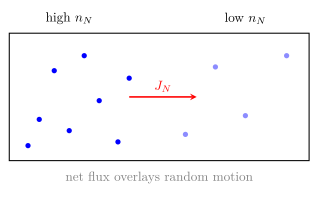
**逸出(effusion)**是气体经小孔进入近似真空的分子流。小孔尺度必须远小于平均自由程,使分子穿孔时不在孔内频繁互撞。理想条件下同温两气体的逸出率比满足 Graham 定律:
\[\frac{r_A}{r_B}=\sqrt{\frac{M_B}{M_A}}.\]
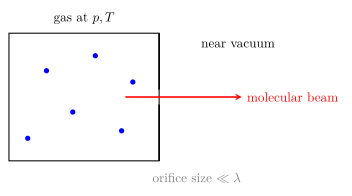
扩散依赖连续碰撞形成随机游走;逸出则要求孔处近似无碰撞。两者都出现质量的平方根标度,但不能把 Graham 定律无条件用于高压管流。
Knowledge 5 — Temperature dependence of heat capacity / 热容的温度依赖
Knowledge ID: P03-U02-L02-K05
经典均分若所有模式始终活跃,会预测常数热容;实验却显示分子热容随温度形成平滑台阶。原因是转动、振动能级量子化:当能级间隔远大于 \(k_BT\),激发被冻结;温度升高后才逐渐贡献。
对一个量子谐振动模,去掉与热容无关的零点能后,摩尔振动热容为
\[C_{V,{\rm vib}}=R\left(\frac{\theta}{T}\right)^2 \frac{e^{\theta/T}}{\left(e^{\theta/T}-1\right)^2}, \qquad \theta=\frac{h\nu}{k_B}.\]
\(T\ll\theta\) 时该贡献指数抑制;\(T\gg\theta\) 时趋向经典极限 \(R\)。
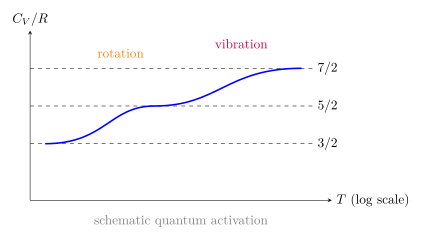
真实曲线的台阶位置依分子转动惯量和振动频率;在更高温还可能出现电子激发、解离或电离,固定组成理想气体模型随之失效。
Worked Examples / 完整例题
Worked Example 1 — 刚性容器中双原子气体升温
已知: \(n=2.00\ \mathrm{mol}\),\(\Delta T=50.0\ \mathrm K\);温区内平动与两个转动自由度活跃,振动冻结。
系统、边界与参考系: 刚性、密闭容器中的气体;容器参考系,\(V\) 恒定。
模型及理由: 理想线性双原子气体,\(f_{\rm q}=5\),故 \(C_V=5R/2\)。
方程与计算:
\[\Delta U=nC_V\Delta T =(2.00)\left(\frac52R\right)(50.0) =2.08\times10^3\ \mathrm J.\]
刚性边界无体积功,在只存在热传递时 \(Q=\Delta U=+2.08\ \mathrm{kJ}\)。
检查: 单位为 mol·J mol\(^{-1}\) K\(^{-1}\)·K = J;正号与升温一致。若振动激活,所需能量更大。
Worked Example 2 — 氮气三种代表速率
已知: \(T=300\ \mathrm K\),\(M=28.0\times10^{-3}\ \mathrm{kg\,mol^{-1}}\)。
系统与模型: 平衡、经典、理想氮气;速率在容器参考系统计。
计算:
\[v_p=\sqrt{\frac{2RT}{M}}=422\ \mathrm{m\,s^{-1}},\]
\[\bar v=\sqrt{\frac{8RT}{\pi M}}=476\ \mathrm{m\,s^{-1}}, \qquad v_{\rm rms}=\sqrt{\frac{3RT}{M}}=517\ \mathrm{m\,s^{-1}}.\]
检查与解释: \(422<476<517\),符合分布右偏造成的顺序;三者都随 \(\sqrt{T/M}\) 标度,但代表不同统计操作。
Worked Example 3 — Neon 与 argon 的逸出率
已知: 同温同压,\(M_{\rm Ne}=20.18\ \mathrm{g\,mol^{-1}}\),\(M_{\rm Ar}=39.95\ \mathrm{g\,mol^{-1}}\);小孔尺寸远小于 \(\lambda\),外侧近似真空。
系统与模型: 两种独立气体通过相同小孔的分子流;Graham 定律。
计算:
\[\frac{r_{\rm Ne}}{r_{\rm Ar}} =\sqrt{\frac{M_{\rm Ar}}{M_{\rm Ne}}} =\sqrt{\frac{39.95}{20.18}}=1.41.\]
检查: 较轻的 neon 逸出更快,方向正确;质量单位在比值中约去。若孔内发生大量碰撞或存在黏性流,这个结果不适用。
Worked Example 4 — 一个振动模的热容贡献
已知: 振动特征温度 \(\theta=3000\ \mathrm K\),\(T=1000\ \mathrm K\);考虑一个振动模。
系统与模型: 稀薄双原子气体,平动与转动完全激活;振动按量子谐振子。令 \(x=\theta/T=3.00\)。
计算:
\[C_{V,{\rm vib}}=R x^2\frac{e^x}{(e^x-1)^2} =R\frac{9e^3}{(e^3-1)^2} =0.496R=4.13\ \mathrm{J\,mol^{-1}K^{-1}}.\]
总摩尔定容热容近似
\[C_V=\frac52R+C_{V,{\rm vib}}=24.9\ \mathrm{J\,mol^{-1}K^{-1}}.\]
极限检查: \(0<C_{V,{\rm vib}}<R\);当 \(T\gg\theta\) 才趋近 \(R\)。因此在 \(T=\theta/3\) 时把振动贡献直接取 \(R\) 会高估。
Lesson synthesis / 全课整合
微观能量结构决定两个层次:可用的二次项决定平均能量与热容,概率权重决定不同速率出现的频率。碰撞既维持 Maxwell–Boltzmann 平衡分布,也把分子运动转化为扩散;小孔若小于平均自由程则选择近似无碰撞的逸出机制。
建模流程:先确认经典平衡和活跃模式,再选择 \(C_V\);涉及速率时先决定是峰值、平均还是方均根;涉及空间输运时比较孔径或梯度尺度与 \(\lambda\);最后检查概率归一化、热容极限与质量平方根标度。
Formula-and-decision table / 公式—决策表
| Goal | Relation | Use when | Main caution |
|---|---|---|---|
| one quadratic term | \(\langle E\rangle=k_BT/2\) | classical equilibrium, active mode | quantum freezeout invalidates it |
| ideal-gas heat capacity | \(C_V=f_{\rm q}R/2\) | \(f_{\rm q}\) constant over range | count quadratic terms, not labels |
| speed density | \(f(v)=4\pi(m/2\pi k_BT)^{3/2}v^2e^{-mv^2/2k_BT}\) | classical equilibrium gas | \(f(v)\) is not a probability by itself |
| representative speeds | \(v_p,\bar v,v_{\rm rms}\) formulas above | Maxwell distribution | do not interchange them |
| diffusion estimate | \(D\sim\lambda\bar v/3\) | dilute isotropic random walk | order-unity model estimate |
| effusion ratio | \(r_A/r_B=\sqrt{M_B/M_A}\) | molecular-flow small orifice | not viscous pipe flow |
| vibrational heat capacity | quantum oscillator formula | harmonic mode, fixed composition | characteristic temperature is mode-specific |
Model boundaries / 模型边界
- Maxwell–Boltzmann statistics require low phase-space occupancy; quantum gases need BE/FD statistics.
- Equipartition is classical and equilibrium-based; it is not universally valid for arbitrary nonquadratic or frozen coordinates.
- \(C_V=fR/2\) assumes a temperature interval where the active-mode set is effectively constant.
- \(D\sim\lambda\bar v/3\) is a kinetic estimate; precise transport coefficients require collision integrals and intermolecular potentials.
- Graham law requires molecular flow and approximately equal temperature; concentration-driven diffusion is a different process.
- At high temperature, dissociation, ionization, and electronic excitation change composition and energy accounting.
Misconception clinic / 易错概念诊所
| Misconception | Diagnosis | Repair |
|---|---|---|
| 每个自由度瞬时能量相等 | 均分说的是平均值 | 写出系综平均符号 |
| 一个振动模只算一个 \(k_BT/2\) | 谐振子有动能、势能两个二次项 | 完全激活贡献 \(k_BT\) |
| \(f(v)\) 就是速率为 \(v\) 的概率 | 连续变量单点概率为零 | 概率为 \(f(v)dv\) 或积分 |
| \(v_p=\bar v=v_{\rm rms}\) | 三种统计操作不同 | 记住严格顺序 |
| 升温使分布面积增大 | 总概率永远归一为 1 | 峰降低、曲线展宽 |
| 扩散和逸出是同一公式 | 碰撞角色相反 | 先比较孔径与 \(\lambda\) |
| 自由度在阈值温度突然打开 | 量子占据随温度平滑变化 | 台阶只是示意 |
Practice and retrieval / 练习与检索
- 说明“自由度”与“能量中的二次项”在均分计数中为何不能总是简单等同。
- 室温刚性双原子理想气体的 \(C_V\) 为何常近似 \(5R/2\) 而不是 \(7R/2\)?
- 一个完全激活的谐振动模每摩尔向 \(U\) 和 \(C_V\) 各贡献多少?
- 写出 Maxwell 速率分布的归一化条件和 \(f(v)\) 的 SI 单位。
- 对固定气体把温度增至 4 倍,\(v_p,\bar v,v_{\rm rms}\) 如何变化?
- 氦与氙同温,摩尔质量比 \(M_{\rm Xe}/M_{\rm He}=32.8\)。求氦与氙平均速率比。
- \(\lambda=80\ \mathrm{nm}\)、\(\bar v=500\ \mathrm{m\,s^{-1}}\),估算 \(D\)。
- 氢气与氧气通过同一分子流小孔,取 \(M_{\rm H_2}=2.0\)、\(M_{\rm O_2}=32.0\ \mathrm{g\,mol^{-1}}\),求逸出率比。
- 对一个振动模,说明 \(T\ll\theta\) 与 \(T\gg\theta\) 两个极限的热容。
- 某实验在高压长毛细管中测得气体流率,能否直接套 Graham 定律?说明需检查什么。
Answer 1
广义坐标可能在能量中同时带动量和坐标两个二次项;均分按独立二次项各给 \(k_BT/2\),不是只按运动名称计数。
Answer 2
三个平动和两个垂直键轴转动通常活跃;振动的量子间隔较大而冻结,因此共有五个有效二次项。
Answer 3
每分子平均能量贡献 \(k_BT\),故每摩尔 \(U_{\rm vib}=RT\),完全激活时 \(C_{V,{\rm vib}}=R\)。
Answer 4
\(\int_0^\infty f(v)dv=1\);由于 \(f(v)dv\) 无量纲,\(f(v)\) 的单位为 \(\mathrm{s\,m^{-1}}\)。
Answer 5
三者都与 \(\sqrt T\) 成正比,因此均变为 2 倍;它们彼此的比值不变。
Answer 6
\(\bar v\propto M^{-1/2}\),所以 \(\bar v_{\rm He}/\bar v_{\rm Xe}=\sqrt{32.8}=5.73\)。
Answer 7
\(D\sim\lambda\bar v/3=(80\times10^{-9})(500)/3=1.33\times10^{-5}\ \mathrm{m^2\,s^{-1}}\)。
Answer 8
\(r_{\rm H_2}/r_{\rm O_2}=\sqrt{32.0/2.0}=4.00\)。
Answer 9
\(T\ll\theta\) 时激发指数受抑,\(C_{V,{\rm vib}}\to0\);\(T\gg\theta\) 时趋向经典极限 \(R\)。
Answer 10
不能直接套用。必须检验孔径相对 \(\lambda\) 是否足够小、外侧是否近真空以及流动是否为分子流而非黏性连续流。
Exit ticket / 离堂检验
一份双原子气体数据同时给出热容、速率分布和小孔流率。用三条证据判断其是否处于“转动活跃、振动冻结、分子流逸出”的温区与流态,并明确每条证据的模型假设。
References and source notes / 参考资料与使用说明
Source-to-content map
| Source | Used for | Knowledge ID / Section | Model boundary or convention |
|---|---|---|---|
| OpenStax University Physics Vol. 2, §2.3 | degrees of freedom, equipartition, temperature-dependent capacities | K01–K02, K05 | classical theorem with quantum freezeout caveat |
| OpenStax University Physics Vol. 2, §2.4 | normalized Maxwell distribution and representative speeds | K03 | classical equilibrium ideal gas |
| OpenStax Chemistry, §9.4 | diffusion/effusion distinction and Graham law | K04 | molecular-flow condition for effusion |
| MIT OCW 10.40, Lecture 23 notes | molecular energy levels and statistical heat-capacity interpretation | K01–K02, K05 | equilibrium statistical thermodynamics |
| NIST Chemistry WebBook — Oxygen | real-gas molecular constants and temperature-dependent thermochemical data cross-check | K02, K05 | tabulated oxygen-specific data, not universal constants |
Source notes
以上来源均于 2026-08-24 实际打开核对。热容的分段图只表达物理机制,不声称台阶位置对所有分子相同;NIST 数据用于检验“真实热容随温度变化”的事实边界。所有图按本课公式原创绘制。
复习与拓展
- Unit 3.2.3 将用分子间势修正理想模型与输运近似;
- 后续统计物理将从配分函数严格导出均分和 Maxwell 分布;
- 热力学课程将用 \(C_p-C_V\) 和过程约束连接热容;
- 量子课程将解释转动、振动能级及低温冻结。