
Learning objectives / 学习目标
完成本课后,你应当能够:
- 根据研究问题和尺度选择质点、刚体或连续体模型,并写出被保留与被舍弃的信息。
- 解释参考系为什么不等同于一张坐标图;说明观察者、时钟、同步约定、原点和坐标轴各自的作用。
- 在指定参考系中写出位置矢量和位移矢量,并严格区分路程、两点直线距离和位移。
- 在运动图、数据表、位置—时间图和方程之间转换,同时辨认采样与测量不确定度。
- 用量纲、端点、尺度和表示一致性对运动描述作快速审计。
0. Before starting: reality → model → measurement → representation
同一辆汽车可以被描述为公路上的一个点、转弯时有朝向的刚体,或碰撞时会变形的连续体。答案并不矛盾,因为它们回答不同问题。
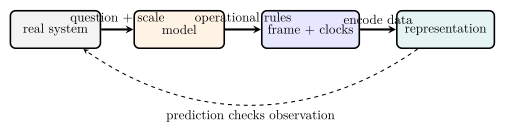
Knowledge 1 — Particle, rigid-body, and continuous-body models / 质点、刚体与连续体模型
Knowledge ID: P01-U01-L01-K01
1.1 Three resolutions of one physical body
| Model | Retains / 保留 | Suppresses / 舍弃 | Typical question |
|---|---|---|---|
| Particle / 质点 | 位置、质量、电荷等集中属性 | 尺寸、形状、内部转动与形变 | 卫星质心的轨道在哪里? |
| Rigid body / 刚体 | 整体平移、朝向、固定形状 | 内部距离变化、弹性波与断裂 | 车身如何转向?轮子如何转动? |
| Continuum / 连续体 | 随位置和时间变化的密度、速度、应变等场 | 原子级离散性 | 翼面附近空气如何流动?梁怎样弯曲? |
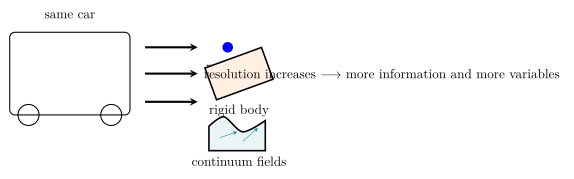
质点的位置通常代表选定的代表点,例如质心位置 \(\mathbf r_C(t)\)。质点仍可以有质量或电荷;“没有尺寸”不等于“没有物理属性”。
刚体的定义性约束是任意两个材料点 \(A,B\) 的间距不随时间改变:
\[\boxed{\lvert\mathbf r_A(t)-\mathbf r_B(t)\rvert=\text{constant}.}\]
真实物体只在形变相对研究精度可忽略时近似刚体。连续体则用场描述材料,例如
\[\rho=\rho(\mathbf r,t), \qquad \mathbf u=\mathbf u(\mathbf r,t).\]
这里 \(\rho\) 是宏观密度,\(\mathbf u\) 是该位置附近材料的平均速度。一个微小体积元仍须含有足够多微粒,连续平均才平滑。
1.2 A scale test before choosing the particle model
设物体特征尺寸为 \(\ell\),运动轨迹或观察距离的特征尺度为 \(L\),测量所需相对精度为 \(\varepsilon\)。若
\[\frac{\ell}{L}\ll\varepsilon,\]
尺寸效应通常低于误差预算,可先用质点模型。这个判据是经验性的筛选,不替代对具体效应的估计。
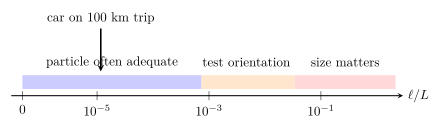
1.3 Worked Example 1 — one bicycle, three questions
一辆自行车沿 \(12.0\ \mathrm{km}\) 路线行驶,车轮半径 \(0.350\ \mathrm m\),轮胎受力时的压缩量约 \(3\ \mathrm{mm}\)。
- 求到达时间:路线尺度远大于车长,质点模型足够。
- 求车轮上气门芯的位置:必须保留车轮的朝向与转角,用刚体模型。
- 求接触斑内橡胶形变:刚体约束已经失败,需要连续体或弹性模型。
若自行车长度取 \(\ell=1.80\ \mathrm m\),则
\[\frac{\ell}{L} =\frac{1.80}{1.20\times10^4} =1.50\times10^{-4}.\]
对 \(1\%\) 的到达时间精度,尺寸效应远小于误差预算;但对气门芯相位,忽略车轮尺寸会删掉所求量本身。
Knowledge 2 — Reference frames, clocks, origins, and coordinate axes / 参考系、时钟、原点与坐标轴
Knowledge ID: P01-U01-L01-K02
2.1 Reference frame is not merely a coordinate chart
在经典运动学中,一个可操作的参考系至少需要:
- 一族相对于彼此静止、可识别空间地点的参考物或观察者;
- 测量空间间隔的标尺约定;
- 各地点的时钟及同步约定,从而给事件赋予共同时间 \(t\);
- 选择坐标图,把每个事件标记成 \((t,x,y,z)\)。
Reference frame / 参考系 是物理测量结构;coordinate chart / 坐标图 是给同一组事件贴数字标签的数学选择。同一个实验室参考系可用 Cartesian、polar 或平移后的坐标描述,而不必换参考系。
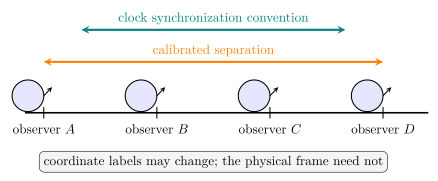
2.2 Origin, axes, orientation, and units
给定 Cartesian 坐标后,位置矢量写作
\[\mathbf r(t)=x(t)\widehat{\mathbf x}+y(t)\widehat{\mathbf y}+z(t)\widehat{\mathbf z}.\]
原点决定零位置,轴决定正方向与分量,单位决定数值尺度。把 \(x\) 轴反向会改变坐标的符号,但不会改变物理事件。
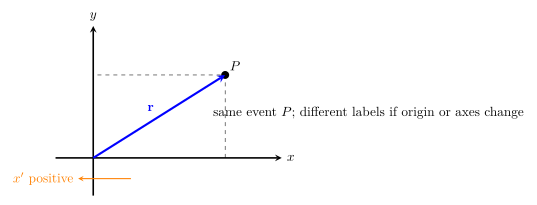
若同一实验室内坐标 \(S'\) 的原点相对 \(S\) 固定在 \(\mathbf b\),且轴平行,则
\[\boxed{\mathbf r'=\mathbf r-\mathbf b.}\]
这只是重新标号。若 \(\mathbf b=3.00\widehat{\mathbf x}-2.00\widehat{\mathbf y}\ \mathrm m\),事件在 \(S\) 中为 \(\mathbf r=8.00\widehat{\mathbf x}+1.00\widehat{\mathbf y}\ \mathrm m\),则
\[\mathbf r'=5.00\widehat{\mathbf x}+3.00\widehat{\mathbf y}\ \mathrm m.\]
2.3 Worked Example 2 — two coordinate charts, one laboratory
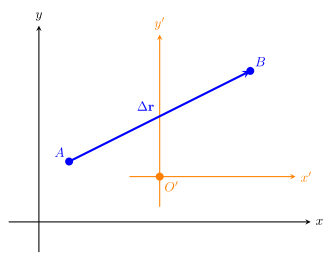
实验室坐标 \(S\) 以门口为原点,东为 \(+x\)、北为 \(+y\)。坐标 \(S'\) 以实验台为原点,实验台在 \(S\) 中的位置为 \((4.0,1.5)\ \mathrm m\);\(S'\) 的轴与 \(S\) 平行。一小车在 \(S\) 中由 \(A=(1.0,2.0)\ \mathrm m\) 移到 \(B=(7.0,5.0)\ \mathrm m\)。
\[\mathbf r_A'=(-3.0\widehat{\mathbf x}+0.5\widehat{\mathbf y})\ \mathrm m,\]
\[\mathbf r_B'=(3.0\widehat{\mathbf x}+3.5\widehat{\mathbf y})\ \mathrm m.\]
两张图中的位移相同:
\[\Delta\mathbf r' =\mathbf r_B'-\mathbf r_A' =(6.0\widehat{\mathbf x}+3.0\widehat{\mathbf y})\ \mathrm m =\Delta\mathbf r.\]
固定平移同时加在起点和终点上,在相减时消去。这里参考系没有改变,只改了坐标原点。
Knowledge 3 — Position, path length, distance, and displacement / 位置、路程与位移
Knowledge ID: P01-U01-L01-K03
3.1 Four related but non-interchangeable quantities
在给定参考系与坐标约定中:
| Quantity | Definition | Type | SI unit |
|---|---|---|---|
| Position / 位置 | 从原点到物体的 \(\mathbf r(t)\) | vector | m |
| Displacement / 位移 | \(\Delta\mathbf r=\mathbf r_f-\mathbf r_i\) | vector | m |
| Straight-line distance / 两点直线距离 | \(d=\lvert\Delta\mathbf r\rvert\) | nonnegative scalar | m |
| Path length / 路程 | 沿实际轨迹累积的弧长 \(s\) | nonnegative scalar | m |
若光滑轨迹由参数 \(\lambda\) 给出,路程为
\[\boxed{ s=\int_{\lambda_i}^{\lambda_f} \left\lvert\frac{d\mathbf r}{d\lambda}\right\rvert d\lambda }.\]
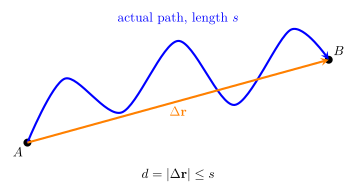
位移只看端点;路程记录整个历史。三角不等式给出
\[\boxed{s\ge d=\lvert\Delta\mathbf r\rvert,}\]
只有路径不折返并沿端点连线前进时才取等号。
3.2 One-dimensional special case
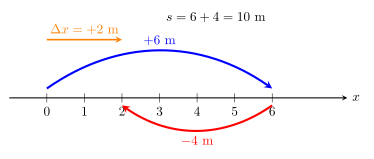
在直线上,位置用带符号坐标 \(x\) 表示,位移为
\[\Delta x=x_f-x_i.\]
若运动分成若干不反向的小段,则总路程
\[s=\sum_j\lvert\Delta x_j\rvert.\]
往返运动可以有 \(\Delta x=0\) 而 \(s>0\);所以“回到原处”不等于“没有运动”。
3.3 Worked Example 3 — path length versus displacement
机器人从 \(A=(0,0)\ \mathrm m\) 沿直线到 \(B=(3.00,0)\ \mathrm m\),再沿直线到 \(C=(3.00,4.00)\ \mathrm m\)。
路程是两段长度之和:
\[s=AB+BC=3.00+4.00=7.00\ \mathrm m.\]
位移矢量只由端点决定:
\[\Delta\mathbf r =\mathbf r_C-\mathbf r_A =(3.00\widehat{\mathbf x}+4.00\widehat{\mathbf y})\ \mathrm m.\]
两点直线距离为
\[d=\lvert\Delta\mathbf r\rvert =\sqrt{(3.00)^2+(4.00)^2} =5.00\ \mathrm m.\]
因此 \(s=7.00\ \mathrm m>d=5.00\ \mathrm m\)。若机器人沿另一条曲线从 \(A\) 到 \(C\),位移不变,路程通常改变。
3.4 Position depends on origin; displacement has a useful invariance
在固定平移的坐标中 \(\mathbf r'=\mathbf r-\mathbf b\),位置数值会改变,但
\[\Delta\mathbf r' =(\mathbf r_f-\mathbf b)-(\mathbf r_i-\mathbf b) =\Delta\mathbf r.\]
若坐标轴旋转,位移的分量会变,但几何矢量与长度 \(\lvert\Delta\mathbf r\rvert\) 不变。若换成相对运动的参考系,端点事件的空间分离一般可能改变;Lesson 1.1.4 会系统处理。
Knowledge 4 — Motion diagrams, graphs, tables, and equations / 运动的多重表征
Knowledge ID: P01-U01-L01-K04
4.1 Four views of the same motion
考虑一维模型
\[\boxed{x(t)=-1.00\ \mathrm m+(2.00\ \mathrm{m/s})t,} \qquad 0\le t\le4.00\ \mathrm s.\]
数据表为:
| \(t\ (\mathrm s)\) | 0 | 1 | 2 | 3 | 4 |
|---|---|---|---|---|---|
| \(x\ (\mathrm m)\) | -1 | 1 | 3 | 5 | 7 |
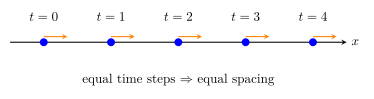
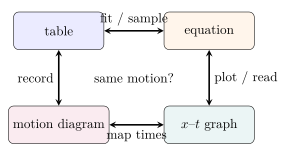
运动图把等时间间隔的采样位置画在物理空间;位置—时间图则把横轴改成时间,纵轴是位置值:
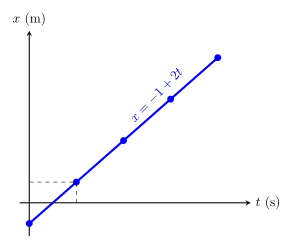
方程是压缩表示,表格是离散采样,图像显示总体趋势,运动图保留空间直觉。可信的模型必须让这些表示彼此一致。
4.2 A position–time graph is not a map of the path
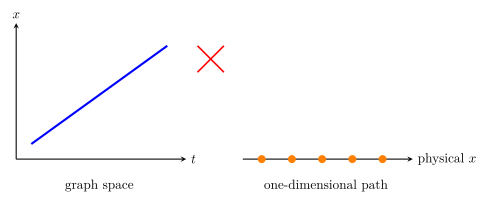
如果 \(x\)–\(t\) 图是一条斜线,它不表示物体在现实空间沿“斜坡”运动。图上竖直方向是位置数值,不是第二个空间方向。
4.3 Sampling, interpolation, and uncertainty
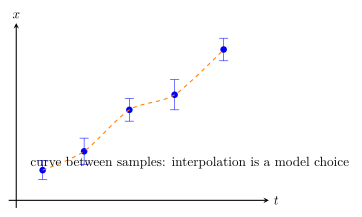
离散表格只直接告诉我们采样时刻的值。点与点之间连直线等于增加“期间按线性变化”的假设;用光滑曲线连接则增加另一种假设。测量值还应带合理有效数字或不确定度,例如
\[x(2.00\ \mathrm s)=(3.02\pm0.03)\ \mathrm m.\]
图上的线宽、点大小和误差棒都可表达测量分辨率;不要从粗略示意图读取超出图示精度的数值。
4.4 Worked Example 4 — reconstructing and cross-checking a motion
小车每 \(1.00\ \mathrm s\) 记录一次位置,得到 \(x=(-2.0,0.0,2.0,4.0)\ \mathrm m\),对应 \(t=(0,1,2,3)\ \mathrm s\)。
相邻位置增量均为 \(+2.0\ \mathrm m\),因此最简单的区间模型是
\[x(t)=(-2.0\ \mathrm m)+(2.0\ \mathrm{m/s})t, \qquad 0\le t\le3.00\ \mathrm s.\]
这个方程预测 \(t=2.50\ \mathrm s\) 时 \(x=3.0\ \mathrm m\)。但该预测依赖“采样间匀速”的插值假设;原始四个数据点本身不能排除小车在每秒内先快后慢。
检查端点:
\[x(0)=-2.0\ \mathrm m, \qquad x(3.00\ \mathrm s)=4.0\ \mathrm m,\]
与表格一致。运动图应显示等时间点等间距;\(x\)–\(t\) 图应为直线。这三项交叉检查同时通过。
5. Lesson synthesis / 全课整合
5.1 A reusable description protocol
- System: 指明研究对象与系统边界。
- Question: 所求量是否需要尺寸、朝向或内部形变?
- Model: 选质点、刚体或连续体,并写近似尺度。
- Frame: 指明相对于谁测量,以及时钟和同步约定。
- Coordinates: 选原点、轴、正方向与 SI 单位。
- Events: 明确初、末事件及对应时刻。
- Representation: 画运动图,列数据,作图或写方程。
- Audit: 检查单位、端点、尺度、符号和表示一致性。
5.2 Core equation sheet
5.3 Approximation map
| Approximation | Reliable when | Failure signal |
|---|---|---|
| Particle | 尺寸/方向效应低于所需精度 | 所求量本身涉及转角、碰撞接触或形变 |
| Rigid body | 内部相对形变可忽略 | 挠曲、压缩、断裂或波传播显著 |
| Continuum | 宏观微元含许多微粒且场平滑 | 尺度接近分子间距或统计涨落显著 |
| Common classical time | \(v\ll c\) 且同步精度要求不高 | 高速、长基线、高精度时序 |
| Smooth interpolation | 采样足够密且运动规律支持 | 采样间可能有急剧转向或突变 |
6. Misconception clinic / 易错概念诊所
| Misconception / 错误观念 | Correction / 修正 |
|---|---|
| “真实物体要么是质点,要么不是。” | 质点是针对问题和精度的模型选择,不是本体分类。 |
| “质点没有质量,因为它没有大小。” | 质点忽略空间延展,仍可保留质量、电荷等集中属性。 |
| “刚体表示永远不会形变。” | 真实物体只是在给定精度下近似满足内部距离不变。 |
| “参考系就是画一对坐标轴。” | 参考系还需要物理观察者、空间标尺、时钟和同步约定;坐标只是标签。 |
| “换原点就是换参考系。” | 同一实验室中换固定原点通常只是换坐标图。 |
| “位置为负表示路程为负。” | 位置和位移分量可有符号;路程与长度非负。 |
| “位移大小等于路程。” | 只有不折返且沿端点直线运动时相等,一般 \(s\ge\lvert\Delta\mathbf r\rvert\)。 |
| “回到起点表示没运动。” | 回到起点只说明净位移为零,路程仍可为正。 |
| “\(x\)–\(t\) 图的斜线就是现实中的斜轨道。” | 图轴是时间和位置数值,不是两个空间方向。 |
| “数据点之间画线不会增加假设。” | 插值规则本身就是模型,应受采样率和物理规律约束。 |
7. Practice and retrieval / 练习与检索
A. Conceptual questions
- 研究地球绕日运动、地球自转昼夜、地震波传播时,分别优先选什么模型?说明理由。
- 为什么“原点、坐标轴”不足以完整定义一个参考系?
- 同一参考系中把 \(x\) 轴反向,位置、位移分量、路程分别怎样变化?
- 一个运动员绕 \(400\ \mathrm m\) 跑道一圈回到起点,路程、位移和两点直线距离各是多少?
- 为什么仅凭稀疏数据点不能唯一恢复采样间的运动?
- 写出一个“位置改变而位移不改变”的坐标变换例子。
B. Quantitative and representation questions
- 无人机从 \((2.0,-1.0,3.0)\ \mathrm m\) 飞到 \((-4.0,2.0,3.0)\ \mathrm m\)。求位移矢量与两点直线距离。
- 行人沿直线从 \(x=-3.0\ \mathrm m\) 到 \(x=5.0\ \mathrm m\),再回到 \(x=1.0\ \mathrm m\)。求总路程和净位移。
- 一艘长 \(300\ \mathrm m\) 的船航行 \(30.0\ \mathrm{km}\)。计算 \(\ell/L\);若只需 \(0.5\%\) 航程精度,质点模型是否初步合理?
- 给定 \(x(t)=4.0\ \mathrm m-(1.5\ \mathrm{m/s})t\),列出 \(t=0,1,2,3\ \mathrm s\) 的表格,并描述运动图的点间距与方向。
- 坐标 \(S'\) 的原点在 \(S\) 中为 \(\mathbf b=(-2\widehat{\mathbf x}+4\widehat{\mathbf y})\ \mathrm m\)。事件 \(P\) 在 \(S\) 中为 \((3,-1)\ \mathrm m\),求 \(S'\) 坐标。
- 机器人沿半圆半径 \(R=2.00\ \mathrm m\) 从直径一端走到另一端。求路程与位移大小之比。
Answers / 参考答案
1. 公转可先把地球视作质点;昼夜需保留朝向,用刚体;地震波需保留位置依赖的位移/应变,用连续体。
2. 还需规定哪些观察者相对静止、怎样测距离、各地点怎样计时和同步。
3. 位置和位移的该轴分量变号;几何位移和路程不变。
4. 路程 \(400\ \mathrm m\);位移矢量为零;端点直线距离为零。
5. 无穷多条路径可穿过同一组离散点;连线方式隐含插值假设。
6. 固定平移 \(\mathbf r'=\mathbf r-\mathbf b\) 改变位置而保持 \(\Delta\mathbf r\)。
7.
\[\Delta\mathbf r=(-6.0\widehat{\mathbf x}+3.0\widehat{\mathbf y})\ \mathrm m,
\qquad
d=\sqrt{45}=6.71\ \mathrm m.\]
8. \(s=8.0+4.0=12.0\ \mathrm m\);\(\Delta x=1.0-(-3.0)=+4.0\ \mathrm m\)。
9. \(\ell/L=300/(3.00\times10^4)=1.00\times10^{-2}=1.0\%\),高于 \(0.5\%\),仅凭尺度测试不能保证足够;需保留船长影响或作更细误差估计。
10. \(x=(4.0,2.5,1.0,-0.5)\ \mathrm m\);等时间点间距 \(1.5\ \mathrm m\),沿负 \(x\) 方向。
11.
\[\mathbf r'=\mathbf r-\mathbf b=(5\widehat{\mathbf x}-5\widehat{\mathbf y})\ \mathrm m.\]
12. \(s=\pi R\),\(d=2R\),故 \(s/d=\pi/2=1.571\)。
Exit ticket
不查笔记,用四句话回答:
- 模型选择由哪两个核心因素决定?
- 参考系为什么不等于坐标轴?
- 路程、直线距离与位移怎样区分?
- 为什么至少要用两种表示交叉检查运动?
8. References and source notes / 参考资料与使用说明
8.1 Source-to-content map
| Source | Used for |
|---|---|
| OpenStax, University Physics Volume 1, §3.1 Position, Displacement, and Average Velocity | reference-frame language; position, displacement, distance traveled; tables and position–time graphs |
| OpenStax, Physics, §2.1 Relative Motion, Distance, and Displacement | high-school distinction between distance and displacement and coordinate conventions |
| MIT OpenCourseWare 8.01SC, Online Textbook | classical-mechanics modeling, reference-frame and kinematics sequence |
| MIT OpenCourseWare 2.003SC, Resource Index | particle and rigid-body kinematics; moving-frame course progression |
| BIPM, The International System of Units (SI Brochure) | SI definitions and the operational role of length and time standards |
8.2 Bibliographic notes
- OpenStax provides the principal HS→UG vocabulary spine. This note separates path length from straight-line endpoint distance more explicitly than many introductory texts.
- MIT 8.01SC and 2.003SC were used to cross-check the undergraduate sequencing from particle and rigid-body kinematics to moving frames. The three-level hierarchy and the explicit \(\ell/L\) error-screening rule in §1.1 are a pedagogical synthesis stated with their own approximation limits, not a claim attributed to those course-index pages.
- The BIPM SI Brochure supports the unit and measurement layer; it is not used as a mechanics derivation source.