
Learning objectives / 学习目标
完成本课后,你应能:
- 从 \(q\mathbf u\times\mathbf B\) 推导动生电动势线积分并判断正电荷分离方向;
- 分析滑动导体棒、导轨、旋转圆盘与旋转线圈的电动势;
- 建立 \(Fv=\mathcal EI=I^2R\) 的能量账本,区分磁力改变方向与电场/外力传递能量的角色;
- 解释涡流的形成、磁制动、趋肤/几何限制的初步意义以及叠片为何减少损耗;
- 在每个问题中声明实验室参考系、实际材料速度、回路路径与系统边界。
Prerequisites / 先修知识
- Faraday's and Lenz's Laws:移动回路的通用 emf。
- 洛伦兹力、叉积右手定则、导线受力 \(\mathbf F=I\boldsymbol\ell\times\mathbf B\)。
- 平动/转动运动学:\(v=\omega r\),功率 \(P=Fv=\tau\omega\)。
- 电阻电路 \(I=\mathcal E/R\);本课多数例子暂忽略自感。
Scope and conventions / 范围与约定
- 采用实验室惯性系与 SI。导体元速度记 \(\mathbf u\),载流子相对导体的漂移速度另计,不混为一谈。
- emf 正方向沿选定 \(d\boldsymbol\ell\);开路端电压由稳态电荷分离产生的静电场平衡磁力。
- 导体棒/导轨默认刚性、接触电阻可忽略、磁场准静态。若题目给总电阻 \(R\),它包括回路所有电阻。
- 发电机默认刚性线圈在匀强场中匀速转动;真实机器的非均匀气隙、铁芯饱和、换向与三相绕组不在本课展开。
- 涡流部分采用连续均匀导体的宏观近似;磁扩散与 skin depth 留到 Unit 4.11。
- TikZ 均为 schematic / not to scale。
Notation and modeling contract / 符号与建模契约
| Symbol | Meaning | SI unit |
|---|---|---|
| \(\mathbf u\) | velocity of conductor element in laboratory frame | \(\mathrm{m\,s^{-1}}\) |
| \(\mathcal E_{ab}\) | work per charge from endpoint \(a\) to \(b\) along conductor | V |
| \(\ell\) | active conductor length | m |
| \(\omega\) | angular speed | \(\mathrm{rad\,s^{-1}}\) |
| \(F_{\rm mag},F_{\rm ext}\) | magnetic drag and external force | N |
| \(P_{\rm mech},P_{\rm elec}\) | mechanical and electrical power | W |
| \(\mathbf J\) | current density in bulk conductor | \(\mathrm{A\,m^{-2}}\) |
Knowledge 1 — Lorentz-force derivation of motional emf / 动生电动势的洛伦兹力推导
Knowledge ID: P04-U08-L02-K01
材料元以 \(\mathbf u\) 运动时,随材料一起运动的正试探电荷所受单位电荷力为
\[\mathbf f=\mathbf E+\mathbf u\times\mathbf B.\]
沿运动导体从 \(a\) 到 \(b\) 的动生贡献为
\[\mathcal E_{ab}^{\rm mot}= \int_a^b(\mathbf u\times\mathbf B)\cdot d\boldsymbol\ell.\]
若直棒长度 \(\ell\)、\(\mathbf u\perp\mathbf B\) 且 \(\mathbf u\times\mathbf B\) 沿棒,则 \(\lvert\mathcal E\rvert=Bu\ell\)。这不是又一种新力,而是洛伦兹磁力在线路方向上的单位电荷积分。
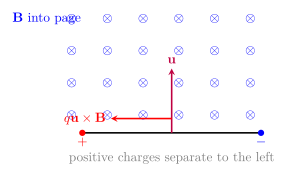
图 1 中 \(\mathbf u\) 向上、\(\mathbf B\) 向纸内,因此 \(\hat{\mathbf y}\times(-\hat{\mathbf z})=-\hat{\mathbf x}\):正电荷聚集在左端,左端电势较高。叉积方向是图示物理的一部分,必须与端点极性一致。
开路稳态时电荷分离建立 \(\mathbf E_{\rm sep}\),使导体内载流子平均不再沿棒继续分离:
\[\mathbf E_{\rm sep}+\mathbf u\times\mathbf B=0.\]
磁力始终垂直于电荷总速度,单独不做功;机械装置维持导体运动,分离电荷所对应的电势能来自外力做功。闭合回路后,静电平衡被电流持续打破,能量继续从机械端流向电路。
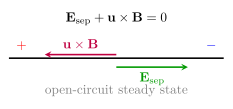
图 2 正确显示 \(\mathbf u\times\mathbf B\) 指向正端,分离电场由正端指向负端,二者在开路稳态相消。
Knowledge 2 — Conducting rods, rails, and rotating conductors / 导体棒、导轨与旋转导体
Knowledge ID: P04-U08-L02-K02
滑动棒与导轨构成最清楚的能量实验。若棒长 \(\ell\) 向右以速度 \(v\) 运动、\(\mathbf B\) 向纸内,则面积增加、向纸内磁通增加;Lenz 定律给逆时针电流,棒上电流向上。
\[\mathcal E=B\ell v, \qquad I=\frac{B\ell v}{R}.\]
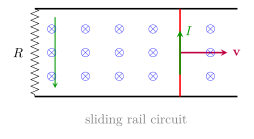
图 3 的电流在棒中向上;由 \(I\boldsymbol\ell\times\mathbf B\) 得棒受磁力向左,阻碍向右运动。
旋转导体不能把所有点都赋同一 \(v\)。半径 \(R\) 的导电圆盘以 \(\omega\) 绕轴转动,在轴向均匀磁场中,\(u(r)=\omega r\),轴心到边缘的电动势为
\[\mathcal E_{0\to R}= \int_0^R B\omega r\,dr =\frac12B\omega R^2.\]
这就是 Faraday disk / homopolar generator 的理想结果;极性由 \(\boldsymbol\omega\times\mathbf r\) 再与 \(\mathbf B\) 叉乘确定。
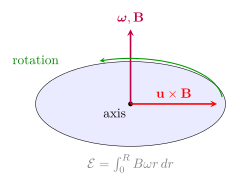
图 4 取 \(\boldsymbol\omega\) 与 \(\mathbf B\) 同向,则正电荷趋向半径外侧,边缘电势高于轴心。
旋转 \(N\) 匝线圈面积 \(A\) 时,若 \(\theta=\omega t\) 为法向与磁场夹角,
\[\Phi_B=BA\cos\omega t, \qquad \mathcal E=NBA\omega\sin\omega t.\]
滑环输出正弦交流;split-ring commutator 可把端口极性机械换接为脉动直流,但并未把内部感应规律变成直流。
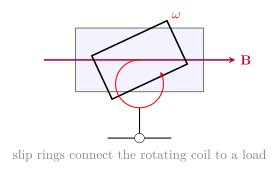
图 5 将机械角度与端口电动势连接起来;输出频率等于机械转动频率(单极对理想模型)。
Knowledge 3 — Mechanical-to-electrical energy conversion / 机械能到电能的转换
Knowledge ID: P04-U08-L02-K03
滑动棒中,磁阻力大小为
\[F_{\rm mag}=I\ell B=\frac{B^2\ell^2}{R}v.\]
维持匀速所需外力与它反向、同大小。功率账本为
\[P_{\rm ext}=F_{\rm ext}v =\frac{B^2\ell^2v^2}{R} =\mathcal EI =I^2R.\]
磁力不对单个载流子做功与系统把机械能转成电能并不矛盾:外力对运动导体做功;磁力改变载流子运动方向并把机械运动与沿线电流耦合;电场在电阻中向微观自由度输送能量。

图 6 的等式只适用于忽略动能变化、场能变化与其他损耗的稳态;加速阶段需加入 \(dK/dt\)。
对旋转发电机,同一账本写成
\[P_{\rm mech}=\tau_{\rm ext}\omega, \qquad P_{\rm elec}=\mathcal EI.\]
有负载电流时,线圈受电磁反扭矩;空载时虽有端电压但 \(I\approx0\),理想电磁反扭矩也接近零。实际空载仍需克服轴承、风阻与铁损。
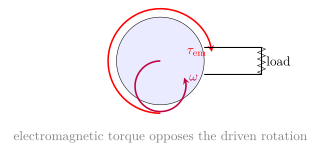
图 7 表明“更大负载电流”意味着更大反扭矩;发电机不创造能量。
Knowledge 4 — Eddy currents and magnetic braking / 涡流与磁制动
Knowledge ID: P04-U08-L02-K04
块状导体中没有预先规定的一维导线;变化磁通在连续材料内驱动闭合电流密度回路,称 eddy currents。它们的方向遵守 Lenz’s law,并通过 \(\mathbf f=\mathbf J\times\mathbf B\) 对运动产生阻力,同时以 \(\mathbf J\cdot\mathbf E\) 形式发热。
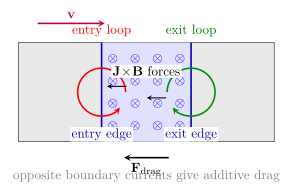
图 8 把有限磁场条带的 entry 与 exit 边界同时画出。导体向右运动时,进入边界的增磁通与离开边界的减磁通驱动相反环流;两环在场内侧的 \(\mathbf J\times\mathbf B\) 都指向左,因而合成与 \(\mathbf v\) 反向的 drag。真实 \(\mathbf J(\mathbf r)\) 仍由导体几何、电导率、频率和边界共同决定。
在低速、线性、准静态的一些几何中,磁阻力可近似 \(F_{\rm drag}=-kv\)。这不是普适定律:高速时 magnetic diffusion、skin effect、温升导致的电阻变化或磁性材料饱和都会改变标度。
切槽或叠片会截断大尺度电流回路、增加有效路径电阻,从而减小涡流损耗;叠片面应使不希望的环流必须跨越绝缘层。
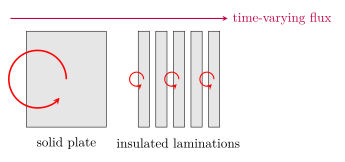
图 9 对比整块与叠片;“叠得越薄越好”仍受机械强度、成本、频率与材料工艺限制。
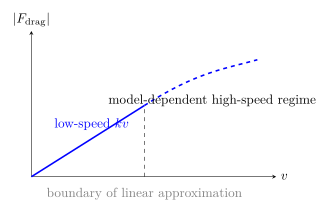
图 10 明确把 \(F\propto v\) 标成低速近似,不把示意曲线冒充某种材料的精确数据。
Worked Examples / 完整例题
Worked Example 1 — Open moving rod / 开路运动导体棒
已知条件: \(B=0.800\ \mathrm T\) 向纸内,棒长 \(\ell=0.250\ \mathrm m\) 沿水平方向,以 \(u=3.00\ \mathrm{m\,s^{-1}}\) 向上。
研究对象与边界: 单根开路棒;比较左右端电势。
参考系与正方向: 实验室系,\(+x\) 向右、\(+y\) 向上、\(+z\) 向纸外;从左到右为正积分方向。
模型及理由: 匀强场、刚性棒、开路稳态。
\[\mathbf u\times\mathbf B =u\hat{\mathbf y}\times(-B\hat{\mathbf z}) =-uB\hat{\mathbf x}.\]
\[\mathcal E_{L\to R}=\int_L^R(\mathbf u\times\mathbf B)\cdot d\boldsymbol\ell =-Bu\ell=-0.600\ \mathrm V.\]
结论: 左端比右端高 \(0.600\ \mathrm V\),三位有效数字。
检查: \(\mathrm{T\,m^2\,s^{-1}}=\mathrm V\);正电荷受力向左,与极性一致。若 \(u=0\) 或 \(B=0\),端电压消失。开路无持续电流,不能用 \(I^2R\) 计算发热。
Worked Example 2 — Sliding rail power ledger / 滑轨能量账本
已知条件: \(B=0.600\ \mathrm T\) 向纸内,\(\ell=0.400\ \mathrm m\),\(v=5.00\ \mathrm{m\,s^{-1}}\) 向右,总电阻 \(R=2.00\ \Omega\)。
研究对象与边界: 棒加导轨加电阻;求电流、阻力与功率。
参考系与正方向: 实验室系;逆时针电流为正。
模型及理由: 匀速、忽略自感和摩擦。
\[\mathcal E=B\ell v=(0.600)(0.400)(5.00)=1.20\ \mathrm V,\]
\[I=\frac{\mathcal E}{R}=0.600\ \mathrm A.\]
\[F_{\rm mag}=I\ell B=(0.600)(0.400)(0.600)=0.144\ \mathrm N\]
方向向左。维持匀速所需外功率为
\[P_{\rm ext}=Fv=(0.144)(5.00)=0.720\ \mathrm W,\]
\[I^2R=(0.600)^2(2.00)=0.720\ \mathrm W.\]
结论: \(I=0.600\ \mathrm A\),磁阻力 \(0.144\ \mathrm N\) 向左,外功率与热功率均为 \(0.720\ \mathrm W\)。
检查: 两种功率一致;若 \(R\) 增大,电流与阻力减小。若释放外力,棒减速,动能而非外功成为热源。
Worked Example 3 — Homopolar disk / 单极圆盘发电机
已知条件: 导电圆盘半径 \(R=0.100\ \mathrm m\),\(B=0.500\ \mathrm T\) 沿 \(+z\),\(\omega=100\ \mathrm{rad\,s^{-1}}\) 沿 \(+z\)。
研究对象与边界: 从轴心到边缘的径向路径。
参考系与正方向: 实验室系,径向向外为正。
模型及理由: 刚性匀速转动、匀强轴向场、开路。
\[\mathcal E_{0\to R}=\int_0^R(\omega r\hat{\boldsymbol\phi}\times B\hat{\mathbf z})\cdot\hat{\mathbf r}\,dr =\int_0^R\omega Br\,dr =\frac12B\omega R^2.\]
\[\mathcal E_{0\to R}=\frac12(0.500)(100)(0.100)^2=0.250\ \mathrm V.\]
结论: 边缘比轴心高 \(0.250\ \mathrm V\)。
检查: \(\hat{\boldsymbol\phi}\times\hat{\mathbf z}=\hat{\mathbf r}\);结果随 \(R^2\) 而非 \(R\),因为局部速度随半径增加。反转 \(B\) 或 \(\omega\) 任一项都会反转极性。
Worked Example 4 — Linear magnetic braking model / 线性磁制动近似
已知条件: 某导轨等效模型满足 \(k=B^2\ell^2/R\);\(B=0.700\ \mathrm T\),\(\ell=0.300\ \mathrm m\),\(R=0.500\ \Omega\),瞬时 \(v=4.00\ \mathrm{m\,s^{-1}}\)。
研究对象与边界: 运动导体及其闭合电流路径;求阻力与热功率。
参考系与正方向: 实验室系,速度方向为正。
模型及理由: 低速准静态、恒定 \(R\)、忽略自感,故 \(F=-kv\)。
\[k=\frac{(0.700)^2(0.300)^2}{0.500}=8.82\times10^{-2}\ \mathrm{kg\,s^{-1}}.\]
\[F_{\rm drag}=-kv=-0.353\ \mathrm N, \qquad P_{\rm heat}=kv^2=1.41\ \mathrm W.\]
结论: 阻力大小 \(0.353\ \mathrm N\)、方向反向,瞬时耗散 \(1.41\ \mathrm W\)。
检查: \((-F)v=1.41\ \mathrm W\);\(v\to0\) 时阻力和功率都趋零,且功率按 \(v^2\)。若频率升高导致有效电阻或电流分布改变,此模型不再可靠。
Lesson synthesis / 课程综合
动生电动势的核心不是记忆 \(B\ell v\),而是三层相互一致的描述:
- 微观层:随材料运动的电荷受 \(q\mathbf u\times\mathbf B\);
- 回路层:\(\mathcal E=\oint(\mathbf E+\mathbf u\times\mathbf B)\cdot d\boldsymbol\ell\);
- 能量层:外力/外转矩提供 \(Fv\) 或 \(\tau\omega\),电路获得 \(\mathcal EI\),损耗成为 \(I^2R\) 或场能变化。
导体棒、发电机与涡流制动只是同一耦合机制的不同几何。
Formula-and-decision table / 公式与决策表
| Situation | Formula | Conditions / limits |
|---|---|---|
| 任意运动导体路径 | \(\mathcal E=\int(\mathbf E+\mathbf u\times\mathbf B)\cdot d\boldsymbol\ell\) | 声明实验室系、路径与材料速度 |
| 直棒正交匀强场 | \(\lvert\mathcal E\rvert=B\ell u\) | \(\mathbf u\times\mathbf B\) 沿棒且量值恒定 |
| 滑轨闭合回路 | \(I=B\ell v/R\) | 忽略自感与接触变化 |
| 圆盘轴到缘 | \(\mathcal E=B\omega R^2/2\) | 匀强轴向场、刚性转动 |
| 旋转 \(N\) 匝线圈 | \(\mathcal E=NBA\omega\sin\omega t\) | 匀强场、等匝、匀速 |
| 稳态能量转换 | \(Fv=\mathcal EI=I^2R\) | 动能与场能不变、无其他损耗 |
| 低速磁制动近似 | \(F=-kv\) | \(k\) 依几何、电导率与场;非普适 |
Model boundaries / 模型边界
- \(B\ell v\) 仅是积分在正交匀强直棒上的结果;曲线导体、非均匀速度或场必须积分。
- “磁力不做功”指磁力与单个电荷瞬时速度垂直;不能据此否认外力对运动导体做功或电场在电阻中做功。
- 发电机峰值公式忽略内阻、自感、铁损、磁滞、涡流与饱和;端电压取决于负载。
- \(F\propto v\) 的涡流阻力只在一定低速/低频线性范围成立。
- 分割导体减小涡流的效果取决于切槽方向与电流路径;任意方向切槽并不保证有效。
Misconception clinic / 误区诊所
- “右端总是正端。” 极性由 \(\mathbf u\times\mathbf B\) 与路径方向决定;反转速度或磁场就反转。
- “空载发电机没有 emf。” 空载可有 emf/端电压,只是 \(I\approx0\),理想电磁输出功率近零。
- “增大电阻会增加磁阻力。” 在给定 \(B,\ell,v\) 的滑轨模型中 \(F=B^2\ell^2v/R\),电阻增大反而减小电流和阻力。
- “涡流只有坏处。” 它会造成铁损,也可用于非接触制动、金属检测与阻尼。
- “磁场给电阻提供能量。” 静磁场负责耦合和方向;能量来自外机械功或先前储存的机械/场能。
Practice and retrieval / 练习与检索
- [P04-U08-L02-K01] 棒长 \(0.500\ \mathrm m\),以 \(2.00\ \mathrm{m\,s^{-1}}\) 垂直穿过 \(0.300\ \mathrm T\) 场。求 emf 大小。
Answer
\(\lvert\mathcal E\rvert=B\ell v=(0.300)(0.500)(2.00)=0.300\ \mathrm V\);极性还需给出 \(\mathbf v\) 与 \(\mathbf B\) 的方向。
- [P04-U08-L02-K01] 开路棒达到稳态后,为何载流子不继续堆积?
Answer
分离电荷产生 \(\mathbf E_{\rm sep}\),直到 \(\mathbf E_{\rm sep}+\mathbf u\times\mathbf B=0\);沿棒净单位电荷力为零。
- [P04-U08-L02-K02] 同一圆盘若 \(B\) 反向而 \(\omega\) 不变,轴缘电势差发生什么变化?
Answer
\(\mathcal E=B\omega R^2/2\) 变号,大小不变;原高电势端变成低电势端。
- [P04-U08-L02-K02] \(N=100\)、\(A=4.00\times10^{-3}\ \mathrm{m^2}\)、\(B=0.250\ \mathrm T\)、\(f=60.0\ \mathrm{Hz}\),求旋转线圈峰值 emf。
Answer
\(\omega=2\pi f=377\ \mathrm{rad\,s^{-1}}\),\(\mathcal E_0=NBA\omega=37.7\ \mathrm V\)。
- [P04-U08-L02-K03] 滑轨中 \(\mathcal E=0.800\ \mathrm V\)、\(I=0.200\ \mathrm A\)。求电磁转换功率。
Answer
\(P=\mathcal EI=(0.800)(0.200)=0.160\ \mathrm W\);匀速且无其他损耗时等于外机械功率与热功率。
- [P04-U08-L02-K03] 为什么给发电机接更重负载时驱动轴更难转?
Answer
负载电流增大,线圈受更大的电磁反扭矩;驱动端必须提供更多 \(\tau\omega\) 才能维持转速。
- [P04-U08-L02-K04] 整块铁芯改成相互绝缘的薄片,主要改变哪一条涡流参数?
Answer
它截断大尺度闭合路径并提高跨片方向的有效电阻,从而减小涡流与 \(J^2/\sigma\) 损耗;主磁通方向的磁性作用尽量保留。
- [P04-U08-L02-K04] 在线性制动模型 \(F=-kv\) 中,若速度加倍,阻力与耗散功率分别如何变化?
Answer
阻力大小加倍;\(P=kv^2\) 变为四倍。只在该低速线性模型有效。
- 一根棒沿自身轴线运动,且 \(\mathbf B\) 垂直棒。其动生 emf 是否一定为 \(B\ell v\)?
Answer
否。若 \(\mathbf u\) 沿棒,则 \(\mathbf u\times\mathbf B\) 垂直棒,与 \(d\boldsymbol\ell\) 点积为零,所以沿棒 emf 为零。
- 一个滑轨系统释放后从速度 \(v_0\) 开始减速,忽略机械摩擦。若 \(F=-kv\),写出速度随时间的形式。
Answer
\(m\,dv/dt=-kv\),故 \(v(t)=v_0e^{-kt/m}\);初始动能最终转为焦耳热,时间常数为 \(m/k\)。
Exit ticket / 离堂检核
- 任选一个动生电动势装置,用同一组方向约定分别画出 \(\mathbf u\)、\(\mathbf B\)、\(\mathbf u\times\mathbf B\)、电流与磁阻力,并写出功率账本。
- 解释为什么 homopolar disk 的 emf 含 \(R^2/2\) 而非 \(R\),以及这与“不同半径的速度不同”有什么关系。
References and source notes / 参考资料与来源说明
以下直接来源均于 2026-08-28 实际打开核验;正文与数值为独立推导,图示未复制来源插图。
- OpenStax University Physics Vol. 2, §13.3 Motional Emf
- OpenStax University Physics Vol. 2, §13.5 Eddy Currents
- OpenStax University Physics Vol. 2, §13.6 Electric Generators and Back Emf
- MIT OpenCourseWare 8.02T, Chapter 10: Faraday’s Law of Induction
- The Feynman Lectures on Physics, Vol. II, Ch. 16: Induced Currents
- The Feynman Lectures on Physics, Vol. II, Ch. 17: The Laws of Induction
Source-to-content map
| Source | Used for | Knowledge ID / Section | Model boundary or convention |
|---|---|---|---|
| OpenStax §13.3 | rod/rail emf and magnetic drag | P04-U08-L02-K01, P04-U08-L02-K02 | orthogonal uniform-field special case |
| OpenStax §13.5 | eddy-current damping and laminations | P04-U08-L02-K04 | distributed currents; geometry matters |
| OpenStax §13.6 | rotating-coil emf and motor/generator back reaction | P04-U08-L02-K02, P04-U08-L02-K03 | ideal rotating coil and load dependence |
| MIT 8.02T Ch. 10 | motional emf, generators, eddy-current applications | P04-U08-L02-K01, P04-U08-L02-K04 | laboratory-frame force integral |
| Feynman Vol. II Ch. 16 | microscopic charge-force picture | P04-U08-L02-K01 | distinguishes moving wire from moving source |
| Feynman Vol. II Ch. 17 | generator and rail energy ledger | P04-U08-L02-K03 | mechanical input equals electrical output ideally |
复习与拓展
- Inductance and RL Circuits 将加入电流自身磁通造成的 back emf 与暂态。
- Sinusoidal Steady State 将把理想旋转发电机的正弦输出转为相量与 RMS 表示。
- Waves in Media and Waveguides 将给出高频导体中的 skin depth,解释涡流模型何时改变。