
Learning objectives / 学习目标
- 解释 wave function 是 probability amplitude,而不是轨迹、力场或涂开的物质密度。
- 用 Born rule 求区间概率,并正确写出 1D/3D probability-density units。
- 归一化给定 wave function,检查 single-valuedness、square integrability 与边界行为。
- 区分 global phase 与 relative phase,并计算 coherent superposition 的 interference term。
- 计算 expectation value、variance 与 standard deviation,并把它们解释为 repeated preparation 的统计量。
Prerequisites / 先修知识
- Matter Waves and Quantum Evidence:single-event detection、wave packet 与 uncertainty。
- complex number \(z=re^{i\theta}\)、complex conjugate \(z^*\) 与 \(\lvert z\rvert^2=z^*z\)。
- probability density 的积分、mean 与 standard deviation。
- 本课不预设 Schrödinger equation;time evolution 在下一课建立。
Scope and conventions / 范围与约定
- 主要讨论一维单粒子 position representation \(\Psi(x,t)\);三维推广把 \(dx\) 换成 \(d^3r\)。
- coordinate \(x\) 在 laboratory frame 中定义;所有 position probabilities 均相对于所声明的 reference frame。
- \(\rho(x,t)=\Psi^*\Psi=\lvert\Psi\rvert^2\);1D normalized \(\Psi\) 的单位为 \(\mathrm{m^{-1/2}}\)。
- global phase \(e^{i\alpha}\) 作用于整个 state;relative phase 是不同 components 的相位差。
- expectation 是 identical preparation ensemble 的平均,不保证单次 measurement 等于该数。
- boundary behavior 只先讨论可接受 state 的一般要求;finite/infinite potential 的 derivative matching 在下一课精化。
Notation and modeling contract / 符号与建模契约
| Symbol | Meaning | Unit / property |
|---|---|---|
| \(\Psi(x,t)\) | position-space probability amplitude | \(\mathrm{m^{-1/2}}\) in 1D |
| \(\Psi^*\) | complex conjugate of \(\Psi\) | same as \(\Psi\) |
| \(\rho=\Psi^*\Psi\) | position probability density | \(\mathrm{m^{-1}}\) in 1D |
| \(P(a\le x\le b)\) | interval probability | dimensionless |
| \(\langle x\rangle\) | ensemble mean position | \(\mathrm{m}\) |
| \(\Delta x\) | standard deviation \(\sqrt{\langle x^2\rangle-\langle x\rangle^2}\) | \(\mathrm{m}\) |
| \(c_n\) | complex expansion coefficient | dimensionless for orthonormal basis |
| \(\alpha,\delta\) | global and relative phases | rad, dimensionless |
1. Wave function as probability amplitude / 波函数作为概率振幅
Knowledge ID: P07-U02-L01-K01
1.1 amplitude 的核心角色
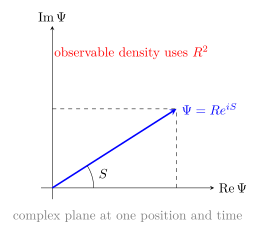
\(\Psi(x,t)\) 是给定 preparation 在位置表象中的 complex amplitude。它本身一般不可直接作为 detector reading;实验比较的是由 amplitude 计算的 probabilities。复数结构允许 phase 在不同 alternatives 间保留并相消或相长。
写成 polar form:
\[\Psi(x,t)=R(x,t)e^{iS(x,t)}, \qquad R\ge0.\]
\(R\) 控制 probability density,\(S\) 控制相对 phase structure。不能把图上正负或 imaginary part 解释成负质量/负概率。
1.2 state 与表示
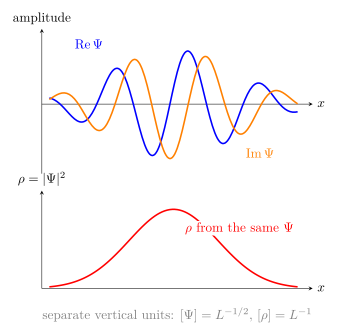
同一个 abstract quantum state 可在 position、momentum 或其他 basis 表示;\(\Psi(x,t)\) 不是“唯一真实形状”的额外 classical medium。position-space amplitude 的完整信息包括 magnitude 与 phase,只有画 \(\rho\) 会丢掉 interference-relevant information。
2. Born rule and probability density / 玻恩规则与概率密度
Knowledge ID: P07-U02-L01-K02
Born rule 在 position measurement 中规定
\[\rho(x,t)=\lvert\Psi(x,t)\rvert^2 =\Psi^*(x,t)\Psi(x,t),\]
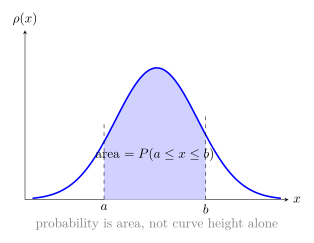
\[P(a\le x\le b;t) =\int_a^b\rho(x,t)\,dx.\]
概率是 dimensionless,所以 1D 中 \([\rho]=\mathrm{m^{-1}}\)、\([\Psi]=\mathrm{m^{-1/2}}\);3D 中相应为 \(\mathrm{m^{-3}}\) 与 \(\mathrm{m^{-3/2}}\)。
2.1 连续 density 与有限 detector bins
理想“恰好在一个 mathematical point”对 continuous density 的概率为零;真实 detector pixel 宽度 \(\Delta x\) 给
\[P_i=\int_{\text{pixel }i}\rho(x,t)\,dx \approx\rho(x_i,t)\Delta x\]
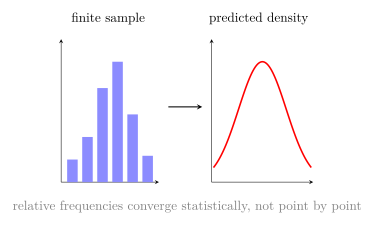
仅当 \(\rho\) 在 pixel 内变化缓慢。Histogram count fraction 在大量 identical trials 下逼近 \(P_i\),但 finite sample 有 statistical fluctuations。
3. Normalization and boundary behavior / 归一化与边界行为
Knowledge ID: P07-U02-L01-K03
3.1 归一化
若 particle 必在考虑的 configuration space 中,
\[\int_{-\infty}^{\infty}\lvert\Psi(x,t)\rvert^2\,dx=1.\]
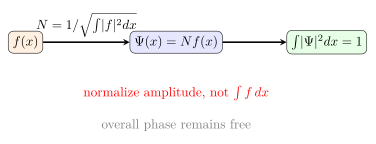
对未归一函数 \(f\),令 \(\Psi=Nf\),则
\[\lvert N\rvert =\left(\int\lvert f\rvert^2dx\right)^{-1/2}.\]
\(N\) 的 phase 任意;通常取正实数,因为 global phase 不影响 probabilities。
3.2 physical admissibility
常规 nonrelativistic single-particle state 应:
- single-valued;
- square-integrable for bound/localized states;
- finite except at explicitly generalized idealizations;
- 在 finite nonsingular potential 中 continuous;
- 满足 apparatus/potential 的 boundary conditions。
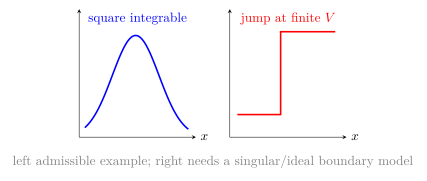
ideal plane wave 不 square-integrable,却可作为 generalized eigenstate 或 box-normalized limit 使用;这不是把其 constant density 当作一粒粒子的普通 normalized probability。
4. Superposition and relative phase / 叠加与相对相位
Knowledge ID: P07-U02-L01-K04
4.1 线性叠加
若 \(\psi_1,\psi_2\) 是允许 amplitudes,则
\[\Psi=c_1\psi_1+c_2\psi_2\]
也是 state amplitude(随后按 inner product normalization)。其 density 为
\[\lvert\Psi\rvert^2 =\lvert c_1\psi_1\rvert^2+\lvert c_2\psi_2\rvert^2 +2\operatorname{Re}\!\left(c_1^*c_2\psi_1^*\psi_2\right).\]
最后一项保留 relative phase,产生 interference。
4.2 global phase 与 relative phase
\[\Psi'(x)=e^{i\alpha}\Psi(x) \quad\Longrightarrow\quad \lvert\Psi'\rvert^2=\lvert\Psi\rvert^2.\]
所有 observable probabilities 对同一 global phase 不变。反之,若只把一个 component 乘 \(e^{i\delta}\),cross term 会随 \(\delta\) 改变。
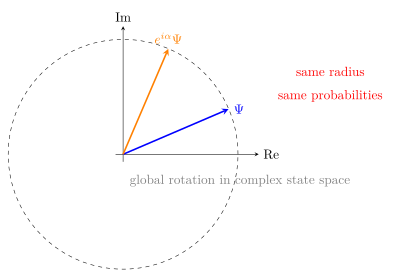
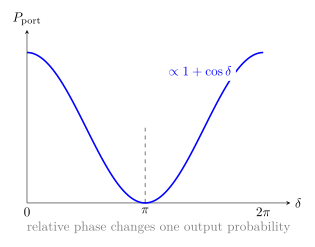
orthogonal basis states may have no position-space overlap yet still form a coherent superposition whose relative phase appears under a different measurement basis。相位“不可见”与“物理无关”不是同义。
5. Expectation values and statistical spread / 期望值与统计展宽
Knowledge ID: P07-U02-L01-K05
position expectation:
\[\langle x\rangle =\int_{-\infty}^{\infty}x\,\lvert\Psi(x,t)\rvert^2\,dx.\]
spread 用 variance 而非肉眼全宽:
\[(\Delta x)^2 =\left\langle(x-\langle x\rangle)^2\right\rangle =\langle x^2\rangle-\langle x\rangle^2.\]
一般 observable \(A\) 由 Hermitian operator \(\hat A\) 表示:
\[\langle A\rangle =\int\Psi^*\hat A\Psi\,dx, \qquad (\Delta A)^2 =\langle A^2\rangle-\langle A\rangle^2.\]
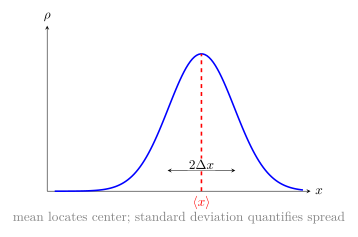
expectation may lie where a single result never occurs,例如 two-outcome spin measurement 的 mean。它是 ensemble statistic,不是 hidden classical trajectory。
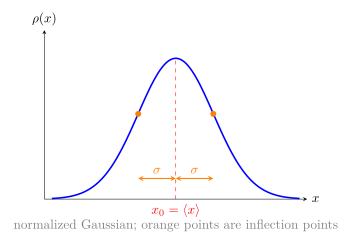
Gaussian density 让“参数”和“统计量”直接对应:曲线中心是 \(\langle x\rangle=x_0\),拐点位于 \(x_0\pm\sigma\),且 \(\Delta x=\sigma\);图上整条曲线下面积仍为 1。
Worked Examples / 完整例题
Example 1 — 归一化双边 exponential state
已知: \(\Psi(x)=A e^{-\lvert x\rvert/a}\),\(a>0\)。
系统与坐标: 1D localized particle;origin at symmetry center。
模型: \(\Psi\) continuous and square-integrable;取 \(A>0\) real as phase convention。
\[1=\int_{-\infty}^{\infty}\lvert\Psi\rvert^2dx =2A^2\int_0^\infty e^{-2x/a}dx =A^2a,\]
\[A=\frac{1}{\sqrt a}.\]
区间 \(\lvert x\rvert\le a\) 的 probability:
\[P=2\int_0^a\frac1a e^{-2x/a}dx =1-e^{-2}=0.8647.\]
检查: \([A]=\mathrm{m^{-1/2}}\);\(0<P<1\);\(a\to\infty\) 时固定相对区间 \(\lvert x\rvert\le a\) 仍给相同无量纲 probability。
解释: normalization 设定 amplitude scale;symmetry 还立即给 \(\langle x\rangle=0\)。
Example 2 — infinite-well sine state 的区间概率
已知: \(0<x<L\) 内 \(\Psi=\sqrt{2/L}\sin(\pi x/L)\),外部为零;求 \(0<x<L/3\) 的 probability。
系统与边界: 1D ideal infinite well,walls at \(0,L\);position axis 向右。
模型: 给定 state 已 normalized and vanishes at walls。
\[P=\frac{2}{L}\int_0^{L/3}\sin^2\!\left(\frac{\pi x}{L}\right)dx.\]
用 \(\sin^2u=(1-\cos2u)/2\):
\[P=\frac13-\frac{\sin(2\pi/3)}{2\pi} =\frac13-\frac{\sqrt3}{4\pi} =0.1955.\]
检查: interval 占长度 \(1/3\),但 density near \(x=0\) 较小,所以 \(P<1/3\) 合理。
解释: probability 由 area 决定,而不是只按几何长度均分。
Example 3 — relative phase 控制一个 interferometer port
已知: 两条路径到某输出 port 的 amplitudes 为 \(1/2\) 与 \(e^{i\delta}/2\),\(\delta=2\pi/3\)。
系统: lossless two-path interferometer 的一个指定 port;另一 port 承担剩余 probability。
模型: equal coherent paths,忽略 detector inefficiency。
\[\Psi_{\rm port} =\frac{1+e^{i\delta}}{2},\]
\[P_{\rm port} =\lvert\Psi_{\rm port}\rvert^2 =\frac{1+\cos\delta}{2} =\frac14.\]
检查: \(0\le P\le1\);\(\delta=0\) 时 \(P=1\),\(\delta=\pi\) 时 \(P=0\),极限正确。
解释: 若把两条 path probabilities \(1/4+1/4\) 直接相加会得 \(1/2\),漏掉 relative-phase cross term。
Example 4 — two-outcome observable 的 mean 与 spread
已知: orthonormal eigenstates \(\lvert1\rangle,\lvert2\rangle\) 的 eigenvalues 为 \(a_1=-1.00\ \mathrm{eV}\)、\(a_2=3.00\ \mathrm{eV}\);state
\[\lvert\psi\rangle=\frac35\lvert1\rangle+\frac{4i}{5}\lvert2\rangle.\]
系统与测量: 重复制备同一 state,测 observable \(A\);basis 已声明。
模型: projective ideal measurement in the eigenbasis。
\[P_1=\frac9{25},\qquad P_2=\frac{16}{25},\]
\[\langle A\rangle =\frac9{25}(-1.00)+\frac{16}{25}(3.00) =1.56\ \mathrm{eV}.\]
\[\langle A^2\rangle =\frac9{25}(1.00)+\frac{16}{25}(9.00) =6.12\ \mathrm{eV^2},\]
\[\Delta A =\sqrt{6.12-(1.56)^2} =1.92\ \mathrm{eV}.\]
检查: coefficients normalize: \(9/25+16/25=1\);mean lies between eigenvalues;variance positive。
解释: 单次只给 \(-1.00\) 或 \(3.00\ \mathrm{eV}\),不会给 \(1.56\ \mathrm{eV}\);后者是 ensemble mean。
Lesson synthesis / 本课综合
quantum prediction 的闭环是:
- preparation 由 complex normalized state \(\Psi\) 表示;
- alternatives 在 amplitude level 线性叠加;
- relative phase 保留于 cross terms,global phase 消去;
- Born rule 把 amplitude 映射为 nonnegative probability density;
- integrals 给 interval probabilities,operator moments 给 ensemble mean 与 spread;
- boundary behavior 保证 state 与所选 physical model 相容。
Formula-and-decision table / 公式与决策表
| Task | Relation | Use when | Check |
|---|---|---|---|
| position density | \(\rho=\Psi^*\Psi\) | position measurement | \(\rho\ge0\), correct units |
| interval probability | \(P=\int_a^b\rho\,dx\) | continuous position | \(0\le P\le1\) |
| normalization | \(\int\lvert\Psi\rvert^2dx=1\) | particle lies in domain | integral converges |
| coherent superposition | \(\Psi=\sum_n c_n\psi_n\) | alternatives indistinguishable | normalize with inner products |
| global phase | \(\Psi\to e^{i\alpha}\Psi\) | entire state rotated | probabilities unchanged |
| expectation | \(\langle A\rangle=\int\Psi^*\hat A\Psi dx\) | normalized state, proper domain | result real for Hermitian \(\hat A\) |
| spread | \((\Delta A)^2=\langle A^2\rangle-\langle A\rangle^2\) | standard deviation | nonnegative |
Model boundaries / 模型边界
- \(\Psi\) is model-dependent representation of a state;position representation is not privileged in all problems。
- ordinary normalization applies to square-integrable states;plane waves use delta/box normalization as generalized states。
- Born rule predicts probabilities, not a unique philosophical interpretation of what occurs between preparation and measurement。
- continuity requirements depend on Hamiltonian and potential singularities;delta potentials and ideal walls need specialized matching。
- a global phase is unobservable for an isolated state;relative phase between coherent components can become observable。
- expectation values require operator domains and normalized states;formal integrals can fail if derivatives or moments diverge。
- finite experimental histograms approximate distributions with sampling noise and detector response。
Misconception clinic / 误区诊所
- “\(\Psi\) 就是 particle trajectory。” 它 assigns amplitudes to possible outcomes;trajectory is not encoded as a classical path \(x(t)\)。
- “negative/imaginary \(\Psi\) means negative/imaginary probability。” probability is \(\Psi^*\Psi\ge0\)。
- “归一化是令 \(\int\Psi dx=1\)。” 正确条件是 \(\int\lvert\Psi\rvert^2dx=1\)。
- “任何 finite function 都是允许 state。” 还需 single-valued、square-integrable and boundary-compatible。
- “所有 phase 都测不到。” 只有 common global phase cancels;relative phase controls interference。
- “expectation 是下一次必定得到的结果。” 它是 repeated outcomes 的 weighted mean,未必是 eigenvalue。
- “spread 是图的左右端点差。” \(\Delta A\) 是 standard deviation,必须从 second moment 计算。
Practice and retrieval / 练习与提取
- 在 1D 中 normalized \(\Psi\) 的 SI unit 是什么?说明理由。
- 若 \(\Psi=(1+i)f(x)\) 且 \(f\) real,写出 \(\rho\)。
- \(\Psi=Ae^{-x/a}\) for \(x\ge0\)、else 0;求 normalized \(A\)。
- 对上题求 \(P(x>a)\)。
- 为什么 constant plane wave on all real line 不能 ordinary-normalize?
- 若 entire state 乘 \(e^{i\pi/3}\),position probability 怎样变?
- 两等 amplitudes 的 relative phase 从 \(0\) 改为 \(\pi\),一个 constructive port 的 probability 怎样变?
- normalized even density \(\rho(x)\) 的 \(\langle x\rangle\) 是多少?
- 若 \(\langle x\rangle=2.0\ \mathrm m\)、\(\langle x^2\rangle=5.0\ \mathrm{m^2}\),求 \(\Delta x\)。
- observable outcomes \(0\) 与 \(4\ \mathrm{eV}\) 的 probabilities 各为 \(1/2\),求 mean 与 standard deviation。
Answers / 答案
1. \(\mathrm{m^{-1/2}}\);因为 \(\int\lvert\Psi\rvert^2dx\) dimensionless,所以 \([\lvert\Psi\rvert^2]=\mathrm{m^{-1}}\)。
2. \(\rho=\Psi^*\Psi=(1-i)(1+i)f^2=2f^2\)。
3. \(1=A^2\int_0^\infty e^{-2x/a}dx=A^2a/2\),故 \(A=\sqrt{2/a}\),取正实 phase convention。
4. \(P(x>a)=\int_a^\infty(2/a)e^{-2x/a}dx=e^{-2}=0.1353\)。
5. \(\lvert\Psi\rvert^2\) constant 使 \(\int_{-\infty}^\infty\lvert\Psi\rvert^2dx\) 发散;需 wave packet、box 或 delta normalization。
6. 不变,因为 \(\lvert e^{i\pi/3}\Psi\rvert^2=\lvert\Psi\rvert^2\)。
7. ideal equal-path port 从 maximum 变为 zero;cross term 从 positive 变 negative。
8. \(0\),因为 \(x\rho(x)\) odd,symmetric integral vanishes。
9. \(\Delta x=\sqrt{5.0-(2.0)^2}=1.0\ \mathrm m\)。
10. \(\langle A\rangle=2\ \mathrm{eV}\);\(\langle A^2\rangle=8\ \mathrm{eV^2}\),\(\Delta A=\sqrt{8-4}=2\ \mathrm{eV}\)。
Exit ticket / 离堂检验
- 给出两个 states,它们有相同 \(\lvert\Psi(x)\rvert^2\) 但不同 phase,并说明下一步什么类型的 experiment 可区分它们。
- 对任一 proposed \(\Psi\) 写出四项检查:unit、normalization、boundary、finite moment。
References and source notes / 参考资料与来源说明
- OpenStax University Physics Vol. 3, 7.1 Wave Functions — Born rule、normalization、probability and expectation;核对于 2026-08-29。
- MIT OpenCourseWare 8.04, Lecture Note 5 — complex wavefunctions and probability interpretation;核对于 2026-08-29。
- MIT OpenCourseWare 8.04, Lecture Note 6 — normalization、global phase、probability amplitude and current;核对于 2026-08-29。
- MIT OpenCourseWare 8.04, Lecture Note 8 — momentum representation and expectation values;核对于 2026-08-29。
- MIT OpenCourseWare 8.05, Chapter 1: The Wave Function — state equivalence under global phase, Born probabilities and stationary-state context;核对于 2026-08-29。
- NIST 2022 CODATA, Fundamental Physical Constants — constants and SI consistency;核对于 2026-08-29。
所有 TikZ 为本课原创:complex-plane arrows、densities、normalization flow、phase and ensemble figures 均依据正文关系绘制,未复制来源图。
Source-to-content map
| Source | Used for | Knowledge ID / Section | Model boundary or convention |
|---|---|---|---|
| OpenStax 7.1 | Born density, interval probability | K01–K03, K05 | 1D units stated explicitly |
| MIT 8.04 Note 5 | amplitude interpretation | K01, K02 | amplitude is not matter density |
| MIT 8.04 Note 6 | normalization and global phase | K03, K04 | generalized plane waves separated |
| MIT 8.04 Note 8 | representations and expectation | K05 | operator-domain caveat retained |
| MIT 8.05 Chapter 1 | state rays and phase | K04, synthesis | global versus relative phase |
| NIST CODATA | constants and dimensions | examples/checks | 2022 values |
复习与拓展
- 下一课 Schrödinger Equation 将给出 \(\Psi\) 的 time evolution,并证明 real potential 下 normalization 由 continuity equation 保持。
- 与 Matter Waves and Quantum Evidence 对照:single clicks 是数据,Born rule 是从 amplitude 到数据分布的定量桥梁。
- 可扩展:Hilbert space、Dirac notation、density operators、POVMs、continuous-spectrum normalization。