
Learning objectives / 学习目标
- 读写 1D time-dependent Schrödinger equation (TDSE),并说明其 initial-value、linearity 与 nonrelativistic limits。
- 从 TDSE 及其 complex conjugate 推出正确符号的 continuity equation 与 probability current。
- 对 time-independent real potential 分离 \(\Psi(x,t)=\psi(x)e^{-iEt/\hbar}\),解释 stationary 的精确含义。
- 用 time-independent Schrödinger equation (TISE) 判断局部 curvature、oscillatory/evanescent behavior。
- 从 TISE 积分推导 finite step、delta potential 与 infinite wall 的不同 boundary conditions。
Prerequisites / 先修知识
- Wave Functions and Probability:Born rule、normalization、superposition and phase。
- partial derivatives、complex conjugation、integration by parts。
- Potential Energy and Conservative Forces:\(V(x)\) 与 force \(F=-dV/dx\)。
- Energy, Momentum, and Reactions:识别本课 nonrelativistic energy approximation 的边界。
Scope and conventions / 范围与约定
- 一维、单一 spinless nonrelativistic particle,mass \(m\) constant;laboratory coordinate \(x\) 向右。
- Hamiltonian
\[\hat H=-\frac{\hbar^2}{2m}\frac{\partial^2}{\partial x^2}+V(x,t).\]
- 除非特别说明,\(V\) real;并采用使 \(\hat H\) self-adjoint 的 domain 与 boundary conditions。于是 closed-system evolution 保持 normalization,而局部 continuity equation 不含吸收或增益源项。
- probability current \(j>0\) 表示向 \(+x\) 流;fixed interval \([a,b]\) 的 outward flux 为 \(j(b)-j(a)\)。
- stationary-state separation 要求 \(V\) 不显含 \(t\);energy eigenvalue \(E\) real。
- 本课不讨论 spin、electromagnetic vector potential、relativistic Klein–Gordon/Dirac dynamics 或 measurement collapse。
Notation and modeling contract / 符号与建模契约
| Symbol | Meaning | SI unit |
|---|---|---|
| \(\Psi(x,t)\) | time-dependent wave function | \(\mathrm{m^{-1/2}}\) |
| \(\psi(x)\) | spatial energy-eigenfunction | \(\mathrm{m^{-1/2}}\) after normalization |
| \(\hat H\) | Hamiltonian operator | \(\mathrm{J}\) acting on a state |
| \(V(x,t)\) | potential energy, real unless stated | \(\mathrm{J}\) |
| \(\rho=\Psi^*\Psi\) | probability density | \(\mathrm{m^{-1}}\) |
| \(j\) | 1D probability current | \(\mathrm{s^{-1}}\) |
| \(E\) | stationary-state energy eigenvalue | \(\mathrm{J}\) or \(\mathrm{eV}\) |
| \(k,\kappa\) | oscillatory and evanescent wave numbers | \(\mathrm{m^{-1}}\) |
1. Time-dependent Schrödinger equation / 含时薛定谔方程
Knowledge ID: P07-U02-L02-K01
1.1 dynamical law
TDSE 为
\[i\hbar\frac{\partial\Psi}{\partial t} =\hat H\Psi =-\frac{\hbar^2}{2m}\frac{\partial^2\Psi}{\partial x^2} +V(x,t)\Psi.\]
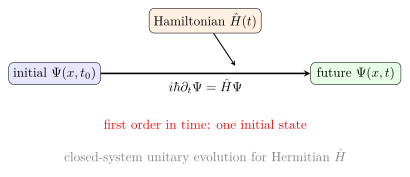
它对 time 一阶:给定某时刻完整 \(\Psi(x,t_0)\) 与 Hamiltonian,未来 evolution 被决定;它对 \(\Psi\) 线性,因此 solutions 的 complex linear combinations 仍为 solutions。
1.2 free-particle consistency
对 \(V=0\),plane-wave component
\[\Psi=Ae^{i(kx-\omega t)}\]
代入 TDSE 给
\[\hbar\omega=\frac{\hbar^2k^2}{2m}, \qquad E=\frac{p^2}{2m}\]
其中 \(E=\hbar\omega\)、\(p=\hbar k\)。这说明 TDSE 编码的是 nonrelativistic dispersion;当 kinetic energy 接近 \(mc^2\) 时应换 relativistic quantum equation。
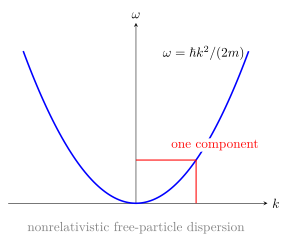
real sine/cosine alone generally不满足 first-order-in-time TDSE;complex exponential 的 phase relation 是动力学所需,不是装饰符号。
2. Probability current and conservation / 概率流与概率守恒
Knowledge ID: P07-U02-L02-K02
2.1 从 TDSE 推 continuity equation
对 real \(V\),TDSE 与其 conjugate 为
\[\frac{\partial\Psi}{\partial t} =\frac{i\hbar}{2m}\frac{\partial^2\Psi}{\partial x^2} -\frac{i}{\hbar}V\Psi,\]
\[\frac{\partial\Psi^*}{\partial t} =-\frac{i\hbar}{2m}\frac{\partial^2\Psi^*}{\partial x^2} +\frac{i}{\hbar}V\Psi^*.\]
令 \(\rho=\Psi^*\Psi\);potential terms cancel,整理成
\[\frac{\partial\rho}{\partial t} +\frac{\partial j}{\partial x}=0,\]
\[j =\frac{\hbar}{2mi} \left( \Psi^*\frac{\partial\Psi}{\partial x} -\Psi\frac{\partial\Psi^*}{\partial x} \right) =\frac{\hbar}{m} \operatorname{Im}\!\left( \Psi^*\frac{\partial\Psi}{\partial x} \right).\]
2.2 integral sign check
固定 control interval \([a,b]\):
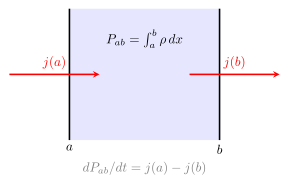
\[\frac{d}{dt}\int_a^b\rho\,dx =-\int_a^b\frac{\partial j}{\partial x}\,dx =j(a,t)-j(b,t).\]
left boundary 的 rightward current 流入,贡献 \(+j(a)\);right boundary 的 rightward current 流出,贡献 \(-j(b)\)。
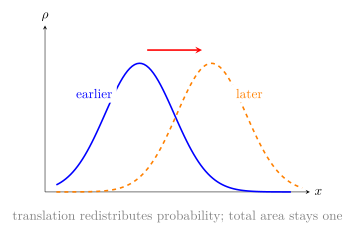
若 \(\Psi,\partial_x\Psi\) 在 infinity 使 boundary current vanish,则 total normalization constant。若 \(V\) 有 imaginary part,则会出现 source/sink term,已不描述本课的 closed Hermitian system。
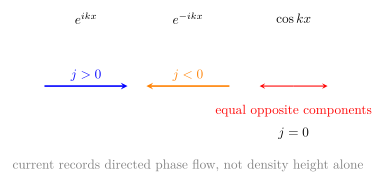
current 对 phase gradient 敏感。相同 constant density 下,\(e^{ikx}\) 与 \(e^{-ikx}\) 分别产生右、左 current;等幅 standing-wave combination \(\cos kx\) 可使净 current 为零。
3. Stationary states and separation of time / 定态与时间变量分离
Knowledge ID: P07-U02-L02-K03
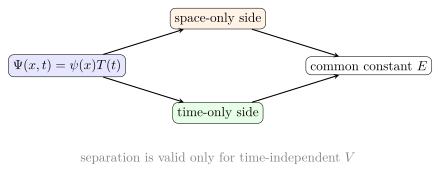
当 \(V=V(x)\) 不显含 time,尝试 product \(\Psi(x,t)=\psi(x)T(t)\)。代入 TDSE、除以 \(\psi T\):
\[i\hbar\frac{1}{T}\frac{dT}{dt} =-\frac{\hbar^2}{2m}\frac{1}{\psi}\frac{d^2\psi}{dx^2} +V(x).\]
left only \(t\)、right only \(x\),故两者等于 real separation constant \(E\):
\[T(t)=e^{-iEt/\hbar}, \qquad \Psi_E(x,t)=\psi_E(x)e^{-iEt/\hbar}.\]
“stationary” 意味着
\[\rho_E(x,t) =\Psi_E^*\Psi_E =\lvert\psi_E(x)\rvert^2\]
与 time 无关,并非 complex amplitude 不转相,也不保证 current 为零。ring 上 traveling energy eigenstate 可有 constant nonzero current。
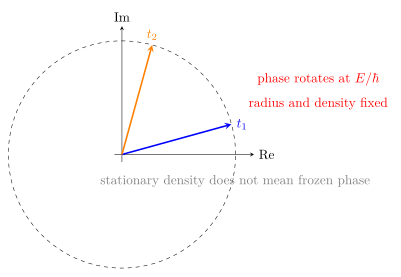
A coherent superposition of different energies generally has time-dependent relative phases \(e^{-i(E_n-E_m)t/\hbar}\),所以其 density 未必 stationary。
4. Time-independent Schrödinger equation / 定态薛定谔方程
Knowledge ID: P07-U02-L02-K04
spatial factor 满足 TISE:
\[-\frac{\hbar^2}{2m}\frac{d^2\psi}{dx^2} +V(x)\psi =E\psi.\]
重排得到 curvature rule:
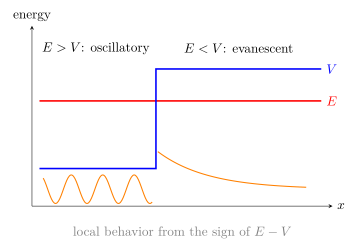
\[\psi''(x) =-\frac{2m}{\hbar^2}[E-V(x)]\psi(x).\]
- \(E>V\):local \(k(x)=\sqrt{2m(E-V)}/\hbar\) real,solutions oscillatory;
- \(E<V\):\(\kappa(x)=\sqrt{2m(V-E)}/\hbar\),solutions locally exponential;
- turning point \(E=V\) 附近,simple sinusoidal/exponential approximations break down。
TISE 是 eigenvalue problem,不是对任意 time-dependent state 的替代品。Boundary conditions 只对某些 \(E\) 给 nontrivial normalizable solutions,于是产生 energy quantization。
5. Boundary and continuity conditions / 边界与连续条件
Knowledge ID: P07-U02-L02-K05
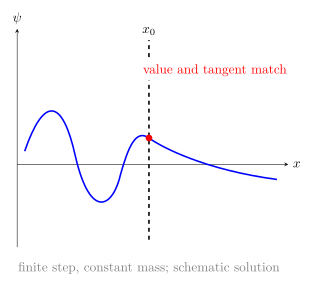
5.1 finite nonsingular potential step
在 \(x_0-\epsilon\) 到 \(x_0+\epsilon\) 积分 TISE:
\[-\frac{\hbar^2}{2m} \left[\psi'(x_0+\epsilon)-\psi'(x_0-\epsilon)\right] +\int_{x_0-\epsilon}^{x_0+\epsilon}(V-E)\psi\,dx=0.\]
若 \(V\) finite,\(\epsilon\to0\) 时 integral vanishes,所以 \(\psi'\) continuous;\(\psi\) 本身也必须 continuous,否则 \(\psi''\) 含更强 singular distribution。对 constant mass:
\[\psi(x_0^-)=\psi(x_0^+), \qquad \psi'(x_0^-)=\psi'(x_0^+).\]
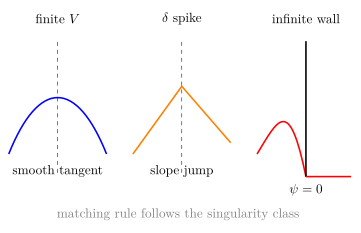
5.2 singular and ideal boundaries
对 \(V(x)=g\delta(x)\),integral survives:
\[\psi'(0^+)-\psi'(0^-) =\frac{2mg}{\hbar^2}\psi(0),\]
而 \(\psi\) remains continuous。对 ideal infinite wall,physical domain ends and \(\psi=0\) at wall;其 derivative 无需与“墙外恒零函数”的 derivative 连续。position-dependent mass 或 vector potentials 也会改变 matching rule,本课不涉及。
Worked Examples / 完整例题
Example 1 — box-normalized free plane wave
已知: electron in a periodic box of length \(L=1.00\ \mu\mathrm m\),\(k=5.00\times10^9\ \mathrm{m^{-1}}\),\(V=0\)。
系统与坐标: 1D free electron,\(+x\) along \(k\);periodic box makes normalization finite。
模型: nonrelativistic plane-wave eigenstate。
取
\[\Psi=\frac1{\sqrt L}e^{i(kx-\omega t)}.\]
TDSE 要求
\[E=\hbar\omega=\frac{\hbar^2k^2}{2m_e} =1.53\times10^{-19}\ \mathrm J =0.953\ \mathrm{eV}.\]
current:
\[j=\frac{\hbar k}{m_eL} =5.79\times10^{11}\ \mathrm{s^{-1}}.\]
检查: \(K/(m_ec^2)=1.86\times10^{-6}\),nonrelativistic self-consistent;\(j>0\) 与 \(k>0\) direction 一致;1D current unit is \(\mathrm{s^{-1}}\)。
解释: density \(1/L\) stationary,但 probability circulates;stationary 不等于 zero current。
Example 2 — fixed interval 的 probability balance
已知: 某瞬间 \(j(a)=0.080\ \mathrm{s^{-1}}\)、\(j(b)=0.030\ \mathrm{s^{-1}}\),interval probability \(P_{ab}=0.400\);currents 在下一 \(0.50\ \mathrm s\) 近似 constant。
系统与方向: fixed interval \([a,b]\),\(+x\) right;positive current rightward。
模型: source-free real potential,短时 currents constant。
\[\frac{dP_{ab}}{dt}=j(a)-j(b) =0.050\ \mathrm{s^{-1}}.\]
\[P_{ab}(0.50\ \mathrm s) \approx0.400+(0.050)(0.50) =0.425.\]
检查: inflow at left exceeds outflow at right,probability increases;result remains within \([0,1]\)。
解释: continuity equation 是 local bookkeeping,不要求 packet “整块移动”才能改变 interval probability。
Example 3 — 1.00 nm infinite well 的 \(n=2\) stationary state
已知: electron in \(0<x<L\),\(L=1.00\ \mathrm{nm}\),\(n=2\)。
系统与边界: ideal infinite walls,\(\psi(0)=\psi(L)=0\);lab frame。
模型: TISE with \(V=0\) inside。
\[\psi_2(x)=\sqrt{\frac2L}\sin\!\left(\frac{2\pi x}{L}\right),\]
\[E_2=\frac{4\pi^2\hbar^2}{2m_eL^2} =2.41\times10^{-19}\ \mathrm J =1.50\ \mathrm{eV}.\]
\[\Psi_2(x,t)=\psi_2(x)e^{-iE_2t/\hbar}.\]
phase period:
\[T_{\rm phase}=\frac{h}{E_2}=2.75\times10^{-15}\ \mathrm s.\]
检查: density \(\lvert\Psi_2\rvert^2=\lvert\psi_2\rvert^2\) has two lobes and a node at \(L/2\),time independent;units correct。
解释: complex phase changes on femtosecond scale while every position probability remains stationary。
Example 4 — finite step matching and flux
已知: \(V=0\) for \(x<0\),\(V_0=4.00\ \mathrm{eV}\) for \(x>0\);electron energy \(E=9.00\ \mathrm{eV}\) incident from left。
system/frame: stationary step in lab;\(+x\) along incidence。
模型: constant mass, finite step, \(E>V_0\);plane-wave stationary scattering。
\[\psi_L=e^{ik_1x}+re^{-ik_1x}, \qquad \psi_R=te^{ik_2x},\]
\[\frac{k_2}{k_1}=\sqrt{\frac{E-V_0}{E}} =\sqrt{\frac59}=0.745.\]
continuity at \(x=0\):
\[1+r=t, \qquad k_1(1-r)=k_2t.\]
所以
\[r=\frac{k_1-k_2}{k_1+k_2}=0.146, \qquad t=\frac{2k_1}{k_1+k_2}=1.15.\]
probability flux ratios:
\[R=\lvert r\rvert^2=0.0213, \qquad T=\frac{k_2}{k_1}\lvert t\rvert^2=0.979.\]
检查: 用未舍入值计算得 \(R+T=1.000\ldots\);amplitude \(t>1\) 不违反 probability,因为 transmitted velocity/current factor \(k_2/k_1\) 必须计入。
解释: finite step 同时要求 value and derivative matching;只连续 \(\psi\) 无法决定两 amplitudes。
Lesson synthesis / 本课综合
从 dynamics 到 observables 的闭环:
- 指定 system、reference frame、real \(V\) 与 initial normalized \(\Psi\);
- TDSE 推动 complex amplitude;
- TDSE 与 conjugate 的差给 continuity equation;
- time-independent \(V\) 允许 energy separation,得到 stationary phase factor;
- TISE 把 allowed energies 变成 spatial eigenvalue/boundary problem;
- matching conditions 由 potential 的 finite、delta 或 infinite singularity class 决定;
- 最终用 Born rule 与 current 检查 probability conservation。
Formula-and-decision table / 公式与决策表
| Task | Relation | Conditions | Diagnostic |
|---|---|---|---|
| evolve state | \(i\hbar\partial_t\Psi=\hat H\Psi\) | nonrelativistic single particle | first order in time |
| probability current | \(j=(\hbar/m)\operatorname{Im}(\Psi^*\partial_x\Psi)\) | no vector potential | sign gives flow direction |
| local conservation | \(\partial_t\rho+\partial_xj=0\) | real \(V\), Hermitian dynamics | integrate to verify boundary signs |
| stationary separation | \(\Psi=\psi e^{-iEt/\hbar}\) | \(V\) time independent | density of one eigenstate fixed |
| spatial eigenproblem | \(-\hbar^2\psi''/(2m)+V\psi=E\psi\) | stationary state | boundary conditions quantize \(E\) |
| finite step matching | \(\psi,\psi'\) continuous | finite nonsingular \(V\), constant mass | current continuous |
| delta matching | \(\psi'_+-\psi'_-=(2mg/\hbar^2)\psi(0)\) | \(V=g\delta(x)\) | slope jumps |
Model boundaries / 模型边界
- TDSE uses \(E=p^2/(2m)+V\) and is not relativistically covariant;high-energy particles require other equations。
- spin, identical-particle symmetry and electromagnetic vector potential are absent;with \(\mathbf A\) the current formula changes。
- real local \(V\) yields source-free local continuity;global unitary evolution additionally requires a self-adjoint Hamiltonian domain and probability-conserving boundary conditions。complex optical potentials model open-system loss/gain and change normalization。
- stationary separation fails for explicitly time-dependent \(V(x,t)\) except special transforms/approximations。
- \(E>V\) versus \(E<V\) is a local qualitative guide;turning points and rapidly varying potentials need fuller solutions。
- derivative continuity assumes finite nonsingular \(V\) and constant mass;delta, infinite wall and effective-mass interfaces differ。
- TISE eigenfunctions must belong to the Hamiltonian domain;formal differentiability alone is insufficient。
Misconception clinic / 误区诊所
- “TDSE 是把 \(E=p^2/2m+V\) 中符号机械替换后的证明。” operator correspondence motivates form;Schrödinger dynamics is a postulate validated by predictions。
- “real wave function 总能单独随 time 演化。” TDSE 含 \(i\);一般需要 complex phase。
- “continuity equation 是 \(\partial_t\rho=\partial_xj\)。” 正确为 \(\partial_t\rho+\partial_xj=0\);interval derivative is \(j(a)-j(b)\)。
- “stationary state 的 \(\Psi\) 不变。” \(\Psi\) rotates in phase;only probabilities and time-independent-observable distributions are stationary。
- “任何 superposition of energy eigenstates 也是 stationary。” 不同 energies 带不同 phase rates,cross terms 通常随 time。
- “\(E<V\) 表示 wave function 必须为零。” 它通常 evanescent;finite barrier 中可非零并导致 tunneling。
- “\(\psi'\) 在所有边界都连续。” finite step 是;delta slope jumps,infinite wall derivative need not match exterior。
Practice and retrieval / 练习与提取
- TDSE 对 time 是几阶?给定 initial state 还需要另给 \(\partial_t\Psi\) 吗?
- free plane wave 代入 TDSE,写出 \(\omega(k)\)。
- \(\Psi=Ae^{-ikx}\) 的 current direction 是什么?
- 若 \(j(a)=-0.02\ \mathrm{s^{-1}}\)、\(j(b)=0.05\ \mathrm{s^{-1}}\),求 \(dP_{ab}/dt\) 并解释。
- total normalization 守恒需要 infinity 处怎样的 current boundary?
- 为什么 time-independent \(V\) 才能一般地分离 \(\psi(x)e^{-iEt/\hbar}\)?
- 单一 energy eigenstate 的 density 是否随 time?两个不同-energy eigenstates 的 coherent superposition 呢?
- 在某区 \(E-V=4.0\ \mathrm{eV}\),局部 \(k\) 与 \(E-V=1.0\ \mathrm{eV}\) 时相比多少倍?
- finite step at \(x_0\) 对 constant mass 要匹配哪两个量?
- 对 attractive delta \(V=-g\delta(x)\)、\(g>0\),写出 derivative jump 的符号。
Answers / 答案
1. first order;给完整 \(\Psi(x,t_0)\) 即可,不应再任意指定独立 \(\partial_t\Psi\),后者由 TDSE 决定。
2. \(\omega=\hbar k^2/(2m)\)。
3. \(j=(\hbar/m)\operatorname{Im}[\Psi^*(-ik)\Psi]=-\hbar k\lvert A\rvert^2/m<0\),向 \(-x\)。
4. \(dP/dt=j(a)-j(b)=-0.02-0.05=-0.07\ \mathrm{s^{-1}}\);left boundary current 向左流出、right boundary current 向右流出,interval loses probability。
5. 需 net boundary flux vanish;localized state 常有 \(j(\pm\infty)=0\),或 periodic domain 两端 currents cancel。
6. separation 后 space side 含 \(V\);若 \(V\) 显含 time,无法令一边纯 \(x\)、另一边纯 \(t\) 并等于同一 constant。
7. 单一 energy eigenstate density 不变;different-energy coherent superposition 通常有 frequency \((E_n-E_m)/\hbar\) 的 time-dependent cross terms。
8. \(k=\sqrt{2m(E-V)}/\hbar\),energy difference 四倍使 \(k\) 两倍。
9. \(\psi(x_0^-)=\psi(x_0^+)\) 与 \(\psi'(x_0^-)=\psi'(x_0^+)\)。
10. 令 potential coefficient 为 \(-g\),则 \(\psi'(0^+)-\psi'(0^-)=-2mg\,\psi(0)/\hbar^2\)。
Exit ticket / 离堂检验
- 从 \(\partial_t\rho+\partial_xj=0\) 不跳步地写出 fixed interval 的 balance,并给每一项方向意义。
- 对一个 piecewise potential,先分类 finite/delta/infinite,再写 matching conditions;说明为什么不能用同一口诀处理三者。
References and source notes / 参考资料与来源说明
- OpenStax University Physics Vol. 3, 7.3 The Schrödinger Equation — TDSE、TISE、stationary separation and basic boundary conditions;核对于 2026-08-29。
- MIT OpenCourseWare 8.04, Lecture Note 5 — free-particle equation and complex solutions;核对于 2026-08-29。
- MIT OpenCourseWare 8.04, Lecture Note 6 — probability current and continuity equation;核对于 2026-08-29。
- MIT OpenCourseWare 8.04, Lecture Note 10 — stationary states and TISE eigenproblem;核对于 2026-08-29。
- MIT OpenCourseWare 8.04, Lecture Note 11 — Infinite and Finite Square Wells — infinite/finite well boundaries;核对于 2026-08-29。
- MIT OpenCourseWare 8.05, Chapter 1: Wave Mechanics — continuity sign、stationary states、TISE properties and matching;核对于 2026-08-29。
- NIST 2022 CODATA, Fundamental Physical Constants — \(\hbar,m_e,e\) for examples;核对于 2026-08-29。
所有 TikZ 依据本课 equations 原创绘制。Probability flow arrows follow the declared \(+x\) convention;finite/delta/infinite boundary sketches intentionally show different tangent behavior。
Source-to-content map
| Source | Used for | Knowledge ID / Section | Model boundary or convention |
|---|---|---|---|
| OpenStax 7.3 | TDSE/TISE and basic solutions | K01, K03–K05 | nonrelativistic scalar particle |
| MIT 8.04 Note 5 | complex free solutions | K01 | plane waves generalized/box normalized |
| MIT 8.04 Note 6 | current and conservation | K02, Example 2 | \(j>0\) defined toward \(+x\) |
| MIT 8.04 Note 10 | stationary eigenproblem | K03, K04 | time-independent real potential |
| MIT 8.04 Note 11 | well boundaries | K05, Example 3 | infinite wall is ideal singular limit |
| MIT 8.05 Chapter 1 | continuity, phase, matching | K02–K05 | constant mass; delta exception explicit |
| NIST CODATA | numerical constants | Examples 1, 3 | 2022 recommended values |
复习与拓展
- 下一课 Free Particles, Steps, and Barriers 将系统研究 reflection、transmission、evanescent waves and tunneling。
- 与 Wave Functions and Probability 对照:Born normalization 不是每时刻另行强加,而由 Hermitian TDSE 保持。
- 可扩展:time-evolution operator、self-adjoint domains、vector-potential current、time-dependent perturbations、numerical split-operator methods。