
Learning objectives / 学习目标
你应能构造 \(\mathbf R=n_1\mathbf a_1+n_2\mathbf a_2+n_3\mathbf a_3\);区分 lattice、basis、unit cell、primitive cell;说明 7 crystal systems 与 14 Bravais types 的层级;检验 rotation/reflection/inversion/translation;由截距求 Miller indices;计算 SC/BCC/FCC packing fraction 并声明 hard-sphere 假设。
Prerequisites / 先修知识
- Interatomic Bonding and Material Classes。
- 三维向量、determinant volume、整数线性组合、几何截距。
Scope and conventions / 范围与约定
- Direct-lattice primitive vectors 记作 \(\mathbf a_i\);fractional coordinate 相对 conventional cell。
- 晶向用 \([uvw]\),晶向族用 \(\langle uvw\rangle\);晶面用 \((hkl)\),晶面族用 \(\{hkl\}\)。
- 仅在 cubic orthogonal axes 中 \([hkl]\) 自动垂直 \((hkl)\);一般晶系不能这样猜。
- Packing fraction 用不可重叠 hard spheres;不等同于电子密度占比。
Notation and modeling contract / 符号与建模契约
| Symbol | Meaning | SI unit |
|---|---|---|
| \(\mathbf a_i\) | primitive translation vectors | m |
| \(\mathbf R\) | lattice translation | m |
| \(\boldsymbol\tau_s\) | basis position inside cell | m |
| \(V_c\) | chosen cell volume | m\(^3\) |
| \((hkl)\) | family of parallel crystal planes | 1 |
| \(d_{hkl}\) | adjacent-plane spacing | m |
| \(\eta\) | atomic packing fraction | 1 |
1. Lattice, basis, and unit cell / 点阵、基元与晶胞
Knowledge ID: P09-U01-L02-K01
另一项实用检查是把 cell 内所有原子平移一个 primitive vector,确认所得集合与原集合逐点重合。若只在部分位置重合,说明所选向量不是晶格平移;若 cell 含有额外等价点,则它是非原胞但仍可合法使用。坐标变换后应重新核对原子数、化学计量和体积,防止因边界计数造成重复或遗漏。
点阵是“哪些位置在平移意义下等价”的数学骨架,基元则回答每个等价位置附近放什么原子、以什么相对坐标放置。把二者分开能避免两个常见错误:第一,把 conventional cell 内所有原子数误当作 lattice-point 数;第二,在换 cell 后误以为结构已经改变。Primitive vectors 可以做任意整数可逆基变换,只要生成同一平移群;原子 fractional coordinates 也要随之变换。验证一个候选 cell 时,应检查其平移能否无缝铺满空间、边界共享后的 lattice-point count、basis 是否在每个点完全相同,以及 cell volume 是否为 primitive volume 的整数倍。只有这些条件同时成立,图中的重复方框才具有晶体学含义。
Bravais lattice 是所有整数平移的点集;crystal structure 是每个 lattice point 加上相同 basis:
\[\mathbf r_{n,s}=\mathbf R_n+\boldsymbol\tau_s, \qquad \mathbf R_n=\sum_{i=1}^3n_i\mathbf a_i.\]
Primitive cell 恰含一个 lattice point(按边界分数计);conventional cell 为凸显 symmetry 可含多个 lattice points。Unit cell 不唯一,坐标选择不能改变物理结构。
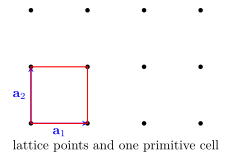
图 1 中红框平移铺满平面;边界点须按相邻 cells 分享。
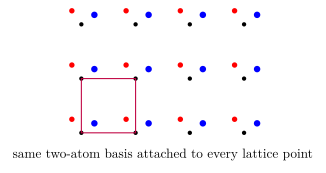
图 2 显示 lattice points 不是 atoms;蓝红 basis 才携带 species/position。
2. Bravais lattices and crystal systems / 布拉维点阵与晶系
Knowledge ID: P09-U01-L02-K02
判定晶系时不能只凭晶胞外形“看起来像什么”,而应考察保持无限点阵不变的度量关系与允许的对称操作。例如正交晶系要求三条基矢彼此垂直,却不要求三边相等;立方晶系则进一步要求三边等长。Bravais 分类还区分原始、体心、面心与底心等格心方式,因为格心改变了最小平移群,却不等同于额外加入一种原子。选取 conventional cell 是为了清楚展示对称性,primitive cell 才严格只含一个格点。模型边界是理想无限周期晶体;真实应变、缺陷或表面会降低局域对称性,因此实验图样应解释为理想群结构上的扰动,而不是据少量畸变立即另判晶系。
七个晶系与十四种点阵的关系不是简单相乘:某些晶系允许多种中心化,另一些只允许一种。判断中心化时要寻找额外平移,而不是看 cell 中央是否恰好有原子;若中心原子属于基元装饰,它未必生成新的点阵点。对实验峰进行索引时,metric 决定峰间几何关系,centering 则常通过消光条件提供第二重约束。
Bravais 分类关注平移点阵在保持对称性的连续变形和整数基变换下的类型,不等于具体物质名称。七个晶系由 point-group 类型组织,十四种 Bravais types 又加入 P、I、F、C 等 centering;IUCr 对 trigonal crystal system、rhombohedral lattice system 和 hexagonal family 有精细区别。教学中最安全的方法是先写 metric tensor \(g_{ij}=\mathbf a_i\cdot\mathbf a_j\) 的约束,再问哪些正交操作保持该 metric 与 lattice invariant。偶然出现 \(a=b\) 不会自动提高晶系,必须有相应 symmetry operation。结构鉴定时也不能只凭一张投影图;不同三维 lattices 可能共享相似投影,需要结合完整 reciprocal metric 和 systematic absences。
三维有 14 Bravais lattice types。常用七 crystal systems 为 triclinic、monoclinic、orthorhombic、tetragonal、trigonal、hexagonal、cubic;IUCr 进一步区分 crystal system、lattice system 与 crystal family,尤其 trigonal/rhombohedral/hexagonal 的术语不能随意混用。
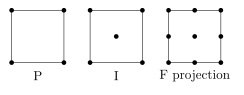
图 3 以投影比较 primitive、body-centred、face-centred centering;centering 是 lattice property,不是随意加 basis 的同义词。
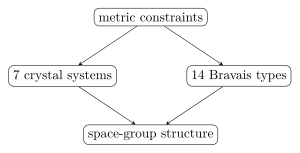
图 4 强调分类来自 metric 与 symmetry constraints,而非只看 cell 外形。
3. Point-group and translational symmetry / 点群与平移对称
Knowledge ID: P09-U01-L02-K03
对称操作还决定哪些宏观方向等价。例如立方晶体的三个坐标轴可由旋转互换,二阶标量响应因此可能各向同性;低对称晶体则一般需要不同方向的系数。检验操作时应逐个映射所有化学种类,不能让 A 原子落到 B 原子位置后仍称结构不变。磁性或外场存在时,还可能需要加入时间反演或降低原有空间对称,这属于后续扩展。
对称操作的核心是“操作后所有可测结构不变”。Point group 忽略 translation,只考察绕某固定点的旋转、镜映、反演与反旋;translation group 则由 primitive vectors 的整数线性组合生成。二者组合形成 space group,screw axis 与 glide plane 表明旋转或镜映可与分数平移绑定。对称性直接约束物性张量:具有 inversion 的晶体禁止某些奇宇称响应,高旋转对称会迫使若干 tensor components 相等。做判断时要作用于完整 basis 而不是只作用于 cell 外框;一个方形 cell 若内部装饰不对称,整体可能没有 \(C_4\)。同样,热振动的瞬时快照可破坏几何外观,但 equilibrium average 仍保留晶体 symmetry。
若操作 \(g\) 后结构与原结构不可区分,则 \(g\) 是 symmetry。Point-group operations 保持至少一个点不动,包括 proper rotations、mirrors、inversion 与 rotoinversion;translations 形成无限离散群。完整 space group 还含 screw/glide,本课只建立接口。晶格限制允许的纯旋转阶数为 \(1,2,3,4,6\),不允许周期晶体有严格五重旋转。
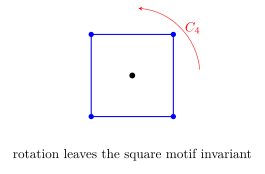
图 5 是 point symmetry;中心固定。
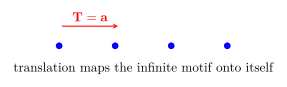
图 6 的 translation 不固定某个点,却保持无限结构。
4. Miller indices and crystal planes / 米勒指数与晶面
Knowledge ID: P09-U01-L02-K04
Miller 指数描述的是一族等间距平行晶面,而不是某一块有限平面的三个边长。操作上先取晶面与晶轴截距,以晶格常数为单位求倒数,再化成最小整数;与某轴平行意味着截距无穷大,所以对应指数为零,负截距用上划线表示。必须特别区分方向 \([hkl]\) 与晶面 \((hkl)\):只有在立方晶系中,两者才可借助普通欧氏分量直接视为相互垂直;一般晶系需要度量张量或倒易基矢。这个限制解释了为何把立方晶体的几何口诀机械搬到单斜、三斜晶体会出错,也说明衍射计算中使用倒易法向比仅看实空间草图更可靠。
米勒指标的负号和零具有明确几何意义:负号指 plane 在相应负轴截取,零指平行而非“没有该坐标”。绘图时可先画与所求 plane 平行、但不穿过原点的一张代表面,因为穿过原点会让截距法失效。得到整数后三步自检是:法向是否一致、相邻面间距是否随指标增大而减小、对称操作是否把它映到同一晶面族。
Miller indices 是一族等间距平面的方向标签。构造时应先把截距写成相对 cell edges 的无量纲数,再取倒数和化整数;平行轴的截距为无穷,因此 index 为零,负截距用 bar。\((hkl)\) 与 \(n(hkl)\) 在 primitive indexing 中通常描述同向但间距不同的 Laue order,centred conventional cell 还会出现 reflection conditions,不能机械约分后丢掉实验信息。对于非正交晶格,plane normal 是 \(h\mathbf b_1+k\mathbf b_2+l\mathbf b_3\),并不沿 \(h\mathbf a_1+k\mathbf a_2+l\mathbf a_3\)。求滑移面、表面密度或衍射角之前,应先声明用的是单一 plane、plane family 还是 symmetry-equivalent family。
在 axes 截距为 \((pa,qb,rc)\) 时,取倒数 \((1/p,1/q,1/r)\),清除分母并约成整数得到 \((hkl)\);平行某轴意味着截距无穷、对应 index 0。负 index 用 bar。Cubic lattice 中
\[d_{hkl}=\frac{a}{\sqrt{h^2+k^2+l^2}}.\]
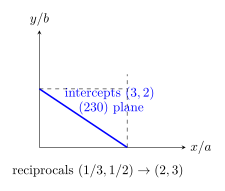
图 7 使用归一化坐标 \(x/a,y/b\) 展示二维 Miller construction;截距 \((3,2)\) 的倒数化为最小整数得到 \((230)\)。Indices 编码 orientation 和 plane family,不编码单一平面的绝对位置。
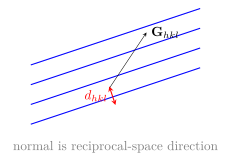
图 8 预告下一课:一般晶系中 plane normal 要用 reciprocal vector 表示。
5. Packing fraction and common structures / 堆积率与常见结构
Knowledge ID: P09-U01-L02-K05
配位数、原子堆积因子与晶胞内有效原子数回答不同问题:配位数是单个格点最近邻的数量,堆积因子是假设硬球后球体总体积占晶胞体积的比例,有效原子数则由角、面、体内位置的共享权重求和。FCC 与 HCP 都有配位数 12 和理想堆积因子约 \(0.740\),但层序分别为 ABCABC 与 ABAB,因此它们的远邻环境及滑移行为并不相同;BCC 配位数为 8,也不能据此简单断言任何宏观强度。硬球模型适合建立几何直觉,却忽略电子云可压缩性、方向性成键和热振动。应用于离子晶体或共价网络时,应把“球相切”视为半经验半径约定,而非不可穿透的真实边界。
堆积率并不直接决定材料稳定结构。某些材料选择较低 packing 的 diamond structure,是因为四面体共价键角带来的电子能量收益超过填满空间的几何收益;离子结构还要满足局部电中性与半径比。硬球模型最适合比较几何上可能的空隙和配位,若用于真实密度计算,还必须把 cell 中各元素质量、热膨胀后的晶格常数和占位缺陷一并纳入。
Packing fraction 的计算必须同时做两张账:cell 中有效 sphere 数与接触几何。Corner、edge、face 和 body sites 的分享系数不同;SC 沿 edge 接触,BCC 沿 body diagonal,FCC 沿 face diagonal。若先错误设 \(a=2r\),后续即使计数正确也会得到错误结果。FCC 与 HCP 都由 triangular close-packed layers 组成,局部配位数同为 12、理想 packing fraction 相同,但 stacking sequence 不同,因而较远邻结构和衍射不同。真实离子晶体常有不同半径与配位限制,共价晶体还有强键角要求,所以 hard-sphere maximum 只是几何 benchmark。将 packing fraction 直接等同密度也不成立,密度还取决于每个 basis 的质量和 cell volume。
Hard-sphere packing fraction
\[\eta=\frac{N_{\rm cell}(4\pi r^3/3)}{V_c}.\]
SC: atoms touch along edge,\(a=2r\)、\(N=1\)、\(\eta=\pi/6\);BCC: along body diagonal,\(\sqrt3a=4r\)、\(N=2\)、\(\eta=\sqrt3\pi/8\);FCC: along face diagonal,\(\sqrt2a=4r\)、\(N=4\)、\(\eta=\pi/(3\sqrt2)\approx0.740\)。HCP 与 FCC 同为 close-packed,但 stacking 分别 ABAB 与 ABCABC。
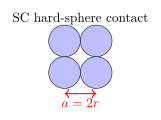
图 9 标明 SC contact geometry;不能在 BCC/FCC 继续假设 edge contact。
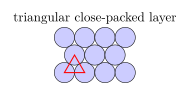
图 10 是 close-packed layer;三维 stacking sequence 决定 FCC/HCP 区别。
Worked Examples / 完整例题
Worked Example 1 — Cell counting
已知与任务: 给定 conventional BCC cell,求按边界分享后的 lattice-point 数,并与 primitive cell 比较。
研究对象与系统边界: 一个无限 BCC point lattice 的单个 conventional cube;暂不附加 atomic basis。
参考系与正方向: 立方轴为 \(x,y,z\),原点取一角;计数与轴正方向无关。
模型与理由: 周期边界中 corner 由八个 cells 分享,body-center 完全属于本 cell。
方程与计算: 写 \(N=8(1/8)+1=2\),再由 conventional volume 是 primitive volume 的两倍交叉检查。
单位与有效数字: lattice-point count 无量纲且必须为整数;这里精确为 2,不使用有效数字近似。
合理性、极限与解释: 若漏算分享会得 9;若把 BCC 当 basis 装饰 simple cubic,则会错误解释平移等价性。
已知: conventional BCC cell。对象: lattice points;边界均匀分享。8 corners contribute \(8(1/8)=1\),body center contributes 1,所以 \(N=2\)。检查:primitive cell 仍只含一个 lattice point;“conventional cell 含 2”不矛盾。
Worked Example 2 — Miller indices
已知与任务: 平面在三轴截距为 \((2a,3b,\infty c)\),求最小整数 Miller indices。
研究对象与系统边界: 由该 orientation 生成的整族平行晶面;不指定其中某一面的位置。
参考系与正方向: 使用给定 crystallographic axes;正截距沿各正轴,平行 \(c\) axis。
模型与理由: Miller definition 取无量纲截距倒数;该算法不要求 axes 正交。
方程与计算: \((2,3,\infty)^{-1}=(1/2,1/3,0)\),乘最小公倍数 6 得 \((320)\)。
单位与有效数字: indices 是 exact integers,无 SI 单位或有效数字。
合理性、极限与解释: \(l=0\) 确认 plane parallel to \(c\);normal direction 仍须由 reciprocal basis 求,不能直接写 \([320]\)。
Plane intercepts are \((2a,3b,\infty c)\)。Reciprocals \((1/2,1/3,0)\);multiply by 6 gives \((320)\)。研究对象为 plane family,坐标沿 crystallographic axes;若 axes nonorthogonal,也只能由 reciprocal geometry 求 normal。
Worked Example 3 — FCC packing fraction
已知与任务: 对 identical hard spheres 的 FCC conventional cell 求 packing fraction。
研究对象与系统边界: 一个 cube 与周期复制;只计几何 sphere volume,不计电子云。
参考系与正方向: cubic axes;接触发生在 face diagonal,方向选择不影响 cubic result。
模型与理由: FCC 每 cell 有 \(8/8+6/2=4\) spheres,face diagonal length \(\sqrt2a\) 包含四个 radii。
方程与计算: 先得 \(r=\sqrt2a/4\),再代入 \(\eta=4(4\pi r^3/3)/a^3\) 并约去 \(a^3\)。
单位与有效数字: 体积比无量纲;解析值精确,decimal 报三位。
合理性、极限与解释: \(0<0.740<1\);与 HCP 理想 close packing 相同,但 stacking 与 diffraction 不同。
模型: identical hard spheres, face-diagonal contact。\(r=\sqrt2a/4\)、\(N=4\):
\[\eta=\frac{4(4\pi/3)(\sqrt2a/4)^3}{a^3}=\frac{\pi}{3\sqrt2}=0.740.\]
无量纲且小于 1;空隙并未消失。
Worked Example 4 — Cubic plane spacing
已知与任务: cubic lattice parameter \(a=0.400\ \mathrm{nm}\),求 adjacent \((220)\) planes spacing。
研究对象与系统边界: 无限 ideal cubic lattice;忽略 strain、thermal expansion 和 finite-size broadening。
参考系与正方向: \(h,k,l\) 相对 cubic reciprocal axes;spacing 为正标量。
模型与理由: Cubic reciprocal metric 给 \(d_{hkl}=a/\sqrt{h^2+k^2+l^2}\)。
方程与计算: denominator \(\sqrt{4+4+0}=\sqrt8\),所以 \(d=0.400/2.828=0.141\ \mathrm{nm}\)。
单位与有效数字: 比值保留 nm,输入三位故答案三位。
合理性、极限与解释: Higher indices yield smaller spacing;结果小于 \(a\),不能把该 cubic formula 用于 monoclinic metric。
已知: cubic \(a=0.400\ \mathrm{nm}\),求 \((220)\) spacing。模型: cubic metric。
\[d_{220}=\frac{0.400}{\sqrt{8}}\ \mathrm{nm}=0.141\ \mathrm{nm}.\]
有效数字 3 位;不能把该公式直接用于 monoclinic cell。
Lesson synthesis / 全课综合
先用 translations 定 lattice,再把 species/positions 放进 basis;选择 primitive 或 conventional cell 只是坐标便利。Point operations 与 translations 决定 symmetry classification;Miller indices 把 direct-space planes编码为整数;hard-sphere geometry 给 packing benchmark。解题流程:识别 lattice/basis → 选 cell 并计数 → 声明 symmetry → 求 planes/directions → 用正确 contact geometry 算 packing。
Formula-and-decision table / 公式与决策表
| Task | Relation | Use only when | Model boundary or convention |
|---|---|---|---|
| lattice point | \(\mathbf R=\sum n_i\mathbf a_i\) | \(n_i\) integers | basis handled separately |
| cell volume | \(V_c=\lvert\mathbf a_1\cdot(\mathbf a_2\times\mathbf a_3)\rvert\) | chosen vectors span cell | conventional cell may not be primitive |
| Miller construction | reciprocal intercepts | crystallographic axes stated | zero means parallel axis |
| cubic spacing | \(d_{hkl}=a/\sqrt{h^2+k^2+l^2}\) | cubic metric | not general crystal |
| packing | \(\eta=N(4\pi r^3/3)/V_c\) | hard spheres/contact known | not electron-density fraction |
Model boundaries / 模型边界
- 14 Bravais types classify translation lattices, not all decorated crystal structures.
- A visually cubic cell can have a basis that lowers total crystal symmetry.
- Miller indices depend on selected crystallographic basis; plane families and direction families use distinct brackets.
- Hard-sphere packing ignores bonding direction, ionic radii choices, thermal motion and electronic density.
Misconception clinic / 误区诊所
- “lattice point 就是 atom。” Lattice point is an equivalence site; basis may contain many atoms.
- “unit cell 必须 primitive。” Conventional cell can contain multiple lattice points to expose symmetry.
- “\((hkl)\) 总垂直 \([hkl]\)。” Only automatically true for cubic orthogonal metric.
- “FCC packing 100%。” Close packing still has tetrahedral/octahedral voids,\(\eta\approx0.740\)。
- “晶体必须完美。” Defects and thermal displacements coexist with long-range order.
Practice and retrieval / 练习与提取
- [K01] 写出 lattice + basis 位置式。
- [K01] Conventional BCC cell 含多少 lattice points?
- [K02] 三维有多少 Bravais types?
- [K03] 五重 rotation 为何与 ordinary periodic lattice 冲突?
- [K03] 区分 point operation 与 translation。
- [K04] 截距 \((a,\infty,2c)\) 的 indices。
- [K04] cubic \(a=0.300\ \mathrm{nm}\),求 \(d_{111}\)。
- [K05] 求 SC packing fraction。
- [K05] BCC spheres 沿哪条线接触?
- [综合] 为什么同一 Bravais lattice 可产生不同 diffraction intensities?
Answer 1
\(\mathbf r_{n,s}=\sum_i n_i\mathbf a_i+\boldsymbol\tau_s\)。
Answer 2
\(8/8+1=2\)。
Answer 3
14。
Answer 4
周期平移与五重旋转无法无缝铺满三维 Euclidean lattice;crystallographic restriction 允许 \(1,2,3,4,6\)。
Answer 5
Point operation 至少固定一点;translation 移动所有点但映回无限结构。
Answer 6
\((102)\)。
Answer 7
\(0.300/\sqrt3=0.173\ \mathrm{nm}\)。
Answer 8
\(\eta=(4\pi r^3/3)/(2r)^3=\pi/6=0.524\)。
Answer 9
Body diagonal,\(\sqrt3a=4r\)。
Answer 10
Peak positions reflect lattice;basis species/positions enter structure factor and change intensities/extinctions。
Exit ticket / 离堂检验
- 给出一个“同一 lattice、不同 basis”的二维例子,并说明哪些 diffraction features 可保持、哪些会改变。
- 对一个未知 cubic structure 列出从 cell counting 到 packing fraction 的完整假设清单。
References and source notes / 参考资料与来源说明
以下来源于 2026-08-30 实际打开核验。
- MIT OCW 3.012, Bravais lattices and crystal structures. https://ocw.mit.edu/courses/3-012-fundamentals-of-materials-science-fall-2005/resources/lec16b/
- MIT OCW 3.091, Recitation 13: Bravais Lattices and Crystal Packing. https://ocw.mit.edu/courses/3-091-introduction-to-solid-state-chemistry-fall-2018/fb4be166dbbac638423967647ca2799b_MIT3_091F18_REC13.pdf
- IUCr, Miller indices. https://dictionary.iucr.org/Miller_indices
- IUCr, A general introduction to space groups. https://it.iucr.org/Ac/ch1o3v0001/
- IUCr, An introduction to X-ray analysis: classification of crystals. https://www.iucr.org/education/pamphlets/2/full-text
Source-to-content map
| Source | Used for | Knowledge ID / Section | Model boundary or convention |
|---|---|---|---|
| MIT 3.012 | lattice, basis, unit cells, common structures | K01–K02, K05 | conventional/primitive distinction |
| MIT 3.091 | packing calculations | K05 | hard-sphere geometry |
| IUCr Miller dictionary | plane indices and reciprocal normal | K04 | crystallographic bracket convention |
| IUCr International Tables | point/translation groups and systems | K02–K03 | precise IUCr hierarchy |
| IUCr pamphlet 2 | 7 systems, 14 lattices, crystal classification | K02–K03 | introductory summary |
复习与拓展
- 下一课用 reciprocal basis 把 \((hkl)\) planes、Bragg condition 与 structure factor 统一。
- Unit 9.2 将 basis atoms 的 masses/couplings 变成 acoustic/optical branches。
- Defects lesson will revisit grain boundaries and imperfect crystals。