
Learning objectives / 学习目标
构造含 \(2\pi\) convention 的 reciprocal basis;画 first Brillouin zone;证明 \(\Delta\mathbf k=\mathbf G\) 与 Bragg law 等价;计算 structure factor 和 systematic absence;比较 X-ray、neutron、electron 的耦合、穿透与适用边界。
Prerequisites / 先修知识
- Crystal Lattices and Symmetry。
- Plane waves \(e^{i\mathbf k\cdot\mathbf r}\)、geometric series、elastic scattering。
Scope and conventions / 范围与约定
- 采用 solid-state convention \(\mathbf a_i\cdot\mathbf b_j=2\pi\delta_{ij}\);IUCr 常用无 \(2\pi\) reciprocal axes,比较资料时须转换。
- Elastic diffraction 取 \(\lvert\mathbf k_i\rvert=\lvert\mathbf k_f\rvert=2\pi/\lambda\)。
- Kinematic/single-scattering approximation;强 electron diffraction 的 dynamical effects 另行处理。
Notation and modeling contract / 符号与建模契约
| Symbol | Meaning | SI unit |
|---|---|---|
| \(\mathbf b_i\) | reciprocal primitive vectors | m\(^{-1}\) |
| \(\mathbf G\) | reciprocal-lattice vector | m\(^{-1}\) |
| \(\mathbf q=\mathbf k_f-\mathbf k_i\) | momentum-transfer wavevector | m\(^{-1}\) |
| \(F(\mathbf G)\) | unit-cell structure amplitude | probe-dependent |
| \(I\) | diffracted intensity | instrument units |
1. Reciprocal lattice / 倒易点阵
Knowledge ID: P09-U01-L03-K01
倒易点阵不是另一套任意坐标,而是平移群的傅里叶对偶:任何倒易矢量 \(\mathbf G\) 都满足对所有实空间平移 \(\mathbf R\) 有 \(\exp(i\mathbf G\cdot\mathbf R)=1\)。因此周期函数只能含波矢相差倒易矢量的 Fourier 分量。由 \(\mathbf a_i\cdot\mathbf b_j=2\pi\delta_{ij}\) 可知,实空间晶格常数增大时倒易间距缩小;这一反比关系也是用衍射峰间距反推晶格尺度的基础。这里的点不代表真实粒子位置,而代表允许的空间频率。有限晶体会把理想的 \(\delta\) 型倒易点展宽,缺陷和有限相关长度也会产生弥散散射,所以实验峰宽不能被误认为“倒易格点具有实体尺寸”。
倒易基底也给出最简便的晶面算法:指定整数 \((hkl)\) 后,\(\mathbf G_{hkl}\) 同时给法向与间距。若 direct cell 被拉长,垂直方向的 reciprocal spacing 会缩小;这可用于从 peak shift 反推出应变。计算中应以点积逐项验证 \(\mathbf a_i\cdot\mathbf b_j\),因为仅凭图形直观很容易在斜晶格中取错垂直方向。有限晶体仍可使用同一 reciprocal centers,只是每个点被形状函数展宽。
倒易点阵不是把每个实空间坐标逐项取倒数,而是由相位不变条件定义。任何 \(\mathbf G\) 若对所有 lattice translations 都满足 \(e^{i\mathbf G\cdot\mathbf R}=1\),就是 reciprocal vector;这使周期函数的 Fourier series 只能出现离散 \(\mathbf G\)。Direct cell 体积越大,reciprocal cell 越小,二者在含 \(2\pi\) convention 下满足 \(V_cV_c^*=(2\pi)^3\)。对非正交 primitive vectors,cross-product formula 自动给出正确方向。实际计算必须先声明是否把 \(2\pi\) 放进 \(\mathbf b_i\),否则 plane spacing、Ewald sphere radius 和 Bloch phase 会相差常数。倒易坐标的可测意义体现在 momentum transfer、diffraction spot 和 band/phonon wavevector,而非一套纯形式符号。
\[\mathbf b_1=2\pi\frac{\mathbf a_2\times\mathbf a_3}{V_c},\quad \mathbf b_2=2\pi\frac{\mathbf a_3\times\mathbf a_1}{V_c},\quad \mathbf b_3=2\pi\frac{\mathbf a_1\times\mathbf a_2}{V_c}.\]
\(\mathbf G=\sum h_i\mathbf b_i\) 满足 \(e^{i\mathbf G\cdot\mathbf R}=1\),因此是 lattice-periodic Fourier components。\((hkl)\) plane normal parallel to \(\mathbf G_{hkl}\),且在此 convention 下 \(d_{hkl}=2\pi/\lvert\mathbf G_{hkl}\rvert\)。
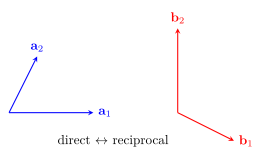
图 1 说明 reciprocal vectors 一般不是 direct vectors 的简单倒数方向。
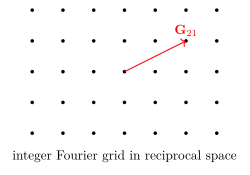
图 2 的每个 reciprocal point 对应一个允许的 lattice Fourier phase。
2. Brillouin zones / 布里渊区
Knowledge ID: P09-U01-L03-K02
第一 Brillouin 区是以倒易原点为中心的 Wigner–Seitz 原胞:对每个邻近倒易点作垂直平分面,围出的最近区域即为第一布里渊区。把任意波矢写成 \(\mathbf k=\mathbf k_{\mathrm{red}}+\mathbf G\),并将 \(\mathbf k_{\mathrm{red}}\) 约化进第一布里渊区,不会丢失周期晶格中的 Bloch 物理,因为相差 \(\mathbf G\) 的平移相因子等价。区边界处自由波近简并,微弱周期势就能耦合 \(\mathbf k\) 与 \(\mathbf k-\mathbf G\) 并打开能隙。该几何构造依赖真实倒易度量;对非正交晶格不能在纸面坐标上直接画普通中垂线而忽略基矢夹角。
布里渊区的体积等于 reciprocal primitive-cell volume,任何合法划分都应覆盖 reciprocal space 且无重叠。高对称点和高对称线只是选定 lattice symmetry 后的特殊位置,不同晶系的字母命名不能直接混用。数值 band 或 phonon 图只沿少数路径取样,曲线之间的空白并不表示没有 states;求态密度必须对整个区域积分。区边界处的法向还对应一族 Bragg planes,这是周期波被反射和混合的几何来源。
First Brillouin zone 是 reciprocal lattice 的 Wigner–Seitz cell,故它不是任意截取的长方盒。构造时连接 origin 与所有近邻 reciprocal points,在中点作垂直平分面,取包含 origin 的交集;第二、第三 zones 则按从 origin 发出的射线穿过 Bragg planes 的顺序定义。BZ boundary 上 \(\mathbf k\) 与 \(\mathbf k-\mathbf G\) 的 free-wave energies 可简并,周期势会把它们混合并可能打开 gap。选择 reduced-zone、extended-zone 或 repeated-zone scheme 只改变表示,不改变状态。比较两张 dispersion 图时应先核对 path、high-symmetry labels 和 reciprocal convention,不能把横轴相同字母当作相同物理方向。
First Brillouin zone 是 reciprocal lattice 的 Wigner–Seitz cell:所有比任何其他 reciprocal point 更接近 origin 的 \(\mathbf k\)。Opposite boundaries differ by \(\mathbf G\);Bloch states 的 \(\mathbf k\) 与 \(\mathbf k+\mathbf G\) 表示同一 crystal-momentum class。
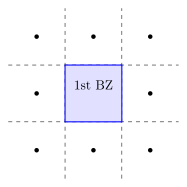
图 3 为 square reciprocal lattice 的 first BZ。
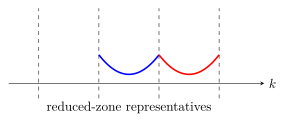
图 4 预告 folding:BZ boundary 是等价 \(k\) classes 相遇处,不是粒子撞墙。
3. Bragg condition and Laue equations / 布拉格条件与劳厄方程
Knowledge ID: P09-U01-L03-K03
Bragg 条件 \(2d\sin\theta=n\lambda\) 是相邻晶面散射路径差为整波长的几何表达;Laue 条件 \(\Delta\mathbf k=\mathbf G\) 则直接陈述弹性散射的动量转移。两者等价需同时使用 \(\lvert\mathbf k_{\mathrm{in}}\rvert=\lvert\mathbf k_{\mathrm{out}}\rvert=2\pi/\lambda\),因此若发生显著非弹性散射,简单 Bragg 角不再完整描述过程。角度 \(\theta\) 是入射束与晶面的夹角,不是实验仪器常报告的散射角 \(2\theta\)。有限晶粒尺寸、应变分布与仪器分辨率都会改变峰宽或峰位;“未见峰”也可能源于结构因子消光,而不能直接等同于该晶面不存在。
从相位和推导峰宽还可看出晶体尺寸信息:若某方向只有有限个重复 cells,几何级数主峰宽度约与该方向长度成反比。微应变则让不同区域具有略不同的 \(d\),造成额外展宽;两种效应需要不同峰形或多峰拟合区分。布拉格方程只给中心条件,不能单独说明强度、宽度或峰是否因基元相消而缺失。实验角度校准错误也会造成系统 peak shift,必须用标准样品检查。
Laue 条件来自所有晶胞散射振幅的相位和;当 \(\mathbf q\cdot\mathbf R\) 对每个 translation 都是 \(2\pi\) 整数时,振幅随 cell 数相干增长。Bragg law 则把同一条件投影到一族实空间平面,路径差为整数波长。两者等价,但各自适合不同任务:indexing 和 Ewald construction 用 vector form 更稳健,已知 plane spacing 求角度时 scalar Bragg form 更直接。有限晶粒只产生有限 geometric sum,因此 peak 有宽度;strain 分布会移动/展宽峰,disorder 会形成 diffuse scattering。实验中还须区分 elastic peak 与 phonon 等 inelastic sidebands,后者的 \(\lvert\mathbf k_f\rvert\) 不再等于 \(\lvert\mathbf k_i\rvert\)。
来自 lattice sites 的 amplitude sum 含 \(\sum_{\mathbf R}e^{i\mathbf q\cdot\mathbf R}\);宏观晶体中相干峰发生在
\[\mathbf q=\mathbf k_f-\mathbf k_i=\mathbf G.\]
等价 Laue equations 为 \(\mathbf a_j\cdot\mathbf q=2\pi h_j\)。将 \(\lvert\mathbf q\rvert=2k\sin\theta\) 与 \(\lvert\mathbf G\rvert=2\pi/d\) 合并得到
\[2d\sin\theta=n\lambda.\]
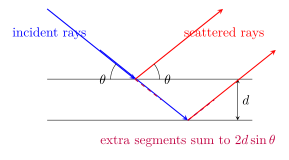
图 5 是 Bragg geometry;\(\theta\) 是 beam 与 plane 的夹角,不是常见 diffractometer 读出的 \(2\theta\)。
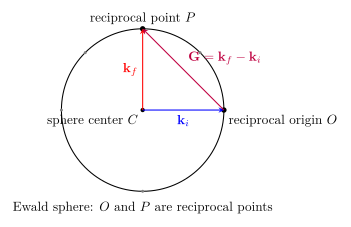
图 6 将 elastic sphere 与 reciprocal point intersection 统一。
4. Structure factor / 结构因子
Knowledge ID: P09-U01-L03-K04
结构因子 \(F(\mathbf G)=\sum_j f_j\exp(i\mathbf G\cdot\mathbf r_j)\) 把晶胞内各散射中心的复振幅相干相加,测得强度在运动学近似下与 \(\lvert F\rvert^2\) 成正比。关键是先加振幅、后取模平方;若直接相加强度,就会丢掉系统消光与相位干涉。例如相同原子的体心基元给出因子 \(1+\exp[i\pi(h+k+l)]\),从而奇数和时消光。原子散射因子随探针与动量转移改变,热振动还引入 Debye–Waller 衰减。实际晶体若存在占位无序或多重散射,理想选择定则会被软化,因此弱峰需要与背景、吸收及仪器效应共同判断。
结构因子中的相位取决于坐标原点,但强度不应因整体平移改变:所有项共同乘上同一 phase,绝对值平方保持不变。这是检查计算的有力方法。若更换 conventional cell,indices 和 basis 列表可能改变,但对同一物理 scattering vector 的预测必须一致。热运动会使高 \(q\) 振幅衰减,occupancy 小于一或元素混占则改变对应项权重;精修时这些参数可能相关,必须报告不确定度而不是只给最佳结构图。
Structure factor 是一个复数振幅和,关键在相位而不只在原子数。两个强散射原子也可能因相差 \(\pi\) 完全相消;弱原子在某些 reflection 又可能因其他项相消而变得可见。\(f_s(\mathbf q)\) 随探针和 \(q\) 改变,X-ray atomic form factor 通常随 \(q\) 下降,neutron nuclear scattering length 则不按 atomic number 单调变化。Measured intensity 还要乘 multiplicity、polarization/Lorentz、absorption 和 Debye–Waller 等因子。因此由 intensity 反演 basis 是 phase problem,不可仅开平方得到唯一电子密度。Systematic absence 可强约束 centering、glide 或 screw symmetry,但应排除 detector gap、preferred orientation 与动态散射伪影。
Lattice 决定可能 peak positions;basis amplitude
\[F(\mathbf G)=\sum_s f_s(\mathbf G)e^{i\mathbf G\cdot\boldsymbol\tau_s}, \qquad I(\mathbf G)\propto\lvert F(\mathbf G)\rvert^2.\]
\(f_s\) 是 probe-dependent scattering amplitude。两个相同 scatterers 在 \(0\) 与 \(a/2\) 的一维 basis 给 \(F=f[1+(-1)^h]\),odd \(h\) extinct。
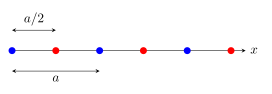
图 7 的 basis phase 在 odd reciprocal orders 相消。
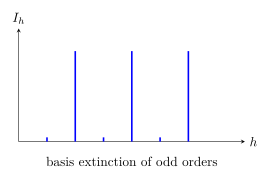
图 8 说明 absence 可由 structure factor 引起,不能直接断言 instrument failure。
5. X-ray, neutron, and electron diffraction / X 射线、中子与电子衍射
Knowledge ID: P09-U01-L03-K05
三类探针还可做互补联合精修:X-ray 精确约束重原子电子密度,neutron 补充轻元素与磁矩,electron 提供局部纳米区域。它们的散射振幅不是同一函数,因此联合数据能减少结构退化。与此同时,样品环境会限制选择,例如高压砧、低温磁场或原位反应需要兼顾窗口和吸收。任何结构结论都应区分体平均与局部区域,避免把电子显微镜中的一个晶粒代表整个 bulk。
选探针是在相互作用强度、对比机制、穿透深度、空间/能量分辨率和样品损伤之间取舍。X-ray 对 electron density 灵敏,实验室与 synchrotron 技术成熟;neutron 可区分某些邻近元素和同位素,也直接耦合 magnetic moment,但 source flux 较低、样品常需更大;electron wavelength 很短且散射强,适合纳米区域和薄片,却更容易 multiple scattering。若目标是 hydrogen positions、magnetic order 或 surface reconstruction,三类探针可能给完全不同的最优方案。任何比较都必须声明 elastic/inelastic mode、powder/single-crystal geometry、sample thickness 与 radiation damage;“波长更短”本身不保证更准确的结构。
X-rays 主要与 electron density 耦合,重元素通常散射强;neutrons 与 nuclei 和 magnetic moments 耦合,同位素差异显著且穿透深;electrons 与 electrostatic potential 强耦合,薄样品可高信号但 multiple scattering 常重要。分辨率、样品厚度、损伤、磁灵敏度与可用 source 决定选择。

图 9 是 interaction contrast map,不代表三种探针有相同 penetration 或 dynamical regime。
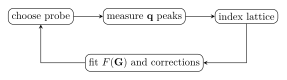
图 10 表明结构求解必须同时审计 polarization、form factor、absorption、multiplicity、temperature factor 和 multiple scattering。
Worked Examples / 完整例题
Worked Example 1 — Reciprocal basis of simple cubic
已知与任务: \(\mathbf a_i=a\hat{\mathbf e}_i\) 且 \(a=0.400\ \mathrm{nm}\),求 reciprocal primitive vectors 与 magnitude。
研究对象与系统边界: 无限 simple-cubic translation lattice;basis scattering 暂不进入。
参考系与正方向: Cartesian axes 与 direct primitive vectors 同向,采用 \(2\pi\) convention。
模型与理由: 用 defining condition \(\mathbf a_i\cdot\mathbf b_j=2\pi\delta_{ij}\),orthogonal cubic geometry 可直接求解。
方程与计算: 得 \(\mathbf b_i=(2\pi/a)\hat{\mathbf e}_i\);将 \(a=4.00\times10^{-10}\) m 代入。
单位与有效数字: reciprocal length 为 m\(^{-1}\);三位输入给 \(1.57\times10^{10}\ \mathrm{m^{-1}}\)。
合理性、极限与解释: \(a\) 增大使 reciprocal spacing 减小;结果也满足 reciprocal-cell volume \((2\pi/a)^3\)。
\(\mathbf a_i=a\hat{\mathbf e}_i\),故 \(\mathbf b_i=(2\pi/a)\hat{\mathbf e}_i\)。若 \(a=0.400\ \mathrm{nm}\),\(\lvert\mathbf b_1\rvert=1.57\times10^{10}\ \mathrm{m^{-1}}\)。量纲正确;该结论依赖 cubic orthogonal basis。
Worked Example 2 — Bragg angle
已知与任务: \(d=0.200\) nm、\(\lambda=0.154\) nm,求 first-order Bragg angle 与 detector \(2\theta\)。
研究对象与系统边界: 一族无限平行 planes 的 elastic kinematic reflection;忽略 refraction 和 broadening。
参考系与正方向: \(\theta\) 定义为 incident beam 与 plane 的锐角;detector scattering angle 为 \(2\theta\)。
模型与理由: 用 \(2d\sin\theta=n\lambda\),因为已知 plane spacing 和 wavelength。
方程与计算: \(\sin\theta=0.154/(0.400)=0.385\),inverse sine 得 \(22.6^\circ\),再乘二。
单位与有效数字: ratio 无量纲;角度三位有效数字。
合理性、极限与解释: \(0.385<1\) 故 reflection allowed;若 \(n\lambda>2d\),该 order 不存在。
已知: \(d=0.200\ \mathrm{nm}\)、\(\lambda=0.154\ \mathrm{nm}\)、first order。\(\sin\theta=\lambda/(2d)=0.385\),\(\theta=22.6^\circ\),diffractometer peak at \(2\theta=45.3^\circ\)。\(\sin\theta<1\),reflection kinematically possible。
Worked Example 3 — Two-site structure factor
已知与任务: identical scatterers at \(0\) 与 \((a/2,a/2,a/2)\),判断 reflections allowed/extinct。
研究对象与系统边界: 一个 two-site basis 重复在 translation lattice;采用 coherent kinematic scattering。
参考系与正方向: Fractional positions relative to cubic conventional axes;\(\mathbf G=2\pi(h,k,l)/a\)。
模型与理由: Unit-cell amplitude 是带 phase 的 sum,intensity 与 modulus squared 成正比。
方程与计算: 第二项 phase 为 \(e^{i\pi(h+k+l)}\);even sum gives \(2f\),odd sum gives zero。
单位与有效数字: \(F\) unit follows scattering amplitude \(f\);parity result exact。
合理性、极限与解释: Extinction comes from destructive interference, not missing plane;different species would make cancellation incomplete。
Identical atoms at \(0\) and \((a/2,a/2,a/2)\):
\[F_{hkl}=f[1+e^{i\pi(h+k+l)}].\]
若 \(h+k+l\) even,\(F=2f\)、\(I\propto4\lvert f\rvert^2\);odd 时 extinct。This is basis interference, not absence of those plane families。
Worked Example 4 — Probe choice
已知与任务: 在含重元素 matrix 中定位 hydrogen 且希望测 bulk structure,选择 probe 并说明限制。
研究对象与系统边界: Representative bulk sample,已知 isotope composition;目标是 nuclear positions,不是仅 surface morphology。
参考系与正方向: Single-crystal reciprocal axes用于 indexing;probe-choice conclusion 不依赖惯性参考系。
模型与理由: 比较 X-ray electron-density、neutron nuclear/magnetic 与 electron electrostatic scattering contrasts。
方程与计算: 无单一数值方程;决策依据是 structure amplitude \(F=\sum b_se^{i\mathbf G\cdot\tau_s}\),neutron \(b_s\) 对 H/D 有显著对比。
单位与有效数字: 若定量拟合,scattering lengths、absorption cross sections 和 wavelength 必须使用一致数据库单位;本题为模型选择。
合理性、极限与解释: Neutron 优先但需足够样品/flux;纳米薄片可考虑 electron diffraction,随后必须处理 multiple scattering。
需定位含重元素 matrix 中的 H positions 且样品可做 bulk。X-ray electron-density contrast 对 H 弱;neutron nuclear scattering 对 light elements/isotopes 可有强 contrast,故优先 neutron diffraction。研究对象/边界包含 isotope composition、absorption and magnetic order;若只能制备纳米薄片,electron diffraction 可能更实际但需 dynamical correction。
Lesson synthesis / 全课综合
Reciprocal lattice 是 translation symmetry 的 Fourier dual;first BZ 是 \(\mathbf k\) equivalence 的 primitive domain。Laue/Bragg condition 选择 allowed momentum transfers,structure factor 决定 basis amplitudes,probe physics 决定 \(f_s\)。流程:声明 convention → construct \(\mathbf b_i\) → index peak positions → calculate \(F\) → apply probe/instrument corrections → compare alternative structures。
Formula-and-decision table / 公式与决策表
| Task | Relation | Use only when | Model boundary or convention |
|---|---|---|---|
| reciprocal basis | \(\mathbf a_i\cdot\mathbf b_j=2\pi\delta_{ij}\) | \(2\pi\) convention stated | IUCr may omit \(2\pi\) |
| plane spacing | \(d=2\pi/\lvert\mathbf G\rvert\) | matching convention | \(\mathbf G\) for primitive plane family |
| diffraction | \(\mathbf q=\mathbf G\) | elastic kinematic scattering | finite size broadens peaks |
| Bragg law | \(2d\sin\theta=n\lambda\) | plane angle \(\theta\) | detector often reports \(2\theta\) |
| structure amplitude | \(F=\sum f_se^{i\mathbf G\cdot\tau_s}\) | coherent scattering | intensity needs corrections |
Model boundaries / 模型边界
- Finite crystals give broadened peaks, disorder gives diffuse scattering, and inelastic scattering has energy transfer.
- Structure factor alone does not include Lorentz-polarization, multiplicity, absorption or Debye–Waller factors.
- Electron diffraction often violates single-scattering approximation.
- Bragg law and Laue equations are equivalent geometric statements under elastic scattering, not two independent mechanisms.
Misconception clinic / 误区诊所
- “Reciprocal space is fictional.” It is the natural coordinate space of measurable wavevector transfer/Fourier components.
- “Every \((hkl)\) gives a peak.” Basis symmetry can make \(F=0\).
- “Peak intensity只看 atom count。” It depends on phases and probe-dependent amplitudes.
- “Bragg angle 就是仪器横轴 \(2\theta\)。” They differ by factor two in common geometry.
- “Electron diffraction总是最佳。” Strong coupling brings multiple scattering and thin-sample constraints.
Practice and retrieval / 练习与提取
- [K01] 写出 reciprocal-basis defining dot product。
- [K01] Simple cubic \(a\) 的 reciprocal spacing 是多少?
- [K02] First BZ 如何由 perpendicular bisectors 构造?
- [K03] 推导 \(\lvert\mathbf q\rvert=2k\sin\theta\)。
- [K03] \(d=0.25\ \mathrm{nm}\)、\(\lambda=0.10\ \mathrm{nm}\),求 first-order \(\theta\)。
- [K04] 两相同 sites at \(0,a/2\),哪个 \(h\) extinct?
- [K04] 为什么 lattice 不变时换 basis 会改 intensity?
- [K05] 哪种探针对 magnetic structure 特别有用?
- [K05] Electron diffraction 需要哪项重要边界检查?
- [综合] Peak position 与 intensity 分别优先约束什么?
Answer 1
\(\mathbf a_i\cdot\mathbf b_j=2\pi\delta_{ij}\)。
Answer 2
\(2\pi/a\)。
Answer 3
从 origin 到相邻 reciprocal points 作垂直平分面,围成 Wigner–Seitz cell。
Answer 4
Equal-length \(\mathbf k_i,\mathbf k_f\) chord geometry gives \(q=2k\sin\theta\)。
Answer 5
\(\sin\theta=0.2\),\(\theta=11.5^\circ\)。
Answer 6
Odd \(h\)。
Answer 7
Basis changes \(F(\mathbf G)\) phase sum, while translation lattice and candidate \(\mathbf G\) remain。
Answer 8
Neutron diffraction。
Answer 9
Multiple/dynamical scattering and sample thickness。
Answer 10
Positions constrain lattice metric/symmetry;intensities constrain basis species/coordinates and probe form factors。
Exit ticket / 离堂检验
- 用一条等式把 direct translation、reciprocal phase 与 diffraction peak 连起来。
- 面对一个 systematic absence,列出 structure factor、space-group symmetry 与 instrument artifact 三种可检验解释。
References and source notes / 参考资料与来源说明
以下来源于 2026-08-30 实际打开核验。
- MIT OCW 8.511, Lecture 2: Bravais lattice, reciprocal lattice and diffraction. https://ocw.mit.edu/courses/8-511-theory-of-solids-i-fall-2004/resources/lec2/
- IUCr, The reciprocal lattice. https://www.iucr.org/education/pamphlets/4/full-text
- IUCr, Principles of X-ray diffraction. https://www.iucr.org/publ/50yearsofxraydiffraction/full-text/principles
- IUCr, Reciprocal lattice dictionary. https://dictionary.iucr.org/Reciprocal_lattice
- MIT OCW 2.57, Nano-to-Macro Transport Processes complete lecture notes. https://ocw.mit.edu/courses/2-57-nano-to-macro-transport-processes-spring-2012/2e4ecaa5cf55f03bcefbc8ccce79aed6_MIT2_57S12_lec_notes_2004.pdf
Source-to-content map
| Source | Used for | Knowledge ID / Section | Model boundary or convention |
|---|---|---|---|
| MIT 8.511 Lecture 2 | lattice/basis, reciprocal vectors, Ewald construction, structure intensity | K01–K04 | solid-state \(2\pi\) convention |
| IUCr reciprocal pamphlet | reciprocal/direct planes and Bragg equivalence | K01, K03 | IUCr no-\(2\pi\) convention converted |
| IUCr diffraction chapter | Ewald sphere and experimental geometries | K03, K05 | elastic diffraction |
| IUCr dictionary | reciprocal lattice definition | K01 | direct/reciprocal terminology |
| MIT 2.57 notes | diffraction and reciprocal vectors, probe/transport context | K03–K05 | kinematic framework stated |
复习与拓展
- 下一课的 phonon wavevector 也只需取 first BZ;\(q\) 超界可减去 \(\mathbf G\)。
- Band theory 将在 BZ boundary 讨论 Bragg mixing and gaps。
- Thermal lesson 中 Umklapp 正是 phonon momentum balance modulo \(\mathbf G\)。