
Learning objectives / 学习目标
推导 Einstein heat capacity 及两极限;由 Debye DOS 得 \(T^3\) law 与 Dulong–Petit limit;用 kinetic relation 分析 \(\kappa\);说明 thermal expansion 必须来自 anharmonic free energy;写 normal/Umklapp crystal-momentum balances并解释后者产生热阻的条件。
Prerequisites / 先修知识
- Vibrations of Crystal Lattices:branches、phonon quantization、DOS。
- Bose occupation \(n_B=(e^{\hbar\omega/k_BT}-1)^{-1}\)、\(C_V=(\partial U/\partial T)_V\)、Fourier law。
Scope and conventions / 范围与约定
- 讨论 insulating crystalline solid 的 lattice contribution;金属的 electronic heat/thermal current 留到 Unit 9.3。
- \(C_V\) per mole unless marked volumetric \(c_V\);\(\kappa\) SI 为 \(\mathrm{W,m^{-1}K^{-1}}\)。
- Relaxation-time approximation 只用于近局域平衡;ballistic regime 需边界 Landauer picture。
- Harmonic phonons 无 thermal expansion、也无 intrinsic phonon–phonon resistance;两者均要求 anharmonicity。
Notation and modeling contract / 符号与建模契约
| Symbol | Meaning | SI unit |
|---|---|---|
| \(\Theta_E=\hbar\omega_E/k_B\) | Einstein temperature | K |
| \(\Theta_D=\hbar\omega_D/k_B\) | Debye temperature | K |
| \(C_V\) | molar constant-volume heat capacity | J mol\(^{-1}\) K\(^{-1}\) |
| \(c_V\) | volumetric heat capacity | J m\(^{-3}\) K\(^{-1}\) |
| \(\kappa\) | thermal conductivity | W m\(^{-1}\) K\(^{-1}\) |
| \(\ell=v\tau\) | phonon mean free path | m |
| \(\alpha\) | linear expansion coefficient | K\(^{-1}\) |
1. Einstein model of heat capacity / 爱因斯坦热容模型
Knowledge ID: P09-U02-L02-K01
Einstein 模型把每个原子视为三个相同频率、彼此独立的量子谐振子,因此配分函数可直接给出热容。高温时 \(\hbar\omega_E\ll k_BT\),平均能量趋于经典均分,恢复 \(C_V\to3Nk_B\);低温时激发概率按 \(\exp(-\Theta_E/T)\) 冻结,热容指数下降。模型成功解释经典定律为何在低温失效,却因假设单一频率而遗漏晶体必有的低频声学模,所以无法得到普遍的 \(T^3\) 律。\(\Theta_E=\hbar\omega_E/k_B\) 是频率尺度而非真实相变温度。用于拟合复杂材料时,多 Einstein 项可代表窄光学带,但参数不应被误解为每个原子真的各自独立振动。
应用爱因斯坦公式时应先确认报告的是每原子、每摩尔原子还是每摩尔化学式。若一个化学式含多个原子,高温极限按总振动自由度计数。多组窄频模式可用多个 Einstein terms 近似,但参数之间可能高度相关;拟合好并不证明晶体真的只有若干无色散频率。低温数据若明显呈幂律,就不能用增加一个有限频率来代替缺失的 acoustic continuum。
Einstein 模型把固体的复杂 normal-mode spectrum 压缩成一个频率,因此特别适合展示量子化如何修正经典 equipartition。每个 oscillator 的平均激发能由 Bose factor 决定,零点能对固定频率的 \(C_V\) 导数为零。高温时许多 occupation levels 被访问,结果回到每原子 \(3k_B\);低温时跨越有限 gap \(\hbar\omega_E\) 的概率呈指数小。它能定性解释热容在低温消失,却无法产生实验常见的 \(T^3\) law,因为真实无限晶体必有频率趋零的 acoustic modes。对具有窄 optical band 的部分振动,Einstein term 仍可作为多频 fit 的一个组成,但不能把拟合出的 \(\Theta_E\) 当作唯一真实 phonon frequency。
Einstein assumes \(3N\) independent quantum oscillators at one frequency \(\omega_E\)。Discarding temperature-independent zero-point energy,
\[U=3N\frac{\hbar\omega_E}{e^{\Theta_E/T}-1},\]
\[C_V=3Nk_B\left(\frac{\Theta_E}{T}\right)^2 \frac{e^{\Theta_E/T}}{(e^{\Theta_E/T}-1)^2}.\]
\(T\gg\Theta_E\) gives \(3Nk_B\);\(T\ll\Theta_E\) gives exponential suppression, too rapid compared with ordinary 3D acoustic solids。
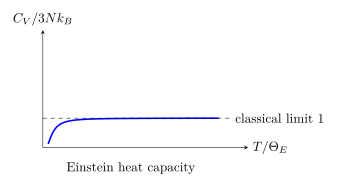
图 1 表明量子冻结与高温饱和;因纵轴已除以 \(3Nk_B\),经典高温极限为 1。
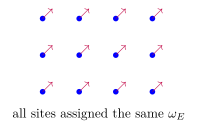
图 2 说明 Einstein model 缺少 collective long-wavelength modes。
2. Debye model and low-temperature law / 德拜模型与低温定律
Knowledge ID: P09-U02-L02-K02
Debye 模型把固体长波振动近似为各向同性弹性连续介质,包含一条纵波与两条横波,并令三维态密度随 \(\omega^2\) 增长。截止频率 \(\omega_D\) 不是声子突然不能存在的真实边缘,而是通过 \(\int_0^{\omega_D}g(\omega)d\omega=3N\) 保证模总数正确的计数构造。低温仅有 \(\omega\lesssim k_BT/\hbar\) 的长波模被激发,从积分可得 \(C_V\propto T^3\);高温又回到 Dulong–Petit 极限。各向异性晶体应使用不同方向声速的适当平均,低维系统的 DOS 幂次也会改变,故 \(T^3\) 不是所有维度与所有温区的无条件定律。
德拜温度既可由低温热容系数估计,也可由声速和原子数密度估计,两者不完全相同可反映模型近似。低温展开要求积分上限足够大;在接近截止温度时必须用完整积分,不能继续外推立方律。若样品含导电电子,常写 \(C/T=\gamma+\beta T^2\) 分离电子线性项与晶格立方项;本课的纯晶格公式只对应后者。
Debye 模型保留长波 acoustic modes,并用一只球形 cutoff 替代真实 Brillouin zone。Cutoff 的目的不是声称 dispersion 突然终止,而是确保总 mode count 正好为 \(3N\)。低温时典型热 phonon 满足 \(\hbar\omega\sim k_BT\),只采样线性色散与 \(g\propto\omega^2\) 区域;令 \(x=\hbar\omega/k_BT\) 后,能量积分带出 \(T^4\),再对温度求导得到 \(T^3\)。高温时 Bose factor 回到 classical limit,Debye 与 Einstein 都趋近 \(3Nk_B\)。真实材料可有 anisotropic sound speeds、optical modes、electronic/magnetic contributions;因此用 \(C/T^3\) 平台或低温 fit 提取 \(\Theta_D\) 时必须说明温区。
Debye uses three acoustic continua \(\omega=v_s k\) and chooses cutoff to count \(3N\) modes:
\[C_V=9Nk_B\left(\frac{T}{\Theta_D}\right)^3 \int_0^{\Theta_D/T}\frac{x^4e^x}{(e^x-1)^2}\,dx.\]
Low temperature:
\[C_V\simeq\frac{12\pi^4}{5}Nk_B\left(\frac{T}{\Theta_D}\right)^3.\]
High temperature again gives \(3Nk_B\)。\(T^3\) comes jointly from 3D acoustic DOS \(g\propto\omega^2\) and Bose occupation—not from each atom having three independent low-frequency modes。
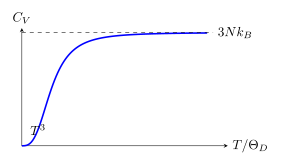
图 3 是 asymptotic map,不按横纵轴精确比例绘制。
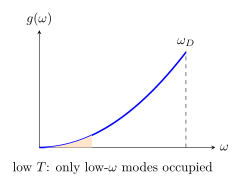
图 4 将 \(T^3\) law 连到低频 DOS。
3. Phonon contribution to thermal conductivity / 声子对热导的贡献
Knowledge ID: P09-U02-L02-K03
声子热导常写为 \(\kappa\simeq\tfrac13 c_V\bar v\ell\),它把可携带能量的热容、传播速度和平均自由程分开。该式来自各向同性弛豫时间近似;严格处理应对每一分支与波矢积分 \(C_{\mathbf q s}v_{\mathbf q s}^2\tau_{\mathbf q s}\)。低温时边界或缺陷限制 \(\ell\),热容上升使 \(\kappa\) 增大;更高温时声子—声子散射加强,\(\ell\) 缩短,常形成峰后下降。电子导热显著的金属不能只用声子项解释。样品尺寸、同位素纯度和晶界会直接改变测得热导,因此材料常数必须连同温度、方向与微结构报告。
热导分析应配合尺寸依赖和同位素控制。若降低横向尺寸使低温热导按比例下降,说明边界限制平均自由程;若同位素纯化显著提高峰值,说明质量无序散射重要。高温下近似 \(1/T\) 的下降常提示声子—声子过程,但不能只凭斜率断言唯一机制。接触热阻与辐射漏热也会污染测量,需要从样品本征热导中分离。
热导率描述非平衡能量流,不等于 equilibrium heat capacity。温度梯度使沿冷端运动的 phonon occupation 略多,散射在时间 \(\tau\) 后抹去偏差;角向平均产生 \(1/3\)。因此 \(c_V\) 决定可携能量,\(v\) 决定传播速度,\(\ell\) 决定记忆梯度的距离。极低温 clean crystal 常由 sample boundary 限制 \(\ell\),改变样品宽度会改变 \(\kappa\);中温 defect/isotope scattering 重要;高温 anharmonic scattering 尤其 Umklapp 缩短 lifetime。若 \(\ell\) 接近器件尺寸,diffusive Fourier law 和局域温度假设失效,需 ballistic treatment。比较材料必须统一几何、晶向和温度,晶体热导通常是 tensor。
在 isotropic relaxation-time estimate 中
\[\kappa\simeq\frac13c_V\bar v\ell =\frac13c_V\bar v^2\tau.\]
低温 boundary-limited 时 \(\ell\sim L\) 且 \(c_V\propto T^3\),故 \(\kappa\propto T^3\);温度上升时 phonon population 增加但 scattering 更强,\(\kappa(T)\) 常先升至峰值再下降。Matthiessen sum \(\tau^{-1}=\sum_i\tau_i^{-1}\) 需要近独立散射渠道。
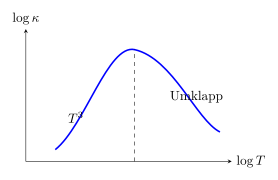
图 5 是典型绝缘晶体趋势;杂质、尺寸和 branches 会移动峰值。
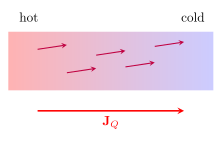
图 6 把 heat flux 画成偏离平衡的 phonon energy transport,而非单个 phonon 恒定飞行路径。
4. Anharmonicity and thermal expansion / 非谐性与热膨胀
Knowledge ID: P09-U02-L02-K04
纯谐势关于平衡位置对称,热平均位移虽随温度增大,但正负方向等价,不能产生净热膨胀。加入三次、四次等非谐项后,势阱两侧曲率不同,升温会把平均键长推向较软的一侧。宏观上体膨胀系数可与 Grüneisen 参数、热容和体积模量联系,说明膨胀来自模频率对体积的敏感性,而不仅是“原子振幅变大”。非谐性同时允许声子衰变、频移和有限寿命。负热膨胀材料提醒我们,单一不对称键图景不是普遍定律;横向振动、框架几何或特定模的负 Grüneisen 参数可使总体积随升温收缩。
热膨胀系数本质上由自由能对体积和温度的混合导数决定,因此压力会改变结果。各向异性晶体可能一个轴膨胀、另一个轴收缩,即使总体体积仍增加;用单一线膨胀系数会丢失信息。靠近结构相变时软模和序参量涨落可主导膨胀,简单准谐模型失效。实验上同时测晶格常数、弹性模量和热容,才能较可靠地检验格林艾森关系。
Harmonic Hamiltonian 的模式彼此独立、frequency 不随振幅或 volume 改变,因此既不能给 intrinsic phonon scattering,也不能给 thermal expansion。真实势在 minimum 两侧不对称,升温后 probability distribution 访问较浅的一侧更多,平均键长改变;quasiharmonic picture 则把这种效应写成 \(\omega_s(V)\),通过振动自由能产生 thermal pressure。Mode Grüneisen parameters 可正可负,因此某些框架材料会在特定温区负热膨胀。宏观 linear expansion 还受 bulk modulus、各向异性和相变影响,简单 pair-potential 图仅是直觉。计算时应区分 minimum shift、mean displacement shift 与 cell free-energy minimum,这三者在有限温度并非同一概念。
纯 quadratic \(U(x)\) 对称,任何 temperature 下 \(\langle x\rangle=0\),故不能产生 thermal expansion。加入 \(ax^3+bx^4\) 或允许 phonon frequencies 随 volume 变,热采样偏向较浅的扩张侧。Grüneisen parameter \(\gamma_s=-\partial\ln\omega_s/\partial\ln V\) connects mode shifts to expansion;isotropic estimate \(\alpha_V\sim\gamma C_V/(BV)\),需明确 averaging。
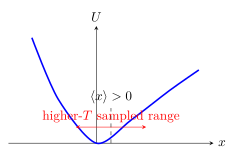
图 7 的 asymmetry shifts mean separation rightward;minimum itself need not move in this fixed potential picture。
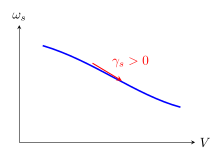
图 8 表示 expansion softens a positive-\(\gamma\) mode;negative expansion materials may have important negative-\(\gamma\) modes。
5. Umklapp processes / 倒逆过程
Knowledge ID: P09-U02-L02-K05
三声子过程中既要满足能量守恒,也满足晶体动量守恒到一个倒易矢量:\(\mathbf q_1+\mathbf q_2=\mathbf q_3+\mathbf G\)。Normal 过程取 \(\mathbf G=0\),整体声子准动量仍留在第一布里渊区;Umklapp 过程有非零 \(\mathbf G\),约化后表现为热流方向的有效回折,因此能直接松弛净热流。低温高波矢声子稀少,Umklapp 被抑制;升温后其相空间迅速增加,常导致 \(\kappa\) 近似随 \(1/T\) 下降。这里的“动量损失”不是违反真实动量守恒,余量由晶格整体吸收。杂质和边界也能松弛热流,实验上必须区分不同散射率的温度依赖。
热流衰减并不是一次倒逆事件简单把一个声子“撞回去”,而是许多碰撞使偏离平衡的分布失去净漂移。严格输运需解玻尔兹曼方程,正常过程可与倒逆过程共同决定集体流动;在极纯材料中甚至出现声子流体效应。经验弛豫时间模型把这些细节压缩为有效寿命,使用时必须说明它不能区分所有碰撞渠道,也不能自动满足守恒律。
Phonon–phonon scattering 来自 cubic/quartic anharmonic terms。Normal process 的 wavevectors 在 first BZ 内相加,保存总 crystal momentum,能快速建立局部平衡却不一定直接消除整体 drift;Umklapp sum 越过 zone boundary,减去 reciprocal vector 后的 final momentum 可反向,从而有效 relax heat current。两类过程都必须同时满足 energy conservation,故 allowed phase space 由真实 dispersion 决定。低温只有小 \(k\) phonons 被占据,很难凑出跨 boundary 的总波矢,Umklapp rate 常被指数抑制;高温大 \(k\) occupation 增多,\(\ell\) 缩短并使 \(\kappa\) 下降。Reciprocal vector 表示 lattice 可接收 crystal momentum,不代表普通机械动量凭空消失。
Three-phonon normal process:
\[\mathbf k_1+\mathbf k_2=\mathbf k_3.\]
Umklapp:
\[\mathbf k_1+\mathbf k_2=\mathbf k_3+\mathbf G.\]
All wavevectors are reduced to first BZ;the reciprocal vector transfers crystal momentum to lattice/background and relaxes heat-current-carrying distribution. Energy conservation \(\omega_1+\omega_2=\omega_3\) also required。Low \(T\) lacks occupied large-\(k\) modes, so Umklapp is exponentially suppressed。
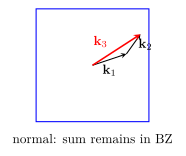
图 9 的 resultant stays inside BZ。
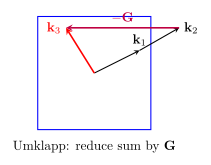
图 10 显示 reduced \(\mathbf k_3\) 可与 initial heat-flow direction opposite;箭头是 crystal-momentum bookkeeping,不是原子整体倒飞。
Worked Examples / 完整例题
Worked Example 1 — Einstein heat capacity at \(T=\Theta_E\)
已知与任务: 一摩尔 Einstein solid 在 \(T=\Theta_E\),求 molar \(C_V\)。
研究对象与系统边界: \(3N_A\) independent harmonic modes,volume fixed;不含 electrons、magnetism 或 expansion work。
参考系与正方向: Crystal rest frame;heat added raises \(T\),\(C_V\) taken positive。
模型与理由: All modes share \(\omega_E\),so \(x=\Theta_E/T=1\) exactly。
方程与计算: Substitute \(x=1\) into \(C_V=3Rx^2e^x/(e^x-1)^2\) and evaluate。
单位与有效数字: Dimensionless factor multiplies J mol\(^{-1}\) K\(^{-1}\);report four significant digits from constants。
合理性、极限与解释: Result lies below \(3R\) and above zero;raising \(T\) must approach classical limit monotonically。
已知: one mole、\(x=\Theta_E/T=1\)。对象: lattice oscillators;constant volume。模型: one Einstein frequency, zero-point term drops from derivative。
\[C_V=3R\frac{e}{(e-1)^2}=0.921(3R)=22.97\ \mathrm{J,mol^{-1}K^{-1}}.\]
单位来自 \(R\);小于 \(3R=24.94\),并在 \(T\to\infty\) 接近它,合理。
Worked Example 2 — Debye low-\(T\) heat capacity
已知与任务: \(\Theta_D=300\) K、\(T=10.0\) K、one mole,求 lattice \(C_V\)。
研究对象与系统边界: 3D acoustic phonons at fixed volume;忽略 optical/electronic contributions。
参考系与正方向: Crystal rest frame;energy and heat capacity are scalars。
模型与理由: \(T/\Theta_D=0.0333\ll1\) justifies asymptotic Debye \(T^3\) law。
方程与计算: Insert values in \((12\pi^4/5)R(T/\Theta_D)^3\),evaluate ratio before multiplying constants。
单位与有效数字: Only \(R\) carries J mol\(^{-1}\) K\(^{-1}\);temperature ratio dimensionless,answer three significant figures。
合理性、极限与解释: Much smaller than \(3R\) as expected;doubling \(T\) in same regime multiplies result by eight。
已知: \(\Theta_D=300\ \mathrm K\)、\(T=10.0\ \mathrm K\)、一摩尔。对象: acoustic lattice contribution。模型理由: \(T/\Theta_D=0.0333\ll1\)。
\[C_V=\frac{12\pi^4}{5}R\left(\frac{10}{300}\right)^3 =0.0719\ \mathrm{J,mol^{-1}K^{-1}}.\]
结果远小于 \(3R\),符合 frozen high-frequency modes;不含 electron contribution。
Worked Example 3 — Kinetic thermal conductivity
已知与任务: 由 volumetric \(c_V\)、average speed 与 mean free path 计算 \(\kappa\)。
研究对象与系统边界: Isotropic bulk insulating crystal under small steady gradient;local equilibrium and diffusive transport。
参考系与正方向: Crystal rest frame;\(+x\) along decreasing temperature so heat flux positive。
模型与理由: Relaxation-time kinetic theory gives angular average factor \(1/3\)。
方程与计算: Convert \(2.00\ \mu\)m to SI, then multiply \(c_Vv\ell/3\) without mixing molar and volumetric heat capacities。
单位与有效数字: J m\(^{-3}\) K\(^{-1}\) times m s\(^{-1}\) times m gives W m\(^{-1}\) K\(^{-1}\);three significant figures。
合理性、极限与解释: \(\ell\to0\) suppresses conduction;large clean-crystal value is possible but nanostructure boundaries reduce it。
已知: \(c_V=2.00\times10^5\ \mathrm{J,m^{-3}K^{-1}}\)、\(v=4.00\times10^3\ \mathrm{m,s^{-1}}\)、\(\ell=2.00\ \mu\mathrm m\)。系统: isotropic bulk phonons;steady small gradient。模型: relaxation-time kinetic estimate。
\[\kappa=\frac13c_Vv\ell =\frac13(2.00\times10^5)(4.00\times10^3)(2.00\times10^{-6}) =5.33\times10^2\ \mathrm{W,m^{-1}K^{-1}}.\]
Unit audit gives W m\(^{-1}\) K\(^{-1}\);large value is plausible for clean crystal but boundary/isotope scattering could lower it。
Worked Example 4 — Normal or Umklapp classification
已知与任务: In 1D BZ,classify \(k_1=0.70\pi/a\) plus \(k_2=0.65\pi/a\) and find reduced \(k_3\)。
研究对象与系统边界: One candidate three-phonon absorption channel;dispersion/occupations otherwise unspecified。
参考系与正方向: Crystal rest frame,positive \(k\) along \(+x\),first BZ \([-\pi/a,\pi/a]\)。
模型与理由: Crystal momentum is conserved modulo \(G=2\pi/a\);energy conservation must be tested separately。
方程与计算: Raw sum \(1.35\pi/a\) exceeds boundary;subtract one \(G\) to obtain \(-0.65\pi/a\) and write balance explicitly。
单位与有效数字: Every wavevector has units m\(^{-1}\);coefficients given to two decimals,result same precision。
合理性、极限与解释: Reduced vector lies inside BZ and reverses sign, so channel is Umklapp;classification alone does not give rate。
已知: one-dimensional BZ \([-\pi/a,\pi/a]\),\(k_1=0.70\pi/a\)、\(k_2=0.65\pi/a\)。对象: three-phonon absorption bookkeeping;assume energy conservation separately satisfied。Sum \(1.35\pi/a\) lies outside BZ。Subtract \(G=2\pi/a\):
\[k_3=-0.65\pi/a, \qquad k_1+k_2=k_3+G.\]
Thus Umklapp。Signs and units are consistent;classification alone does not give scattering rate or prove energy conservation。
Lesson synthesis / 全课综合
Einstein isolates quantum occupation but misses low-frequency collective modes;Debye restores acoustic DOS and \(T^3\) heat capacity。Heat storage \(c_V\) is only one factor in heat transport; velocities and mean free paths complete \(\kappa\)。Anharmonicity makes frequencies volume-dependent, produces expansion and phonon collisions;Umklapp is the momentum-relaxing subset important at higher temperature。Workflow: select DOS/model → compute occupation/energy → differentiate \(C_V\) → identify carriers and scattering → test harmonic vs anharmonic → enforce energy and crystal-momentum conservation。
Formula-and-decision table / 公式与决策表
| Task | Relation | Use only when | Model boundary or convention |
|---|---|---|---|
| Einstein \(C_V\) | \(3Nk_Bx^2e^x/(e^x-1)^2\) | one characteristic frequency | wrong low-\(T\) power law |
| Debye low-\(T\) | \((12\pi^4/5)Nk_B(T/\Theta_D)^3\) | \(T\ll\Theta_D\), 3D acoustic solid | omits optical/electronic terms |
| phonon \(\kappa\) | \(c_Vv\ell/3\) | isotropic diffusive regime | not ballistic nanoscale |
| expansion scale | \(\alpha_V\sim\gamma C_V/(BV)\) | averaged quasiharmonic model | anisotropic tensors may differ |
| Umklapp | \(\mathbf k_1+\mathbf k_2=\mathbf k_3+\mathbf G\) | energy conservation also met | crystal momentum modulo \(\mathbf G\) |
Model boundaries / 模型边界
- Einstein and Debye model lattice \(C_V\), not necessarily measured \(C_P\); their difference grows with expansion.
- Debye isotropy and one cutoff approximate real branches.
- Kinetic \(\kappa\) assumes quasiparticles with meaningful lifetime and local temperature.
- Quasiharmonic theory allows \(\omega(V)\) but neglects some explicit finite-amplitude interactions.
- Not every Umklapp channel is kinematically allowed; dispersion and occupation matter.
Misconception clinic / 误区诊所
- “Dulong–Petit 对所有温度成立。” It is high-\(T\) classical limit.
- “\(C_V\) 大就必然 \(\kappa\) 大。” Strong scattering can shorten \(\ell\) and lower \(\kappa\).
- “Thermal expansion 来自 atoms vibrating farther but symmetric。” A symmetric harmonic potential keeps mean separation unchanged.
- “Normal process完全不散射 phonons。” It redistributes modes but conserves total crystal momentum; by itself less effective at relaxing heat current.
- “Umklapp violates momentum conservation。” Crystal momentum is conserved modulo reciprocal vector; lattice receives the difference.
Practice and retrieval / 练习与提取
- [K01] 写 Einstein \(C_V\) high-\(T\) limit。
- [K01] 为什么 Einstein low-\(T\) behavior 不是 \(T^3\)?
- [K02] 3D Debye DOS 的频率幂律。
- [K02] \(\Theta_D=200\) K 时,5 K 与10 K 的 low-\(T\) heat-capacity ratio。
- [K03] \(c_V\) 加倍而 \(v,\ell\) 不变,\(\kappa\) 如何变?
- [K03] 列出三种 phonon scattering sources。
- [K04] 纯 harmonic potential 的 \(\alpha\) 为什么为零?
- [K04] 定义 mode Grüneisen parameter。
- [K05] 写 normal 和 Umklapp balances。
- [综合] 为什么绝缘晶体 \(\kappa(T)\) 常有峰?
Answer 1
\(C_V\to3Nk_B\),每摩尔为 \(3R\)。
Answer 2
One-frequency model has a finite excitation gap, so occupation is exponentially suppressed; it lacks gapless acoustic DOS。
Answer 3
\(g(\omega)\propto\omega^2\)。
Answer 4
\(C(10)/C(5)=(10/5)^3=8\)。
Answer 5
Diffusive kinetic model predicts doubling。
Answer 6
Boundaries、isotopic/point defects、dislocations、phonon–phonon anharmonic scattering,任三。
Answer 7
\(U(x)=U(-x)\) gives symmetric Boltzmann/quantum probability and \(\langle x\rangle=0\) at every \(T\)。
Answer 8
\(\gamma_s=-\partial\ln\omega_s/\partial\ln V\)。
Answer 9
Normal: \(\mathbf k_1+\mathbf k_2=\mathbf k_3\);Umklapp: \(\mathbf k_1+\mathbf k_2=\mathbf k_3+\mathbf G\),两者还须守能。
Answer 10
At low \(T\), growing \(c_V\) raises \(\kappa\) while boundary-limited \(\ell\) is long; at higher \(T\), anharmonic/Umklapp scattering rapidly shortens \(\ell\), producing a maximum。
Exit ticket / 离堂检验
- 从 \(g(\omega)\propto\omega^2\) 与 Bose occupation 写出 \(T^3\) scaling 的变量替换逻辑。
- 对一条 measured \(\kappa(T)\) curve,列出区分 boundary、defect 与 Umklapp regimes 所需的额外实验(尺寸、同位素、温度)。
References and source notes / 参考资料与来源说明
以下链接与所用主题于 2026-08-30 实际打开核验;Cambridge 采用当前公开课程页,只用于课程范围,不把已失效的历史 PDF 当作逐页证据。
- MIT OCW 5.62, Thermodynamics of Solids: Einstein and Debye Models. https://ocw.mit.edu/courses/5-62-physical-chemistry-ii-spring-2008/resources/21_562ln08/
- MIT OCW 8.044, Problem Set 9: Einstein, phonons and Debye law. https://ocw.mit.edu/courses/8-044-statistical-physics-i-spring-2013/72fb67e2358b965dee7738ec720b6ec2_MIT8_044S13_ps9.pdf
- MIT OCW 3.020, Lecture 9: Specific Heats and Phase Transformations. https://ocw.mit.edu/courses/3-020-thermodynamics-of-materials-spring-2021/mit3_020s21_l09.pdf
- Cambridge Cavendish, Condensed Matter Physics course page(syllabus includes Debye theory and thermal conductivity of insulators). https://www-teach.phy.cam.ac.uk/students/courses/condensed-matter-physics/87
- MIT OCW 8.511, Lecture 20: phonon contribution to specific heat. https://ocw.mit.edu/courses/8-511-theory-of-solids-i-fall-2004/resources/lec20/
- MIT OCW 3.11, Atomistic Basis of Elasticity(anharmonic bond-energy curve and thermal expansion). https://ocw.mit.edu/courses/3-11-mechanics-of-materials-fall-1999/47b8bb075c947c20da6f30ac2fbb0719_MIT3_11F99_elas_2.pdf
- MIT OCW 2.57, Nano-to-Macro Transport Processes: Complete Lecture Notes(phonon transport and scattering). https://ocw.mit.edu/courses/2-57-nano-to-macro-transport-processes-spring-2012/2e4ecaa5cf55f03bcefbc8ccce79aed6_MIT2_57S12_lec_notes_2004.pdf
Source-to-content map
| Source | Used for | Knowledge ID / Section | Model boundary or convention |
|---|---|---|---|
| MIT 5.62 | Einstein/Debye partition functions and limits | K01–K02 | harmonic equilibrium models |
| MIT 8.044 PSet 9 | \(3N\) modes, DOS integral and \(T^3\) derivation | K01–K02 | constant-volume lattice heat |
| MIT 3.020 Lecture 9 | experimental heat capacity and model comparison | K01–K02 | materials thermodynamics context |
| Cambridge Condensed Matter Physics course page | Debye theory and thermal conductivity course scope | K02–K03 | syllabus-level scope only; not used for detailed derivation |
| MIT 8.511 Lecture 20 | phonon quantization and heat capacity | K01–K03 | harmonic phonon framework |
| MIT 3.11 Atomistic Basis of Elasticity | asymmetric/anharmonic bond curve and thermal expansion | K04 | pair-potential illustration; real crystals require quasiharmonic/multimode treatment |
| MIT 2.57 complete notes | phonon kinetic transport and momentum-relaxing scattering | K03, K05 | quasiparticle and diffusive-transport regime |
复习与拓展
- Unit 9.3 adds electronic \(C_V\) and electronic thermal conductivity in metals。
- Semiconductor/device lessons use phonon scattering to understand mobility and self-heating。
- Superconductivity revisits lattice modes as one possible pairing interaction, without equating every phonon effect with pairing。