
Learning objectives / 学习目标
推导最近邻 monoatomic chain 的 \(\omega(k)\);建立 diatomic dynamical matrix 并识别两支;区分 phase/group velocity;将每个 normal mode 量子化为 phonons;由 \(g(\omega)=\sum\delta(\omega-\omega_{s\mathbf k})\) 解释 van Hove features 与 Debye low-frequency form。
Prerequisites / 先修知识
- Reciprocal Space and Diffraction。
- Coupled harmonic oscillators、eigenvectors/eigenvalues、quantum oscillator。
Scope and conventions / 范围与约定
- 一维链用 nearest-neighbor spring constant \(K\)、lattice repeat \(a\);harmonic、Born–von Kármán periodic boundary。
- \(k\) 限于 first BZ;\(k\) 与 \(k+G\) 等价。
- Phonon “momentum” \(\hbar k\) 是 crystal momentum;与整体机械 momentum 不总相同。
Notation and modeling contract / 符号与建模契约
| Symbol | Meaning | SI unit |
|---|---|---|
| \(u_n\) | displacement of cell \(n\) | m |
| \(K\) | nearest-neighbor force constant | N m\(^{-1}\) |
| \(M,m\) | atomic masses | kg |
| \(k\) | crystal wavevector | m\(^{-1}\) |
| \(\omega\) | angular frequency | s\(^{-1}\) |
| \(v_g=d\omega/dk\) | group velocity | m s\(^{-1}\) |
| \(g(\omega)\) | vibrational density of states | s |
1. Monoatomic and diatomic chains / 单原子与双原子链
Knowledge ID: P09-U02-L01-K01
单原子链的离散性决定色散不可能在整个波矢范围都保持线性。对质量 \(M\)、最近邻弹簧常量 \(C\)、间距 \(a\) 的链,平面波代入差分运动方程得到 \(\omega=2\sqrt{C/M}\lvert\sin(ka/2)\rvert\)。长波极限 \(ka\ll1\) 才有 \(\omega\approx a\sqrt{C/M}\lvert k\rvert\),此时群速度近似常数并对应连续介质声速;接近区边界时相邻原子近乎反相,群速度趋零。Born–von Karman 周期边界只是离散化允许波矢的计数工具,宏观极限下边界细节不影响体性质。若存在远邻耦合或多维各向异性,色散形状会改变,但周期性与第一布里渊区的约化仍保留。
推导双原子链时可用两个极限自检:当两种质量相等时,若把 primitive cell 人为加倍,两条曲线应等价于原单原子 branch 的折叠;当一种质量远大于另一种时,高频支主要由轻原子运动。若结果不满足这些极限,通常是相邻弹簧计数或 phase factor 出错。边界条件改变允许的离散波数,但大体积中的 bulk dispersion 不应改变。
建立链模型的第一步是明确 primitive cell 与 displacement variables。单原子链每 cell 只有一个纵向自由度,Fourier transform 后每个 \(k\) 只产生一条 branch;双原子链每 cell 有两个相互耦合的位移,故 dynamical matrix 有两个 eigenvalues 和两套 polarization ratios。质量差改变惯性,force constant 改变恢复力,两者共同决定 branch frequencies;不能把重原子简单说成“永远不动”。Periodic boundary 只为离散化 \(k\),最后取宏观极限;自由边界会产生不同 standing modes。真实三维每原子有三个 displacement components,若 primitive cell 含 \(p\) 个原子便有 \(3p\) branches,其中三条在 \(k\to0\) 为 acoustic。
Monoatomic nearest-neighbor equation:
\[M\ddot u_n=K(u_{n+1}+u_{n-1}-2u_n).\]
Substitute \(u_n=u e^{i(kna-\omega t)}\):
\[\omega(k)=2\sqrt{K/M}\,\lvert\sin(ka/2)\rvert.\]

图 1 是 linearized model;spring 表示 \(U''(r_0)\),不是实体连接。
Diatomic chain 每 primitive cell 有两个 displacement,故每个 \(k\) 的 \(2\times2\) dynamical matrix 给两个 eigenfrequencies。
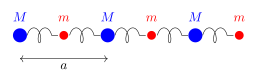
图 2 的 repeat distance \(a\) 包含 two-atom basis。
2. Dispersion relations of lattice waves / 晶格波色散关系
Knowledge ID: P09-U02-L01-K02
双原子链每个原胞含两个自由度,因此对每个约化波矢产生两条本征频率分支。建立耦合方程后需令动力学矩阵行列式为零;平方根中的正、负号分别给出 optical 与 acoustic 分支。\(k\to0\) 时,声学支两种质量近同相运动,整体平移不产生恢复力,所以 \(\omega\to0\);光学支则近反相,原胞内部键被拉伸,频率保持有限。两种原子带有相反有效电荷时,光学模可与红外电场耦合,但“光学”名称不保证所有晶体都强吸光。最近邻一维模型忽略极化长程力与三维纵横分裂,只用于揭示两支产生的最小机制。
色散还决定波包是否展宽:若某频段二阶导数显著,不同波数分量的群速度不同,原本局域的包络会逐渐变形。靠近带边时群速度小并不代表原子停止振动,而是能量包络的净传播慢。测量色散时得到的谱峰还含有限寿命宽度;若宽度与频率同量级,清晰 quasiparticle 和单一群速度的描述就应谨慎使用。
Dispersion relation 同时编码频率、波长与能量传播。代入 plane-wave ansatz 后,translation symmetry 使不同 \(k\) 解耦;离散 lattice 又使 \(\omega(k)\) 对 reciprocal translation 周期。\(k\to0\) 时相邻原子几乎同相,chain 看起来像连续介质,slope 给 sound speed;靠近 zone boundary 时相邻位移接近反相,frequency 有限但 group velocity 可归零。Phase velocity 追踪相位面,group velocity 决定窄 wavepacket 包络;在强色散或短寿命情形,简单粒子轨迹图景会失效。检查推导时应验证 \(\omega(-k)=\omega(k)\)(time-reversal/inversion 简化下)、频率实且非负,并在 \(K\to0\) 或 \(M\to\infty\) 极限得到合理结果。
离散采样令 \(\omega(k)\) periodic in reciprocal space。Long wavelength \(ka\ll1\) 时 \(\omega\simeq a\sqrt{K/M}\lvert k\rvert\),连续介质 sound speed \(v_s=a\sqrt{K/M}\);zone boundary \(k=\pi/a\) 时 neighboring atoms alternate and \(v_g=0\)。
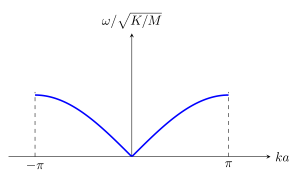
图 3 是 exact monoatomic dispersion;直线只适用于中心附近。
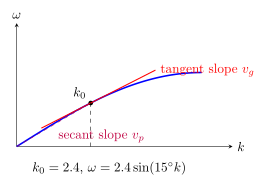
图 4 区分 phase velocity 与 transport-relevant group velocity。
3. Acoustic and optical branches / 声学支与光学支
Knowledge ID: P09-U02-L01-K03
声学支的零频极限源于连续平移对称性:所有原子同时位移不改变势能,这是一种 Goldstone 型软模。光学支描述基元内部相对位移,故需要每个原胞至少两个动力学自由度;其群速度与相速度都不必等于声速。判读色散图时,应以斜率 \(v_g=d\omega/dk\) 判断能量包络传播,而不是用曲线高度判断速度。区边界的驻波可有零群速度但非零频率,仍储存振动能。真实三维晶体每个原胞含 \(s\) 个原子时共有三条声学支和 \(3s-3\) 条光学支;一维示意图不能表达纵、横极化及简并劈裂。
在三维 polar crystal 中,长程库仑场可使纵向与横向光学模式在区中心分裂,说明最近邻机械弹簧模型不足。声学支也分为一条纵向和两条横向,其低波数斜率对应不同 elastic constants。Mode 的名称应包含 wavevector、branch 与 polarization;只写“某晶体的光学声子频率”往往遗漏方向和对称表示,无法唯一对应实验峰。
Acoustic 与 optical 的命名来自长波极限的 eigenvector,而不只是曲线高低。Acoustic \(k=0\) 模式是整个晶体刚体平移,因此在无外 pinning 时频率必须为零;这也是 translation invariance 的 Goldstone-like consequence。Optical \(k=0\) 模式中 basis atoms 相对运动,若它们带不同 effective charge,会形成 oscillating polarization 并与 infrared light 耦合;Raman activity 则由 polarizability tensor 与 symmetry 决定。Acoustic/optical branches 之间是否有 gap、是否交叉、横向与纵向如何分裂都取决于 masses、force constants 和 long-range Coulomb forces。阅读实验 dispersion 时必须同时看 polarization 和 selection rules,不能仅凭一条高频曲线宣布“光学可见”。
Diatomic nearest-neighbor chain obeys
\[\omega_\pm^2=K\left(\frac1M+\frac1m\right) \pm K\sqrt{\left(\frac1M+\frac1m\right)^2-\frac{4}{Mm}\sin^2(ka/2)}.\]
Minus branch has \(\omega\to0\) at \(k\to0\): cells move in phase, acoustic. Plus branch has finite \(\omega(0)\) and basis atoms move oppositely: optical. “Optical” means it may couple to electromagnetic field if charges/dipoles permit—not every optical phonon is optically active。
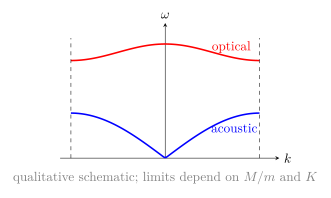
图 5 是定性 branch schematic,显示 zone-center optical gap;曲线未指定质量比,具体极限值必须由上式给定的 \(M/m\) 与 \(K\) 计算。
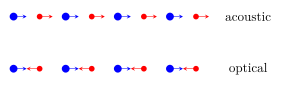
图 6 比较 \(k\approx0\) eigenvectors:同相与反相。
4. Normal modes and phonon quantization / 简正模与声子量子化
Knowledge ID: P09-U02-L01-K04
正规模是质量加权动力学矩阵的本征矢,每个模具有确定频率、波矢与极化,并在谐近似下彼此独立。量子化后单个模等价于量子谐振子,其能量为 \((n+1/2)\hbar\omega\);声子是占据数增加一个的集体激发,并非某个原子沿晶格飞行。晶体动量 \(\hbar\mathbf k\) 只在模倒格矢意义下守恒,可与真实机械动量不同。零点能即使在 \(T=0\) 也存在,但纯谐模型中不会自行造成热阻。声子寿命、线宽与热膨胀需要非谐相互作用或缺陷散射,因此把“独立声子”当作永不相互作用的实体会越过模型边界。
量子化的实际证据来自能量转移为 \(\hbar\omega\) 的离散模式占据和 Bose 温度因子。散射实验中创建声子与湮灭声子的强度不同,满足详细平衡;这可用来判断样品温度。零点位移则随质量和频率变化,对轻原子材料尤其明显。把 phonon 当作永久小球会误解寿命、局域性和 number nonconservation,正确对象始终是谐振模式的量子占据。
Normal-mode transformation 把许多 coupled coordinates 变为独立 harmonic oscillators;每个 mode 的 eigenvector 指定所有 atoms 的相对振幅与相位,normalization 则保证 \(Q\) 与 conjugate momentum 有标准能量形式。量子化后 occupation \(n\) 可为任意非负整数,单次增加带来能量 \(\hbar\omega\) 和 crystal momentum \(\hbar\mathbf k\)。Zero-point energy 即使在 \(T=0\) 仍存在,但若 frequencies 与 volume 无关,它不贡献 heat capacity。Phonons 是 quasiparticles:anharmonicity、disorder 和 boundaries 给有限 lifetime,谱线宽度约与 inverse lifetime 相关。由于 phonon number 可由三声子过程改变,equilibrium chemical potential 通常为零,不能套用守恒粒子气体的全部公式。
Harmonic dynamical matrix diagonalization yields independent coordinates \(Q_{s\mathbf k}\):
\[H=\sum_{s,\mathbf k}\hbar\omega_{s\mathbf k} \left(n_{s\mathbf k}+\frac12\right).\]
Phonon is one quantum of a collective mode, not a labeled atom. Number is not conserved because anharmonic interactions create/annihilate phonons; equilibrium chemical potential is normally zero。

图 7 表明 normal modes 是 coordinates 的 basis transformation。
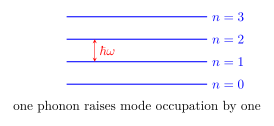
图 8 是单一 normal mode 的 equally spaced quantum ladder。
5. Density of vibrational states / 振动态密度
Knowledge ID: P09-U02-L01-K05
振动态密度 \(g(\omega)\) 定义单位角频率区间内的模数,并满足积分给出总正规模数。其计算本质是在 \(k\) 空间把等频面面积除以群速度大小,因此色散平坦处会积聚态,形成 van Hove singularity;一维区边界的 \(v_g\to0\) 正是典型来源。Debye 近似只保留低频线性色散,三维时得到 \(g(\omega)\propto\omega^2\),并以截止频率调节总模数为 \(3N\)。这对低温热容极有效,却不能重现真实光学支或中高频峰。比较实验 DOS 时还需注明中子加权、极化选择与展宽,否则测得谱强度并不等同于未加权的纯几何态密度。
计算态密度常采用在整个布里渊区均匀采样波矢、对每个 branch 累积 histogram,再用展宽近似 delta function。网格太粗会产生假峰,展宽太大会抹掉真正的 van Hove 结构;应做收敛检查。由热容反推 DOS 是积分反问题,通常不唯一;中子非弹性散射能提供更多波矢分辨信息,但仍受到散射矩阵元和仪器分辨率影响。
DOS 回答单位频率区间有多少 normal modes,不回答这些 modes 在哪一原子上振幅最大。一般三维中 \(g(\omega)\) 是 constant-frequency surface 上 \(1/\lvert\nabla_{\mathbf k}\omega\rvert\) 的积分,因此平坦 dispersion 或 stationary point 会积累 states 并形成 van Hove features。Debye \(\omega^2\) 只描述低频三维线性 acoustic region;optical bands、anisotropic speeds 和 gaps 会使真实 DOS 偏离。Finite sample 的 modes 离散,实验 linewidth 与分辨率把 delta peaks broaden。Neutron/Raman/IR measured spectrum 还乘 polarization-dependent matrix elements,所以“没有强峰”不等于 DOS 为零。Normalization \(\int g\,d\omega=3N\) 是最重要的总数检查。
\[g(\omega)=\sum_{s,\mathbf k}\delta(\omega-\omega_{s\mathbf k}), \qquad \int g(\omega)d\omega=3N\]
对三维 isotropic linear acoustic branches,\(g(\omega)\propto\omega^2\)。一维中 \(g(\omega)\propto\lvert d\omega/dk\rvert^{-1}\),故 group velocity vanishes 处出现 van Hove singularity;实际 disorder/finite lifetime broadens it。
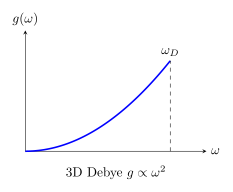
图 9 是 low-frequency continuum DOS with cutoff chosen to count \(3N\) modes。
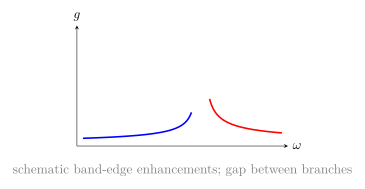
图 10 示意一维 band edges 的 DOS enhancement 与 acoustic–optical gap。
Worked Examples / 完整例题
Worked Example 1 — Monoatomic zone-boundary frequency
已知与任务: \(K=20.0\ \mathrm{N,m^{-1}}\)、\(M=4.00\times10^{-26}\ \mathrm{kg}\),求 \(k=\pi/a\) 的 angular/cyclic frequency。
研究对象与系统边界: 无限一维 monoatomic chain;只含最近邻 harmonic coupling。
参考系与正方向: Lattice rest frame,\(+x\) 沿链;frequency 取正 branch。
模型与理由: Zone-boundary exact dispersion uses \(\sin(ka/2)=1\);periodic boundary has no surface mode。
方程与计算: 代入 \(\omega=2\sqrt{K/M}\),再用 \(f=\omega/(2\pi)\)。
单位与有效数字: \(K/M\) units s\(^{-2}\);输入三位,结果三位。
合理性、极限与解释: THz scale is atomic-lattice plausible;\(M\to\infty\) lowers frequency,\(K\to0\) makes it vanish。
\(K=20.0\ \mathrm{N,m^{-1}}\)、\(M=4.00\times10^{-26}\ \mathrm{kg}\)。At \(k=\pi/a\),\(\omega=2\sqrt{K/M}=4.47\times10^{13}\ \mathrm{s^{-1}}\),\(f=\omega/(2\pi)=7.12\ \mathrm{THz}\)。单位 \(\sqrt{\mathrm{N,m^{-1}/kg}}=\mathrm{s^{-1}}\)。
Worked Example 2 — Long-wave sound speed
已知与任务: 使用 \(a=0.300\) nm 和前例 \(K,M\) 求 long-wave group velocity。
研究对象与系统边界: 同一 harmonic chain 的 \(ka\ll1\) acoustic packet。
参考系与正方向: Lattice rest frame;positive \(k\) packet 沿 \(+x\),speed 报 magnitude。
模型与理由: 展开 \(\sin(ka/2)\simeq ka/2\) 得 linear dispersion。
方程与计算: \(\omega\simeq a\sqrt{K/M}\lvert k\rvert\),故 \(v_g=d\omega/dk=a\sqrt{K/M}\)。
单位与有效数字: m times s\(^{-1}\) gives m s\(^{-1}\);三位有效数字。
合理性、极限与解释: \(6.71\) km/s 属常见固体 sound speed;靠近 zone boundary 不可继续用此常数。
先把晶格常数换为 SI:\(a=3.00\times10^{-10}\ \mathrm{m}\)。由精确色散
\[\omega(k)=2\sqrt{K/M}\,\lvert\sin(ka/2)\rvert\]
在 \(0<k<\pi/a\) 的正波矢区间求导,得到
\[v_g=\frac{d\omega}{dk}=a\sqrt{K/M}\cos(ka/2)\longrightarrow a\sqrt{K/M}.\]
代入前例 \(K,M\) 得 \(v_s=6.71\times10^3\ \mathrm{m\,s^{-1}}\)。量纲为 \(\mathrm m\times\mathrm{s^{-1}}\);若 \(a\) 或 \(K\) 增大,声速上升,而质量增大使声速按 \(M^{-1/2}\) 下降。这个数值只代表纵向、最近邻、长波模型;三维横波速度以及接近区边界的群速度必须另算。
Worked Example 3 — Diatomic \(k=0\) modes
已知与任务: 给定 \(K,M,m\),求 zone-center acoustic 与 optical frequencies。
研究对象与系统边界: Infinite alternating-mass chain;相同 nearest-neighbor springs。
参考系与正方向: Lattice rest frame;displacement 沿链,frequency 为非负 eigenvalue root。
模型与理由: 在 \(k=0\) dynamical matrix 可由同相/反相 eigenvectors 直接对角化。
方程与计算: Uniform translation gives \(\omega_-=0\);relative motion gives \(\omega_+^2=2K(1/M+1/m)\),逐项代 SI。
单位与有效数字: \(K/M\) 为 s\(^{-2}\),square root 为 s\(^{-1}\);输入两位,答案三位仅作计算展示。
合理性、极限与解释: Acoustic zero is required by translation symmetry;若 \(m\to\infty\) optical frequency approaches vibration of light mass against fixed neighbor scale。
At \(k=0\),\(\omega_-(0)=0\) and
\[\omega_+(0)=\sqrt{2K(1/M+1/m)}.\]
For \(K=10.0\ \mathrm{N,m^{-1}}\), \(M=4.0\times10^{-26}\) kg, \(m=2.0\times10^{-26}\) kg,\(\omega_+=3.87\times10^{13}\ \mathrm{s^{-1}}\)。Zero acoustic mode expresses uniform translation, not zero spring constant。
Worked Example 4 — Debye DOS normalization
已知与任务: 假设 \(g=A\omega^2\) 到 cutoff \(\omega_D\),用总数 \(3N\) 求 \(A\) 与半 cutoff 以下 fraction。
研究对象与系统边界: 三维 isotropic acoustic continuum;把真实 BZ 替换为 Debye sphere。
参考系与正方向: Lattice rest frame;\(\omega\ge0\),无空间方向偏好。
模型与理由: Linear acoustic dispersion in three dimensions gives quadratic DOS;cutoff enforces mode counting。
方程与计算: 积分 \(\int_0^{\omega_D}A\omega^2d\omega=A\omega_D^3/3=3N\),再取积分上限 \(\omega_D/2\) 的 ratio。
单位与有效数字: \(A\) units s\(^3\),\(g\) units s;fraction exact \(1/8\)。
合理性、极限与解释: Total count is exactly \(3N\);低频 fraction small reflects 3D phase-space growth。
Assume \(g=A\omega^2\) on \(0<\omega<\omega_D\) and total modes \(3N\):\(A\omega_D^3/3=3N\),so \(A=9N/\omega_D^3\)。Then fraction below \(\omega_D/2\) is \((1/2)^3=1/8\)。Dimension of \(g\) is seconds so \(g\,d\omega\) dimensionless。
Lesson synthesis / 全课综合
势曲率产生 coupled linear equations;translation symmetry permits plane-wave labels \(k\);basis size determines branch count;dynamical-matrix eigenvalues give dispersion,eigenvectors give polarization;quantization turns each mode into phonon ladder;DOS counts modes by frequency。流程:choose cell/basis → linearize forces → Fourier transform → diagonalize \(D(k)\) → restrict to BZ → quantize → count DOS。
Formula-and-decision table / 公式与决策表
| Task | Relation | Use only when | Model boundary or convention |
|---|---|---|---|
| monoatomic dispersion | \(\omega=2\sqrt{K/M}\lvert\sin(ka/2)\rvert\) | 1D nearest-neighbor harmonic chain | longitudinal single branch |
| sound speed | \(v_s=a\sqrt{K/M}\) | \(ka\ll1\) | continuum limit |
| transport speed | \(v_g=d\omega/dk\) | wavepacket well defined | lifetime also matters |
| phonon energy | \(E=\hbar\omega(n+1/2)\) | harmonic normal mode | anharmonicity couples modes |
| DOS | \(g=\sum\delta(\omega-\omega_{sk})\) | normalization declared | finite systems have discrete modes |
Model boundaries / 模型边界
- Nearest-neighbor 1D chains illustrate logic, not quantitative 3D dispersions.
- Harmonic theory gives infinite lifetimes and no thermal expansion.
- Optical/acoustic labels concern \(k\to0\) eigenvectors; selection rules determine spectroscopy.
- Crystal momentum is defined modulo reciprocal vectors.
- DOS alone omits eigenvectors and probe coupling.
Misconception clinic / 误区诊所
- “Phonon 是某个 atom 在振动。” It is a quantum of a collective normal mode.
- “\(v_p=v_g\)。” Only for exactly linear dispersion.
- “Optical branch 必然发光。” Activity depends on effective charges and symmetry.
- “Zone boundary 是真实空间边界。” It is a reciprocal-space identification boundary.
- “Harmonic crystal 可以有 thermal resistance。” Scattering/lifetimes require boundaries, disorder or anharmonicity。
Practice and retrieval / 练习与提取
- [K01] 写 monoatomic equation of motion。
- [K01] Two-atom basis 在一维每个 \(k\) 有几支?
- [K02] 求 monoatomic \(k=0\) 与 \(\pi/a\) frequencies。
- [K02] Zone boundary 的 \(v_g\) 为何为零?
- [K03] Acoustic \(k=0\) eigenvector 的物理意义。
- [K03] Optical mode 为什么可能形成 dipole oscillation?
- [K04] 一个 phonon 增加多少 energy?
- [K04] Phonon number 是否守恒?
- [K05] 3D linear acoustic DOS 的低频幂律。
- [综合] 为什么 DOS peak 不必表示平坦的 displacement amplitude?
Answer 1
\(M\ddot u_n=K(u_{n+1}+u_{n-1}-2u_n)\)。
Answer 2
两支。
Answer 3
\(0\) 与 \(2\sqrt{K/M}\)。
Answer 4
\(d\omega/dk\propto\cos(ka/2)=0\)。
Answer 5
所有 cells 同位移,是 rigid translation,frequency zero。
Answer 6
Oppositely moving differently charged basis ions change polarization。
Answer 7
\(\hbar\omega\)。
Answer 8
一般不守恒;anharmonic interactions 可创建/湮灭,equilibrium chemical potential zero。
Answer 9
\(g(\omega)\propto\omega^2\)。
Answer 10
DOS counts inverse dispersion slope/constant-frequency surface;eigenvector amplitude and probe matrix element are separate。
Exit ticket / 离堂检验
- 从一行 equation of motion 推到 monoatomic dispersion,并指出每一步的 approximation。
- 给出一张表区分 branch frequency、eigenvector、group velocity、DOS 与 measured spectral intensity。
References and source notes / 参考资料与来源说明
以下来源于 2026-08-30 实际打开核验。
- Cambridge Cavendish, Condensed Matter Physics handout/course synopsis. https://www-teach.phy.cam.ac.uk/students/courses/condensed-matter-physics/87
- MIT OCW 6.730, Physics for Solid-State Applications lecture notes. https://ocw.mit.edu/courses/6-730-physics-for-solid-state-applications-spring-2003/pages/lecture-notes/
- MIT OCW 8.511, Lecture 20: phonons and specific heat. https://ocw.mit.edu/courses/8-511-theory-of-solids-i-fall-2004/resources/lec20/
- MIT OCW 8.044, Problem Set 9: phonons and density of states. https://ocw.mit.edu/courses/8-044-statistical-physics-i-spring-2013/72fb67e2358b965dee7738ec720b6ec2_MIT8_044S13_ps9.pdf
- MIT OCW 2.57, Complete lecture notes: lattice waves and reciprocal space. https://ocw.mit.edu/courses/2-57-nano-to-macro-transport-processes-spring-2012/2e4ecaa5cf55f03bcefbc8ccce79aed6_MIT2_57S12_lec_notes_2004.pdf
Source-to-content map
| Source | Used for | Knowledge ID / Section | Model boundary or convention |
|---|---|---|---|
| Cambridge handout | mono/diatomic phonons, Debye and transport course framework | K01–K05 | undergraduate condensed-matter scope |
| MIT 6.730 | monoatomic lattice waves and specific heat sequence | K01–K03, K05 | 1D models used pedagogically |
| MIT 8.511 Lecture 20 | normal-mode quantization and phonon heat capacity | K04–K05 | harmonic approximation |
| MIT 8.044 PSet 9 | \(3N\) modes, DOS and low-frequency behavior | K04–K05 | statistical-mechanics normalization |
| MIT 2.57 notes | lattice dispersion/transport connection | K02–K05 | continuum and reciprocal conventions checked |
复习与拓展
- 下一课 integrates \(g(\omega)\) with Bose occupation to obtain Einstein/Debye heat capacities。
- Umklapp will use crystal momentum modulo \(\mathbf G\)。
- Electron and photon probes measure phonons only through selection rules and matrix elements。