
Learning objectives / 学习目标
学完本课后,你应能:
- 从 \(m\dot{\mathbf v}=q(\mathbf E+\mathbf v\times\mathbf B)\) 推导 uniform-\(\mathbf B\) 下的 gyrofrequency、gyroradius、helical orbit 与电荷符号方向;
- 定义 guiding center 并用 \(\epsilon_B=\rho/L_B\ll1\)、\(\epsilon_t=(\omega_c\tau_B)^{-1}\ll1\) 判断近似;
- 推导或应用 \(\mathbf E\times\mathbf B\)、gradient-\(B\)、curvature 与 polarization drifts,正确判断 charge/mass dependence;
- 用 magnetic moment \(\mu=mv_\perp^2/(2B)\) 与能量守恒计算 mirror point、loss cone;
- 区分单粒子 collisionless theory、collective fields、collisional transport 与 relativistic/gyrokinetic extensions。
Prerequisites / 先修知识
- Plasma State and Characteristic Scales 中的 \(\omega_p,\lambda_D\) 与 plasma criteria;
- Lorentz force、右手定则、vector decomposition 和 circular motion;
- work–energy theorem、magnetic dipole moment 与 slowly varying parameter 的直觉;
- 微分方程、Taylor expansion 与数量级估计。
Scope and conventions / 范围与约定
- 默认 nonrelativistic point particle,\(v\ll c\);不含 radiation reaction、spin、quantum Landau levels。
- 若无特别说明,\(\mathbf B=B\hat{\mathbf z}\)、Cartesian right-handed coordinates,\(q\) 保留正负号。
- 定义 signed gyrofrequency \(\Omega=qB/m\) 与 positive cyclotron angular frequency \(\omega_c=\lvert q\rvert B/m\);gyroradius \(\rho=v_\perp/\omega_c>0\)。
- “drift”指 gyro-averaged guiding-center velocity,不是瞬时 cycloidal velocity。
- gradient/curvature formulas 要求 field scale 远大于 \(\rho\) 且变化慢于 gyroperiod;mirror formula 另要求 collisions 和 \(E_\parallel\) 可忽略。
Notation and modeling contract / 符号与建模契约
| Symbol | Meaning | SI / convention |
|---|---|---|
| \(q,m\) | particle charge and rest mass | C, kg |
| \(\Omega=qB/m\) | signed gyrofrequency | \(\mathrm{rad\,s^{-1}}\) |
| \(\omega_c=\lvert\Omega\rvert\) | cyclotron angular frequency | \(\mathrm{rad\,s^{-1}}\) |
| \(\rho=v_\perp/\omega_c\) | gyroradius | m |
| \(\mathbf b=\mathbf B/B\) | field unit vector | 1 |
| \(\mathbf R\) | guiding-center position | m |
| \(\boldsymbol\kappa=(\mathbf b\cdot\nabla)\mathbf b\) | field-line curvature | \(\mathrm{m^{-1}}\) |
| \(\mu=mv_\perp^2/(2B)\) | first adiabatic invariant | \(\mathrm{J\,T^{-1}}\) |
| \(\alpha\) | pitch angle, \(\tan\alpha=v_\perp/v_\parallel\) | rad or degree |
1. Gyromotion and cyclotron frequency / 回旋运动与回旋频率
Knowledge ID: P13-U01-L02-K01
在 uniform \(\mathbf B=B\hat{\mathbf z}\) 且 \(\mathbf E=0\) 时:
\[m\dot{\mathbf v}=q\mathbf v\times\mathbf B.\]
磁场不做功,因为 \(q\mathbf v\cdot(\mathbf v\times\mathbf B)=0\),故 speed 不变。平行分量恒定,垂直分量满足:
\[\dot v_x=\Omega v_y, \qquad \dot v_y=-\Omega v_x, \qquad \Omega=\frac{qB}{m}.\]
轨迹是半径 \(\rho=v_\perp/\omega_c\) 的圆叠加沿场匀速,形成 helix。对页面上 \(\mathbf B\) 指向纸外,positive charge 的轨道按标准 \(x\) 右、\(y\) 上坐标为 clockwise,electron 反向。若从相反视向观察,视觉顺逆时针会反转,所以最好用 \(q\mathbf v\times\mathbf B\) 逐点判断。
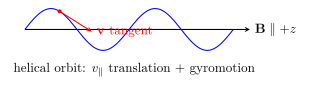
图 1 展示 helix 的两种速度分量;红色速度箭头从轨迹上的点出发并与正弦投影相切。投影压缩使圆看似正弦线,图为 schematic。
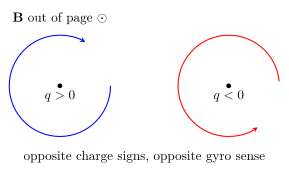
图 2 明示 charge-sign dependence;这里的弧箭头是轨道方向,不是 force vector。
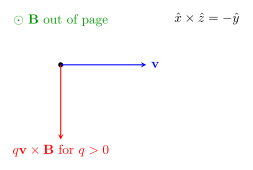
图 3 是 instantaneous vector audit:\(\mathbf v=+v\hat x\)、\(\mathbf B=+B\hat z\) 时,positive charge force 指 \(-\hat y\);negative charge 反向。
2. Guiding-center approximation / 导引中心近似
Knowledge ID: P13-U01-L02-K02
把位置分解为:
\[\mathbf r(t)=\mathbf R(t)+\boldsymbol\rho(t),\]
其中 \(\boldsymbol\rho\) 是快速、近周期 gyro-orbit,\(\mathbf R\) 是慢 guiding center。若磁场空间尺度 \(L_B=B/\lvert\nabla B\rvert\)、时间尺度 \(\tau_B\),则基本 ordering:
\[\epsilon_B=\frac{\rho}{L_B}\ll1, \qquad \epsilon_t=\frac{1}{\omega_c\tau_B}\ll1.\]
还需 orbit 在一个周期内不遇到强 discontinuity/collision。gyroaverage 定义为对快速 gyroangle 的平均;它保留 slow drift 而滤去周期项。guiding-center theory 不是把 gyro-orbit 删除,而是系统展开到指定 \(\epsilon\) 阶。
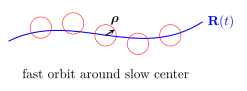
图 4 分离 \(\mathbf r\)、\(\mathbf R\) 与 \(\boldsymbol\rho\);曲线宽度不按比例。
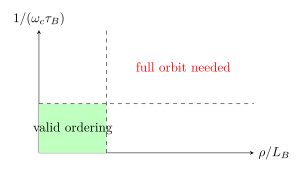
图 5 是 approximation map:两个小参数都要控制,不能只算 gyroradius。
3. Electric, gradient, curvature, and polarization drifts / 电场、梯度、曲率与极化漂移
Knowledge ID: P13-U01-L02-K03
3.1 Electric drift
在 uniform crossed fields、\(E_\parallel=0\) 时,选常速 \(\mathbf v_E\) 使 \(\mathbf E+\mathbf v_E\times\mathbf B=0\):
\[\boxed{\mathbf v_E=\frac{\mathbf E\times\mathbf B}{B^2}}.\]
它与 \(q,m\) 无关,因此所有 species 一起 drift,不直接造成 charge separation。
3.2 Magnetic and inertial drifts
定义 \(\mu=mv_\perp^2/(2B)\) 和 curvature \(\boldsymbol\kappa=(\mathbf b\cdot\nabla)\mathbf b\):
\[\mathbf v_{\nabla B}=\frac{\mu}{qB^2}\mathbf B\times\nabla B,\]
\[\mathbf v_{c}=\frac{mv_\parallel^2}{qB}\mathbf b\times\boldsymbol\kappa.\]
两者随 \(1/q\) 改变方向,电子与离子通常产生相反 drift/current。若 \(\mathbf E_\perp(t)\) 缓慢变化:
\[\mathbf v_{p}=\frac{m}{qB^2}\frac{d\mathbf E_\perp}{dt},\]
是 polarization drift;它依赖质量和电荷符号,要求变化慢于 \(\omega_c\)。公式是在指定 ordering 的低阶结果,场非均匀项同时存在时应统一展开,不能任意叠加到失效区域。
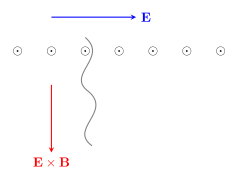
图 6 在 \(\mathbf B\) 出纸面、\(\mathbf E\) 向右时得到 \(\mathbf v_E\) 向下;轨迹是 drifted gyromotion。
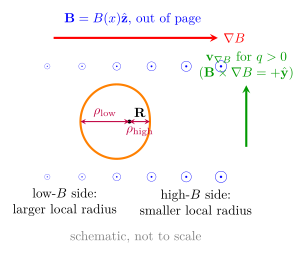
图 7 明示 \(\mathbf B\) 出纸面且大小向右增大;轨道在高-\(B\) 一侧的局域半径更小。此时 \(\mathbf B\times\nabla B=+\hat{\mathbf y}\),所以 positive charge 的 grad-\(B\) drift 向上,electron 则向下。
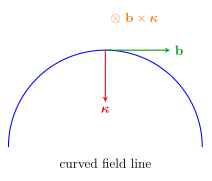
图 8 标出 curvature vector 指向曲率中心;此处 \(\mathbf b\) 向右、\(\boldsymbol\kappa\) 向下,所以 \(\mathbf b\times\boldsymbol\kappa\) 指入纸面。
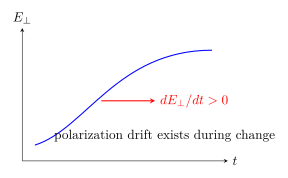
图 9 展示 polarization drift 对 derivative 而非 \(E\) 本身响应;steady \(E\) 只留下 \(\mathbf E\times\mathbf B\) drift。
4. Adiabatic invariants and magnetic mirrors / 绝热不变量与磁镜
Knowledge ID: P13-U01-L02-K04
当 \(B\) 沿 orbit 缓慢变化且无显著 collisions/rapid waves 时,第一 adiabatic invariant:
\[\boxed{\mu=\frac{mv_\perp^2}{2B}\simeq\mathrm{constant}}.\]
若静电势不变、总 kinetic energy \(K=m(v_\perp^2+v_\parallel^2)/2\) 守恒,则粒子进入更强 \(B\) 时 \(v_\perp^2\) 增大、\(v_\parallel^2\) 减小;到 \(v_\parallel=0\) 处反射。由起点 \(B_0,\alpha_0\):
\[\frac{\sin^2\alpha}{B}=\frac{\sin^2\alpha_0}{B_0}, \qquad B_m=\frac{B_0}{\sin^2\alpha_0}.\]
对最大场 \(B_{\max}\) 的 mirror machine,equatorial loss-cone half-angle 满足:
\[\sin^2\alpha_{\rm lc}=\frac{B_0}{B_{\max}}.\]
位于 loss cone 内的粒子平行速度过大,不能在最大场前反射。collisions 会 pitch-angle scatter 粒子进入 loss cone,破坏理想永久 confinement。
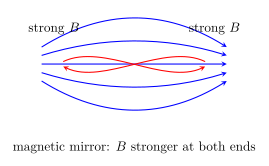
图 10 画出 bounce orbit;磁力线收敛表示 \(B\) 增强,但线密度只是示意。
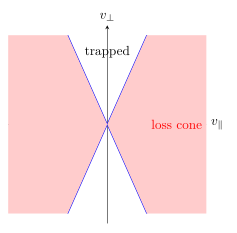
图 11 是 velocity-space loss cone;实际 Maxwellian 分布及 scattering 不由阴影面积单独给出。
Worked examples / 完整例题
Worked Example 1 — Proton 与 electron 的 gyro scales
已知: \(B=0.200\ \mathrm T\),\(v_\perp=3.00\times10^5\ \mathrm{m\,s^{-1}}\)。
研究对象: 单个 proton 和 electron;\(\mathbf E=0\)。
坐标与方向: \(\mathbf B=+B\hat z\);positive/negative charge gyrate oppositely。
模型: nonrelativistic uniform field。
\[\omega_{cp}=\frac{eB}{m_p}=1.92\times10^7\ \mathrm{rad\,s^{-1}}, \qquad \rho_p=\frac{v_\perp}{\omega_{cp}}=1.57\times10^{-2}\ \mathrm m.\]
\[\omega_{ce}=\frac{eB}{m_e}=3.52\times10^{10}\ \mathrm{rad\,s^{-1}}, \qquad \rho_e=8.53\times10^{-6}\ \mathrm m.\]
检查: \(qB/m\) 单位为 \(\mathrm{s^{-1}}\);较轻 electron 的 frequency 更高、radius 更小。三位有效数字。两者 signed \(\Omega\) 符号相反,以上报 magnitude。
Worked Example 2 — Crossed-field drift
已知: \(\mathbf E=(300\ \mathrm{V\,m^{-1}})\hat x\),\(\mathbf B=(0.0500\ \mathrm T)\hat z\)。
研究对象: 任一 nonrelativistic charged species;忽略 gradients/collisions。
坐标: \(\hat x\times\hat z=-\hat y\)。
\[\mathbf v_E=\frac{\mathbf E\times\mathbf B}{B^2} =-\frac{E}{B}\hat y =-6.00\times10^3\hat y\ \mathrm{m\,s^{-1}}.\]
检查: \(E/B\) 的 SI 单位为 \(\mathrm{m\,s^{-1}}\);代回 \(\mathbf E+\mathbf v_E\times\mathbf B=0\)。结果与 charge/mass 无关,electron 和 ion 同向 drift。
Worked Example 3 — Proton 的 gradient-\(B\) drift
已知: proton perpendicular energy \(K_\perp=100\ \mathrm{eV}\),\(\mathbf B=0.400\hat z\ \mathrm T\),\(\nabla B=2.00\hat x\ \mathrm{T\,m^{-1}}\)。
系统: 单 particle guiding center;\(\rho/L_B\ll1\)。
方向: \(\mathbf B\times\nabla B=+B(\hat z\times\hat x)=+B\hat y\)。
因 \(\mu=K_\perp/B\):
\[v_{\nabla B}=\frac{K_\perp}{qB^2}\lvert\nabla B\rvert =\frac{(100e)(2.00)}{e(0.400)^2} =1.25\times10^3\ \mathrm{m\,s^{-1}}.\]
故 \(\mathbf v_{\nabla B}=+1.25\times10^3\hat y\ \mathrm{m\,s^{-1}}\)。检查: 以 eV 表示的 \(K_\perp/e=100\ \mathrm V\) 可直接消去 \(e\);electron 若同 \(K_\perp\),因 \(q<0\) 方向反转。场尺度 \(L_B=B/\lvert\nabla B\rvert=0.200\ \mathrm m\),仍需另算 \(\rho\ll L_B\) 才能确认近似。
Worked Example 4 — Mirror 与 loss cone
已知: midplane \(B_0=0.500\ \mathrm T\),端部 \(B_{\max}=2.00\ \mathrm T\),粒子初始 pitch angle \(\alpha_0=40.0^\circ\)。
系统: collisionless static mirror,\(E_\parallel=0\),\(\mu\) adiabatically conserved。
正方向: 平行速度初始朝向右端。
所需 mirror field:
\[B_m=\frac{B_0}{\sin^2\alpha_0} =\frac{0.500}{\sin^240.0^\circ}=1.21\ \mathrm T.\]
因为 \(B_m<B_{\max}\),粒子在到达端部前反射。loss-cone angle:
\[\alpha_{\rm lc}=\sin^{-1}\sqrt{\frac{B_0}{B_{\max}}} =\sin^{-1}(0.500)=30.0^\circ.\]
检查: \(40.0^\circ>30.0^\circ\),确属 trapped population。当 \(\alpha_0\to90^\circ\) 时,\(B_m\to B_0\),粒子在中点已处于转向极限;若中点是精确对称的 \(B\) 极小值,则该点瞬时 \(F_\parallel=-\mu\nabla_\parallel B=0\),小位移后才出现恢复作用。三位有效数字。
Lesson synthesis / 全课整合
单粒子建模流程:写 vector Lorentz equation → 选 field-aligned coordinates → 求 uniform-field fast orbit → 计算 \(\rho/L_B\) 与 \(1/(\omega_c\tau_B)\) → 若小,gyroaverage 并加入低阶 drifts → 检查能量与 adiabatic invariants → 在 mirror、boundary 或 collision 处重新评估 ordering。
Formula-and-decision table / 公式与决策表
| Need | Relation | Use only when | Main caution |
|---|---|---|---|
| gyrofrequency | \(\omega_c=\lvert q\rvert B/m\) | nonrelativistic uniform local \(B\) | angular frequency, not Hz |
| gyroradius | \(\rho=v_\perp/\omega_c\) | same local ordering | use perpendicular speed |
| electric drift | \(\mathbf v_E=\mathbf E\times\mathbf B/B^2\) | slowly varying perpendicular fields | charge independent |
| grad-\(B\) drift | \(\mu\mathbf B\times\nabla B/(qB^2)\) | \(\rho/L_B\ll1\) | reverses with charge |
| curvature drift | \(mv_\parallel^2\mathbf b\times\boldsymbol\kappa/(qB)\) | slowly curved field | centrifugal guiding-center result |
| polarization drift | \(m\dot{\mathbf E}_\perp/(qB^2)\) | slow time variation | zero for steady \(E\) |
| mirror condition | \(B_m=B_0/\sin^2\alpha_0\) | \(\mu,K\) conserved | collisions and \(E_\parallel\) alter it |
Model boundaries / 模型边界
- Relativistic motion replaces \(m\) with momentum dynamics and reduces gyrofrequency by \(\gamma\).
- Sharp sheath, reconnection layer or wave resonance may have \(\rho/L\not\ll1\); guiding-center expansion fails.
- Collisions interrupt gyrophase and scatter pitch angle; transport belongs to Unit 13.2.
- Self-consistent collective fields require distribution/fluid equations, not independent test particles alone.
- Rapid cyclotron-frequency forcing breaks adiabatic invariance and can heat particles.
- Magnetic mirrors do not confine loss-cone particles indefinitely; finite geometry and instabilities matter.
Misconception clinic / 易错概念诊所
| Misconception | Correction |
|---|---|
| magnetic field speeds a particle up | magnetic force is perpendicular to velocity and does no work |
| \(\omega_c\) in rad/s equals \(f_c\) in Hz | \(f_c=\omega_c/(2\pi)\) |
| electron and ion always drift oppositely | \(\mathbf E\times\mathbf B\) drift is charge independent; magnetic drifts reverse |
| guiding center is a real particle location | it is an averaged coordinate in an asymptotic decomposition |
| grad-\(B\) drift is along \(\nabla B\) | it is perpendicular, along \(\mathbf B\times\nabla B/q\) |
| mirror force reflects all particles | small pitch-angle particles lie in loss cone and escape |
Practice and retrieval / 练习与检索
- [K01] 若 \(B\) 加倍而 \(v_\perp\) 不变,\(\omega_c\) 与 \(\rho\) 如何变化?
Answer 1
\(\omega_c\propto B\) 加倍,\(\rho=v_\perp/\omega_c\) 减半。
- [K01] 为什么 helical orbit 的 pitch 不因 magnetic force 改变?
Answer 2
uniform static \(B\) 不做功,\(v_\parallel\)、\(v_\perp\) magnitudes 分别不变;每周期沿场位移固定。
- [K02] \(\rho=2\ \mathrm{mm}\)、\(L_B=0.50\ \mathrm m\),求 \(\epsilon_B\) 并判断。
Answer 3
\(\epsilon_B=0.002/0.50=4.0\times10^{-3}\ll1\),空间 guiding-center ordering 良好;仍需检查时间变化和 collisions。
- [K02] 为什么 \(\rho/L_B\ll1\) 仍不足以保证 \(\mu\) 守恒?
Answer 4
场可在时间上以接近 gyrofrequency 快速变化,或有 collisions/resonant waves;还需 \(1/(\omega_c\tau_B)\ll1\) 等条件。
- [K03] \(\mathbf E=E\hat y\)、\(\mathbf B=B\hat z\) 时 \(\mathbf v_E\) 方向?
Answer 5
\(\hat y\times\hat z=\hat x\),故 \(\mathbf v_E=(E/B)\hat x\),与 charge sign 无关。
- [K03] 两 species 同 \(K_\perp\)、相反电荷,在同一 \(\nabla B\) 中 drift 如何比较?
Answer 6
magnitude 若 \(\lvert q\rvert\) 相同则相等,方向因 \(1/q\) 相反;它们形成 diamagnetic current tendency。
- [K03] steady uniform \(\mathbf E_\perp\) 下 polarization drift 是多少?
Answer 7
\(d\mathbf E_\perp/dt=0\),故 \(\mathbf v_p=0\);仍存在 \(\mathbf E\times\mathbf B\) drift。
- [K04] \(B_{\max}/B_0=9\) 时 loss-cone half-angle?
Answer 8
\(\sin^2\alpha_{lc}=1/9\),所以 \(\alpha_{lc}=\sin^{-1}(1/3)=19.5^\circ\)。
- [K04] 粒子进入更强 \(B\) 时若 \(\mu\) 守恒,\(v_\perp\) 怎样变化?能量从何而来?
Answer 9
\(v_\perp^2\propto B\) 增大;在静态无电场时总 kinetic energy 不变,能量由平行分量转到垂直分量,\(v_\parallel\) 减小。
- [综合] 某 reconnection layer 的厚度与 electron gyroradius 同量级,能否用本课 drift formulas 精确描述?
Answer 10
不能;\(\rho/L\sim1\) 破坏 guiding-center ordering,应求 full-orbit/kinetic dynamics,并考虑强非均匀、自洽场与可能的非绝热效应。
Exit ticket / 迁移检验
给出一个场配置后,写出你在使用任一 drift formula 前必须完成的“方向—尺度—守恒”三联检查。
Exit-ticket benchmark
方向:先声明坐标并做 cross product、保留 \(q\) 符号;尺度:核对 \(\rho/L\ll1\)、\(\omega_c\tau\gg1\);守恒:检查磁场是否做功、\(E_\parallel\)/collisions 是否改变能量或 \(\mu\)。
References and source notes / 参考资料与使用说明
以下权威直接来源均在 2026-08-30 实际打开核对:
本课所有 TikZ 均依据正文方程原创绘制,未复制来源插图。
- MIT OpenCourseWare 22.611J, Chapter 2 — Motion of Charged Particles in Fields — uniform-field orbit、drifts、mirror effect。
- Richard Fitzpatrick, UT Austin, Charged Particle Motion — guiding-center expansion、magnetic drifts 与 adiabatic invariants。
- Richard Fitzpatrick, UT Austin, Guiding Center Motion — ordering 与 first-order guiding-center equations。
- Richard Fitzpatrick, UT Austin, Magnetic Mirrors — mirror points、loss cone 与 confinement limits。
- Princeton Plasma Physics Laboratory SULI, Introduction to Plasmas, Part II — undergraduate single-particle motion、crossed-field and magnetic drifts。
- U.S. Naval Research Laboratory, 2023 NRL Plasma Formulary — constants、gyrofrequency/radius and unit checks。
Source-to-content map
| Source | Used for | Knowledge ID / Section | Model boundary or convention |
|---|---|---|---|
| MIT OCW Ch. 2 | gyro-orbit and all principal drifts | K01–K04 | nonrelativistic guiding-center ordering |
| Fitzpatrick Charged Particle Motion | systematic derivations | K01–K04 | asymptotic expansion, signed charge |
| Fitzpatrick Guiding Center | validity parameters | K02–K03 | slow spatial/time variation |
| Fitzpatrick Magnetic Mirrors | \(\mu\), mirror, loss cone | K04 | collisionless adiabatic limit |
| PPPL SULI Part II | teaching sequence and device context | K01–K04 | diagrams redrawn independently |
| NRL Formulary | constants and numerical cross-check | Worked 1 | source coefficients have unit conventions |
复习与拓展
- Lesson 13.2.1 将加入 Coulomb collisions,回答 guiding center 如何随机化并形成 conductivity/diffusion。
- Lesson 13.2.2 将从单 orbit 过渡到 phase-space distribution;drifts 成为 drift-kinetic ordering 的基础。
- 可扩展:relativistic gyro motion、canonical adiabatic invariants、bounce/azimuthal invariants 与 gyrokinetics。