
Learning objectives / 学习目标
完成本课后,你应当能够:
- 用自由粒子的运动定义惯性系,并说明 Galilean 变换只把一个惯性系变到另一个惯性系的条件。
- 区分单个物体、固定物质系统与空间控制体,正确写出合外力—动量变化关系。
- 对定质量系统从 \(\sum\mathbf F_{\mathrm{ext}}=d\mathbf p/dt\) 得到 \(m\mathbf a\),并解释变质量问题为何需要动量通量。
- 用“施力者 \(\to\) 受力者”下标识别第三定律对,避免把同一物体上的平衡力误认作作用—反作用。
- 按矢量叠加求合力,并用量纲、方向、极限与系统边界检查答案。
- 说出 Newton 模型在相对论、量子尺度、非惯性系与非封闭系统中的适用边界。
0. Notation and the modeling contract / 记号与建模协议
| Symbol | Meaning |
|---|---|
| \(S\) | chosen reference frame |
| \(\mathcal S\) | chosen material system or body |
| \(\mathbf p=\sum_i m_i\mathbf v_i\) | momentum of the selected material system |
| \(\mathbf F_{A\to B}\) | force exerted by \(A\) on \(B\) |
| \(\sum\mathbf F_{\mathrm{ext}}\) | vector sum of forces crossing the system boundary |
| \(\mathbf u\) | inertial-frame velocity of transferred mass at a port |
| \(\mathbf u_{\mathrm{rel}}=\mathbf u-\mathbf v\) | transfer velocity relative to the receiving/losing body |
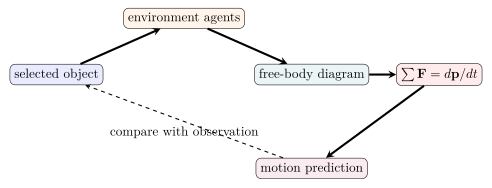
每次动力学计算都按同一顺序:
- System: 圈出研究对象;
- Frame: 声明惯性系与正方向;
- Interactions: 只画跨越边界的相互作用;
- Law: 写矢量方程,再投影;
- Check: 核对单位、符号、极限与第三定律配对。

Knowledge 1 — Inertia and inertial reference frames / 惯性与惯性参考系
Knowledge ID: P01-U02-L01-K01
1.1 Newton's first law is an operational frame test
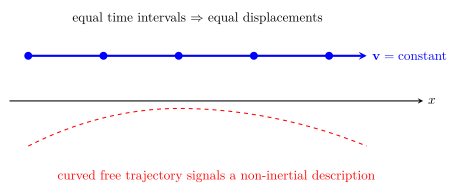
在相互作用可忽略的极限中,若粒子的速度保持恒定,所用参考系称为惯性参考系:
\[\sum\mathbf F_{\mathrm{ext}}=\mathbf 0 \quad\Longrightarrow\quad \frac{d\mathbf v}{dt}=\mathbf 0.\]
“静止”不是特殊状态;\(\mathbf v=\mathbf 0\) 与任意恒定 \(\mathbf v\) 都是惯性运动。第一定律同时完成两件事:定义惯性系,并指出改变速度需要净外部相互作用。
1.2 The Galilean family and its boundary
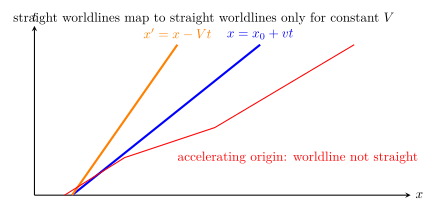
若 \(S'\) 相对惯性系 \(S\) 以恒速度 \(\mathbf V\) 平移且坐标轴不转动,
\[\mathbf r'=\mathbf r-\mathbf Vt-\mathbf b, \qquad \mathbf v'=\mathbf v-\mathbf V, \qquad \mathbf a'=\mathbf a.\]
因此所有这种 \(S'\) 也都是惯性系。若原点有加速度 \(\mathbf A\) 或坐标轴转动,\(\mathbf a'\ne\mathbf a\),直接写 \(m\mathbf a'=\sum\mathbf F_{\mathrm{real}}\) 会失败;Lesson 1.2.4 将系统处理这些附加项。
1.3 Worked Example 1 — two observers, one net force
一辆 \(m=2.00\ \mathrm{kg}\) 小车在地面惯性系中受恒合力 \(\mathbf F=6.00\widehat{\mathbf x}\ \mathrm N\)。另一惯性系以 \(\mathbf V=4.00\widehat{\mathbf x}\ \mathrm{m/s}\) 匀速运动。
\[\mathbf a=\frac{\mathbf F}{m}=3.00\widehat{\mathbf x}\ \mathrm{m/s^2}.\]
因为 \(\mathbf a'=\mathbf a\),第二位观察者也得到 \(3.00\widehat{\mathbf x}\ \mathrm{m/s^2}\),尽管两人测得的速度相差 \(4.00\ \mathrm{m/s}\)。若第二系改为 \(\mathbf A=1.00\widehat{\mathbf x}\ \mathrm{m/s^2}\) 的加速系,则 \(\mathbf a'=2.00\widehat{\mathbf x}\ \mathrm{m/s^2}\);此时不能只用真实的 \(6.00\ \mathrm N\) 写 \(m\mathbf a'\)。
Knowledge 2 — Net force and momentum change / 合力与动量变化
Knowledge ID: P01-U02-L01-K02
2.1 Fixed material system
对一个由同一批物质粒子组成的系统,在惯性系中 Newton 第二定律写成
\[\boxed{ \sum\mathbf F_{\mathrm{ext}} =\frac{d\mathbf p_{\mathcal S}}{dt} }, \qquad \mathbf p_{\mathcal S}=\sum_{i\in\mathcal S}m_i\mathbf v_i.\]
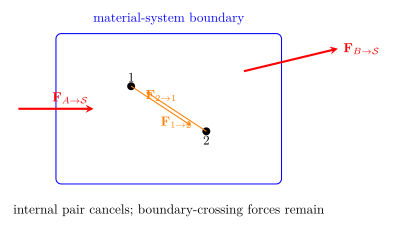
内部成对相互作用在系统总动量方程中相消;外力才改变系统总动量。积分形式是冲量—动量定理:
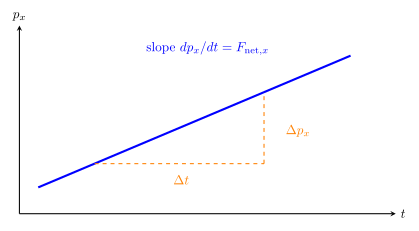
\[\boxed{ \int_{t_1}^{t_2}\sum\mathbf F_{\mathrm{ext}}\,dt =\Delta\mathbf p }.\]
2.2 Net force is a vector, not a list of magnitudes
\[\sum\mathbf F_{\mathrm{ext}} =\left(\sum F_x\right)\widehat{\mathbf i} +\left(\sum F_y\right)\widehat{\mathbf j} +\left(\sum F_z\right)\widehat{\mathbf k}.\]
“合力为零”要求每个独立分量都为零。净力与 \(d\mathbf p/dt\) 同向;它不必与 \(\mathbf v\) 同向。垂直于速度的净力可以只改变动量方向。
2.3 Worked Example 2 — impulse with a time-varying force
一个 \(0.250\ \mathrm{kg}\) 球初速度为 \(-6.00\widehat{\mathbf x}\ \mathrm{m/s}\)。球拍在 \(0\le t\le0.0200\ \mathrm s\) 内施力 \(F_x(t)=F_0\sin(\pi t/0.0200\ \mathrm s)\),其中 \(F_0=200\ \mathrm N\)。冲量为
\[J_x=\int_0^{0.0200}F_0\sin\left(\frac{\pi t}{0.0200}\right)dt =\frac{2F_0(0.0200)}{\pi} =2.55\ \mathrm{N\,s}.\]
于是
\[v_{f,x}=v_{i,x}+\frac{J_x}{m} =-6.00+\frac{2.55}{0.250} =4.19\ \mathrm{m/s}.\]
球改变了运动方向。峰值力不是平均力;本例平均力为 \(J/\Delta t=127\ \mathrm N\)。
Knowledge 3 — Newton's second law for constant and variable mass / 定质量与变质量形式的第二定律
Knowledge ID: P01-U02-L01-K03
3.1 Constant mass: the familiar special case
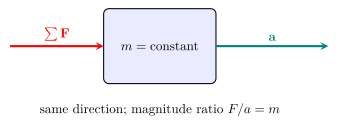
若研究对象质量恒定且作为固定物质系统,
\[\frac{d(m\mathbf v)}{dt}=m\frac{d\mathbf v}{dt},\]
所以
\[\boxed{\sum\mathbf F_{\mathrm{ext}}=m\mathbf a.}\]
这不是“力的定义”,而是实验规律在定质量模型下的形式。\(1\ \mathrm N=1\ \mathrm{kg\,m/s^2}\)。
3.2 Why \(d(m\mathbf v)/dt\) is not the open-body force law
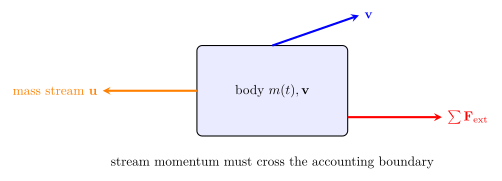
若一个“物体”因喷出、吸入或收集物质而改变成员,它已不是固定物质系统。直接对它当前的 \(m\mathbf v\) 求导得到
\[\frac{d(m\mathbf v)}{dt}=m\mathbf a+\mathbf v\frac{dm}{dt},\]
但右边第二项并没有自动计入流入/流出物质携带的动量。因此一般不能写
\[\sum\mathbf F_{\mathrm{ext}}=\frac{d(m\mathbf v)}{dt}\]
来描述这个成员不断变化的“物体”。必须先指定控制体和边界处的质量速度。
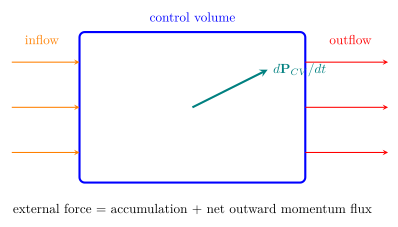
对固定空间控制体,惯性系动量平衡可写成
\[\boxed{ \sum\mathbf F_{\mathrm{ext}} =\frac{d}{dt}\int_{CV}\rho\mathbf v\,dV +\oint_{CS}\rho\mathbf v(\mathbf v\cdot\mathbf n)\,dA }.\]
第一项是控制体内动量积累,第二项是向外法向 \(\mathbf n\) 定义的净输出动量通量。移动控制面时,通量中的法向速度必须改为流体相对控制面的速度。
3.3 One-port lumped result, with an explicit sign convention
对速度为 \(\mathbf v\) 的均匀主体,只有一股物质以惯性系速度 \(\mathbf u\) 穿越边界,并规定 \(dm/dt>0\) 表示主体质量增加,则瞬时极限给出
\[\boxed{ m\frac{d\mathbf v}{dt} =\sum\mathbf F_{\mathrm{ext}} +(\mathbf u-\mathbf v)\frac{dm}{dt} }.\]
该式只适用于上述单股、均匀主体、清楚定义 \(\mathbf u\) 与 \(dm/dt\) 的模型;多入口、多出口或非均匀体应回到通量平衡。对喷射,\(dm/dt<0\),喷出物相对主体的速度 \(\mathbf u-\mathbf v\) 与推力方向相反。
3.4 Worked Example 3 — cart collecting stationary rain
一辆初始质量 \(m_0=100\ \mathrm{kg}\)、水平速度 \(v_0=5.00\ \mathrm{m/s}\) 的无阻力小车,以 \(\dot m=2.00\ \mathrm{kg/s}\) 收集在地面系中无水平速度的竖直雨水。因此 \(u_x=0\),水平外力为零:
\[m\frac{dv}{dt}=(u_x-v)\dot m=-v\dot m.\]
于是
\[\frac{d}{dt}(mv)=m\dot v+v\dot m=0,\]
\[v(t)=\frac{m_0v_0}{m_0+\dot mt}.\]
\(t=25.0\ \mathrm s\) 时 \(m=150\ \mathrm{kg}\),所以
\[v=\frac{(100)(5.00)}{150}=3.33\ \mathrm{m/s}.\]
若误写 \(\sum F_x=d(mv)/dt\) 但不说明固定物质系统,恰好会在这个特殊水平分量得到同一结果,却掩盖了雨滴入流动量的物理来源;一般流入速度不为零时这种偷换会导致错误。
Knowledge 4 — Interaction pairs and Newton's third law / 相互作用对与第三定律
Knowledge ID: P01-U02-L01-K04
4.1 Directed interaction notation
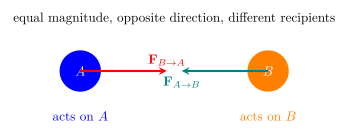
若 \(A\) 与 \(B\) 相互作用,第三定律为
\[\boxed{ \mathbf F_{A\to B}=-\mathbf F_{B\to A} }.\]
两力同时存在、大小相等、方向相反、属于同一种相互作用,但它们作用在不同物体上。因此只有当系统边界同时包含 \(A\) 与 \(B\) 时,这一对才作为内力在系统总动量方程中相消。
4.2 Third-law pair versus balanced forces
桌上的书受到地球对书的重力 \(\mathbf F_{E\to B}\) 与桌面对书的支持力 \(\mathbf F_{T\to B}\)。若书静止,这两力可以相平衡,但它们不是第三定律对,因为受力者都是书。它们各自的配对分别是书对地球、书对桌面的力。
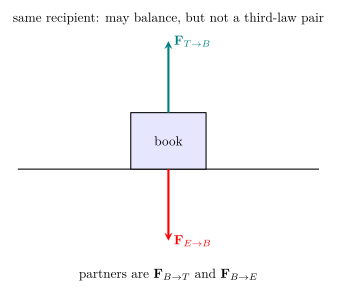
4.3 Worked Example 4 — unequal accelerations do not violate the third law
滑冰者 \(A\) 的质量为 \(50.0\ \mathrm{kg}\),\(B\) 的质量为 \(80.0\ \mathrm{kg}\)。他们互推时,\(A\) 对 \(B\) 的水平力为 \(120\ \mathrm N\)。忽略冰面阻力:
\[F_{A\to B}=120\ \mathrm N, \qquad F_{B\to A}=-120\ \mathrm N.\]
加速度大小为
\[a_A=\frac{120}{50.0}=2.40\ \mathrm{m/s^2}, \qquad a_B=\frac{120}{80.0}=1.50\ \mathrm{m/s^2}.\]
力相等不意味着加速度相等;质量不同导致响应不同。若把两人作为一个系统,水平内力相消,系统总动量不变。
Knowledge 5 — Superposition of forces / 力的叠加
Knowledge ID: P01-U02-L01-K05
5.1 One acceleration, vector sum of all interactions
多个相互作用同时作用时,每一个力按其模型独立计算,再作矢量和:
\[\boxed{ \mathbf F_{\mathrm{net}}=\sum_{j=1}^{N}\mathbf F_j }.\]
坐标分解只是计算工具,不会创造新的力。\(F_x\) 和 \(F_y\) 是同一矢量的分量,不是额外的相互作用。
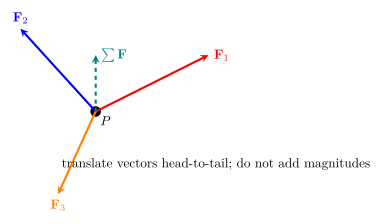
线性叠加在 Newton 力学中意味着总动量变化率等于所有外部作用之和;它不意味着每种经验力模型在所有尺度都线性,也不意味着材料响应一定线性。
5.2 Worked Example 5 — three applied forces
一个 \(4.00\ \mathrm{kg}\) 质点受到
\[\mathbf F_1=(12.0\widehat{\mathbf i}+5.00\widehat{\mathbf j})\ \mathrm N,\]
\[\mathbf F_2=(-3.00\widehat{\mathbf i}+7.00\widehat{\mathbf j})\ \mathrm N, \qquad \mathbf F_3=(-5.00\widehat{\mathbf i}-4.00\widehat{\mathbf j})\ \mathrm N.\]
因此
\[\mathbf F_{\mathrm{net}}=(4.00\widehat{\mathbf i}+8.00\widehat{\mathbf j})\ \mathrm N,\]
\[\mathbf a=(1.00\widehat{\mathbf i}+2.00\widehat{\mathbf j})\ \mathrm{m/s^2}.\]
合力大小 \(8.94\ \mathrm N\),方向为 \(\tan^{-1}(8/4)=63.4^\circ\)(从 \(+x\) 逆时针量)。先分量相加再求大小,不能把 \(\lvert\mathbf F_1\rvert+\lvert\mathbf F_2\rvert+\lvert\mathbf F_3\rvert\) 当合力。
5.3 A complete interaction-to-equation map
6. Lesson synthesis / 全课整合
6.1 Formula and decision table
| Situation | Correct starting equation | Required condition |
|---|---|---|
| Free particle in inertial frame | \(\mathbf v=\mathrm{constant}\) | negligible net external interaction |
| Fixed material system | \(\sum\mathbf F_{\mathrm{ext}}=d\mathbf p/dt\) | same material particles followed |
| Constant-mass body | \(\sum\mathbf F=m\mathbf a\) | mass constant; inertial frame |
| Finite time interval | \(\mathbf J=\int\sum\mathbf F\,dt=\Delta\mathbf p\) | fixed material system |
| Open/control-volume system | force = accumulation + momentum flux | boundary and crossing velocities specified |
| Interaction pair | \(\mathbf F_{A\to B}=-\mathbf F_{B\to A}\) | pair acts on different bodies |
| Many external forces | \(\mathbf F_{\mathrm{net}}=\sum_j\mathbf F_j\) | vector addition in one frame |
6.2 Model boundaries
| Assumption | Useful regime | Failure signal |
|---|---|---|
| Newtonian/Galilean mechanics | speeds much smaller than \(c\), macroscopic bodies | relativistic timing or quantum behavior |
| Ground as inertial | short, local terrestrial experiments | Coriolis/Foucault/long-range motion matters |
| Particle or rigid-body translation | size/rotation/deformation irrelevant to question | torque, deformation, distributed stress matters |
| Constant mass | no material crosses system boundary | collection, leakage, ablation, exhaust |
| Pairwise third-law model | ordinary Newtonian mechanical interactions | field momentum or retardation must be included in enlarged system |
7. Misconception clinic / 易错概念诊所
| Misconception / 错误观念 | Correction / 修正 |
|---|---|
| “没有力,物体就会停。” | 在惯性系中无合力意味着速度不变,包括非零恒速。 |
| “第一定律只是第二定律令 \(F=0\)。” | 第一定律还给出惯性系的操作性定义;没有这个前提,\(F=ma\) 的形式不成立。 |
| “净力沿速度方向。” | 净力沿 \(d\mathbf p/dt\);可以垂直于瞬时速度。 |
| “任何时候都可写 \(F=d(mv)/dt\)。” | 只对固定物质系统成立;成员变化的主体必须计入动量通量。 |
| “把 \(m(t)\) 填进 \(F=ma\) 就完成变质量问题。” | 还必须知道穿越边界物质的速度与质量流率。 |
| “第三定律两力在受力图中互相抵消。” | 它们作用在不同物体上;单个物体的受力图只含其中一个。 |
| “书的重力与支持力是一对作用—反作用。” | 两力都作用在书上;它们可能平衡,但各有不同的第三定律伙伴。 |
| “多个力直接加大小。” | 力是矢量,应逐分量叠加。 |
| “内力永远不重要。” | 对系统总动量会成对抵消,但可改变内部相对运动、形变和能量分配。 |
8. Practice and retrieval / 练习与检索
A. Conceptual questions
- 为什么加速电梯不是严格惯性系?
- 一个物体匀速向东运动,合力一定向东吗?
- 怎样用系统边界判断某个力是内力还是外力?
- 为什么 \(\mathbf F_{A\to B}\) 与 \(\mathbf F_{B\to A}\) 不会在 \(B\) 的受力图上相消?
- 变质量主体还缺少哪两类边界信息,才可写动量平衡?
- Galilean 惯性系族的相对运动必须满足什么条件?
B. Quantitative and derivation questions
- \(3.00\ \mathrm{kg}\) 物体受合力 \((9.00\widehat{\mathbf i}-12.0\widehat{\mathbf j})\ \mathrm N\),求加速度大小与方向。
- \(0.150\ \mathrm{kg}\) 球的速度由 \(+20.0\ \mathrm{m/s}\) 变为 \(-15.0\ \mathrm{m/s}\),接触时间 \(5.00\ \mathrm{ms}\),求平均力。
- 两滑块质量分别为 \(2.00\ \mathrm{kg}\) 和 \(5.00\ \mathrm{kg}\),相互作用力大小 \(10.0\ \mathrm N\)。求各自加速度大小并说明方向关系。
- 无水平外力的小车以 \(v_0=4.00\ \mathrm{m/s}\) 运动,质量由 \(50.0\ \mathrm{kg}\) 均匀增至 \(80.0\ \mathrm{kg}\),收集的物质地面水平速度为零。求末速度。
- 证明对由两个粒子组成的系统,若第三定律成立,则内力不改变总动量。
- 某控制体稳态流入率和流出率均为 \(2.00\ \mathrm{kg/s}\),一维入口速度 \(+3.00\ \mathrm{m/s}\),出口速度 \(-1.00\ \mathrm{m/s}\)。忽略压强等其他外力时,维持该流动所需外力是多少?
Answers / 参考答案
1. 电梯原点相对惯性系有加速度,测得的自由粒子加速度不再为零。
2. 不一定;匀速意味着合力为零。
3. 力的施力者与受力者若分居边界两侧就是外力;都在边界内则是内力。
4. 两力的受力者不同;\(B\) 的图上只有 \(\mathbf F_{A\to B}\)。
5. 质量流率及穿越边界物质相对/惯性速度;多口还需每个口的信息。
6. 原点相对速度恒定且轴不转动;同时处于 Newtonian 低速范围。
7. \(\mathbf a=(3.00\widehat{\mathbf i}-4.00\widehat{\mathbf j})\ \mathrm{m/s^2}\),大小 \(5.00\ \mathrm{m/s^2}\),从 \(+x\) 向下 \(53.1^\circ\)。
8. \(\Delta v=-35.0\ \mathrm{m/s}\),\(F_{\mathrm{avg}}=m\Delta v/\Delta t=-1.05\times10^3\ \mathrm N\)。
9. \(a_1=5.00\ \mathrm{m/s^2}\),\(a_2=2.00\ \mathrm{m/s^2}\),方向相反。
10. 水平动量守恒:\(v_f=(50.0)(4.00)/80.0=2.50\ \mathrm{m/s}\)。
11. \(d(\mathbf p_1+\mathbf p_2)/dt=\mathbf F_{2\to1}+\mathbf F_{1\to2}=\mathbf0\)。
12. 稳态动量流:\(F_x=\dot m(v_{out}-v_{in})=2.00(-1.00-3.00)=-8.00\ \mathrm N\);外力向 \(-x\)。
Exit ticket
请分别用一句话说明:何时可写 \(\sum\mathbf F=d\mathbf p/dt\),何时可进一步写成 \(m\mathbf a\),以及何时必须添加动量通量。
9. References and source notes / 参考资料与使用说明
9.1 Source-to-content map
| Source | Used for |
|---|---|
| OpenStax, University Physics Volume 1, §5.1 Forces | force as a vector, system language, Newtonian scale boundary |
| OpenStax, §5.2 Newton's First Law | inertia, equilibrium, operational inertial-frame discussion |
| OpenStax, §5.3 Newton's Second Law | constant-mass vector law and component method |
| OpenStax, §5.5 Newton's Third Law | interaction-pair interpretation and system selection |
| MIT OpenCourseWare 8.01SC, Chapter 7 — Newton's Laws of Motion | inertial frames, momentum principle, force notation |
| MIT OpenCourseWare 8.01SC, Chapter 10 — Momentum, System of Particles, and Conservation | material-system momentum and internal/external forces |
| MIT OpenCourseWare 8.01SC, Chapter 12 — Momentum and the Flow of Mass | continuous mass transfer and the need for momentum-flux accounting |
9.2 Bibliographic and modeling notes
OpenStax provides the HS→UG1 Newton-law spine. MIT 8.01SC is used to sharpen the distinction among a material system, a changing-membership body, and a control volume. 本课有意不把“\(\sum\mathbf F=d(m\mathbf v)/dt\)”当作任意变质量主体的通式;变质量结果都从明确的系统边界与通量约定出发。