
Learning objectives / 学习目标
完成本课后,你应当能够:
- 针对单体或复合系统画只含外力的 free-body diagram,并解释不同系统选择的利弊。
- 选择贴合几何的坐标轴,逐力投影而不重复计算原矢量与分量。
- 从不可伸长绳的长度恒定式推导速度、加速度约束,而不是凭图猜“加速度相等”。
- 联立多个物体的 Newton 方程与约束方程,处理斜面、滑轮和连接体。
- 在圆周运动中写径向净力方程,区分“向心力需求”与真实力,并计算视重/接触条件。
- 用符号极限、接触不等式与能否维持约束检查解的物理性。
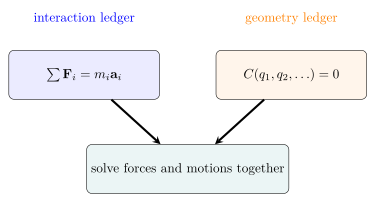
0. Two ledgers: dynamics and geometry / 两本账
| Dynamics ledger | Geometry ledger |
|---|---|
| one equation set per selected body/system | one relation per independent constraint |
| contains external forces | contains rope lengths, contacts, prescribed paths |
| \(\sum\mathbf F=m\mathbf a\) | \(C(q_1,q_2,\ldots,t)=0\) |
| predicts force response | couples coordinates, velocities, accelerations |
Knowledge 1 — System selection and free-body diagrams / 系统选择与受力图
Knowledge ID: P01-U02-L03-K01
1.1 The boundary decides what appears
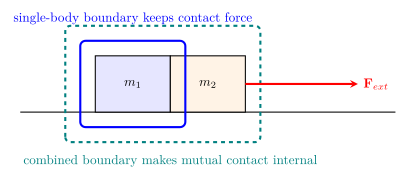
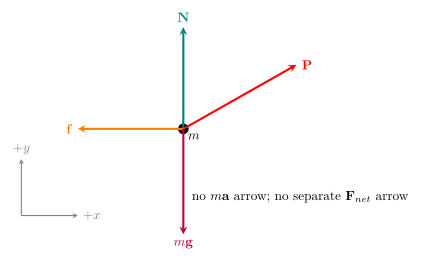
受力图只画环境对所选系统的外力。不要画物体对环境的力,不要把 \(m\mathbf a\) 或“向心力”另加成一根力箭头,也不要同时保留一个斜力及其两个分量。多个物体时,若要求内部张力/接触力就分别画图;若只求整体加速度,可把它们合成系统使内力相消。
1.2 A defensible FBD protocol
- 把研究对象从环境中“孤立”成点或简图。
- 对每个环境施力者问:是否跨边界发生引力、接触、绳、弹簧等相互作用?
- 从受力点画箭头并标“施力者 \(\to\) 受力者”。
- 另画坐标轴;加速度可在图旁注明,但不是力。
- 逐分量写 \(\sum F_j=ma_j\)。
1.3 Worked Example 1 — choosing one block or two
水平无摩擦面上 \(m_1=2.00\ \mathrm{kg}\) 与 \(m_2=3.00\ \mathrm{kg}\) 接触,外力 \(F=20.0\ \mathrm N\) 推 \(m_1\) 向右。先选整体:
\[F=(m_1+m_2)a \quad\Rightarrow\quad a=\frac{20.0}{5.00}=4.00\ \mathrm{m/s^2}.\]
再只选 \(m_2\),其唯一水平外力是 \(m_1\) 对它的接触力 \(C\):
\[C=m_2a=(3.00)(4.00)=12.0\ \mathrm N.\]
整体系统快速消掉内部接触力;单体系统才能求出该接触力。两个选择并不矛盾。
Knowledge 2 — Translating geometry into force components / 从几何关系到力的分量
Knowledge ID: P01-U02-L03-K02
2.1 Choose axes that reduce unknown coupling
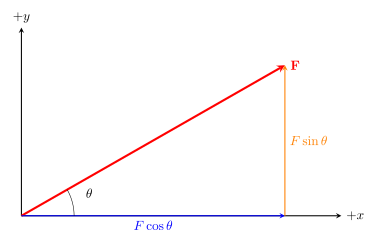
斜面问题通常取 \(x\) 沿面、\(y\) 法向;圆周问题取 \(n\) 指向圆心、\(t\) 沿切线。若力 \(\mathbf F\) 与 \(+x\) 夹角为 \(\theta\),则
\[F_x=F\cos\theta, \qquad F_y=F\sin\theta.\]
角度是相对哪条轴量的必须从图判断;不要靠“水平用 cos、竖直用 sin”死记。
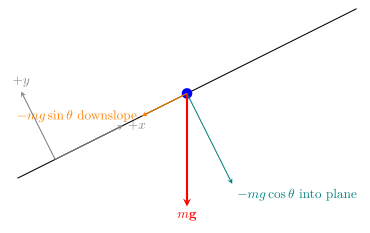
2.2 Gravity on an incline
若斜面相对水平倾角为 \(\theta\),取 \(+x\) 上坡、\(+y\) 离开斜面,则
\[(m\mathbf g)_x=-mg\sin\theta, \qquad (m\mathbf g)_y=-mg\cos\theta.\]
法向无加速度且保持接触时,若无其他法向分量,\(N=mg\cos\theta\)。
2.3 Worked Example 2 — angled pull changes the normal force
\(m=15.0\ \mathrm{kg}\) 箱子在水平地面上,绳以水平上方 \(30.0^\circ\) 拉力 \(P=80.0\ \mathrm N\)。竖直加速度为零:
\[N+P\sin30.0^\circ-mg=0,\]
\[N=15.0(9.81)-80.0(0.500)=107\ \mathrm N.\]
水平分量 \(P_x=69.3\ \mathrm N\)。向上分量减小 \(N\),因此也会减小 Coulomb 摩擦上限;若拉力向下倾斜,结论相反。
Knowledge 3 — Connected objects, pulleys, and constraint equations / 连接体、滑轮与约束方程
Knowledge ID: P01-U02-L03-K03
3.1 Derive constraints from a length equation
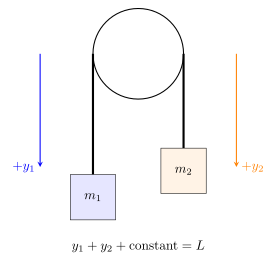
不可伸长绳意味着总长度 \(L\) 恒定。对固定滑轮两侧均取向下坐标 \(y_1,y_2\):
\[L=y_1+y_2+L_0,\]
\[\dot y_1+\dot y_2=0, \qquad \boxed{a_1+a_2=0}.\]
这表示按各自向下正方向的加速度相反;不是无条件写 \(a_1=a_2\)。先写长度,符号会自动产生。
3.2 A moving pulley changes the acceleration ratio
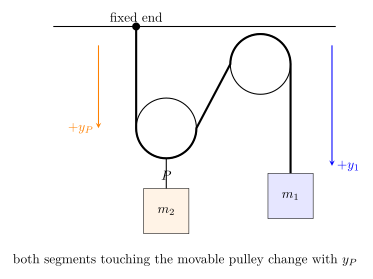
若一根绳的一端连接物块 1,另两段共同托住可动滑轮 \(P\),按向下坐标:
\[L=y_1+2y_P+L_0,\]
\[\boxed{a_1+2a_P=0}.\]
因此物块 1 的位移/速度/加速度大小是可动滑轮的两倍。张力相等与长度约束是两条不同假设:前者来自理想无质量绳/滑轮,后者来自不可伸长几何。
3.3 Worked Example 3 — dynamics with a moving pulley
理想绳的一端挂 \(m_1=4.00\ \mathrm{kg}\),可动滑轮连着 \(m_2=6.00\ \mathrm{kg}\)。两者均取向下为正,约束为 \(a_1+2a_2=0\)。动力学方程:
\[m_1g-T=m_1a_1,\]
\[m_2g-2T=m_2a_2.\]
令 \(a_1=-2a_2\) 并消元:
\[a_2=\frac{(m_2-2m_1)g}{m_2+4m_1} =\frac{(6.00-8.00)9.81}{22.0} =-0.892\ \mathrm{m/s^2}.\]
所以 \(m_2\) 实际向上 \(0.892\ \mathrm{m/s^2}\),\(m_1\) 向下 \(1.78\ \mathrm{m/s^2}\);
\[T=m_1(g-a_1)=4.00(9.81-1.78)=32.1\ \mathrm N.\]
负号不是错误,它纠正了最初假设的方向。
Knowledge 4 — Inclined planes and coupled acceleration / 斜面与耦合加速度
Knowledge ID: P01-U02-L03-K04
4.1 One coordinate per path, one common rope relation
考虑斜面物块 \(m_1\) 经固定理想滑轮连接悬挂物 \(m_2\)。取 \(m_1\) 上坡、\(m_2\) 向下均为正。不可伸长绳使两坐标增量相等,因此 \(a_1=a_2=a\)(这是在本次坐标约定下由长度式导出的结论)。
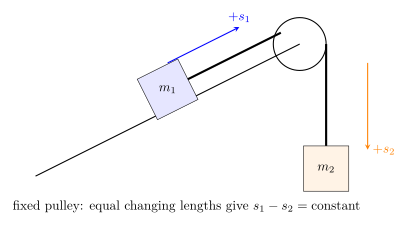
无摩擦时
\[T-m_1g\sin\theta=m_1a,\]
\[m_2g-T=m_2a,\]
\[\boxed{ a=\frac{m_2g-m_1g\sin\theta}{m_1+m_2} }.\]
若结果 \(a<0\),真实运动与所选正方向相反。若有摩擦,必须先判断滑动趋势,再给摩擦符号并检查静摩擦是否足够。
4.2 Worked Example 4 — coupled incline and hanging mass
\(m_1=5.00\ \mathrm{kg}\) 在 \(30.0^\circ\) 无摩擦斜面上,\(m_2=4.00\ \mathrm{kg}\) 悬挂。以上述正方向:
\[a=\frac{4.00(9.81)-5.00(9.81)\sin30.0^\circ}{9.00} =1.64\ \mathrm{m/s^2}.\]
张力为
\[T=m_2(g-a)=4.00(9.81-1.64)=32.7\ \mathrm N.\]
检验:驱动力差 \(m_2g-m_1g\sin\theta=14.7\ \mathrm N\);除以总惯性质量 \(9.00\ \mathrm{kg}\) 正好得到 \(1.64\ \mathrm{m/s^2}\)。
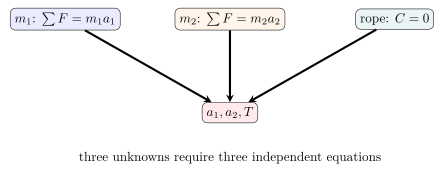
4.3 Equation-count map
Knowledge 5 — Circular dynamics and apparent weight / 圆周动力学与视重
Knowledge ID: P01-U02-L03-K05
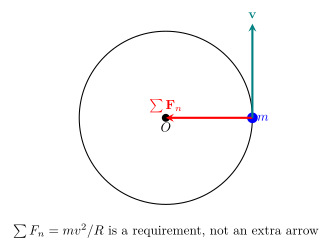
5.1 “Centripetal force” is the radial net force
沿指向曲率中心的 \(+n\) 方向,
\[\boxed{ \sum F_n=m\frac{v^2}{R} }.\]
\(mv^2/R\) 是所需径向净力,不是一种新的相互作用。它可以由重力、张力、支持力、摩擦或它们的组合提供。若速率变化,切向另有
\[\sum F_t=m\frac{dv}{dt}.\]
5.2 Apparent weight is a contact force
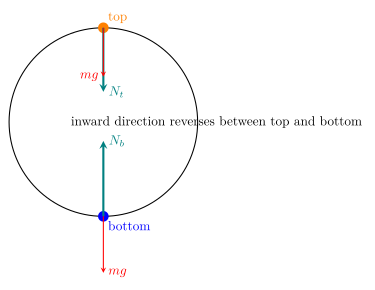
理想秤读数等于秤对人的法向力 \(N\)。竖直圆周运动中,在最低点取向上(向心)为正:
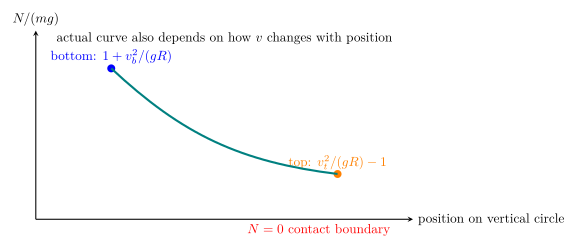
\[N-mg=m\frac{v_b^2}{R}, \qquad \boxed{N_b=m\left(g+\frac{v_b^2}{R}\right)}.\]
在最高点,若人位于环内且向下为向心正方向:
\[N+mg=m\frac{v_t^2}{R}, \qquad \boxed{N_t=m\left(\frac{v_t^2}{R}-g\right)}.\]
接触要求 \(N_t\ge0\),故顶部至少 \(v_t\ge\sqrt{gR}\);若更慢,轨道不能提供“负支持力”,物体会脱离。
5.3 Worked Example 5 — roller-coaster apparent weight
\(m=60.0\ \mathrm{kg}\) 乘客在半径 \(R=12.0\ \mathrm m\) 的竖直圆弧最低点以 \(v=15.0\ \mathrm{m/s}\) 运动:
\[N=m\left(g+\frac{v^2}{R}\right) =60.0\left(9.81+\frac{225}{12.0}\right) =1.71\times10^3\ \mathrm N.\]
其重力仅为 \(589\ \mathrm N\),但座椅支持力约为重力的 \(2.91\) 倍。若把“向心力 \(mv^2/R\)”另加到 \(N\) 与 \(mg\) 之外,会重复计算净力。
5.4 Radial-force sign map
6. Lesson synthesis / 全课整合
6.1 Complete workflow
- 选系统;决定哪些相互作用跨边界。
- 每个独立物体画一张 FBD;另画装置几何图。
- 选沿运动/约束的坐标轴,逐力投影。
- 为每个物体写 \(\sum F_j=m_ia_{i,j}\)。
- 从 \(L=\mathrm{constant}\)、接触或路径方程推导约束。
- 联立求解;负号只表示方向与假设相反。
- 检查 \(N\ge0\)、静摩擦上限、绳张力和特殊极限。
6.2 Formula and boundary table
| Tool | Equation | Do not assume |
|---|---|---|
| FBD | all external forces on one selected system | forces exerted by system; \(m\mathbf a\) as a force |
| Component projection | \(F_j=\mathbf F\cdot\widehat{\mathbf e}_j\) | a memorized sine/cosine without reading angle |
| Fixed-pulley rope | derive from \(L(q_i)=\mathrm{constant}\) | equal signed accelerations in arbitrary coordinates |
| Moving pulley | each moving segment contributes to \(L\) | one-to-one displacement ratio |
| Circular radial law | \(\sum F_n=mv^2/R\) | a separate “centripetal force” |
| Contact | \(N\ge0\) | negative normal force from an ordinary track |
| Apparent weight | scale/contact force \(N\) | gravitational force \(mg\) |
7. Misconception clinic / 易错概念诊所
| Misconception / 错误观念 | Correction / 修正 |
|---|---|
| “装置图就是受力图。” | FBD 必须孤立一个明确系统,只保留作用于它的外力。 |
| “把合力或 \(ma\) 也画成力。” | \(ma\) 是运动响应;合力是已画各力的矢量和。 |
| “作用—反作用都画在同一 FBD。” | 第三定律两力作用在不同物体,应出现在不同 FBD。 |
| “斜面上重力变小。” | 重力仍为 \(mg\);只是沿面与法向分量为 \(mg\sin\theta\)、\(mg\cos\theta\)。 |
| “一根绳连接的物体总有同加速度。” | 必须从绳长式求;可动滑轮会给 2:1 等比例。 |
| “理想绳相同张力就自动给相同加速度。” | 张力条件来自绳质量,运动比例来自不可伸长几何,两者不同。 |
| “向心力是第五种常见力。” | 它是径向净力的角色,可由真实力组合承担。 |
| “秤读数就是 \(mg\)。” | 秤测法向接触力,随加速度和曲率变化。 |
| “顶部算得 \(N<0\) 仍可继续套轨道方程。” | 普通接触已丢失,应切换到抛体/自由飞行阶段。 |
8. Practice and retrieval / 练习与检索
A. Conceptual questions
- 何时选择两个物块作为整体比逐块分析更高效?何时不能只选整体?
- FBD 上能否画速度与加速度?它们为何不是力?
- 为什么可动滑轮的加速度比必须由绳长式得到?
- 斜面坐标为何通常比水平—竖直坐标简洁?
- “径向净力为零”与“速率为零”之间有什么关系?
- 为什么过山车顶部 \(N<0\) 表明模型切换,而不是“座椅向外拉人”?
B. Quantitative and derivation questions
- 两水平接触物块 \(m_1=1.00\ \mathrm{kg}\)、\(m_2=4.00\ \mathrm{kg}\),外力 \(15.0\ \mathrm N\) 推 \(m_1\),无摩擦。求加速度与接触力。
- \(20.0\ \mathrm{kg}\) 箱子受 \(100\ \mathrm N\)、水平上方 \(37.0^\circ\) 的拉力。若竖直无加速度,求 \(N\) 与水平分量。
- 固定滑轮两侧均以向下为正,写出绳长式并证明 \(a_1=-a_2\)。
- 可动滑轮系统满足 \(y_1+2y_P=L_0\)。若自由端向下 \(0.600\ \mathrm m\),滑轮位移是多少、方向如何?
- \(m_1=3.00\ \mathrm{kg}\) 在 \(20.0^\circ\) 无摩擦斜面上,连接 \(m_2=2.00\ \mathrm{kg}\) 悬挂。求加速度与张力。
- \(900\ \mathrm{kg}\) 汽车在水平弯道以 \(20.0\ \mathrm{m/s}\)、半径 \(80.0\ \mathrm m\) 转弯。求所需水平静摩擦及最低 \(\mu_s\)。
- \(50.0\ \mathrm{kg}\) 乘客在 \(R=10.0\ \mathrm m\) 圆弧最低点速度 \(12.0\ \mathrm{m/s}\),求视重。
Answers / 参考答案
1. 求整体加速度时内力可消去;求张力/接触力时必须再选单体。
2. 可在旁边注明运动量,但不能当作力箭头;FBD 只表示相互作用。
3. 同一根绳可能有多个长度可变段,几何系数决定运动比例。
4. 法向加速度常为零,且 \(N\) 只落在一个分量方程中。
5. 径向净力零意味着瞬时曲率加速度零(若 \(v\ne0\) 则不能保持有限半径圆周),并不直接要求速率零。
6. 单侧接触不能拉;负值违反 \(N\ge0\)。
7. \(a=15.0/5.00=3.00\ \mathrm{m/s^2}\);对 \(m_2\),\(C=m_2a=12.0\ \mathrm N\)。
8. \(N=mg-P\sin37.0^\circ=136\ \mathrm N\);\(P_x=79.9\ \mathrm N\)。
9. \(L=y_1+y_2+L_0\),二次求导得 \(a_1+a_2=0\)。
10. \(\Delta y_P=-0.300\ \mathrm m\),即向上 \(0.300\ \mathrm m\)。
11. \(a=[m_2g-m_1g\sin20^\circ]/(m_1+m_2)=1.91\ \mathrm{m/s^2}\),\(m_2\) 向下;\(T=m_2(g-a)=15.8\ \mathrm N\)。
12. \(f_s=mv^2/R=4.50\times10^3\ \mathrm N\);\(\mu_s\ge v^2/(Rg)=0.510\)。
13. \(N=m(g+v^2/R)=1.21\times10^3\ \mathrm N\)。
Exit ticket
对一个“斜面物块—悬挂物—理想固定滑轮”系统,独立写出两张 FBD 方程和一条绳长约束;然后说明若解得 \(a<0\) 应怎样解释。
9. References and source notes / 参考资料与使用说明
9.1 Source-to-content map
| Source | Used for |
|---|---|
| OpenStax, University Physics Volume 1, §5.7 Drawing Free-Body Diagrams | system isolation, external-force-only FBD rules, separate diagrams for separate bodies |
| OpenStax, §6.1 Solving Problems with Newton's Laws | component workflow, connected objects and solution checks |
| OpenStax, §6.3 Centripetal Force | radial net-force equation, banked/unbanked curve interpretation |
| MIT OpenCourseWare 8.01SC, Lesson 12 — Pulleys and Constraints | rope-length constraint method and moving-pulley equation counting |
| MIT OpenCourseWare 8.01SC, Chapter 8 — Applications of Newton's Second Law | inclined-plane and pulley examples; constraint-force framework |
| MIT OpenCourseWare 8.01SC, Lesson 11.1 — Newton's Second Law and Circular Motion | radial/tangential decomposition and circular-motion applications |