
Learning objectives / 学习目标
完成本课后,你应当能够:
- 推导平动加速系中的 \(-m\mathbf A_O\) 惯性项,并用它分析加速车、电梯等问题。
- 从旋转基底导数推导 Coriolis、离心与 Euler 项,正确判断符号和方向。
- 在一般平移—转动坐标系中写完整动力学方程,并通过 \(\Omega=0\)、\(\mathbf v_R=0\) 等极限复核。
- 证明 Coriolis 项对旋转系相对速度不做功,并解释离心项的有效势。
- 建立地球局地东—北—上坐标,得到 \(f=2\Omega_E\sin\lambda\) 的水平近似与适用边界。
- 推导傅科摆摆动平面的领先阶进动率 \(\Omega_E\sin\lambda\),区分极点、赤道与中纬度。
0. The one derivative identity behind every term / 唯一核心恒等式
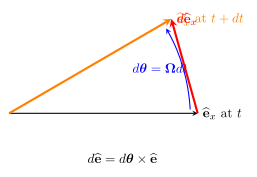
任意矢量 \(\mathbf A=A_i\widehat{\mathbf e}_i(t)\) 在旋转基底中展开。由于
\[\left(\frac{d\widehat{\mathbf e}_i}{dt}\right)_I =\boldsymbol\Omega\times\widehat{\mathbf e}_i,\]
得到 transport theorem:
\[\boxed{ \left(\frac{d\mathbf A}{dt}\right)_I =\left(\frac{d\mathbf A}{dt}\right)_R +\boldsymbol\Omega\times\mathbf A }.\]
Knowledge 1 — Translating accelerated frames and inertial forces / 平动加速系与惯性力
Knowledge ID: P01-U02-L04-K01
1.1 Parallel axes with an accelerating origin
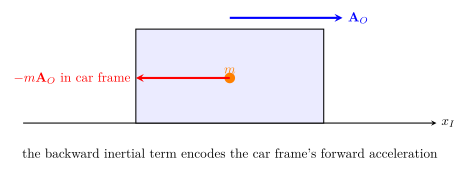
若两套轴平行、不转动,位置关系为
\[\mathbf r_I=\mathbf R_O(t)+\mathbf r_R.\]
两次求导:
\[\mathbf a_I=\mathbf A_O+\mathbf a_R.\]
惯性系 Newton 方程 \(m\mathbf a_I=\sum\mathbf F_{\mathrm{real}}\) 改写为
\[\boxed{ m\mathbf a_R =\sum\mathbf F_{\mathrm{real}}-m\mathbf A_O }.\]
定义平动惯性力
\[\mathbf F_{\mathrm{trans}}=-m\mathbf A_O\]
可让方程保持“合力等于 \(m\mathbf a_R\)”的形式。它与质量成正比、没有施力物体,且只在指定非惯性系中出现。
1.2 Effective gravity in a translating frame
在均匀重力场中可定义
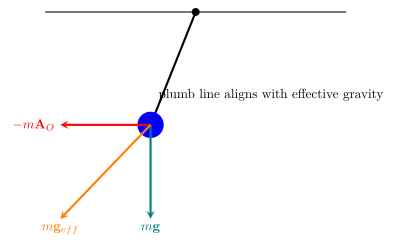
\[\mathbf g_{\mathrm{eff}}=\mathbf g-\mathbf A_O.\]
从悬点指向摆球的下垂方向沿 \(\mathbf g_{\mathrm{eff}}\);张力的向上方向沿 \(-\mathbf g_{\mathrm{eff}}\)。静止液面的法线平行 \(\mathbf g_{\mathrm{eff}}\),而液面本身与它垂直。这是局部等效描述,并不把重力与惯性项在所有空间尺度上视为同一真实场。
1.3 Worked Example 1 — pendulum in an accelerating train
列车水平向右加速 \(A=2.00\ \mathrm{m/s^2}\)。车内静止的小摆相对车无加速度。水平、竖直平衡给
\[T\sin\theta=mA, \qquad T\cos\theta=mg,\]
其中摆线向后偏角 \(\theta\) 相对竖直,故
\[\tan\theta=\frac{A}{g}=\frac{2.00}{9.81}, \qquad \theta=11.5^\circ.\]
\[T=m\sqrt{g^2+A^2}.\]
若列车匀速,\(A=0\),摆线恢复竖直;速度本身不产生平动惯性力。
Knowledge 2 — Centrifugal and Coriolis effects / 离心与科里奥利效应
Knowledge ID: P01-U02-L04-K02
2.1 Direction and diagnostic signatures
一般旋转系动力学中两项最常见:
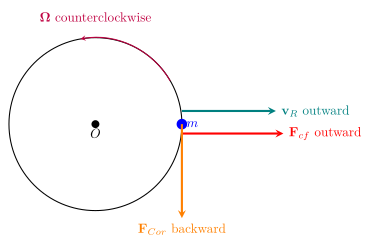
\[\boxed{ \mathbf F_{\mathrm{cf}} =-m\boldsymbol\Omega\times(\boldsymbol\Omega\times\mathbf r) },\]
\[\boxed{ \mathbf F_{\mathrm{Cor}} =-2m\boldsymbol\Omega\times\mathbf v_R }.\]
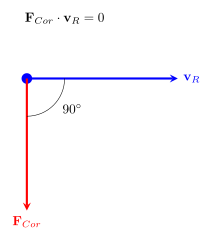
离心项只依赖离转轴的垂直位移,指向远离转轴;Coriolis 项只在 \(\mathbf v_R\ne0\) 时出现,垂直于 \(\boldsymbol\Omega\) 与 \(\mathbf v_R\)。它们都是旋转系记账项。
2.2 Coriolis force does no instantaneous work in the rotating frame
\[P_{Cor}=\mathbf F_{Cor}\cdot\mathbf v_R =-2m(\boldsymbol\Omega\times\mathbf v_R)\cdot\mathbf v_R=0.\]
它能改变相对速度方向,却不能直接改变 \(\tfrac12m v_R^2\)。恒定 \(\boldsymbol\Omega\) 下离心项可由有效势产生:
\[U_{cf}=-\frac12m\lvert\boldsymbol\Omega\times\mathbf r\rvert^2, \qquad -\boldsymbol\nabla U_{cf}=\mathbf F_{cf}.\]
2.3 Worked Example 2 — radial motion on a turntable
质量 \(m=0.500\ \mathrm{kg}\) 的滑块在逆时针转盘上相对盘面径向向外,\(u=0.800\ \mathrm{m/s}\),转盘 \(\Omega=2.00\ \mathrm{rad/s}\),瞬时 \(r=1.50\ \mathrm m\)。旋转系惯性项大小:
\[F_{cf}=m\Omega^2r=(0.500)(2.00)^2(1.50)=3.00\ \mathrm N\]
向外;
\[F_{Cor}=2m\Omega u=2(0.500)(2.00)(0.800)=1.60\ \mathrm N\]
沿 \(-\widehat{\mathbf e}_\theta\)。若要让滑块严格保持径向槽运动,槽壁必须提供相应横向约束力来抵消 Coriolis 项。
2.4 Worked Example 3 — static friction on a rotating disk
物块相对水平圆盘静止,半径 \(r=0.600\ \mathrm m\),\(\Omega=3.00\ \mathrm{rad/s}\),\(\mu_s=0.400\)。惯性系看,静摩擦向心并要求
\[f_s=m\Omega^2r.\]
无滑动条件
\[m\Omega^2r\le\mu_smg\]
给出
\[r\le r_{max}=\frac{\mu_sg}{\Omega^2} =\frac{0.400(9.81)}{9.00}=0.436\ \mathrm m.\]
因为 \(0.600>0.436\ \mathrm m\),静摩擦不足,物块将相对圆盘向外滑。旋转系说法是向外离心项超过最大向内静摩擦;两种描述给出同一判据。
Knowledge 3 — Dynamics in a rotating frame / 旋转系动力学
Knowledge ID: P01-U02-L04-K03
3.1 Derive the full acceleration before moving terms
位置关系
\[\mathbf r_I=\mathbf R_O+\mathbf r.\]
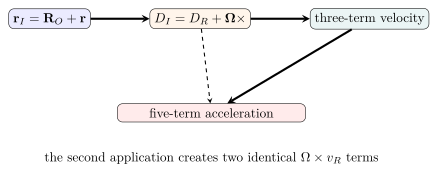
一次使用 transport theorem:
\[\mathbf v_I=\mathbf V_O+\mathbf v_R+\boldsymbol\Omega\times\mathbf r.\]
再次求导:
\[\boxed{ \mathbf a_I =\mathbf A_O+\mathbf a_R +2\boldsymbol\Omega\times\mathbf v_R +\dot{\boldsymbol\Omega}\times\mathbf r +\boldsymbol\Omega\times(\boldsymbol\Omega\times\mathbf r) }.\]
其中 \(\dot{\boldsymbol\Omega}\) 是在惯性系中对角速度求导(对 \(\boldsymbol\Omega\) 本身,旋转与惯性导数相同,因为 \(\boldsymbol\Omega\times\boldsymbol\Omega=0\))。
3.2 Rotating-frame Newton equation and signs
把惯性系方程 \(m\mathbf a_I=\sum\mathbf F_{real}\) 中的坐标项移到右侧:
\[\boxed{ m\mathbf a_R =\sum\mathbf F_{real} -m\mathbf A_O -2m\boldsymbol\Omega\times\mathbf v_R -m\dot{\boldsymbol\Omega}\times\mathbf r -m\boldsymbol\Omega\times(\boldsymbol\Omega\times\mathbf r) }.\]
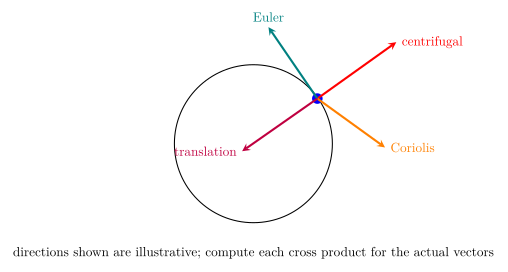
四类惯性项依次为平动、Coriolis、Euler、离心。记忆符号最安全的方法不是背列表,而是先写 \(\mathbf a_I\) 的全正号运动学恒等式,再统一移项。
3.3 Limit checks
| Limit | Surviving relation |
|---|---|
| \(\boldsymbol\Omega=\mathbf0\) | translating-frame equation only |
| \(\mathbf A_O=\mathbf0\), \(\dot{\boldsymbol\Omega}=\mathbf0\) | uniform rotating frame: Coriolis + centrifugal |
| \(\mathbf v_R=\mathbf0\) | no Coriolis term, but centrifugal remains |
| \(\mathbf r\parallel\boldsymbol\Omega\) | centrifugal vanishes; Euler also vanishes only for a fixed axis with \(\dot{\boldsymbol\Omega}\parallel\boldsymbol\Omega\) (or at \(\mathbf r=\mathbf0\)) |
| \(\boldsymbol\Omega=\mathrm{constant}\) | Euler term vanishes |
3.4 Worked Example 4 — spin-up and Euler force
一圆盘在某刻 \(\boldsymbol\Omega=(1.00\ \mathrm{rad/s})\widehat{\mathbf z}\)、\(\dot{\boldsymbol\Omega}=(0.500\ \mathrm{rad/s^2})\widehat{\mathbf z}\)。质量 \(m=2.00\ \mathrm{kg}\) 的点相对圆盘静止于 \(\mathbf r=(0.800\ \mathrm m)\widehat{\mathbf x}\),原点不平动。
\[\mathbf F_{cf}=m\Omega^2r\widehat{\mathbf x} =1.60\widehat{\mathbf x}\ \mathrm N,\]
\[\mathbf F_E=-m\dot{\boldsymbol\Omega}\times\mathbf r =-(2.00)(0.500)(0.800)\widehat{\mathbf y} =-0.800\widehat{\mathbf y}\ \mathrm N.\]
Coriolis 项为零,因为 \(\mathbf v_R=0\)。若点要保持相对静止,真实约束力必须等于 \(-(\mathbf F_{cf}+\mathbf F_E)\)。
Knowledge 4 — Foucault pendulum and geophysical applications / 傅科摆与地球物理应用
Knowledge ID: P01-U02-L04-K04
4.1 Earth's rotation in a local frame
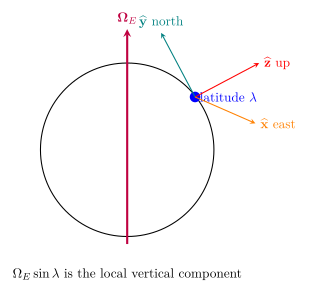
在纬度 \(\lambda\) 的局地东—北—上基底中,
\[\boldsymbol\Omega_E =\Omega_E\cos\lambda\widehat{\mathbf y} +\Omega_E\sin\lambda\widehat{\mathbf z},\]
\[\Omega_E=7.292115\times10^{-5}\ \mathrm{rad/s}.\]
对局地速度 \(\mathbf v=(u,v,w)\),Coriolis 加速度为
\[\mathbf a_C=-2\boldsymbol\Omega_E\times\mathbf v.\]
其水平分量是
\[a_{C,x}=2\Omega_E\sin\lambda\,v-2\Omega_E\cos\lambda\,w,\]
\[a_{C,y}=-2\Omega_E\sin\lambda\,u.\]
对近水平、浅层运动 \(w\approx0\),定义
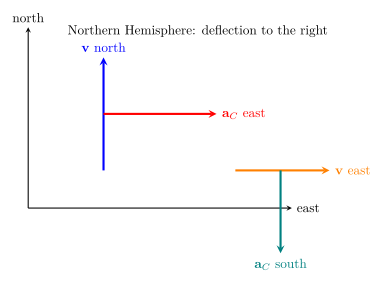
\[\boxed{f=2\Omega_E\sin\lambda}, \qquad (a_{C,x},a_{C,y})=(fv,-fu).\]
北半球 \(f>0\),水平运动向其前进方向右侧偏;南半球相反。
4.2 Foucault pendulum: why the factor is half of \(f\)
小振幅、近各向同性的长摆在水平面中以 \(x\) 向东、\(y\) 向北。忽略 \(\Omega_E^2\)、阻尼和悬点各向异性,令 \(\omega_0=\sqrt{g/\ell}\):
\[\ddot x+\omega_0^2x-f\dot y=0,\]
\[\ddot y+\omega_0^2y+f\dot x=0, \qquad f=2\Omega_E\sin\lambda.\]
用 \(z=x+iy\) 合并:
\[\ddot z+if\dot z+\omega_0^2z=0.\]
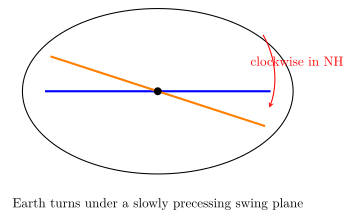
两圆偏振本征频率在 \(f\ll\omega_0\) 时相差约 \(f\);它们叠加成线偏振,摆动平面以差频的一半进动:
\[\boxed{ \Omega_F=\Omega_E\sin\lambda }.\]
北半球相对地面从上方看顺时针,南半球逆时针。理想进动周期为
\[\boxed{ T_F=\frac{2\pi}{\Omega_E\lvert\sin\lambda\rvert} =\frac{T_{sidereal}}{\lvert\sin\lambda\rvert} }.\]
极点为一个恒星日;赤道领先阶进动为零。靠近赤道时其他微小不对称可超过地球旋转信号。
4.3 Worked Example 5 — Foucault period at \(45^\circ\) N
取恒星日 \(T_{sidereal}=23.934\ \mathrm h\),纬度 \(\lambda=45.0^\circ\):
\[T_F=\frac{23.934}{\sin45.0^\circ} =33.8\ \mathrm h.\]
每小时摆动平面相对地面转过
\[\frac{360^\circ}{33.8\ \mathrm h}=10.6^\circ/\mathrm h\]
(北半球顺时针)。用太阳日 \(24.000\ \mathrm h\) 会得到非常接近但略低精度的 \(33.9\ \mathrm h\)。
4.4 The \(f\)-plane and its boundary
中纬度、区域尺度远小于地球半径时,可把
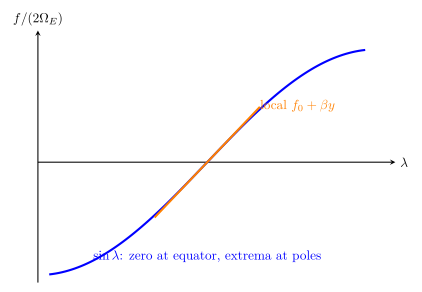
\[f=2\Omega_E\sin\lambda\]
视为常量(\(f\)-plane)。若南北尺度足以感受纬度变化,则在参考纬度 \(\lambda_0\) 附近
\[f\approx f_0+\beta y, \qquad \beta=\frac{2\Omega_E\cos\lambda_0}{R_E}.\]
赤道处 \(f_0=0\),因此常量 \(f\)-plane 不能捕捉跨赤道现象,\(\beta\) 与球面几何变得关键。短时间、小尺度的日常投掷中 Coriolis 往往远小于其他误差;它在长时间、大尺度大气海洋运动中积累显著。
5. Lesson synthesis / 全课整合
5.1 Full inertial-force table
| Coordinate effect | Inertial-force term in \(R\) | Present when |
|---|---|---|
| translating origin | \(-m\mathbf A_O\) | origin accelerates |
| Coriolis | \(-2m\boldsymbol\Omega\times\mathbf v_R\) | frame rotates and object moves relative to it |
| Euler | \(-m\dot{\boldsymbol\Omega}\times\mathbf r\) | rotation rate/vector changes |
| centrifugal | \(-m\boldsymbol\Omega\times(\boldsymbol\Omega\times\mathbf r)\) | point is off rotation axis |
5.2 Safe derivation workflow
- 在惯性系列真实力 \(\sum\mathbf F_{real}\)。
- 写 \(\mathbf r_I=\mathbf R_O+\mathbf r\)。
- 两次使用 \(D_I=D_R+\boldsymbol\Omega\times\) 得到 \(\mathbf a_I\)。
- 代入 \(m\mathbf a_I=\sum\mathbf F_{real}\) 后统一移项。
- 用 \(\Omega=0\)、\(\dot\Omega=0\)、\(\mathbf v_R=0\) 等极限检查。
- 地球问题明确局地轴、纬度与小参数;不要只背“北右南左”。
5.3 Approximation map
| Approximation | Reliable when | Failure signal |
|---|---|---|
| uniform translating acceleration | frame axes parallel, prescribed \(\mathbf A_O\) | rotation or spatially varying frame motion |
| rigid rotating frame | orthonormal rigid basis with one \(\boldsymbol\Omega\) | deforming/shearing coordinates |
| constant \(\Omega\) | steady rotation | spin-up/spin-down requires Euler term |
| local horizontal Coriolis | shallow motion and local tangent plane | vertical velocity or global geometry important |
| \(f\)-plane | small latitude range away from equator | large north–south extent or equatorial crossing |
| ideal Foucault rate | small angle, \(\Omega_E\ll\omega_0\), symmetric suspension | anisotropy, damping, ellipticity, support motion |
6. Misconception clinic / 易错概念诊所
| Misconception / 错误观念 | Correction / 修正 |
|---|---|
| “非惯性系不能用 Newton 定律。” | 可用,但必须加入由坐标加速度导出的惯性项。 |
| “匀速移动也产生惯性力。” | 平行匀速系仍惯性;平动项只依赖 \(\mathbf A_O\)。 |
| “离心力在惯性系也是真实向外力。” | 惯性系中物体需要向心净力;离心项是旋转系移项后的记账力。 |
| “Coriolis 对相对旋转系静止的物体也存在。” | \(\mathbf v_R=0\) 时 Coriolis 项为零。 |
| “Coriolis 会提高物体速率。” | 它与 \(\mathbf v_R\) 垂直,瞬时功率为零。 |
| “只需 Coriolis 与离心两项。” | 原点加速或 \(\dot\Omega\ne0\) 时还需平动和 Euler 项。 |
| “北半球所有物体都自动向右弯。” | 是相对其运动方向的水平领先阶描述;需明确速度、纬度、时间与其他力。 |
| “傅科摆进动率是 \(2\Omega\sin\lambda\)。” | \(f=2\Omega\sin\lambda\) 是 Coriolis 参数;摆动平面进动率为 \(f/2=\Omega\sin\lambda\)。 |
| “赤道上地球旋转没有任何效应。” | 水平 \(f\) 为零,但垂直耦合、\(\beta\) 变化与球面几何仍可重要。 |
7. Practice and retrieval / 练习与检索
A. Conceptual questions
- 为什么加速车内的 \(-m\mathbf A_O\) 没有第三定律伙伴?
- 哪个惯性项在物体相对转盘静止时消失,哪个仍存在?
- 为什么 Coriolis 项不改变 \(v_R^2\)?
- \(\dot\Omega\ne0\) 时少写哪一项会导致切向方向错误?
- 北半球向东运动的物体,其水平 Coriolis 偏向哪边?
- 傅科摆为何在赤道领先阶不进动、在极点最快?
B. Quantitative and derivation questions
- 电梯向下加速 \(3.00\ \mathrm{m/s^2}\)。在电梯系中写出 \(70.0\ \mathrm{kg}\) 人的平动惯性力与有效重力大小。
- 转盘 \(\Omega=4.00\ \mathrm{rad/s}\),\(m=0.250\ \mathrm{kg}\) 点位于 \(r=0.300\ \mathrm m\) 并相对盘径向向内 \(0.500\ \mathrm{m/s}\)。求离心与 Coriolis 惯性力大小、方向。
- 从 transport theorem 连续使用两次,指出系数 2 的来源。
- 若 \(\Omega=2.00\ \mathrm{rad/s}\)、\(\dot\Omega=-0.300\ \mathrm{rad/s^2}\),点在 \(r=0.500\ \mathrm m\) 且相对盘静止,求单位质量的离心与 Euler 加速度大小。
- 纬度 \(30.0^\circ\) N,水平速度正北 \(20.0\ \mathrm{m/s}\),求水平 Coriolis 加速度方向和大小。
- 求纬度 \(60.0^\circ\) N 的理想傅科摆进动周期,取恒星日 \(23.934\ \mathrm h\)。
Answers / 参考答案
1. 它不是另一物体施加的相互作用,而是坐标系加速产生的移项。
2. Coriolis 消失;离心项在离轴位置仍存在。
3. \((\boldsymbol\Omega\times\mathbf v_R)\cdot\mathbf v_R=0\)。
4. Euler 项 \(-m\dot{\boldsymbol\Omega}\times\mathbf r\)。
5. 向南,即前进方向右侧。
6. 进动取决于地球角速度的局地竖直分量 \(\Omega_E\sin\lambda\)。
7. 电梯 \(\mathbf A_O\) 向下,惯性力 \(210\ \mathrm N\) 向上;\(g_{eff}=9.81-3.00=6.81\ \mathrm{m/s^2}\) 向下。
8. \(F_{cf}=m\Omega^2r=1.20\ \mathrm N\) 向外;向内 \(\mathbf v_R\) 给 \(F_{Cor}=2m\Omega v=1.00\ \mathrm N\) 沿转动方向 \(+\widehat{\mathbf e}_\theta\)。
9. 对 \(\mathbf v_R\) 的基底导数产生一项,对 \(\boldsymbol\Omega\times\mathbf r\) 中 \(\mathbf r\) 的导数再产生一项。
10. 离心 \(\Omega^2r=2.00\ \mathrm{m/s^2}\) 向外;Euler \(\lvert\dot\Omega\rvert r=0.150\ \mathrm{m/s^2}\),因减速而沿原转动方向。
11. \(a_C=2\Omega_E\sin30^\circ(20.0)=1.46\times10^{-3}\ \mathrm{m/s^2}\) 向东。
12. \(T_F=23.934/\sin60.0^\circ=27.6\ \mathrm h\)。
Exit ticket
不查表,从 \(\mathbf a_I\) 的五项运动学关系写出旋转系 Newton 方程;然后用一句话解释为什么离心项前的双叉积带负号后却指向外。
8. References and source notes / 参考资料与使用说明
8.1 Source-to-content map
| Source | Used for |
|---|---|
| MIT OpenCourseWare 8.01SC, Chapter 31 — Non-Inertial Linear and Rotating Reference Frames | transport theorem, translating-frame term, full rotating acceleration, Earth applications |
| MIT OpenCourseWare, Rotating Frames of Reference concept video | turntable observations and qualitative centripetal/Coriolis comparison |
| MIT OpenCourseWare 8.09, Advanced Classical Mechanics, Chapter 2 | rotating-frame signs, centrifugal direction, Foucault rate \(\Omega_E\sin\lambda\) and latitude convention |
| MIT OpenCourseWare 8.09, Problem Set 3 — Foucault Pendulum and Coriolis Effect | local-coordinate Foucault setup and small-rotation approximation |
| MIT OpenCourseWare RES.12-001, A Coriolis Tutorial, Part 1 | local Earth rotation, geophysical scale analysis and approximation boundaries |
| NOAA National Ocean Service, The Coriolis Effect | observed right/left hemispheric deflection and atmosphere/ocean context |
8.2 Bibliographic and modeling notes
MIT 8.01SC provides the UG1 derivation spine; MIT 8.09 supplies the small-\(\Omega_E\) Foucault approximation and sign check; MIT RES.12-001 and NOAA connect the local formula to geophysical scales. “惯性力”在本课始终表示坐标变换后的项,不列入真实相互作用对。