
Learning objectives / 学习目标
完成本课后,你应当能够:
- 用统一符号判定恒力做正功、负功或零功,并从 \(F_x\)–\(x\) 图读取有符号面积。
- 从微元定义 \(dW=\mathbf F\cdot d\mathbf r\) 建立沿实际路径的线积分,并正确参数化路径。
- 解释平动动能 \(K=\tfrac12mv^2\) 的标量性、非负性、经典适用域与参考系依赖。
- 从牛顿第二定律推导三维功—动能定理,并说明它必须在同一惯性系中使用。
- 对多力、多维、曲线路径问题逐力记账,用单位、符号、端点和参考系作交叉检查。
0. From force along a path to change of speed
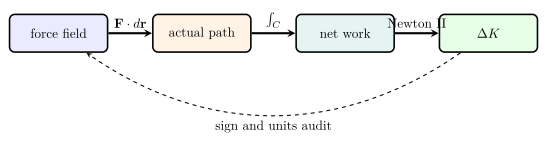
功—动能方法通常不能告诉我们“经过了多久”或路径随时间的完整细节,却能直接把端点速率与沿途各力联系起来。它是牛顿动力学的积分形式,不是独立于牛顿定律的另一套规律。
Knowledge 1 — Work by constant and variable forces / 恒力与变力做功
Knowledge ID: P01-U03-L01-K01
1.1 Constant force: projection, not force times path length
若恒力 \(\mathbf F\) 作用于质点,而质点位移为 \(\Delta\mathbf r\),则该力所做的功为
\[\boxed{W_{A\to B}=\mathbf F\cdot\Delta\mathbf r =F\,\Delta r\cos\theta.}\]
\(\theta\) 是 \(\mathbf F\) 与有向位移 \(\Delta\mathbf r\) 的夹角,不是力与某条坐标轴的夹角。SI 单位为
\[1\ \mathrm J=1\ \mathrm{N\,m}=1\ \mathrm{kg\,m^2/s^2}.\]
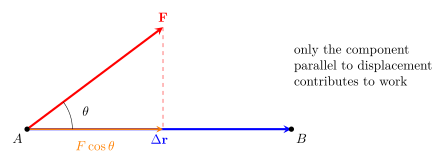
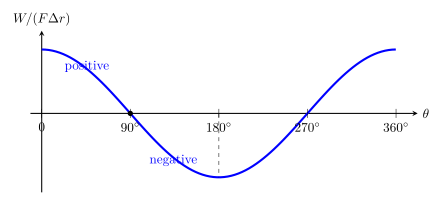
因此:
| Geometry | Sign of work | Immediate interpretation |
|---|---|---|
| \(0\le\theta<90^\circ\) | \(W>0\) | 该力倾向于增加动能 |
| \(\theta=90^\circ\) | \(W=0\) | 该力可改变速度方向而不改变速率 |
| \(90^\circ<\theta\le180^\circ\) | \(W<0\) | 该力倾向于减少动能 |
“倾向于”很重要:单个力做正功不保证质点加速;最终要看所有力的净功。
1.2 Variable force in one dimension
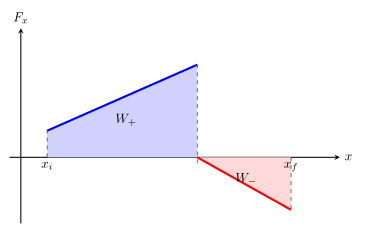
当 \(F_x\) 随 \(x\) 变化,把区间切成许多小段,在每段近似恒力:
\[W_{x_i\to x_f} =\lim_{\max\Delta x_j\to0}\sum_jF_x(x_j^*)\Delta x_j =\boxed{\int_{x_i}^{x_f}F_x(x)\,dx}.\]
\(F_x\)–\(x\) 图中,曲线与横轴之间的有符号面积就是功。横轴上方为正,横轴下方为负;它不是几何面积的绝对值之和。
1.3 Worked Example 1 — constant force at an angle
一只箱子在水平地面上向右移动 \(8.00\ \mathrm m\)。绳的拉力恒为 \(50.0\ \mathrm N\),与水平向右夹角 \(37.0^\circ\)。绳对箱子做功
\[W_T=(50.0\ \mathrm N)(8.00\ \mathrm m)\cos37.0^\circ =3.19\times10^2\ \mathrm J.\]
若箱子始末高度相同,重力做功为零;若地面对箱子的法向力始终竖直,它也做零功。是否存在摩擦必须另行判断,不能因拉力做正功就断言净功为 \(319\ \mathrm J\)。
1.4 Worked Example 2 — variable force and signed area
在 \(x\) 轴上有
\[F_x(x)=(4.00\ \mathrm{N/m})x+2.00\ \mathrm N.\]
质点由 \(x_i=1.00\ \mathrm m\) 移到 \(x_f=3.00\ \mathrm m\),该力的功为
\[\begin{aligned} W&=\int_{1.00\ \mathrm m}^{3.00\ \mathrm m} \left[(4.00\ \mathrm{N/m})x+2.00\ \mathrm N\right]dx\\ &=\left[(2.00\ \mathrm{N/m})x^2+(2.00\ \mathrm N)x\right]_{1.00\ \mathrm m}^{3.00\ \mathrm m}\\ &=20.0\ \mathrm J. \end{aligned}\]
反向从 \(3.00\ \mathrm m\) 回到 \(1.00\ \mathrm m\),积分限交换,因此功为 \(-20.0\ \mathrm J\)。
Knowledge 2 — Dot-product and line-integral definitions of work / 功的点积与线积分定义
Knowledge ID: P01-U03-L01-K02
2.1 Infinitesimal work and the actual path
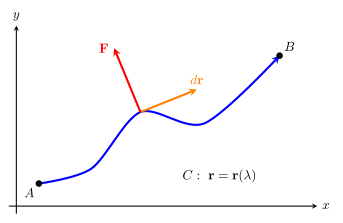
对于微小位移 \(d\mathbf r\),定义
\[\boxed{dW=\mathbf F\cdot d\mathbf r.}\]
沿从 \(A\) 到 \(B\) 的实际路径 \(C\) 积分:
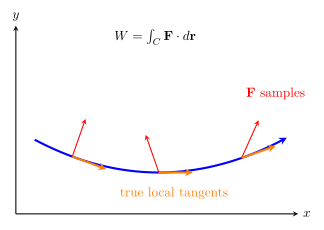
\[\boxed{W_{A\to B}[C]=\int_C\mathbf F(\mathbf r,t)\cdot d\mathbf r.}\]
方括号 \([C]\) 提醒我们:一般力的功可能依赖路径。若力还显含时间,必须在真实运动的时序上取 \(\mathbf F(\mathbf r(t),t)\)。
2.2 Parameterizing a curve
令一条路径由无量纲参数 \(\lambda\in[\lambda_i,\lambda_f]\) 表示:
\[\mathbf r=\mathbf r(\lambda), \qquad d\mathbf r=\frac{d\mathbf r}{d\lambda}\,d\lambda.\]
于是
\[\boxed{ W=\int_{\lambda_i}^{\lambda_f} \mathbf F\bigl(\mathbf r(\lambda),t(\lambda)\bigr) \cdot\frac{d\mathbf r}{d\lambda}\,d\lambda.}\]
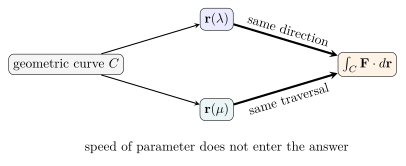
重新参数化不会改变几何线积分,只要路径方向和遍历次数不变。把 \(\int F\,ds\) 不带点积地套用通常是错误的;只有当 \(F_t=\mathbf F\cdot\hat{\mathbf t}\) 已经明确为切向分量时,才有
\[W=\int_C F_t\,ds.\]
2.3 The point of application matters
功中的 \(d\mathbf r\) 是该力作用点的位移。手推墙但墙上接触点不动,墙所受手力的机械功为零;人的代谢能消耗属于人体内部过程,不能据此把“用力感”直接等同于对墙做机械功。对可形变物体,不同接触点可能有不同速度,后续功率也必须用相应作用点速度。
Knowledge 3 — Translational kinetic energy / 平动动能
Knowledge ID: P01-U03-L01-K03
3.1 Definition and properties
经典质点的平动动能定义为
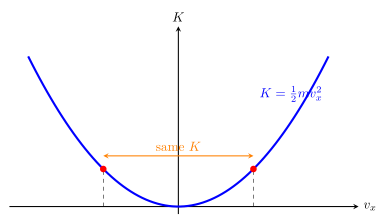
\[\boxed{K=\frac12m\mathbf v\cdot\mathbf v=\frac12mv^2.}\]
它是标量、在 \(m>0\) 时非负,并只由速率而不由速度方向决定。其量纲与功一致:
\[[K]=\mathrm{kg}\left(\frac{\mathrm m}{\mathrm s}\right)^2=\mathrm J.\]
3.2 Reference-frame dependence
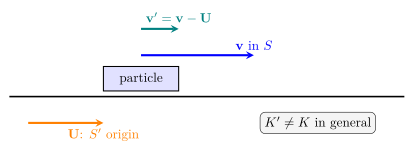
在 Galilean 变换中,若 \(S'\) 相对 \(S\) 以恒速 \(\mathbf U\) 平移,则
\[\mathbf v'=\mathbf v-\mathbf U,\]
\[K'=\frac12m\lvert\mathbf v-\mathbf U\rvert^2 =K-m\mathbf U\cdot\mathbf v+\frac12mU^2.\]
因此动能不是参考系不变量。功也会相应改变,而同一惯性系内的 \(W_{\mathrm{net}}=\Delta K\) 保持成立。
3.3 Worked Example 3 — theorem covariance between two inertial frames
质量 \(m=2.00\ \mathrm{kg}\) 的质点在 \(S\) 中从 \(v_i=3.00\ \mathrm{m/s}\) 变到 \(v_f=5.00\ \mathrm{m/s}\)。于是
\[\Delta K =\frac12(2.00)(5.00^2-3.00^2) =16.0\ \mathrm J.\]
令 \(S'\) 以 \(U=1.00\ \mathrm{m/s}\) 同向匀速运动,则 \(v_i'=2.00\ \mathrm{m/s}\)、\(v_f'=4.00\ \mathrm{m/s}\),
\[\Delta K'=\frac12(2.00)(4.00^2-2.00^2)=12.0\ \mathrm J.\]
冲量为
\[J=m(v_f-v_i)=4.00\ \mathrm{N\,s}.\]
两事件之间的位移满足 \(\Delta x'=\Delta x-U\Delta t\),所以同一个合力的功变为
\[W_{\mathrm{net}}'=W_{\mathrm{net}}-UJ =16.0\ \mathrm J-(1.00\ \mathrm{m/s})(4.00\ \mathrm{N\,s}) =12.0\ \mathrm J.\]
两个数值不同并非矛盾;每个惯性系内部都满足自己的 \(W_{\mathrm{net}}=\Delta K\)。
Knowledge 4 — Work-energy theorem / 功—动能定理
Knowledge ID: P01-U03-L01-K04
4.1 Derivation directly from Newton's second law
在惯性系中、质量恒定时,
\[\mathbf F_{\mathrm{net}}=m\frac{d\mathbf v}{dt}.\]
两边点乘 \(d\mathbf r=\mathbf v\,dt\):
\[\begin{aligned} dW_{\mathrm{net}} &=\mathbf F_{\mathrm{net}}\cdot d\mathbf r\\ &=m\frac{d\mathbf v}{dt}\cdot\mathbf v\,dt\\ &=m\mathbf v\cdot d\mathbf v\\ &=d\left(\frac12m\mathbf v\cdot\mathbf v\right)\\ &=dK. \end{aligned}\]
从事件 \(A\) 积分到事件 \(B\):
\[\boxed{W_{\mathrm{net},A\to B} =\int_A^B\mathbf F_{\mathrm{net}}\cdot d\mathbf r =K_B-K_A.}\]

4.2 Work by each force versus net work
若有多个力,
\[W_{\mathrm{net}}=\sum_iW_i.\]
定理把合力总功而非某一个选中的功等同于 \(\Delta K\)。零净功意味着端点速率相同,不意味着各力都不做功,也不意味着速度方向相同。
4.3 Worked Example 4 — speed increase from positive net work
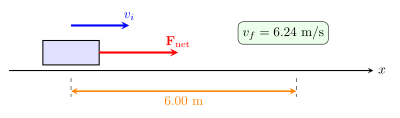
质量 \(4.00\ \mathrm{kg}\) 的小车在水平直线上以 \(v_i=3.00\ \mathrm{m/s}\) 前进。沿前进方向的恒合力为 \(10.0\ \mathrm N\),持续位移 \(6.00\ \mathrm m\)。净功为
\[W_{\mathrm{net}}=(10.0)(6.00)=60.0\ \mathrm J.\]
由功—动能定理,
\[60.0=\frac12(4.00)(v_f^2-3.00^2),\]
\[v_f=\sqrt{39.0}=6.24\ \mathrm{m/s}.\]
平方根取正是因为题目说明小车仍沿正方向运动;能量方程只直接给速率,不能单独恢复方向。
4.4 What the theorem does not determine
端点动能相同只说明端点速率相同。匀速圆周运动中向心力始终垂直瞬时位移,故做功为零;但速度方向持续改变,合加速度并不为零。功—动能定理不替代矢量动力学。
Knowledge 5 — Work in multiple dimensions / 多维运动中的功
Knowledge ID: P01-U03-L01-K05
5.1 Cartesian component form
在三维 Cartesian 坐标中,
\[d\mathbf r=dx\,\hat{\mathbf i}+dy\,\hat{\mathbf j}+dz\,\hat{\mathbf k},\]
\[\boxed{W=\int_C(F_x\,dx+F_y\,dy+F_z\,dz).}\]
路径约束决定 \(dx,dy,dz\) 之间的关系。只把端点坐标代入而忽略路径,等于未经证明就假设路径无关;这要到下一课由“保守力”条件判断。
5.2 Worked Example 5 — a line integral on a curved path
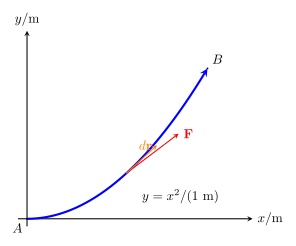
力场为
\[\mathbf F(x,y) =(2.00\ \mathrm{N/m^2})xy\,\hat{\mathbf i} +(1.00\ \mathrm{N/m^2})x^2\,\hat{\mathbf j}.\]
实际路径用无量纲 \(0\le\lambda\le1\) 参数化:
\[x=(1.00\ \mathrm m)\lambda, \qquad y=(1.00\ \mathrm m)\lambda^2.\]
因此
\[d\mathbf r =(1.00\ \mathrm m)\hat{\mathbf i}\,d\lambda +(2.00\ \mathrm m)\lambda\hat{\mathbf j}\,d\lambda,\]
沿路径有 \(F_x=(2.00\ \mathrm N)\lambda^3\)、\(F_y=(1.00\ \mathrm N)\lambda^2\),故
\[\begin{aligned} W&=\int_0^1\left[(2.00\ \mathrm J)\lambda^3 +(2.00\ \mathrm J)\lambda^3\right]d\lambda\\ &=(4.00\ \mathrm J)\int_0^1\lambda^3d\lambda\\ &=1.00\ \mathrm J. \end{aligned}\]
5.3 A robust workflow
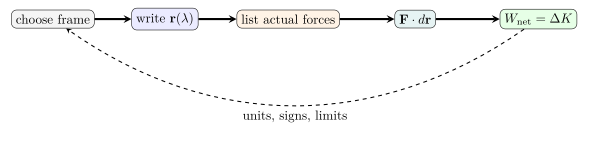
- 指定惯性系、研究对象与两个端点事件。
- 画自由体图;功要逐个真实力计算。
- 写实际路径并确定每个力作用点的位移。
- 先做点积,再积分;不要先把矢量取大小。
- 求和得到净功,再与 \(\Delta K\) 相等。
- 能量式若得到 \(v^2\),结合运动信息恢复方向。
- 用 \(\mathrm{N\,m}=\mathrm J\)、正负号、零位移极限和参考系一致性审核。
6. Lesson synthesis / 全课整合
6.1 Model boundaries and special cases / 模型边界与特殊情形
| Situation | What remains valid | What must change |
|---|---|---|
| Constant-mass particle, inertial frame | \(W_{\rm net}=\Delta(\tfrac12mv^2)\) | none within classical accuracy |
| Uniformly translating inertial frame | theorem still holds within that frame | both \(W\) and \(K\) generally change |
| Accelerating frame | an energy relation may be written | include inertial forces consistently or return to inertial frame |
| Variable mass | \(\mathbf F=m\dot{\mathbf v}\) is generally incomplete | use momentum-flux/system analysis |
| Relativistic speed | work remains energy transfer by force along displacement | replace \(K=\tfrac12mv^2\) by relativistic kinetic energy |
| Extended deformable body | local force-point work remains meaningful | sum/integrate over contact points and internal degrees of freedom |
| Static friction | may be zero, positive, or negative work depending on system and contact motion | inspect the actual contact point; do not assume zero automatically |
7. Misconception clinic / 易错概念诊所
| Misconception / 错误观念 | Correction / 修正 |
|---|---|
| “有力就一定做功。” | 还需要力作用点有位移且存在沿位移分量。 |
| “功等于 \(Fs\),\(s\) 是路程。” | 一般应为 \(\int\mathbf F\cdot d\mathbf r\);\(Fs\) 只适用于恒切向分量。 |
| “法向力永远不做功。” | 对固定光滑轨道上的质点常为零;移动边界、滚动物体或形变接触需检查作用点。 |
| “摩擦力永远做负功。” | 其功取决于所选对象、参考系和接触点运动;摩擦可使传送带上的物体加速。 |
| “净功为零,所以物体静止。” | 只推出端点动能相同;可能匀速直线或匀速转弯。 |
| “动能是矢量,因为速度是矢量。” | \(K=\tfrac12m\mathbf v\cdot\mathbf v\) 是标量。 |
| “功和动能在所有参考系中相同。” | 二者都依参考系;定理要求在同一惯性系内配对。 |
| “线积分只看端点。” | 只有保守场才路径无关;一般必须给实际路径。 |
| “功—动能定理给出速度方向。” | 它直接给速率平方;方向仍需动力学或几何信息。 |
8. Formula sheet / 公式表
| Quantity | Equation | Conditions |
|---|---|---|
| Constant-force work | \(W=\mathbf F\cdot\Delta\mathbf r=F\Delta r\cos\theta\) | \(\mathbf F\) constant |
| Differential work | \(dW=\mathbf F\cdot d\mathbf r\) | force-point displacement |
| Line-integral work | \(W=\int_C\mathbf F\cdot d\mathbf r\) | actual oriented path \(C\) |
| Cartesian form | \(W=\int_C(F_xdx+F_ydy+F_zdz)\) | Cartesian components |
| Translational kinetic energy | \(K=\tfrac12mv^2\) | classical, constant mass |
| Work-energy theorem | \(W_{\rm net}=K_f-K_i\) | same inertial frame |
| Unit | \(1\ \mathrm J=1\ \mathrm{N\,m}\) | SI |
9. Practice and retrieval / 练习与检索
A. Conceptual questions
- 手托重物静止一分钟,手对重物的机械功是多少?这是否意味着人体不消耗能量?
- 匀速圆周运动中合力做多少功?它是否产生加速度?
- 为什么 \(F_x\)–\(x\) 图的横轴下方面积必须带负号?
- 两个惯性系测得的动能为何不同而不破坏功—动能定理?
- 何时可以把 \(\int_C\mathbf F\cdot d\mathbf r\) 写成 \(\int F\,ds\)?
B. Quantitative and derivation questions
- \(30.0\ \mathrm N\) 的恒力与 \(5.00\ \mathrm m\) 位移夹角 \(120^\circ\),求该力做功。
- \(F_x=(6.00\ \mathrm{N/m})x\),质点从 \(x=0\) 到 \(x=2.00\ \mathrm m\),求功。
- 质量 \(3.00\ \mathrm{kg}\) 的质点由静止出发,净功为 \(54.0\ \mathrm J\)。求末速率。
- 力场 \(\mathbf F=(ay)\hat{\mathbf i}+(ax)\hat{\mathbf j}\),其中 \(a=2.00\ \mathrm{N/m}\)。沿直线 \(y=x\) 从 \((0,0)\) 到 \((1.00\ \mathrm m,1.00\ \mathrm m)\),求功。
- 从 \(\mathbf F_{\rm net}=m\,d\mathbf v/dt\) 出发,在三维中推导功—动能定理。
- 质点在 \(S\) 中从 \(2.0\ \mathrm{m/s}\) 变到 \(6.0\ \mathrm{m/s}\);另一个系以同向 \(1.0\ \mathrm{m/s}\) 运动。说明两个系的 \(\Delta K\) 是否相同。
Answers / 参考答案
1. 对静止重物的机械功为零;人体内部化学能仍可转化为内能,二者不是同一系统记账。
2. 合力与瞬时位移垂直,功为零;仍有指向圆心的加速度。
3. 该区间 \(F_x\) 与 \(dx>0\) 反向,\(F_xdx<0\)。
4. 位移和动能都随系改变;在各自同一惯性系内仍有 \(W_{\rm net}=\Delta K\)。
5. \(F\) 已明确为沿路径切向的有符号分量 \(F_t\) 时。
6. \(W=(30.0)(5.00)\cos120^\circ=-75.0\ \mathrm J\)。
7.
\[W=\int_0^{2.00\ \mathrm m}(6.00\ \mathrm{N/m})x\,dx=12.0\ \mathrm J.\]
8. \(54.0=\tfrac12(3.00)v_f^2\),故 \(v_f=6.00\ \mathrm{m/s}\)。
9. 取 \(x=y=\lambda(1.00\ \mathrm m)\),得 \(W=2.00\ \mathrm J\)。
10. 点乘 \(d\mathbf r=\mathbf vdt\),得到 \(dW=m\mathbf v\cdot d\mathbf v=d(\tfrac12mv^2)\),再积分。
11. 不相同。若质量变量为 \(m\),则
\[\Delta K_S
=\frac12m\left[(6.0\ \mathrm{m/s})^2-(2.0\ \mathrm{m/s})^2\right]
=(16.0\ \mathrm{m^2/s^2})m,\]
\[\Delta K_{S'}
=\frac12m\left[(5.0\ \mathrm{m/s})^2-(1.0\ \mathrm{m/s})^2\right]
=(12.0\ \mathrm{m^2/s^2})m.\]
将 \(m\) 的 SI 数值以千克代入时,结果单位为焦耳;两个系中的净功也分别作相同改变。
Exit ticket
不查公式:画一条弯曲路径和一个任意方向的力矢量,标出 \(d\mathbf r\)、切向分量和 \(dW\) 的符号;再用一句话说明为什么功—动能定理不会给出速度方向。
10. References and source notes / 参考资料与使用说明
10.1 Source-to-content map
| Source | Used for |
|---|---|
| OpenStax, University Physics Volume 1, §7.1 Work | constant/variable force work, dot product, signed graph area and line-integral definition |
| OpenStax, §7.2 Kinetic Energy | classical translational kinetic energy, scalar character, units and frame dependence |
| OpenStax, §7.3 Work-Energy Theorem | Newton-law derivation, net-work bookkeeping and endpoint interpretation |
| OpenStax, Chapter 7 Summary | independent equation and terminology cross-check |
| MIT OpenCourseWare 8.01SC, Classical Mechanics | undergraduate mechanics scope, frame discipline and energy-method sequencing |
| MIT OCW 8.01SC, Week 7: Kinetic Energy and Work | course-level examples connecting variable-force work to kinetic-energy change |
10.2 Bibliographic notes
OpenStax §§7.1–7.3 provide the primary derivation spine. MIT 8.01SC is used as an independent university-course cross-check. All prose, examples, tables, and figures here are newly synthesized rather than copied from those sources.