
Learning objectives / 学习目标
完成本课后,你应当能够:
- 用路径无关、任意闭路功为零与势函数存在这三种等价表述辨认保守力。
- 从保守力做功定义 \(\Delta U=-W_{\rm cons}\),推导近地重力势能与理想弹簧势能。
- 在一维使用 \(F_x=-dU/dx\),在三维使用 \(\mathbf F=-\nabla U\),并从等势面判断力方向。
- 区分势能差的物理意义与势能零点的约定自由,保持同一计算中的参考选择一致。
- 说明“\(\nabla\times\mathbf F=0\)”成为全局保守的充分条件时为何还需要单连通定义域等边界条件。
0. Three equivalent doors into conservative mechanics
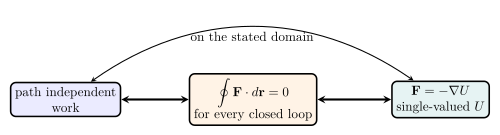
“在所述定义域上”是定理的一部分。若定义域有洞、奇点或被排除区域,局部导数条件可能成立,而环绕洞的闭路积分仍非零。
Knowledge 1 — Conservative and nonconservative forces / 保守力与非保守力
Knowledge ID: P01-U03-L02-K01
1.1 Path independence
设静态力场 \(\mathbf F(\mathbf r)\) 定义在区域 \(D\)。若任意两点 \(A,B\in D\) 之间,所有留在 \(D\) 内的路径 \(C_1,C_2\) 都满足
\[\int_{C_1}\mathbf F\cdot d\mathbf r =\int_{C_2}\mathbf F\cdot d\mathbf r,\]
则称该力在 \(D\) 上是保守力。否则为非保守力。
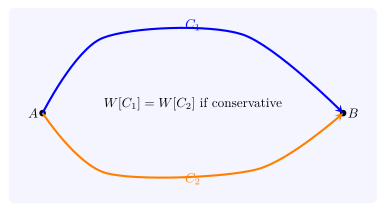
将 \(C_1\) 从 \(A\) 到 \(B\) 与反向 \(-C_2\) 从 \(B\) 回 \(A\) 拼接成闭路,得到等价判据:
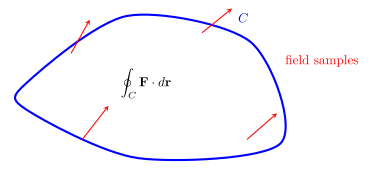
\[\boxed{\oint_C\mathbf F\cdot d\mathbf r=0 \quad\text{for every closed }C\subset D.}\]
1.2 Local curl test and its topological boundary
若 \(\mathbf F\) 在三维单连通区域 \(D\) 上具有连续一阶偏导,则
\[\boxed{\nabla\times\mathbf F=\mathbf0}\]
等价于 \(\mathbf F\) 在 \(D\) 上存在单值势函数。二维 Cartesian 形式为
\[\frac{\partial F_y}{\partial x} =\frac{\partial F_x}{\partial y}.\]
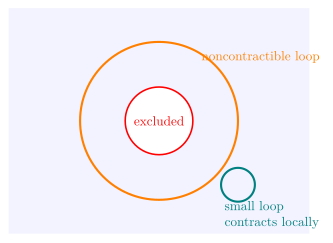
但是“旋度为零”只是局部条件;若定义域不是单连通,必须再检查不能缩成一点的闭路。
1.3 Worked Example 1 — curl-free but not globally conservative
在穿孔平面 \(D=\mathbb R^2\setminus\{(0,0)\}\) 上,令
\[\mathbf F(x,y)=C\left( -\frac{y}{x^2+y^2}\hat{\mathbf i} +\frac{x}{x^2+y^2}\hat{\mathbf j} \right),\]
其中 \(C\) 的单位为焦耳。可在 \(D\) 内直接算得 \(\partial F_y/\partial x=\partial F_x/\partial y\),所以局部旋度为零。取半径 \(R\) 的逆时针圆周
\[\mathbf r(\phi)=R\cos\phi\,\hat{\mathbf i}+R\sin\phi\,\hat{\mathbf j}, \quad 0\le\phi\le2\pi.\]
圆周上 \(\mathbf F=(C/R)\hat{\boldsymbol\phi}\),\(d\mathbf r=R\hat{\boldsymbol\phi}\,d\phi\),所以
\[\oint_C\mathbf F\cdot d\mathbf r =\int_0^{2\pi}C\,d\phi =2\pi C\ne0.\]
因此该场在整个穿孔平面上不是全局保守场;不能定义覆盖所有 \(D\) 的单值势函数。问题不是导数算错,而是圆内奇点被排除,定义域有洞。
1.4 Nonconservative does not mean energy disappears
动摩擦、阻力等常被称为耗散力,因为仅追踪宏观机械能时,\(K+U\) 会减少。但减少的机械能通常转化为物体与环境的内能、声等;“非保守”描述的是无法用单一位置势函数替代其功,并不等于总能量被销毁。
Knowledge 2 — Gravitational and elastic potential energy / 重力势能与弹性势能
Knowledge ID: P01-U03-L02-K02
2.1 Definition by conservative work
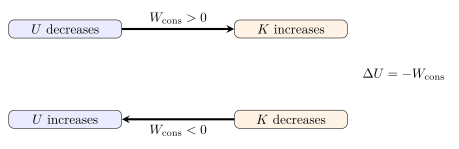
对保守力,定义势能差
\[\boxed{U(B)-U(A)=-\int_A^B\mathbf F_{\rm cons}\cdot d\mathbf r.}\]
因此保守力做正功时势能下降,做负功时势能上升。
2.2 Uniform gravity near Earth's surface
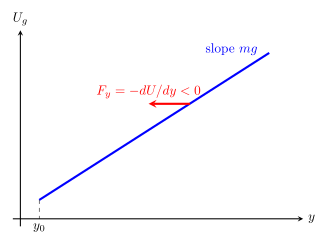
取 \(+y\) 竖直向上,近地匀强重力为
\[\mathbf F_g=-mg\hat{\mathbf j}.\]
于是
\[\Delta U_g=-\int_{y_i}^{y_f}(-mg)\,dy =mg(y_f-y_i),\]
\[\boxed{U_g(y)=mgy+C.}\]
该表达式只适用于高度变化相对地球半径足够小、\(g\) 可视为常量的情形;大尺度引力应使用 \(U(r)=-GMm/r+C\)。
2.3 Ideal spring
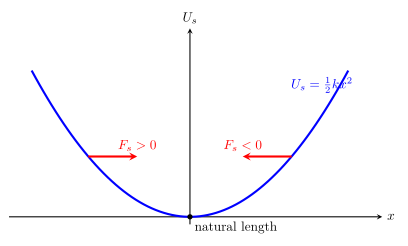
若 \(x\) 表示弹簧相对自然长的有符号伸长量,Hooke 定律为
\[F_s=-kx.\]
故
\[U_s(x)-U_s(0)=-\int_0^x(-kx')dx'=\frac12kx^2,\]
\[\boxed{U_s(x)=\frac12kx^2+C.}\]
Hooke 模型只在弹簧线性弹性范围内可靠;过度拉伸、塑性形变、内耗和迟滞会破坏简单的单值二次势模型。
2.4 Worked Example 2 — gravity and spring energy differences
**(a) 重力:**质量 \(0.500\ \mathrm{kg}\) 的物体缓慢升高 \(2.00\ \mathrm m\),取 \(g=9.81\ \mathrm{m/s^2}\):
\[\Delta U_g=(0.500)(9.81)(2.00)=9.81\ \mathrm J,\]
\[W_g=-9.81\ \mathrm J.\]
**(b) 弹簧:**\(k=200\ \mathrm{N/m}\),伸长由 \(x_i=0.100\ \mathrm m\) 变为 \(x_f=0.250\ \mathrm m\):
\[\begin{aligned} \Delta U_s &=\frac12(200)(0.250^2-0.100^2)\\ &=5.25\ \mathrm J, \end{aligned}\]
故弹簧力做功 \(W_s=-5.25\ \mathrm J\)。两个计算都只依赖端点,因为对应理想力是保守力。
Knowledge 3 — Force as the negative gradient of potential / 力是势能的负梯度
Knowledge ID: P01-U03-L02-K03
3.1 One dimension: force is negative slope
由 \(dU=-F_xdx\) 得
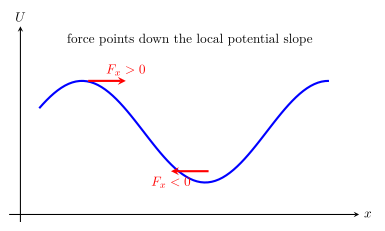
\[\boxed{F_x(x)=-\frac{dU}{dx}.}\]
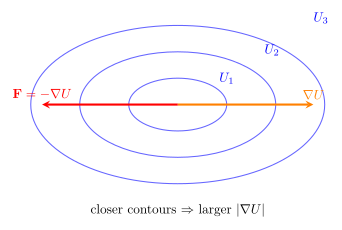
势能图向右上升时 \(dU/dx>0\),力指向左;向右下降时力指向右。力把系统推向较低势能方向,但粒子可因惯性暂时“爬坡”。
3.2 Three dimensions: negative gradient
全微分为
\[dU=\frac{\partial U}{\partial x}dx +\frac{\partial U}{\partial y}dy +\frac{\partial U}{\partial z}dz.\]
与 \(dU=-\mathbf F\cdot d\mathbf r\) 对比,得到
\[\boxed{ \mathbf F=-\nabla U =-\frac{\partial U}{\partial x}\hat{\mathbf i} -\frac{\partial U}{\partial y}\hat{\mathbf j} -\frac{\partial U}{\partial z}\hat{\mathbf k}.}\]
\(\nabla U\) 垂直等势面并指向 \(U\) 增长最快的方向,因此 \(\mathbf F\) 垂直等势面并指向 \(U\) 下降最快的方向。
3.3 Worked Example 3 — recover a potential from a two-dimensional field
令
\[\mathbf F=(2\alpha xy)\hat{\mathbf i}+(\alpha x^2)\hat{\mathbf j}, \qquad \alpha=1.00\ \mathrm{N/m^2}.\]
因为
\[\frac{\partial F_y}{\partial x}=2\alpha x =\frac{\partial F_x}{\partial y},\]
且定义域为整个平面,可求全局势。由 \(\partial U/\partial x=-2\alpha xy\),
\[U=-\alpha x^2y+g(y).\]
再用 \(-\partial U/\partial y=\alpha x^2=F_y\),得到 \(g'(y)=0\),故
\[\boxed{U(x,y)=-\alpha x^2y+C.}\]
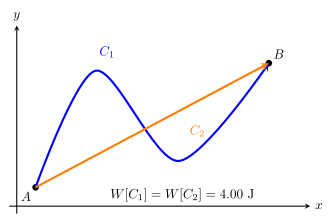
从 \(A=(0,0)\) 到 \(B=(2.00\ \mathrm m,1.00\ \mathrm m)\):
\[\Delta U=-\alpha(2.00\ \mathrm m)^2(1.00\ \mathrm m)=-4.00\ \mathrm J,\]
\[W_{A\to B}=-\Delta U=4.00\ \mathrm J.\]
此后无需知道具体路径;前提是路径留在同一无奇点定义域中。
Knowledge 4 — Reference choices and energy differences / 势能零点与能量差
Knowledge ID: P01-U03-L02-K04
4.1 Additive freedom
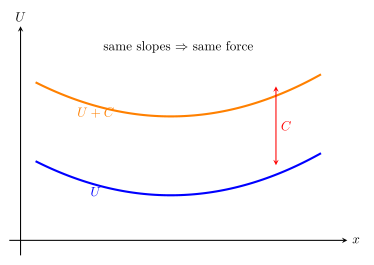
若 \(U(\mathbf r)\) 产生力 \(\mathbf F=-\nabla U\),则
\[U'(\mathbf r)=U(\mathbf r)+C\]
产生完全相同的力,因为 \(\nabla C=0\)。因此绝对零点由约定选择,而
\[\Delta U=U_f-U_i\]
与该常数无关。
常见且方便的选择包括:近地问题令某参考高度 \(y_0\) 处 \(U_g=0\);理想弹簧令自然长 \(x=0\) 处 \(U_s=0\);孤立引力问题常在 \(r\to\infty\) 令 \(U\to0\)。后者只有当极限存在且问题域允许时才可用。
4.2 Consistency when several potentials are added
同一系统可有多个保守相互作用:
\[U_{\rm total}=U_g+U_s+\cdots.\]
每一项可选自己的加法常数,但在同一道题的初态与末态之间必须保持相同约定。改变零点会整体平移总能量数值,却不改变速度、力、转折点条件 \(E-U=K\) 或能量差。
4.3 Worked Example 4 — changing the zero does not change the answer
质量 \(m=1.50\ \mathrm{kg}\) 的物体从 \(y_i=1.00\ \mathrm m\) 升至 \(y_f=4.00\ \mathrm m\)。
若令 \(U=0\) 在 \(y=0\),则
\[U_i=14.7\ \mathrm J, \qquad U_f=58.9\ \mathrm J,\]
\[\Delta U=44.1\ \mathrm J.\]
若改令 \(U=0\) 在 \(y=10.0\ \mathrm m\),则 \(U'=mg(y-10.0\ \mathrm m)\):
\[U_i'=-132\ \mathrm J, \qquad U_f'=-88.3\ \mathrm J,\]
舍入前相减仍给
\[\Delta U'=mg(y_f-y_i)=44.1\ \mathrm J.\]
负势能本身没有异常;零点是约定,差值才进入可测动力学。
4.4 System-boundary picture
5. Lesson synthesis / 全课整合
5.1 Decision workflow / 判定流程
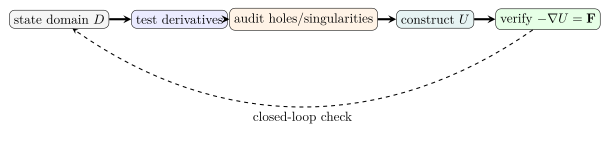
- 写出力场及其完整定义域,标出奇点和被排除区域。
- 在定义域内检查混合偏导或旋度。
- 若区域单连通且光滑条件满足,可积分构造 \(U\);若有洞,再检查非可缩闭路。
- 构造 \(U\) 时保留“另一变量的未知函数”,不要漏掉积分自由度。
- 最后对所得 \(U\) 求 \(-\nabla U\),逐分量复原原力场。
- 所有数值题只用同一势能零点求初末状态;最好直接算 \(\Delta U\)。
6. Model boundaries / 模型边界
| Statement | Valid when | Failure or extension |
|---|---|---|
| Path independence \(\Leftrightarrow\) closed-loop work zero | all compared paths lie in one stated domain | excluded singularities can change loop classes |
| \(\nabla\times\mathbf F=0\Rightarrow\) conservative | \(C^1\) field on a simply connected domain | not sufficient globally on a multiply connected domain |
| \(U_g=mgy+C\) | nearly uniform \(g\) over vertical range | use \(-GMm/r+C\) for planetary scale |
| \(U_s=\tfrac12kx^2+C\) | Hooke-law range, negligible hysteresis | nonlinear elasticity or dissipation needs a richer model |
| \(\mathbf F=-\nabla U\) | position-dependent conservative force | velocity-dependent forces may require generalized potentials |
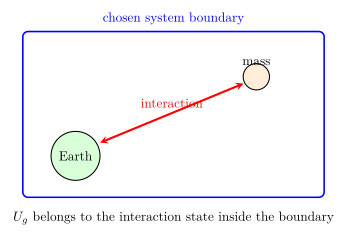
| Potential energy assigned to an object | shorthand when interaction partner is implicit | rigorous accounting requires a system including the interaction |
7. Misconception clinic / 易错概念诊所
| Misconception / 错误观念 | Correction / 修正 |
|---|---|
| “势能是物体自身携带的东西。” | 势能关联相互作用系统及其构型。 |
| “保守力不会改变动能。” | 保守力可在 \(K\) 与 \(U\) 间转换;只是其功可写成 \(-\Delta U\)。 |
| “非保守力不满足能量守恒。” | 总能量仍守恒;只是不能用单值位置势代替该力的全部功。 |
| “旋度为零一定全局保守。” | 还需定义域拓扑与光滑性条件;穿孔平面给出反例。 |
| “势能必须非负。” | 势能零点任意,负值完全允许。 |
| “\(F=-dU/dx\) 中负号表示力总为负。” | 负号表示力指向势能下降方向;具体正负由斜率决定。 |
| “弹簧势能是 \(kx^2\)。” | 正确系数为 \(\tfrac12\),由积分 Hooke 力得到。 |
| “\(mgy\) 对任意高度都精确。” | 它是假设 \(g\) 恒定的近地近似。 |
| “两条路径端点相同,所以功必相同。” | 只有保守力才成立;一般功依路径。 |
8. Formula sheet / 公式表
| Concept | Equation | Conditions |
|---|---|---|
| Potential difference | \(U_B-U_A=-\int_A^B\mathbf F_{\rm cons}\cdot d\mathbf r\) | conservative force |
| Closed-loop test | \(\oint_C\mathbf F_{\rm cons}\cdot d\mathbf r=0\) | every loop in domain |
| Curl test | \(\nabla\times\mathbf F=\mathbf0\) | with domain conditions |
| Force from potential | \(\mathbf F=-\nabla U\) | static scalar potential |
| Uniform-gravity potential | \(U_g=mgy+C\) | local constant \(g\) |
| Ideal-spring potential | \(U_s=\tfrac12kx^2+C\) | Hooke regime |
| Gauge shift | \(U'=U+C\) | same force and \(\Delta U\) |
9. Practice and retrieval / 练习与检索
A. Conceptual questions
- 为什么“任意闭路功为零”与“路径无关”互相推出?
- \(U(x)\) 在某点向右上升,\(F_x\) 指向哪里?
- 势能图整体上移 \(100\ \mathrm J\) 会改变什么、不改变什么?
- 为什么局部旋度为零还不足以处理含奇点的定义域?
- 动摩擦使机械能减少时,总能量去了哪里?
B. Quantitative and derivation questions
- \(2.00\ \mathrm{kg}\) 物体升高 \(3.00\ \mathrm m\),求 \(\Delta U_g\) 和重力功。
- \(k=80.0\ \mathrm{N/m}\) 的弹簧由 \(x=-0.100\ \mathrm m\) 变到 \(x=0.200\ \mathrm m\),求 \(\Delta U_s\) 与弹簧功。
- 给定 \(U(x)=ax^4-bx^2\),求 \(F_x(x)\)。
- 检查 \(\mathbf F=(3y^2)\hat{\mathbf i}+(6xy)\hat{\mathbf j}\) 在整个平面是否保守,并求一个势函数。
- 证明把 \(U\) 换成 \(U+C\) 不改变力和势能差。
- 对 \(\mathbf F=C(-y\hat{\mathbf i}+x\hat{\mathbf j})/(x^2+y^2)\),说明为何不能只凭局部旋度判断全局保守性。
Answers / 参考答案
1. 两条路径拼成闭路;反过来,把闭路拆成去程与反向回程。
2. \(F_x=-dU/dx<0\),指向左。
3. 绝对势能和总能量标签均上移;力、\(\Delta U\)、运动与转折点条件不变。
4. 绕洞闭路不能缩成局部小环,可能包围奇点并有非零环流。
5. 转化为系统与环境的内能、声等;需扩大系统边界记账。
6. \(\Delta U_g=(2.00)(9.81)(3.00)=58.9\ \mathrm J\),\(W_g=-58.9\ \mathrm J\)。
7.
\[\Delta U_s=\frac12(80.0)(0.200^2-0.100^2)=1.20\ \mathrm J,
\qquad W_s=-1.20\ \mathrm J.\]
8. \(F_x=-4ax^3+2bx\)。
9. 混合偏导均为 \(6y\),整个平面单连通;\(U=-3xy^2+C\)。
10. \(-\nabla(U+C)=-\nabla U\),且 \((U_f+C)-(U_i+C)=\Delta U\)。
11. 原点被排除使定义域非单连通;环绕原点一次的闭路积分为 \(2\pi C\)。
Exit ticket
画一幅有闭合等势线的二维图,标出 \(\nabla U\)、\(\mathbf F\) 与任意切向微位移;写出三者的垂直或反向关系,并补上全局保守判据中的定义域条件。
10. References and source notes / 参考资料与使用说明
10.1 Source-to-content map
| Source | Used for |
|---|---|
| OpenStax, University Physics Volume 1, §8.1 Potential Energy of a System | \(\Delta U=-W_{\rm cons}\), interaction-system viewpoint, gravity and spring potentials |
| OpenStax, §8.2 Conservative and Non-Conservative Forces | path independence, closed-loop criterion, component tests and force from potential |
| OpenStax, Chapter 8 Key Equations | notation and equation cross-check |
| MIT OpenCourseWare 8.01SC, Week 8: Potential Energy and Energy Conservation | undergraduate sequencing, system choices and conservative-force applications |
| MIT OCW 18.02SC, Multivariable Calculus — Lecture Notes | line-integral theorem, potential construction, simply connected regions and domain-sensitive vector-calculus criteria |
10.2 Bibliographic notes
OpenStax Chapter 8 supplies the mechanics spine. MIT 8.01SC checks physics conventions; MIT 18.02SC checks the vector-calculus and domain logic. The punctured-plane example is included specifically to prevent overgeneralizing the local curl test.