
Learning objectives / 学习目标
完成本课后,你应当能够:
- 从功—动能定理和 \(W_{\rm cons}=-\Delta U\) 推导机械能守恒条件,而不是无条件套用 \(K_i+U_i=K_f+U_f\)。
- 用系统边界解释摩擦、阻力和非弹性过程中的机械能向内能、声等形式的转化。
- 区分封闭系统与开放系统,并用“储存变化 = 输入 − 输出”的统一结构进行能量核算。
- 计算平均功率和瞬时功率,正确使用 \(P=\mathbf F\cdot\mathbf v_{\rm point}\) 的作用点速度。
- 从能量流图定义效率,区分效率与可大于 \(1\) 的热泵性能系数等其他指标。
0. Storage, transfer, and boundary
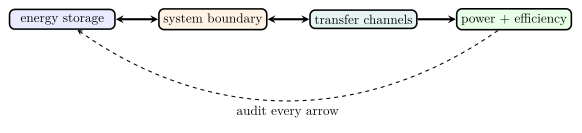
“能量”是可加的守恒记账量;它不是一种必须沿箭头流动的物质。能量流图中的箭头表示跨边界的转移率或在装置内部的转换关系,不表示某种看得见的流体。
Knowledge 1 — Mechanical-energy conservation / 机械能守恒
Knowledge ID: P01-U03-L03-K01
1.1 Derivation and condition
将所有保守力与非保守力的功分开:
\[\Delta K=W_{\rm net}=W_{\rm cons}+W_{\rm nc}.\]
由 \(W_{\rm cons}=-\Delta U\),
\[\Delta K=-\Delta U+W_{\rm nc},\]
\[\boxed{\Delta E_{\rm mech} =\Delta(K+U)=W_{\rm nc}.}\]
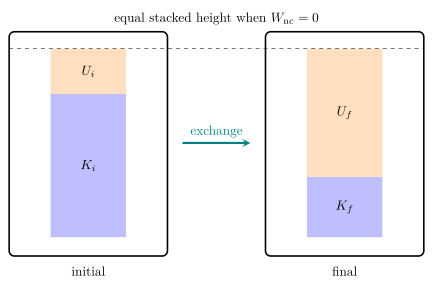
若在所选对象/系统描述中没有非保守力做功,即 \(W_{\rm nc}=0\),才得到
\[\boxed{K_i+U_i=K_f+U_f=E_{\rm mech}.}\]
1.2 Worked Example 1 — frictionless descent
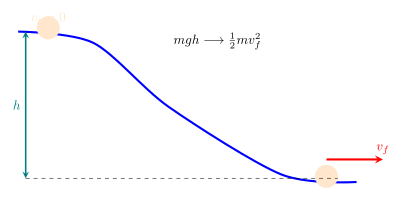
质量 \(0.400\ \mathrm{kg}\) 的小车从静止出发,沿固定光滑轨道下降高度 \(h=5.00\ \mathrm m\)。取底端 \(U_g=0\)。重力保守,轨道法向力始终垂直小车瞬时位移而不做功,因此
\[mgh=\frac12mv_f^2.\]
质量约去:
\[v_f=\sqrt{2gh} =\sqrt{2(9.81)(5.00)} =9.90\ \mathrm{m/s}.\]
轨道形状不影响端点速率,但会影响运动时间与法向力。
1.3 Constraint forces and moving boundaries
固定、光滑轨道的法向力对质点常做零功;但这不是“约束力永不做功”的普遍定理。若轨道移动、接触点运动或物体具有转动与形变,约束力可以跨系统边界转移能量。必须检查力的作用点速度,而不是只看力名。
Knowledge 2 — Energy transfer, dissipation, and thermal energy / 能量转移、耗散与内能
Knowledge ID: P01-U03-L03-K02
2.1 Dissipation is conversion of organized mechanical energy
摩擦或阻力常把宏观有序运动转为微观无序运动,表现为内能增加、温升、形变和声。若系统选为“滑块”单独,地面对它的摩擦功使其机械能流出;若系统选为“滑块 + 地面”,摩擦相互作用在系统内部,减少的机械能主要变成该系统内能。
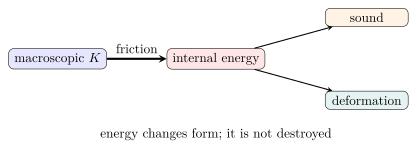
这里的“热能”在严谨表述中通常记为内能 \(E_{\rm int}\) 的一部分或口语简称。热 \(Q\) 是因温差跨边界的传递方式,并不是系统“含有的热”。热学部分将进一步区分内能、热和温度。
2.2 Worked Example 2 — sliding block with friction
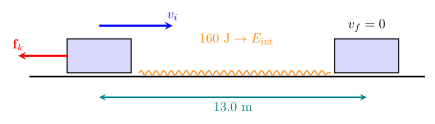
质量 \(m=5.00\ \mathrm{kg}\) 的滑块以 \(v_i=8.00\ \mathrm{m/s}\) 在水平粗糙地面滑动,\(\mu_k=0.250\),取 \(g=9.81\ \mathrm{m/s^2}\)。滑块最终停止。
只选滑块为对象,摩擦功等于动能变化:
\[-\mu_kmgd=0-\frac12mv_i^2.\]
故停止距离
\[d=\frac{v_i^2}{2\mu_kg} =\frac{8.00^2}{2(0.250)(9.81)} =13.0\ \mathrm m.\]
初动能为
\[K_i=\frac12(5.00)(8.00)^2=160\ \mathrm J.\]
扩大到“滑块 + 地面”并近似绝热、忽略声向外传播,则
\[\Delta E_{\rm int}\approx+160\ \mathrm J, \qquad \Delta E_{\rm mech}=-160\ \mathrm J,\]
总能量变化仍为零。
2.3 Energy conservation versus mechanical-energy conservation
| Claim | Status |
|---|---|
| Total energy of an isolated system is conserved | fundamental conservation statement |
| \(K+U\) is conserved | special case: no transfer to other stores/channels |
| Friction destroys energy | false; it reduces recoverable macroscopic mechanical energy while increasing other forms |
| Every energy transfer is “work” | false; heating, radiation and matter transfer are distinct channels |
Knowledge 3 — Open-system and closed-system energy accounting / 开放与封闭系统的能量核算
Knowledge ID: P01-U03-L03-K03
3.1 Boundary classifications
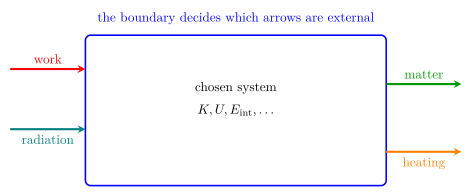
- **Closed system / 封闭系统:**固定的一组物质,没有质量穿越边界;能量仍可通过功、加热或辐射跨界。
- **Isolated system / 孤立系统:**既无物质也无能量跨界,故 \(\Delta E_{\rm sys}=0\)。
- **Open system / 开放系统或控制体:**物质可穿越边界并携带动能、势能、内能等。
3.2 Universal bookkeeping form
最稳健的符号无关结构是
\[\boxed{\Delta E_{\rm stored}=E_{\rm in}-E_{\rm out}.}\]
若采用“进入系统为正”的约定,对封闭系统可写成
\[\boxed{ \Delta E_{\rm sys} =W_{\rm ext,on}+Q_{\rm in}+E_{\rm rad,in}-E_{\rm rad,out}+\cdots.}\]
\(W_{\rm ext,on}\) 是外界对系统做功,\(Q_{\rm in}\) 是因温差传入系统的能量。对于开放系统,还需加入物质携带项:
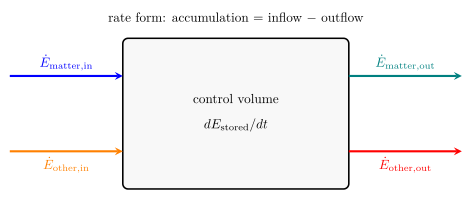
\[\Delta E_{\rm control\ volume} =E_{\rm nonmatter,in}-E_{\rm nonmatter,out} +E_{\rm matter,in}-E_{\rm matter,out}.\]
稳态流动时控制体内储能可不随时间改变,但输入与输出能流仍可很大;“\(\Delta E=0\)”不等于“没有能量通过”。
3.3 Boundary-change audit
同一物理过程可因边界不同而出现不同“外功”:
| Chosen system | Friction between block and floor | Energy description |
|---|---|---|
| block only | external friction does negative work | block's energy leaves to surroundings |
| block + local floor | internal interaction | mechanical energy converts mainly to internal energy |
| block + floor + room | more products retained | sound and warming may remain internal to enlarged system |
不同记账不是物理结论不同;只要所有跨界项和内部储能都计入,最终预测必须一致。
Knowledge 4 — Average and instantaneous power / 平均功率与瞬时功率
Knowledge ID: P01-U03-L03-K04
4.1 Rate of energy transfer
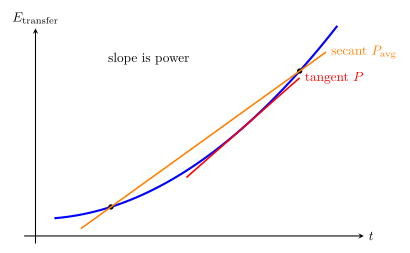
平均功率是时间区间内转移能量与时间之比:
\[\boxed{P_{\rm avg}=\frac{\Delta E_{\rm transfer}}{\Delta t}.}\]
若讨论做功通道,\(\Delta E_{\rm transfer}=W\)。瞬时功率为
\[\boxed{P=\frac{dW}{dt}.}\]
单位为
\[1\ \mathrm W=1\ \mathrm{J/s}.\]
4.2 Power delivered by a force
由 \(dW=\mathbf F\cdot d\mathbf r\):
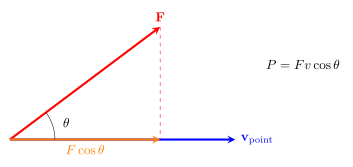
\[\boxed{P=\mathbf F\cdot\frac{d\mathbf r}{dt} =\mathbf F\cdot\mathbf v_{\rm point}.}\]
\(\mathbf v_{\rm point}\) 是力的作用点速度。若力与速度垂直,瞬时功率为零;若反向,功率为负,表示该力从对象的机械运动中移出能量。
4.3 Worked Example 3 — elevator motor and efficiency preview
电梯总质量 \(m=1200\ \mathrm{kg}\),以 \(v=0.750\ \mathrm{m/s}\) 匀速上升。忽略其他损失时,钢缆对电梯的机械输出功率为
\[P_{\rm mech}=mgv =(1200)(9.81)(0.750) =8.83\ \mathrm{kW}.\]
若电机从电源到机械输出的效率为 \(\eta=0.850\),所需电输入功率为
\[P_{\rm in}=\frac{P_{\rm mech}}{\eta} =\frac{8.83\ \mathrm{kW}}{0.850} =10.4\ \mathrm{kW}.\]
其余约 \(1.56\ \mathrm{kW}\) 最终主要成为电机、线路和环境的内能。
4.4 Worked Example 4 — force not parallel to velocity
骑行者对自行车的等效驱动力大小为 \(180\ \mathrm N\),与瞬时速度 \(12.0\ \mathrm{m/s}\) 夹角 \(25.0^\circ\)。该力传递的瞬时机械功率为
\[P=Fv\cos\theta =(180)(12.0)\cos25.0^\circ =1.96\ \mathrm{kW}.\]
垂直于速度的分量不贡献此刻功率,但仍可改变运动方向。
4.5 Rotational preview and its boundary
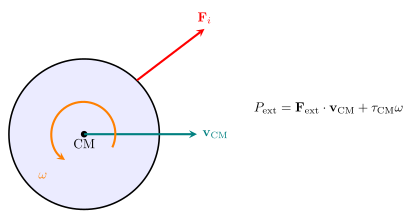
对平面刚体,所有外力作用点的总功率可分解为
\[\sum_i\mathbf F_i\cdot\mathbf v_i =\mathbf F_{\rm ext}\cdot\mathbf v_{\rm CM} +\tau_{\rm CM}\omega.\]
第二项是转动功率前瞻。它要求刚体运动学和关于质心的合外力矩定义;本课不能在质点问题中擅自添加 \(\tau\omega\),也不能用质心速度替代所有移动接触点速度。
Knowledge 5 — Efficiency and energy-flow diagrams / 效率与能量流图
Knowledge ID: P01-U03-L03-K05
5.1 Definition
对能量转换装置,先声明“desired / 有用输出”是什么,再定义
\[\boxed{ \eta=\frac{E_{\rm desired,out}}{E_{\rm total,in}} =\frac{P_{\rm desired,out}}{P_{\rm total,in}}.}\]
对稳态、无额外储能变化的被动转换器,\(0\le\eta\le1\)。所谓“损失”是未进入目标输出的能量,通常进入内能、声或其他非目标通道;它仍需出现在能量流图中。
5.2 Worked Example 5 — pump efficiency
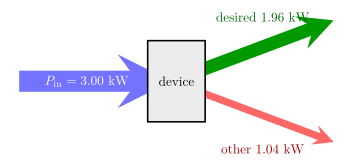
一台泵在 \(45.0\ \mathrm s\) 内把 \(500\ \mathrm{kg}\) 的水提高 \(18.0\ \mathrm m\),电输入功率恒为 \(3.00\ \mathrm{kW}\)。有用的重力势能增加为
\[\Delta U_g=mgh=(500)(9.81)(18.0)=8.83\times10^4\ \mathrm J.\]
有用输出功率
\[P_{\rm desired}=\frac{8.83\times10^4}{45.0} =1.96\ \mathrm{kW}.\]
效率
\[\eta=\frac{1.96}{3.00}=0.654=65.4\%.\]
非目标输出率约为
\[P_{\rm other}=3.00-1.96=1.04\ \mathrm{kW}.\]
5.3 Efficiency is not every performance ratio
热泵的性能系数定义为“送入目标空间的热量/所需功”,其中输出热量还包含从环境转移来的能量,所以性能系数可大于 \(1\);这不违反能量守恒,也不应与这里的被动转换效率混为一谈。
6. Lesson synthesis / 全课整合
6.1 Boundary-first workflow
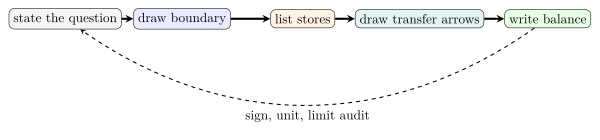
- 明确所问量与两个状态或时间区间。
- 画系统边界,声明开放、封闭或孤立。
- 列出系统内储能:\(K,U,E_{\rm int},\ldots\)。
- 列出所有跨界通道:外功、加热、辐射、物质等。
- 用“储存变化 = 输入 − 输出”写平衡式。
- 只有在条件满足时才简化为 \(K_i+U_i=K_f+U_f\)。
- 若问速率,除以时间;若由力求瞬时功率,用作用点的 \(\mathbf F\cdot\mathbf v\)。
- 效率图中所有输出之和加上储能变化必须与输入一致。
6.2 Conservation hierarchy
| Level | Equation | Interpretation |
|---|---|---|
| Mechanical special case | \(\Delta(K+U)=0\) | only conservative exchanges within chosen description |
| Closed-system balance | \(\Delta E_{\rm sys}=E_{\rm nonmatter,in}-E_{\rm nonmatter,out}\) | no matter crosses boundary |
| Open-system balance | accumulation = all inflows \(-\) all outflows | matter also carries energy |
| Isolated system | \(\Delta E_{\rm total}=0\) | no mass or energy crosses boundary |
7. Misconception clinic / 易错概念诊所
| Misconception / 错误观念 | Correction / 修正 |
|---|---|
| “能量守恒就是 \(K+U\) 守恒。” | \(K+U\) 守恒只是特例;总能量还可含内能等。 |
| “摩擦把能量消灭了。” | 摩擦常把机械能转成内能、声和形变。 |
| “系统能量不变,所以没有能量流。” | 稳态开放系统可有相等但很大的输入与输出。 |
| “封闭系统等于孤立系统。” | 封闭系统不交换物质,但仍可交换能量;孤立系统两者都不交换。 |
| “热是物体储存的一种物质。” | 热是因温差跨边界的能量传递;系统储存的是内能等。 |
| “\(P=Fv\) 总成立。” | 一般是 \(P=\mathbf F\cdot\mathbf v_{\rm point}\),需点积和作用点速度。 |
| “功率大就一定做功多。” | 功率是速率;总功还取决于作用时间。 |
| “效率未达到 \(100\%\) 的部分不必记账。” | 所有非目标输出仍是能量,必须出现在流图中。 |
| “任何大于 \(1\) 的性能比都违反守恒。” | 热泵性能系数不是能量转换效率,可因同时搬运环境能量而大于 \(1\)。 |
8. Formula sheet / 公式表
| Concept | Equation | Conditions / convention |
|---|---|---|
| Mechanical-energy change | \(\Delta(K+U)=W_{\rm nc}\) | work-energy partition |
| Mechanical conservation | \(K_i+U_i=K_f+U_f\) | \(W_{\rm nc}=0\) |
| General balance | \(\Delta E_{\rm stored}=E_{\rm in}-E_{\rm out}\) | declared boundary |
| Average power | \(P_{\rm avg}=\Delta E_{\rm transfer}/\Delta t\) | finite interval |
| Instantaneous work power | \(P=dW/dt\) | differential limit |
| Force power | \(P=\mathbf F\cdot\mathbf v_{\rm point}\) | force application point |
| Efficiency | \(\eta=E_{\rm desired,out}/E_{\rm total,in}\) | same interval; passive converter |
| Power unit | \(1\ \mathrm W=1\ \mathrm{J/s}\) | SI |
9. Practice and retrieval / 练习与检索
A. Conceptual questions
- 为什么固定光滑轨道的形状不改变只受重力小车的端点速率,却会改变运动时间?
- 滑块因摩擦停下时,分别选“滑块”和“滑块 + 地面”为系统,能量记账有何不同?
- 封闭系统能否吸热?孤立系统呢?
- 什么时候 \(P=Fv\) 可以省略点积的余弦?
- 效率定义前为什么必须声明“有用输出”?
B. Quantitative and derivation questions
- 小球从静止无摩擦下降 \(3.20\ \mathrm m\),求末速率。
- \(2.00\ \mathrm{kg}\) 滑块以 \(6.00\ \mathrm{m/s}\) 滑行后停止。若滑块与地面均在系统内且无能量外泄,内能增加多少?
- 起重机用 \(20.0\ \mathrm s\) 将 \(800\ \mathrm{kg}\) 货物匀速提升 \(12.0\ \mathrm m\),求平均机械输出功率。
- 一力 \(\mathbf F=(100\hat{\mathbf i}+40\hat{\mathbf j})\ \mathrm N\),作用点速度 \(\mathbf v=(3.0\hat{\mathbf i}-2.0\hat{\mathbf j})\ \mathrm{m/s}\),求瞬时功率。
- 输入功率 \(5.00\ \mathrm{kW}\) 的机器以 \(72.0\%\) 效率工作 \(30.0\ \mathrm s\),求有用输出能量与其他输出能量。
- 从功—动能定理推导 \(\Delta(K+U)=W_{\rm nc}\),并写出机械能守恒的附加条件。
Answers / 参考答案
1. 端点能量差只依赖高度;路径长度和沿途加速度分量会改变时间。
2. 滑块系统有外摩擦负功;扩大系统后摩擦为内部过程,机械能转为内能。
3. 封闭系统可以经热交换能量;孤立系统不可以。
4. 力与作用点速度平行同向,或 \(F\) 已指有符号切向分量时。
5. 同一装置可有不同目标;效率的分子依任务定义。
6. \(v=\sqrt{2gh}=7.92\ \mathrm{m/s}\)。
7. \(\Delta E_{\rm int}=\tfrac12(2.00)(6.00)^2=36.0\ \mathrm J\)。
8.
\[P=\frac{mgh}{\Delta t}=\frac{(800)(9.81)(12.0)}{20.0}=4.71\ \mathrm{kW}.\]
9. \(P=100(3.0)+40(-2.0)=220\ \mathrm W\)。
10. 输入能量 \(150\ \mathrm{kJ}\);有用输出 \(108\ \mathrm{kJ}\);其他输出 \(42.0\ \mathrm{kJ}\)。
11. \(\Delta K=W_{\rm cons}+W_{\rm nc}=-\Delta U+W_{\rm nc}\);移项即得。\(W_{\rm nc}=0\) 时机械能守恒。
Exit ticket
对“刹车使汽车的能量消失”这句话,画两个不同系统边界并各写一条能量方程;随后写出汽车制动力与接触点速度的功率符号。
10. References and source notes / 参考资料与使用说明
10.1 Source-to-content map
| Source | Used for |
|---|---|
| OpenStax, University Physics Volume 1, §8.3 Conservation of Energy | mechanical-energy equation, nonconservative work and full energy conservation |
| OpenStax, §7.4 Power | average/instantaneous power, \(P=\mathbf F\cdot\mathbf v\) and watt definition |
| OpenStax, Chapter 8 Summary | conservation terminology and equation cross-check |
| MIT OpenCourseWare 8.01SC, Week 8: Potential Energy and Energy Conservation | boundary-sensitive mechanics examples and conservation-method sequencing |
| MIT OCW 8.01SC, Week 7: Kinetic Energy and Work | force power and work-energy linkage |
| MIT OCW 16.01, F12 — Energy Conservation for a Fixed Control Volume | rate-form control-volume energy balance; energy carried by mass crossing the boundary; distinction between stored energy and inflow/outflow terms |
10.2 Bibliographic notes
OpenStax §§7.4 and 8.3 provide the main mechanics spine. MIT 8.01SC independently checks the work–energy–power sequence. MIT 16.01 F12 supplies the direct control-volume basis for the open-system rate balance and for treating mass flow as an energy-transfer channel. The boundary-first accounting language is deliberately more explicit than the common shorthand so friction and open-system cases remain internally consistent.