
Learning objectives / 学习目标
完成本课后,你应当能够:
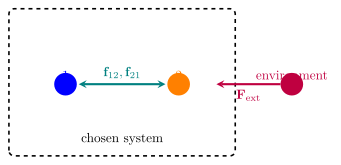
- 先画系统边界,再按边界把力分类为内力或外力。
- 从每个粒子的动量方程推导总动量核算,并用外冲量判定是否守恒。
- 计算离散质点、线、面和体分布的质心,正确选择 \(dm\) 与积分范围。
- 推导 \(\mathbf P=M\mathbf V_{\rm CM}\) 与 \(\mathbf F_{\rm ext}=M\mathbf A_{\rm CM}\) 的条件。
- 转换到质心系,并使用 \(\mathbf P^*=0\) 与动能分解检查碰撞问题。
0. Boundary first / 先定边界
| 物理量 | 定质量粒子系统 |
|---|---|
| 总质量 | \(M=\sum_i m_i\) |
| 总动量 | \(\mathbf P=\sum_i m_i\mathbf v_i\) |
| 质心 | \(\mathbf R=\dfrac{1}{M}\sum_i m_i\mathbf r_i\) |
| 外冲量 | \(\mathbf J_{\rm ext}=\int\mathbf F_{\rm ext}\,dt\) |
Knowledge 1 — Internal and external forces / 内力与外力
Knowledge ID: P01-U04-L02-K01
1.1 Classification depends on the boundary / 内外力分类取决于边界
对粒子 \(i\),动量方程为
\[\frac{d\mathbf p_i}{dt} =\mathbf F_i^{\rm ext}+\sum_{j\ne i}\mathbf f_{ij},\]
其中 \(\mathbf f_{ij}\) 表示粒子 \(j\) 对粒子 \(i\) 的力。对系统内所有粒子求和,
\[\frac{d\mathbf P}{dt} =\sum_i\mathbf F_i^{\rm ext} +\sum_i\sum_{j\ne i}\mathbf f_{ij}.\]
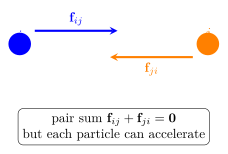
对满足 Newton 第三定律的经典成对相互作用,
\[\mathbf f_{ij}=-\mathbf f_{ji},\]
每一对内力项成对相消,剩下
\[\boxed{\frac{d\mathbf P}{dt}=\mathbf F_{\rm ext}}.\]
1.2 Internal forces do not vanish individually / 内力不是逐个消失
内力能够在系统各部分之间重新分配动量,也能使能量在动能、弹性势能、化学能和热能之间转化。在上述假设下,相消的是完整定质量系统中所有内力的矢量和;若某个相互作用伙伴位于系统边界之外,该力就是外力,不能在系统内部相消。
Worked Example 1 — spring release and boundary choice / 弹簧释放与边界选择
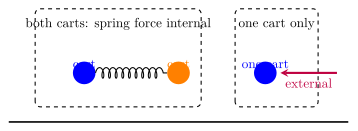
质量分别为 \(1.00\ \mathrm{kg}\) 与 \(3.00\ \mathrm{kg}\) 的两辆小车静止在水平无摩擦轨道上,中间夹着一根被压缩的弹簧。释放后,\(1.00\ \mathrm{kg}\) 小车以 \(+6.00\ \mathrm{m\,s^{-1}}\) 运动。若把两辆小车都纳入系统,水平方向外冲量为零:
\[0=(1.00)(6.00)+(3.00)v_2,\]
\[\boxed{v_2=-2.00\ \mathrm{m\,s^{-1}}}.\]
若系统只包含小车 2,弹簧力便是外力,其冲量为 \(\Delta p_2=-6.00\ \mathrm{N\,s}\)。同一相互作用究竟是内力还是外力,完全取决于系统边界。
Knowledge 2 — Conservation of total linear momentum / 总线动量守恒
Knowledge ID: P01-U04-L02-K02
2.1 Integral balance and exact condition / 积分平衡式与严格条件
对总动量方程在所选时间区间内积分,
\[\boxed{\mathbf P_f-\mathbf P_i =\mathbf J_{\rm ext} =\int_{t_i}^{t_f}\mathbf F_{\rm ext}\,dt}.\]
因此,
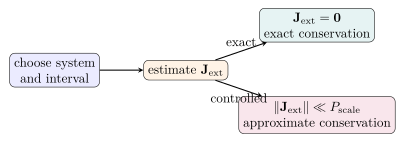
\[\boxed{\mathbf J_{\rm ext}=\mathbf0 \Longrightarrow \mathbf P_f=\mathbf P_i}.\]
真正的条件是:在所选时间区间内,净外冲量为零。系统可以受到多个外力,只要它们的冲量矢量和为零;也可以有非零外力,但若其作用短暂或很弱,使外冲量相对问题的动量尺度可忽略,便可在声明精度下近似守恒。
2.2 Conservation can hold componentwise / 动量可按分量守恒
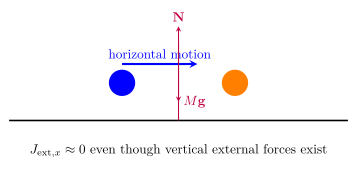
若 \(J_{{\rm ext},x}=0\) 而 \(J_{{\rm ext},y}\ne0\),则 \(P_x\) 守恒而 \(P_y\) 不守恒。水平面上的短时碰撞常出现这种情形:支持力与重力在竖直方向提供外冲量,而水平方向外冲量可能小到可以忽略。
Knowledge 3 — Center of mass for discrete and continuous systems / 离散与连续系统的质心
Knowledge ID: P01-U04-L02-K03
3.1 Discrete masses / 离散质点
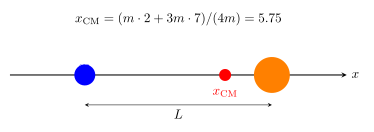
质心位置是各位置以质量为权重的平均:
\[\boxed{\mathbf R_{\rm CM}=\frac{1}{M}\sum_i m_i\mathbf r_i}, \qquad M=\sum_i m_i.\]
质心可以位于没有物质的空间,甚至位于物体材料之外;圆环或新月形物体就是典型例子。
3.2 Continuous distributions / 连续分布
对连续质量分布,把求和替换为积分:
\[\boxed{\mathbf R_{\rm CM}=\frac{1}{M}\int\mathbf r\,dm}.\]
应根据几何维数选择恰当的质量元:
\[dm=\lambda\,d\ell, \qquad dm=\sigma\,dA, \qquad dm=\rho\,dV.\]
这里的 \(\lambda,\sigma,\rho\) 都可以随位置变化。积分前可利用对称性直接确定某些质心分量,但前提是几何形状与密度分布同时具有该对称性。
Worked Example 2 — nonuniform rod / 非均匀细棒
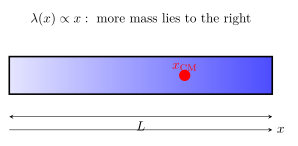
一根细杆占据 \(0\le x\le L\),其中 \(L=1.20\ \mathrm m\),线密度为 \(\lambda(x)=kx\)。先由总质量确定归一化关系:
\[M=\int_0^L kx\,dx=\frac{kL^2}{2}.\]
再计算一阶矩:
\[x_{\rm CM}=\frac{1}{M}\int_0^L x(kx)\,dx =\frac{kL^3/3}{kL^2/2}=\frac{2L}{3}.\]
因此,
\[\boxed{x_{\rm CM}=0.800\ \mathrm m}.\]
结果位于杆内,并偏向密度较大的一端;这两点都是有用的合理性检查。
Knowledge 4 — Center-of-mass motion / 质心运动
Knowledge ID: P01-U04-L02-K04
4.1 Velocity, momentum, and acceleration / 质心速度、动量与加速度
当各粒子质量恒定时,
\[\mathbf V_{\rm CM}=\frac{d\mathbf R_{\rm CM}}{dt} =\frac{1}{M}\sum_i m_i\mathbf v_i,\]
因此
\[\boxed{\mathbf P=M\mathbf V_{\rm CM}}.\]
再次求导并使用系统总动量方程,
\[\boxed{\mathbf F_{\rm ext}=M\mathbf A_{\rm CM}}.\]
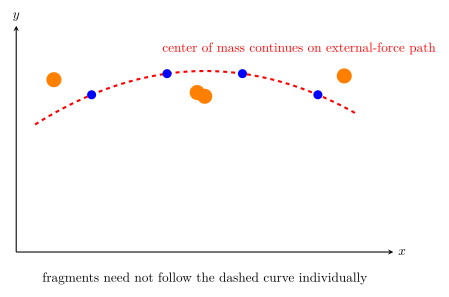
即使系统内部运动十分剧烈,质心仍只按合外力决定的轨迹运动。
Worked Example 3 — projectile explodes at its apex / 抛体在最高点爆炸
一个 \(6.00\ \mathrm{kg}\) 的炮弹以 \(20.0\ \mathrm{m\,s^{-1}}\) 水平运动,并在轨迹最高点爆炸。\(0.500\ \mathrm s\) 后,一个 \(2.00\ \mathrm{kg}\) 碎片位于“若未爆炸时质心应在位置”的东侧 \(5.00\ \mathrm m\),另一个 \(1.00\ \mathrm{kg}\) 碎片位于其西侧 \(4.00\ \mathrm m\)。以该预测质心位置为原点,记各碎片偏移为 \(\delta x_i\)。重力对完整系统的质心运动已包含在预测轨迹中,所以质量加权的水平偏移仍为零:
\[2.00(5.00)+1.00(-4.00)+3.00\delta x_3=0.\]
由此,
\[\boxed{\delta x_3=-2.00\ \mathrm m}.\]
在完整的 \(0.500\ \mathrm s\) 内,竖直动量并不守恒,因为重力提供了外冲量;质心的抛物线轨迹已经包含这一加速度。
Knowledge 5 — Center-of-mass reference frame / 质心参考系
Knowledge ID: P01-U04-L02-K05
5.1 Transformation and zero total momentum / 参考系变换与零总动量
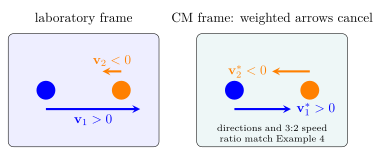
在惯性实验室系中,把相对质心的速度定义为
\[\mathbf v_i^*=\mathbf v_i-\mathbf V_{\rm CM}.\]
于是,
\[\sum_i m_i\mathbf v_i^* =\sum_i m_i\mathbf v_i-M\mathbf V_{\rm CM} =\mathbf0.\]
所以,
\[\boxed{\mathbf P^*=\mathbf0}.\]
若 \(\mathbf V_{\rm CM}\) 恒定,质心系是惯性系。若合外力使质心加速,与质心共动的参考系就是非惯性系,必须加入相应惯性力。
5.2 Translational plus internal kinetic energy / 平动动能与内部动能的分解
代入 \(\mathbf v_i=\mathbf V_{\rm CM}+\mathbf v_i^*\):
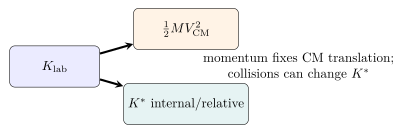
\[K=\sum_i\frac12m_i v_i^2 =\frac12MV_{\rm CM}^2 +\sum_i\frac12m_i(v_i^*)^2,\]
交叉项含有 \(\sum_i m_i\mathbf v_i^*=0\),因此消失。于是
\[\boxed{K=K_{\rm CM}+K^*}.\]
Worked Example 4 — two particles in the CM frame / 质心系中的两粒子
在实验室系中,\(m_1=2.00\ \mathrm{kg}\)、\(v_1=+5.00\ \mathrm{m\,s^{-1}}\);\(m_2=3.00\ \mathrm{kg}\)、\(v_2=-1.00\ \mathrm{m\,s^{-1}}\)。因此
\[V_{\rm CM}=\frac{2.00(5.00)+3.00(-1.00)}{5.00}=1.40\ \mathrm{m\,s^{-1}}.\]
故 \(v_1^*=3.60\ \mathrm{m\,s^{-1}}\),\(v_2^*=-2.40\ \mathrm{m\,s^{-1}}\),并满足
\[2.00(3.60)+3.00(-2.40)=0.\]
实验室系中的总动能为 \(26.5\ \mathrm J\)。按质心平动与内部相对运动分解,
\[K_{\rm CM}=\frac12(5.00)(1.40)^2=4.90\ \mathrm J,\]
\[\boxed{K^*=21.6\ \mathrm J},\]
两部分相加得到 \(K_{\rm CM}+K^*=26.5\ \mathrm J\),与直接计算一致。
6. Lesson synthesis / 本课综合
对固定的一批物质,在经典成对力模型中,内力只重新分配动量而不改变其矢量总和;外冲量才改变总动量。质心则把整个系统的平动压缩为一个关系:\(\mathbf P=M\mathbf V_{\rm CM}\)。
7. Misconception clinic / 易错诊所
| 常见错误 | 错误原因 | 修正方法 |
|---|---|---|
| 未说明系统就称重力为“外力” | 地球可能在边界内,也可能在边界外。 | 先画出并标明系统边界。 |
| “内力为零” | 相消的是内力对的矢量和,单个内力仍可很大。 | 显式相加所有粒子的方程。 |
| “力抵消,所以动量守恒” | 控制总动量的是外冲量。 | 计算或估算 \(\mathbf J_{\rm ext}\)。 |
| 非均匀密度仍用 \(x_{\rm CM}=\int x\,dx/L\) | 这只是位置平均,不是质量加权平均。 | 使用 \(x_{\rm CM}=M^{-1}\int x\,dm\)。 |
| 假设质心一定落在材料内部 | 质心只是质量加权的几何点。 | 接受圆环、曲线物体的质心位于空处。 |
| 假设所有质心系都是惯性系 | 加速的质心系是非惯性系。 | 检查 \(\mathbf F_{\rm ext}\) 与 \(\mathbf A_{\rm CM}\)。 |
8. Practice and retrieval / 练习与检索
P1 — 外冲量检验
一个双冰球系统的初总动量为 \(\mathbf P_i=(3.0,4.0)\ \mathrm{kg\,m\,s^{-1}}\)。在 \(0.20\ \mathrm s\) 内,系统受到外力 \((10,0)\ \mathrm N\) 与 \((-10,5.0)\ \mathrm N\)。求 \(\mathbf P_f\)。
答案
\[\mathbf J_{\rm ext}=(0,1.0)\ \mathrm{N\,s}, \qquad \boxed{\mathbf P_f=(3.0,5.0)\ \mathrm{kg\,m\,s^{-1}}}.\]
\(P_x\) 守恒,而 \(P_y\) 不守恒。
P2 — 离散质心
质量分别为 \(1.00,2.00,3.00\ \mathrm{kg}\) 的三个质点位于 \(x=0,2.00,5.00\ \mathrm m\)。求 \(x_{\rm CM}\)。
答案
\[x_{\rm CM}=\frac{1(0)+2(2.00)+3(5.00)}{6.00}=3.17\ \mathrm m.\]
P3 — 半圆形细线
一根均匀半圆形细线半径为 \(R\),圆心在原点,且位于 \(x\) 轴上方。求其质心。
答案
由对称性知 \(x_{\rm CM}=0\)。取 \(dm=\lambda R\,d\theta\),其中 \(0\le\theta\le\pi\),
\[y_{\rm CM}=\frac{1}{\lambda\pi R}\int_0^\pi(R\sin\theta)(\lambda R\,d\theta) =\frac{2R}{\pi}.\]
P4 — 质心加速度
一个 \(4.00\ \mathrm{kg}\) 的系统受到合外力 \((6.00\,\hat{\mathbf i}-8.00\,\hat{\mathbf j})\ \mathrm N\)。求 \(\mathbf A_{\rm CM}\)。
答案
\[\boxed{\mathbf A_{\rm CM}=(1.50\,\hat{\mathbf i}-2.00\,\hat{\mathbf j})\ \mathrm{m\,s^{-2}}}.\]
9. Formula sheet / 公式表
\[\mathbf P=\sum_i\mathbf p_i, \qquad \Delta\mathbf P=\mathbf J_{\rm ext},\]
\[\mathbf J_{\rm ext}=\mathbf0 \Longrightarrow \mathbf P_f=\mathbf P_i,\]
\[\mathbf R_{\rm CM}=\frac1M\sum_i m_i\mathbf r_i =\frac1M\int\mathbf r\,dm,\]
\[\mathbf P=M\mathbf V_{\rm CM}, \qquad \mathbf F_{\rm ext}=M\mathbf A_{\rm CM},\]
\[\mathbf v_i^*=\mathbf v_i-\mathbf V_{\rm CM}, \qquad \sum_i m_i\mathbf v_i^*=\mathbf0,\]
\[K=\frac12MV_{\rm CM}^2+K^*.\]
复习与拓展
- 写“动量守恒”之前,先说明系统、时间区间以及被忽略的外冲量。
- 连续体的固定流程:几何 \(\to dm\) \(\to M\) \(\to \int\mathbf r\,dm\)。
- 积分前先预判质心大致应位于何处。
- 前向联系:碰撞期间若短时外冲量可忽略,总动量守恒;但动能是否守恒必须另行检验。
11. References and source notes / 参考资料与来源说明
本课所有示意图与数值例题均为原创;参考资料最后核验于 2026-08-20。
Answers / 答案速查
P1:\(\mathbf P_f=(3.0,5.0)\ \mathrm{kg\,m\,s^{-1}}\)。P2:\(x_{\rm CM}=3.17\ \mathrm m\)。P3:\((x_{\rm CM},y_{\rm CM})=(0,2R/\pi)\)。P4:\(\mathbf A_{\rm CM}=(1.50\,\hat{\mathbf i}-2.00\,\hat{\mathbf j})\ \mathrm{m\,s^{-2}}\)。