
Learning objectives / 学习目标
完成本课后,你应当能够:
- 从几何约束与速度映射系统地构造 \(L=T-V\),并说明该形式的模型边界。
- 由循环坐标识别守恒广义动量,并区分广义动量与 \(m\mathbf v\)。
- 推导 Lagrangian energy function 的演化式,判断它何时等于机械能、何时守恒。
- 以 \(\delta L=dF/dt\) 的准对称形式陈述并应用 Noether 定理。
- 用 Lagrangian 方法处理中心力轨道与刚体主轴转动。
- 在稳定平衡附近建立质量矩阵与刚度矩阵,求解简正频率和简正坐标。
0. Conventions and a construction workflow / 约定与构造流程
本课沿用
\[\frac{d}{dt} \left( \frac{\partial L}{\partial\dot q_i} \right) -\frac{\partial L}{\partial q_i}=0, \qquad p_i\equiv\frac{\partial L}{\partial\dot q_i}.\]
| Quantity | Meaning | Dimension |
|---|---|---|
| \(L\) | Lagrangian | J |
| \(p_i\) | momentum conjugate to \(q_i\) | \(\mathrm{J\,s}/[q_i]\) |
| \(\mathcal E_L=\sum_i\dot q_i p_i-L\) | Lagrangian energy function | J |
| \(M_{ij}\) | small-oscillation mass matrix | \(\mathrm J/([\dot q_i][\dot q_j])\) |
| \(K_{ij}\) | potential Hessian | \(\mathrm J/([q_i][q_j])\) |
Knowledge 1 — Constructing the Lagrangian / 拉格朗日量的构造
Knowledge ID: P01-U09-L02-K01
1.1 Natural mechanical systems
对惯性系中、理想完整约束下的质点系统,先写
\[\mathbf r_a=\mathbf r_a(\mathbf q,t), \qquad \dot{\mathbf r}_a =\sum_i\mathbf r_{a,i}\dot q_i+\mathbf r_{a,t}.\]
将其代入
\[T=\frac12\sum_a m_a\dot{\mathbf r}_a^2.\]
一般会得到
\[T= \frac12\sum_{ij}a_{ij}(\mathbf q,t)\dot q_i\dot q_j +\sum_i b_i(\mathbf q,t)\dot q_i+c(\mathbf q,t).\]
若所有施加保守力来自与速度无关的势 \(V(\mathbf q,t)\),则
\[\boxed{L=T-V}.\]
当约束定常、参考系惯性且坐标变换不显含时间时,通常 \(b_i=c=0\),动能是速度的齐次二次型。1
1.2 A reliable six-step recipe
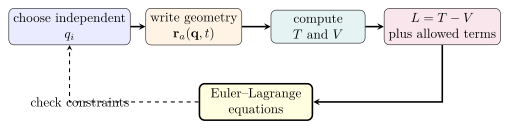
- 先数自由度,选择不冗余的 \(q_i\)。
- 明确参考系,并写出每个质量点的 \(\mathbf r_a(\mathbf q,t)\)。
- 先求速度再平方,避免漏掉 moving-basis 或 moving-support 项。
- 统一势能零点;势能加常数不影响运动。
- 形成 \(L=T-V\),逐项检查单位为 J。
- 推导后用极限、对称性与 Newton 方程交叉检查。
1.3 Nonuniqueness
对任意光滑 \(F(\mathbf q,t)\),
\[L'=L+\frac{dF}{dt}\]
给出相同 Euler–Lagrange 方程。势能的任意常数只是这一自由度的最简单特例。不同坐标中的 \(L\) 表面形式也可以很不同,但作用量是同一几何动力学的表示。
Worked Example 1 — Pendulum with a moving support
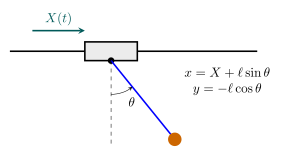
摆长 \(\ell\),支点水平位置为给定函数 \(X(t)\)。取向下竖直方向的摆角 \(\theta\):
\[x=X(t)+\ell\sin\theta, \qquad y=-\ell\cos\theta.\]
因此
\[v^2 =\dot X^2+2\ell\dot X\dot\theta\cos\theta +\ell^2\dot\theta^2.\]
选 \(V=-mg\ell\cos\theta\):
\[L= \frac12m \left( \dot X^2+2\ell\dot X\dot\theta\cos\theta+\ell^2\dot\theta^2 \right) +mg\ell\cos\theta.\]
Euler–Lagrange 方程化简为
\[\boxed{ \ell\ddot\theta+g\sin\theta =-\ddot X\cos\theta }.\]
支点匀速时 \(\ddot X=0\),运动与静止支点相同;真正驱动摆的是支点加速度而不是速度本身。
Knowledge 2 — Cyclic coordinates and conserved momenta / 循环坐标与守恒广义动量
Knowledge ID: P01-U09-L02-K02
2.1 Ignorable coordinate
若 \(L\) 不显含某个 \(q_k\),
\[\frac{\partial L}{\partial q_k}=0,\]
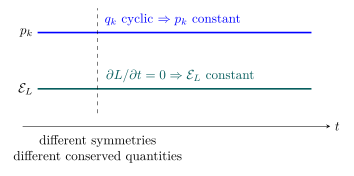
则 \(q_k\) 是 cyclic / ignorable coordinate。Euler–Lagrange 方程立即给出
\[\boxed{ \dot p_k=0, \qquad p_k=\frac{\partial L}{\partial\dot q_k} }.\]
“坐标守恒”不是说 \(q_k\) 不变,而是它的共轭动量不变。\(q_k\) 往往仍随时间演化。
2.2 The Lagrangian energy function
定义
\[\boxed{ \mathcal E_L \equiv \sum_i\dot q_i \frac{\partial L}{\partial\dot q_i} -L }.\]
沿 Euler–Lagrange 解:
\[\begin{aligned} \frac{d\mathcal E_L}{dt} &= \sum_i \left( \ddot q_i\frac{\partial L}{\partial\dot q_i} +\dot q_i\frac{d}{dt}\frac{\partial L}{\partial\dot q_i} \right) -\frac{dL}{dt}\\ &=-\frac{\partial L}{\partial t}. \end{aligned}\]
所以
\[\boxed{ \frac{\partial L}{\partial t}=0 \quad\Longrightarrow\quad \mathcal E_L=\text{constant} }.\]
若 \(L=T-V\)、\(V\) 与速度无关、\(T\) 是速度的齐次二次型,则 Euler 定理给出
\[\sum_i\dot q_i\frac{\partial T}{\partial\dot q_i}=2T, \qquad \mathcal E_L=T+V.\]
Knowledge 3 — Noether's theorem / 诺特定理
Knowledge ID: P01-U09-L02-K03
3.1 Fixed-time quasi-symmetry
先考虑不改变时间的无穷小连续变换
\[q_i\longrightarrow q_i+\varepsilon\xi_i(\mathbf q,t).\]
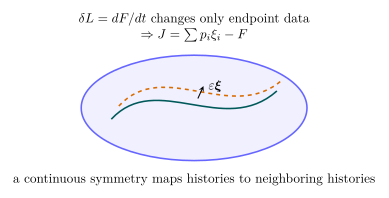
若 Lagrangian 的变化只是一个全时间导数,
\[\boxed{ \delta L =\varepsilon\frac{dF(\mathbf q,t)}{dt} },\]
则作用量在固定端点下只改变边界项。这称为 quasi-symmetry / 准对称;严格 \(\delta L=0\) 是 \(F=0\) 的特例。2
沿运动方程,
\[\delta L =\sum_i \left[ \frac{\partial L}{\partial q_i}\delta q_i +\frac{\partial L}{\partial\dot q_i} \frac{d}{dt}\delta q_i \right] =\frac{d}{dt} \left( \sum_i p_i\delta q_i \right).\]
与 \(\delta L=\varepsilon\,dF/dt\) 比较:
\[\boxed{ J=\sum_i p_i\xi_i-F \quad\text{is conserved} }.\]
3.2 Including time transformations
更一般地令
\[t'=t+\varepsilon\tau, \qquad q_i'(t')=q_i(t)+\varepsilon\xi_i.\]
若作用量密度的变化仍只是 \(dF/dt\),Noether charge 可写成
\[\boxed{ J= \sum_i p_i\xi_i-\mathcal E_L\tau-F }.\]
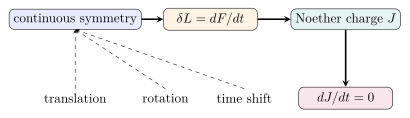
整体负号不改变“守恒”的内容。典型对应关系是:
| Continuous symmetry | Generator | Conserved quantity |
|---|---|---|
| spatial translation | \(\delta\mathbf r=\varepsilon\mathbf a\) | linear momentum component |
| rotation | \(\delta\mathbf r=\varepsilon\boldsymbol\alpha\times\mathbf r\) | angular momentum component |
| time translation | \(\tau=\text{constant}\) | \(\mathcal E_L\) |
| internal cyclic shift | \(\delta q_k=\varepsilon\) | \(p_k\) |
Worked Example 2 — Uniform gravity as a quasi-symmetry
一维竖直坐标 \(z\) 向上:
\[L=\frac12m\dot z^2-mgz.\]
平移 \(z\to z+\varepsilon\) 并不是 \(L\) 的严格对称,因为
\[\delta L=-mg\varepsilon =\varepsilon\frac{d}{dt}(-mgt).\]
所以 \(\xi=1\)、\(F=-mgt\),Noether charge 是
\[\boxed{ J=m\dot z+mgt }.\]
由 \(\ddot z=-g\) 直接验证 \(dJ/dt=m\ddot z+mg=0\)。例如 \(m=0.500\ \mathrm{kg}\)、\(\dot z(0)=8.00\ \mathrm{m\,s^{-1}}\),则
\[J=4.00\ \mathrm{kg\,m\,s^{-1}},\]
并且任意时刻 \(\dot z=8.00-9.81t\) 都保持该组合不变。
Knowledge 4 — Central-force and rigid-body applications / 中心力与刚体应用
Knowledge ID: P01-U09-L02-K04
4.1 Central forces: symmetry reduces the orbit
对平面中心势 \(V(r)\),
\[L= \frac12m \left( \dot r^2+r^2\dot\phi^2 \right) -V(r).\]
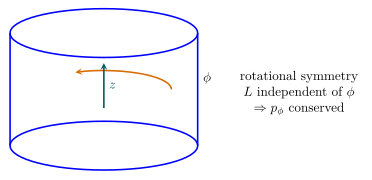
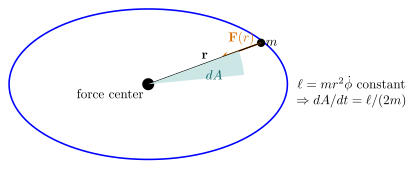
\(\phi\) 循环,因此
\[\boxed{ \ell=p_\phi=mr^2\dot\phi=\text{constant} }.\]
这就是垂直轨道平面的角动量。径向方程
\[m\ddot r-mr\dot\phi^2=-\frac{dV}{dr}\]
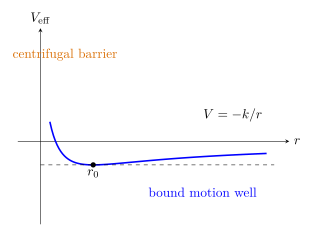
可改写成一维有效势问题:
\[\frac12m\dot r^2+V_{\rm eff}(r)=E, \qquad \boxed{ V_{\rm eff}(r)=V(r)+\frac{\ell^2}{2mr^2} }.\]
第二项是由守恒角动量产生的 centrifugal barrier,不是新增的基本相互作用。
Worked Example 3 — Circular orbit from the effective potential
对 \(V(r)=-GMm/r\),圆轨道满足 \(dV_{\rm eff}/dr=0\):
\[\frac{GMm}{r^2}-\frac{\ell^2}{mr^3}=0.\]
用 \(\ell=mrv\) 得
\[\boxed{v=\sqrt{\frac{GM}{r}}}.\]
若给定 \(GM=3.986\times10^{14}\ \mathrm{m^3\,s^{-2}}\)、\(r=7.00\times10^6\ \mathrm m\),
\[v=7.55\times10^3\ \mathrm{m\,s^{-1}},\]
\[T_{\rm orb}=\frac{2\pi r}{v} =5.83\times10^3\ \mathrm s =97.1\ \mathrm{min}.\]
这里所有结论都来自旋转对称导致的 \(\ell\) 守恒与径向平衡。
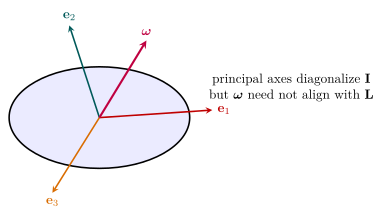
4.2 Rigid body: inertia tensor and principal axes
刚体绕质心的转动动能为3
\[\boxed{ T_{\rm rot} =\frac12\boldsymbol\omega\cdot\mathbf I\boldsymbol\omega }.\]
在惯性张量的主轴系,
\[T_{\rm rot} =\frac12 \left( I_1\omega_1^2+I_2\omega_2^2+I_3\omega_3^2 \right).\]
刚体取向需要三个广义坐标,例如 Euler angles \((\phi,\theta,\psi)\)。对一端固定的对称陀螺,令 \(\theta\) 为“从支点指向质心的对称轴”与竖直向上方向的夹角,则 \(V=Mgl\cos\theta\),
\[L= \frac12I_1 \left( \dot\theta^2+\dot\phi^2\sin^2\theta \right) +\frac12I_3 \left( \dot\psi+\dot\phi\cos\theta \right)^2 -Mgl\cos\theta.\]
\(\phi\) 与 \(\psi\) 都是循环坐标,所以有两个守恒共轭动量;这使原本耦合的三角运动大幅降阶。
Worked Example 4 — Rotational energy of a rectangular block
均匀长方体质量 \(M=2.00\ \mathrm{kg}\),边长 \(a=0.300\ \mathrm m\)、\(b=0.200\ \mathrm m\)、\(c=0.100\ \mathrm m\)。绕穿过质心且平行于 \(c\) 边的主轴,
\[I_c=\frac{M}{12}(a^2+b^2) =2.17\times10^{-2}\ \mathrm{kg\,m^2}.\]
若 \(\omega_c=12.0\ \mathrm{rad\,s^{-1}}\),
\[T_{\rm rot} =\frac12I_c\omega_c^2 =1.56\ \mathrm J.\]
若无外力矩且恰绕主轴转动,这种定轴状态保持;一般不沿主轴的 torque-free rotation 需要 Euler equations 描述。
Knowledge 5 — Small oscillations and normal coordinates / 小振动与简正坐标
Knowledge ID: P01-U09-L02-K05
5.1 Quadratic expansion near equilibrium
令稳定平衡为 \(\mathbf q_0\),定义小偏移 \(\boldsymbol\eta=\mathbf q-\mathbf q_0\)。在平衡点
\[\left. \frac{\partial V}{\partial q_i} \right|_{\mathbf q_0}=0.\]
保留二阶项:
\[L^{(2)} =\frac12\dot{\boldsymbol\eta}^{\mathsf T} \mathbf M \dot{\boldsymbol\eta} -\frac12\boldsymbol\eta^{\mathsf T} \mathbf K \boldsymbol\eta,\]
其中
\[M_{ij} =\left. \frac{\partial^2T} {\partial\dot q_i\partial\dot q_j} \right|_{\mathbf q_0}, \qquad K_{ij} =\left. \frac{\partial^2V} {\partial q_i\partial q_j} \right|_{\mathbf q_0}.\]
小振动方程是
\[\boxed{ \mathbf M\ddot{\boldsymbol\eta} +\mathbf K\boldsymbol\eta=0 }.\]
5.2 Generalized eigenvalue problem
设
\[\boldsymbol\eta(t)=\mathbf a\,e^{i\omega t},\]
则
\[\boxed{ \mathbf K\mathbf a =\omega^2\mathbf M\mathbf a }, \qquad \det(\mathbf K-\omega^2\mathbf M)=0.\]
对正定 \(\mathbf M\) 和对称 \(\mathbf K\),不同频率的本征向量可选为 \(\mathbf M\)-正交:
\[\mathbf a_\alpha^{\mathsf T} \mathbf M \mathbf a_\beta =\delta_{\alpha\beta}.\]
将这些列向量组成矩阵 \(\mathbf A\),取4
\[\boldsymbol\eta=\mathbf A\boldsymbol\xi,\]
即可得到解耦的简正坐标:
\[L^{(2)} =\frac12\sum_\alpha \left( \dot\xi_\alpha^2-\omega_\alpha^2\xi_\alpha^2 \right).\]
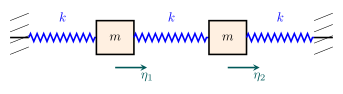
Worked Example 5 — Two equal masses and three equal springs
对上图系统,
\[\mathbf M=m \begin{pmatrix} 1&0\\ 0&1 \end{pmatrix}, \qquad \mathbf K=k \begin{pmatrix} 2&-1\\ -1&2 \end{pmatrix}.\]
特征方程
\[\det \begin{pmatrix} 2k-m\omega^2&-k\\ -k&2k-m\omega^2 \end{pmatrix} =0\]
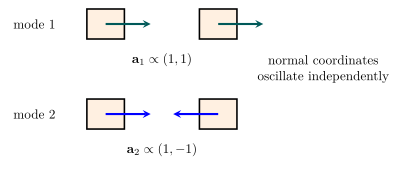
给出
\[\boxed{ \omega_1=\sqrt{\frac{k}{m}}, \quad \mathbf a_1\propto(1,1) },\]
\[\boxed{ \omega_2=\sqrt{\frac{3k}{m}}, \quad \mathbf a_2\propto(1,-1) }.\]
若 \(m=0.500\ \mathrm{kg}\)、\(k=200\ \mathrm{N\,m^{-1}}\),
\[\omega_1=20.0\ \mathrm{rad\,s^{-1}}, \qquad f_1=3.18\ \mathrm{Hz},\]
\[\omega_2=34.6\ \mathrm{rad\,s^{-1}}, \qquad f_2=5.51\ \mathrm{Hz}.\]
6. Lesson synthesis / 全课整合
6.1 Symmetry-to-solution chain
\[\boxed{ \text{geometry} \longrightarrow L(\mathbf q,\dot{\mathbf q},t) \longrightarrow \text{continuous symmetry} \longrightarrow \text{conserved quantity} \longrightarrow \text{reduced dynamics} }\]
- Central force: rotational symmetry \(\Rightarrow\ell\) conserved \(\Rightarrow\) effective radial problem.
- Symmetric top: cyclic Euler angles \(\Rightarrow\) two momenta conserved \(\Rightarrow\) nutation reduces to one dimension.
- Small oscillations: quadratic symmetry of matrices \(\Rightarrow\) generalized eigenvectors \(\Rightarrow\) independent normal coordinates.
6.2 Core equation sheet
\[p_i=\frac{\partial L}{\partial\dot q_i}, \qquad \dot p_i=\frac{\partial L}{\partial q_i},\]
\[\mathcal E_L=\sum_i\dot q_i p_i-L, \qquad \frac{d\mathcal E_L}{dt}=-\frac{\partial L}{\partial t},\]
\[\delta L=\varepsilon\frac{dF}{dt} \quad\Longrightarrow\quad J=\sum_i p_i\xi_i-F,\]
\[V_{\rm eff}=V+\frac{\ell^2}{2mr^2}, \qquad \mathbf K\mathbf a=\omega^2\mathbf M\mathbf a.\]
7. Misconception clinic / 易错概念诊所
| Misconception | Correction |
|---|---|
| “写出 \(T-V\) 就完成了建模。” | 先确认坐标、参考系、约束和速度;漏一个 moving-basis 项会改变全部动力学。 |
| “循环坐标本身守恒。” | 守恒的是共轭动量 \(p_k\),不是一般随时间不变的 \(q_k\)。 |
| “广义动量总是 \(m\mathbf v\) 的分量。” | 曲线坐标、刚体和速度耦合中它可含度量因子或其他项。 |
| “Noether 只适用于 \(\delta L=0\)。” | 更一般的准对称允许 \(\delta L=dF/dt\)。 |
| “无显式时间就自动有 \(T+V\) 守恒。” | 守恒的是 \(\mathcal E_L\);它等于 \(T+V\) 还要求自然 Lagrangian 结构。 |
| “centrifugal barrier 是一种新力。” | 它是固定角动量后的一维有效势项。 |
| “所有小扰动都是简谐振动。” | 仅在稳定平衡、二阶展开和适当正则矩阵条件下成立。 |
8. Practice and retrieval / 练习与检索
A. Conceptual questions
- 为什么支点匀速平移不改变摆的内禀运动,而支点加速度会改变?
- 若 \(q_k\) 循环,能否推出 \(\dot q_k\) 常量?
- 空间平移使 \(L\) 增加全导数时,为什么仍可称为准对称?
- 中心力轨道为什么必定在一个平面内?
- 刚体的 \(\boldsymbol\omega\) 与 \(\mathbf L\) 为什么一般不平行?
- 简正向量为什么应当用 \(\mathbf M\)-内积正交,而不一定用普通点积?
B. Derivation and quantitative questions
- 对自由粒子平移 \(\mathbf r\to\mathbf r+\varepsilon\mathbf a\) 应用 Noether theorem,推出 \(\mathbf p\cdot\mathbf a\) 守恒。
- 对二维各向同性振子 \(L=\frac12m(\dot x^2+\dot y^2)-\frac12k(x^2+y^2)\), 写出由旋转对称产生的守恒量。
- 对 \(V(r)=-k/r\),用 \(V_{\rm eff}\) 求圆轨道半径与 \(\ell\) 的关系,并检查稳定性。
- 一均匀圆盘质量 \(M=3.00\ \mathrm{kg}\)、半径 \(R=0.250\ \mathrm m\),绕对称轴以 \(20.0\ \mathrm{rad\,s^{-1}}\) 转动。求 \(T_{\rm rot}\)。
- 对两个等质量、只有中间一根弹簧相连且整体可自由平移的系统,写出 \(\mathbf K\) 并解释零频模。
- 若 \(\mathbf K\) 有一个负本征值,说明对应线性化解的时间行为。
Answers / 参考答案
1. 匀速只对应 Galilean boost;在速度平方展开中与运动有关的线性项可化为全导数。加速度项不能整体消去,会成为有效驱动。
2. 不能。\(p_k\) 是常量,但 \(p_k\) 与 \(\dot q_k\) 的关系可依赖其他坐标。
3. 作用量只改变端点项;固定端点的变分和运动方程不变,Noether charge 要相应减去 \(F\)。
4. 旋转对称使 \(\mathbf L\) 守恒;\(\mathbf r\cdot\mathbf L=0\),所以轨道始终位于垂直固定 \(\mathbf L\) 的平面。
5. \(\mathbf L=\mathbf I\boldsymbol\omega\);除非绕主轴或惯量各向同性,线性变换会改变方向。
6. 动能的二次型定义自然内积;\(\mathbf M\)-正交使动能和势能同时对角化。
7.
\(F=0\)、\(\boldsymbol\xi=\mathbf a\),故
\(J=\mathbf p\cdot\mathbf a\)。任意常向量 \(\mathbf a\) 都成立,所以 \(\mathbf p\) 守恒。
8.
\[J=p_x(-y)+p_yx
=m(x\dot y-y\dot x)
=L_z.\]
9.
\[\frac{dV_{\rm eff}}{dr}
=\frac{k}{r^2}-\frac{\ell^2}{mr^3}=0
\quad\Rightarrow\quad
r_0=\frac{\ell^2}{mk}.\]
在 \(r_0\),
\(d^2V_{\rm eff}/dr^2=k/r_0^3>0\),所以径向小扰动稳定。
10.
\[I=\frac12MR^2=9.375\times10^{-2}\ \mathrm{kg\,m^2},\]
\[T_{\rm rot}=\frac12I\omega^2=18.75\ \mathrm J.\]
11.
\[\mathbf K=k
\begin{pmatrix}
1&-1\\
-1&1
\end{pmatrix}.\]
\(\mathbf a\propto(1,1)\) 不伸长弹簧,是整体平移对称产生的 \(\omega=0\) 模。
12. 若 \(\omega^2=-\gamma^2<0\),则模方程为 \(\ddot\xi-\gamma^2\xi=0\),解含 \(e^{\gamma t}\),平衡点线性不稳定。
Exit ticket
用一条因果链解释:
\[\text{rotation symmetry} \longrightarrow \text{cyclic coordinate} \longrightarrow \text{angular momentum} \longrightarrow \text{effective potential}.\]
再用一句话说明为什么 normal coordinates 能把耦合小振动变成独立振子。
9. References and source notes / 参考资料与使用说明
9.1 Source-to-content map
| Source | Used for |
|---|---|
| MIT OCW 8.09 — Chapter 1: A Review of Analytical Mechanics | Lagrangian construction, cyclic coordinates, symmetries, conservation laws and energy function |
| David Tong, University of Cambridge — The Lagrangian Formulation | Noether theorem, central-force applications, generalized coordinates and small oscillations |
| MIT OCW 8.09 — Chapter 2: Rigid Body Dynamics | inertia tensor, principal axes, Euler angles and symmetric-top structure |
| MIT OCW 8.09 — Chapter 3: Vibrations and Oscillations | simultaneous diagonalization, mass-normalized eigenvectors and normal coordinates |
| David Tong, University of Cambridge — Classical Dynamics course page | official final-year undergraduate course scope and chapter map |
9.2 Bibliographic notes
- Stewart, I. and MIT 8.09 course staff. Chapters 1–3 of Advanced Classical Mechanics provide the main independent checks for analytical mechanics, rigid bodies and oscillations.
- Tong, D. Lectures on Classical Dynamics. Cambridge DAMTP;用于核对 Noether、中心力与稳定性论证。
- 所有示意图和函数图均由正文方程原创生成,没有复制教材图形。
注释与参考文献
MIT OpenCourseWare 8.09, Chapter 1: A Review of Analytical Mechanics.
↩David Tong, University of Cambridge DAMTP, Lectures on Classical Dynamics.
↩MIT OpenCourseWare 8.09, Chapter 2: Rigid Body Dynamics.
↩MIT OpenCourseWare 8.09, Chapter 3: Vibrations and Oscillations.
↩