
Learning objectives / 学习目标
- 区分 Nernst heat theorem、perfect-crystal convention 与 unattainability formulation,并说明各自前提。
- 从热容与相变焓重建标准压力下的绝对熵,正确处理相变跳跃和单位。
- 用 ground-state degeneracy 计算 residual entropy,并判断何时不能令 \(S(0)=0\)。
- 用有限步骤制冷、Carnot 性能界和绝热退磁图景解释为什么 \(T=0\) 不能在有限操作中达到。
- 识别绝缘晶体的 \(T^3\) phonon term 与金属的 \(T\) electronic term,并由 \(C/T\) 积分检验第三律。
- 对低温公式执行维度、极限、相态、平衡性与参考态审计。
Prerequisites / 先修知识
- 熵差、熵产生与 \(S=k_B\ln\Omega\)。
- 热容、潜热与相变。
- Carnot refrigerator 与第二律性能界。
- 定积分、幂律极限、简并度和自然对数。
Scope and conventions / 范围与约定
- 温度一律为 thermodynamic temperature,单位 K;\(T=0\) 指绝对零度,不等于摄氏零度。
- 对固定组成的平衡物质,在标准压力 \(p^\circ\) 下沿可逆加热路径重建 \(S_m^\circ(T)\);每次一级相变显式加入 \(\Delta H_{tr}/T_{tr}\)。
- “perfect crystal at \(0\ \mathrm K\) has zero entropy”要求唯一、有序的基态。若存在冻结无序或基态简并,必须保留 residual entropy。
- unattainability 表述指任何有限步骤、有限资源的物理过程不能达到 \(T=0\);本课的 Carnot 与绝热退磁图是机制示例,不代替一般定理证明。
- 低温热容模型假设样品接近平衡、维度与能谱已说明;\(T^3\) Debye law 针对三维声学 phonons 的低温极限。
Notation and modeling contract / 符号与建模契约
| Symbol | Meaning | SI unit |
|---|---|---|
| \(S,S_m\) | entropy, molar entropy | \(\mathrm{J\,K^{-1}}\), \(\mathrm{J\,mol^{-1}K^{-1}}\) |
| \(C_p,C_V\) | molar heat capacities | \(\mathrm{J\,mol^{-1}K^{-1}}\) |
| \(\Delta H_{tr}\) | molar enthalpy of a reversible phase transition | \(\mathrm{J\,mol^{-1}}\) |
| \(g_0\) | ground-state degeneracy | 1 |
| \(S_{res}\) | residual entropy | \(\mathrm{J\,mol^{-1}K^{-1}}\) |
| \(\gamma_e\) | electronic heat-capacity coefficient | \(\mathrm{J\,mol^{-1}K^{-2}}\) |
| \(\beta\) | three-dimensional phonon coefficient | \(\mathrm{J\,mol^{-1}K^{-4}}\) |
| \(T_c,T_h\) | cold- and hot-reservoir temperatures | K |
| \(B\) | magnetic flux density in the ideal paramagnet model | T |
Knowledge 1 — Third law and zero-temperature limit / 第三定律与零温极限
Knowledge ID: P03-U04-L03-K01
1.1 第三律给熵标尺加上低温边界条件
第二律只给出熵差。第三律把注意力放到 \(T\to0\):对处于内部平衡的 perfect crystal,若基态唯一,Planck form 写为
\[\boxed{\lim_{T\to0}S(T)=0.}\]
更接近 Nernst heat theorem 的说法是:当 \(T\to0\) 时,同温下两个可由可逆参数变化连接的平衡态之间的熵差趋于零,
\[\lim_{T\to0}\left[S(T,X_2)-S(T,X_1)\right]=0,\]
其中 \(X\) 可代表压力、磁场等外参量。这个极限不允许我们忽略 ground-state degeneracy;若整个系统的基态数为 \(g_0>1\),统计表达给出总熵常数 \(k_B\ln g_0\)。只有当允许构型数随粒子数呈指数增长时,这一项才在热力学极限保留非零 molar residual entropy;有限的整体简并对每摩尔熵趋于零。
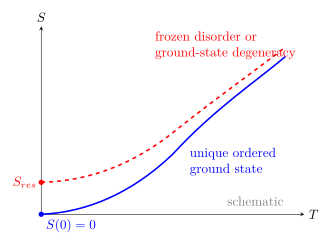
图 1:第三律的 perfect-crystal 零点与 residual entropy 是两条不同低温边界;不能把虚线样品强行平移到零。
1.2 热容必须让低温熵积分收敛
在无相变的固定组成路径上,
\[S(T)-S(0)=\int_0^T\frac{C_p(T')}{T'}\,dT'.\]
因此第三律与有限绝对熵要求 \(C_p/T\) 在 \(T=0\) 附近可积。仅仅说“\(C_p\to0\)”还不够;例如假想 \(C_p\propto T^n\) 时,需要 \(n>0\) 才使积分在下限收敛。
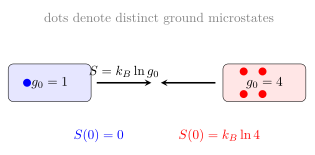
图 2:第三律零点取决于零温基态是否唯一;简并度是微观边界条件,不是任意加上的常数。
Worked Example 1 — 从低温热容与相变重建绝对熵
已知: 一摩尔假想晶体有唯一基态;\(0<T<20.0\ \mathrm K\) 时 \(C_p=\beta T^3\),\(\beta=2.00\times10^{-3}\ \mathrm{J\,mol^{-1}K^{-4}}\)。在 \(20.0\ \mathrm K\) 发生可逆一级相变,\(\Delta H_{tr}=120\ \mathrm{J\,mol^{-1}}\)。求刚完成相变后的 \(S_m\)。
系统与路径: 一摩尔物质、标准压力、从 perfect crystal 的 \(0\ \mathrm K\) 零点沿可逆加热路径;相变温度固定。
模型理由: 给定 Debye-like \(T^3\) 热容且只有一个相变,故连续积分与相变跳跃可分开。
低温段为
\[S_m(20^-)=\int_0^{20}\frac{\beta T^3}{T}\,dT =\frac{\beta T^3}{3}\bigg|_{20} =5.33\ \mathrm{J\,mol^{-1}K^{-1}}.\]
相变熵为
\[\Delta S_{tr}=\frac{\Delta H_{tr}}{T_{tr}} =\frac{120}{20.0} =6.00\ \mathrm{J\,mol^{-1}K^{-1}}.\]
所以
\[\boxed{S_m(20^+)=11.3\ \mathrm{J\,mol^{-1}K^{-1}}.}\]
检查: \(\beta T^3\) 的单位是热容,\(C_p/T\) 积分给熵;两项均为正。若漏掉 latent-heat jump,结果会不连续且少 \(6.00\ \mathrm{J\,mol^{-1}K^{-1}}\)。三位有效数字与输入一致。
Knowledge 2 — Absolute entropy and residual entropy / 绝对熵与剩余熵
Knowledge ID: P03-U04-L03-K02
2.1 绝对熵是沿可逆路径积出来的状态量
在标准压力下,从 \(0\ \mathrm K\) 到目标温度 \(T\),若途中经历若干一级相变,molar absolute entropy 为
\[\boxed{ S_m^\circ(T)=S_m(0) +\int_0^T\frac{C_p^\circ(T')}{T'}\,dT' +\sum_i\frac{\Delta H_{tr,i}^\circ}{T_{tr,i}} }.\]
积分应分相态进行;相变项不能塞进光滑 \(C_p(T)\)。若数据库给出 \(S_m^\circ(298.15\ \mathrm K)\),还必须同时核对物质组成、相态、标准态与参考压力。
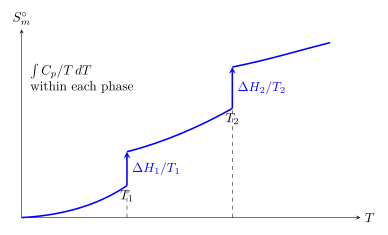
图 3:绝对熵的 calorimetric path 是分段积分加相变跳跃;曲线斜率为 \(C_p/T\)。
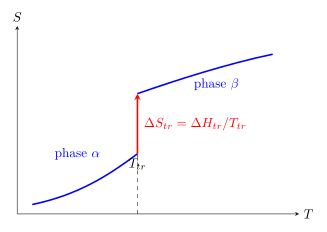
图 4:一级相变在 \(S(T)\) 图上产生有限竖直跳跃;热容积分只给各相内的连续段。
2.2 Residual entropy 来自未消除的低温多重性
若每个独立结构单元在冻结后仍有 \(g\) 种等能取向,\(N\) 个单元的 multiplicity 为 \(\Omega=g^N\),于是
\[S_{res}=k_B\ln(g^N)=Nk_B\ln g.\]
每摩尔为
\[\boxed{S_{m,res}=R\ln g.}\]
真实晶体中的取向受局域约束时,\(\Omega\) 通常不等于简单的 \(g^N\);必须依据可容许构型计数。玻璃或冻结无序也可能不是严格平衡态,所以其“残余熵”需要同时说明制备历史与观测时间尺度。
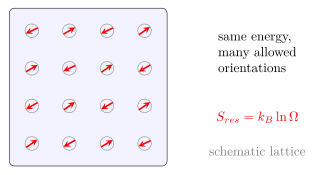
图 5:冻结的取向无序可留下大量基态构型;箭头是结构取向,不是磁矩,图不按比例。
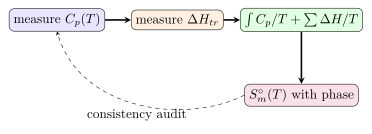
图 6:权威 thermochemical table 的绝对熵值依赖低温热容、相变焓和相态记录,而不是任意指定常数。
Worked Example 2 — 二重取向简并的 residual entropy
已知: 一摩尔冻结分子,每个分子有两种等能、相互独立的取向;忽略邻域约束。
系统与模型: 固定一摩尔样品,\(g=2\) 且 \(\Omega=2^{N_A}\)。这是独立取向的理想化上界模型。
方程与计算:
\[S_{m,res}=R\ln2 =(8.314462618)(0.693147) =5.76\ \mathrm{J\,mol^{-1}K^{-1}}.\]
因此
\[\boxed{S_{m,res}=5.76\ \mathrm{J\,mol^{-1}K^{-1}}.}\]
检查: \(R\) 给出 molar unit,\(\ln2\) 无量纲;若只有唯一取向 \(g=1\),极限正确地给 \(0\)。相互作用会缩小允许构型数,所以不能不加说明地把此结果用于真实晶格。
Knowledge 3 — Unattainability of absolute zero / 绝对零度不可达
Knowledge ID: P03-U04-L03-K03
3.1 越接近零温,有限操作的降温余量越小
Unattainability principle 表示:任何可实现的有限步骤、有限时间、有限资源过程都不能把系统从 \(T>0\) 降到 \(T=0\)。可以构造趋近零的序列,但每个有限编号的状态仍满足 \(T_n>0\)。
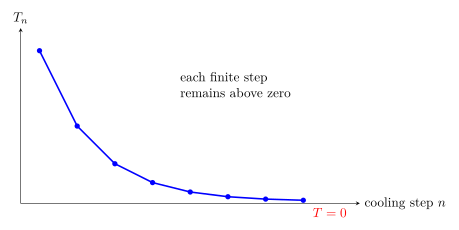
图 7:一列正温度可无限逼近零,但不存在某个有限步骤等于零;纵轴为示意,不按比例。
Carnot refrigerator 提供直观性能界。在 \(T_h\) 固定时,
\[\mathrm{COP}_{R,C}=\frac{T_c}{T_h-T_c},\]
所以 \(T_c\to0\) 时 \(\mathrm{COP}_{R,C}\to0\),每抽走单位热量所需的最小功趋于无穷。这说明接近零温的 cooling leverage 消失,但它不是 unattainability 的一般数学证明。
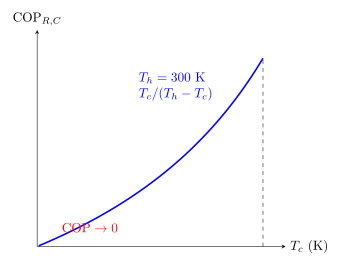
图 8:固定 \(T_h=300\ \mathrm K\) 时,理想冰箱在 \(T_c\to0\) 的 COP 也趋于零。
3.2 绝热退磁是“逼近而非到达”的典型机制
理想非相互作用 paramagnet 在适用区间内,reversible adiabatic demagnetization 近似沿 \(T/B=\text{constant}\) 移动:先在强场下等温磁化排热,再隔热降低 \(B\),自旋系统降温。
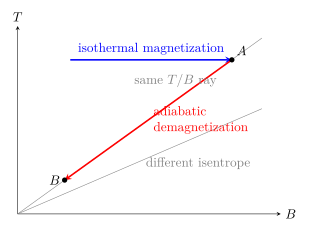
图 9:理想 paramagnet 的绝热退磁沿近似等熵射线降低 \(T\);低场相互作用、磁有序和热漏会使模型失效。
Worked Example 3 — 接近绝对零度的 Carnot 代价
已知: 理想 reversible refrigerator 在 \(T_h=300\ \mathrm K\) 与 \(T_c=1.00\ \mathrm K\) 间工作,每循环从冷端移走 \(Q_c=1.00\ \mathrm J\)。
系统与方向: 装置为 cyclic system;\(Q_c\) 从冷端进入装置,功 \(W_{in}\) 输入装置。
模型理由: Carnot 值给同温界下最大 COP,因此算出的功是理论最小值。
\[\mathrm{COP}_{R,C}=\frac{1.00}{300-1.00}=3.344\times10^{-3}.\]
\[W_{in,min}=\frac{Q_c}{\mathrm{COP}_{R,C}} =299\ \mathrm J, \qquad Q_h=Q_c+W_{in}=300\ \mathrm J.\]
若冷端降到 \(0.100\ \mathrm K\),同样移走 \(1.00\ \mathrm J\) 需
\[W_{in,min}=Q_c\frac{T_h-T_c}{T_c} =2.999\times10^3\ \mathrm J.\]
检查: 温度比无量纲且 \(Q_h=Q_c+W_{in}\);冷端降低十倍,所需功约增十倍。结果只展示 Carnot 性能退化,不声称单凭此式证明所有第三律版本。
Knowledge 4 — Low-temperature heat capacity / 低温热容
Knowledge ID: P03-U04-L03-K04
4.1 Phonons 与 conduction electrons 给出不同幂律
三维绝缘晶体的低温 acoustic phonons 在 Debye limit 下给
\[C_{V,ph}=\beta T^3.\]
普通金属还含有 Fermi surface 附近的电子激发,最低阶为
\[C_{V,e}=\gamma_e T,\]
因此常用拟合式是
\[\boxed{C_V=\gamma_e T+\beta T^3.}\]
把两边除以 \(T\) 得
\[\frac{C_V}{T}=\gamma_e+\beta T^2,\]
所以 \(C_V/T\) 对 \(T^2\) 作图应在适用温区近似为直线;截距区分电子项,斜率给 phonon coefficient。
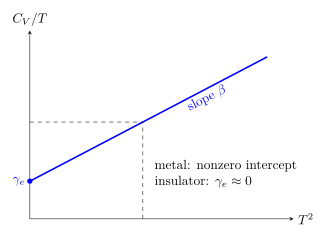
图 10:低温 \(C_V/T\)–\(T^2\) 线性化能分离金属电子项和三维 phonon 项。
4.2 热容幂律必须与熵极限相容
由 \(dS=C_VdT/T\),上述两项分别给
\[S(T)-S(0)=\gamma_e T+\frac{\beta T^3}{3}.\]
当 \(T\to0\) 时,两项都趋于零,与第三律相容。对 gapped excitation,热容常呈 exponential suppression;不同维度、无序、磁性或临界点会改变幂律,不能机械套用 \(T^3\)。
固体低温下常有 \(C_p\approx C_V\),但二者并非定义上相等。一般关系
\[C_p-C_V=TV\frac{\alpha^2}{\kappa_T}\]
其中 \(\alpha\equiv V^{-1}(\partial V/\partial T)_p\) 是体膨胀系数,\(\kappa_T\equiv -V^{-1}(\partial V/\partial p)_T\) 是等温压缩系数;差值是否可忽略取决于二者与温区,不能把 \(\alpha\) 误作线膨胀系数。
Worked Example 4 — 用 \(C/T\) 拟合式求低温热容和熵增量
已知: 一摩尔金属在 \(0<T\le5.00\ \mathrm K\) 内满足 \(C_V=\gamma_eT+\beta T^3\),其中 \(\gamma_e=8.00\ \mathrm{mJ\,mol^{-1}K^{-2}}\),\(\beta=0.200\ \mathrm{mJ\,mol^{-1}K^{-4}}\)。求 \(C_V(5.00\ \mathrm K)\) 与 \(S(5.00)-S(0)\)。
系统与模型: 一摩尔平衡金属,忽略相变、核自旋与额外 magnetic contribution;积分下限模型有效至零。
单位转换: \(\gamma_e=8.00\times10^{-3}\ \mathrm{J\,mol^{-1}K^{-2}}\),\(\beta=2.00\times10^{-4}\ \mathrm{J\,mol^{-1}K^{-4}}\)。
\[C_V=(8.00\times10^{-3})(5.00) +(2.00\times10^{-4})(5.00)^3 =0.0650\ \mathrm{J\,mol^{-1}K^{-1}}.\]
\[S(5)-S(0)=\gamma_eT+\frac{\beta T^3}{3} =0.0400+0.00833 =0.0483\ \mathrm{J\,mol^{-1}K^{-1}}.\]
检查: electronic and phonon heat capacities 分别为 \(0.0400\) 与 \(0.0250\ \mathrm{J\,mol^{-1}K^{-1}}\);均为正。熵积分多除一个 \(T\),故 phonon 熵项是 \(\beta T^3/3\) 而不是 \(\beta T^4/4\)。三位有效数字合理。
Lesson synthesis / 全课整合
第三律把上一课的“只确定熵差”补成一条可比较的标尺,但这条标尺带有明确的物质条件:unique perfect-crystal ground state 才取 \(S(0)=0\);简并或冻结无序留下 \(S_{res}\)。实验上,绝对熵由 \(C_p/T\) 分相积分并加入相变熵。动力学上,任何有限制冷操作只能逼近 \(0\ \mathrm K\)。微观上,低能 excitation spectrum 决定 \(C(T)\),而 \(\int C/T\,dT\) 又必须满足零温熵边界。
建模流程: 确认相态与平衡性 → 判断 \(S(0)\) 是否可取零 → 分段列出 \(C_p(T)\) 与相变 → 积分并加跳跃 → 检查 residual entropy → 用 \(T\to0\) 极限审计热容与制冷模型。
Formula-and-decision table / 公式—决策表
| Task | Relation | Use only when | Key caution |
|---|---|---|---|
| perfect-crystal zero point | \(\lim_{T\to0}S=0\) | unique ordered equilibrium ground state | not universal for frozen disorder |
| absolute molar entropy | \(S_m(T)=S_m(0)+\int_0^T C_p/T'\,dT'+\sum\Delta H_{tr}/T_{tr}\) | reversible standard-pressure reconstruction | integrate phase by phase |
| residual entropy | \(S_{m,res}=R\ln g\) | independent \(g\)-fold local degeneracy | constraints change \(\Omega\) |
| Carnot cooling bound | \(\mathrm{COP}_{R,C}=T_c/(T_h-T_c)\) | reversible two-reservoir refrigerator | illustration, not full third-law proof |
| 3D phonon heat capacity | \(C_{V,ph}=\beta T^3\) | Debye low-\(T\) regime | dimension/disorder can change power |
| metal low-\(T\) fit | \(C_V/T=\gamma_e+\beta T^2\) | normal metal, no nearby transition | extra magnetic/nuclear terms possible |
| entropy from low-\(T\) fit | \(S-S(0)=\gamma_eT+\beta T^3/3\) | same validity range as fitted \(C_V\) | do not extrapolate blindly |
Model boundaries / 模型边界
- Perfect crystal and unique ground state are physical assumptions; metastable glass、ice-rule constraints 或 quenched disorder 需要另外计数。
- Absolute entropy tables are conditional on composition, phase, pressure convention and data extrapolation; a database value is not context-free。
- Debye \(T^3\) law assumes three-dimensional acoustic modes with approximately linear low-frequency dispersion;低维材料幂律不同。
- \(\gamma_eT\) describes ordinary gapless metallic quasiparticles;superconducting gap、magnetic ordering 和 nuclear terms 会改变最低温行为。
- Ideal-paramagnet \(T/B=\mathrm{constant}\) fails when spin interactions, ordering, field-independent splittings or thermal leaks matter。
- Third-law thermodynamics governs equilibrium limits;极端短时 nonequilibrium effective temperature 不自动满足相同推导。
Misconception clinic / 易错概念诊所
- “第三律说所有物体在 \(0\ \mathrm K\) 熵都等于零。” 错;零点表述需要 perfect crystal 与 unique ground state,简并可给 residual entropy。
- “只要 \(C\to0\),熵积分必收敛。” 错;必须检查 \(C/T\) 是否在下限可积。
- “绝对熵是直接用熵计读出来的。” 错;它通常由 calorimetry、相变焓与低温外推重建。
- “有限实验没有做到 \(0\ \mathrm K\),只是仪器不够好。” 不充分;unattainability 是热力学极限,改进仪器只能继续逼近。
- “所有固体都有 \(C\propto T^3\)。” 错;这是三维 acoustic phonon 的低温项,金属还有 \(T\) 项,维度与能隙会改变规律。
- “\(C_p=C_V\) 对固体严格成立。” 错;低温下常近似接近,差值仍由热膨胀与压缩性决定。
Practice and retrieval / 练习与检索
1. 第三律前提(K01)
一个 perfect crystal 有唯一基态。写出其 \(T\to0\) 熵极限;若有四重基态简并,单个粒子的零温熵是什么?
Answer
唯一基态时 \(S\to0\)。四重简并时单个粒子 \(S(0)=k_B\ln4\);不能再使用零熵结论。
2. 收敛条件(K01)
假想 \(C_p=aT^n\)。什么 \(n\) 能使 \(\int_0^T C_p/T'\,dT'\) 在零温端收敛?
Answer
被积函数为 \(aT'^{n-1}\);在下限收敛要求 \(n>0\)。\(n=0\) 给 logarithmic divergence,\(n<0\) 更严重。
3. 相变熵(K02)
一摩尔物质在 \(100\ \mathrm K\) 发生可逆相变,\(\Delta H_{tr}=2.00\ \mathrm{kJ\,mol^{-1}}\)。求熵跳跃。
Answer
\(\Delta S_{tr}=\Delta H_{tr}/T_{tr}=2000/100=20.0\ \mathrm{J\,mol^{-1}K^{-1}}\)。
4. Residual entropy(K02)
每个结构单元有三种独立等能取向。求理想化 molar residual entropy。
Answer
\(S_{m,res}=R\ln3=(8.314462618)(1.098612)=9.13\ \mathrm{J\,mol^{-1}K^{-1}}\)。真实约束可能减少此值。
5. 数据表审计(K02)
为什么引用 \(S_m^\circ=XXX\) 时必须同时写出温度、相态和标准态?
Answer
熵随温度并在相变处跳跃;同一化学式的 solid、liquid、gas 数值不同,标准态还规定压力和稳定形态。缺少这些限定就无法复现或比较。
6. Unattainability(K03)
若理想操作每步把温度减半,从 \(8.00\ \mathrm K\) 开始,五步后温度是多少?这是否达到绝对零度?
Answer
\(T_5=8.00/2^5=0.250\ \mathrm K\),仍为正。任意有限步数都不等于零。
7. Carnot 冷却界(K03)
\(T_h=300\ \mathrm K\)、\(T_c=3.00\ \mathrm K\) 的 Carnot refrigerator 最大 COP 是多少?每移走 \(6.00\ \mathrm J\) 至少需多少功?
Answer
\(\mathrm{COP}_{R,C}=3/(300-3)=0.0101\);\(W_{min}=Q_c/\mathrm{COP}=594\ \mathrm J\)。能量核对给 \(Q_h=600\ \mathrm J\)。
8. 低温线性化(K04)
\(C_V/T\) 对 \(T^2\) 图线的截距与斜率分别代表什么?绝缘体理想外推的截距应怎样?
Answer
由 \(C_V/T=\gamma_e+\beta T^2\),截距为 electronic coefficient \(\gamma_e\),斜率为 phonon coefficient \(\beta\)。无导电电子的理想绝缘体截距近似为零。
9. Debye 熵(K04)
绝缘晶体低温有 \(C_V=\beta T^3\)。从 \(0\) 到 \(T\) 的熵增量是什么?它如何满足第三律?
Answer
\(S(T)-S(0)=\int_0^T\beta T'^2dT'=\beta T^3/3\),在 \(T\to0\) 时趋于零。
10. 模型边界(K01–K04)
实验发现某样品最低温区 \(C/T\) 显著上翘。能否仍用 \(\gamma_e+\beta T^2\) 外推到零?给出至少两项应检查的物理原因。
Answer
不能未经检验直接外推。应检查 magnetic or nuclear Schottky contribution、superconducting/structural transition、样品非平衡、热漏、低维效应或测温误差;确定新项后再积分 \(C/T\)。
Exit ticket / 课末检验
- 给出一句带完整前提的 perfect-crystal 第三律表述,并说明 residual entropy 为什么不构成逻辑矛盾。
- 面对一组低温 \(C_p(T)\) 与相变焓数据,写出从 \(0\ \mathrm K\) 到目标温度的 absolute-entropy reconstruction algorithm,并列出两项模型审计。
References and source notes / 参考资料与来源说明
- OpenStax University Physics Volume 2, 4.7 Entropy on a Microscopic Scale — third law、multiplicity 与 residual-order 接口。
- MIT OCW 5.60, Lecture 11 — The Third Law — absolute entropy、third-law formulations 与 low-temperature limit。
- MIT OCW 20.110J, Lecture 16 — Third Law of Thermodynamics — perfect-crystal zero point、calorimetric entropy construction。
- NIST Chemistry WebBook — phase-specific standard molar entropy and heat-capacity data model。
- NIST Chemistry WebBook Guide — thermochemical quantities、units、phase and standard-state metadata。
- NIST JPCRD Reprints Index — Thermodynamic Properties of Key Organic Oxygen Compounds, Part 1, DOI 10.1063/1.555747 — 官方条目与论文元数据;用于定位低温 calorimetry、glass residual entropy 与 thermal-history caveat。
- MIT OCW 3.012, Lecture 23 — Phonons and the Debye Model — Debye density of states and low-temperature \(T^3\) heat capacity。
- NIST NBS IR 85-3133, Thermometry — thermodynamic temperature scale、cryogenic thermometry 与测量边界。
以上链接均于 2026-08-24 实际打开并核对到具体页面或 PDF。正文统一使用 molar heat capacity 与 SI unit;所有图按本文方程原创,不复制来源插图。
Source-to-content map
| Source | Used for | Knowledge ID / Section | Model boundary or convention |
|---|---|---|---|
| OpenStax 4.7 | third law and microscopic multiplicity | K01, K02 | simplified statistical interpretation |
| MIT 5.60 Lecture 11 | Nernst/Planck forms and absolute entropy | K01, K02 | equilibrium thermodynamic limit |
| MIT 20.110J Lecture 16 | calorimetric reconstruction | K01, K02 | reversible standard-pressure path |
| NIST Chemistry WebBook | standard molar entropy examples | K02 | phase, temperature and standard state required |
| NIST WebBook Guide | metadata and units | K02 | database convention explicitly retained |
| NIST JPCRD reprint index and indexed organic-compounds review | low-temperature glass calorimetry and residual entropy | K01, K02 | preparation history matters; index supplies stable official metadata |
| MIT 3.012 Lecture 23 | Debye phonons and \(T^3\) law | K04 | three-dimensional low-frequency limit |
| NIST NBS IR 85-3133 | low-temperature measurement limits | K03, K04 | operational temperature scale and uncertainty |
复习与拓展
- 下一单元用 \(dU=TdS-pdV\) 把熵、温度和压强组织成 fundamental thermodynamic relations。
- Chemical thermodynamics 将用 absolute entropy 计算 standard reaction entropy 与 Gibbs free energy。
- Solid-state physics 将从 phonon density of states 推导 Debye coefficient,并讨论低维材料和 superconducting gap。
- Statistical mechanics 将区分 exact ground-state degeneracy、ensemble entropy 与 nonequilibrium configurational entropy。