
Learning objectives / 学习目标
完成本课后,你应当能够:
- 严格区分温度、内能与热量,并画出系统边界判断 \(Q\) 的符号。
- 使用热容、比热容与摩尔热容,说明过程约束与温度依赖。
- 建立理想量热器的能量守恒方程,判断是否会越过相变温度。
- 分段计算包含升温、熔化、汽化等步骤的能量传递。
- 说明一级相变中的潜热、两相共存,以及焓、熵或密度等性质可能出现的有限跳变。
- 读取 \(p\)–\(T\) 相图,识别共存线、三相点、临界点和超临界区。
- 用 Clapeyron 关系定性解释熔化线斜率,尤其是水的反常负斜率。
Prerequisites / 先修知识
- Thermal Equilibrium and Temperature 中的温度、热平衡与绝对温标;
- 能量守恒、系统边界、一次方程和分段函数图像;
- 斜率、面积与简单微分的物理意义。
Scope and conventions / 范围与约定
全篇使用 SI,所研究对象明确称为“系统”。因温差进入系统的能量记 \(Q>0\),离开系统记 \(Q<0\)。只有在不计功、动能、重力势能及其他能量通道时才写 \(\Delta U=Q\);完整第一定律留到 Unit 3.3。量热计算默认容器绝热、最终达到共同平衡温度,除非题目显式计入量热器或环境。
Notation and modeling contract / 符号与建模契约
| Symbol | Meaning | SI unit / convention |
|---|---|---|
| \(U\) | internal energy / 内能 | J,状态量 |
| \(Q\) | heat transfer / 因温差传递的能量 | J,过程量;入系统为正 |
| \(C,c,C_m\) | 热容、比热容、摩尔热容 | \(\mathrm{J\,K^{-1}}\)、\(\mathrm{J\,kg^{-1}K^{-1}}\)、\(\mathrm{J\,mol^{-1}K^{-1}}\) |
| \(L\) | specific latent heat / 比潜热 | \(\mathrm{J\,kg^{-1}}\) |
| \(p,T\) | pressure, absolute temperature | Pa, K |
本课中 \(c\) 若无下标表示给定过程下的有效比热容,不暗示它与温度或压强无关;相变平台仅指指定压强下的准静态一级相变。
0. Before starting: state quantities and process quantities
| Quantity | Is it stored in a state? | SI unit | Key question |
|---|---|---|---|
| Temperature \(T\) | yes | K | 热平衡比较给出什么? |
| Internal energy \(U\) | yes | J | 系统微观能量总账是多少? |
| Heat \(Q\) | no | J | 因温差有多少能量跨过边界? |
| Work \(W\) | no | J | 通过宏观力—位移等方式跨边界多少能量? |
Knowledge 1 — Heat, internal energy, and temperature distinction / 热量、内能与温度的区分
Knowledge ID: P03-U01-L02-K01
1.1 Temperature is not energy content
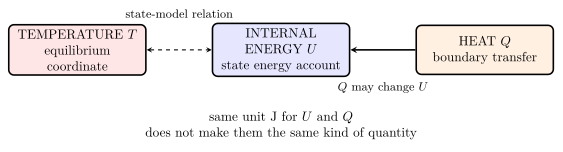
温度决定两个系统热接触时净能量传递的方向;它不是系统总能量。小杯沸水可以比湖水温度高,却远不如湖水的内能大。
内能(internal energy) \(U\) 是系统微观平动、转动、振动、相互作用等能量的总和,不包括把整个系统作为质点的宏观动能和外部势能。它是状态函数;从同一初态到同一末态,\(\Delta U\) 与路径无关。
1.2 Heat is energy in transit
热量(heat) 是仅因系统边界两侧存在温度差而传递的能量。传递结束后,这部分能量成为系统内能或转化为其他能量;系统不会“含有热量”。1
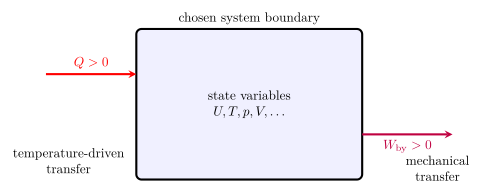
采用“系统对外做功 \(W_{\rm by}>0\)”约定,完整能量账为
\[\Delta U=Q-W_{\rm by}.\]
采用“外界对系统做功 \(W_{\rm on}>0\)”则为 \(\Delta U=Q+W_{\rm on}\)。两种都正确,但不能混用。
1.3 Three ways to raise temperature
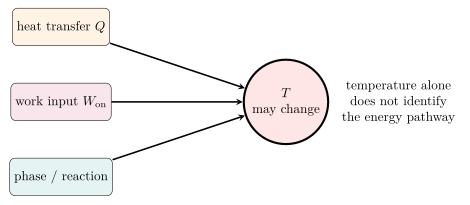
温度升高不证明一定有 \(Q>0\):
- 通过热接触加热:\(Q>0\);
- 绝热压缩:可有 \(Q=0\)、\(W_{\rm on}>0\);
- 摩擦或电阻耗散:输入的功在系统内转化为内能。
1.4 Worked Example 1 — insulated stirring
绝热容器内的液体被搅拌器做功 \(3.20\ \mathrm{kJ}\),容器不动、无其他能量变化。求液体内能的变化。
已知条件: 搅拌器对液体做功 \(W_{\rm on}=3.20\ \mathrm{kJ}\);容器绝热,所以 \(Q=0\);宏观动能、重力势能与容器体积均不变。
研究对象: 容器内全部液体。
系统边界 / 参考系: 系统边界沿液体外缘;搅拌轴穿过边界传入机械功,但边界不传热。在容器静止的实验室参考系中,系统整体无平动。
坐标与正方向: 空间坐标 N/A。能量符号约定为“进入液体为正”,故 \(W_{\rm on}>0\)。
模型及理由: 对封闭系统应用第一定律,并忽略 \(\Delta K\)、\(\Delta U_g\) 与边界体积功;题目已声明绝热且无其他能量变化。
方程建立:
\[\Delta U=Q+W_{\rm on}.\]
逐步计算:
\[Q=0,\qquad W_{\rm on}=+3.20\ \mathrm{kJ},\]
\[\boxed{\Delta U=+3.20\ \mathrm{kJ}}.\]
SI 与有效数字: \(3.20\ \mathrm{kJ}=3.20\times10^3\ \mathrm J\);加法两项均为能量,量纲一致。原数据为三位有效数字,结果保留三位。
方向 / 量纲检查: 搅拌器向系统输入能量,故 \(\Delta U\) 应为正;若算出负值将违背所选符号约定。
极限或合理性检查: 若搅拌器不做功且仍绝热,则 \(W_{\rm on}=Q=0\),公式给出 \(\Delta U=0\)。若存在向外散热,实际 \(\Delta U\) 将小于 \(3.20\ \mathrm{kJ}\)。
物理解释: 液体升温并不意味着它吸收了 \(3.20\ \mathrm{kJ}\) 的“热量”;这里跨越系统边界的能量通道是功,进入系统后才成为内能增加。
Knowledge 2 — Specific and molar heat capacity / 比热容与摩尔热容
Knowledge ID: P03-U01-L02-K02
2.1 Three related capacities
对相邻平衡态之间、维持指定过程条件 \(X\) 的准静态路径,热容定义为
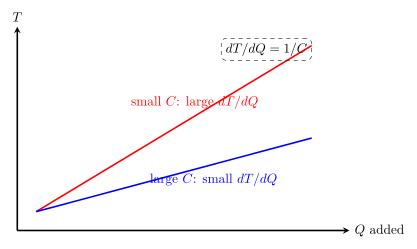
\[C_X\equiv\left(\frac{\delta Q}{dT}\right)_X, \qquad [C_X]=\mathrm{J\,K^{-1}}.\]
比热容与摩尔热容分别为
\[c_X=\frac{C_X}{m}, \qquad C_{m,X}=\frac{C_X}{n},\]
单位为 \(\mathrm{J\,kg^{-1}K^{-1}}\) 与 \(\mathrm{J\,mol^{-1}K^{-1}}\)。这里 \(\delta Q\) 提醒热量不是状态函数;气体尤其必须注明定容 \(C_V\) 或定压 \(C_p\)。对仅有 \(pV\) 功的简单可压缩闭合系统,
\[\boxed{ C_V=\left(\frac{\partial U}{\partial T}\right)_V, \qquad C_p=\left(\frac{\partial H}{\partial T}\right)_p, \qquad H=U+pV }.\]
这些等式依赖所写约束和功模式,不能把一个未注明过程的“热容”当成普适材料常数。2
2.2 Constant-capacity approximation
若全过程维持同一约束 \(X\)、无相变或其他额外能量通道,且 \(c_X\) 在温区内近似常数,
\[\boxed{Q=mc\Delta T=nC_m\Delta T}.\]
一般情形应积分:
\[Q=m\int_{T_1}^{T_2}c_X(T)\,dT.\]
2.3 Capacity depends on material, phase, and temperature
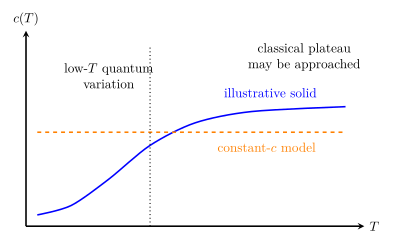
图只表达“\(c\) 可能随 \(T\) 变”,不是某种材料的拟合曲线。接近相变、低温或高温时,把表格中的单一 \(c\) 当作常数尤其危险。
2.4 Worked Example 2 — electric heater
\(m=2.00\ \mathrm{kg}\) 的铝块取 \(c=900\ \mathrm{J\,kg^{-1}K^{-1}}\),由 \(20.0^\circ\mathrm C\) 加热到 \(70.0^\circ\mathrm C\)。用 \(500\ \mathrm W\) 加热器,求忽略损失时的理想加热时间。
已知条件: \(m=2.00\ \mathrm{kg}\)、\(c=900\ \mathrm{J\,kg^{-1}K^{-1}}\)、\(t_i=20.0^\circ\mathrm C\)、\(t_f=70.0^\circ\mathrm C\)、\(P=500\ \mathrm W\)。
研究对象: 整块铝。
系统边界 / 参考系: 系统边界包围铝块;加热器以恒定功率向内输入能量。实验室参考系中铝块静止,忽略加热器、支架和环境的储能或散热。
坐标与正方向: 空间坐标 N/A;把进入铝块的能量和温升定义为正。
模型及理由: 铝在 \(20\)–\(70^\circ\mathrm C\) 内保持单一固相,取 \(c\) 为常数;温差有限且题目给出代表性 \(c\),故用 \(Q=mc\Delta T\)。理想加热器满足 \(Q=Pt\)。
方程建立:
\[\Delta T=t_f-t_i=50.0\ \mathrm K, \qquad Q=mc\Delta T, \qquad t=\frac{Q}{P}.\]
逐步计算:
\[Q=mc\Delta T=(2.00)(900)(50.0)=9.00\times10^4\ \mathrm J.\]
\[t=\frac{9.00\times10^4\ \mathrm J}{500\ \mathrm{J\,s^{-1}}} =180\ \mathrm s.\]
SI 与有效数字: \(\mathrm{kg}\cdot\mathrm{J\,kg^{-1}K^{-1}}\cdot\mathrm K=\mathrm J\),且 \(\mathrm J/(\mathrm{J\,s^{-1}})=\mathrm s\)。按给定数据报告三位有效数字,即 \(1.80\times10^2\ \mathrm s\)。
方向 / 量纲检查: \(t_f>t_i\),所以 \(Q>0\);恒正功率输入给出正时间。
极限或合理性检查: 若功率加倍,\(t\) 应减半;若 \(\Delta T\to0\),则 \(t\to0\)。\(500\ \mathrm W\) 在 \(180\ \mathrm s\) 内提供 \(90.0\ \mathrm{kJ}\),与所需能量吻合。
物理解释: \(180\ \mathrm s\) 是所有输入功率都进入铝块时的下限。真实时间更长,因为容器也吸能且存在向环境的传热。
Knowledge 3 — Calorimetry and thermal mixing / 量热与热混合
Knowledge ID: P03-U01-L02-K03
3.1 The calorimetry balance
理想量热器把参与混合的物体作为近似隔离的总系统:
\[\boxed{\sum_i Q_i=0}.\]
对不相变且 \(c_i\) 恒定的各物体,
\[\sum_i m_ic_i(T_f-T_i)=0.\]
于是
\[\boxed{ T_f=\frac{\sum_i C_iT_i}{\sum_i C_i} }, \qquad C_i=m_ic_i.\]
它是按热容加权的平均值,因而在所有初温的最小值与最大值之间。
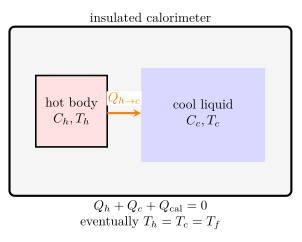
3.2 Heat direction and the weighted mean
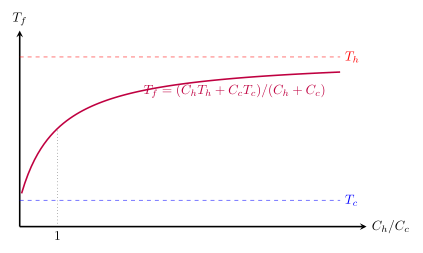
热容更大的一方把 \(T_f\) 拉得更靠近自己的初温。
3.3 Real calorimeters
实际分析至少检查:
- 量热杯、温度计、搅拌器是否吸收能量;
- 混合期间与环境的传热是否可忽略;
- 是否发生蒸发、溶解、化学反应或相变;
- 热平衡读数是否在动态漂移;
- 比热容是否可视为常数。
量热器常数 \(C_{\rm cal}\) 可直接加入:
\[Q_{\rm cal}=C_{\rm cal}(T_f-T_{{\rm cal},i}).\]
3.4 Worked Example 3 — metal, water, and calorimeter
\(0.200\ \mathrm{kg}\) 铜块在 \(150.0^\circ\mathrm C\),投入 \(0.400\ \mathrm{kg}\)、\(20.0^\circ\mathrm C\) 的水中。量热器初温也是 \(20.0^\circ\mathrm C\),\(C_{\rm cal}=150\ \mathrm{J\,K^{-1}}\)。取 \(c_{\rm Cu}=385\)、\(c_w=4186\ \mathrm{J\,kg^{-1}K^{-1}}\)。
已知条件: \(m_{\rm Cu}=0.200\ \mathrm{kg}\)、\(t_{{\rm Cu},i}=150.0^\circ\mathrm C\)、\(c_{\rm Cu}=385\ \mathrm{J\,kg^{-1}K^{-1}}\);\(m_w=0.400\ \mathrm{kg}\)、\(t_{w,i}=20.0^\circ\mathrm C\)、\(c_w=4186\ \mathrm{J\,kg^{-1}K^{-1}}\);量热器 \(C_{\rm cal}=150\ \mathrm{J\,K^{-1}}\) 且初温 \(20.0^\circ\mathrm C\)。
研究对象: 铜块、水和量热器组成的总系统。
系统边界 / 参考系: 总边界包围三者,混合期间近似绝热;实验室参考系中无整体机械能变化。系统内部的热传递可相互抵消,外界交换取零。
坐标与正方向: 空间坐标 N/A。对每一子系统规定 \(Q_i>0\) 表示该子系统吸能,因此热铜块的 \(Q_{\rm Cu}<0\),水与量热器的 \(Q>0\)。
模型及理由: 三者最终达到共同温度 \(t_f\),无相变,且各热容在温区内取常数。隔离总系统满足 \(\sum_i Q_i=0\)。
方程建立:
\[Q_{\rm Cu}+Q_w+Q_{\rm cal}=0,\]
\[m_{\rm Cu}c_{\rm Cu}(t_f-t_{{\rm Cu},i}) +m_wc_w(t_f-t_{w,i}) +C_{\rm cal}(t_f-t_{{\rm cal},i})=0.\]
逐步计算: 各热容为
\[m_{\rm Cu}c_{\rm Cu}=77.0\ \mathrm{J\,K^{-1}}, \quad m_wc_w=1674.4\ \mathrm{J\,K^{-1}}, \quad C_{\rm cal}=150\ \mathrm{J\,K^{-1}}.\]
\[(0.200)(385)(t_f-150.0) +(0.400)(4186)(t_f-20.0) +150(t_f-20.0)=0.\]
解得
\[\boxed{t_f=25.3^\circ\mathrm C}.\]
SI 与有效数字: 每一项都是 \(\mathrm{J\,K^{-1}}\times\mathrm K=\mathrm J\)。输入热容精度约为三位有效数字,故结果写成 \(25.3^\circ\mathrm C\)。
方向 / 量纲检查: \(20.0<t_f<150.0^\circ\mathrm C\),所以铜放能而水和量热器吸能,符号与物理过程一致。
极限或合理性检查: 若忽略量热器,计算得 \(t_f\approx25.7^\circ\mathrm C\),高于含量热器的结果;增加冷端热容应把终温进一步拉向 \(20.0^\circ\mathrm C\)。
物理解释: 水的热容远大于铜块,所以最终温度只比水的初温高约 \(5.3^\circ\mathrm C\)。量热器不是“背景”,它也是吸收能量的系统组成部分。
Knowledge 4 — Latent heat and first-order phase change / 潜热与一级相变
Knowledge ID: P03-U01-L02-K04
4.1 Energy can change phase without changing temperature
在给定压强下,纯物质处于平衡的一阶相变时,两相可在同一温度共存。单位质量相变所需能量是比潜热(specific latent heat):
\[\boxed{Q=mL}.\]
常用 \(L_f\) 表示熔化潜热,\(L_v\) 表示汽化潜热。相反过程的 \(Q\) 符号相反;\(L\) 通常列正的大小。3
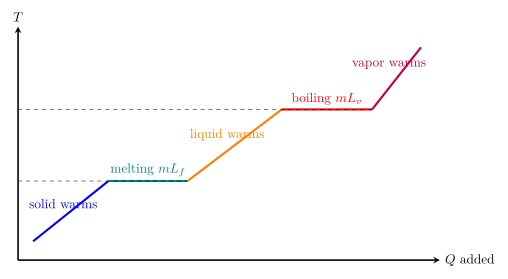
平台宽度表示潜热,不表示“没有能量进入”。在实际有限加热速率、混合物、压力变化或温度梯度下,平台可能倾斜或展宽。
4.2 Why the temperature plateaus
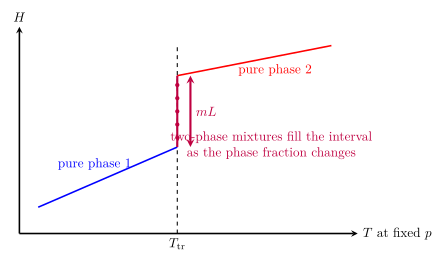
单相升温时,输入能量显著改变热运动分布;两相共存时,增加的能量主要改变相的比例和分子排列。用恒压焓 \(H\) 表示,两个纯相在同一转变温度的焓有有限差值
\[\boxed{\Delta H_{\rm phase}=mL}.\]
在摩尔形式下,平衡转变温度 \(T_{\rm tr}\) 处
\[L_m=T_{\rm tr}\Delta S_m.\]
这里的“跳变”比较的是两个纯相极限。在 \(T_{\rm tr},p\) 固定的两相共存区,若相 2 的质量分数为 \(\chi\),混合物焓可连续取
\[H_{\rm mix}=(1-\chi)H_1+\chi H_2, \qquad 0\le\chi\le1;\]
因此中间不是禁区,而是相分数逐渐改变的共存态。\(L_m=T_{\rm tr}\Delta S_m\) 是 UG1 的前瞻关系:潜热反映两相熵的差异。
4.3 A reliable piecewise workflow
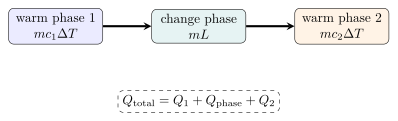
- 标出初态与目标态。
- 找所有会跨过的相变温度。
- 单相区使用 \(m\int c(T)\,dT\)。
- 相变区使用 \(mL\)。
- 给每段按系统吸能或放能赋号,再求和。
4.4 Worked Example 4 — ice added to warm water
\(0.100\ \mathrm{kg}\) 冰在 \(-10.0^\circ\mathrm C\),加入 \(0.500\ \mathrm{kg}\)、\(30.0^\circ\mathrm C\) 的水中;容器绝热。取
\[c_{\rm ice}=2090,\quad c_w=4186\ \mathrm{J\,kg^{-1}K^{-1}}, \qquad L_f=3.334\times10^5\ \mathrm{J\,kg^{-1}}.\]
已知条件: \(m_i=0.100\ \mathrm{kg}\)、\(t_{i,i}=-10.0^\circ\mathrm C\)、\(m_w=0.500\ \mathrm{kg}\)、\(t_{w,i}=30.0^\circ\mathrm C\),以及上列 \(c_{\rm ice}\)、\(c_w\)、\(L_f\)。
研究对象: 初始冰与初始液态水组成的总系统。
系统边界 / 参考系: 绝热容器包围两部分,忽略容器热容、蒸发和机械能变化;在实验室参考系中只追踪内部能量重新分配。
坐标与正方向: 空间坐标 N/A。规定进入初始冰的能量为正;初始热水放出的能量用正的“可供给量”比较,最终能量平衡仍满足总吸能加总为零。
模型及理由: 冰先按 \(mc_{\rm ice}\Delta T\) 升至 \(0^\circ\mathrm C\),再按 \(mL_f\) 熔化;只有先判断热水能否完成这两段,才能决定最终支路。相变完成后,全部液态水以 \(c_w\) 共同升温。
方程建立: 先比较
\[Q_{\rm hot,max}=m_wc_w(30.0-0),\]
与
\[Q_{\rm ice\to water}=m_ic_{\rm ice}[0-(-10.0)]+m_iL_f.\]
若前者大于后者,冰全部熔化,剩余能量满足
\[Q_{\rm rem}=(m_i+m_w)c_w(t_f-0).\]
逐步计算: 水若冷到 \(0^\circ\mathrm C\) 可放出
\[Q_{\rm hot,max}=(0.500)(4186)(30.0)=62.79\ \mathrm{kJ}.\]
冰升到 \(0^\circ\mathrm C\) 并全部熔化需要
\[Q_{\rm ice\to water} =(0.100)(2090)(10.0)+(0.100)(3.334\times10^5) =35.43\ \mathrm{kJ}.\]
因为
\[62.79\ \mathrm{kJ}>35.43\ \mathrm{kJ},\]
能量足够全部熔化。剩余 \(27.36\ \mathrm{kJ}\) 加热总共 \(0.600\ \mathrm{kg}\) 的水:
\[t_f=\frac{27.36\times10^3}{(0.600)(4186)} =10.9^\circ\mathrm C.\]
SI 与有效数字: 每一段均为 \(\mathrm{kg}\cdot\mathrm{J\,kg^{-1}K^{-1}}\cdot\mathrm K\) 或 \(\mathrm{kg}\cdot\mathrm{J\,kg^{-1}}\),单位均为 J。根据输入数据,终温报告三位有效数字 \(10.9^\circ\mathrm C\)。
方向 / 量纲检查: 初始水放能、冰吸能;最终 \(0<t_f<30.0^\circ\mathrm C\),与完成熔化后仍有剩余能量的判断一致。
极限或合理性检查: 若 \(Q_{\rm hot,max}<Q_{\rm ice\to water}\),就不能使用末段升温式,最终应为 \(0^\circ\mathrm C\) 的冰水共存并计算残余冰。若 \(m_i\to0\),则 \(t_f\to30.0^\circ\mathrm C\)。
物理解释: 本题关键不是先求加权平均,而是先用 \(62.79>35.43\ \mathrm{kJ}\) 判定相变能否完成;完成后才允许把 \(0.600\ \mathrm{kg}\) 视为同一液相。
4.5 Worked Example 5 — water to steam
在标准大气压近似下,把 \(0.250\ \mathrm{kg}\) 水从 \(20.0^\circ\mathrm C\) 变为 \(100^\circ\mathrm C\) 饱和水蒸气。取 \(L_v=2.256\times10^6\ \mathrm{J\,kg^{-1}}\),求所需能量。
已知条件: \(m=0.250\ \mathrm{kg}\)、\(t_i=20.0^\circ\mathrm C\)、沸点近似 \(t_b=100^\circ\mathrm C\)、\(c_w=4186\ \mathrm{J\,kg^{-1}K^{-1}}\)、\(L_v=2.256\times10^6\ \mathrm{J\,kg^{-1}}\)。
研究对象: 这 \(0.250\ \mathrm{kg}\) 纯水,过程末态为同质量的饱和水蒸气。
系统边界 / 参考系: 边界包围水及生成的蒸气,外界通过加热传入能量;压力维持在约 \(1\ \mathrm{atm}\)。实验室参考系中忽略整体动能、势能及容器热容。
坐标与正方向: 空间坐标 N/A。规定传入水系统的能量 \(Q>0\)。
模型及理由: 先在单一液相内用常数 \(c_w\) 加热至该压力下的沸点,再在恒温、定压平衡相变中用 \(mL_v\) 完全汽化;两段串联,能量相加。
方程建立:
\[Q=Q_{\rm sensible}+Q_{\rm latent} =mc_w(t_b-t_i)+mL_v.\]
逐步计算:
\[Q_{\rm sensible}=(0.250)(4186)(80.0) =8.37\times10^4\ \mathrm J,\]
\[Q_{\rm latent}=(0.250)(2.256\times10^6) =5.64\times10^5\ \mathrm J,\]
\[Q=(0.250)(4186)(80.0)+(0.250)(2.256\times10^6) =6.48\times10^5\ \mathrm J.\]
SI 与有效数字: 两段单位均为 J;按质量、温差和给定潜热精度,报告 \(Q=6.48\times10^5\ \mathrm J=648\ \mathrm{kJ}\)。
方向 / 量纲检查: 加热与汽化均需系统吸能,所以两项同为正,不应相减。
极限或合理性检查: 汽化段占比
\[\frac{Q_{\rm latent}}{Q}\approx0.870,\]
即约 \(87\%\);这解释了为何在沸点处温度不再升高却仍需大量能量。若 \(L_v\to0\),公式退化为单纯显热项。
物理解释: 总能量中绝大部分用于改变相而非提高温度。实际沸点和 \(L_v\) 都依压强而变,\(100^\circ\mathrm C\) 只是在标准大气压附近的教学近似。
4.6 Model boundaries: metastability and mixtures
- 过冷、过热与成核障碍可使系统暂时越过平衡相变温度。
- 合金、盐水等混合物常在温度区间内相变,不必出现水平平台。
- 潜热随压强和温度而变;表格值只对应指定状态。
- 临界点处液体与气体的差异连续消失,不再有有限汽化潜热。
Knowledge 5 — Phase diagrams and triple/critical points / 相图、三相点与临界点
Knowledge ID: P03-U01-L02-K05
5.1 A phase diagram is an equilibrium map
\(p\)–\(T\) 相图的每个区域表示平衡稳定相;曲线表示两相共存;三条共存线相交于三相点(triple point);液—气共存线终止于临界点(critical point)。
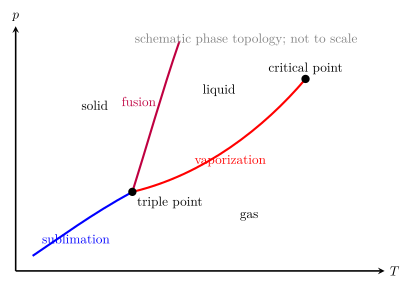
相图是平衡地图:它不直接告诉你转变速率、成核延迟或材料在快速过程中的亚稳态。
5.2 The Clapeyron slope
任意一条两相共存线满足
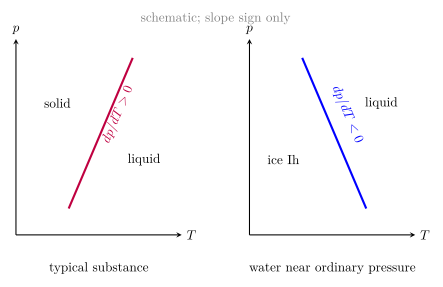
\[\boxed{ \frac{dp}{dT} =\frac{L_m}{T\Delta v_m} },\]
其中 \(\Delta v_m=v_{m,2}-v_{m,1}\)。汽化时 \(\Delta v_m>0\),故液—气曲线通常斜率为正。多数物质熔化后体积增大,熔化线也为正斜率。
水的冰 Ih 熔化时液态水更密,\(\Delta v_m=v_{\rm liquid}-v_{\rm ice}<0\),因此熔化线在普通压强附近为负斜率。
5.3 Water triple and critical points
IAPWS 推荐普通水的关键值:
\[T_t\approx273.16\ \mathrm K, \qquad p_t=(611.657\pm0.010)\ \mathrm{Pa},\]
\[\boxed{ T_c=647.096\ \mathrm K,\qquad p_c=22.064\ \mathrm{MPa} }.\]
\(T_t=273.16\ \mathrm K\) 仍是 ITS-90 的指定值与最佳实用估计,但自 2019 年起不再精确定义 SI kelvin。4
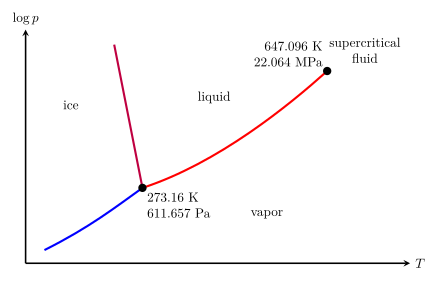
图的压强轴是示意性的对数轴,不能用直线长度读取数值。
5.4 What ends at the critical point?
沿液—气共存线接近临界点:
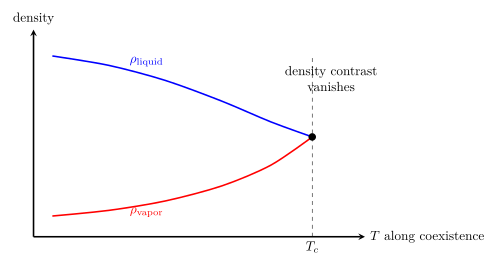
- 液体与蒸气密度差趋于零;
- 表面张力趋于零;
- 液—气界面消失;
- 汽化潜热趋于零。
超过临界点后,从“液态样”连续变到“气态样”无需跨越一级相变线;这并不表示物质“同时是液体和气体”。
6. Lesson synthesis / 全课整合
6.1 Energy-account decision tree
\[\text{choose system} \longrightarrow \text{identify energy channels} \longrightarrow \begin{cases} Q=mc\Delta T,&\text{single phase, constant }c,\\ Q=mL,&\text{equilibrium phase change},\\ \sum_iQ_i=0,&\text{isolated calorimetry}. \end{cases}\]
Formula-and-decision table / 公式—决策表
| Topic | Equation | Boundary |
|---|---|---|
| First-law preview | \(\Delta U=Q-W_{\rm by}\) | closed system, stated sign |
| Heat capacity | \(C_X=\delta Q/dT\) | process \(X\) specified |
| Sensible heating | \(Q=mc\Delta T\) | no phase change, \(c\) constant |
| Variable \(c\) | \(Q=m\int c(T)\,dT\) | path constraint fixed |
| Calorimetry | \(\sum_iQ_i=0\) | isolated total system |
| Phase change | \(Q=mL\) | equilibrium transition |
| Coexistence slope | \(dp/dT=L_m/(T\Delta v_m)\) | equilibrium coexistence line |
Model boundaries / 模型边界
- \(Q=mc\Delta T\) is not a universal definition of heat.
- Calorimetry needs a complete inventory of every heat capacity and phase change.
- A horizontal heating-curve plateau assumes nearly uniform equilibrium temperature and fixed pressure.
- Tabulated \(c\) and \(L\) are state-dependent measured properties.
- Phase diagrams map equilibrium states, not kinetic accessibility.
- Close to critical points, fluctuations and property divergences defeat simple constant-property models.
7. Misconception clinic / 易错概念诊所
| Misconception | Correction |
|---|---|
| 系统“储存热量” | 系统储存内能;热量只描述因温差跨边界的能量 |
| 只要温度升高就有 \(Q>0\) | 做功也可升温,绝热压缩可有 \(Q=0\) |
| \(U\) 只由 \(T\) 决定 | 一般还依赖物质量、体积、相态、组成等 |
| 比热容是永远不变的材料常数 | 它依赖温度、相态和过程约束 |
| 混合终温一定是两个温度的算术平均 | 只有两侧热容相等时才是算术平均 |
| 相变平台表示没有吸收能量 | 能量正在改变相比例,平台宽度对应潜热 |
| 沸点永远是 \(100^\circ\mathrm C\) | 沸点随压强变化 |
| 三相点等于普通熔点 | 三相点是唯一 \(p,T\) 共存状态;普通熔点需指定压强 |
| 2019 年后水三相点仍定义 kelvin | kelvin 由精确 \(k_B\) 定义;三相点保留校准和 ITS-90 角色 |
| 临界点以上是液气两相混合 | 是单一超临界流体,没有液—气界面 |
8. Practice and retrieval / 练习与检索
A. Conceptual questions
- 绝热压缩气体使其升温。\(Q\)、\(\Delta U\) 的符号可是什么?
- 为什么热量和内能都用 J,却不是同一种物理量?
- 量热题为何必须先检查相变,而不能直接用加权平均?
- 为什么水的普通熔化线斜率为负?
- 到达临界点时,哪些液—气差异消失?
B. Quantitative questions
- \(0.750\ \mathrm{kg}\) 水从 \(18.0^\circ\mathrm C\) 加热到 \(65.0^\circ\mathrm C\),取 \(c=4186\ \mathrm{J\,kg^{-1}K^{-1}}\)。求 \(Q\)。
- 两物体热容分别为 \(300\) 和 \(700\ \mathrm{J\,K^{-1}}\),初温 \(80.0^\circ\mathrm C\)、\(20.0^\circ\mathrm C\)。理想隔离混合终温是多少?
- \(50.0\ \mathrm g\)、\(-15.0^\circ\mathrm C\) 的冰升到 \(0^\circ\mathrm C\) 并完全熔化,需要多少能量?使用本课数值。
- \(0.100\ \mathrm{kg}\)、\(100^\circ\mathrm C\) 的蒸汽在 \(100^\circ\mathrm C\) 完全凝结,释放多少能量?取 \(L_v=2.256\ \mathrm{MJ\,kg^{-1}}\)。
- 某物质在 \(400\ \mathrm K\) 熔化,摩尔熔化潜热 \(12.0\ \mathrm{kJ\,mol^{-1}}\),熔化摩尔体积变化 \(+1.50\times10^{-6}\ \mathrm{m^3\,mol^{-1}}\)。求共存线斜率。
- 在水相图上,若低于三相点压强加热冰,能否经过稳定液相?说明路径。
Answer 1
\(Q=0\);外界做正功时 \(\Delta U>0\)。
Answer 2
J 只表示能量维度;\(U\) 是状态函数,\(Q\) 是依赖路径的边界传递。
Answer 3
若越过相变,能量包含 \(mL\) 且温度可能停在转变点。
Answer 4
熔化时 \(\Delta v_m<0\),而 \(L_m,T>0\),故 Clapeyron 斜率为负。
Answer 5
密度差、表面张力、清晰界面和汽化潜热趋于零。
Answer 6
\(Q=(0.750)(4186)(47.0)=1.48\times10^5\ \mathrm J\)。
Answer 7
\(t_f=(300\times80.0+700\times20.0)/1000=38.0^\circ\mathrm C\)。
Answer 8
\(Q=(0.0500)(2090)(15.0)+(0.0500)(3.334\times10^5)=18.2\ \mathrm{kJ}\)。
Answer 9
\(\lvert Q\rvert=(0.100)(2.256\times10^6)=226\ \mathrm{kJ}\),对蒸汽系统 \(Q<0\)。
Answer 10
\(dp/dT=12000/[400(1.50\times10^{-6})]=2.00\times10^7\ \mathrm{Pa\,K^{-1}}\)。
Answer 11
不能沿该低压等压路径进入稳定液相;冰越过升华线直接成为蒸气。
Exit ticket
画一条从“系统边界”到“相图”的推理链,至少包含 \(Q\)、\(U\)、\(c\)、\(L\)、三相点和临界点。
9. References and source notes / 参考资料与使用说明
9.1 Source-to-content map
| Source | Used for | Knowledge ID / Section | Model boundary or convention |
|---|---|---|---|
| OpenStax University Physics Vol. 2, §1.4 | heat/internal-energy distinction, heat capacity, calorimetry | K01–K03 | ideal calorimeter unless losses stated |
| OpenStax University Physics Vol. 2, §1.5 | latent heat, heating curves, phase-change workflow | K04–K05 | equilibrium phase-change model |
| OpenStax University Physics Vol. 2, §2.3 | molar capacity and process constraints | K02 | classical capacity context |
| MIT OCW 5.60 — Thermodynamics lecture notes | state/process language and zeroth-law equilibrium framework | K01 | equilibrium-state description; heat is a path transfer |
| MIT OCW 5.60 — Calorimetry lecture notes | calorimetry and heat-capacity energy accounting | K02–K03 | closed calorimeter balance and stated process constraint |
| MIT OCW 5.60 — Phase Equilibria in a 1-Component System | one-component coexistence, phase boundaries, triple and critical context | K04–K05 | pure-substance equilibrium |
| MIT OCW 5.60 — Clausius–Clapeyron Equation | phase-boundary slope and latent-heat connection | K05 | equilibrium coexistence curve; approximation stated in lesson |
| IAPWS — FAQs About Water and Steam | water saturation, triple point, critical-point interpretation | K05 | pure-water equilibrium |
| IAPWS G5-01(2026) — Fundamental Physical Constants and Basic Constants of Water | \(T_t,p_t,T_c,p_c\) and post-2019 kelvin caveat | K05 | authoritative water constants |
| IAPWS R6-95 — Formulation 1995 | water-property and vapor–liquid equilibrium boundary | K04–K05 | IAPWS-95 validity region |
9.2 Source notes
以上来源均于 2026-08-24 实际打开核对。MIT 5.60 不再引用课程首页,而是分别使用 Lecture 1、7、18、19 的具体讲义资源页;数值例题采用教学用代表值,水的精密状态点采用 IAPWS。相图与加热曲线均依据方程和相区关系原创重绘,坐标尺度只在明确标注时定量。
9.3 Reading route
- 传热速率与空间温度分布:Heat Transfer。
- 分子尺度解释热容:Molecular Energy and Distributions。
- 完整的 \(Q\)、\(W\)、\(\Delta U\):Thermodynamic Systems and Processes。
注释与参考文献
OpenStax, University Physics Volume 2, §1.4 “Heat Transfer, Specific Heat, and Calorimetry”.
↩OpenStax, University Physics Volume 2, §2.3 “Heat Capacity and Equipartition of Energy”.
↩OpenStax, University Physics Volume 2, §1.5 “Phase Changes”.
↩IAPWS, Guideline on the Use of Fundamental Physical Constants and Basic Constants of Water.
↩