
Learning objectives / 学习目标
完成本课后,你应当能够:
- 从 Lorentz force 推导均匀磁场中非相对论粒子的 Larmor radius、cyclotron frequency、period 与 helical pitch。
- 用电荷符号判断回旋方向,同时区分 signed angular frequency \(\omega_c=qB/m\) 与正的频率大小 \(\Omega_c=|q|B/m\)。
- 推导交叉场速度选择条件,并识别该条件对方向、均匀性和初始速度分量的限制。
- 建立 Bainbridge-type mass spectrometer 与加速电压型 mass analyzer 的 \(m/q\) 关系。
- 解释非相对论 cyclotron 的同步机制、能量增加与相对论失谐边界。
- 用小参数 \(\rho_L/L_B\ll1\) 说明 guiding-center 近似与 magnetic mirror 的适用条件,而不把示意图误当精确轨迹。
Prerequisites / 先修知识
- Magnetic Field and Lorentz Force。
- 匀速圆周运动:\(a_c=v^2/r=\Omega^2r\)。
- 动能与电势差:\(\Delta K=q\Delta V\),使用符号后再转为速度大小。
- 平行/垂直向量分解与右手定则。
Scope and conventions / 范围与约定
- 除非特别说明,采用真空、无碰撞、经典非相对论点粒子模型。
- \(\mathbf B=B\hat{\mathbf z}\) 且 \(B>0\);\(v_\parallel\) 沿 \(\mathbf B\),\(v_\perp\) 在垂直平面。
- \(\omega_c=qB/m\) 保留电荷符号,描述旋转 sense;\(\Omega_c=|q|B/m>0\) 是角频率大小。
- \(\rho_L=mv_\perp/(|q|B)>0\) 是 Larmor radius。
- 速度选择器的 \(v=E/B\) 是力平衡的速度大小,只有给定几何与电荷运动方向时成立。
- 磁约束部分仅介绍 adiabatic guiding-center picture;完整 plasma kinetics 不在本课范围。
Notation and modeling contract / 符号与建模契约
| Symbol | Meaning | SI unit |
|---|---|---|
| \(m\) | rest mass in nonrelativistic model | kg |
| \(q\) | signed charge | C |
| \(v_\perp\), \(v_\parallel\) | speeds perpendicular/parallel to \(\mathbf B\) | \(\mathrm{m\,s^{-1}}\) |
| \(\rho_L\) | Larmor/gyroradius | m |
| \(\omega_c=qB/m\) | signed cyclotron angular frequency | \(\mathrm{rad\,s^{-1}}\) |
| \(\Omega_c=\lvert q\rvert B/m\) | positive angular-frequency magnitude | \(\mathrm{rad\,s^{-1}}\) |
| \(T_c=2\pi/\Omega_c\) | cyclotron period | s |
| \(p_h=v_\parallel T_c\) | helical pitch | m |
| \(L_B=B/\lvert\boldsymbol\nabla B\rvert\) | magnetic-field scale length | m |
| \(\mu_m=mv_\perp^2/(2B)\) | first adiabatic invariant | \(\mathrm{J\,T^{-1}}\) |
Knowledge 1 — Circular and helical motion in a uniform magnetic field / 匀强磁场中的圆周与螺旋运动
Knowledge ID: P04-U06-L02-K01
1.1 Purely perpendicular entry: uniform circular motion
当 \(\mathbf v\perp\mathbf B\),磁力大小恒为 \(|q|vB\) 且总指向曲率中心:
\[|q|vB=\frac{mv^2}{\rho_L}.\]
所以
\[\boxed{\rho_L=\frac{mv_\perp}{|q|B}}, \qquad \boxed{\Omega_c=\frac{|q|B}{m}},\]
\[\boxed{T_c=\frac{2\pi m}{|q|B}}, \qquad \boxed{f_c=\frac{|q|B}{2\pi m}}.\]
非相对论理想模型中,周期与速度和半径无关;更快粒子有更大半径,恰好保持同一角速度。
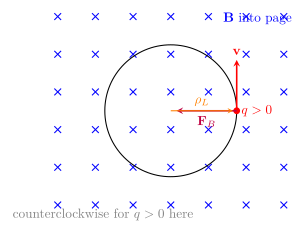
若保持相同 \(\mathbf v\) 和 \(\mathbf B\) 而改变 \(q\) 符号,轨道弯曲方向反转,但 \(\rho_L\) 与 \(T_c\) 大小不变。
1.2 Vector solution and signed frequency
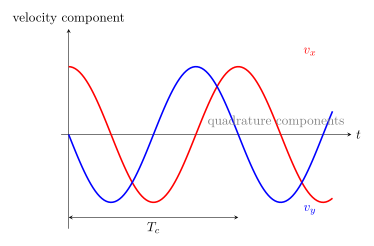
取 \(\mathbf B=B\hat{\mathbf z}\),Newton–Lorentz equations 为
\[m\dot v_x=qBv_y, \qquad m\dot v_y=-qBv_x, \qquad m\dot v_z=0.\]
定义 \(\omega_c=qB/m\),则每个垂直分量满足
\[\ddot v_x+\omega_c^2v_x=0, \qquad \ddot v_y+\omega_c^2v_y=0.\]
\(\omega_c\) 的符号只控制相位随时间的旋转方向;可观测周期用 \(\Omega_c=|\omega_c|\)。
1.3 Oblique entry: a helix
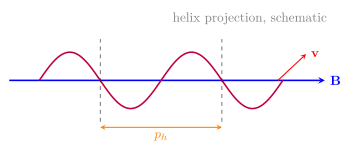
平行速度不受磁力,垂直速度回旋,因此
\[\boxed{p_h=v_\parallel T_c =\frac{2\pi m v_\parallel}{|q|B}}.\]
速度大小 \(v=\sqrt{v_\perp^2+v_\parallel^2}\) 恒定;螺距符号方向由 \(v_\parallel\) 决定,回旋 sense 由 \(q\) 决定。
1.4 Limiting checks
- \(v_\perp\to0\):\(\rho_L\to0\),退化为沿磁场直线运动。
- \(v_\parallel\to0\):\(p_h\to0\),退化为圆周运动。
- \(B\to0\):公式给 \(\rho_L,T_c\to\infty\),在有限观察时间内轨迹趋直线。
- \(m\) 增大:相同 \(q,v,B\) 下半径和周期均增大。
Knowledge 2 — Velocity selectors and crossed fields / 速度选择器与交叉场
Knowledge ID: P04-U06-L02-K02
2.1 Force balance is a vector condition
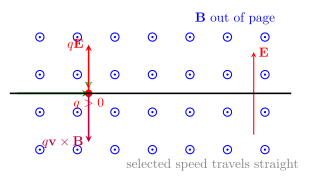
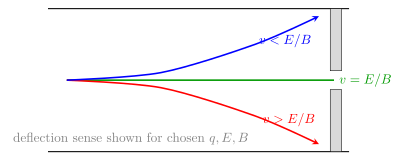
在互相垂直的 \(\mathbf E\)、\(\mathbf B\) 中,要使带电粒子无偏转:
\[q(\mathbf E+\mathbf v\times\mathbf B)=\mathbf0.\]
若 \(\mathbf v\perp\mathbf E\)、\(\mathbf v\perp\mathbf B\) 且方向使两力相反,则
\[\boxed{v=\frac{E}{B}}.\]
\(q\) 在平衡式中约去,所以同一速度和运动方向的正负粒子都可直行;但它们各自的电力和磁力会同时反向。
2.2 What happens off the selected speed
若 \(v>E/B\),磁力大小更大,粒子向磁力方向偏;若 \(v<E/B\),电力占优,向电力方向偏。狭缝只让近似直行的粒子进入下一段。
Knowledge 3 — Mass spectrometers and cyclotrons / 质谱仪与回旋加速器
Knowledge ID: P04-U06-L02-K03
3.1 Bainbridge mass spectrometer
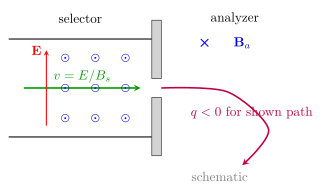
第一段用 \(E\)、\(B_s\) 选速:\(v=E/B_s\)。第二段只有分析磁场 \(B_a\),半径
\[r=\frac{mv}{|q|B_a}.\]
组合得
\[\boxed{\frac{|q|}{m}=\frac{E}{B_sB_ar}}, \qquad \boxed{\frac{m}{|q|}=\frac{B_sB_ar}{E}}.\]
仪器直接区分的是 mass-to-charge ratio,不是单独质量;只有知道电荷态时才能求 \(m\)。
另一常见方案先由电势差 \(\Delta V\) 从静止加速:
\[|q|\Delta V=\frac12mv^2.\]
再在磁场中测 \(r\),消去 \(v\):
\[\boxed{\frac{m}{|q|}=\frac{B^2r^2}{2\Delta V}}.\]
3.2 Cyclotron synchronization
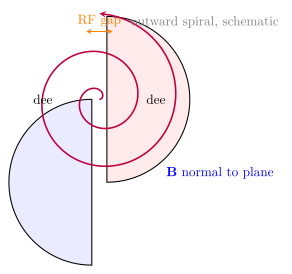
均匀 \(B\) 使粒子在 dee electrode 内走半圆;间隙的交变电场每次过缝加速。非相对论半周时间
\[\frac{T_c}{2}=\frac{\pi m}{|q|B}\]
与半径无关,所以固定 RF frequency
\[\boxed{f_{\mathrm{RF}}=f_c=\frac{|q|B}{2\pi m}}\]
可保持同步。每过一次间隙,动能约增加 \(|q|\Delta V_{gap}\),速度与半径逐步增大。
3.3 Relativistic boundary
当 \(v\) 接近 \(c\),轨道动力学用 \(\mathbf p=\gamma m\mathbf v\),回旋角频率大小变为
\[\Omega=\frac{|q|B}{\gamma m}.\]
\(\gamma\) 随能量上升,粒子逐渐落后于固定 RF 相位,普通 cyclotron 失谐。同步回旋加速器等装置必须调频或调场;本课的 \(f_c=|q|B/(2\pi m)\) 不是高能普适式。
Knowledge 4 — Magnetic confinement and guiding-center motion / 磁约束与导引中心运动
Knowledge ID: P04-U06-L02-K04
4.1 Guiding center as a scale-separated approximation
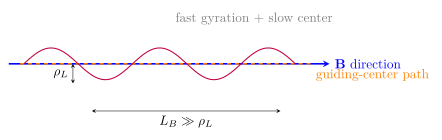
若磁场在一个回旋轨道上变化很小,定义
\[L_B\equiv\frac{B}{\lvert\boldsymbol\nabla B\rvert}, \qquad \epsilon\equiv\frac{\rho_L}{L_B}\ll1.\]
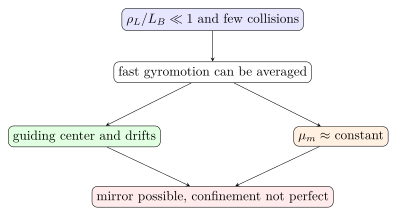
就可以把快回旋与慢 guiding-center 运动分开。导引中心不是每一瞬间的真实粒子位置,而是一个回旋周期上的平均中心。
4.2 Magnetic moment and mirror conversion
在场缓慢变化、碰撞很少且没有显著快速电场时,第一 adiabatic invariant 近似守恒:
\[\boxed{\mu_m=\frac{mv_\perp^2}{2B}\approx\text{constant}}.\]
总动能也近似不变,故粒子进入更强 \(B\) 区域时 \(v_\perp\) 增大、\(v_\parallel\) 减小;若 \(v_\parallel\to0\),发生 mirror reflection。
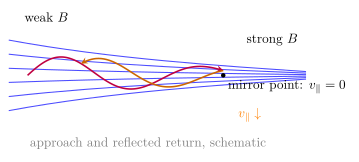
若起点场为 \(B_0\),pitch angle \(\alpha_0\) 满足 \(v_{\perp0}=v\sin\alpha_0\),mirror point 的场强满足
\[B_m=\frac{B_0}{\sin^2\alpha_0}.\]
只有系统能达到该 \(B_m\) 且 adiabatic conditions 成立时才反射。
4.3 What magnetic confinement cannot guarantee
磁场本身不降低粒子能量;它依靠几何和绝热不变量限制跨场运动。场的曲率、梯度、电场、碰撞与 collective plasma effects 会引起 drift 或损失。因此“粒子绕场线”是局部直观,不等于粒子永远粘在一根场线上。
Worked Examples / 完整例题
Worked Example 1 — Proton helix in a uniform field
Known. 质子 \(m_p=1.673\times10^{-27}\ \mathrm{kg}\)、\(q=+e\),在 \(B=0.500\ \mathrm T\) 中有 \(v_\perp=2.00\times10^6\ \mathrm{m/s}\)、\(v_\parallel=1.50\times10^6\ \mathrm{m/s}\)。求 \(\rho_L\)、\(T_c\) 与螺距。
Object/frame/axes. 单个质子;实验室惯性系,\(\mathbf B\) 定义为 \(+z\)。
Model. 真空、均匀静磁场、无碰撞;总速度 \(2.50\times10^6\ \mathrm{m/s}=0.00834c\),非相对论足够。
\[\rho_L=\frac{m_pv_\perp}{eB} =\frac{(1.673\times10^{-27})(2.00\times10^6)}{(1.602\times10^{-19})(0.500)} =4.18\times10^{-2}\ \mathrm m.\]
\[T_c=\frac{2\pi m_p}{eB}=1.31\times10^{-7}\ \mathrm s.\]
\[p_h=v_\parallel T_c=(1.50\times10^6)(1.31\times10^{-7}) =1.97\times10^{-1}\ \mathrm m.\]
Checks. 半径只用 \(v_\perp\);螺距随 \(v_\parallel\to0\) 归零。所有结果三位有效数字。
Worked Example 2 — Velocity selector and isotope analyzer
Known. \(E=2.40\times10^4\ \mathrm{V/m}\)、选择场 \(B_s=0.0800\ \mathrm T\);分析场 \(B_a=0.500\ \mathrm T\)。单价正离子轨道半径 \(r=0.250\ \mathrm m\)。求选定速度与离子质量。
System/directions. 场互相垂直并排列使正离子直行;分析段速度垂直 \(B_a\)。
\[v=\frac{E}{B_s}=\frac{2.40\times10^4}{0.0800}=3.00\times10^5\ \mathrm{m/s}.\]
\[m=\frac{eB_ar}{v} =\frac{(1.602\times10^{-19})(0.500)(0.250)}{3.00\times10^5} =6.68\times10^{-26}\ \mathrm{kg}.\]
换算 atomic mass unit \(u=1.66054\times10^{-27}\ \mathrm{kg}\):
\[m=40.2\ u.\]
Checks. \(E/B\) 单位为速度;测量本质给 \(m/q\),这里借助单价假设才得到 \(m\)。
Worked Example 3 — Cyclotron frequency and exit energy
Known. 非相对论质子 cyclotron,\(B=1.20\ \mathrm T\),最大轨道半径 \(R=0.450\ \mathrm m\)。求 RF frequency 和理想最大 kinetic energy。
System/model. 真空、均匀场、普通 cyclotron,同步且忽略边缘场。先按非相对论计算,再检查相对论参数。
\[f_c=\frac{eB}{2\pi m_p} =\frac{(1.602\times10^{-19})(1.20)}{2\pi(1.673\times10^{-27})} =1.83\times10^7\ \mathrm{Hz}.\]
边缘速度 \(v=eBR/m_p\),故
\[K=\frac12m_pv^2 =\frac{e^2B^2R^2}{2m_p} =2.24\times10^{-12}\ \mathrm J =14.0\ \mathrm{MeV}.\]
由 \(v=eBR/m_p=5.17\times10^7\ \mathrm{m/s}=0.172c\),\(\gamma\approx1.015\)。
Check and boundary. 1.5% 的相对论频移已不一定可忽略,因此结果是理想非相对论估计;实际同步设计需修正。
Worked Example 4 — Magnetic-mirror threshold
Known. 粒子在 \(B_0=0.200\ \mathrm T\) 处 pitch angle \(\alpha_0=30.0^\circ\),沿场线进入更强区域。忽略碰撞并满足 adiabatic approximation。求 mirror field \(B_m\);若设备最大场只有 \(0.600\ \mathrm T\),会否反射?
Object/boundary. 单点带电粒子;以局部场方向为平行轴,初始与镜点之间总能量和 \(\mu_m\) 近似守恒。
\[B_m=\frac{B_0}{\sin^2\alpha_0} =\frac{0.200}{(0.500)^2}=0.800\ \mathrm T.\]
设备只能达到 \(0.600\ \mathrm T<0.800\ \mathrm T\),所以在这一理想模型中粒子不会在该端发生镜反射。
Checks. \(\alpha_0\to90^\circ\) 时 \(B_m\to B_0\);\(\alpha_0\to0\) 时 \(B_m\to\infty\),沿场粒子最难镜反射。结论依赖 \(\rho_L/L_B\ll1\) 和低碰撞率。
Lesson synthesis / 全课综合
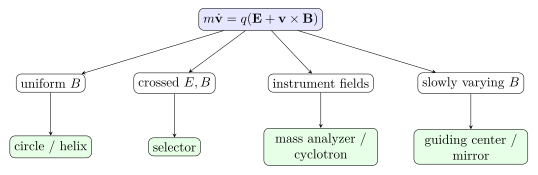
所有装置都从同一条 Lorentz equation 出发。均匀 \(B\) 给出精确回旋;交叉 \(E,B\) 通过力平衡选速;质谱仪读出 \(m/q\);cyclotron 用与回旋周期同步的电场输入能量;非均匀场只有在尺度分离时才可用 guiding-center 和 adiabatic invariant。
Formula-and-decision table / 公式与决策表
| Task | Relation | Conditions / warning |
|---|---|---|
| gyroradius | \(\rho_L=mv_\perp/(\lvert q\rvert B)\) | uniform \(B\), nonrelativistic |
| cyclotron frequency | \(\Omega_c=\lvert q\rvert B/m\) | magnitude; use \(\omega_c=qB/m\) for sense |
| period | \(T_c=2\pi m/(\lvert q\rvert B)\) | independent of speed only nonrelativistically |
| helical pitch | \(p_h=v_\parallel T_c\) | uniform \(B\) |
| selector | \(v=E/B\) | perpendicular fields and correct entry direction |
| Bainbridge analyzer | \(m/\lvert q\rvert=B_sB_ar/E\) | selected \(v=E/B_s\) and circular analyzer |
| voltage-accelerated analyzer | \(m/\lvert q\rvert=B^2r^2/(2\Delta V)\) | starts from rest, nonrelativistic |
| cyclotron RF | \(f=\lvert q\rvert B/(2\pi m)\) | ordinary nonrelativistic cyclotron |
| adiabatic parameter | \(\rho_L/L_B\ll1\) | low collisions and slowly varying fields |
| mirror invariant | \(\mu_m=mv_\perp^2/(2B)\approx\text{const.}\) | adiabatic guiding-center regime |
| mirror field | \(B_m=B_0/\sin^2\alpha_0\) | constant energy and first invariant |
Model boundaries / 模型边界
- Nonrelativistic orbit formulas: replace \(m\mathbf v\) by \(\gamma m\mathbf v\) at high speed; the ordinary cyclotron frequency decreases by \(1/\gamma\).
- No radiation reaction: accelerated charges radiate; losses are negligible only when radiation timescales are long relative to the motion considered.
- No collisions: gas scattering and plasma collisions disrupt exact helices and adiabatic invariants.
- Uniform fields: exact circular/helix formulas require \(B\) nearly constant across the orbit.
- Selector geometry: \(v=E/B\) is not a universal crossed-field drift formula.
- Known charge state: mass spectrometry returns \(m/|q|\); multiple ionization changes interpretation.
- Guiding-center ordering: require \(\rho_L/L_B\ll1\) and slow temporal changes compared with \(\Omega_c^{-1}\).
- Confinement is finite: gradients, curvature, electric fields and collective effects drive losses.
Misconception clinic / 误区诊所
- “回旋半径用总速度。” 只有 \(v_\perp\) 决定半径;\(v_\parallel\) 决定螺距。
- “负电荷有负半径。” 半径是正长度;电荷符号进入旋转方向。
- “周期与速度永远无关。” 仅在非相对论均匀场中成立。
- “速度选择器使所有粒子都以 \(E/B\) 运动。” 它只让已有该速度的粒子无偏转通过。
- “质谱仪直接称质量。” 它测 \(m/q\),必须知道电荷态。
- “cyclotron 的磁场给粒子能量。” 加速发生在间隙的电场中;磁场负责弯轨。
- “粒子沿着磁力线旋转,因此轨迹就是场线。” 轨迹绕场线附近的 guiding center 螺旋,二者不是同一曲线。
- “磁镜一定能困住所有粒子。” 小 pitch-angle 粒子落在 loss cone 内,且非绝热/碰撞过程会造成损失。
Practice and retrieval / 练习与提取
- [K01] 电子与质子以相同 \(v_\perp\) 进入相同 \(B\)。比较半径、周期与旋转方向。
- [K01] \(\mathrm{He}^{2+}\) 离子 \(m=6.64\times10^{-27}\ \mathrm{kg}\),\(v_\perp=1.00\times10^6\ \mathrm{m/s}\),\(B=0.800\ \mathrm T\)。求 \(\rho_L\)。
- [K01] 某粒子 \(T_c=2.00\ \mathrm{\mu s}\)、\(v_\parallel=3.00\times10^5\ \mathrm{m/s}\)。求螺距。
- [K02] \(E=3.00\times10^4\ \mathrm{V/m}\)、\(B=0.150\ \mathrm T\)。求选定速度。
- [K02] 在给定几何下正离子若 \(v>E/B\) 向下偏。负离子以相同过大速度会向哪里偏?解释两力如何变化。
- [K03] 单价离子经 \(2.00\ \mathrm{kV}\) 从静止加速,在 \(0.500\ \mathrm T\) 中轨道半径 \(0.100\ \mathrm m\)。求质量。
- [K03] 一个非相对论 deuteron cyclotron 使用 \(B=1.50\ \mathrm T\);取 \(m_d=3.34\times10^{-27}\ \mathrm{kg}\)、\(q=e\)。求 RF frequency。
- [K03] 为什么普通 cyclotron 到高能时失谐?磁场是否直接增加动能?
- [K04] \(B_0=0.100\ \mathrm T\)、\(\alpha_0=45.0^\circ\)。求理想 mirror field。
- [K04, 边界] 写出 guiding-center 近似的两个独立条件,并说明 \(\rho_L\sim L_B\) 时哪里失效。
Answers / 答案
1. \(\rho\propto m/|q|\)、\(T\propto m/|q|\),故质子的两者约为电子的 1836 倍;因电荷符号相反,旋转方向相反。
2. \(|q|=2e\),\(\rho_L=mv/(2eB)=6.64\times10^{-27}\times10^6/[2(1.602\times10^{-19})(0.800)]=2.59\times10^{-2}\ \mathrm m\)。
3. \(p_h=v_\parallel T_c=(3.00\times10^5)(2.00\times10^{-6})=0.600\ \mathrm m\)。
4. \(v=E/B=2.00\times10^5\ \mathrm{m/s}\)。
5. 向上。电荷反号使电力与磁力各自反向;过大速度时磁力仍占优,但合力方向随 \(q\) 反转。
6. \(m/|q|=B^2r^2/(2\Delta V)\),所以 \(m=e(0.500)^2(0.100)^2/[2(2000)]=1.00\times10^{-25}\ \mathrm{kg}\)。
7. \(f=eB/(2\pi m_d)=1.14\times10^7\ \mathrm{Hz}=11.4\ \mathrm{MHz}\)。
8. 高能时 \(\gamma\) 增大,频率降为 \(|q|B/(2\pi\gamma m)\),与固定 RF 不再同步。动能由 gap electric field 增加,磁场只弯轨。
9. \(B_m=B_0/\sin^245^\circ=0.200\ \mathrm T\)。
10. 例如 \(\rho_L/L_B\ll1\) 且场随时间的变化频率远小于 \(\Omega_c\)(并要求低碰撞)。若 \(\rho_L\sim L_B\),一圈内场变化不再小,平均中心与 \(\mu_m\) 守恒均不可靠。
Exit ticket
- 从 \(|q|v_\perp B=mv_\perp^2/r\) 出发,在不背诵的情况下重建 \(r\)、\(T\) 和 pitch。
- 说明 velocity selector、mass analyzer、cyclotron 和 magnetic mirror 中电场与磁场分别承担什么角色。
Exit-ticket benchmark
\(r=mv_\perp/(|q|B)\),\(T=2\pi r/v_\perp=2\pi m/(|q|B)\),pitch \(=v_\parallel T\)。选择器用相反的电、磁力筛速度;分析器用磁曲率读 \(m/q\);cyclotron 用磁场回转、用间隙电场加能;磁镜靠慢变场和近似绝热不变量把平行动能转成垂直动能。
References and source notes / 参考资料与来源说明
Source-to-content map
| Source | Used for | Knowledge ID / section | Model boundary or convention |
|---|---|---|---|
| OpenStax University Physics Vol. 2, §11.3 Motion of a Charged Particle in a Magnetic Field | circular/helix motion, radius, period, pitch, magnetic bottle | K01, K04 | nonrelativistic uniform-field core |
| OpenStax University Physics Vol. 2, §11.7 Applications of Magnetic Forces and Fields | Bainbridge spectrometer and cyclotron | K02–K03 | known charge state and ideal fields |
| MIT OCW 8.02, Chapter 8: Magnetic Fields | independent orbit and selector derivations | K01–K03 | SI laboratory-frame convention |
| NASA Glenn, Cyclotron Operation | dee geometry, RF gap acceleration, beam extraction | K03 | historical device description; formulas derived here |
| U.S. Particle Accelerator School, Adiabatic Invariants | guiding-center separation, cyclotron motion, first invariant | K04 | adiabatic and low-collision assumptions |
| NASA/GSFC, Principles of the Magnetic Trapping of Particles | magnetic mirror physical picture and trapping limits | K04 | educational treatment of geomagnetic trapping |
资料和链接实际核对日期:2026-08-26。所有轨迹图是依据方程的原创 schematic;未复制来源插图。
复习与拓展
- Plasma physics:系统推导 \(\mathbf E\times\mathbf B\)、gradient-\(B\) 与 curvature drifts。
- Special relativity:用 \(\gamma m\) 修正 orbit、frequency 与 accelerator synchronism。
- Electromagnetic radiation:分析回旋/同步辐射能损。
- Laboratory extension:由轨道图像拟合 \(q/m\),并传播 \(B,r,V\) 的测量不确定度。