
Learning objectives / 学习目标
完成本课后,你应当能够:
- 从 \(q\mathbf v_d\times\mathbf B\) 与 \(\mathbf J=nq\mathbf v_d\) 推导 \(d\mathbf F=I\,d\boldsymbol\ell\times\mathbf B\)。
- 计算直导线和弯曲导线在均匀或非均匀磁场中的合力,声明电流方向和系统边界。
- 推导矩形线圈在匀强场中的净力与力矩,推广到 \(\boldsymbol\tau=\boldsymbol\mu\times\mathbf B\)。
- 定义 \(\boldsymbol\mu=NIA\hat{\mathbf n}\),使用 \(U=-\boldsymbol\mu\cdot\mathbf B\) 判断平衡与外力做功。
- 推导 Hall field、Hall coefficient 与 Hall voltage,在明确端子约定下判断载流子符号。
- 识别均匀场、稳恒电流、单载流子模型和小偶极近似的边界。
Prerequisites / 先修知识
- Electric Current and Conduction:\(\mathbf J=nq\mathbf v_d\)。
- Magnetic Field and Lorentz Force:\(\mathbf F_B=q\mathbf v\times\mathbf B\)。
- Torque and Rotational Inertia。
- 叉积、力矩、曲线积分和 passive/active system boundary。
Scope and conventions / 范围与约定
- 稳恒 conventional current \(I>0\) 沿 \(d\boldsymbol\ell\) 方向;电子漂移方向通常相反。
- 导线整体近似电中性;本课计算外加 \(\mathbf B\) 对载流系统的机械作用。
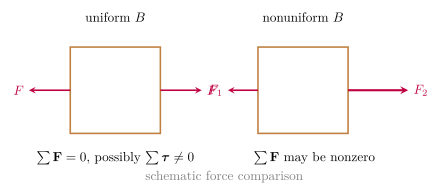
- 均匀场中的闭合线圈合力为零,但可有力矩;非均匀场可产生合力。
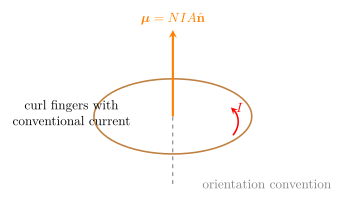
- 面积向量 \(\hat{\mathbf n}\) 用右手绕行规则由 conventional current 决定。
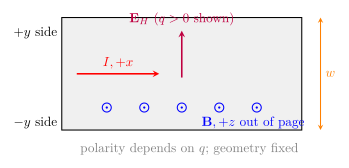
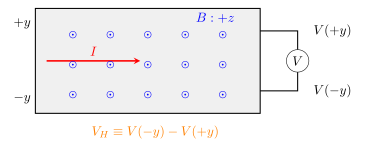
- Hall bar 约定:电流沿 \(+x\)、磁场沿 \(+z\)、宽度沿 \(y\)、厚度 \(t\) 沿 \(z\);定义 \(V_H\equiv V(-y)-V(+y)\)。
- 力和力矩图均为 schematic,除非明确说明按比例。
Notation and modeling contract / 符号与建模契约
| Symbol | Meaning | SI unit |
|---|---|---|
| \(I\) | conventional current | A |
| \(d\boldsymbol\ell\) | directed wire element along \(I\) | m |
| \(\mathbf J\) | conventional current density | \(\mathrm{A\,m^{-2}}\) |
| \(\mathbf F\) | net magnetic force on stated wire/loop system | N |
| \(A\) | loop area | \(\mathrm{m^2}\) |
| \(N\) | number of turns | dimensionless |
| \(\boldsymbol\mu=NIA\hat{\mathbf n}\) | magnetic dipole moment | \(\mathrm{A\,m^2=J/T}\) |
| \(\boldsymbol\tau\) | torque about stated origin/axis | \(\mathrm{N\,m}\) |
| \(R_H=1/(nq)\) | one-carrier Hall coefficient | \(\mathrm{m^3\,C^{-1}}\) |
| \(V_H=V(-y)-V(+y)\) | signed Hall voltage in this note | V |
Knowledge 1 — Force on a current-carrying wire / 载流导线所受力
Knowledge ID: P04-U06-L03-K01
1.1 From carriers to the wire force
取长度 \(L\)、截面积 \(A_c\) 的直导线段。若载流子数密度 \(n\)、电荷 \(q\)、漂移速度 \(\mathbf v_d\),其中载流子数为 \(nA_cL\)。所有载流子所受磁力总和是
\[\mathbf F_{\mathrm{carriers}} =nA_cLq\mathbf v_d\times\mathbf B.\]
用 \(\mathbf J=nq\mathbf v_d\) 与 \(\mathbf J A_c=I\hat{\boldsymbol\ell}\),载流子通过碰撞/晶格约束把横向作用传给导线,得到
\[\boxed{\mathbf F=I\mathbf L\times\mathbf B},\]
其中 \(\mathbf L=L\hat{\boldsymbol\ell}\) 沿 conventional current。大小为
\[F=ILB\sin\theta.\]
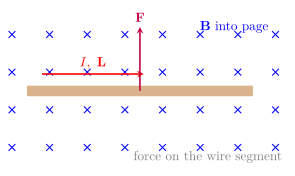
电子金属中,\(q<0\) 且 \(\mathbf v_d\) 与 \(I\) 相反;两次反向恰使宏观公式仍沿 conventional current 使用右手定则。
1.2 Differential law and curved wires
对细导线:
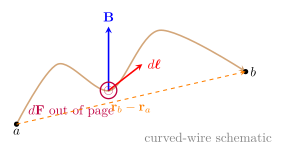
\[\boxed{d\mathbf F=I\,d\boldsymbol\ell\times\mathbf B(\mathbf r)}, \qquad \boxed{\mathbf F=I\int_Cd\boldsymbol\ell\times\mathbf B}.\]
在均匀 \(\mathbf B\) 中,开放导线从起点 \(a\) 到终点 \(b\):
\[\mathbf F=I\left(\int_a^bd\boldsymbol\ell\right)\times\mathbf B =I(\mathbf r_b-\mathbf r_a)\times\mathbf B.\]
因此形状不影响合力,只取决于端点位移;但在非均匀场中必须真实积分。
1.3 Closed loop in a uniform field
对任意闭合细线圈,若 \(I\) 与 \(\mathbf B\) 均匀:
\[\mathbf F_{\mathrm{net}} =I\oint d\boldsymbol\ell\times\mathbf B =I\left(\oint d\boldsymbol\ell\right)\times\mathbf B =\mathbf0.\]
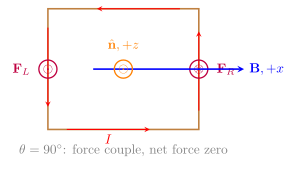
零合力不等于每段无力;分布在不同位置的力可组成力偶,从而产生力矩。
Knowledge 2 — Torque on a current loop / 载流线圈所受力矩
Knowledge ID: P04-U06-L03-K02
2.1 Rectangular-loop derivation
矩形线圈面积 \(A=ab\),面积法线与 \(\mathbf B\) 夹角为 \(\theta\)。两条与 \(\mathbf B\) 有效平行的边不产生相应转动力;另两条长度 \(a\) 的边受大小 \(IaB\)、方向相反的力,形成 lever arm \(b\sin\theta\) 的力偶:
\[\tau=IaB(b\sin\theta)=IAB\sin\theta.\]
\(N\) 匝时:
\[\boxed{\tau=NIAB\sin\theta}.\]
2.2 Vector torque and direction
定义磁偶极矩后,力矩统一写作
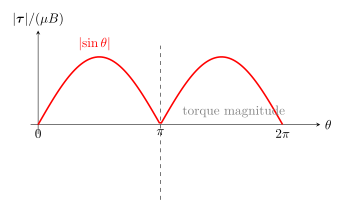
\[\boxed{\boldsymbol\tau=\boldsymbol\mu\times\mathbf B}.\]
它倾向于把 \(\boldsymbol\mu\) 转向 \(\mathbf B\)。\(\theta=90^\circ\) 力矩最大;\(\theta=0\) 或 \(\pi\) 力矩为零,但稳定性不同。
2.3 Net force versus torque
在均匀场中闭合线圈总磁力为零,却可有力矩;在非均匀场中两边受力大小不同,既可能有合力也可能有力矩。说“线圈受力为零”必须指明是合力且满足均匀场条件。
Knowledge 3 — Magnetic dipole moment and potential energy / 磁偶极矩与势能
Knowledge ID: P04-U06-L03-K03
3.1 Definition and right-hand convention
对 \(N\) 匝平面线圈:
\[\boxed{\boldsymbol\mu=NIA\hat{\mathbf n}}.\]
右手四指沿 conventional current,拇指给 \(\hat{\mathbf n}\) 和 \(\boldsymbol\mu\)。单位
\[[\mu]=\mathrm{A\,m^2}=\mathrm{J/T}.\]
3.2 Potential energy and equilibrium
若外场均匀且线圈电流被维持,取 \(U=0\) 于 \(\theta=90^\circ\):
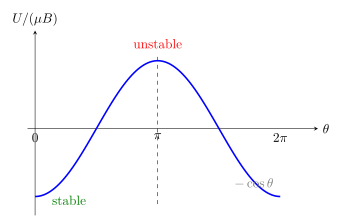
\[\boxed{U=-\boldsymbol\mu\cdot\mathbf B=-\mu B\cos\theta}.\]
因为 \(\tau_\theta=-dU/d\theta=-\mu B\sin\theta\),\(\theta=0\) 是最低能量稳定平衡,\(\theta=\pi\) 是最高能量不稳定平衡。
外部 agent 缓慢旋转线圈时,其做功等于 \(\Delta U\);磁场做功为 \(-\Delta U\),但维持电流的 source 和 mechanical constraints 可能交换能量,必须说明系统边界。
3.3 Small dipole in a nonuniform field
若线圈尺寸远小于场变化尺度,且 \(\boldsymbol\mu\) 可视为固定:
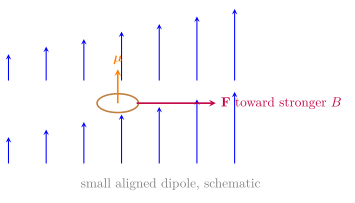
\[\boxed{\mathbf F\approx\boldsymbol\nabla(\boldsymbol\mu\cdot\mathbf B)}.\]
这解释了已对齐磁偶极趋向较强场区域。它不是任意大线圈的精确式;大线圈应对 \(I\,d\boldsymbol\ell\times\mathbf B\) 积分。
Knowledge 4 — Hall effect and carrier sign / 霍尔效应与载流子符号
Knowledge ID: P04-U06-L03-K04
4.1 Transverse force balance
载流子沿导体漂移时,\(q\mathbf v_d\times\mathbf B\) 把载流子推向侧面;电荷积累建立横向 Hall field。稳态横向合力为零:
\[q(\mathbf E_H+\mathbf v_d\times\mathbf B)=0,\]
\[\boxed{\mathbf E_H=-\mathbf v_d\times\mathbf B}.\]
由于 \(\mathbf J=nq\mathbf v_d\),在一载流子、各向同性模型中
\[\boxed{\mathbf E_H=-R_H\,\mathbf J\times\mathbf B =R_H\,\mathbf B\times\mathbf J}, \qquad \boxed{R_H=\frac{1}{nq}}.\]
\(R_H\) 的符号直接反映有效载流子电荷符号。
4.2 Hall voltage with an explicit terminal convention
取 \(J_x=I/(wt)\)、\(\mathbf B=B\hat{\mathbf z}\)。则
\[E_y=R_HJ_xB=\frac{IB}{nqwt}.\]
本课定义
\[V_H\equiv V(-y)-V(+y)=E_yw,\]
故
\[\boxed{V_H=\frac{IB}{nqt}}.\]
若交换电压表引线、反转 \(I\) 或反转 \(B\),读数变号。必须把端子约定和场向写清,否则“正 Hall voltage”没有独立意义。
4.3 What Hall measurements reveal—and when they do not
在单一载流子模型中,测得 \(R_H\) 可得
\[n=\frac{1}{|qR_H|}.\]
结合纵向 conductivity 还能推断 mobility。但多带半导体、电子和空穴同时导电、异常霍尔效应或强磁场量子化时,\(R_H\ne1/(nq)\);此时简单符号仍可能提供线索,却不能直接当作唯一载流子密度。
Worked Examples / 完整例题
Worked Example 1 — Force on an oblique straight wire
Known. 长度向量 \(\mathbf L=(0.300\hat{\mathbf i}+0.400\hat{\mathbf j})\ \mathrm m\) 的直导线承载 \(I=5.00\ \mathrm A\),处于 \(\mathbf B=(0.200\hat{\mathbf k})\ \mathrm T\)。求磁力。
Object/frame/axes. 系统为这段导线及其载流子;\(\mathbf L\) 沿 conventional current,Cartesian basis 右手。
Model. 直细导线、稳恒电流、均匀外场。
\[\mathbf L\times\mathbf B =(0.300\hat{\mathbf i}+0.400\hat{\mathbf j})\times0.200\hat{\mathbf k} =0.0800\hat{\mathbf i}-0.0600\hat{\mathbf j}.\]
\[\boxed{\mathbf F=I\mathbf L\times\mathbf B =(0.400\hat{\mathbf i}-0.300\hat{\mathbf j})\ \mathrm N}.\]
\(F=0.500\ \mathrm N\)。Checks. \(\mathbf F\cdot\mathbf L=0\)、\(\mathbf F\cdot\mathbf B=0\);单位为 A·m·T=N。
Worked Example 2 — Torque on a multi-turn coil
Known. \(N=80\) 匝、面积 \(A=25.0\ \mathrm{cm^2}\)、电流 \(I=0.600\ \mathrm A\) 的线圈,面积法线与 \(B=0.350\ \mathrm T\) 成 \(40.0^\circ\)。求 \(\mu\) 和 torque magnitude。
System/axis/model. 整个刚性线圈;力矩关于质心。线圈足够小,外场均匀。
\[A=25.0\times10^{-4}=2.50\times10^{-3}\ \mathrm{m^2},\]
\[\mu=NIA=80(0.600)(2.50\times10^{-3})=0.120\ \mathrm{A\,m^2},\]
\[\tau=\mu B\sin40.0^\circ =(0.120)(0.350)(0.6428) =\boxed{2.70\times10^{-2}\ \mathrm{N\,m}}.\]
Checks. \(\theta\to0\) 时力矩归零;方向由 \(\boldsymbol\mu\times\mathbf B\) 给出,趋向对齐。
Worked Example 3 — Quasistatic rotation and energy
Known. 恒定磁矩 \(\mu=0.0800\ \mathrm{A\,m^2}\) 的线圈在 \(B=0.500\ \mathrm T\) 中,被外部 agent 缓慢从 \(\theta_i=30.0^\circ\) 转到 \(\theta_f=150^\circ\)。求磁势能变化与外部做功。
Boundary/convention. 系统为“被维持电流的磁偶极 + 外场相互作用”;准静态、初末角速度为零,外部做功 \(W_{ext}=\Delta U\)。
\[\Delta U=-\mu B(\cos\theta_f-\cos\theta_i).\]
\[\Delta U=-(0.0800)(0.500)[\cos150^\circ-\cos30^\circ] =6.93\times10^{-2}\ \mathrm J.\]
所以
\[\boxed{W_{ext}=+6.93\times10^{-2}\ \mathrm J}.\]
Checks. 线圈从接近稳定对齐转向接近反对齐,能量应上升;结果小于最大能差 \(2\mu B=0.0800\ \mathrm J\)。
Worked Example 4 — Hall coefficient, density, and carrier sign
Known. Hall bar 厚度 \(t=0.500\ \mathrm{mm}\),\(I=20.0\ \mathrm{mA}\) 沿 \(+x\),\(B=0.800\ \mathrm T\) 沿 \(+z\)。按本课 \(V_H=V(-y)-V(+y)\),测得 \(V_H=-2.00\ \mathrm{mV}\)。假设单一载流子且 \(|q|=e\),求载流子符号与 \(n\)。
System/convention. 整个 Hall bar;电压引线定义如上。稳态、均匀 \(J\) 与 \(B\)。
由
\[V_H=\frac{IB}{nqt}\]
且 \(I,B,t,n>0\),负 \(V_H\) 表明 \(q<0\),即电子型有效载流子。
\[n=\frac{IB}{e t|V_H|} =\frac{(0.0200)(0.800)}{(1.602\times10^{-19})(0.500\times10^{-3})(2.00\times10^{-3})} =\boxed{9.99\times10^{22}\ \mathrm{m^{-3}}}.\]
Checks and boundary. 单位为 \(\mathrm{m^{-3}}\);反转 \(B\) 应使读数反号,是排除接触偏置的实验检查。多载流子材料中该 \(n\) 只是单带模型的有效值。
Lesson synthesis / 全课综合
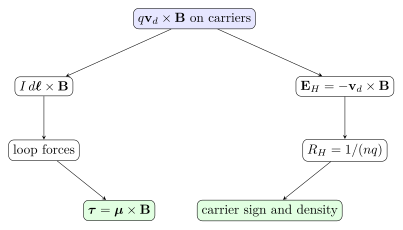
宏观导线力并不是新的基本相互作用:它是大量载流子 Lorentz force 与材料约束的总和。同一微观横向偏转,在自由移动被边界阻止时建立 Hall field;在闭合几何中,分布力可组成力偶,产生磁偶极矩的转动效应。
Formula-and-decision table / 公式与决策表
| Task | Relation | Conditions / warning |
|---|---|---|
| straight wire | \(\mathbf F=I\mathbf L\times\mathbf B\) | uniform \(B\), \(\mathbf L\) along conventional current |
| arbitrary thin wire | \(\mathbf F=I\int d\boldsymbol\ell\times\mathbf B\) | steady current; integrate actual path |
| closed loop net force | \(\mathbf F=0\) | only guaranteed in uniform \(B\) |
| loop moment | \(\boldsymbol\mu=NIA\hat{\mathbf n}\) | right-hand rule from conventional current |
| torque | \(\boldsymbol\tau=\boldsymbol\mu\times\mathbf B\) | uniform field; planar loop exact in dipole form |
| energy | \(U=-\boldsymbol\mu\cdot\mathbf B\) | maintained/fixed moment in external field |
| small-dipole force | \(\mathbf F\approx\boldsymbol\nabla(\boldsymbol\mu\cdot\mathbf B)\) | loop small relative to field scale |
| Hall balance | \(\mathbf E_H=-\mathbf v_d\times\mathbf B\) | transverse steady state |
| one-carrier coefficient | \(R_H=1/(nq)\) | single isotropic carrier type |
| Hall voltage | \(V_H=IB/(nqt)\) | this note: \(V(-y)-V(+y)\), \(I:+x\), \(B:+z\) |
Model boundaries / 模型边界
- Steady current: rapidly time-varying currents require induced electric fields and distributed electromagnetic momentum.
- Thin-wire approximation: conductor dimensions must be small enough that a path current represents the distribution.
- Uniform-field results: closed-loop net force zero and simple torque formula require suitable uniformity; otherwise integrate segment forces.
- Fixed magnetic moment: \(U=-\mu B\cos\theta\) assumes a specified current/moment; permanent magnets and induced moments require their own energy bookkeeping.
- Small-dipole force: \(\nabla(\mu\cdot B)\) fails if loop size is comparable to \(L_B\).
- Hall one-carrier model: multiband conduction, anisotropy, anomalous Hall response and quantum Hall regimes are outside \(R_H=1/(nq)\).
- Neutral conductor: the magnetic force on carriers is transmitted to the lattice; a full microscopic account includes collisions and surface charge.
Misconception clinic / 误区诊所
- “\(\mathbf L\) 沿电子漂移。” \(\mathbf L\) 沿 conventional current;在金属中与电子漂移相反。
- “闭合线圈在磁场中不受力,所以也不转。” 均匀场中合力可为零,分布力仍可给非零力矩。
- “力矩角度是线圈平面与磁场的角。” 公式的 \(\theta\) 是面积法线/磁矩与 \(\mathbf B\) 的角。
- “\(\theta=\pi\) 力矩为零,所以稳定。” 它是势能最大值,不稳定平衡。
- “磁场对点电荷不做功,所以电动机不能输出功。” 电动机能量由电源和电磁场传递;点电荷瞬时磁功率零不等于宏观系统无能量转换。
- “Hall voltage 的正负不需要端子约定。” 换表笔、反转 \(I\) 或 \(B\) 都会变号;必须声明几何。
- “\(R_H=1/(nq)\) 对任何材料都成立。” 它是单载流子各向同性模型,不适合多带或异常 Hall 情况。
Practice and retrieval / 练习与提取
- [K01] 长 \(0.500\ \mathrm m\) 的导线沿 \(+x\) 载流 \(3.00\ \mathrm A\),\(\mathbf B=0.200\hat{\mathbf z}\ \mathrm T\)。求磁力矢量。
- [K01] 为什么电子漂移与 conventional current 相反,却不需要在 \(I\mathbf L\times\mathbf B\) 前额外加负号?
- [K01] 证明均匀场中任意闭合细线圈合力为零,并指出证明中最关键的假设。
- [K02] \(N=50\)、\(I=0.400\ \mathrm A\)、\(A=4.00\times10^{-3}\ \mathrm{m^2}\)、\(B=0.300\ \mathrm T\)、\(\theta=90^\circ\)。求最大力矩。
- [K02] 均匀场中一个闭合线圈合力为零但力矩不为零。画/述两个相反力如何构成力偶。
- [K03] \(\mu=0.0500\ \mathrm{A\,m^2}\)、\(B=0.800\ \mathrm T\)。求平行与反平行状态的势能差。
- [K03] 哪两个取向力矩都为零?哪一个稳定?用 \(U(\theta)\) 解释。
- [K04] 单载流子材料 \(R_H=-6.25\times10^{-5}\ \mathrm{m^3/C}\)。求载流子符号和数密度(取 \(|q|=e\))。
- [K04] 按本课 Hall convention,若 \(I\) 或 \(B\) 单独反向,\(V_H\) 怎样变化?两者同时反向呢?
- [综合/边界] 为什么在非均匀场中不能用“闭合回路积分为零”断言线圈合力为零?写出正确积分式。
Answers / 答案
1. \(\mathbf F=I\mathbf L\times\mathbf B=3.00(0.500\hat i)\times(0.200\hat k)=-0.300\hat j\ \mathrm N\)。
2. \(I\mathbf L\) 已由 \(\mathbf J=nq\mathbf v_d\) 定义;电子的负 \(q\) 与反向 \(\mathbf v_d\) 同时包含在 conventional current 中。
3. \(\mathbf F=I\oint d\boldsymbol\ell\times\mathbf B=I(\oint d\boldsymbol\ell)\times\mathbf B=0\)。关键是假设 \(\mathbf B\) 可从积分中提出,即均匀。
4. \(\tau_{max}=NIAB=50(0.400)(4.00\times10^{-3})(0.300)=2.40\times10^{-2}\ \mathrm{N\,m}\)。
5. 两边受等大反向平行力,作用线不重合;合力零而力矩相加。
6. \(U_\parallel=-\mu B\),\(U_{anti}=+\mu B\),差 \(U_{anti}-U_\parallel=2\mu B=0.0800\ \mathrm J\)。
7. \(\theta=0,\pi\) 均有零力矩;\(U=-\mu B\cos\theta\) 在 \(0\) 最小、在 \(\pi\) 最大,故前者稳定。
8. \(R_H<0\) 表明负载流子;\(n=1/(e|R_H|)=9.99\times10^{22}\ \mathrm{m^{-3}}\)。
9. 单独反转任一个,\(V_H\) 反号;同时反转两者,乘积 \(IB\) 不变,\(V_H\) 不变。
10. 非均匀场不能把 \(\mathbf B(\mathbf r)\) 提出积分;应算 \(\mathbf F=I\oint d\boldsymbol\ell\times\mathbf B(\mathbf r)\),一般不为零。
Exit ticket
- 从 \(nA_cL\) 个载流子出发,用三行式子得到 \(I\mathbf L\times\mathbf B\)。
- 说明 torque、energy、Hall polarity 三者各需要哪一个方向约定,漏掉会造成什么错误。
Exit-ticket benchmark
载流子总力 \(nA_cLq\mathbf v_d\times\mathbf B\);用 \(nq\mathbf v_d=\mathbf J\) 得 \(A_cL\mathbf J\times\mathbf B\);再用 \(A_c\mathbf J=I\hat\ell\) 得 \(I\mathbf L\times\mathbf B\)。力矩需用 conventional current 定面积法线,能量角度是 \(\boldsymbol\mu\) 与 \(\mathbf B\) 的夹角,Hall 正负必须声明 \(I,B\) 和电压表端子。
References and source notes / 参考资料与来源说明
Source-to-content map
| Source | Used for | Knowledge ID / section | Model boundary or convention |
|---|---|---|---|
| OpenStax University Physics Vol. 2, §11.4 Magnetic Force on a Current-Carrying Conductor | carrier-to-wire force, straight conductor | K01 | conventional-current direction |
| OpenStax University Physics Vol. 2, §11.5 Force and Torque on a Current Loop | rectangular-loop torque and magnetic moment | K02–K03 | uniform-field loop model |
| OpenStax University Physics Vol. 2, §11.6 The Hall Effect | transverse balance, Hall voltage and applications | K04 | note declares its own electrode sign convention |
| MIT OCW 8.02, Chapter 8: Magnetic Fields | independent force/torque/Hall derivations | K01–K04 | SI and current-direction cross-check |
| The Feynman Lectures on Physics, Vol. II, Ch. 15 | torque, magnetic moment, energy interpretation | K02–K03 | system-energy discussion |
| NIST, The Hall Effect | Hall measurement, carrier density, material characterization | K04 | real measurement and model limitations |
资料和链接实际核对日期:2026-08-26。图示全部依据本课方程原创重绘;数值独立复算。
复习与拓展
- Biot–Savart Law:从“场对电流施力”转向“电流产生场”。
- Motors and generators:把线圈 torque 与 electrical/mechanical power flow 结合。
- Magnetic materials:从微观/轨道 magnetic moments 进入 magnetization。
- Solid-state physics:多带 Hall coefficient、mobility tensor、quantum Hall effect。