
Learning objectives / 学习目标
完成本课后,你应当能够:
- 把磁场 \(\mathbf B(\mathbf r,t)\) 解释为具有大小和方向的矢量场,而不是物体“拥有的力”。
- 使用完整 Lorentz force law \(\mathbf F=q(\mathbf E+\mathbf v\times\mathbf B)\),区分电场项与磁场项。
- 计算磁力大小,使用右手定则和分量行列式确定方向,并正确处理负电荷。
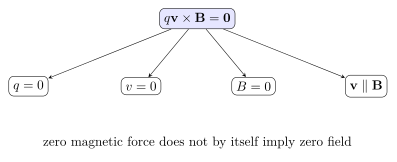
- 识别 \(q=0\)、\(v=0\)、\(B=0\) 或 \(\mathbf v\parallel\mathbf B\) 的零磁力情形。
- 从瞬时功率证明磁力对经典点电荷不做功,区分速度大小、速度方向、动量与动能。
- 用单位、正交性、极限情形和能量检查诊断计算结果。
Prerequisites / 先修知识
- 向量点积、叉积与右手坐标系。
- Newton's Laws and Interactions。
- Work and Kinetic Energy。
- Unit 4.1 的电场定义与 \(\mathbf F_E=q\mathbf E\)。
Scope and conventions / 范围与约定
- 默认实验室 inertial frame;\(\mathbf v\) 是电荷相对该参考系的瞬时速度。
- 经典点粒子、非相对论运动为主;相对论修正只在模型边界说明。
- 使用 SI;磁场用 tesla(T)。
- 坐标轴均为右手系;页面外用 \(\odot\),页面内用 \(\otimes\)。
- 本课研究给定 \(\mathbf B\) 对试探电荷的作用;磁场如何由电流产生从 Unit 4.7 开始系统讨论。
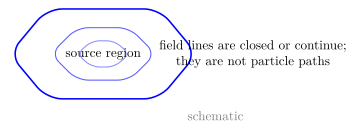
- 场线仅为可视化工具,不是粒子轨迹,也不是物质细线。
Notation and modeling contract / 符号与建模契约
| Symbol | Meaning | SI unit |
|---|---|---|
| \(q\) | signed charge | C |
| \(\mathbf r\) | particle position in chosen frame | m |
| \(\mathbf v=d\mathbf r/dt\) | particle velocity | \(\mathrm{m\,s^{-1}}\) |
| \(\mathbf E\) | electric field | \(\mathrm{V\,m^{-1}}\) |
| \(\mathbf B\) | magnetic flux density / magnetic field | T |
| \(\mathbf F_B=q\mathbf v\times\mathbf B\) | magnetic part of Lorentz force | N |
| \(v_\perp\) | component of \(\mathbf v\) perpendicular to \(\mathbf B\) | \(\mathrm{m\,s^{-1}}\) |
| \(K\) | kinetic energy | J |
| \(P=dW/dt\) | instantaneous power delivered to particle | W |
Knowledge 1 — Magnetic field as a vector field / 磁场作为矢量场
Knowledge ID: P04-U06-L01-K01
1.1 A field assigns a vector to each event
磁场写作 \(\mathbf B(\mathbf r,t)\):给定空间位置和时刻,它给出一个矢量。场是空间的属性;试探电荷受力取决于场、速度和电荷,不应把 \(\mathbf B\) 与 \(\mathbf F\) 混为同一对象。
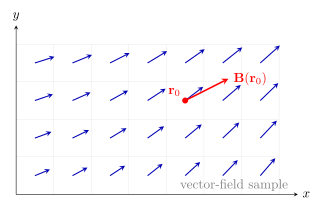
在操作上,若已知正试探电荷的速度与受力,只有与速度垂直的磁场分量能由单次测量显现;沿 \(\mathbf v\) 的分量不产生磁力。因此确定完整 \(\mathbf B\) 需要改变试探速度方向或使用等效的磁探测程序。
1.2 Field lines encode direction and relative magnitude
磁场线在每点的切线方向给出 \(\mathbf B\) 方向,线密度示意大小。经典 Maxwell theory 满足 \(\boldsymbol\nabla\cdot\mathbf B=0\),所以磁力线不在空间中孤立起止;它们形成闭合曲线或延伸至边界。
1.3 Unit and operational scale
由 \(F_B=|q|v_\perp B\),
\[1\ \mathrm T =1\ \frac{\mathrm N}{\mathrm{A\,m}} =1\ \frac{\mathrm{N\,s}}{\mathrm{C\,m}}.\]
因此 \(B\) 不是“每单位电荷的力”——还必须指定速度方向和大小。若 \(q=1\ \mathrm C\)、\(v_\perp=1\ \mathrm{m\,s^{-1}}\) 且 \(B=1\ \mathrm T\),磁力大小才是 \(1\ \mathrm N\)。
Knowledge 2 — Lorentz force on a moving charge / 运动电荷所受洛伦兹力
Knowledge ID: P04-U06-L01-K02
2.1 Vector law before components
电磁场对经典点电荷的总作用是
\[\boxed{\mathbf F=q\left(\mathbf E+\mathbf v\times\mathbf B\right)}.\]
磁场项为
\[\boxed{\mathbf F_B=q\mathbf v\times\mathbf B},\]
其大小
\[\boxed{F_B=|q|vB\sin\theta=|q|v_\perp B},\]
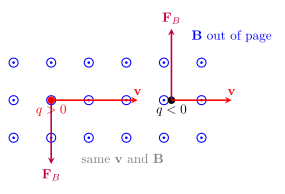
其中 \(\theta\) 是 \(\mathbf v\) 转向 \(\mathbf B\) 的较小夹角。先写矢量定律再投影,可以避免把 \(q\) 的符号和 \(\sin\theta\) 混乱。
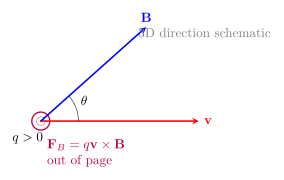
上图用二维投影表达三维叉积;真正的 \(\mathbf F_B\) 同时垂直于 \(\mathbf v\) 和 \(\mathbf B\),不能在 \(v\)–\(B\) 平面内。
2.2 Component calculation
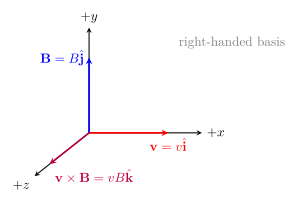
在右手 Cartesian basis 中,
\[\mathbf v\times\mathbf B =\begin{vmatrix} \hat{\mathbf i}&\hat{\mathbf j}&\hat{\mathbf k}\\ v_x&v_y&v_z\\ B_x&B_y&B_z \end{vmatrix}.\]
即
\[\mathbf F_B=q\bigl( v_yB_z-v_zB_y, v_zB_x-v_xB_z, v_xB_y-v_yB_x \bigr).\]
分量法是右手定则的代数版本。检验必须满足
\[\mathbf F_B\cdot\mathbf v=0, \qquad \mathbf F_B\cdot\mathbf B=0.\]
2.3 Frame dependence
\(\mathbf E\)、\(\mathbf B\) 与 \(\mathbf v\) 都依赖参考系;同一事件在另一惯性系中电场与磁场会混合变换。但在一个给定惯性系中,必须使用同一系测得的三者。低速本科问题通常固定实验室系;把粒子静止系的 \(\mathbf v=0\) 与实验室的 \(\mathbf B\) 混用没有意义。
Knowledge 3 — Cross-product direction and zero-force cases / 叉积方向与零力情形
Knowledge ID: P04-U06-L01-K03
3.1 Direction algorithm
对正电荷:右手四指从 \(\mathbf v\) 的方向卷向 \(\mathbf B\),拇指给 \(\mathbf v\times\mathbf B\)。对负电荷,将该方向反转。可靠的三步法是:
- 暂时令 \(q>0\) 求 \(\mathbf v\times\mathbf B\);
- 若 \(q<0\),整体反向;
- 用分量或点积正交性复核。
3.2 Zero-force cases
\[\mathbf F_B=\mathbf 0\]
可能来自:\(q=0\)、\(\mathbf v=\mathbf0\)、\(\mathbf B=\mathbf0\),或 \(\mathbf v\) 与 \(\mathbf B\) 平行/反平行。特别地,静止电荷不受磁力,但这不意味着所在处 \(\mathbf B=0\)。
3.3 Parallel and perpendicular velocity components
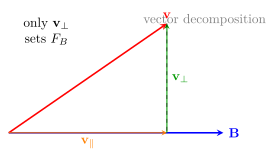
分解
\[\mathbf v=\mathbf v_\parallel+\mathbf v_\perp, \qquad \mathbf v_\parallel=(\mathbf v\cdot\hat{\mathbf b})\hat{\mathbf b}, \quad \hat{\mathbf b}=\frac{\mathbf B}{B}.\]
因为 \(\mathbf v_\parallel\times\mathbf B=0\),
\[\mathbf F_B=q\mathbf v_\perp\times\mathbf B.\]
Knowledge 4 — Magnetic force does no work on a point charge / 磁力对点电荷不做功
Knowledge ID: P04-U06-L01-K04
4.1 Instantaneous power proof
对点电荷,磁力的瞬时功率为
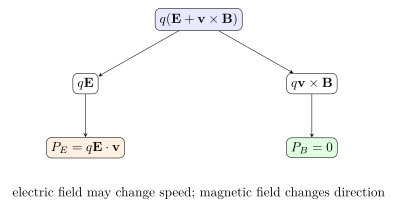
\[P_B=\mathbf F_B\cdot\mathbf v =q(\mathbf v\times\mathbf B)\cdot\mathbf v=0.\]
由 work–energy theorem,
\[\boxed{\frac{dK}{dt}=P_B=0}\]
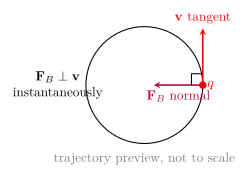
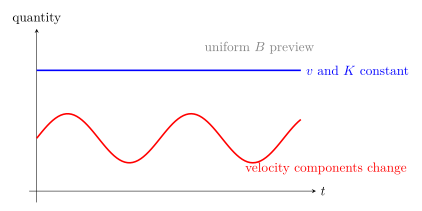
(若只有磁力)。磁力可以改变 \(\mathbf p\) 的方向,因为 \(d\mathbf p/dt=\mathbf F_B\ne0\),却不改变非相对论动能 \(K=mv^2/2\) 或速度大小 \(v\)。
4.2 Electric and magnetic contributions to power
对完整 Lorentz force,
\[\frac{dK}{dt}=\mathbf F\cdot\mathbf v =q\mathbf E\cdot\mathbf v +q(\mathbf v\times\mathbf B)\cdot\mathbf v =\boxed{q\mathbf E\cdot\mathbf v}.\]
所以电场能直接改变点电荷的能量;磁场只弯折运动方向。在速度选择器等交叉场装置中,净力可能为零;这比“磁力不做功”更强,意味着方向也不变。
4.3 What the statement does and does not mean
“磁力不做功”严格指 \(q\mathbf v\times\mathbf B\) 对理想点电荷的机械功率为零。它不等于:
- 磁场不能改变轨迹;事实上磁场可产生法向加速度。
- 含时电磁装置不能传递能量;变化磁场可伴随感生电场,真正做功的是 \(q\mathbf E\)。
- 磁力对有内部自由度的宏观系统永远没有能量效应;磁偶极在外场中的势能、约束和电源做功必须按完整系统账本分析。
Worked Examples / 完整例题
Worked Example 1 — Proton in mutually perpendicular velocity and field
Known. 质子 \(q=+e=1.602\times10^{-19}\ \mathrm C\) 以 \(\mathbf v=(3.00\times10^6\ \mathrm{m\,s^{-1}})\hat{\mathbf i}\) 进入 \(\mathbf B=(0.250\ \mathrm T)\hat{\mathbf k}\)。求磁力。
Object/frame/axes. 研究对象为质子;实验室惯性系,\(x,y,z\) 为右手系。
Model. 点电荷、匀强静磁场、非相对论;\(v/c=0.0100\) 足够小。
\[\mathbf v\times\mathbf B =(3.00\times10^6)(0.250)(\hat{\mathbf i}\times\hat{\mathbf k}) =-7.50\times10^5\hat{\mathbf j}\ \mathrm{T\,m\,s^{-1}}.\]
\[\mathbf F_B=q\mathbf v\times\mathbf B =-(1.602\times10^{-19})(7.50\times10^5)\hat{\mathbf j} =\boxed{-1.20\times10^{-13}\hat{\mathbf j}\ \mathrm N}.\]
Checks. \(\mathbf F\perp\mathbf v\)、\(\mathbf B\);单位 \(\mathrm C(\mathrm{m/s})T=N\)。正电荷方向与叉积一致。
Worked Example 2 — Electron with oblique velocity
Known. 电子 \(q=-e\),\(\mathbf B=0.400\hat{\mathbf k}\ \mathrm T\),\(\mathbf v=(2.00\hat{\mathbf i}+3.00\hat{\mathbf k})\times10^6\ \mathrm{m\,s^{-1}}\)。求 \(\mathbf F_B\) 及说明哪个速度分量不起作用。
Reference and model. 同一实验室系;经典点电荷。\(z\) 分量平行 \(\mathbf B\)。
\[\mathbf v\times\mathbf B =(2.00\times10^6)(0.400)(\hat{\mathbf i}\times\hat{\mathbf k}) =-8.00\times10^5\hat{\mathbf j}.\]
\[\mathbf F_B=(-1.602\times10^{-19})(-8.00\times10^5)\hat{\mathbf j} =\boxed{1.28\times10^{-13}\hat{\mathbf j}\ \mathrm N}.\]
\(3.00\times10^6\hat{\mathbf k}\) 与 \(\mathbf B\) 平行,贡献为零。Checks. 负电荷使正电荷右手方向反转;\(\mathbf F\cdot\mathbf v=0\)。
Worked Example 3 — Magnetic force magnitude and angle reconstruction
Known. \(|q|=4.00\ \mathrm{nC}\)、\(v=2.50\times10^5\ \mathrm{m\,s^{-1}}\)、\(B=0.600\ \mathrm T\),测得 \(F_B=3.00\times10^{-4}\ \mathrm N\)。求 \(\theta\) 的可能值。
System/convention. 点电荷;\(\theta\in[0,\pi]\) 是 \(\mathbf v\) 与 \(\mathbf B\) 的夹角。力大小不能确定电荷符号或唯一方向。
\[\sin\theta=\frac{F_B}{|q|vB} =\frac{3.00\times10^{-4}}{(4.00\times10^{-9})(2.50\times10^5)(0.600)} =0.500.\]
\[\boxed{\theta=30.0^\circ\ \text{or}\ 150^\circ}.\]
Checks. 比值无量纲且不超过 1;仅由 \(\sin\theta\) 无法区分锐角和钝角。若给定矢量方向才可消除歧义。
Worked Example 4 — Energy change in simultaneous electric and magnetic fields
Known. \(q=+2.00\ \mathrm{\mu C}\),某时刻 \(\mathbf v=(4.00\hat{\mathbf i}+3.00\hat{\mathbf j})\times10^3\ \mathrm{m\,s^{-1}}\),\(\mathbf E=(200\hat{\mathbf i}-100\hat{\mathbf j})\ \mathrm{V\,m^{-1}}\),另有任意 \(\mathbf B\)。求该时刻动能变化率。
Object/frame/model. 经典点电荷,所有量在同一惯性系。只求瞬时功率,无需知道 \(\mathbf B\)。
\[\frac{dK}{dt}=q\mathbf E\cdot\mathbf v.\]
\[\mathbf E\cdot\mathbf v =(200)(4.00\times10^3)+(-100)(3.00\times10^3) =5.00\times10^5\ \mathrm{V\,s^{-1}}.\]
\[\boxed{\frac{dK}{dt}=(2.00\times10^{-6})(5.00\times10^5)=1.00\ \mathrm W}.\]
Checks and interpretation. \(q\mathbf E\cdot\mathbf v\) 单位为 \(\mathrm{C\,V/s=J/s}\);正号表示动能增加。无论 \(\mathbf B\) 多大,其瞬时功率项仍为零。
Lesson synthesis / 全课综合
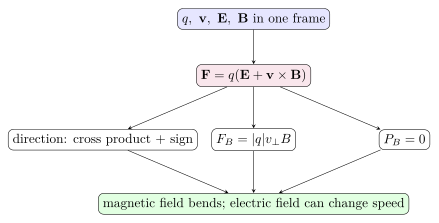
建模顺序:声明参考系与坐标 → 写矢量 Lorentz law → 分离电、磁项 → 用叉积求方向和大小 → 对负电荷反向 → 用两次点积和功率检验。下一课将把这里的瞬时法向力积分成圆周、螺旋和交叉场轨迹。
Formula-and-decision table / 公式与决策表
| Task | Relation | Conditions / warning |
|---|---|---|
| total electromagnetic force | \(\mathbf F=q(\mathbf E+\mathbf v\times\mathbf B)\) | all quantities in same frame |
| magnetic-force magnitude | \(F_B=\lvert q\rvert vB\sin\theta=\lvert q\rvert v_\perp B\) | use \(\lvert q\rvert\) only for magnitude |
| direction | positive-charge direction is \(\mathbf v\times\mathbf B\) | reverse for \(q<0\) |
| component check | \(\mathbf F_B\cdot\mathbf v=\mathbf F_B\cdot\mathbf B=0\) | failure signals cross-product error |
| zero force | \(q=0\), \(v=0\), \(B=0\), or \(\mathbf v\parallel\mathbf B\) | zero force does not prove zero field |
| magnetic power | \(P_B=q(\mathbf v\times\mathbf B)\cdot\mathbf v=0\) | ideal point charge |
| total power | \(dK/dt=q\mathbf E\cdot\mathbf v\) | magnetic term vanishes |
| tesla | \(1\ \mathrm T=1\ \mathrm{N/(A\,m)}\) | equivalent to \(\mathrm{N\,s/(C\,m)}\) |
Model boundaries / 模型边界
- Classical particle: quantum spin and Stern–Gerlach forces are not described by \(q\mathbf v\times\mathbf B\) alone.
- Relativistic speed: Lorentz force law remains valid, but \(\mathbf p=\gamma m\mathbf v\) and \(K=(\gamma-1)mc^2\) replace Newtonian relations.
- Same reference frame: fields and velocity must be evaluated in one frame; electric and magnetic classifications are frame dependent.
- Point-charge work statement: macroscopic magnetic devices require a full account of fields, constraints, currents and power supplies.
- Field-line limits: line density is qualitative unless a calibrated flux tube is specified; field lines are not trajectories.
- Test-particle approximation: the charge must not significantly alter the prescribed source field when interpreting \(\mathbf B\) operationally.
Misconception clinic / 误区诊所
- “\(B=F/q\)。” 磁力还依赖 \(v\) 和夹角;静止试探电荷无法用力读出 \(B\)。
- “右手定则直接给电子受力。” 右手先给正电荷的 \(\mathbf v\times\mathbf B\),电子必须反向。
- “\(\mathbf v\parallel\mathbf B\) 时场为零。” 只是叉积为零,场可很强。
- “磁力不做功,所以磁力为零。” 法向力可持续改变动量方向而瞬时功率为零。
- “圆形磁力线就是粒子轨迹。” 场线描述 \(\mathbf B\),轨迹由 Newton–Lorentz 方程决定。
- “负电荷的磁力大小带负号。” 大小永远非负;符号只用于矢量方向。
- “只要有磁场,速度一定改变。” 若 \(v=0\) 或 \(\mathbf v\parallel\mathbf B\),磁力为零。
Practice and retrieval / 练习与提取
- [K01] 写出 tesla 的两种力学/电学组合单位,并解释为何 \(\mathbf B\) 不是力。
- [K01] 场线在某处更密表示什么?为什么不能把场线当作带电粒子轨迹?
- [K02] \(q=3.00\ \mathrm{\mu C}\)、\(\mathbf v=200\hat{\mathbf i}\ \mathrm{m/s}\)、\(\mathbf B=0.400\hat{\mathbf j}\ \mathrm T\)。求 \(\mathbf F_B\)。
- [K02] 对 \(\mathbf v=(2,-1,3)\ \mathrm{m/s}\)、\(\mathbf B=(0,4,2)\ \mathrm T\)、\(q=0.500\ \mathrm C\),求磁力分量。
- [K03] 电子向东运动、磁场向北。磁力指向哪里?
- [K03] 在已知试探粒子带电(\(q\ne0\))的前提下,列出磁力为零的其余三种原因;哪一种不能用改变试探速度来排除?
- [K03] \(v=5.00\times10^4\ \mathrm{m/s}\),与 \(0.200\ \mathrm T\) 场成 \(30.0^\circ\),\(|q|=2.00\ \mathrm{nC}\)。求力大小。
- [K04] 用一行向量恒等式证明磁力功率为零。
- [K04] 只有匀强磁场时,一个经典点电荷的哪些量恒定:速度矢量、速度大小、动量矢量、动量大小、动能?
- [综合] 若测得某粒子在已知 \(\mathbf B\) 中磁力为零,能否断言粒子静止?给出反例并说明需要什么额外测量。
Answers / 答案
1. \(1\ \mathrm T=1\ \mathrm{N/(A\,m)}=1\ \mathrm{N\,s/(C\,m)}\)。\(\mathbf B\) 是每点的矢量场;受力还依赖 \(q\)、\(\mathbf v\)。
2. 更密通常表示更强的相对场;场线切向给 \(\mathbf B\),而轨迹切向给 \(\mathbf v\),两者一般不相同。
3. \(\mathbf F=qvB\hat{\mathbf k}=(3.00\times10^{-6})(200)(0.400)\hat{\mathbf k}=2.40\times10^{-4}\hat{\mathbf k}\ \mathrm N\)。
4. \(\mathbf v\times\mathbf B=(-14,-4,8)\),故 \(\mathbf F=(-7,-2,4)\ \mathrm N\)。点积检查:\(-14(2)+(-4)(-1)+8(3)=0\)。
5. 对正电荷 east \(\times\) north 是向上;电子反向,所以向下。
6. 在已知 \(q\ne0\) 时,其余原因是 \(v=0\)、\(B=0\)、\(\mathbf v\parallel\mathbf B\)。改变为多个非零、互不平行的试探速度可排除前后两种运动学情形;真正 \(B=0\) 对任何速度均无磁力。
7. \(F=|q|vB\sin30^\circ=(2.00\times10^{-9})(5.00\times10^4)(0.200)(0.500)=1.00\times10^{-5}\ \mathrm N\)。
8. \(P_B=q(\mathbf v\times\mathbf B)\cdot\mathbf v=0\),因为叉积垂直于 \(\mathbf v\)。
9. 速度大小、动量大小和动能恒定;速度矢量、动量矢量一般改变方向。
10. 不能;它可能沿 \(\mathbf B\) 运动。需测速度矢量并改变其方向,或用多个独立试探速度测场。
Exit ticket
- 一个负电荷以与 \(\mathbf B\) 成角度的速度运动。用文字给出求磁力方向的无歧义步骤。
- 用“力—功率—动量”三句话解释磁场为何能弯曲轨迹却不改变点电荷速度大小。
Exit-ticket benchmark
先忽略符号按右手定则求 \(\mathbf v\times\mathbf B\),再因 \(q<0\) 反向,并用与 \(\mathbf v\)、\(\mathbf B\) 均垂直作复核。磁力是动量的时间变化率,因而可改方向;其与速度正交,所以功率为零;只有磁力时动能与速度大小保持不变。
References and source notes / 参考资料与来源说明
Source-to-content map
| Source | Used for | Knowledge ID / section | Model boundary or convention |
|---|---|---|---|
| OpenStax University Physics Vol. 2, §11.2 Magnetic Fields and Lines | operational field definition, right-hand direction, field lines | K01–K03 | positive test-charge convention |
| MIT OCW 8.02, Chapter 8: Magnetic Fields | Lorentz force, vector decomposition, work argument | K01–K04 | SI and laboratory-frame presentation |
| David Tong, University of Cambridge, Electromagnetism lecture notes | Lorentz law and field viewpoint | K01–K04 | relativistic field context identified as beyond core scope |
| The Feynman Lectures on Physics, Vol. II, Ch. 15 | magnetic force, current/moving-charge interpretation, no-work reasoning | K02–K04 | classical particle and circuit interpretation |
| NIST SP 330, The International System of Units | SI tesla and derived-unit convention | K01 | SI unit standard |
资料和链接实际核对日期:2026-08-26。正文均为重新推导与组织;TikZ 依据方程原创绘制。
复习与拓展
- 下一课把 \(q\mathbf v\times\mathbf B\) 积分为圆周与螺旋运动。
- Unit 4.7 从电流源计算 \(\mathbf B\),连接场的“响应”与“来源”。
- Maxwell equations 中正式处理 \(\boldsymbol\nabla\cdot\mathbf B=0\) 与场变换。
- 相对论扩展中比较 \(\mathbf E\)、\(\mathbf B\) 在不同惯性系的混合。