
Learning objectives / 学习目标
- 用 reduced-eye model 计算远点、近点与 accommodation range。
- 由焦点相对视网膜的位置判断 myopia、hyperopia 与 astigmatism,并求理想矫正镜光焦度。
- 用薄透镜、f-number 与允许弥散圈分析 focus、exposure 和 depth of field。
- 用 pixel pitch、Nyquist frequency、Poisson shot noise 与 read noise 建立传感器预算。
- 区分 optical blur、defocus blur、sampling alias 与 random noise。
Prerequisites / 先修知识
- Thin-lens equation, magnification, and optical power。
- 小角近似、相似三角形、平方反比与独立随机量方差相加。
- Poisson 计数:平均值为 \(N\) 时,理想 shot-noise 标准差为 \(\sqrt N\)。
Scope and conventions / 范围与约定
- 眼睛采用单薄透镜 reduced-eye model;真实多界面被等效为总光焦度。
- 眼睛/相机数值成像用正实距离:\(s_o>0\) 是镜前实物,\(s_i>0\) 是镜后实像,\(1/f=1/s_o+1/s_i\)。
- corrective lens 使用带符号焦距:发散镜 \(f<0\)、会聚镜 \(f>0\);除非说明,忽略眼镜到眼的 vertex distance。
- aperture diameter 为 \(D_a\),f-number 为 \(N_f=f/D_a\),避免与光子数混淆。
- sensor pitch \(p\) 是像素中心距;Nyquist 只限制采样,不保证 optics 仍传递对比度。
- 噪声以 electrons 计,假设独立方差相加;不做临床诊断,不讨论 demosaicing 和非线性降噪。
Notation and modeling contract / 符号与建模契约
| Symbol | Meaning | SI unit |
|---|---|---|
| \(s_o,s_i,f\) | object distance, image distance, focal length | m |
| \(P=1/f\) | optical power | \(\mathrm{m^{-1}}=\mathrm D\) |
| \(R_N,R_F\) | near and far point distances | m |
| \(D_a,N_f\) | aperture diameter and f-number | m, 1 |
| \(t_e,c\) | exposure time, accepted circle of confusion | s, m |
| \(p,\nu_N\) | pixel pitch, Nyquist spatial frequency | m, cycles m\(^{-1}\) |
| \(N_e,\sigma_r,\sigma_d\) | signal electrons, read and dark noise | electrons |
| SNR | mean signal / total standard deviation | 1 |
Knowledge 1 — Eye optics, accommodation, and near/far points / 眼球光学、调焦与远近点
Knowledge ID: P05-U03-L01-K01
角膜提供主要会聚,晶状体改变曲率做精细调焦。把二者等效为一片透镜,视网膜位于固定 \(s_i\)。要看清不同距离 \(s_o\),眼睛改变光焦度:
\[P=\frac1f=\frac1{s_o}+\frac1{s_i}.\]
远物 \(s_o\to\infty\) 时所需光焦度最小;物体靠近时 \(1/s_o\) 增大,必须增加光焦度。这称 accommodation / 调焦。
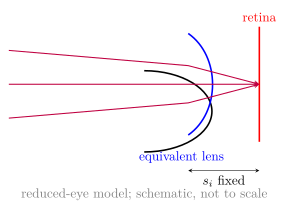
图 1 把多界面眼球压缩为单透镜;它适合一阶估算,不代表真实眼球只有一个折射面。
- far point \(R_F\): 最小调焦时仍能看清的最远物点;正视眼约在无穷远。
- near point \(R_N\): 最大调焦时能看清的最近物点;\(0.250\ \mathrm m\) 只是教材参考值。
- accommodation range:
\[\Delta P=P_N-P_F=\frac1{R_N}-\frac1{R_F}.\]
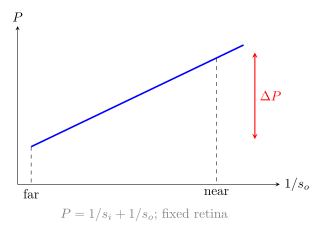
图 2 的斜率为 1;accommodation 是光焦度差,不是简单焦距差。
Knowledge 2 — Myopia, hyperopia, astigmatism, and correction / 近视、远视、散光与矫正
Knowledge ID: P05-U03-L01-K02
- myopia / 近视: 放松眼对平行光会聚过强,焦点在视网膜前;用负光焦度镜把远物形成在眼的有限远点。
- hyperopia / 远视: 眼轴偏短或光焦度不足,焦点倾向落在视网膜后;用正光焦度镜预会聚。
- astigmatism / 散光: 两个主子午面光焦度不同,同一物点产生两个焦线;需 cylindrical/toric power 并给 axis。
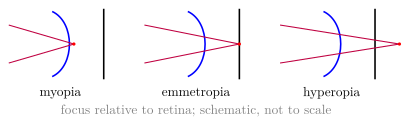
图 3 只比较焦点位置;真实成因可来自眼轴、角膜或晶状体。
近视眼远点为 \(R_F\),紧贴眼睛的矫正镜需把无穷远物体形成在 \(s_i=-R_F\):
\[P_c=\frac1{f_c}=-\frac1{R_F}.\]
远视眼若要把位于参考近点 \(D\) 的物体形成在自身近点 \(R_N\):
\[P_c=\frac1D-\frac1{R_N}>0.\]
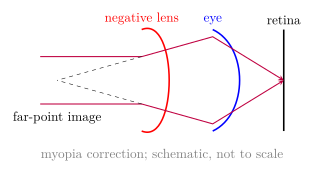
图 4 显示眼镜先制造眼睛能聚焦的虚物,不是独自形成视网膜实像。
Knowledge 3 — Camera focus, aperture, exposure, and depth of field / 相机对焦、光圈、曝光与景深
Knowledge ID: P05-U03-L01-K03
相机令 lens 形成实像并使 sensor 位于 \(s_i\):
\[\frac1f=\frac1{s_o}+\frac1{s_i}, \qquad m=-\frac{s_i}{s_o}.\]
远物 \(s_i\approx f\);物体靠近时 \(s_i\) 增大,相机移动镜组或改变内部等效焦距。
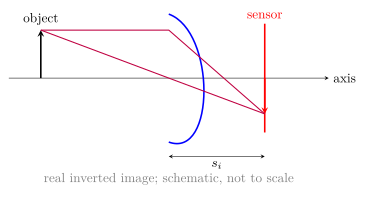
图 5 同时给出对焦位置与倒立实像;电子显示旋转不改变光学方向。
f-number 为
\[N_f=\frac f{D_a}.\]
同一场景、透过率与焦距下,sensor exposure 近似满足
\[H\propto\frac{t_e}{N_f^2}.\]
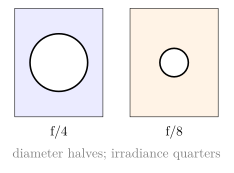
图 6 按 2:1 直径画出 f/4 与 f/8;同为 f/8 的不同焦距并不具有同一物理直径。
邻近焦平面的物点在 sensor 上形成 circle of confusion。允许直径 \(c\) 越大、aperture 越小,通常可接受的物距范围越宽,称 depth of field。
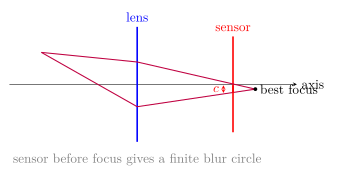
图 7 表明景深由容许度定义,不是空间中绝对清晰的硬边界。
Knowledge 4 — Sensor size, pixel sampling, and image noise / 传感器尺寸、像素采样与图像噪声
Knowledge ID: P05-U03-L01-K04
固定焦距时,大 sensor 截取更大 image circle、视场更宽;“透视”主要由 viewpoint 决定。像素 pitch 为 \(p\) 时
\[\boxed{\nu_N=\frac1{2p}}.\]
超过 \(\nu_N\) 的条纹会 alias 成错误低频;pixel aperture、optical PSF 与 demosaicing 还会改变有效传递。
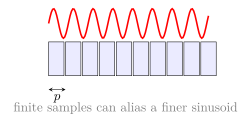
图 8 将连续光强与离散像素并列;更多 megapixels 只有在 optics、focus、motion 与 SNR 支持时才变成细节。
平均信号 \(N_e\) 的 shot-noise variance 为 \(N_e\)。加入独立 read/dark noise:
\[\sigma_{\rm tot}=\sqrt{N_e+\sigma_r^2+\sigma_d^2}, \qquad \mathrm{SNR}=\frac{N_e}{\sigma_{\rm tot}}.\]
photon-limited 且未饱和时 \(\mathrm{SNR}\approx\sqrt{N_e}\);曝光 4 倍,SNR 只增 2 倍。
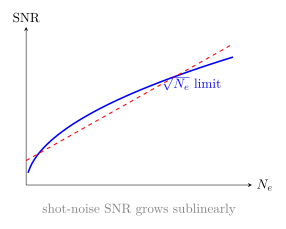
图 9 显示平方根规律;曲线在 full-well saturation 处终止。

图 10 给出成像链;不能仅凭“坏图”唯一反推问题发生在哪一环。
Worked Examples / 完整例题
Worked Example 1 — Accommodation range of a reduced eye
已知: \(s_i=17.0\ \mathrm{mm}\),\(R_F=\infty\),\(R_N=0.250\ \mathrm m\)。
研究对象/系统: 角膜—晶状体等效透镜与固定视网膜,不含眼镜。
参考系/正向: 沿光传播;正实距离。
模型: reduced eye、近轴薄透镜。
\[P_F=\frac1{0.0170}=58.8\ \mathrm D,\]
\[P_N=\frac1{0.250}+\frac1{0.0170}=62.8\ \mathrm D, \qquad \Delta P=4.00\ \mathrm D.\]
结论: 从无穷远调到 \(0.250\ \mathrm m\) 需增加 \(4.00\ \mathrm D\)。
检查: 单位为 m\(^{-1}\);\(R_N\to\infty\) 时 \(\Delta P\to0\)。靠近物体要求增加会聚能力,符合图 2。
Worked Example 2 — Correcting a myopic far point
已知: 裸眼远点 \(R_F=0.500\ \mathrm m\),眼镜紧贴眼睛,看无穷远。
研究对象/系统: corrective lens 先成像,眼睛后聚焦。
参考系/正向: 入射从左向右;远点虚像 \(s_i=-R_F\)。
模型: 薄镜、vertex distance 忽略、平行入射。
\[P_c=\frac1{s_i}=\frac1{-0.500}=-2.00\ \mathrm D, \qquad f_c=-0.500\ \mathrm m.\]
结论: 需 \(-2.00\ \mathrm D\) 发散镜。
检查: 负号符合降低总光焦度;\(R_F\to\infty\) 时处方趋零。眼镜制造远点虚像,而非视网膜实像。
Worked Example 3 — Camera focus shift and aperture stop
已知: \(f=50.0\ \mathrm{mm}\),\(s_o=2.00\ \mathrm m\);f/4、\(1/250\ \mathrm s\) 改为 f/8 并保持曝光。
研究对象/系统: lens 到 sensor,场景和透过率不变。
参考系/正向: 镜前实物与镜后实像距离取正。
模型: 薄透镜,\(H\propto t_e/N_f^2\)。
\[s_i=\left(\frac1{0.0500}-\frac1{2.00}\right)^{-1} =0.0513\ \mathrm m.\]
相对无穷远焦平面,后移 \(51.3-50.0=1.28\ \mathrm{mm}\)。曝光时间倍率
\[\left(\frac84\right)^2=4, \qquad t_e'=\frac4{250}=0.0160\ \mathrm s=\frac1{62.5}\ \mathrm s.\]
结论: \(s_i=51.3\ \mathrm{mm}\),保持曝光需约 \(1/62.5\ \mathrm s\)。
检查: 有限物距给 \(s_i>f\);直径减半、面积四分之一。长曝光会增大 motion blur 风险。
Worked Example 4 — Sampling and photon-noise budget
已知: \(p=4.00\ \mu\mathrm m\),\(N_e=1.00\times10^4\) electrons,\(\sigma_r=5.00\) electrons,dark noise 忽略。
研究对象/系统: 单像素线性传感器;量化与固定图样噪声不计。
参考系/正向: sensor plane 一维空间频率,计数非负。
模型: 均匀采样;独立 Poisson shot noise 与 Gaussian read noise。
\[\nu_N=\frac1{2(4.00\times10^{-6})} =1.25\times10^5\ \mathrm{cycles\,m^{-1}} =125\ \mathrm{cycles\,mm^{-1}}.\]
\[\sigma_{\rm tot}=\sqrt{10\,000+5.00^2}=100.1\ \mathrm{electrons}, \qquad \mathrm{SNR}=99.9.\]
结论: Nyquist frequency 为 \(125\ \mathrm{cycles\,mm^{-1}}\),SNR 为 \(99.9\)。
检查: shot noise 约 \(100\) electrons,远大于 read noise;Nyquist 不承诺镜头仍有高对比度。
Lesson synthesis / 本课综合
眼睛与相机共享“lens → aperture → image plane → detector”的骨架。眼睛固定 retina、改变光焦度;相机多移动镜组改变像距。成像质量应依次检查 focus、aperture 的通光/景深/衍射权衡、pixel sampling,最后建立 photon/read/dark noise budget。
Formula-and-decision table / 公式与决策表
| Task | Formula | Conditions | Main caution |
|---|---|---|---|
| eye/camera focus | \(1/f=1/s_o+1/s_i\) | paraxial thin system | state distance signs |
| accommodation | \(\Delta P=1/R_N-1/R_F\) | fixed retina | near point varies |
| myopia correction | \(P_c=-1/R_F\) | lens close to eye | virtual far-point image |
| f-number | \(N_f=f/D_a\) | entrance pupil | not diameter alone |
| exposure | \(H\propto t_e/N_f^2\) | same scene/transmission | real T-stop may differ |
| Nyquist | \(\nu_N=1/(2p)\) | uniform sampling | optics may cut off first |
| sensor SNR | \(N_e/\sqrt{N_e+\sigma_r^2+\sigma_d^2}\) | independent linear noises | excludes saturation |
Model boundaries / 模型边界
- reduced eye 忽略角膜非球面、晶状体梯度折射率、瞳孔位置与神经处理,不能替代验光。
- 高度数处方若 vertex distance 不可忽略,不能直接套紧贴公式。
- 薄透镜相机忽略多片镜组、focus breathing、vignetting、aberration 与 diffraction。
- depth of field 由 circle-of-confusion 容许度定义,不是绝对清晰区间。
- Nyquist theorem 假设均匀采样;Bayer mosaic、fill factor 与 demosaicing 会改变二维结果。
- shot noise 是光子统计,不是廉价 sensor 的制造缺陷;算法不能恢复未收集的信息。
Misconception clinic / 误区诊所
- “眼睛前后移动晶状体调焦。” 主要改变曲率与等效光焦度,retina distance 基本固定。
- “近视镜直接在视网膜成像。” 它先制造远点虚像,眼睛再成像。
- “f/8 就是 8 mm 孔径。” f-number 是 \(f/D_a\)。
- “缩光圈只增加景深。” 它降低 irradiance、可能延长曝光并增强 diffraction blur。
- “像素越多必然越清晰。” optics、sampling、motion、focus 与 SNR 中最弱环节限制细节。
- “提高 ISO 收集更多光子。” 给定 aperture 和 exposure time,ISO/gain 不增加入射光子。
Practice and retrieval / 练习与提取
- K01: \(s_i=16.7\ \mathrm{mm}\) 的 reduced eye 看无穷远时光焦度?
Answer
\[P=1/0.0167=59.9\ \mathrm D.\]
- K01: 远点无穷远、近点 \(0.400\ \mathrm m\),accommodation range?
Answer
\[\Delta P=1/0.400=2.50\ \mathrm D.\]
- K02: 近视远点 \(0.800\ \mathrm m\),紧贴眼睛看无穷远需多大光焦度?
Answer
\[P_c=-1/0.800=-1.25\ \mathrm D.\]
- K02: 为什么普通球面镜不能完整矫正 astigmatism?
Answer
两主子午面需要不同 power;球面镜各方位功率相同,需 cylindrical/toric component 和 axis。
- K03: \(f=100\ \mathrm{mm}\) 镜头 f/5 的 entrance-pupil diameter?
Answer
\[D_a=f/N_f=20.0\ \mathrm{mm}.\]
- K03: 从 f/2.8 收到 f/5.6,保持曝光需把时间乘多少?
Answer
\[(5.6/2.8)^2=4.\]
- K03: 为什么 depth of field 不是绝对边界?
Answer
“可接受清晰”由 \(c\) 定义,而 \(c\) 依赖 sensor、放大、显示尺寸、观看距离与任务。
- K04: \(p=2.00\ \mu\mathrm m\) 的一维 Nyquist frequency?
Answer
\[\nu_N=250\ \mathrm{cycles\,mm^{-1}}.\]
- K04: photon-limited 像素由 \(N_e=400\) 增至 \(1600\),SNR 变为几倍?
Answer
\(\mathrm{SNR}\approx\sqrt{N_e}\),所以由 20 到 40,是 2 倍。
- 综合: 错误宽条纹与暗区随机颗粒分别对应哪类问题?
Answer
前者典型为 undersampling alias;后者常由 photon/read/dark noise 主导,应分别处理 sampling 与 SNR。
Exit ticket / 离堂检核
- 对“远处清楚、近处模糊”的眼睛,画焦点、选矫正镜符号并用近点写出处方关系。
- 给定 lens、aperture、exposure、pixel pitch 与 photon count,建立 focus → sampling → noise 审计。
References and source notes / 参考资料与来源说明
Source-to-content map
| Source | Used for | Knowledge ID / section | Model boundary or convention |
|---|---|---|---|
| OpenStax `2.5 The Eye | eye image, accommodation, near/far points and correction | K01–K02 | reduced eye; 25 cm is a reference |
| OpenStax `2.6 The Camera | sensor image and finite-object focus | K03 | Gaussian thin-lens baseline |
| National Eye Institute: Refractive Errors | myopia, hyperopia, astigmatism | K02 | education, not diagnosis |
| EMVA 1288 Release 4.0 | shot/read/quantization noise, SNR, saturation | K04 | linear sensor assumptions |
| Purdue ECE 495 camera notes | digital sensors, photon arrivals and noise | K04 | statistical sensor model |
| Stanford EE392B image-sensor notes | sensor optics, resolution and noise taxonomy | K04 | sampling separated from blur |
资料和链接实际打开核对日期:2026-08-28。图示依据方程原创;例题与练习独立复算。
复习与拓展
- Lenses and Optical Systems:薄透镜与光焦度。
- Optical Instruments:angular magnification。
- Imaging Quality:PSF/MTF。
- Resolution and Fourier Optics:空间频率与采样。