
Learning objectives / 学习目标
- 从视网膜像大小推导 angular magnification,并区分它与 linear magnification。
- 推导 simple magnifier 的 relaxed-eye 与 near-point magnification。
- 分解 compound microscope 的 objective linear magnification 与 eyepiece angular magnification。
- 比较 Keplerian、Galilean 与 reflecting telescope 的光路、像向和长度。
- 定量连接 aperture area、light gathering、Rayleigh resolution 与 microscope numerical aperture。
Prerequisites / 先修知识
- Near point and retinal angular size。
- Thin-lens imaging and sequential systems。
- Circular-aperture diffraction 的物理图景;具体分辨率在本课给出。
Scope and conventions / 范围与约定
- 光从左向右,光轴向右为正;instrument angles 按逆时针为正。
- 参考近点记作 \(D=0.250\ \mathrm m\);它是比较基准,不是每个人固定生理常数。
- angular magnification \(M=\theta'/\theta\) 带符号;负号表示相对倒立,讨论“倍数”时使用 \(\lvert M\rvert\)。
- microscope tube length \(L\) 是 objective 后焦区到 eyepiece 前焦区的一阶有效长度;只在 \(L\gg f_o,f_e\) 的近似式中使用。
- telescope 默认无焦 afocal、最终像在无穷远;real instruments 的 field stop、exit pupil、aberration 与 atmosphere 另行说明。
- aperture diameter 记 \(D_a\);显微镜 numerical aperture 记 \(\mathrm{NA}=n\sin\alpha\)。
Notation and modeling contract / 符号与建模契约
| Symbol | Meaning | SI unit |
|---|---|---|
| \(\theta,\theta'\) | unaided and instrument-assisted visual angles | rad |
| \(M\) | signed angular magnification | 1 |
| \(D\) | conventional near-point distance | m |
| \(f_m,f_o,f_e\) | magnifier, objective, eyepiece focal lengths | m |
| \(L\) | effective microscope tube length | m |
| \(D_a\) | entrance aperture diameter | m |
| \(\lambda\) | vacuum wavelength unless stated | m |
| \(\mathrm{NA}=n\sin\alpha\) | microscope numerical aperture | 1 |
Knowledge 1 — Angular magnification / 角放大率
Knowledge ID: P05-U03-L02-K01
眼睛感知的“大小”首先由视角决定。小角下,视网膜像高近似 \(h_r=f_{\rm eye}\theta\)。仪器的核心量是
\[\boxed{M=\frac{\theta'}{\theta_{\rm ref}}}.\]
参考视角必须声明:simple magnifier/microscope 通常与物体放在裸眼近点 \(D\) 时比较;telescope 与同一远物裸眼视角比较。linear magnification \(m=y_i/y_o\) 描述一对共轭平面,不能替代 \(M\)。
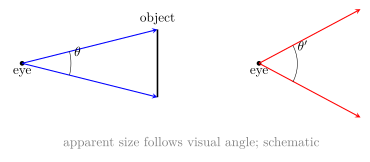
图 1 只比较视角;两幅物体的纸面高度不是线性像放大率。
Knowledge 2 — Simple magnifier / 放大镜
Knowledge ID: P05-U03-L02-K02
会聚 lens 把位于焦内的物体变成正立放大虚像。镜片靠近眼睛、最终像在无穷远时,物体放在前焦面:
\[\theta'\approx\frac h{f_m}, \qquad \theta_{\rm ref}\approx\frac hD,\]
\[\boxed{M_\infty=\frac D{f_m}}.\]
若最大调焦使虚像位于近点:
\[\boxed{M_N=1+\frac D{f_m}}.\]
near-point configuration 多 1 倍,但眼睛需 accommodation;relaxed-eye configuration 舒适且模型更稳定。
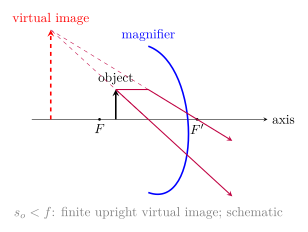
图 2 显示焦内物产生虚像;若物恰在焦面,出射光平行而虚像位于无穷远。
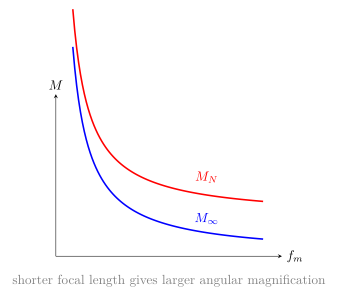
图 3 说明缩短焦距提高放大率,但通常同时增加曲率、像差与操作困难。
Knowledge 3 — Compound microscope / 复合显微镜
Knowledge ID: P05-U03-L02-K03
objective 先把物体(略在 \(f_o\) 外)形成放大倒立实中间像;eyepiece 再作为 magnifier。总角放大率是两级乘积:
\[M=m_oM_e.\]
relaxed-eye 且 \(L\gg f_o\) 时
\[m_o\approx-\frac L{f_o}, \qquad M_e\approx\frac D{f_e},\]
\[\boxed{M\approx-\frac{LD}{f_of_e}}.\]
负号表示最终相对原物倒立。真正分辨细节不仅靠 magnification,还依赖 objective NA;空放大不能创造缺失空间频率。
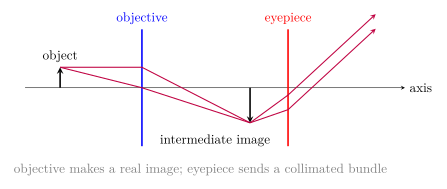
图 4 采用 relaxed-eye configuration:objective 形成 real intermediate image,且它位于 positive eyepiece 的前焦面;eyepiece 使出射束平行,对应位于无穷远的 virtual final image。
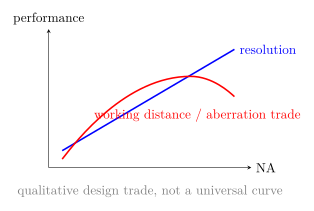
图 5 提醒:增大 NA 改善 diffraction limit,但 real objective 设计还受 working distance、aberration 与介质匹配约束。
Knowledge 4 — Refracting and reflecting telescopes / 折射与反射望远镜
Knowledge ID: P05-U03-L02-K04
Refracting telescopes
远物以角 \(\theta\) 入射 objective,在焦平面形成高度 \(h\approx f_o\theta\) 的中间像;eyepiece 令出射角 \(\theta'\approx-h/f_e\)。Keplerian telescope:
\[\boxed{M=-\frac{f_o}{f_e}}, \qquad L_{\rm tube}=f_o+f_e.\]
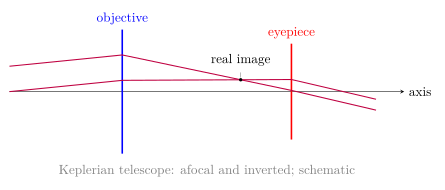
图 6 中 objective 后焦面与 eyepiece 前焦面重合,系统 afocal。
Galilean telescope 使用 negative eyepiece,出射像正立:
\[M=+\frac{f_o}{\lvert f_e\rvert}, \qquad L_{\rm tube}=f_o-\lvert f_e\rvert.\]
它更短,但简单形式的视场与 exit pupil 不如 Keplerian 易于扩展。
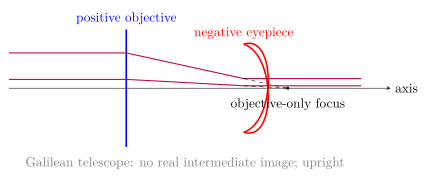
图 7 表示负 eyepiece 在 objective 光束真正会聚前使其恢复平行。
Reflecting telescopes
凹面主镜聚光,不因材料折射率色散产生 primary chromatic aberration。Newtonian design 用平面副镜把焦点折向侧面;其他 designs 用 secondary mirror 改变焦点位置。reflector 仍有 spherical/coma、遮挡、衍射、制造和准直误差。
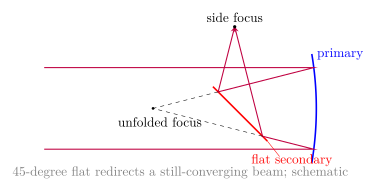
图 8 展示折返光路;副镜遮挡会改变 pupil 和 diffraction pattern,不能忽略。
Knowledge 5 — Aperture, light gathering, and resolution / 口径、集光能力与分辨率
Knowledge ID: P05-U03-L02-K05
同一 irradiance 下,理想圆 aperture 收集功率与面积成正比:
\[P_{\rm collect}\propto D_a^2.\]
因此口径加倍,收集光子约 4 倍,photon-limited SNR 约 2 倍。对 unobstructed circular aperture,Rayleigh angular criterion:
\[\boxed{\theta_R=1.22\frac{\lambda}{D_a}}.\]
显微镜常写 object-space lateral scale
\[\boxed{\delta_R\approx0.61\frac{\lambda_0}{\mathrm{NA}}}, \qquad \mathrm{NA}=n\sin\alpha.\]
这里 \(\lambda_0\) 是真空波长。Rayleigh 是分辨判据,不是“低于此值信息绝对为零”的定理。
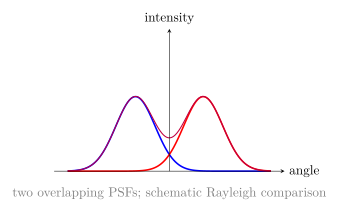
图 9 用两个 PSF 说明“分辨”要定义判据;真实 Airy profile 不是 Gaussian,本图仅示意峰谷。
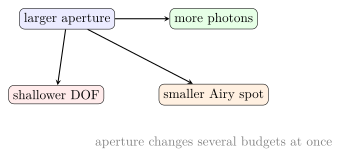
图 10 汇总 aperture 权衡:集光与 diffraction resolution 改善,不代表景深、像差或成本也改善。
Worked Examples / 完整例题
Worked Example 1 — Simple magnifier in two viewing modes
已知: \(f_m=50.0\ \mathrm{mm}\),参考近点 \(D=0.250\ \mathrm m\)。
研究对象/系统: magnifier + eye;比较裸眼近点视角。
参考系/正向: 小角取正,报告 magnification magnitude。
模型: thin lens close to eye,分别 relaxed eye 与 near-point image。
\[M_\infty=\frac{0.250}{0.0500}=5.00, \qquad M_N=1+\frac{0.250}{0.0500}=6.00.\]
结论: relaxed-eye 为 \(5.00\times\);near-point 为 \(6.00\times\)。
检查: 无量纲;\(f_m\) 变大时 \(M\to1\) 附近。多出的 1 倍以 accommodation 为代价。
Worked Example 2 — Compound microscope
已知: \(f_o=4.00\ \mathrm{mm}\),\(f_e=25.0\ \mathrm{mm}\),\(L=160\ \mathrm{mm}\),\(D=250\ \mathrm{mm}\);final image at infinity。
研究对象/系统: objective + eyepiece + eye。
参考系/正向: 角度逆时针为正;负 \(M\) 表倒立。
模型: thin elements、paraxial、\(L\gg f_o\)。
\[m_o\approx-\frac{160}{4.00}=-40.0, \qquad M_e=\frac{250}{25.0}=10.0,\]
\[M=m_oM_e=-400.\]
结论: angular magnification 为 \(-400\),即倒立的 \(400\times\)。
检查: 比值无量纲;缩短任一 focal length 会提高模型放大率,但不保证 resolution 相应提高。
Worked Example 3 — Keplerian telescope
已知: \(f_o=1.00\ \mathrm m\),\(f_e=25.0\ \mathrm{mm}\),afocal relaxed viewing。
研究对象/系统: positive objective + positive eyepiece。
参考系/正向: incoming/off-axis angle 与 outgoing angle 同一符号基准。
模型: distant object、thin lenses、paraxial。
\[M=-\frac{1.00}{0.0250}=-40.0, \qquad L_{\rm tube}=1.00+0.0250=1.025\ \mathrm m.\]
结论: \(40.0\times\) 倒立,lens separation \(1.025\ \mathrm m\)。
检查: \(f_e\) 缩短会增大 \(\lvert M\rvert\);两焦面重合使平行光入、平行光出。
Worked Example 4 — Telescope aperture versus the eye
已知: telescope \(D_t=0.200\ \mathrm m\),dark-adapted pupil \(D_p=5.00\ \mathrm{mm}\),\(\lambda=550\ \mathrm{nm}\)。
研究对象/系统: 两个理想 circular apertures;同一远点源。
参考系/正向: angular separation 取非负。
模型: 相同透过率、unobstructed、diffraction limited。
集光比
\[\frac{P_t}{P_p}=\left(\frac{0.200}{0.00500}\right)^2=1.60\times10^3.\]
\[\theta_t=1.22\frac{550\times10^{-9}}{0.200} =3.36\times10^{-6}\ \mathrm{rad},\]
\[\theta_p=1.22\frac{550\times10^{-9}}{0.00500} =1.34\times10^{-4}\ \mathrm{rad}.\]
结论: 理想 telescope 收光约 \(1.60\times10^3\) 倍,Rayleigh angle 小 40.0 倍。
检查: aperture ratio 是 40;area scales as 40\(^2\),resolution angle as \(1/40\)。实际 atmosphere、obstruction 与 aberration 只会使表现更差。
Lesson synthesis / 本课综合
三类仪器统一为“先创建合适的 intermediate image,再把它转换为更大 visual angle”。magnifier 只有一片 lens;microscope 用 objective 获得高 spatial scale、eyepiece 改变视角;telescope 用大口径 objective 收集远物波前、eyepiece 放大角度。放大率、集光力和分辨率是不同性能量,必须分别预算。
Formula-and-decision table / 公式与决策表
| Instrument/task | Formula | Conditions | Caution |
|---|---|---|---|
| angular magnification | \(M=\theta'/\theta_{\rm ref}\) | small angles | state reference angle |
| magnifier relaxed | \(M=D/f_m\) | final image at infinity | comfortable, smaller by 1 |
| magnifier near point | \(M=1+D/f_m\) | lens close to eye | requires accommodation |
| microscope | \(M\approx-LD/(f_of_e)\) | long-tube paraxial model | magnification is not resolution |
| Kepler telescope | \(M=-f_o/f_e\) | positive eyepiece, afocal | inverted |
| Galilean telescope | \(M=f_o/\lvert f_e\rvert\) | negative eyepiece | upright, shorter |
| light gathering | \(P\propto D_a^2\) | same irradiance/transmission | obstruction changes area |
| circular resolution | \(\theta_R=1.22\lambda/D_a\) | ideal circular aperture | criterion, not hard information wall |
| microscope scale | \(\delta_R\approx0.61\lambda_0/\mathrm{NA}\) | scalar diffraction | state wavelength and medium |
Model boundaries / 模型边界
- \(D=25\ \mathrm{cm}\) 是标准比较距离;真实 near point 随人和年龄变化。
- microscope 近似式要求 objective 物距接近焦距且 \(L\) 定义一致;精确系统应逐面成像。
- telescope magnification 不决定 brightness、field of view、exit pupil 或 seeing。
- large aperture 提高理论 resolution,但 central obstruction 改变 PSF;atmosphere 可主导 ground telescope。
- NA 式假设 scalar wave 与良好像差校正;高 NA 需 vector diffraction。
- 过大的 magnification 只放大 Airy disk、aberration 与噪声,称 empty magnification。
Misconception clinic / 误区诊所
- “\(10\times\) 就是像高变为 10 倍。” 目视仪器的 \(M\) 是 visual-angle ratio。
- “near-point magnifier 总更好。” 它多 1 倍但要求 accommodation;relaxed viewing 更舒适。
- “microscope 的 eyepiece 负责解析细节。” objective aperture/NA 先决定可传递细节,eyepiece 主要改变视角。
- “reflector 没有任何像差。” 它消除 primary chromatic aberration,但仍有 coma、spherical、alignment 与 diffraction。
- “倍数越高看得越细。” 超过有效 spatial bandwidth 后只是 empty magnification。
Practice and retrieval / 练习与提取
- K01: \(\theta_{\rm ref}=2.00\ \mathrm{mrad}\),仪器后 \(\theta'=-30.0\ \mathrm{mrad}\),求 \(M\)。
Answer
\[M=-30.0/2.00=-15.0,\] 即倒立的 \(15.0\times\)。
- K02: \(f_m=0.100\ \mathrm m\),求 relaxed-eye magnification。
Answer
\(M=D/f_m=0.250/0.100=2.50\)。
- K02: 同一 magnifier 在 near-point mode 的 \(M\)?
Answer
\(M_N=1+2.50=3.50\)。
- K03: \(L=0.160\ \mathrm m\)、\(f_o=8.00\ \mathrm{mm}\)、\(f_e=20.0\ \mathrm{mm}\),relaxed-eye \(M\)?
Answer
\[M\approx-\frac{(0.160)(0.250)}{(0.00800)(0.0200)}=-250.\]
- K03: 为什么提高 eyepiece magnification 不能恢复 objective 未收集的细节?
Answer
objective pupil 已截断相应高 spatial frequencies;后级只能放大已有 field/image,不能重建缺失信息。
- K04: Kepler telescope \(f_o=800\ \mathrm{mm}\)、\(f_e=20.0\ \mathrm{mm}\),求 \(M\) 与长度。
Answer
\(M=-40.0\),长度 \(820\ \mathrm{mm}\)。
- K04: 同一 objective 改用 \(f_e=-20.0\ \mathrm{mm}\) 的 Galilean eyepiece,求像向和长度。
Answer
\(M=+40.0\),正立;长度 \(800-20=780\ \mathrm{mm}\)。
- K05: aperture 从 \(0.10\) m 增到 \(0.30\) m,集光能力理想增至几倍?
Answer
\((0.30/0.10)^2=9.00\) 倍。
- K05: \(D_a=0.100\ \mathrm m\)、\(\lambda=600\ \mathrm{nm}\),Rayleigh angle?
Answer
\[\theta_R=1.22(600\times10^{-9})/0.100=7.32\times10^{-6}\ \mathrm{rad}.\]
- K05: \(\lambda_0=500\ \mathrm{nm}\)、\(\mathrm{NA}=1.25\),估算 microscope Rayleigh scale。
Answer
\[\delta_R=0.61(500\ \mathrm{nm})/1.25=244\ \mathrm{nm}.\]
Exit ticket / 离堂检核
- 从 visual angle 出发推导 magnifier、microscope、Kepler telescope 的三个 magnification 公式。
- 解释为何 telescope aperture 同时改变 limiting magnitude 与 angular resolution,却不单独决定 magnification。
References and source notes / 参考资料与来源说明
Source-to-content map
| Source | Used for | Knowledge ID / section | Model boundary or convention |
|---|---|---|---|
| OpenStax `2.7 Simple Magnifier | angular magnification, near/infinity configurations | K01–K02 | \(D=25\) cm reference and small angles |
| OpenStax `2.8 Microscopes and Telescopes | microscope and refracting/reflecting telescope | K03–K04 | ideal thin elements |
| MIT OCW 2.71 Lecture 8 | telescope architecture and aberration limits | K04–K05 | paraxial versus real instruments |
| Feynman Lectures I.27 | geometrical-optics instrument viewpoint | K01–K04 | ray-model boundary |
| OpenStax `4.5 Circular Apertures | Rayleigh, aperture, NA and resolution | K05 | ideal circular aperture |
资料和链接实际打开核对日期:2026-08-28。图示原创;数值独立复算。
复习与拓展
- The Eye and Cameras:near point 与 detector。
- Imaging Quality and Aberrations:PSF、MTF 与像差。
- Single-Aperture Diffraction:Airy pattern 来源。
- Resolution and Fourier Optics:aperture 的 spatial-frequency 解释。