
Learning objectives / 学习目标
完成本课后,你应能:
- 由四动量解释 \(\mathbf p=\gamma m\mathbf u\),并检验低速与 \(u\to c\) 极限。
- 区分 rest energy、kinetic energy 与 total energy,推导 \(K=(\gamma-1)mc^2\)。
- 灵活使用 \(E^2=p^2c^2+m^2c^4\),在 \(E\)、\(p\)、\(u\)、\(m\) 间转换。
- 对给定系统和 frame 写出碰撞/衰变的四动量守恒,并求两体衰变运动学。
- 用 \(s=P_{tot}^2c^2\) 或系统 invariant mass 求 fixed-target threshold,并解释 collider 的效率优势。
Prerequisites / 先修知识
- Four-Vectors:\(p^\mu=(E/c,\mathbf p)\)、scalar product、boost 与 mass shell。
- 经典动量、动能、冲量与质心系。
- 二次方程、向量点积与 SI/eV 单位换算意识。
Scope and conventions / 范围与约定
- SI 为默认单位;粒子物理数值可用 eV、MeV、GeV 表示能量,并把动量写成 \(\mathrm{MeV}/c\)、质量写成 \(\mathrm{MeV}/c^2\),绝不把三者省略后混用。
- 度规仍为 \(\eta=\operatorname{diag}(1,-1,-1,-1)\),四动量 \(p^\mu=(E/c,\mathbf p)\)。
- \(m\) 是 invariant mass;单粒子静能 \(E_0=mc^2\)。不采用 velocity-dependent mass。
- 碰撞前后都以同一封闭系统为边界;若有未观测 photon、neutrino 或外场交换,它们仍属于四动量账本。
lab frame必须说明靶是否静止;CM frame(center-of-momentum frame)定义为总三动量为零的惯性系。- threshold 指满足守恒律的最小初态能量;在 CM frame 的 threshold,产物彼此无相对动量,但整个产物系统在 lab 中通常仍运动。
- 忽略量子矩阵元、截面、寿命与相互作用动力学;本课只判断 kinematic allowance 与能量—动量分配。
Notation and modeling contract / 符号与建模契约
| Symbol | Meaning | SI / particle unit |
|---|---|---|
| \(\mathbf u,\beta,\gamma\) | particle velocity, \(u/c\), Lorentz factor | mixed |
| \(\mathbf p\) | relativistic three-momentum | \(\mathrm{kg\,m\,s^{-1}}\) or \(\mathrm{MeV}/c\) |
| \(E_0\) | rest energy \(mc^2\) | J or MeV |
| \(K\) | kinetic energy \(E-E_0\) | J or MeV |
| \(E\) | total single-particle energy | J or MeV |
| \(P^\mu\) | total four-momentum of a stated system | momentum unit |
| \(M\) | invariant mass of a composite system | kg or \(\mathrm{MeV}/c^2\) |
| \(s\) | Mandelstam invariant \(s=(P_{initial}c)^2\) in energy-squared convention | \(\mathrm{J^2}\) or \(\mathrm{GeV^2}\) |
| \(Q\) | initial rest-energy sum minus final rest-energy sum | J or MeV |
| \(p^*\) | momentum magnitude in the parent/CM frame | momentum unit |
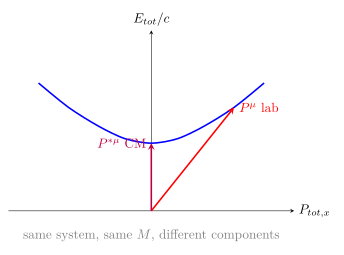
这里用
\[s=E_{tot}^2-c^2\lvert\mathbf P_{tot}\rvert^2=M^2c^4.\]
若某资料在 natural units 中写 \(s=P^2\)、\(c=1\),恢复 SI 时必须检查每一项都是 energy squared。
Knowledge 1 — Relativistic momentum / 相对论动量
Knowledge ID: P06-U03-L02-K01
定义与低速极限
相对论三动量是四动量的空间分量:
\[\boxed{\mathbf p=\gamma m\mathbf u}, \qquad \gamma=\frac1{\sqrt{1-u^2/c^2}}.\]
它与 \(\mathbf u\) 同向,但大小不再与速度线性。低速 \(\beta\ll1\) 时
\[\gamma=1+\frac12\beta^2+O(\beta^4),\]
所以
\[\mathbf p=m\mathbf u\left[1+\frac12\frac{u^2}{c^2}+O\left(\frac{u^4}{c^4}\right)\right].\]
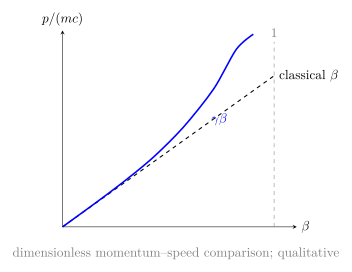
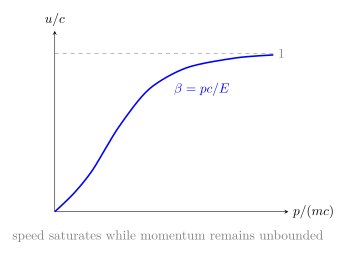
当 \(u\to c\),\(\gamma\to\infty\),因此有限 invariant mass 的粒子需要无穷动量才能达到 \(c\)。速度虽然趋于上限,动量却没有上限。
守恒的适用条件
若系统外部四动量通量为零,则
\[\frac{d\mathbf P_{tot}}{dt}=0.\]
这并不要求每个粒子动量不变;内部相互作用可以重新分配动量。若只选一个受外力粒子为系统,动量一般不守恒。
Knowledge 2 — Rest energy and total energy / 静能与总能量
Knowledge ID: P06-U03-L02-K02
三层能量账本
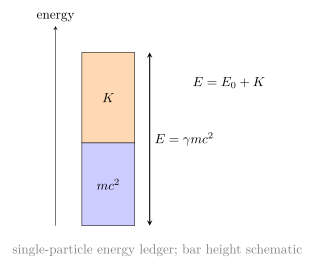
单个 on-shell massive particle 的总能量为
\[\boxed{E=\gamma mc^2}.\]
其静止系中 \(\gamma=1\),故 rest energy
\[\boxed{E_0=mc^2}.\]
定义 kinetic energy 为总能量相对静能的增量:
\[\boxed{K=E-E_0=(\gamma-1)mc^2}.\]
低速展开给
\[K=\frac12mu^2+\frac38m\frac{u^4}{c^2}+O\left(m\frac{u^6}{c^4}\right).\]
第一项恢复 Newtonian kinetic energy;第二项给领先相对论修正。
静能不是“可随意取零”的单粒子常数
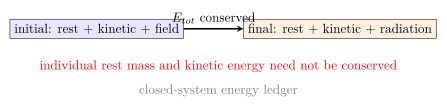
在非相对论单粒子运动中,加减一个固定能量常数常不影响运动方程;但反应会改变粒子种类和数目,静能差会变为产物动能或辐射。因此完整反应账本必须使用 total energy,而不能只守恒各粒子的 kinetic energy。
Knowledge 3 — Energy–momentum relation / 能量—动量关系
Knowledge ID: P06-U03-L02-K03
mass shell 的三种用法
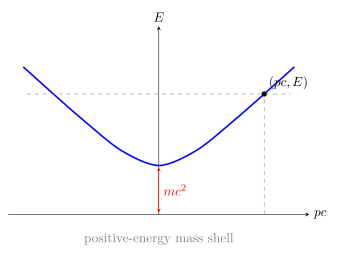
由 \(p^\mu p_\mu=m^2c^2\):
\[\boxed{E^2=p^2c^2+m^2c^4}.\]
它可改写为
\[E=\sqrt{p^2c^2+m^2c^4},\]
\[pc=\sqrt{E^2-m^2c^4},\]
\[\beta=\frac{pc}{E}.\]
对 massless particle,\(m=0\),所以
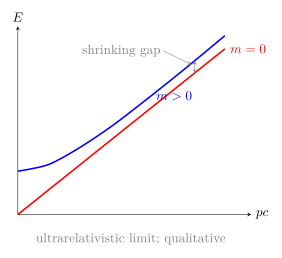
\[\boxed{E=pc}.\]
它不是“低质量近似”,而是 null mass shell 的精确关系。对 \(pc\gg mc^2\) 的 massive particle,才可近似 \(E\approx pc\),更精确展开为
\[E=pc+\frac{m^2c^3}{2p}+O(p^{-3}).\]
量纲与数值稳定性
若 \(E\) 与 \(mc^2\) 极接近,直接用 \(K=E-mc^2\) 可能发生数值消减。可用
\[K=\frac{p^2c^2}{E+mc^2}\]
作为等价且更稳定的表达。低速时分母约 \(2mc^2\),自动给 \(K\approx p^2/(2m)\)。
Knowledge 4 — Relativistic collisions and decays / 相对论碰撞与衰变
Knowledge ID: P06-U03-L02-K04
四动量账本
对封闭系统,
\[\boxed{\sum_i p_i^\mu=\sum_f p_f^\mu}.\]
选择 frame 只改变各分量,不改变等式。处理步骤是:先圈定系统、写所有初末粒子,再决定 lab 或 CM 哪个更简便。
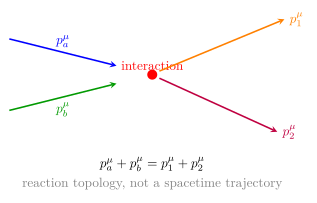
elastic collision 保持各粒子种类及质量,但仍需同时守恒总能量与总动量。inelastic collision 可改变系统内部能和粒子种类;总四动量仍守恒,而“总静质量简单相加”一般不守恒。
两体衰变
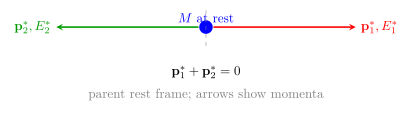
母粒子质量 \(M\) 在自身静止系衰变为质量 \(m_1,m_2\)。母粒子四动量为 \((Mc,\mathbf0)\),故产物动量反向等大:
\[\mathbf p_1^*=-\mathbf p_2^*, \qquad \lvert\mathbf p_1^*\rvert=\lvert\mathbf p_2^*\rvert=p^*.\]
能量为
\[E_1^*=\frac{M^2+m_1^2-m_2^2}{2M}c^2, \qquad E_2^*=\frac{M^2+m_2^2-m_1^2}{2M}c^2,\]
而
\[\boxed{p^*=\frac{c}{2M} \sqrt{\left[M^2-(m_1+m_2)^2\right] \left[M^2-(m_1-m_2)^2\right]}}.\]
根号为实数要求 \(M\ge m_1+m_2\)。若等号成立,产物在 threshold 时 \(p^*=0\);若 \(M<m_1+m_2\),该孤立衰变 kinematically forbidden。
Knowledge 5 — Invariant mass and threshold energy / 不变质量与阈能
Knowledge ID: P06-U03-L02-K05
复合系统的不变质量
对任意粒子集合定义总四动量
\[P^\mu=\sum_i p_i^\mu =\left(\frac{E_{tot}}c,\mathbf P_{tot}\right).\]
系统 invariant mass 为
\[\boxed{M^2c^4=E_{tot}^2-c^2\lvert\mathbf P_{tot}\rvert^2}.\]
它等于系统 CM frame 的总能量除以 \(c^2\)。对于两个粒子,
\[M^2c^4=m_1^2c^4+m_2^2c^4 +2\left(E_1E_2-c^2\mathbf p_1\mathbin{\cdot}\mathbf p_2\right).\]
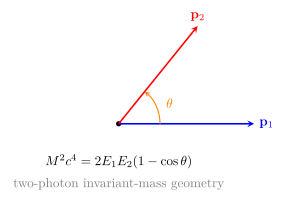
即使每个 constituent 都是 massless,系统也可有 \(M>0\)。两个 photon 的夹角为 \(\theta\) 时
\[M^2c^4=2E_1E_2(1-\cos\theta).\]
同向时 \(M=0\);反向时 invariant mass 最大。这说明系统质量包含内部相对运动。
fixed-target threshold
反应 \(a+b\to f\) 中,若 lab frame 的 \(b\) 静止,则初态 invariant 为
\[s=m_a^2c^4+m_b^2c^4+2m_bc^2E_a.\]
threshold 时 CM frame 中所有末态粒子无相对动量,故
\[s_{th}=\left(\sum_fm_fc^2\right)^2.\]
因此 projectile 的 threshold total energy 为
\[\boxed{E_{a,th}= \frac{\left(\sum_fm_fc^2\right)^2-m_a^2c^4-m_b^2c^4} {2m_bc^2}}.\]
最后再求 \(K_{a,th}=E_{a,th}-m_ac^2\)。
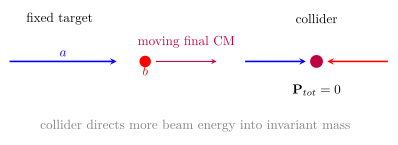
fixed target 中,阈值时末态整体必须带走初始动量,所以不少能量成为无助于造新质量的 CM translational kinetic energy。对称 collider 让初始总动量为零,更有效地把束流能量转成 \(\sqrt{s}\)。
\(Q\) value 与 threshold 的区别
\[Q=\left(\sum_im_i-\sum_fm_f\right)c^2.\]
\(Q>0\) 表示 rest energy 可释放,但具体动能分配仍受动量守恒约束;\(Q<0\) 表示需输入能量,而 fixed-target threshold 通常大于 \(-Q\),因为还要满足末态总动量。
Worked Examples / 完整例题
Worked Example 1 — Electron energy and momentum at \(0.800c\)
电子以 \(u=0.800c\) 运动,取 \(m_ec^2=0.511\,\mathrm{MeV}\)。求 \(E\)、\(K\) 和 \(p\)。
研究对象: 单电子。
系统/参考系: 给定 inertial lab;无反应。
坐标与正方向: 动量沿速度方向。
模型: on-shell massive particle。
\[\gamma=\frac1{\sqrt{1-0.800^2}}=1.667.\]
\[E=\gamma m_ec^2=(1.667)(0.511)=0.852\,\mathrm{MeV}.\]
\[K=(\gamma-1)m_ec^2=0.341\,\mathrm{MeV}.\]
\[pc=\gamma\beta m_ec^2=(1.667)(0.800)(0.511)=0.681\,\mathrm{MeV},\]
故 \(p=0.681\,\mathrm{MeV}/c\)。
检查: \(E=K+mc^2=0.852\,\mathrm{MeV}\);\(E^2-(pc)^2\approx(0.511\,\mathrm{MeV})^2\);三位有效数字。
Worked Example 2 — Invariant mass of two photons
两个 photon 能量分别为 \(E_1=3.00\,\mathrm{MeV}\)、\(E_2=4.00\,\mathrm{MeV}\),传播方向夹角 \(60.0^\circ\)。求该两光子系统 invariant mass。
研究对象: 两 photon 的封闭瞬时系统。
系统/参考系: 给出的任意 inertial frame;用 invariant 避免先找 CM。
坐标: 两动量夹角 \(60.0^\circ\)。
模型: 两个 massless on-shell particles。
\[M^2c^4=2E_1E_2(1-\cos60.0^\circ) =2(3.00)(4.00)(0.500)\,\mathrm{MeV^2} =12.0\,\mathrm{MeV^2}.\]
\[Mc^2=\sqrt{12.0}\,\mathrm{MeV}=3.46\,\mathrm{MeV}.\]
所以
\[M=3.46\,\mathrm{MeV}/c^2.\]
检查: 单 photon 质量为零而系统质量可非零;\(\theta\to0\) 时 \(M\to0\);单位正确,三位有效数字。
Worked Example 3 — Two-body decay in the parent rest frame
质量 \(M=1.20\,\mathrm{GeV}/c^2\) 的母粒子静止衰变为 \(m_1=0.300\,\mathrm{GeV}/c^2\)、\(m_2=0.400\,\mathrm{GeV}/c^2\)。求产物能量与动量大小。
研究对象: 母粒子及两个 daughter particles。
系统/参考系: parent rest frame,也是初态 CM。
坐标与正方向: 令 daughter 1 沿 \(+x\),daughter 2 沿 \(-x\)。
模型: isolated two-body decay。
\[E_1^*=\frac{1.20^2+0.300^2-0.400^2}{2(1.20)}\,\mathrm{GeV} =0.571\,\mathrm{GeV},\]
\[E_2^*=1.20-0.571=0.629\,\mathrm{GeV}.\]
\[p^*c=\sqrt{E_1^{*2}-m_1^2c^4} =0.486\,\mathrm{GeV}.\]
故 \(\mathbf p_1^*=+0.486\,\mathrm{GeV}/c\,\hat{\mathbf x}\),\(\mathbf p_2^*=-0.486\,\mathrm{GeV}/c\,\hat{\mathbf x}\)。
检查: \(E_1^*+E_2^*=1.20\,\mathrm{GeV}\);三动量和为零;两者 mass shell 均成立。三位有效数字。
Worked Example 4 — Fixed-target pion-production threshold
求 fixed-target 反应 \(p+p\to p+p+\pi^0\) 的 projectile threshold kinetic energy。取 \(m_pc^2=938.272\,\mathrm{MeV}\)、\(m_{\pi^0}c^2=134.977\,\mathrm{MeV}\);并与对称 \(p\)–\(p\) collider 每束所需 kinetic energy 比较。
研究对象: 两质子初态与 \(pp\pi^0\) 末态。
系统/参考系: fixed-target lab 中 target proton 静止;threshold 在 CM 判定。
坐标与正方向: projectile 沿 \(+x\)。
模型: 忽略束流散度与相互作用截面,只做运动学阈值。
fixed-target 初态
\[s=2m_p^2c^4+2m_pc^2E_a.\]
阈值
\[\sqrt{s_{th}}=(2m_p+m_{\pi^0})c^2.\]
解得 projectile total energy
\[E_{a,th}=1217.934\,\mathrm{MeV},\]
所以
\[K_{a,th}=E_{a,th}-m_pc^2 =279.662\,\mathrm{MeV} \approx279.7\,\mathrm{MeV}.\]
对称 collider 中 \(\mathbf P_{tot}=0\),阈值满足
\[2(m_pc^2+K_{beam})=(2m_p+m_{\pi^0})c^2,\]
\[K_{beam}=\frac12m_{\pi^0}c^2=67.49\,\mathrm{MeV}.\]
检查与解释: 两束合计 kinetic energy 为 \(135.0\,\mathrm{MeV}\),远低于 fixed target 的 \(279.7\,\mathrm{MeV}\);后者需保留末态整体 lab 动量。有效数字与给定质量一致。
Lesson synthesis / 本课综合
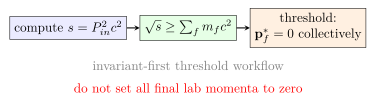
面对 reaction,按以下流程:
- 圈定系统: 把所有初末粒子、不可见粒子和必要的辐射纳入。
- 写四动量: 每个粒子满足自己的 mass shell,系统满足总四动量守恒。
- 先算 invariant: \(s=P_{initial}^2c^2=P_{final}^2c^2\)。
- 选择 frame: 衰变优先 parent rest frame;碰撞阈值优先 CM;实验输入常在 lab。
- 做边界检查: 产物质量和、根号实数性、\(\beta<1\)、低速/无质量极限以及 SI/\(c\) 单位。
Formula-and-decision table / 公式与决策表
| Task | Formula | Frame / condition | Main caution |
|---|---|---|---|
| momentum from speed | \(\mathbf p=\gamma m\mathbf u\) | massive on-shell particle | \(m\) is invariant mass |
| total and kinetic energy | \(E=\gamma mc^2\), \(K=(\gamma-1)mc^2\) | stated inertial frame | conserve total \(E\), not generally \(K\) |
| mass shell | \(E^2=p^2c^2+m^2c^4\) | each free particle | \(m=0\) gives \(E=pc\) |
| system mass | \(M^2c^4=E_{tot}^2-c^2P_{tot}^2\) | any inertial frame | \(M\) is not generally \(\sum m_i\) |
| two-body decay energy | \(E_1^*=(M^2+m_1^2-m_2^2)c^2/(2M)\) | parent rest frame | require \(M\ge m_1+m_2\) |
| reaction invariant | \(s=P_{initial}^2c^2\) | closed initial system | keep units of energy squared |
| fixed-target initial \(s\) | \(s=m_a^2c^4+m_b^2c^4+2m_bc^2E_a\) | \(b\) at rest | \(E_a\) is total energy |
| threshold | \(\sqrt{s_{th}}=\sum_fm_fc^2\) | final particles at relative rest in CM | not all at rest in lab |
Model boundaries / 模型边界
- Kinematic allowance 不保证反应有可观测概率;charge、angular momentum、baryon/lepton number 和 interaction matrix element 还会限制过程。
- isolated one-body decay into one lighter body 不可能同时守恒能量与动量;至少需额外产物或外界交换。
- constituent invariant masses 的和不是复合系统质量;内部动能增加系统质量,负 binding energy 可使 bound-state mass 小于自由组分质量和。
- threshold 结论假设末态允许共同 CM frame;若有外场、晶格反冲或介质,系统边界和不变量必须扩展。
- eV、MeV、GeV 是能量单位;写质量和动量时必须保留 \(/c^2\)、\(/c\),除非明确宣布 natural units \(c=1\)。
- 本课忽略 finite widths;不稳定粒子的“质量”实验上呈分布,精确反应分析需 resonance line shape。
Misconception clinic / 误区诊所
- “总能量就是 kinetic energy。” massive particle 即使静止也有 \(mc^2\);反应中静能可转换,必须守恒 total energy。
- “系统不变质量等于每个粒子静质量相加。” 相对动能与夹角进入 \(P_{tot}^2\);两个 photon 也可组成有质量系统。
- “threshold 时所有末态粒子在 lab 静止。” 它们只在 CM 中彼此无相对运动;fixed-target lab 的末态整体仍带初始动量。
- “\(Q=-100\,\mathrm{MeV}\),入射 kinetic energy 恰好 \(100\,\mathrm{MeV}\) 就够。” fixed target 还需满足动量守恒,阈能通常更高。
- “碰撞中 mass 不守恒意味着 relativity 破坏守恒律。” 守恒的是总四动量;静质量可以与 kinetic/internal/radiation energy 互换。
Practice and retrieval / 练习与提取
- K01: 质量 \(m\) 的粒子以 \(0.600c\) 运动。求 \(p/(mc)\)。
Answer
\(\gamma=1.25\),故 \[\frac{p}{mc}=\gamma\beta=(1.25)(0.600)=0.750.\]
- K01: 为什么 \(u\) 接近 \(c\) 后继续输入冲量仍可显著增大 \(p\),却只小幅增大 \(u\)?
Answer
因 \(p=\gamma mu\),\(u\to c\) 时主要由 \(\gamma\) 无界增长承担动量增量,而 \(u\) 受 \(c\) 上限约束。
- K02: 若粒子 \(K=mc^2\),求 \(\gamma\) 与 \(u/c\)。
Answer
\(\gamma-1=1\),故 \(\gamma=2\); \[\beta=\sqrt{1-\gamma^{-2}}=\frac{\sqrt3}{2}=0.866.\]
- K03: 粒子满足 \(E=5.00\,\mathrm{GeV}\)、\(pc=4.00\,\mathrm{GeV}\)。求 \(mc^2\)。
Answer
\[mc^2=\sqrt{E^2-p^2c^2}=\sqrt{25-16}\,\mathrm{GeV}=3.00\,\mathrm{GeV}.\]
- K03: 写出 \(pc\gg mc^2\) 时 \(E\) 的 leading correction。
Answer
\[E=pc\sqrt{1+\frac{m^2c^2}{p^2}} \approx pc+\frac{m^2c^3}{2p}.\]
- K04: 质量 \(M\) 的粒子静止衰变为两个 photon。求每个 photon 能量。
Answer
静止系总动量为零,两个 photon 反向等能;能量守恒给 \[E_1=E_2=\frac12Mc^2.\]
- K04: 说明孤立 massive particle 不能衰变为单个 photon。
Answer
初态四动量平方为 \(M^2c^2>0\),单 photon 四动量平方为 0;四动量守恒会要求二者平方相等,矛盾。
- K05: 两个能量均为 \(5.00\,\mathrm{GeV}\) 的 photon 反向传播。求系统 invariant mass。
Answer
总动量为零、总能量为 \(10.0\,\mathrm{GeV}\),故 \[M=10.0\,\mathrm{GeV}/c^2.\]
- K05: 两个同向、能量任意的 photon 系统 invariant mass 是多少?
Answer
\(\theta=0\),故 \(M^2c^4=2E_1E_2(1-\cos0)=0\)。其总四动量仍是 null。
- K05 综合: 为什么对称 collider 的每束能量不能直接拿来与 fixed-target projectile 能量逐束比较,而应比较 \(\sqrt{s}\)?
Answer
产生新粒子可用的是 CM energy \(\sqrt{s}\)。fixed target 中大量 projectile energy 用于末态 CM 的整体运动;对称 collider 的总动量可为零,两束总能量几乎全部成为 \(\sqrt{s}\)。
Exit ticket / 离堂检核
- 为反应 \(a+b\to1+2+3\) 写出 fixed-target threshold 的 invariant-first 解题框架,并解释 \(E_a\) 为何必须是 total energy。
- 构造两个 massless particles 组成 \(M>0\) 系统的例子,并说明它们的 CM frame 如何存在而单 photon 静止系不存在。
References and source notes / 参考资料与来源说明
Source-to-content map
| Source | Used for | Knowledge ID / section | Model boundary or convention |
|---|---|---|---|
| OpenStax University Physics Vol. 3, 5.8 Relativistic Momentum | momentum definition, low-speed limit, mass terminology | K01 | single-particle introductory treatment |
| OpenStax University Physics Vol. 3, 5.9 Relativistic Energy | rest, kinetic and total energy; work-energy connection | K02–K03 | SI factors retained; reaction treatment expanded with invariants |
| MIT OCW 8.033 (2024), Lecture 07: 4-Momentum and 4-Velocity | energy–momentum four-vector and conservation | K01–K04 | source signature translated to this lesson's \(+---\) convention |
| MIT OCW 8.033 (2024), Lecture 08: Using 4-Momentum | collision, decay and invariant-first methods | K04–K05 | examples independently recomputed |
| Particle Data Group 2024, Review of Kinematics | CM energy, two-body decay, invariant mass and reaction kinematics | K04–K05 | PDG uses \(c=1\); SI factors restored here |
| UT Austin, Relativistic Energy and Momentum | force-momentum relation, collision conservation, mass-energy conversion | K01–K05 | this lesson uses invariant mass rather than velocity-dependent mass |
资料与 URL 实际打开核对日期:2026-08-29。所有数值例题独立复算;图示依据本文方程原创绘制,不复制来源插图。
复习与拓展
- Four-Vectors:四动量变换与 Lorentz scalar 基础。
- Relativistic Mechanics:由 \(d\mathbf p/dt\) 定义三力,由 action 得能量—动量。
- Particle physics:Dalitz plot、missing mass、transverse mass 与 detector reconstruction。
- Nuclear physics:binding energy、\(Q\) value、reaction threshold 和衰变谱。