
Learning objectives / 学习目标
- 从 independent random steps 推导 ideal-chain end-to-end scale,并解释 entropic elasticity 的适用区间。
- 用 Langevin/Stokes–Einstein picture 连接 colloidal drag、diffusion 与 mean-square displacement。
- 用 director 和 orientational order parameter 区分 nematic、smectic 与 isotropic phases。
- 区分 glass transition、jamming 与 crystallization,并用 observation time 判定“固态般”响应。
- 对每个模型明确 coarse-graining scale、thermal/noise assumptions 与 non-equilibrium boundary。
Prerequisites / 先修知识
- Boltzmann factor、equipartition、random walk 与 Gaussian distribution。
- Viscosity、Stokes drag、diffusion equation 与 Diffusion in solids。
- Order parameter、phase transition、relaxation time 与 basic continuum fields。
Scope and conventions / 范围与约定
- Soft matter 通常是 classical many-body systems;\(k_BT\) 与 mesoscopic deformation/interaction energy 相竞争,但不表示所有 microscopic quantum effects 消失。
- Polymer 的 \(N\) 是 statistical segments 数,\(b\) 是 Kuhn length;不是逐个化学键的长度。
- Colloid 为半径 \(a\) 的 sphere,默认 infinite Newtonian liquid、no-slip、low Reynolds number 与 dilute limit。
- Nematic director 满足 \(\mathbf n\equiv-\mathbf n\);它不是有向速度矢量。
- Glass 与 jamming 都涉及动力学变慢,但 control parameters 和 thermal relevance 不同,不作简单同义替换。
Notation and modeling contract / 符号与建模契约
| Symbol | Meaning | SI unit |
|---|---|---|
| \(N\) | number of statistical chain segments | 1 |
| \(b\) | Kuhn length | m |
| \(R\) | end-to-end distance | m |
| \(a\) | colloid radius | m |
| \(\eta\) | solvent dynamic viscosity | \(\mathrm{Pa\,s}\) |
| \(D\) | translational diffusion coefficient | \(\mathrm{m^2\,s^{-1}}\) |
| \(S\) | scalar nematic order parameter | 1 |
| \(\tau_\alpha\) | structural relaxation time | s |
| \(\phi\) | particle volume fraction | 1 |
任何平均值都必须说明 ensemble 与 time window;\(\langle r^2\rangle\) 是重复轨迹或足够长 ergodic record 的统计量,不是单条轨迹必然平滑增长。
1. Polymers and random-chain models / 聚合物与随机链模型
Knowledge ID: P09-U07-L02-K01
Flexible polymer 的 microscopic bond correlations 在 persistence length 以上可 coarse-grain 成 \(N\) 个 statistical segments。Freely jointed ideal chain 取独立、各向同性 step \(\mathbf b_i\),end-to-end vector 为 \(\mathbf R=\sum_i\mathbf b_i\)。Cross terms 的 ensemble average 为零,于是
\[\langle R^2\rangle=Nb^2, \qquad R_{\mathrm{rms}}=b\sqrt N.\]
这不是 contour length \(Nb\):随机方向让 size 只按 \(\sqrt N\) 增长。Gaussian-chain free energy 在 \(R\ll Nb\) 时近似 \(F(R)=3k_BTR^2/(2Nb^2)\),故 entropic restoring force
\[f=\frac{\partial F}{\partial R}=\frac{3k_BT}{Nb^2}R.\]
当 \(R\) 接近 contour length,linear spring model 会错误预测无限延伸,必须改用 finite-extensibility model。Good solvent 的 excluded volume 让 chain swollen,\(R\sim bN^\nu\) 且三维 \(\nu\) 约 \(0.588\);theta solvent 才接近 ideal exponent \(1/2\)。Entanglement、cross-link 与 chain architecture 再把单链统计转化为 melt rheology、rubber elasticity 和 viscoelastic relaxation。
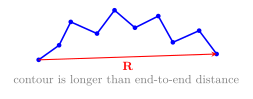
图 1 区分 contour 与 \(\mathbf R\);折线不表示真实 bond angles 完全自由。
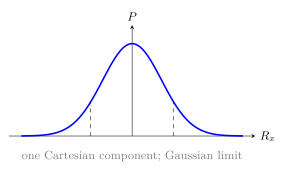
图 2 表示许多 independent steps 后一个分量的 Gaussian distribution,不是 \(R\) magnitude 的完整分布。
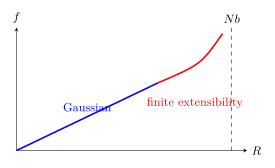
图 3 显示 small-extension linear response 与接近 contour length 时的非线性硬化。
2. Colloids and Brownian motion / 胶体与布朗运动
Knowledge ID: P09-U07-L02-K02
Colloidal particle 大于 solvent molecules 却足够小,能感受大量 molecular impacts 的随机不平衡。过阻尼 Langevin equation 可写 \(\zeta\dot{\mathbf r}=\boldsymbol\xi(t)+\mathbf F_{\mathrm{ext}}\),其中 sphere 的 Stokes drag coefficient \(\zeta=6\pi\eta a\)。Fluctuation–dissipation relation 要求 noise strength 与 drag 共同保证 equilibrium Boltzmann distribution,导出 Stokes–Einstein relation:
\[D=\frac{k_BT}{6\pi\eta a}.\]
Free Brownian motion 在三维的 mean-square displacement 为
\[\langle \lvert\Delta\mathbf r\rvert^2\rangle=6D\Delta t.\]
短于 momentum relaxation time 时 motion 可呈 ballistic,长时才是 diffusive。靠近 wall 时 hydrodynamic drag 改变;高 concentration 下 hydrodynamic 和 direct interactions 使 self-diffusion 不再等于 dilute \(D\)。DLVO picture 用 screened electrostatic repulsion 与 van der Waals attraction 判断 aggregation tendency,但 charge regulation、polymer coating 和 non-equilibrium flow 可超出该简化模型。
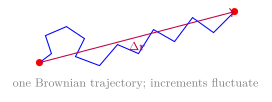
图 4 强调单条 trajectory jagged,MSD 是许多 increments 的 ensemble average。
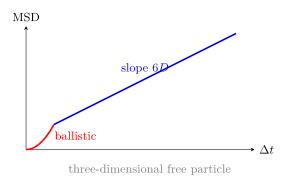
图 5 区分 short-time quadratic 与 long-time linear MSD。
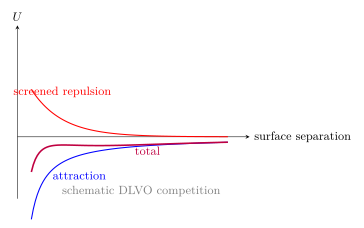
图 6 分开 repulsion、attraction 与 total potential;曲线未代表某一具体 colloid 的拟合参数。
3. Liquid crystals and orientational order / 液晶与取向有序
Knowledge ID: P09-U07-L02-K03
Liquid crystal 在流动性和有序性之间形成 mesophase。Nematic 有长程 orientational order 却无普通三维 translational order;smectic 还具有一维 layering;isotropic liquid 则方向随机。Nematic 用 head-tail symmetric director \(\mathbf n\) 与 scalar order parameter
\[S=\left\langle\frac{3\cos^2\theta-1}{2}\right\rangle\]
描述,\(\theta\) 是分子长轴与 \(\mathbf n\) 的夹角。Perfect alignment 给 \(S=1\),isotropic distribution 给 \(S=0\),而单个分子垂直于 director 可贡献 \(-1/2\);所以 \(S\) 不是“aligned molecules 的百分比”。
Spatial distortion 可按 splay、twist、bend 分解,Frank free-energy density 由相应 elastic constants 加权。Electric-field coupling 来自 dielectric anisotropy;在合适 anchoring 下,Freedericksz threshold 的简单 one-constant 结果为
\[V_c=\pi\sqrt{\frac{K}{\epsilon_0\Delta\epsilon}}.\]
该阈值依赖 boundary anchoring、elastic anisotropy、conductivity 与 frequency;不能把 display operating voltage 无条件等同于上式。Disclinations 是 director field 的 topological defects,与 crystal dislocation 的 order parameter 不同。
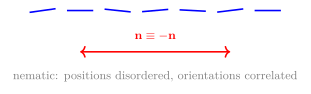
图 7 的 rods 近似平行但位置无 lattice;\(\mathbf n\) 与 \(-\mathbf n\) 等价。
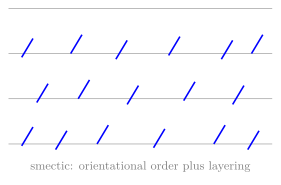
图 8 将 smectic layering 与三维 crystalline positional order 区分。
4. Glasses, jamming, and amorphous order / 玻璃、阻塞与非晶有序
Knowledge ID: P09-U07-L02-K04
Glass formation 通常是 structural relaxation time \(\tau_\alpha\) 随降温急剧增长,终于超过实验 observation time;operational glass-transition temperature \(T_g\) 因 cooling rate 和 measurement protocol 而变。玻璃缺少 crystal 的 periodic long-range order,却可有 short-range coordination、medium-range motifs 和 heterogeneous dynamics。“看不见 Bragg lattice”不等于 pair correlations 全无。
Jamming 关注 packing、load 与 agitation 下的 mechanical arrest。Athermal frictionless spheres 的 idealized point J 常由 volume fraction 控制;real grains、foams 和 attractive colloids 还依赖 friction、particle softness、attraction、stress 与 preparation history。一个 state 在给定观察窗内有 yield stress,可称 mechanically arrested,但 thermal molecular glass 与 athermal granular jam 不可直接用同一温度轴。
Maxwell estimate \(\tau_M=\eta/G_\infty\) 把 viscosity 与 high-frequency shear modulus 连接为一个 relaxation scale;当 observation time \(t_{obs}\ll\tau_M\),样品显得 elastic,反之可 flow。它只是一模态 linear viscoelastic estimate,真实 glass 有 broad spectrum 与 aging。Jamming force chains 使 stress highly heterogeneous;average pressure 不能代表每个 contact force。
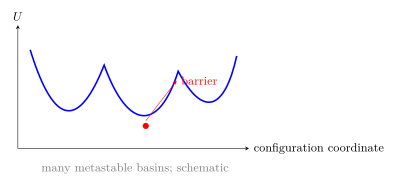
图 9 用 energy landscape 表示 slow escape;横轴不是单一真实空间坐标。
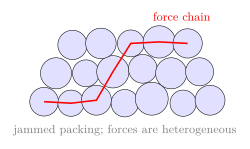
图 10 以一条受力链示意 heterogeneous load bearing,不暗示只有这条链承载。
Worked Examples / 完整例题
Worked Example 1 — Ideal-chain size and contour comparison
系统与边界: dilute theta-solvent 中一条 isolated flexible chain;忽略 excluded volume 与 walls。参考系与坐标: solvent rest frame,\(\mathbf R\) 从 chain head 指向 tail。模型与数据: freely jointed chain,\(N=1000\),\(b=0.700\ \mathrm{nm}\)。
\[R_{\mathrm{rms}}=b\sqrt N=(0.700\ \mathrm{nm})\sqrt{1000}=22.1\ \mathrm{nm},\]
而 contour length \(Nb=700\ \mathrm{nm}\)。有效数字: 三位。量纲检查: \(\sqrt N\) 无量纲。极限检查: \(N\) 加四倍,rms size 加两倍而 contour 加四倍。合理性: \(R_{\mathrm{rms}}\ll Nb\),Gaussian coiling picture 自洽。
Worked Example 2 — Entropic restoring force
系统与边界: 上例 chain 两端被缓慢拉开至 \(R=10.0\ \mathrm{nm}\);equilibrium、small extension。参考系与坐标: solvent frame,\(+x\) 沿拉伸。模型与数据: Gaussian entropic spring,\(T=300\ \mathrm K\)。
\[f=\frac{3k_BTR}{Nb^2} =\frac{3(1.380649\times10^{-23}\ \mathrm{J\,K^{-1}})(300\ \mathrm K)(1.00\times10^{-8}\ \mathrm m)}{1000(7.00\times10^{-10}\ \mathrm m)^2} =2.54\times10^{-13}\ \mathrm N.\]
即 \(0.254\ \mathrm{pN}\)。量纲检查: \(\mathrm J/m=N\)。方向: restoring force 指向 \(-x\),上式是 magnitude。合理性: \(R/R_{\mathrm{rms}}=0.452\),small-extension estimate 尚合理;接近 \(700\ \mathrm{nm}\) 时无效。
Worked Example 3 — Brownian diffusion of a colloid
系统与边界: radius \(a=0.500\ \mathrm{\mu m}\) 的 isolated sphere,远离 walls,水近似 Newtonian。参考系与坐标: liquid rest frame,三维 Cartesian axes。模型与数据: \(T=298\ \mathrm K\),\(\eta=1.00\times10^{-3}\ \mathrm{Pa\,s}\),no-slip Stokes–Einstein。
\[D=\frac{k_BT}{6\pi\eta a}=4.37\times10^{-13}\ \mathrm{m^2\,s^{-1}}.\]
在 \(\Delta t=2.00\ \mathrm s\) 后,
\[\sqrt{\langle\lvert\Delta\mathbf r\rvert^2\rangle}=\sqrt{6D\Delta t}=2.29\ \mathrm{\mu m}.\]
有效数字: 三位。量纲检查: \(D t\) 是 \(\mathrm{m^2}\)。极限检查: radius 加倍则 \(D\) 减半,rms displacement 乘 \(1/\sqrt2\)。合理性: 位移为 particle diameter 的几倍,符合秒尺度 microscopy 可见量级。
Worked Example 4 — Nematic Freedericksz threshold
系统与边界: planar-aligned nematic cell,strong anchoring、uniform electric field;忽略 elastic anisotropy。参考系与坐标: cell frame,\(z\) 垂直 plates。模型与数据: one-constant \(K=10.0\ \mathrm{pN}\),dielectric anisotropy \(\Delta\epsilon=10.0\)。
\[V_c=\pi\sqrt{\frac{K}{\epsilon_0\Delta\epsilon}} =\pi\sqrt{\frac{1.00\times10^{-11}\ \mathrm N}{(8.854\times10^{-12}\ \mathrm{F\,m^{-1}})(10.0)}} =1.06\ \mathrm V.\]
量纲检查: \(K/(\epsilon_0\Delta\epsilon)\) 化为 \(\mathrm{V^2}\)。极限检查: 更强 elastic stiffness 提高 threshold,更大 dielectric anisotropy 降低它。合理性: volt-scale threshold 与 thin LC cells 相符;weak anchoring 会修正结果。
Worked Example 5 — Observation-time criterion for a glassy response
系统与边界: 小振幅 shear 下的 homogeneous amorphous sample;temperature 固定。参考系与坐标: rheometer frame,\(x\) 为 flow、\(y\) 为 gradient。模型与数据: single-mode Maxwell estimate,\(\eta=1.00\times10^{12}\ \mathrm{Pa\,s}\),\(G_\infty=2.00\times10^9\ \mathrm{Pa}\)。
\[\tau_M=\frac{\eta}{G_\infty}=5.00\times10^2\ \mathrm s.\]
对 \(t_{obs}=1.00\ \mathrm s\),\(t_{obs}/\tau_M=2.00\times10^{-3}\),sample 显得 elastic;对 \(t_{obs}=1.00\times10^4\ \mathrm s\),ratio 为 \(20.0\),relaxation 可显著发生。量纲检查: \(\mathrm{Pa\,s}/\mathrm{Pa}=\mathrm s\)。合理性: 判定随 observation window 改变,正是 operational glass concept;真实 broad spectrum 不会在 \(\tau_M\) 处突然切换。
Lesson synthesis / 全课综合
Polymer size 来自许多随机 segment 的统计叠加,elasticity 可由 entropy 产生;colloid 的 thermal noise 与 viscous drag 由 fluctuation–dissipation 绑定;liquid crystal 保留流动性却自发选择取向;glass 与 jammed state 则把 relaxation time 推到 observation window 之外。软与无序不是“没有规律”,而是规律更多地写在 probability distribution、correlation、response 与 timescale 中。
Formula-and-decision table / 公式与决策表
| Task | Relation | Use when | Boundary |
|---|---|---|---|
| ideal-chain size | \(R_{rms}=b\sqrt N\) | independent statistical segments | excluded volume changes exponent |
| entropic force | \(f=3k_BTR/(Nb^2)\) | Gaussian small extension | diverging stretch needs finite-extensibility model |
| dilute colloid diffusion | \(D=k_BT/(6\pi\eta a)\) | isolated no-slip sphere | walls and concentration modify drag |
| Brownian MSD | \(\langle\Delta r^2\rangle=6Dt\) | 3D long-time diffusion | short-time motion can be ballistic |
| nematic order | \(S=\langle(3\cos^2\theta-1)/2\rangle\) | uniaxial orientational distribution | not aligned fraction |
| viscoelastic time | \(\tau_M=\eta/G_\infty\) | one-mode Maxwell estimate | glasses have broad aging spectra |
Model boundaries / 模型边界
- Kuhn segments are coarse-grained and need not equal chemical monomers.
- Gaussian chain fails near full extension and in strong excluded-volume conditions.
- Stokes–Einstein assumes continuum hydrodynamics, dilute suspension and equilibrium temperature.
- Nematic \(S\) does not specify spatial texture or distinguish every liquid-crystal phase.
- \(T_g\) is protocol dependent; it is not automatically a unique equilibrium critical temperature.
- Jamming of athermal grains and vitrification of thermal molecules can share ideas without being identical transitions.
Misconception clinic / 误区诊所
- Random chain 的 average vector 可为零,但 average squared size 不是零。
- Brownian motion 不是有一个长期固定方向的“Brownian force”。
- 更大 particle 在同一 solvent 中 diffuses more slowly,而不是因受更多 molecular hits 而更快。
- Nematic molecules 位置仍可无序;orientational order 不等于 crystal lattice。
- Director 没有 head-tail arrow,\(\mathbf n\) 与 \(-\mathbf n\) 是同一态。
- Glass 有 short-range structure;amorphous 不等于 featureless。
- Jammed 不表示每个 contact force 相同,也不保证永久不流动。
Practice and retrieval / 练习与提取
- [K01] \(N\) 增加到九倍,ideal-chain rms size 怎样变?
Answer 1
增加到三倍,因为 \(R_{rms}\propto\sqrt N\)。
- [K01] 为什么 \(R_{rms}\) 不能等同于 contour length?
Answer 2
Contour length 把所有 segment 长度标量相加为 \(Nb\);end-to-end vector 含方向抵消,rms 只为 \(b\sqrt N\)。
- [K02] 相同 \(T\)、\(\eta\) 下,radius 加三倍时 \(D\) 怎样变?
Answer 3
变为三分之一,因为 \(D\propto a^{-1}\)。
- [K02] 三维 diffusive MSD 对时间的 log-log slope 是多少?
Answer 4
是 1;ballistic regime 的 slope 则是 2。
- [K02] 靠近 wall 时为何不能直接用 bulk Stokes–Einstein?
Answer 5
Wall 改变 surrounding flow field 和 hydrodynamic drag,扩散还可能具有平行与垂直 wall 的各向异性。
- [K03] Isotropic orientation distribution 的 \(S\) 是多少?
Answer 6
是 0,因为 angular average \(\langle\cos^2\theta\rangle=1/3\)。
- [K03] Nematic 与 smectic 的关键结构差别是什么?
Answer 7
两者都有 orientational order;smectic 还具有一维 layer positional order。
- [K04] 为什么同一样品的 operational \(T_g\) 可依 cooling rate 改变?
Answer 8
因为判据是 structural relaxation time 何时超过实验时间窗;cooling rate 改变可用于 relaxation 的时间。
- [K04] \(t_{obs}\ll\tau_\alpha\) 时 sample 显得更像 solid 还是 liquid?
Answer 9
更像 solid,因为结构在观测期间来不及 relaxation。
- [K04] 举出一个 jamming control parameter 与一个 glass control parameter。
Answer 10
Jamming 可由 packing fraction 或 applied stress 控制;molecular glass 常由 temperature 或 cooling rate 控制。具体体系还可有 attraction、friction 等参数。
Exit ticket / 离堂检验
- 用 energy、length、time 三种尺度各写一句话,解释为何 micron colloid 既非普通分子也非 deterministic marble。
- 比较 polymer coil、nematic texture 与 glass:分别选择最自然的 observable,并说明为什么仅看一张静态显微图不足以完成判别。
References and source notes / 参考资料与来源说明
以下直接来源的标题、机构与 URL 于 2026-08-30 实际打开核验:
- University of Cambridge Cavendish Laboratory, Soft Condensed Matter 2025–26. https://www-teach.phy.cam.ac.uk/students/courses/soft-condensed-matter/28
- MIT OpenCourseWare 3.063, Polymer Physics — Lecture Notes. https://ocw.mit.edu/courses/3-063-polymer-physics-spring-2007/pages/lecture-notes/
- MIT OpenCourseWare 3.012, lec24b.pdf — Liquid Crystals. https://ocw.mit.edu/courses/3-012-fundamentals-of-materials-science-fall-2005/resources/lec24b/
- V. Trappe et al., Jamming phase diagram for attractive particles, Nature 411, 772–775 (2001). https://www.nature.com/articles/35081021
Source-to-content map
| Source | Used for | Knowledge ID / Section | Model boundary or convention |
|---|---|---|---|
| Cambridge Soft Condensed Matter | Brownian, polymers, colloids, viscoelasticity | K01, K02, K04 | multi-scale qualitative estimates plus stochastic dynamics |
| MIT 3.063 | chain statistics, polymer diffusion, glass transition | K01, K04 | polymer-specific coarse graining |
| MIT 3.012 | nematic and smectic classification | K03 | mesogen and phase-classification baseline |
| Trappe et al. | attractive-colloid jamming diagram | K02, K04 | non-equilibrium arrest and control-parameter dependence |
复习与拓展
- 与 Random Processes 连接 Langevin equation、MSD 与 fluctuation–dissipation。
- 与 Defects and Mechanical Properties 对照:crystal defect 有 reference lattice,glass 的 disorder 则遍及整体结构。
- 下一课 Mesoscopic and Nanoscale Physics 将把“系统尺寸与特征长度竞争”转向 de Broglie wavelength、mean free path 与 charging energy。