
Learning objectives / 学习目标
- 依几何维数辨认点、线、面、体缺陷,并区分 defect concentration 与 defect density 的单位。
- 用 Burgers vector、resolved shear stress 与 dislocation motion 解释塑性形变和加工硬化。
- 从 Fick 定律与 Arrhenius 扩散系数估算通量、时间尺度并识别稳态假设。
- 连接晶粒尺寸、晶界滑移和 Hall–Petch response,同时说明纳米晶极限。
- 区分 fracture、fatigue 与 creep 的驱动量、时间尺度和安全判据。
Prerequisites / 先修知识
- Crystal Lattices and Symmetry:晶格、晶向、晶面与对称性。
- Stress、strain、Young modulus、shear modulus 和 elastic energy。
- Probability、thermal activation 与指数函数;一维 continuity equation。
Scope and conventions / 范围与约定
- 以普通晶体和各向同性线弹性为基线;强各向异性、复相材料与辐照损伤另需专门本构关系。
- Tensile stress 取正;裂纹长度 \(a\) 若无特别说明指中心裂纹半长。应力强度用 mode-I \(K_I\)。
- 扩散浓度 \(c\) 取 number concentration,单位 \(\mathrm{m^{-3}}\);\(J\) 取沿 \(+x\) 的 number flux。
- Hall–Petch 是经验尺度律;不会外推到晶粒仅含少数原子层的极限。
Notation and modeling contract / 符号与建模契约
| Symbol | Meaning | SI unit |
|---|---|---|
| \(b\) | Burgers-vector magnitude | m |
| \(\rho_d\) | dislocation line length per volume | \(\mathrm{m^{-2}}\) |
| \(\tau_R\) | resolved shear stress | Pa |
| \(D\) | diffusion coefficient | \(\mathrm{m^2\,s^{-1}}\) |
| \(J\) | number flux | \(\mathrm{m^{-2}\,s^{-1}}\) |
| \(d\) | mean grain diameter | m |
| \(K_I,K_{IC}\) | mode-I stress intensity and toughness | \(\mathrm{Pa\sqrt m}\) |
| \(\dot\epsilon\) | strain rate | \(\mathrm{s^{-1}}\) |
使用任何式子前都要声明 system boundary、reference frame、loading history、temperature 与 microstructural scale;宏观应力不等于裂纹尖端局域应力,diffusion coefficient 也不是普适常数。
1. Point, line, surface, and volume defects / 点、线、面与体缺陷
Knowledge ID: P09-U07-L01-K01
缺陷不是“坏掉的晶格”,而是相对于选定 reference crystal 的结构偏离。零维点缺陷包括 vacancy、interstitial 和 substitutional impurity;一维线缺陷是 dislocation;二维面缺陷包括 free surface、stacking fault、twin boundary 与 grain boundary;三维体缺陷包括 void、precipitate、inclusion 和 crack-like cavity。维数决定 density 的量纲,也决定 elastic field 与 kinetics:vacancy concentration 是无量纲 fraction,dislocation density 是线长除以体积而为 \(\mathrm{m^{-2}}\),grain-boundary area density 为 \(\mathrm{m^{-1}}\)。
平衡 vacancy fraction 常写成
\[x_v\simeq \exp\left(\frac{S_f}{k_B}\right)\exp\left(-\frac{H_f}{k_BT}\right),\]
其中 \(H_f\) 与 \(S_f\) 是每个 vacancy 的形成 enthalpy 与 entropy。淬火、辐照或塑性加工可冻结非平衡浓度;因此只凭温度倒推 vacancy 数量必须先问样品 history。缺陷既可成为载流子或原子迁移通道,也可散射 phonons/electrons;同一 defect 对 strength、ductility、conductivity 的影响不必同号。
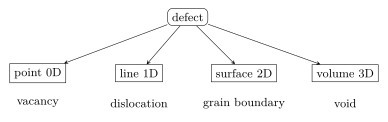
图 1 用几何维数组织缺陷,并提醒 density 单位随维数改变。
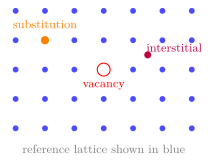
图 2 区分三类点缺陷;颜色代表物种或占位差异,不代表电荷符号。
2. Dislocations and plastic deformation / 位错与塑性形变
Knowledge ID: P09-U07-L01-K02
Edge dislocation 的 Burgers vector 垂直于 dislocation line;screw dislocation 则平行,实际线常为 mixed character。围绕 defect 做 Burgers circuit,闭合差定义 \(\mathbf b\),它是晶格平移向量而非 dislocation 的瞬时速度。Slip 由 dislocation glide 逐步搬运局部键,因而实际 yield stress 可远低于整面原子同时滑移的理想 shear strength。
单轴拉伸 \(\sigma\) 在给定 slip system 上的 resolved shear stress 是 Schmid law:
\[\tau_R=\sigma\cos\phi\cos\lambda,\]
其中 \(\phi\) 是 load axis 与 slip-plane normal 的夹角,\(\lambda\) 是 load axis 与 slip direction 的夹角。达到 critical resolved shear stress 才启用该 slip system。Plastic strain rate 可由 Orowan relation \(\dot\gamma=\rho_d b v_d\) 连接移动 dislocation density 与平均速度。加工硬化来自 dislocation forest、solute atoms、precipitates 等障碍,使继续运动需要更高 stress;“缺陷更多必然更软”因此是错的。
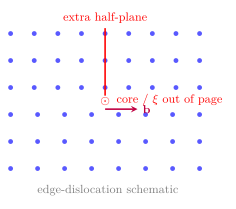
图 3 以 \(\odot\) 明示 dislocation line 沿纸面外投影,因此 edge character 的 \(\boldsymbol\xi\perp\mathbf b\);红色竖段只是 extra half-plane,不是纸面内的位错线。
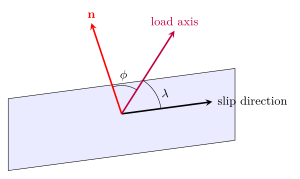
图 4 将 Schmid factor 的两个角和 slip system 明确分开。
3. Diffusion in solids / 固体扩散
Knowledge ID: P09-U07-L01-K03
原子扩散需要可用路径与 thermal activation。Substitutional diffusion 常借 vacancy exchange;小原子的 interstitial diffusion 可更快。宏观上 Fick first law 给稳态通量,continuity equation 与它合并得到 Fick second law:
\[J_x=-D\frac{\partial c}{\partial x}, \qquad \frac{\partial c}{\partial t}=D\frac{\partial^2c}{\partial x^2}.\]
负号表示粒子沿 concentration 下降方向净迁移。扩散系数常服从
\[D=D_0\exp\left(-\frac{Q}{RT}\right),\]
这里 \(Q\) 是每 mole activation energy,必须与 \(R\) 配套;若用每粒子 barrier 则配 \(k_B\)。Characteristic distance 只可估作 \(\ell_D\sim\sqrt{Dt}\),精确因子取决于维数、初始和边界条件。Dislocation core 与 grain boundary 常成为 short-circuit paths,所以一个 polycrystal 可能不能用单一 bulk \(D\) 描述。
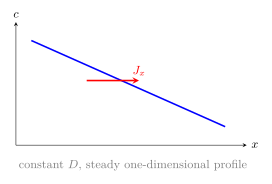
图 5 中 \(dc/dx<0\),故通量沿 \(+x\);箭头方向与 Fick 负号一致。
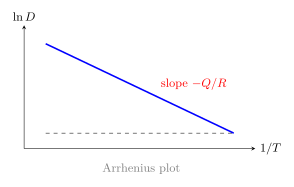
图 6 说明升高 \(T\) 对应向左移动并提高 \(D\);只有单一机制主导时近似直线。
4. Grain boundaries and polycrystalline response / 晶界与多晶响应
Knowledge ID: P09-U07-L01-K04
晶界把不同 orientation 的 grains 连接起来。它能阻挡或传递 dislocations、吸收 point defects,并提供较快 diffusion path;response 取决于 misorientation、boundary structure、solute segregation、temperature 与 strain rate。多晶宏观塑性还需邻晶 compatibility,不可把单晶 Schmid factor 直接当成整块材料的唯一 yield criterion。
常温普通 grain size 范围中,Hall–Petch relation 写作
\[\sigma_y=\sigma_0+k_y d^{-1/2}.\]
较小 grain 让 dislocation pile-up length 缩短,通常提高 yield stress。但当 \(d\) 进入数十纳米甚至更小尺度,grain-boundary sliding、rotation 和 diffusion 可占主导,简单外推会失效,甚至出现 inverse Hall–Petch trend。晶界既可能强化也可能在高温 creep 或 intergranular fracture 中成为弱路径。
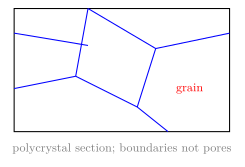
图 7 把晶界画成 orientation interfaces,而不是空隙网络。
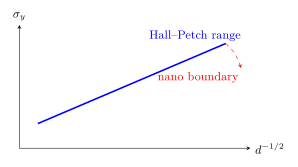
图 8 只在适用 grain-size window 内画直线,虚线提示纳米晶机制转换。
5. Fracture, fatigue, and creep / 断裂、疲劳与蠕变
Knowledge ID: P09-U07-L01-K05
Fracture 是 crack growth 与新表面形成;fatigue 是 cyclic loading 下裂纹从微小缺陷逐步萌生和扩展;creep 是高温或长时恒载下的 time-dependent strain。三者都受缺陷控制,却不能用一个“最大应力”数值统包。线弹性断裂力学用
\[K_I=Y\sigma\sqrt{\pi a},\]
当 \(K_I\ge K_{IC}\) 时存在失稳断裂风险。该判据需要 small-scale yielding、已知 crack geometry 与近似线弹性;若 plastic zone 不小,应改用 \(J\)-integral 或其他 elastic-plastic fracture method。
Fatigue stable-growth 区常以 Paris law \(da/dN=C(\Delta K)^m\) 拟合,但 near-threshold、short crack 与 final fast fracture 不服从同一指数。Creep 的 steady stage 常用 Norton law \(\dot\epsilon=A\sigma^n\exp[-Q_c/(RT)]\);初生与三级 creep、晶界 cavitation 仍需额外模型。安全评估必须同时报告 load ratio、frequency、environment、temperature 与 inspection resolution。
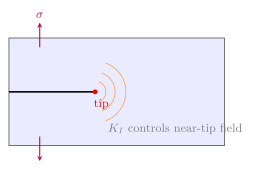
图 9 将 far-field stress 与 crack-tip singular field 分开;裂纹尖端并非无限小真实区域。
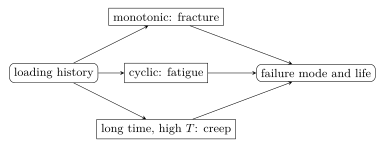
图 10 用 loading history 作第一层决策;实际部件可同时经历三种机制。
Worked Examples / 完整例题
Worked Example 1 — Vacancy fraction at two temperatures
系统与边界: 一块达到 thermal equilibrium 的纯晶体内部,忽略 surface 与 quench history。参考系与坐标: 晶体静止实验室系;本题为标量,无方向选择。模型: \(S_f=0\) 的简化 vacancy model,\(H_f=1.00\ \mathrm{eV}\) per vacancy;比较 \(T_1=800\ \mathrm K\) 和 \(T_2=1000\ \mathrm K\)。
\[\frac{x_v(T_2)}{x_v(T_1)} =\exp\left[\frac{H_f}{k_B}\left(\frac{1}{T_1}-\frac{1}{T_2}\right)\right] =\exp(2.90)=18.2.\]
取 \(k_B=8.617\times10^{-5}\ \mathrm{eV\,K^{-1}}\),结果保留三位有效数字。量纲检查: 指数中 eV 与 eV 相消。极限与合理性: \(T_2>T_1\) 应给更多 vacancies,ratio 大于 1;若 \(T\to0\),fraction 趋零。边界: 非平衡淬火样品不能使用这个 ratio。
Worked Example 2 — Schmid law and slip activation
系统与边界: 单晶拉伸试样,只有一个候选 slip system;忽略 strain hardening。参考系与坐标: 实验室系,\(+z\) 沿拉伸轴。模型与数据: \(\sigma=85.0\ \mathrm{MPa}\),\(\phi=45.0^\circ\),\(\lambda=54.7^\circ\),critical resolved shear stress \(\tau_c=32.0\ \mathrm{MPa}\)。
\[\tau_R=(85.0\ \mathrm{MPa})(\cos45.0^\circ)(\cos54.7^\circ) =34.7\ \mathrm{MPa}.\]
因为 \(34.7>32.0\ \mathrm{MPa}\),该 slip system 启动。有效数字: 三位。量纲检查: cosines 无量纲,\(\tau_R\) 保持 Pa。极限检查: 若 slip direction 或 plane normal 与 load axis 垂直,一个 cosine 为零,resolved shear 应为零。合理性: Schmid factor \(0.408<0.5\),在允许范围内。
Worked Example 3 — Steady diffusion flux
系统与边界: 厚度 \(L=2.00\ \mathrm{mm}\) 的平板,两面浓度固定,温度恒定;edge effects 忽略。参考系与坐标: slab rest frame,\(+x\) 从高浓度面指向低浓度面。模型与数据: steady 1D Fick law,\(D=1.20\times10^{-14}\ \mathrm{m^2\,s^{-1}}\),\(c(0)=9.00\times10^{27}\ \mathrm{m^{-3}}\),\(c(L)=1.00\times10^{27}\ \mathrm{m^{-3}}\)。
\[J_x=-D\frac{c(L)-c(0)}{L} =4.80\times10^{16}\ \mathrm{m^{-2}\,s^{-1}}.\]
方向: 正号表示沿 \(+x\)。量纲检查: \(\mathrm{m^2\,s^{-1}}\,\mathrm{m^{-4}}=\mathrm{m^{-2}\,s^{-1}}\)。合理性: 若两面浓度相同,flux 归零;若厚度加倍,flux 减半。换算为 molar flux 是 \(7.97\times10^{-8}\ \mathrm{mol\,m^{-2}\,s^{-1}}\)。
Worked Example 4 — Hall–Petch yield stress and model warning
系统与边界: 等轴、随机取向的单相 polycrystal;常温、准静态加载。参考系与坐标: specimen frame,\(+z\) 沿拉伸。模型与数据: \(\sigma_0=50.0\ \mathrm{MPa}\),\(k_y=0.500\ \mathrm{MPa\sqrt m}\),\(d=25.0\ \mathrm{\mu m}\)。
\[\sigma_y=50.0\ \mathrm{MPa} +\frac{0.500\ \mathrm{MPa\sqrt m}}{\sqrt{25.0\times10^{-6}\ \mathrm m}} =150\ \mathrm{MPa}.\]
量纲检查: \(k_y d^{-1/2}\) 的 \(\sqrt{\mathrm m}\) 相消。极限检查: 较小 \(d\) 在该经验区间给较高 strength。合理性: 结果是基线的三倍,属于金属可见的数量级;但不得把式子外推到 atomic-scale grains。
Worked Example 5 — Critical far-field stress for a crack
系统与边界: 宽板中的中心 through crack,半长 \(a=1.00\ \mathrm{mm}\);plane stress、small-scale yielding。参考系与坐标: plate frame,\(x\) 沿裂纹,\(y\) 为 opening direction。模型与数据: \(Y=1.00\),\(K_{IC}=25.0\ \mathrm{MPa\sqrt m}\)。
\[\sigma_c=\frac{K_{IC}}{Y\sqrt{\pi a}} =\frac{25.0\ \mathrm{MPa\sqrt m}}{\sqrt{\pi(1.00\times10^{-3}\ \mathrm m)}} =446\ \mathrm{MPa}.\]
有效数字: 三位。量纲检查: \(\mathrm{MPa\sqrt m}/\sqrt m=MPa\)。极限检查: \(a\) 增大四倍会使 \(\sigma_c\) 减半。合理性: 若所得 \(\sigma_c\) 已引起大范围屈服,LEFM 假设自相矛盾,应改用 elastic-plastic method。
Lesson synthesis / 全课综合
缺陷的维数决定它如何计数与如何产生长程场;dislocation motion 把局部键重排转化为塑性;point-defect migration 与 fast paths 产生固体扩散;grain boundaries 同时控制强化、扩散和高温失效;crack、cyclic history 与 thermal activation 最终决定 fracture、fatigue、creep。真正的材料设计不是“消灭缺陷”,而是控制缺陷种类、尺度、迁移率与相互作用。
Formula-and-decision table / 公式与决策表
| Task | Relation | Use when | Boundary |
|---|---|---|---|
| equilibrium vacancies | \(x_v\sim e^{-H_f/(k_BT)}\) | equilibrated crystal | history and formation entropy matter |
| activate slip | \(\tau_R=\sigma\cos\phi\cos\lambda\) | single crystal, known slip system | not a full polycrystal yield law |
| steady diffusion | \(J_x=-D\,dc/dx\) | constant \(D\), local continuum | transient profile needs second law |
| grain-size strengthening | \(\sigma_y=\sigma_0+k_yd^{-1/2}\) | empirical grain-size window | nano mechanisms can reverse trend |
| mode-I fracture | \(K_I=Y\sigma\sqrt{\pi a}\) | LEFM, small-scale yielding | geometry and crack definition required |
| steady creep | \(\dot\epsilon=A\sigma^ne^{-Q_c/(RT)}\) | secondary creep regime | not primary or tertiary creep |
Model boundaries / 模型边界
- Perfect-crystal reference is a modeling choice; a defect can be thermodynamically stable at finite temperature.
- Schmid law predicts resolved stress, not dislocation nucleation barriers or work hardening by itself.
- A single Arrhenius slope assumes one dominant diffusion mechanism over the fitted temperature range.
- Hall–Petch is not a law valid down to zero grain size.
- LEFM does not describe a large plastic zone, and Paris law does not cover an entire fatigue life.
- Fracture, fatigue and creep may interact; the three labels are not mutually exclusive in service.
Misconception clinic / 误区诊所
- 晶体“有缺陷”不等于结构随机;缺陷是相对于有序 reference lattice 的局部或延展偏离。
- Dislocation density 高不一定更软;interaction 和 pinning 可造成 work hardening。
- Diffusion 不是原子沿浓度梯度直线行走,而是随机跳跃的统计净效应。
- Grain boundary 不是普通空隙;它是两种 orientation 的界面结构。
- Tough material、strong material 与 hard material 不是同义词。
- 低于 yield stress 的 cyclic load 仍可能 fatigue failure。
Practice and retrieval / 练习与提取
- [K01] Dislocation density 为何用 \(\mathrm{m^{-2}}\)?
Answer 1
因为它定义为样品中 dislocation 总线长除以体积,单位是 \(\mathrm m/\mathrm{m^3}=\mathrm{m^{-2}}\)。
- [K01] 给出一个 point、surface 与 volume defect。
Answer 2
例如 vacancy、grain boundary、void;其他合理对应也可。
- [K02] 若 \(\lambda=90^\circ\),\(\tau_R\) 为何值?
Answer 3
\(\cos90^\circ=0\),所以 \(\tau_R=0\);load 不在该 slip direction 上提供 resolved shear。
- [K02] Orowan relation 中提高 \(\rho_d\) 是否必然提高长期 strain rate?
Answer 4
不必然;更高 density 也会增强互相钉扎并降低平均速度 \(v_d\),两项需共同判断。
- [K03] 一维浓度随 \(x\) 增大而上升时,diffusion flux 指向哪里?
Answer 5
\(dc/dx>0\),由 \(J_x=-Ddc/dx\) 得 \(J_x<0\),指向 \(-x\)。
- [K03] 为什么 Arrhenius 式中不能把 molar \(Q\) 与 \(k_B\) 混用?
Answer 6
两者基准不同;molar energy 应除以 \(RT\),per-particle energy 才除以 \(k_BT\),否则指数有额外 Avogadro factor。
- [K04] Hall–Petch 中晶粒直径缩小四倍,强化项怎样变化?
Answer 7
\(d^{-1/2}\) 增大两倍,所以相对于 \(\sigma_0\) 的强化项加倍。
- [K04] 晶界为何可同时强化又加速 creep?
Answer 8
常温下它阻挡 dislocations;高温下却可提供快速 diffusion、sliding 或 cavitation path,主导机制随条件改变。
- [K05] \(K_I\) 在 \(a\) 加倍、\(\sigma\) 不变时乘何因子?
Answer 9
乘 \(\sqrt2\),因为 \(K_I\propto\sqrt a\)。
- [K05] Paris law 为什么不能直接预测 crack initiation?
Answer 10
它拟合的是已存在 long crack 的稳定增长区;initiation、short-crack threshold 与 final instability 需要其他模型。
Exit ticket / 离堂检验
- 选一种真实工程材料,画出从 defect type 到 transport 或 failure observable 的两条不同因果链。
- 对给定 \(D(T)\)、grain size、crack size 和 cyclic history,说明你会先选 Fick、Hall–Petch、LEFM 还是 fatigue model,并列出拒绝其他模型的边界理由。
References and source notes / 参考资料与来源说明
以下直接来源的标题、机构与 URL 于 2026-08-30 实际打开核验:
- MIT OpenCourseWare 3.091SC, 20. Line, Interface & Bulk Defects. https://ocw.mit.edu/courses/3-091sc-introduction-to-solid-state-chemistry-fall-2010/pages/crystalline-materials/20-line-interface-and-bulk-defects/
- MIT OpenCourseWare 3.205, lecture06_slides.pdf — Thermodynamics and Kinetics of Materials. https://ocw.mit.edu/courses/3-205-thermodynamics-and-kinetics-of-materials-fall-2006/resources/lecture06_slides/
- MIT OpenCourseWare 3.11, Mechanics of Materials — Lecture Notes. https://ocw.mit.edu/courses/3-11-mechanics-of-materials-fall-1999/resources/lecture-notes/
- National Institute of Standards and Technology, Fatigue and Fracture Group. https://www.nist.gov/mml/acmd/fatigue-and-fracture-group
Source-to-content map
| Source | Used for | Knowledge ID / Section | Model boundary or convention |
|---|---|---|---|
| MIT 3.091SC | defect dimensions, slip, grain boundaries | K01, K02, K04 | introductory crystalline-material picture |
| MIT 3.205 | short-circuit diffusion and microstructure | K03, K04 | continuum and activated diffusion |
| MIT 3.11 | dislocation yield, creep, fatigue, fracture | K02, K05 | engineering mechanics approximations |
| NIST MML | testing, toughness, fatigue reliability | K05 | measurement and real-service constraints |
复习与拓展
- 回看 Reciprocal Space and Diffraction:diffuse scattering 和 peak broadening 可表征 disorder 与 finite grain size。
- 与 Superfluidity and Bose Condensation 对照:crystal dislocation 与 vortex 都有拓扑特征,但 order parameter 和可观测量不同。
- 下一课 Soft and Disordered Matter 将把“结构无序 + 时间尺度”扩展到 polymer、colloid、liquid crystal 与 glass。