
Learning objectives / 学习目标
学完本课后,你应能:
- 从局域 \(U(1)\) 相位变换推导协变导数与电磁规范场的变换;
- 解释光子是量子化电磁场的激发,而不是经典力线上的小球;
- 把费曼图读作给定微扰阶数的 amplitude terms,并说明内部线不代表可观测轨迹;
- 从 \(\mathcal M\)、Lorentz-invariant phase space 与 flux factor 建立截面或衰变率;
- 用真空极化与 renormalization group 解释 \(\alpha(Q^2)\) 的标度依赖,并分清 scheme、threshold 与测量定义。
Prerequisites / 先修知识
- Reactions and Decays:四维动量、invariant mass 与相空间。
- Four Fundamental Interactions:电磁相互作用的现象层描述。
- 复波函数、偏导数、四维指标求和与基本概率论。
Scope and conventions / 范围与约定
- 采用度规 \(g_{\mu\nu}=\operatorname{diag}(1,-1,-1,-1)\),正文场论公式使用 Heaviside–Lorentz 自然单位 \(\hbar=c=1\);需要 SI 量纲时显式恢复 \(\hbar,c,\varepsilon_0\)。
- 电子的自然单位 coupling 为 \(q=-e\),其中 \(e>0\) 且 \(e=\sqrt{4\pi\alpha}\);协变导数统一写作 \(D_\mu=\partial_\mu+iqA_\mu\)。SI 电荷另记 \(q_{\rm SI}\)(单位 C),避免与自然单位 coupling 混写。
- 本课只建立 Abelian \(U(1)\) QED 的概念骨架;规范固定、ghost、严格 LSZ、loop integral regularization 仅说明边界。
- 微扰图依赖 coupling expansion 与 gauge choice;只有完整可观测量在一致阶数上才可与实验比较。
Notation and modeling contract / 符号与建模契约
| Symbol | Natural-unit meaning / dimension | Restored-unit relation |
|---|---|---|
| \(\psi\) | charged spinor field; mass dimension \(3/2\) | normalization convention-dependent |
| \(A_\mu\) | electromagnetic gauge field; mass dimension \(1\) | SI potential normalization carries the required \(\hbar,c\) factors |
| \(D_\mu\) | \(\partial_\mu+iqA_\mu\); mass dimension \(1\) | inverse length after restoring units |
| \(F_{\mu\nu}\) | field-strength tensor; mass dimension \(2\) | maps to electric/magnetic field components by the chosen SI convention |
| \(q\) | signed dimensionless coupling; electron has \(q=-e\) | physical SI charge is \(q_{\rm SI}\) in C; \(\alpha=q_{\rm SI}^2/(4\pi\varepsilon_0\hbar c)\) for its magnitude |
| \(\mathcal M\) | invariant scattering/decay amplitude | dimension depends on process/state normalization |
| \(\sigma\) | cross section | area, e.g. \(\mathrm{m^2}\) or barn |
| \(\Gamma_E\) | energy width | eV, MeV, GeV |
| \(\Gamma_{\rm rate}\) | decay rate | \(\mathrm{s^{-1}}\), with \(\Gamma_E=\hbar\Gamma_{\rm rate}\) |
| \(Q\) | characteristic momentum-transfer scale | eV, GeV |
| \(\alpha(Q^2)\) | effective electromagnetic coupling | dimensionless |
1. Local symmetry and gauge principle / 局域对称性与规范原理
Knowledge ID: P11-U03-L01-K01
自由带电场的整体相位变换 \(\psi\mapsto e^{iq\chi}\psi\)(常数 \(\chi\))不改变概率。若把它升级为局域变换 \(\chi=\chi(x)\),普通导数会多出 \(\partial_\mu\chi\) 项。引入连接 \(A_\mu\) 并令
\[D_\mu=\partial_\mu+iqA_\mu, \qquad A_\mu\mapsto A_\mu-\partial_\mu\chi,\]
则
\[D_\mu\psi\mapsto e^{iq\chi(x)}D_\mu\psi.\]
因此 \(\bar\psi i\gamma^\mu D_\mu\psi\) 与 \(F_{\mu\nu}F^{\mu\nu}\) 可组成局域 \(U(1)\) 不变的 QED Lagrangian density:
\[\mathcal L_{\mathrm{QED}} =\bar\psi(i\gamma^\mu D_\mu-m)\psi -\frac14F_{\mu\nu}F^{\mu\nu}, \qquad F_{\mu\nu}=\partial_\mu A_\nu-\partial_\nu A_\mu.\]
“规范对称”首先是描述冗余:同一物理场可由许多 \(A_\mu\) 表示。其物理力量来自要求 action、quantization 与 observables 在这种冗余下自洽,而不是“自然界主动选择了某种坐标”。
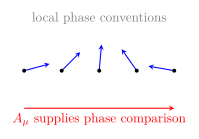
图 1:每点相位箭头可独立旋转;连接提供跨点比较规则。箭头不是可观测电场。
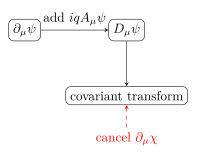
图 2:协变导数的任务是抵消局域相位导数项。
2. Photons as electromagnetic field quanta / 光子作为电磁场量子
Knowledge ID: P11-U03-L01-K02
在有限体积内把 transverse electromagnetic field 展开成 normal modes,每个 mode 的 Hamiltonian 具有 harmonic oscillator 形式:
\[H=\sum_{\mathbf k,\lambda}\hbar\omega_{\mathbf k} \left(a^\dagger_{\mathbf k\lambda}a_{\mathbf k\lambda}+\frac12\right).\]
\(a^\dagger\) 增加一个 mode excitation;这个量子就是光子。真空中的光子满足 \(E=pc\)、两种物理 transverse helicities,静质量为零。经典场是许多量子形成的 coherent-state 极限;单光子态并不是“振幅很小的经典正弦波”。
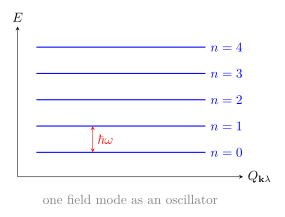
图 3:同一 mode 的能级等间隔;横轴 \(Q_{\mathbf k\lambda}\) 是该 normal mode 的 amplitude coordinate,不是 electric charge;光子数是占据数而非轨道数。
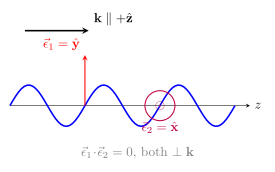
图 4:传播沿 \(+z\);\(\vec\epsilon_1\) 沿纸面内 \(y\) 方向,\(\vec\epsilon_2\) 用 \(\odot\) 表示出纸面 \(x\) 方向,二者正交且都横于 \(\mathbf k\)。蓝色曲线只编码一个场分量,不是光子空间轨迹。
3. Feynman diagrams as perturbative bookkeeping / 费曼图作为微扰记账工具
Knowledge ID: P11-U03-L01-K03
Dyson expansion 把 \(S\) matrix 展开为 interaction powers。每个顶点带一个 \(q\),内部线对应 propagator,外部线对应 asymptotic states;所有同阶且相同 external state 的图必须先把复 amplitude 相加,再取模平方:
\[\mathcal M=\mathcal M_1+\mathcal M_2+\cdots, \qquad \lvert\mathcal M\rvert^2 =\sum_i\lvert\mathcal M_i\rvert^2 +2\operatorname{Re}\sum_{i<j}\mathcal M_i\mathcal M_j^*.\]
内部线的 four-momentum 可 off shell,因此它不是探测器中可被跟踪的粒子路径。“virtual particle 借能量”是危险比喻;每个顶点仍严格守恒 four-momentum。
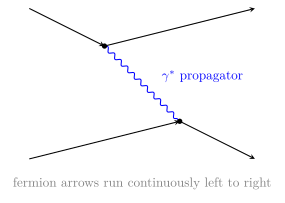
图 5:两个 charged fermion lines 通过内部 \(\gamma^*\) 交换;直线箭头编码 fermion-number flow,并不表示实验室轨迹,水平方向也不必等于真实时间。
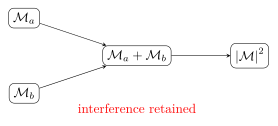
图 6:概率不是各图概率之和;相位信息先进入总振幅。
4. Scattering amplitudes, cross sections, and decay rates / 散射振幅、截面与衰变率
Knowledge ID: P11-U03-L01-K04
振幅本身不可直接观测。对于 \(2\to n\) 过程,Lorentz-invariant phase-space element 为
\[\mathrm d\Phi_n=(2\pi)^4\delta^{(4)}\!\left(p_1+p_2-\sum_f p_f\right) \prod_f\frac{\mathrm d^3p_f}{(2\pi)^3 2E_f}.\]
截面把 transition probability 除以 incident flux;衰变率则除以初态归一化:
\[\mathrm d\sigma =\frac{\overline{\lvert\mathcal M\rvert^2}}{4\sqrt{(p_1\!\cdot p_2)^2-m_1^2m_2^2}}\,\mathrm d\Phi_n, \qquad \mathrm d\Gamma=\frac{\overline{\lvert\mathcal M\rvert^2}}{2M}\,\mathrm d\Phi_n.\]
横线表示对不可分辨的 final spin/color states 求和,并对 unpolarized initial spin/color states 作平均;若外态 quantum states 已逐一指定,则不用平均并改写为对应 fixed-state \(\lvert\mathcal M\rvert^2\)。实验得到的是 acceptance、efficiency、resolution 与 backgrounds 卷积后的 event counts。简单情形下 \(N=\mathcal L_{\mathrm int}\sigma\varepsilon\),但反演 \(\sigma\) 需要 detector model 和系统不确定度。
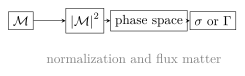
图 7:从理论振幅到率必须经过平方、求和/平均、相空间与 flux。
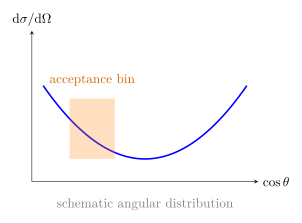
图 8:differential cross section 的形状含动力学信息;阴影区只是有限 acceptance。
5. Vacuum polarization and running coupling / 真空极化与跑动耦合
Knowledge ID: P11-U03-L01-K05
光子 propagator 的 loop correction 包含 charged virtual fields。它改变不同 momentum transfer 下的有效响应,称 vacuum polarization。经 renormalization 后,QED coupling 随 scale 跑动;单个轻费米子且远高于 threshold 的 leading-log 直觉可写为
\[\alpha(Q^2)\simeq \frac{\alpha(\mu^2)}{1-\dfrac{\alpha(\mu^2)}{3\pi}\ln\!\left(\dfrac{Q^2}{\mu^2}\right)}.\]
分母随 \(Q\) 增大而减小,所以 QED 有效耦合缓慢增大。该式不是跨所有 threshold 的精确公式:实际需计入所有带电粒子、hadronic vacuum polarization、scheme 与 timelike/spacelike continuation。\(\alpha(0)\) 的 CODATA 值是低能定义;不能把它当所有高能过程的固定输入。
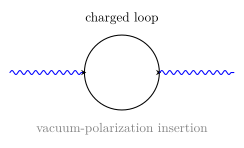
图 9:loop insertion 是 propagator correction 的一项,不是可直接拍摄的 pair cloud。
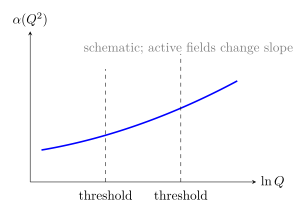
图 10:QED coupling 的定性跑动;纵轴未按比例,阈值处应做 matching。
Worked Examples / 完整例题
Example 1 — 检验协变导数
已知: \(D_\mu=\partial_\mu+iqA_\mu\),\(\psi'=e^{iq\chi}\psi\)。
对象与参考系: 任意惯性系中的局域 field relation;不涉及 detector boundary。
坐标与约定: 四维坐标 \(x^\mu\),\(A'_\mu=A_\mu-\partial_\mu\chi\)。
模型理由: Abelian \(U(1)\),可直接用 product rule。
\[\begin{aligned} D'_\mu\psi'&=(\partial_\mu+iqA'_\mu)e^{iq\chi}\psi\\ &=e^{iq\chi}[\partial_\mu+iq(\partial_\mu\chi)+iqA_\mu-iq(\partial_\mu\chi)]\psi\\ &=e^{iq\chi}D_\mu\psi. \end{aligned}\]
单位与检查: \(\partial_\mu\) 与 \(qA_\mu\) 必须有同一 inverse-length 量纲;额外项严格抵消。若 \(\chi\) 为常数,退化为 global phase。
解释: 局域相位自由要求引入 connection;这不是从零“证明只有电磁力”,而是给定 \(U(1)\) matter representation 后的最小耦合结构。
Example 2 — 两振幅干涉
已知: \(\mathcal M_1=A\),\(\mathcal M_2=Ae^{i\phi}\),\(A\) 为实正数。
对象/系统: 同一 initial/final state 的两条 indistinguishable quantum alternatives。
参考系与坐标: 结果 Lorentz scalar;角变量已固定。
模型理由: 两项已在同一 normalization 与 perturbative order。
\[\lvert\mathcal M\rvert^2=A^2\lvert1+e^{i\phi}\rvert^2 =2A^2(1+\cos\phi)=4A^2\cos^2\frac\phi2.\]
当 \(\phi=0\) 时为 \(4A^2\);当 \(\phi=\pi\) 时为 0。
检查: 非负且周期为 \(2\pi\);若错误相加概率只得 \(2A^2\),会遗漏 constructive/destructive interference。
解释: 图的数目不是事件概率;相对相位可改变可测率。
Example 3 — 从截面估计事件数
已知: \(\sigma=2.0\,\mathrm{pb}\),\(\mathcal L_{\mathrm int}=150\,\mathrm{fb^{-1}}\),总 efficiency \(\varepsilon=0.40\)。
对象/系统边界: 选定 fiducial signal channel 与通过 cuts 的 reconstructed events。
参考系: collider center-of-momentum frame;event count 为 scalar。
模型理由: 忽略 pileup-dependent efficiency variation,使用单一平均效率。
因为 \(1\,\mathrm{pb}=10^3\,\mathrm{fb}\),
\[N=\sigma\mathcal L_{\mathrm int}\varepsilon =(2.0\times10^3\,\mathrm{fb})(150\,\mathrm{fb^{-1}})(0.40) =1.2\times10^5.\]
有效数字与检查: 两位有效数字;面积与 inverse area 抵消。\(\varepsilon\to0\) 时 \(N\to0\)。
解释: 这是 expected yield,不含 Poisson fluctuation、background 或 luminosity uncertainty。
Example 4 — leading-log QED 跑动的数量级
已知: 教学模型取一个轻费米子,\(\alpha(\mu)=1/137.036\),\(Q/\mu=100\)。
对象/系统: spacelike momentum-transfer process 的 effective coupling。
尺度约定: 自然单位;只估 leading logarithm。
模型理由: 假设区间内无 threshold,忽略 higher loops 与 hadronic contribution。
\[\delta=\frac{\alpha}{3\pi}\ln(10^4)\approx0.00713, \qquad \alpha(Q^2)\approx\frac{1/137.036}{1-0.00713}\approx\frac1{136.06}.\]
检查: \(Q\) 增大时 QED \(\alpha\) 略增;变化小,符合 weak-coupling premise。
解释: 数值只演示符号与数量级,不可代替含多种粒子、阈值与 renormalization scheme 的精确 prediction。
Lesson synthesis / 本课综合
建模链条是:选择 matter field 与局域 symmetry → 引入 gauge connection 与 field strength → 量子化 normal modes → 对 interaction 做 perturbative expansion → 汇总 amplitude → 与 phase space/flux 组合成 rates → 指定 renormalization scale 与实验定义。任何一步省略,都会把“图像语言”误当成可测量物理。
Formula-and-decision table / 公式—决策表
| Need | Expression | Use when | Boundary |
|---|---|---|---|
| local covariance | \(D_\mu=\partial_\mu+iqA_\mu\) | charged field under \(U(1)\) | sign tied to charge convention |
| field strength | \(F_{\mu\nu}=\partial_\mu A_\nu-\partial_\nu A_\mu\) | Abelian QED | non-Abelian form differs |
| combine alternatives | \(\mathcal M=\sum_i\mathcal M_i\) | indistinguishable same final state | same order/normalization |
| scattering rate | \(\mathrm d\sigma\propto\lvert\mathcal M\rvert^2\mathrm d\Phi/\text{flux}\) | asymptotic scattering | detector response separate |
| decay rate | \(\mathrm d\Gamma=\lvert\mathcal M\rvert^2\mathrm d\Phi/(2M)\) | parent rest normalization | width conventions matter |
| running coupling | \(\mu\,\mathrm d\alpha/\mathrm d\mu=\beta(\alpha)\) | compare scales consistently | scheme/threshold dependent |
Model boundaries / 模型边界
- Gauge symmetry is a redundancy; gauge-dependent \(A_\mu\) components are not independent observables.
- Tree diagrams omit loop corrections; a single loop graph is generally not gauge-invariant by itself.
- Perturbation theory needs a small expansion parameter and a well-defined observable; strong fields or large logs can require resummation/nonperturbative methods.
- Cross sections assume asymptotic states; bound-state, medium and finite-time measurements require additional modeling.
- Running coupling is a renormalized parameter tied to scale and scheme, not a literal spatial dielectric profile.
Misconception clinic / 误区诊疗
- “局域相位变化会被仪器直接测到。” 单点 phase convention 是冗余;可测的是 gauge-invariant interference/field strength/holonomy。
- “虚光子短时间违反能量守恒。” 每个 vertex 守恒 four-momentum;internal line off shell 不等于借能量。
- “费曼图是粒子真实轨迹。” 图是 perturbative term;内部坐标通常积分掉。
- “更多图就简单加更多概率。” 必须先加复 amplitudes,interference 可增强或抵消。
- “\(\alpha=1/137\) 在所有能量都精确固定。” 这是低能常数;高尺度 effective coupling 跑动。
Practice and retrieval / 练习与检索
- [P11-U03-L01-K01] 推导 \(A_\mu\) 的变换使 \(D_\mu\psi\) 协变。
- [P11-U03-L01-K01] 说明 \(F_{\mu\nu}\) 在 Abelian gauge transformation 下为何不变。
- [P11-U03-L01-K02] 一束频率 \(6.0\times10^{14}\,\mathrm{Hz}\) 的单光子能量是多少?
- [P11-U03-L01-K02] 为什么光子只有两个物理 transverse polarization?给出概念回答。
- [P11-U03-L01-K03] 若 \(\mathcal M=A-A/2\),求 \(\lvert\mathcal M\rvert^2\) 并与概率相加比较。
- [P11-U03-L01-K03] 判断“内部线一定满足 \(p^2=m^2\)”真伪并解释。
- [P11-U03-L01-K04] \(\sigma=8.0\,\mathrm{fb}\)、\(\mathcal L=250\,\mathrm{fb^{-1}}\)、\(\varepsilon=0.30\),求 expected yield。
- [P11-U03-L01-K04] 为什么 differential cross section 比 total cross section 含更多动力学信息?
- [P11-U03-L01-K05] 用 beta-function 符号判断 QED coupling 随 \(Q\) 的定性变化。
- [P11-U03-L01-K05] 列出 leading-log 单费米子跑动公式不能直接跨越的两个边界。
Answer 1
取 \(\psi'=e^{iq\chi}\psi\) 与 \(A'_\mu=A_\mu-\partial_\mu\chi\),product rule 给出两项 \(\pm iq\partial_\mu\chi\),故 \(D'_\mu\psi'=e^{iq\chi}D_\mu\psi\)。
Answer 2
\(F'_{\mu\nu}=F_{\mu\nu}-\partial_\mu\partial_\nu\chi+\partial_\nu\partial_\mu\chi=F_{\mu\nu}\),假定普通偏导可交换。
Answer 3
\[E=h\nu=(6.62607015\times10^{-34})(6.0\times10^{14}) =4.0\times10^{-19}\,\mathrm J\approx2.5\,\mathrm{eV}.\]
Answer 4
Massless spin-1 field 的 gauge redundancy 去除 longitudinal/time-like redundant components,留下 helicity \(+1\) 与 \(-1\) 两个 physical states。
Answer 5
\(\lvert A-A/2\rvert^2=A^2/4\);若错误相加概率得 \(A^2+A^2/4=5A^2/4\),差异来自 destructive interference。
Answer 6
假。外部 asymptotic particles on shell;内部 propagator momentum 被积分,通常 \(p^2\ne m^2\)。
Answer 7
\[N=(8.0\,\mathrm{fb})(250\,\mathrm{fb^{-1}})(0.30)=6.0\times10^2.\]
Answer 8
Total rate 积分掉角度/能量相关;differential shape 保留 spin、propagator、interference 与 cuts 的分布信息。
Answer 9
QED 的 leading beta function 为正,因此 \(Q\) 增大时 \(\alpha(Q^2)\) 缓慢增大。
Answer 10
例如:带电粒子 mass thresholds、hadronic vacuum polarization、higher loops、scheme change 或 timelike analytic continuation;任列两项均可。
Exit ticket / 离堂任务
一位同学说:“局域相位对称性产生真实光子,图中的虚光子在传播时临时违反能量守恒,而 \(1/137\) 是其固定强度。”请用不超过六句话逐条纠正,并写出一个 gauge-covariant equation 与一个 observable-rate equation。
References and source notes / 参考资料与来源说明
访问与核验日期均为 2026-08-30。
- MIT OpenCourseWare, 8.701 Introduction to Nuclear and Particle Physics — Lecture Notes, especially Lectures 4.4–4.9 (photons, QED rules, cross sections, renormalization). https://ocw.mit.edu/courses/8-701-introduction-to-nuclear-and-particle-physics-fall-2020/resources/lecture-notes/
- MIT OpenCourseWare, Lecture 4.9: Renormalization and Higher-Order QED Diagrams. https://ocw.mit.edu/courses/8-701-introduction-to-nuclear-and-particle-physics-fall-2020/bff37d3c0eee1c95a502085e3ba5164c_MIT8_701f20_lec4.9.pdf
- MIT OpenCourseWare 8.324, Relativistic Quantum Field Theory II — Lecture 2, gauge principle and Abelian gauge fields. https://ocw.mit.edu/courses/8-324-relativistic-quantum-field-theory-ii-fall-2010/b29379aced2b46bbe9f2715922d72b10_MIT8_324F10_Lecture2.pdf
- Particle Data Group, Electroweak Model and Constraints on New Physics (2025), electromagnetic coupling and renormalization conventions. https://pdg.lbl.gov/2025/reviews/rpp2025-rev-standard-model.pdf
- NIST/CODATA, 2022 CODATA Recommended Values of the Fundamental Physical Constants. https://physics.nist.gov/cuu/pdf/JPCRD2022CODATA.pdf
- CERN, The Standard Model. https://home.cern/science/physics/standard-model/
Source-to-content map / 来源—内容映射
| Source | Used for | Knowledge ID / Section | Model boundary or convention |
|---|---|---|---|
| MIT 8.701 QED lectures | photons, diagrams, amplitudes, cross sections | K02–K04 | diagrams are perturbative bookkeeping |
| MIT Lecture 4.9 | vacuum polarization and renormalization | K05 | higher-order and scale dependence |
| MIT 8.324 Lecture 2 | local \(U(1)\) gauge transformation and covariant derivative | K01 | exact Abelian section; notation converted to this lesson's sign convention |
| PDG electroweak review | running electromagnetic coupling | K05 | scheme/threshold awareness |
| NIST/CODATA | low-energy \(\alpha\) and constants | K02, K05, examples | CODATA value is not all-scale coupling |
| CERN Standard Model | empirical context and force carriers | synthesis | outreach-level overview, not derivation |
复习与拓展
- 下一课把 \(U(1)\) 扩展到 \(SU(2)_L\times U(1)_Y\),并讨论 spontaneous symmetry breaking。
- QCD 课将比较 Abelian 与 non-Abelian field strength、beta-function 符号和 self-interaction。
- QFT bridge 将补上 mode quantization、creation/annihilation operators 与 renormalization group 的结构。