
Learning objectives / 学习目标
学完本课后,你应能:
- 采用明确的度规约定建立四动量,并由末态四动量重建母粒子不变质量;
- 求总系统的 center-of-momentum(COM)速度,并解释 COM 能量为何是反应可用能量;
- 推导二体衰变的 daughter energy 与 Källén-function 动量公式,判断衰变是否允许;
- 分别计算 fixed-target 与 collider 的阈值,解释“同样束流能量”不等于“同样新粒子质量可达范围”;
- 读取 Dalitz plot 的边界、共振带与事件密度,同时区分运动学允许区和动力学振幅。
Prerequisites / 先修知识
- Relativistic Momentum and Energy:\(E^2=p^2c^2+m^2c^4\)。
- Lorentz Transformations:boost 与洛伦兹不变量。
- 三维动量守恒、能量守恒、向量点积和平方根函数。
- 本课只回顾必要的狭义相对论,不重建其时空几何证明。
Scope and conventions / 范围与约定
- 采用度规号差 \((+,-,-,-)\),四矢量点积为 \(a^\mu b_\mu=a^0b^0-\mathbf a\cdot\mathbf b\)。
- 除标明 SI 的位置外,推导常暂取 \(c=1\);恢复单位时,质量常以 \(\mathrm{MeV}/c^2\)、动量以 \(\mathrm{MeV}/c\) 表示。
- 所有 external particles 均视为 on shell;共振宽度、矩阵元和探测器分辨率只在需要时说明。
- “质心系”在本课严格指 center-of-momentum frame,即总三动量为零;它不一定是几何质心静止系。
- 阈值只给运动学最低能量;截面可能因选择定则、角动量屏障或耦合很小而在阈值处仍接近零。
Notation and modeling contract / 符号与建模契约
| Symbol | Meaning | Typical unit |
|---|---|---|
| \(p^\mu=(E/c,\mathbf p)\) | single-particle four-momentum | \(\mathrm{GeV}/c\) |
| \(P^\mu=\sum_i p_i^\mu\) | system four-momentum | \(\mathrm{GeV}/c\) |
| \(s=P^\mu P_\mu c^2\) | squared COM energy | \(\mathrm{GeV^2}\) |
| \(M\) | invariant mass of a system | \(\mathrm{GeV}/c^2\) |
| \(\sqrt{s}\) | total energy in COM frame | \(\mathrm{GeV}\) |
| \(\lambda(x,y,z)\) | Källén function | depends on arguments |
| \(m_{ij}^2\) | pair invariant mass squared | \(\mathrm{GeV^2}/c^4\) |
| \(\Gamma\) | partial or total decay width | eV, MeV, GeV |
为减少单位拥挤,核心推导取 \(c=1\);任何数值结论都写回常用粒子物理单位,SI 关系由 \(1\,\mathrm{eV}=1.602\,176\,634\times10^{-19}\,\mathrm J\) 精确连接。
1. Four-momentum and invariant mass / 四维动量与不变质量
Knowledge ID: P11-U01-L01-K01
单粒子四动量定义为
\[p^\mu=\left(\frac{E}{c},\mathbf p\right),\]
其 Minkowski 范数为
\[p^\mu p_\mu=\frac{E^2}{c^2}-p^2=m^2c^2.\]
不同惯性观察者测得不同的 \(E\) 和 \(\mathbf p\),但都得到相同的 \(m\)。对于多个粒子的系统,必须先加四矢量再平方:
\[P^\mu=\sum_i p_i^\mu, \qquad M^2c^2=P^\mu P_\mu.\]
因此
\[M^2c^4=\left(\sum_i E_i\right)^2-c^2\left\lvert\sum_i\mathbf p_i\right\rvert^2.\]
关键点是 \(M\) 包含 constituents 的静质量、相对动能和相互作用能;一般不等于 \(\sum_i m_i\)。对两个近似无质量粒子,夹角为 \(\theta\) 时,
\[M^2c^4=2E_1E_2(1-\cos\theta).\]
这解释了 calorimeter 中只测能量与方向也能重建双光子共振。
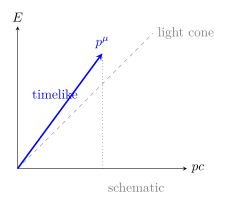
图 1 用能量—动量平面表示 massive particle 的四动量位于 light cone 内;boost 改变箭头坐标,却不改变 \(E^2-p^2c^2\)。
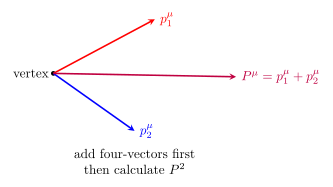
图 2 强调不变量重建的顺序;逐个取质量再相加会丢掉粒子之间的相对运动信息。
2. Center-of-momentum frame / 质心动量系
Knowledge ID: P11-U01-L01-K02
若实验室系中系统总能量为 \(E_{\mathrm{tot}}\)、总动量为 \(\mathbf P\),沿 \(\mathbf P\) 方向作 boost,可令总三动量为零。COM 速度为
\[\mathbf v_{\mathrm{CM}}=\frac{c^2\mathbf P}{E_{\mathrm{tot}}}, \qquad \boldsymbol\beta_{\mathrm{CM}}=\frac{c\mathbf P}{E_{\mathrm{tot}}}.\]
在该系中 \(P^{\mu *}=(\sqrt{s}/c,\mathbf0)\),所以
\[\sqrt{s}=E_{\mathrm{tot}}^*=Mc^2.\]
\(\sqrt{s}\) 是可分配给末态静质量与 COM 动能的总能量。实验室总能量中属于整体平移的部分不能在反应中“变成新粒子”。
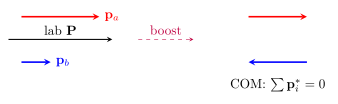
图 3 对比 lab 与 COM:后者不是让每个粒子静止,而是让矢量总动量为零。
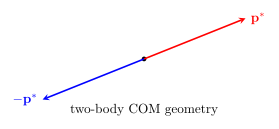
图 4 表示二体 initial 或 final state 在 COM 中的动量必等大反向;能量可因质量不同而不同。
3. Two-body decay kinematics / 二体衰变运动学
Knowledge ID: P11-U01-L01-K03
考虑母粒子 \(A\) 在自身静止系衰变为 \(1+2\)。守恒给出
\[M=E_1^*+E_2^*, \qquad \mathbf p_1^*=-\mathbf p_2^*.\]
将 \(p_A-p_1=p_2\) 平方,可直接得到
\[E_1^*=\frac{M^2+m_1^2-m_2^2}{2M}, \qquad E_2^*=\frac{M^2+m_2^2-m_1^2}{2M}.\]
共同动量大小为
\[p^*=\frac{\sqrt{\lambda(M^2,m_1^2,m_2^2)}}{2M},\]
其中
\[\lambda(x,y,z)=x^2+y^2+z^2-2xy-2xz-2yz.\]
亦可写成
\[p^*=\frac{\sqrt{[M^2-(m_1+m_2)^2][M^2-(m_1-m_2)^2]}}{2M}.\]
必须有 \(M\ge m_1+m_2\)。等号对应阈值 \(p^*=0\);若根号内为负,过程在 on-shell 二体模型中不允许。
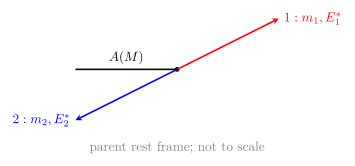
图 5 展示母粒子静止系的二体几何;若实验室中的两箭头并非反向,不代表动量不守恒,而是母粒子在运动。
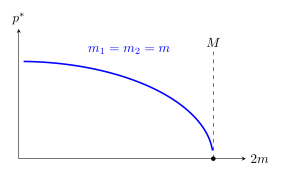
图 6 限定 \(m_1=m_2=m\) 且固定 \(M\),此时 \(p^*=\tfrac12\sqrt{M^2-4m^2}\) 是横轴 \(2m\) 的单值函数;当 \(2m\to M\) 时,相空间动量压缩到零。
4. Threshold production / 阈上产生
Knowledge ID: P11-U01-L01-K04
反应 \(a+b\rightarrow 1+\cdots+n\) 的阈值条件应写成不变量:
\[s_{\mathrm{thr}}=\left(\sum_f m_f\right)^2c^4,\]
因为在阈值 COM 中,所有末态粒子可共同静止而无相对动能。固定靶实验令 \(b\) 静止,则
\[s=m_a^2c^4+m_b^2c^4+2m_bc^2E_a^{\mathrm{lab}}.\]
于是 projectile 的 threshold total energy 为
\[E_{a,\mathrm{thr}}^{\mathrm{lab}}= \frac{\left(\sum_fm_f\right)^2-m_a^2-m_b^2}{2m_b}c^2.\]
固定靶中,大量能量保留为整体 COM 运动。对于等能反向、总动量为零的 collider,近似有 \(\sqrt{s}=2E_{\mathrm{beam}}\),能量利用率高得多。
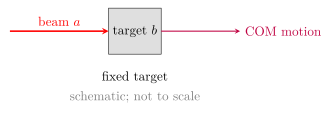
图 7 表示 fixed-target 阈值事件仍须携带实验室总动量;末态不可能全部在实验室静止。
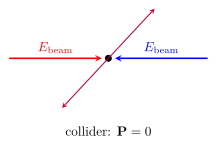
图 8 表示 symmetric collider 从一开始就在 COM 系中;并非“碰撞自动消除动量”,而是两束动量预先抵消。
5. Dalitz-plot and many-body phase-space viewpoint / Dalitz 图与多体相空间观点
Knowledge ID: P11-U01-L01-K05
三体衰变 \(A\to1+2+3\) 在母粒子静止系中有连续的能量分配。定义
\[s_{ij}=m_{ij}^2=(p_i+p_j)^2.\]
四动量守恒给出一个重要恒等式:
\[s_{12}+s_{23}+s_{13}=M^2+m_1^2+m_2^2+m_3^2.\]
因此只需两个 pair invariants 描述三体内部运动学;常用坐标为 \((s_{12},s_{23})\)。边界由能量—动量守恒与 \(s_{ij}\ge(m_i+m_j)^2\) 共同确定,不是随意矩形。
若矩阵元近似常数,适当变量中的事件密度反映相空间;若存在中间共振 \(R\to i+j\),事件会在 \(s_{ij}\approx m_R^2\) 附近形成带。带的交叉与密度变化包含干涉和自旋信息,但仅凭“有一条线”不能完成动力学解释。
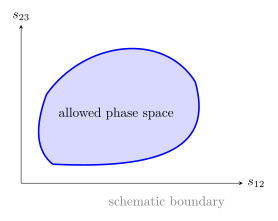
图 9 表示 Dalitz plot 的相关边界;坐标轴范围必须由给定 masses 计算,图中形状只作概念示意。
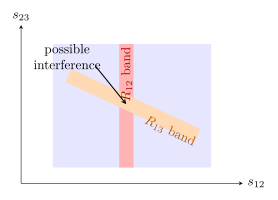
图 10 显示两种中间态共振带可能交叉;真实宽度还卷积了 intrinsic width、相空间和 detector resolution。
Worked Examples / 完整例题
Worked Example 1 — 双光子不变质量重建
已知: 两个光子在同一事件中有 \(E_1=1.20\,\mathrm{GeV}\)、\(E_2=0.800\,\mathrm{GeV}\),夹角 \(60.0^\circ\)。求 pair invariant mass。
研究对象与参考系: 系统边界取两光子;实验室系测得能量和夹角,但结果是 Lorentz invariant。坐标不必特别选择。
模型理由: 光子近似 on shell 且 \(m_\gamma=0\),使用四动量和。
\[M^2c^4=2E_1E_2(1-\cos\theta).\]
代入得
\[M^2c^4=2(1.20)(0.800)(1-0.500)\,\mathrm{GeV^2} =0.960\,\mathrm{GeV^2},\]
\[Mc^2=0.980\,\mathrm{GeV}.\]
检查: 若 \(\theta\to0\),\(M\to0\);若背对背,\(M\) 最大。量纲为 energy squared。三位有效数字结果为 \(M=0.980\,\mathrm{GeV}/c^2\)。物理上,pair mass 来自相对方向而非光子静质量。
Worked Example 2 — 静止 \(\pi^0\to\gamma\gamma\)
已知: \(m_{\pi^0}c^2=134.98\,\mathrm{MeV}\)。求静止母粒子系中两个光子的能量和动量。
系统与坐标: 取 \(\pi^0\) 及两光子为封闭系统;在 parent rest frame 中令光子 1 沿 \(+x\)。
模型: 二体衰变、光子无质量。由对称性或二体能量公式,
\[E_1^*=E_2^*=\frac{M}{2}=67.49\,\mathrm{MeV}.\]
\[p_1^*=p_2^*=\frac{E_\gamma}{c}=67.49\,\mathrm{MeV}/c.\]
方向分别为 \(+x\) 与 \(-x\)。检查: 能量和为 \(134.98\,\mathrm{MeV}\),总动量为零;恢复 \(m_1=m_2=0\) 时 Källén 公式也给 \(p^*=M/2\)。两位小数已与输入精度匹配。
Worked Example 3 — \(p+p\to p+p+\pi^0\) 的固定靶阈值
已知: projectile proton 撞击静止 proton;\(m_pc^2=938.27\,\mathrm{MeV}\),\(m_{\pi^0}c^2=134.98\,\mathrm{MeV}\)。求 projectile threshold kinetic energy。
系统与参考系: 实验室系中 target 静止;正方向沿 beam。末态在阈值 COM 中无相对动能,但在 lab 中整体前进。
\[s=4m_p^2c^4+2m_pc^2T_p.\]
阈值为 \(\sqrt{s}=2m_pc^2+m_{\pi^0}c^2\),故
\[T_{p,\mathrm{thr}} =\frac{(2m_p+m_{\pi^0})^2-4m_p^2}{2m_p}c^2 =2m_{\pi^0}c^2+\frac{m_{\pi^0}^2}{2m_p}c^2.\]
\[T_{p,\mathrm{thr}}=269.96\,\mathrm{MeV}+9.71\,\mathrm{MeV} =279.67\,\mathrm{MeV}.\]
检查: 结果大于单纯产生 \(\pi^0\) 的 rest energy,因为须保持实验室动量守恒;量纲为能量。取三位有效数字,\(T_{\mathrm{thr}}=280\,\mathrm{MeV}\)。
Worked Example 4 — 三个无质量末态的 Dalitz 恒等式
已知: 质量 \(Mc^2=2.00\,\mathrm{GeV}\) 的静止母粒子衰变为三个近似无质量粒子,能量依次为 \(0.800\)、\(0.700\)、\(0.500\,\mathrm{GeV}\)。求三组 pair invariant masses squared。
系统与模型: parent rest frame;三粒子总能量为 \(M\)、总动量为零。对任一 pair,\(p_i+p_j=P-p_k\),因此
\[s_{ij}=(P-p_k)^2=M^2-2ME_k\]
(因 \(m_k=0\))。故
\[s_{23}=4.00-2(2.00)(0.800)=0.800\,\mathrm{GeV^2},\]
\[s_{13}=4.00-2(2.00)(0.700)=1.20\,\mathrm{GeV^2},\]
\[s_{12}=4.00-2(2.00)(0.500)=2.00\,\mathrm{GeV^2}.\]
检查: \(s_{12}+s_{23}+s_{13}=4.00\,\mathrm{GeV^2}=M^2\),符合三粒子无质量极限。每个 \(s_{ij}\ge0\);能量边长 \(0.8,0.7,0.5\) 可构成动量三角形,因此候选点在物理区域内。
Lesson synthesis / 本课综合
统一流程是:
- 明确系统边界和观测参考系;
- 为每个可见或假设粒子写 on-shell four-momentum;
- 先用四动量守恒,再取 \(P^2\)、\(s\) 或 \(s_{ij}\);
- 若问题涉及能量可达范围,转到 COM 而不是直接相加 lab kinetic energies;
- 检查根号非负、阈值极限、量纲和所有 pair-invariant 关联;
- 运动学只给允许区域,事件密度还需矩阵元、寿命和 detector response。
Formula-and-decision table / 公式与决策表
| Question | Formula | Use when | Limitation |
|---|---|---|---|
| 系统不变质量? | \(M^2c^4=E_{\rm tot}^2-c^2P^2\) | 已知同一系中总能量和总动量 | 必须包括系统内所有对象 |
| COM 速度? | \(\mathbf v_{\rm CM}=c^2\mathbf P/E_{\rm tot}\) | 系统总四动量为 timelike | 光样系统无静止 COM |
| 二体 daughter 动量? | \(p^*=\sqrt{\lambda(M^2,m_1^2,m_2^2)}/(2M)\) | parent rest frame、on-shell daughters | 宽共振需逐事件质量 |
| fixed-target 阈值? | \(s=m_a^2+m_b^2+2m_bE_a\) | target 静止 | 写的是 total projectile energy |
| 三体坐标? | \(s_{12}+s_{23}+s_{13}=M^2+\sum m_i^2\) | 三个确定末态 | 两变量仍受曲线边界约束 |
Model boundaries / 模型边界
- 不变质量重建若漏掉 neutrino、软光子或 acceptance 外粒子,得到的是 visible mass,不是 parent mass。
- unstable resonance 没有每次都等于单一质量;观测峰受 Breit–Wigner-like line shape、phase space 和 detector resolution 共同影响。
- 二体公式假设确定 parent mass 与 on-shell daughters;medium effects 或 off-shell intermediate states 需更一般处理。
- fixed-target threshold 假设 target 自由且静止;原子核内 Fermi motion、binding energy 会改写精确边界。
- Dalitz density 不是“纯相空间图”的同义词;若矩阵元不常数,均匀相空间也可变成非均匀事件密度。
Misconception clinic / 常见误区诊所
- “系统质量等于各粒子静质量之和。” 错在忽略 COM 中的相对动能和相互作用能;应先加四动量再平方。
- “COM 系中所有粒子都静止。” 只有阈值末态可共同无相对运动;一般事件只是总动量为零。
- “束流总能量都能制造新质量。” fixed target 的整体运动不可消除,真正可用的是 \(\sqrt{s}\)。
- “二体衰变能量可任意分配。” parent rest frame 中 daughters 的能量由三种质量唯一确定,只有方向与动力学角分布仍可变化。
- “Dalitz 图中每个矩形点都允许。” 三个 pair invariants 相关,物理区边界由守恒与 on-shell 条件共同限定。
Practice and retrieval / 练习与提取
- [K01 · 推导] 证明 \(p^\mu p_\mu=m^2c^2\) 在沿 \(x\) 方向的 Lorentz boost 下保持不变。
- [K01 · 定量] 一个质子有 \(p=1.50\,\mathrm{GeV}/c\)。取 \(m_pc^2=0.938\,\mathrm{GeV}\),求总能量。
- [K01 · 图像] 两个能量均为 \(0.500\,\mathrm{GeV}\)、夹角 \(120^\circ\) 的光子,其 pair invariant mass 是多少?
- [K02 · 定量] 实验室中一个 \(E=3.00\,\mathrm{GeV}\) 的 proton 撞击静止 proton。求系统 \(\beta_{\mathrm{CM}}\)。
- [K03 · 定量] \(M=1.00\,\mathrm{GeV}/c^2\) 的粒子静止衰变为 \(m_1=0.300\)、\(m_2=0.400\,\mathrm{GeV}/c^2\),求 \(p^*\)。
- [K03 · 边界] 为什么 \(M=0.600\,\mathrm{GeV}/c^2\to0.350+0.300\,\mathrm{GeV}/c^2\) 的 on-shell 二体衰变不允许?
- [K04 · 推导] 推导等质量 projectile/target、末态总静质量 \(M_f\) 的 fixed-target threshold kinetic energy。
- [K04 · 比较] 对称 collider 要产生总静质量 \(4.00\,\mathrm{GeV}/c^2\) 的阈值末态,每束至少需多少总能量?
- [K05 · 定量] 三体衰变中若 \(M=2.50\,\mathrm{GeV}/c^2\),\(m_1=m_2=m_3=0.200\,\mathrm{GeV}/c^2\),求 \(s_{12}+s_{23}+s_{13}\)。
- [K05 · 综合] 实验只重建到两个 charged tracks,而假设末态还含一个 neutrino。解释为何两轨 invariant mass 通常小于且不固定等于 parent mass。
Answer 1
Lorentz boost 给 \(E'=\gamma(E-vp_x)\)、\(p_x'=\gamma(p_x-vE/c^2)\),\(p_y,p_z\) 不变。展开 \(E'^2/c^2-p_x'^2\),交叉项抵消,利用 \(\gamma^2(1-\beta^2)=1\),得到 \(E^2/c^2-p_x^2\),再减去不变的 \(p_y^2+p_z^2\)。
Answer 2
\[E=\sqrt{p^2c^2+m_p^2c^4}=\sqrt{1.50^2+0.938^2}\,\mathrm{GeV}=1.77\,\mathrm{GeV}.\] 极限检查:\(E>pc\) 且 \(E>m_pc^2\)。
Answer 3
\[M^2c^4=2(0.500)^2[1-\cos(120^\circ)]=0.750\,\mathrm{GeV^2},\] 因而 \(M=0.866\,\mathrm{GeV}/c^2\)。
Answer 4
Projectile 动量 \(pc=\sqrt{3.00^2-0.938^2}=2.85\,\mathrm{GeV}\)。总能量 \(3.00+0.938=3.938\,\mathrm{GeV}\),故 \[\beta_{\mathrm{CM}}=\frac{Pc}{E_{\mathrm{tot}}}=\frac{2.85}{3.938}=0.724.\]
Answer 5
\[p^*=\frac{\sqrt{[1-(0.7)^2][1-(0.1)^2]}}{2}\,\mathrm{GeV}/c =0.355\,\mathrm{GeV}/c.\] 根号为正且 \(p^*<M/2\),合理。
Answer 6
Daughter 静质量和为 \(0.650\,\mathrm{GeV}/c^2>M\)。即使在最省能的 COM 阈值状态,也需要比母粒子更多的能量;Källén 公式第一因子为负。
Answer 7
对 \(a=b=m\),\(s=4m^2c^4+2mc^2T\)。令 \(s_{\rm thr}=M_f^2c^4\),得 \[T_{\rm thr}=\frac{M_f^2-4m^2}{2m}c^2.\] \(M_f\) 是所有末态静质量之和,不是某一个新粒子质量。
Answer 8
对称 collider 在 COM 中 \(\sqrt{s}=2E_{\mathrm{beam}}\),所以每束至少 \(2.00\,\mathrm{GeV}\)。这是总能量;若 beam particle 有质量,其动能略小于该值。
Answer 9
\[\sum s_{ij}=M^2+3m^2=2.50^2+3(0.200)^2=6.37\,\mathrm{GeV^2}/c^4.\]
Answer 10
两轨总四动量只等于 parent 四动量减去 neutrino 四动量;漏失的正能量与动量逐事件变化。因此 visible mass 是子系统不变量,其 endpoint 可能编码 parent/invisible masses,但单个值一般不等于 parent mass。
Exit ticket / 离堂任务
- 用不超过四行推导“二光子若完全平行则 pair invariant mass 为零”,并说明这不表示总能量为零。
- 面对一个未知碰撞题,先写出你会用来判断 fixed-target 或 collider 能量可达范围的三个检查量。
References and source notes / 参考资料与来源说明
以下来源均于 2026-08-30 实际打开核对;正文重新组织,全部图依据方程原创绘制:
- Particle Data Group, Review of Particle Physics 2024: Kinematics — invariant phase space、two/three-body kinematics、Dalitz boundaries。
- MIT OpenCourseWare 8.701, Lecture 0.8: Relativistic Kinematics — four-momentum、invariant-mass reconstruction 与 COM conventions。
- MIT OpenCourseWare 8.701, Lecture 1.4: Decays — decay width、branching 与二体衰变框架。
- MIT OpenCourseWare 8.701, Lecture Notes Index: Reactions — reaction kinematics、threshold 与课程层级边界。
- MIT OpenCourseWare 8.20, Introduction to Special Relativity — Lorentz transformations and relativistic kinematics background。
Source-to-content map / 来源—内容映射
| Source | Used for | Knowledge ID / Section | Model boundary or convention |
|---|---|---|---|
| PDG Kinematics | exact invariant and phase-space relations | K01, K03, K05 | \((+,-,-,-)\) convention stated locally |
| MIT 8.701 Relativistic Kinematics | four-momentum and COM pedagogy | K01, K02 | natural units restored in numerical answers |
| MIT 8.701 Decays | parent-rest-frame decay reasoning | K03 | width dynamics separated from kinematics |
| MIT 8.701 Reactions | fixed-target/collider thresholds | K04 | threshold is necessary, not sufficient for large rate |
| MIT 8.20 | Lorentz-invariance prerequisite | Prerequisites, Practice 1 | special-relativity derivation not repeated in full |
复习与拓展
- 下一课把“允许的运动学过程”进一步交给 continuous/discrete symmetries 与 quantum-number conservation 判断。
- Unit 11.4 将把 invariant mass、missing momentum 和 \(\sqrt{s}\) 连接到真实 accelerator/detector reconstruction。
- 未来可扩展 helicity angles、Lorentz-invariant phase-space measure \(\mathrm d\Phi_n\)、Jacobian peaks 与 transverse mass。