
Learning objectives / 学习目标
学完本课后,你应能:
- 比较四种 interactions 的 sources、mediators、range 与 scale-dependent strength,并指出简单排名表的边界;
- 用 photon exchange/QED language 连接 Coulomb long range、radiation 与 annihilation;
- 用 \(W^\pm/Z\) 的质量估计 weak range,沿 beta decay 追踪 quark flavor change 与 charge flow;
- 区分 fundamental color force、confinement、hadronization 与 residual nuclear force;
- 用 dimensionless gravitational coupling 定量说明 ordinary particle scattering 中 gravity 可忽略,并说明极端能标例外。
Prerequisites / 先修知识
- Leptons, Quarks, and Hadrons 的 electric charge(本课记为 \(Q_{\mathrm{em}}\))、color、flavor 与 antiparticles。
- Symmetries and Conservation Laws 的 interaction-dependent selection rules。
- Coulomb/Newton inverse-square laws、Compton wavelength 与 \(E=mc^2\)。
- 本课不推导完整 gauge Lagrangian;下一 Unit 依次进入 QED、electroweak 与 QCD。
Scope and conventions / 范围与约定
- “Strength”必须指定 process 与 energy scale。表中的 relative strengths 只是 order-of-magnitude guide,不是 universal constants 的同一维度比较。
- Mediator language 是量子场论的 perturbative description;虚粒子不是可直接观测、短暂违反能量守恒的经典小球。
- Massive mediator 常给出 Yukawa-like range \(\ell\sim\hbar/(Mc)\);massless mediator 可支持 long-range field,但 screening、confinement 与 geometry 会改变观测范围。
- Strong interaction 的 gluon massless,却因 non-Abelian confinement 不产生普通 long-range \(1/r\) color force;nuclear force 是 color-singlet hadrons 间的 residual interaction。
- Gravity 的量子 mediator graviton 尚未观测,且 gravity 不在 Standard Model 内;经典 general relativity 是宏观已验证描述。
Notation and modeling contract / 符号与建模契约
| Symbol | Meaning | Value / unit |
|---|---|---|
| \(\alpha=e^2/(4\pi\varepsilon_0\hbar c)\) | fine-structure constant | \(\approx1/137\) at low energy |
| \(Q_{\mathrm{em}}\) | electric charge | C or multiples of \(e\) |
| \(q_{\mathrm{tr}}=\sqrt{-q_{\mathrm{transfer}}^2}\) | spacelike momentum-transfer magnitude / hard scale | momentum; commonly \(\mathrm{GeV}/c\) |
| \(\alpha_s(q_{\mathrm{tr}})\) | strong running coupling | scale dependent |
| \(G_F\) | Fermi constant | \(1.166\times10^{-5}\,\mathrm{GeV^{-2}}\) in natural units |
| \(M_W,M_Z\) | weak-boson masses | about \(80,91\,\mathrm{GeV}/c^2\) |
| \(\ell\) | characteristic range | m |
| \(\alpha_G(m_1,m_2)\) | \(Gm_1m_2/(\hbar c)\) | dimensionless |
| \(\kappa\) | schematic QCD string tension | about \(0.9\,\mathrm{GeV/fm}\) |
1. Characteristic strengths, ranges, and mediators / 特征强度、作用程与媒介子
Knowledge ID: P11-U02-L02-K01
一个 interaction 的可观察大小至少由四件事决定:external particles 是否携带相应 charge、dimensionless coupling、mediator propagation、phase space/kinematics。对 massive mediator 的静态极限,势能常有
\[V(r)\propto\frac{e^{-r/\ell}}{r}, \qquad \ell\sim\frac{\hbar}{Mc}.\]
这给 weak interaction 的短程直觉。对 photon,\(M=0\),经典静态 potential 为 \(1/r\);对 gravity,classical field 同样 long range。对 gluons,\(M=0\) 却不能套“无限程自由 color force”,因为 QCD vacuum、gluon self-interaction 与 confinement 改变 infrared physics。
| Interaction | Couples to | Standard mediator | Characteristic reach | Essential caveat |
|---|---|---|---|---|
| electromagnetic | electric charge/current | photon | long range | screening and neutrality |
| weak | weak isospin/hypercharge combinations | \(W^\pm,Z\) | about \(10^{-18}\,\mathrm m\) | energy-dependent electroweak behavior |
| strong | color | eight gluons | confined at hadron scale | residual nuclear force differs |
| gravity | stress–energy | spacetime / hypothetical graviton | long range | tiny dimensionless coupling for particles |
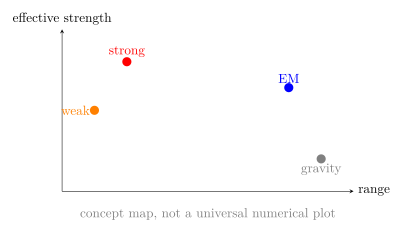
图 1 只提供尺度图景;interaction strength 随 energy/process 改变,不能从点的高度读精确比值。
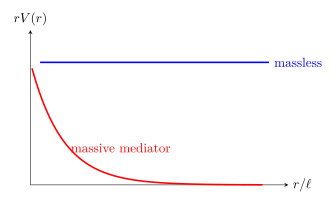
图 2 画的是 \(rV\) 以突出 exponential cutoff;实际 QCD infrared potential 不服从这条简单 red curve。
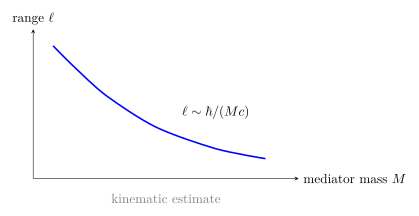
图 3 表示 mediator mass–range inverse scaling;\(M=0\) 与 confinement 等非微扰情形需另外分析。
2. Electromagnetic interaction / 电磁相互作用
Knowledge ID: P11-U02-L02-K02
Electromagnetic interaction 耦合到 electric four-current。Quantum electrodynamics(QED)中 field quantum 是 photon;最低阶 charged-particle scattering 可用 virtual-photon exchange 记账。低能耦合
\[\alpha=\frac{e^2}{4\pi\varepsilon_0\hbar c}\approx\frac1{137}.\]
Photon mass 在标准模型中为零,支持长程 Coulomb field;但 ordinary matter 的正负电荷 cancellation、plasma/Debye screening 与 conductor boundary conditions 会缩短实际可见场。EM 保持 electric charge,且不会直接改变 quark/lepton flavor;annihilation、radiation、pair production 与 atomic binding 都是同一 interaction 的不同 kinematic regimes。
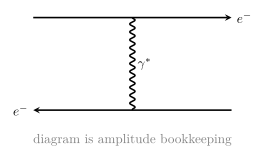
图 4 是 lowest-order QED exchange schematic;internal photon 不应被解释为可单独探测的能量借贷粒子。
3. Weak interaction and flavor change / 弱相互作用与味改变
Knowledge ID: P11-U02-L02-K03
Weak interaction 有 charged-current(\(W^\pm\))与 neutral-current(\(Z\))过程。Charged current 可连接 up-type 与 down-type quarks,因而改变 flavor,例如 neutron beta decay 的 constituent-level chain:
\[d\rightarrow u+W^-, \qquad W^-\rightarrow e^-+\bar\nu_e.\]
Neutral current \(Z\) exchange 不改变 electric charge,并非每个 weak event 都改变 flavor。Weak interaction 对 chirality 敏感,破坏 C 与 P;neutrinos 缺少 EM/strong channel,且在 spacelike momentum-transfer magnitude \(q_{\mathrm{tr}}=\sqrt{-q_{\mathrm{transfer}}^2}\ll M_{W,Z}c\) 时,重 \(W/Z\) propagator 使有效作用由 \(G_F\) 抑制,故截面很小、难以探测。这里的“weak”不是说 electroweak gauge coupling 类似 gravity 那样微小——在 electroweak scale,weak 与 electromagnetic 属统一理论。
\(W/Z\) 很重,给出
\[\ell_W\sim\frac{\hbar}{M_Wc}\approx2.5\times10^{-18}\,\mathrm m.\]
低能 weak amplitudes 可由 Fermi constant 描述;能量接近 \(M_Wc^2\) 时必须恢复 propagator 和 electroweak gauge theory。
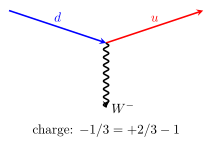
图 5 显示 charged-current vertex 同时改变 quark flavor 与 charge;总 electric charge 仍严格守恒。
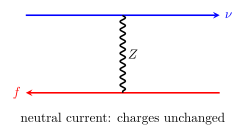
图 6 表示 neutrino neutral-current scattering;weak interaction 不等于“每次都发出 charged lepton”。
4. Strong interaction and confinement / 强相互作用与禁闭
Knowledge ID: P11-U02-L02-K04
Quantum chromodynamics(QCD)耦合 color charge,mediators 是八种 gluon field states。Gluons 自身携带 color,产生 non-Abelian self-interactions。Coupling \(\alpha_s(q_{\mathrm{tr}})\) 随 momentum-transfer scale 运行:高 \(q_{\mathrm{tr}}\) 时较小(asymptotic freedom),低 \(q_{\mathrm{tr}}\) 时增大并进入 nonperturbative regime。
Confinement 表示 isolated color charges 未被观测;拉开 quark–antiquark 时,color flux 集中成 tube,势能在一定距离范围近似
\[V(r)\sim\kappa r.\]
继续输入能量更倾向产生新的 \(q\bar q\) pairs 并 hadronize,而不是得到自由 quark。Nucleons 间的 residual nuclear interaction 是 color-singlet composites 间的剩余效应,低能可用 pion exchange/effective field theory 描述;不能把 pion 称为 fundamental strong-force gauge boson。
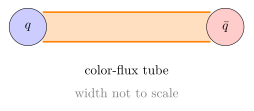
图 7 表示 flux-tube intuition;真实 QCD field distribution 由 nonperturbative dynamics 决定。
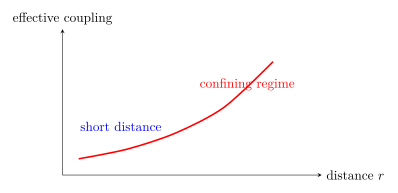
图 8 用 distance language 表示 inverse relationship to momentum scale;曲线为概念图,不是精确 \(\alpha_s\) fit。
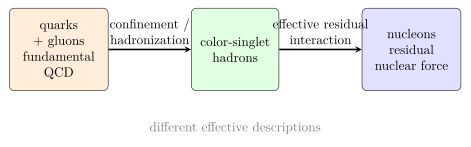
图 9 分隔 QCD gauge interaction 与 nuclear residual force;把两者都简称“strong force”时必须说明层级。
5. Gravity at particle scales / 粒子尺度的引力
Knowledge ID: P11-U02-L02-K05
Newtonian limit 下两粒子的 dimensionless gravitational coupling 可写为
\[\alpha_G(m_1,m_2)=\frac{Gm_1m_2}{\hbar c}.\]
它依 particles 的 masses,不像 electric charge unit 下的 \(\alpha\)。对 proton–proton,\(\alpha_G\approx5.9\times10^{-39}\);相比 low-energy \(\alpha\approx7.3\times10^{-3}\) 极小。因此 laboratory particle reactions 中,除非其他 interactions 被禁止到极端程度,gravity 对 cross section 可忽略。
Gravity 却因总是 attractive、long range、无法由正负“质量荷”屏蔽而在 astronomical aggregates 中占主导。接近 Planck mass/curvature 或 black-hole regime 时,particle physics 与 quantum gravity 的接口变得重要;目前没有实验确认的 graviton,也没有完成并验证的 Standard-Model quantum gravity sector。
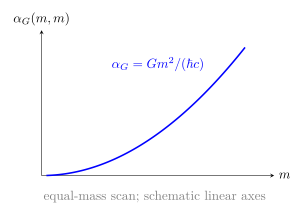
图 10 明确取 \(m_1=m_2=m\);equal-mass gravitational coupling 按 \(\alpha_G(m,m)=Gm^2/(\hbar c)\) 随 \(m^2\) 增长。曲线为 schematic linear-axis relation,不表示任何特定粒子的实际点位。
Worked Examples / 完整例题
Worked Example 1 — 从 \(W\) mass 估计 weak range
已知: \(M_Wc^2=80.4\,\mathrm{GeV}\),\(\hbar c=197.327\,\mathrm{MeV\,fm}\)。
模型: 用 massive propagator 的 Compton scale;忽略 electroweak mixing 和 process-dependent factors。
\[\ell_W\sim\frac{\hbar c}{M_Wc^2} =\frac{197.327\,\mathrm{MeV\,fm}}{8.04\times10^4\,\mathrm{MeV}} =2.45\times10^{-3}\,\mathrm{fm}.\]
\[\ell_W\approx2.45\times10^{-18}\,\mathrm m.\]
检查: mediator mass 越大,range 越短;结果远小于 proton radius \(\sim10^{-15}\,\mathrm m\)。这是 characteristic scale,不是 hard cutoff。
Worked Example 2 — Electron–proton 的 EM/Gravity force ratio
已知: \(k=8.988\times10^9\,\mathrm{N\,m^2/C^2}\),\(e=1.602\times10^{-19}\,\mathrm C\),\(G=6.6743\times10^{-11}\,\mathrm{m^3kg^{-1}s^{-2}}\),\(m_p=1.673\times10^{-27}\,\mathrm{kg}\),\(m_e=9.109\times10^{-31}\,\mathrm{kg}\)。
两种 inverse-square forces 的距离因子相消:
\[\frac{F_E}{F_G}=\frac{ke^2}{Gm_pm_e}.\]
\[ke^2=2.307\times10^{-28}\,\mathrm{N\,m^2},\]
\[Gm_pm_e=1.017\times10^{-67}\,\mathrm{N\,m^2}.\]
\[\frac{F_E}{F_G}=2.27\times10^{39}.\]
检查: 比值无量纲、与 separation 无关。原子内 gravity 可安全忽略;macroscopic neutral matter 的 EM 大量 cancel,而 gravity 累加,结论可反转。
Worked Example 3 — Beta decay 的 vertex ledger
过程: \(d\to u+W^-\),随后 \(W^-\to e^-+\bar\nu_e\)。
第一 vertex:
\[Q_{\mathrm{em}}/e:-\frac13=+\frac23-1, \qquad B:\frac13=\frac13+0.\]
第二 vertex:
\[Q_{\mathrm{em}}/e:-1=-1+0, \qquad L_e:0=1-1.\]
系统边界与方向: 所有 arrows 按 decay products 输出;\(W^-\) 是 intermediate field excitation,不是 neutron 中预存 constituent。检查: quark flavor \(d\to u\) 改变,但 exact electric charge 和 baryon number 每个 vertex 都守恒。
Worked Example 4 — Flux-tube energy 与 pair creation scale
已知: schematic string tension \(\kappa=0.90\,\mathrm{GeV/fm}\),把 \(q\bar q\) separation 拉到 \(r=1.20\,\mathrm{fm}\)。
线性势近似给
\[\Delta E\sim\kappa r=(0.90)(1.20)\,\mathrm{GeV}=1.08\,\mathrm{GeV}.\]
该能量已是 light-hadron mass scale,系统可通过产生 light \(q\bar q\) pairs 而重组成两个 color-singlet hadrons。检查: \(r\to0\) 时线性 infrared model 不再完整,应转为 short-distance QCD;\(1.08\,\mathrm{GeV}\) 不是 universal pair threshold,因 flavor masses、quantum numbers 和 hadronization stochasticity 均会改变 outcome。
Lesson synthesis / 本课综合
判断 interaction dominance 的流程:
- 确定 external particles 携带哪些 charges:electric、weak、color、stress–energy;
- 选定 momentum-transfer/energy scale,拒绝脱离能标的“固定强度排名”;
- 用 mediator mass 或 field dynamics 判断 range,但对 screening/confinement 单独处理;
- 用 vertex quantum-number flow 判断是否改变 flavor、charge 或 color;
- 区分 fundamental interaction 与 low-energy residual/effective force;
- 最后比较 amplitudes/cross sections,而不是比较日常宏观“力感”。
Formula-and-decision table / 公式与决策表
| Question | Formula / criterion | Use when | Limitation |
|---|---|---|---|
| Massive mediator range? | \(\ell\sim\hbar/(Mc)\) | Yukawa-like low-energy exchange | not a hard cutoff |
| EM strength? | \(\alpha=e^2/(4\pi\varepsilon_0\hbar c)\) | low-energy QED estimate | runs with scale |
| Weak low-energy scale? | amplitudes involve \(G_F\) | \(q_{\mathrm{tr}}^2\ll M_W^2c^2\) | restore full propagator near EW scale |
| QCD regime? | small \(\alpha_s(q_{\mathrm{tr}})\) at high \(q_{\mathrm{tr}}\) | perturbative hard process | low \(q_{\mathrm{tr}}\) is nonperturbative |
| Particle gravity? | \(\alpha_G=Gm_1m_2/(\hbar c)\) | dimensionless comparison | depends on masses |
Model boundaries / 模型边界
- Exchange-particle cartoons omit gauge choice, loops, interference and external-state wave packets;它们是 perturbative terms,不是 classical trajectories。
- A massless mediator is not sufficient for an observed infinite-range force: confinement and screening are decisive counterexamples/qualifiers。
- Weak range estimate does not mean weak processes are impossible beyond a sharp radius; propagator suppression is smooth。
- Linear QCD potential is an infrared model for static heavy sources, not a universal potential for every relativistic quark event。
- Classical gravity is extremely successful macroscopically, but extrapolating a hypothetical spin-2 graviton as established particle would overstate evidence。
Misconception clinic / 常见误区诊所
- “四种力有一张永远正确的强度表。” Couplings run,process/charges/energy 都改变比较;只能给特征层级。
- “Virtual mediator 暂时违反能量守恒。” 完整 amplitude 保持时空平移对称;virtual line 是内部积分变量,不是可观测借贷。
- “所有 weak processes 都改变 flavor。” Charged current 常改变 quark/lepton identity,neutral current 可保持 flavor 与 charge。
- “Gluon 无质量,所以 color force 应无限程。” Non-Abelian confinement 阻止 isolated color field 成为普通 \(1/r\) long-range force。
- “Gravity 对单粒子为零。” 它非零但 dimensionless coupling 极小;在巨大质量/能量或累积天体尺度可主导。
Practice and retrieval / 练习与提取
- [K01 · 概念] 用一句话解释为什么 relative strength 必须附带 energy scale 与 process。
- [K01 · 定量] 一个 hypothetical mediator mass 为 \(200\,\mathrm{MeV}/c^2\),用 \(\hbar c=197.3\,\mathrm{MeV\,fm}\) 估计 range。
- [K02 · 边界] 为什么 neutral atom 的远场 electromagnetic force 可很小,而单个 proton 与 electron 的 EM interaction 很强?
- [K02 · 账本] 在 bremsstrahlung \(e^-+\mathcal N\to e^-+\mathcal N+\gamma\) 的 electron–photon vertex 检查 electric charge,并说明为何它不是孤立 free-electron decay。
- [K03 · 账本] 写出 \(u\to d+W^+\) 的 charge ledger。
- [K03 · 边界] \(Z\) exchange 是否必然改变 quark flavor?为什么?
- [K04 · 图像] 解释 asymptotic freedom 与 confinement 分别对应高 \(q_{\mathrm{tr}}\)/短距离还是低 \(q_{\mathrm{tr}}\)/长距离。
- [K04 · 定量] 若 \(\kappa=0.85\,\mathrm{GeV/fm}\)、\(r=0.80\,\mathrm{fm}\),估计 flux energy。
- [K05 · 定量] 用 \(\alpha_G=Gm^2/(\hbar c)\) 说明粒子质量增加十倍时 equal-particle gravitational coupling 如何变化。
- [K05 · 层级] 区分 gluon-mediated QCD 与 pion-mediated residual nuclear model。
Answer 1
Observable amplitude 还依 external charges、running coupling、propagator、kinematics 与 phase space;脱离能标的单一数字不能普遍排序。
Answer 2
\[\ell\sim\frac{197.3}{200}\,\mathrm{fm}=0.987\,\mathrm{fm}=9.87\times10^{-16}\,\mathrm m.\]
Answer 3
Atom 的 net charge 近零,正负 charge fields 在大距离 multipole-expand 后大幅 cancel/screen;微观 constituent 间仍有强 Coulomb binding。
Answer 4
Electron–photon vertex 的 charge ledger 为 \(-1=-1+0\);外部散射中心 \(\mathcal N\) 的 charge 在过程两侧相同。该 vertex 嵌在完整 bremsstrahlung diagram 中,至少一条 electron leg 为 off shell;孤立 on-shell free electron 在真空中不能以 \(e^-\to e^-+\gamma\) 同时满足 four-momentum conservation。
Answer 5
\[+\frac23=-\frac13+1.\] Baryon number 同时为 \(1/3=1/3+0\)。
Answer 6
不必然。Standard neutral-current vertex 可保持 fermion flavor 与 electric charge;flavor-changing neutral currents 在 Standard Model 中高度 suppressed,需更精细 loop/mixing 分析。
Answer 7
High momentum transfer \(q_{\mathrm{tr}}\) 对应 short distance,\(\alpha_s\) 较小,表现 asymptotic freedom;low \(q_{\mathrm{tr}}\)/long distance coupling 增强,进入 confinement/nonperturbative regime。
Answer 8
\[\Delta E\sim\kappa r=(0.85)(0.80)\,\mathrm{GeV}=0.68\,\mathrm{GeV}.\] 这是 schematic stored field energy,不是精确 hadron mass。
Answer 9
对两粒子都由 \(m\) 变为 \(10m\),\(m_1m_2\) 增加 \(100\) 倍,故 \(\alpha_G\) 增加 \(100\) 倍;在普通粒子尺度仍通常极小。
Answer 10
QCD 的 fundamental color gauge fields 是 gluons,作用于 quarks/gluons;pion exchange 是 color-singlet nucleons 间的 low-energy effective/residual description,不是新的 fundamental gauge force。
Exit ticket / 离堂任务
- 选择 beta decay 或 electron scattering,按“charge—mediator—range—energy scale—selection rule”五栏完成一张 interaction card。
- 用 confinement、screening、massive mediator 三个词分别解释三种“看起来短程”的不同机制。
References and source notes / 参考资料与来源说明
以下来源均于 2026-08-30 实际打开核对;公式符号已统一,图示为原创:
- CERN, The Standard Model — four interactions、carrier particles、Standard Model/gravity boundary。
- CERN, The Z Boson — weak neutral current、\(W/Z\) mass–range relation 与 flavor change context。
- MIT OpenCourseWare 8.701, Lecture 1.3: Ranges of Forces — mediator mass and characteristic range pedagogy。
- OpenStax, University Physics Volume 3, 11.5 The Standard Model — HS→UG comparison of interactions and exchange particles。
- Particle Data Group, Review of Particle Physics 2024: Quantum Chromodynamics — gluons、running coupling、asymptotic freedom and color-singlet boundary。
- NIST/CODATA, 2022 Recommended Values of Fundamental Constants — \(G\) and constants used in gravity/EM comparison。
- CERN, From Partons to Hadrons — confinement and hadronization scale dependence。
Source-to-content map / 来源—内容映射
| Source | Used for | Knowledge ID / Section | Model boundary or convention |
|---|---|---|---|
| CERN Standard Model | interaction inventory | K01–K05 | graviton explicitly hypothetical |
| CERN Z Boson | weak range and neutral/charged currents | K03 | electroweak unification noted |
| MIT 8.701 Ranges | Yukawa/Compton estimate | K01, Example 1 | characteristic, not hard cutoff |
| OpenStax 11.5 | accessible comparison and mediator table | K01–K03 | fixed strength ranking qualified |
| PDG QCD | running coupling and confinement | K04 | perturbative/nonperturbative regimes separated |
| NIST CODATA | numerical constants | K05, Example 2 | SI values and significant figures |
| CERN Partons to Hadrons | hadronization/confinement interpretation | K04 | flux-tube energy labeled schematic |
复习与拓展
- 下一课从 electromagnetic interaction 进入 local gauge symmetry、photon field quanta 与 QED amplitudes。
- Unit 11.3 将分别展开 electroweak mixing、QCD running coupling 与 open BSM questions。
- Unit 11.5 将把“mediator exchange”升级为 quantized fields、creation/annihilation operators 与 renormalization-scale language。