
Learning objectives / 学习目标
- 用 CC partner 定义 \(\nu_e,\nu_\mu,\nu_\tau\) flavor,并区分 production/detection state 与 propagation mass state;
- 推导 two-flavor vacuum oscillation probability,分析 \(L/E\)、mixing angle、mass-squared difference 与 coherence;
- 区分 Dirac 与 Majorana mass possibilities,说明 neutrinoless double-beta decay 的条件与解释边界;
- 陈述 baryogenesis 的必要条件与 Standard Model CP violation 的不足,分开 measured asymmetry 与 proposed mechanisms;
- 建立 dark-matter evidence → gravitational inference → candidate/model test 的证据链,不把任一 candidate 写成 discovery。
Prerequisites / 先修知识
- Weak and Electroweak Interactions:CC/NC、chirality、Higgs 与 CP violation。
- Reactions and Decays:relativistic phase 与 energy approximation。
- 两态量子系统、复指数、三角函数与条件概率。
Scope and conventions / 范围与约定
- Flavor labels由 charged-current production/detection partner 定义;mass eigenstates \(\nu_i\) 在自由传播中积累相位。
- 默认 ultrarelativistic vacuum propagation;matter effects、wave-packet treatment、three-flavor CP phase 在正文说明但不完整推导。
- \(\Delta m_{ij}^2=m_i^2-m_j^2\);振荡测量主要给 differences 与 mixing,不直接给 common absolute mass offset。
- Dark matter 采用“引力证据强、微观身份未知”的表述;任何具体粒子 candidate 都是 hypothesis。
Notation and modeling contract / 符号与建模契约
| Symbol | Meaning | Unit |
|---|---|---|
| \(\nu_\alpha\) | flavor state, \(\alpha=e,\mu,\tau\) | state |
| \(\nu_i\) | mass state, \(i=1,2,3\) | state |
| \(U_{\alpha i}\) | PMNS matrix element | 1 |
| \(\Delta m_{ij}^2\) | mass-squared difference | \(\mathrm{eV^2}\) |
| \(L\) | source-to-detector baseline | km in practical formula |
| \(E\) | neutrino energy | GeV in practical formula |
| \(\theta\) | two-flavor mixing angle | rad / 1 |
| \(m_{\beta\beta}\) | effective Majorana mass in \(0\nu\beta\beta\) interpretation | eV |
| \(\eta_B\) | baryon-to-photon asymmetry parameter | 1 |
1. Neutrino flavors and weak production / 中微子味与弱产生
Knowledge ID: P11-U03-L04-K01
Flavor 是 interaction label:在 charged current process 中与 electron、muon、tau 相伴的 neutral state 分别称 \(\nu_e,\nu_\mu,\nu_\tau\)。例如
\[\pi^+\to\mu^++\nu_\mu, \qquad \nu_\mu+n\to\mu^-+p.\]
弱产生态是 coherent superposition:
\[\lvert\nu_\alpha\rangle=\sum_iU_{\alpha i}^*\lvert\nu_i\rangle.\]
因此“源产生了 \(\nu_\mu\)”不等于产生某一个确定 \(m_i\)。Neutrino/antineutrino 的 helicity preference 来自 chiral weak interaction;对 massive neutrino,chirality 与 helicity 不能在所有 frame 严格等同。
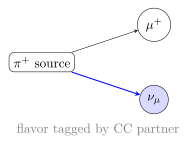
图 1:production flavor 标签来自同一 CC vertex 的 charged lepton。
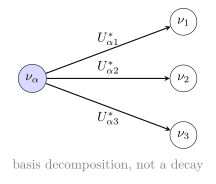
图 2:flavor state 在 mass basis 的展开;线表示 amplitudes。
2. Neutrino oscillations and mass differences / 中微子振荡与质量差
Knowledge ID: P11-U03-L04-K02
Mass state 传播相位 \(e^{-i(E_it-p_iL)}\) 不同;在 ultrarelativistic approximation 中相对相位
\[\Delta\phi_{ij}\simeq\frac{\Delta m_{ij}^2L}{2E}.\]
Two-flavor vacuum model 对不同 flavors(\(\alpha\ne\beta\))的 appearance probability 给
\[P(\nu_\alpha\to\nu_\beta) =\sin^2(2\theta)\sin^2\!\left(\frac{\Delta m^2L}{4E}\right),\]
相应 survival probability 为
\[P(\nu_\alpha\to\nu_\alpha) =1-P(\nu_\alpha\to\nu_\beta)\]
(two-flavor unitary vacuum approximation)。
或 practical units:
\[P=\sin^2(2\theta) \sin^2\!\left[1.267\, \frac{\Delta m^2(\mathrm{eV^2})L(\mathrm{km})}{E(\mathrm{GeV})}\right].\]
Oscillation requires nonzero mixing and nonzero \(\Delta m^2\)。单个非零 splitting 已证明 neutrino masses 不可能全为零(至少一个非零);现有 three-flavor data 给出两个独立的非零 mass-squared splittings,因此至少两个 mass eigenstates 非零。振荡仍不独自给 absolute masses。若 wave packets separation 超过 coherence length 或能量/基线平均太粗,interference 被洗平。Matter effects 通过 flavor-dependent forward scattering 改变 effective mixing。
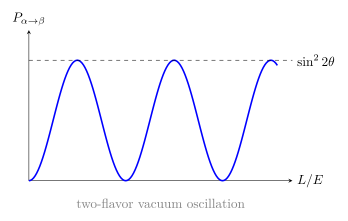
图 3:振荡 amplitude 由 mixing 控制,周期由 \(\Delta m^2L/E\) 控制。
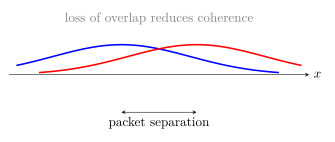
图 4:不同 group velocities 可使 mass wave packets 分离;曲线为示意。
3. Dirac versus Majorana possibilities / 狄拉克与马约拉纳可能性
Knowledge ID: P11-U03-L04-K03
Dirac fermion 的 particle 与 antiparticle 是不同 states,通常需要加入 right-handed neutrino fields 形成 Yukawa mass。Majorana fermion 可满足 field equals its charge conjugate(up to phase);对 electrically neutral neutrino 才可能。两者在 ultrarelativistic weak processes 中可极难区分。
Neutrinoless double-beta decay candidate process
\[(A,Z)\to(A,Z+2)+2e^-\]
若由 light Majorana neutrino exchange 引起,会违反 total lepton number by two units,rate contains nuclear matrix element, phase-space factor and an effective mass \(m_{\beta\beta}=\lvert\sum_iU_{ei}^2m_i\rvert\)。Observation would establish lepton-number violation but interpreting a rate as \(m_{\beta\beta}\) is mechanism- and nuclear-model-dependent;non-observation only sets conditional limits。
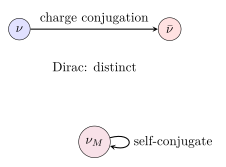
图 5:Dirac/Majorana distinction concerns quantum field identity, not visible “shape”。
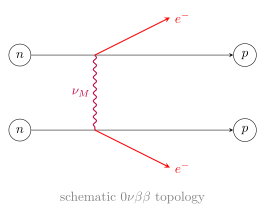
图 6:无外出 neutrinos 的拓扑示意;nuclear many-body physics 未画出。
4. Matter–antimatter asymmetry / 物质—反物质不对称
Knowledge ID: P11-U03-L04-K04
观测宇宙在可见大尺度上 baryonic matter 主导。由对称初态动态产生 net baryon number 的机制统称 baryogenesis。Sakharov conditions 概括为:baryon-number violation、C and CP violation、departure from thermal equilibrium(或其 generalized quantum condition)。
Standard Model 确有 electroweak baryon-number violation 与 CKM CP violation,但已知 electroweak transition 和 CP strength 无法产生 observed asymmetry 的数量级。Leptogenesis 是可能机制之一:先生成 lepton asymmetry,再由 electroweak processes 部分转换;它依赖未证实的 heavy-neutrino/Majorana-sector physics。不能从“neutrino may be Majorana”直接宣布 leptogenesis 已发生。
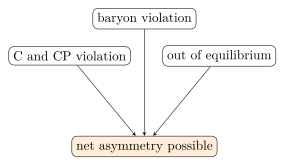
图 7:Sakharov conditions 是必要结构指引,不是某个具体机制的充分证明。
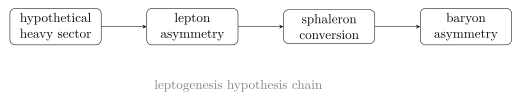
图 8:每个箭头都需要模型参数与实验约束;首节点尚非 established particle sector。
5. Dark matter and physics beyond the Standard Model / 暗物质与超越标准模型
Knowledge ID: P11-U03-L04-K05
Galaxy dynamics、gravitational lensing、cluster collisions、CMB 与 large-scale structure 共同支持额外 non-luminous gravitating matter。证据首先指向 stress-energy distribution,不直接指定 particle identity。普通 active neutrinos 有质量但过轻/过热,只占 dark-matter budget 的很小部分;minimal Standard Model 没有合适 cold dark matter candidate。
Candidate space 包括 axions、WIMPs、sterile-neutrino-like states、ultralight fields、primordial black holes 等;它们有不同 production、stability 与 interaction signatures。Direct detection、indirect detection、collider missing momentum 与 astrophysical probes 提供互补 constraints;null result 排除 parameter region,不等于排除“所有 dark matter”。
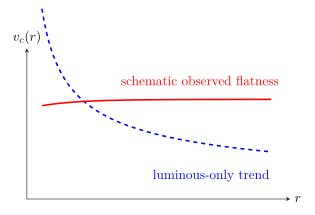
图 9:flat rotation curve 是证据之一;实际 inference 要联合 baryons、geometry 与 systematics。
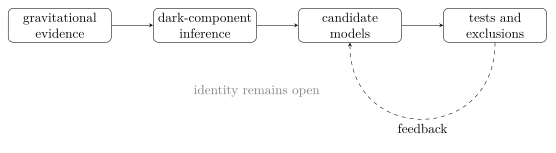
图 10:证据链把 robust gravitational inference 与 candidate-level uncertainty 分开。
Worked Examples / 完整例题
Example 1 — Flavor-tagged production
已知: \(\pi^+\to\mu^++\nu\)。
对象/系统: pion decay vertex;source rest frame 仅便于 kinematics,flavor label frame independent。
正方向: neutrino momentum 定义 \(+x\)。
模型: Standard Model CC,忽略 tiny neutrino mass in energy balance。
Muon 的 charged-current partner 要求 neutral state labeled \(\nu_\mu\);charge \(+1=+1+0\),\(L_\mu:0=(-1)+(+1)\)。
检查: four-momentum 与 lepton number ledger consistent。
解释: produced \(\nu_\mu\) 是 mass states 的 coherent superposition,不是一个确定 mass eigenstate。
Example 2 — Long-baseline appearance maximum
已知: two-flavor model,\(\sin^22\theta=1.00\),\(\Delta m^2=2.50\times10^{-3}\,\mathrm{eV^2}\),\(L=295\,\mathrm{km}\),\(E=0.600\,\mathrm{GeV}\)。
对象/系统: vacuum neutrino beam between source and detector。
参考系/方向: lab baseline \(+x\);matter effect neglected。
模型理由: teaching estimate of dominant atmospheric splitting。
\[\phi=1.267\frac{(2.50\times10^{-3})(295)}{0.600}=1.557,\]
\[P=\sin^2(1.557)=0.9998\approx1.00.\]
检查: \(0\le P\le1\);\(\phi\) 接近 \(\pi/2\)。
解释: 理想 two-flavor maximum;real beam includes three flavors、spectrum、matter、detector efficiencies。
Example 3 — Oscillation data 能否给 absolute mass
已知: 实验测得 \(\Delta m_{21}^2=7.5\times10^{-5}\,\mathrm{eV^2}\)。
对象/系统: two mass eigenvalues。
模型: \(\Delta m_{21}^2=m_2^2-m_1^2\)。
若假设 \(m_1=0\),则 \(m_2=8.7\times10^{-3}\,\mathrm{eV}\);若 \(m_1=0.100\,\mathrm{eV}\),则
\[m_2=\sqrt{0.100^2+7.5\times10^{-5}}\,\mathrm{eV} =0.1004\,\mathrm{eV}.\]
检查: 两组都产生同一 \(\Delta m^2\)。
解释: oscillation fixes splitting, not common offset;absolute mass needs beta endpoint/cosmology/other probes。
Example 4 — Rotation curve 的 enclosed mass
已知: spherical teaching model,\(v_c=200\,\mathrm{km\,s^{-1}}\) 在 \(r=20.0\,\mathrm{kpc}\) 近似 flat;\(G=6.6743\times10^{-11}\,\mathrm{m^3\,kg^{-1}\,s^{-2}}\)。
对象/系统边界: radius \(r\) 内总 gravitating mass;忽略 disk geometry。
参考系/方向: galaxy center inertial approximation,radial inward acceleration。
模型: circular orbit \(v_c^2/r=GM(<r)/r^2\)。
先换算 \(v_c=2.00\times10^5\,\mathrm{m\,s^{-1}}\)、\(r=20.0(3.0857\times10^{19})\,\mathrm m=6.1714\times10^{20}\,\mathrm m\)。于是
\[M(<r)=\frac{v_c^2r}{G} =\frac{(2.00\times10^5\,\mathrm{m\,s^{-1}})^2 (6.1714\times10^{20}\,\mathrm m)} {6.6743\times10^{-11}\,\mathrm{m^3\,kg^{-1}\,s^{-2}}} =3.70\times10^{41}\,\mathrm{kg}.\]
约为 \(1.86\times10^{11}\) solar masses(取 \(M_\odot=1.9885\times10^{30}\,\mathrm{kg}\))。
检查: \(v^2r/G\) 量纲为 kg;flat \(v\) implies \(M(<r)\propto r\)。
解释: 动力学推断总质量分布,但不识别 dark matter microscopic candidate。
Lesson synthesis / 本课综合
Weak production/detection defines flavor,free propagation resolves mass basis phases,interference produces oscillation。This establishes nonzero mass differences beyond the minimal massless-neutrino Standard Model, but Dirac/Majorana nature and absolute scale remain separate questions。Baryon asymmetry 与 dark matter 也都有 robust observational input,却没有唯一被证实的 microscopic mechanism;高标准写作必须把 observation、inference、model 与 speculation 分层。
Formula-and-decision table / 公式—决策表
| Question | Formula/model | What it determines | What it does not determine |
|---|---|---|---|
| flavor composition | \(\lvert\nu_\alpha\rangle=\sum_iU_{\alpha i}^*\lvert\nu_i\rangle\) | production/detection amplitudes | a unique mass |
| vacuum oscillation | \(P=\sin^22\theta\sin^2(1.267\Delta m^2L/E)\) | mixing and splitting | absolute mass alone |
| Majorana exchange | \(m_{\beta\beta}=\lvert\sum_iU_{ei}^2m_i\rvert\) | conditional \(0\nu\beta\beta\) scale | mechanism-independent mass without assumptions |
| baryogenesis test | Sakharov conditions | necessary structural checks | unique history of Universe |
| rotation support | \(M(<r)=v_c^2r/G\) | total gravitating mass in spherical model | particle identity |
Model boundaries / 模型边界
- Two-flavor vacuum formula omits three-flavor interference, CP phase, matter effects and realistic spectra.
- Oscillation proves mass splittings; absolute mass, ordering details and Majorana phases need other observables.
- \(0\nu\beta\beta\) rate interpretation depends on nuclear matrix elements and possible mechanisms.
- Sakharov conditions guide baryogenesis; meeting them in a model does not establish that model historically occurred.
- Dark-matter gravitational evidence does not by itself imply a particular particle, nor exclude all modified-gravity discussions; combined evidence constrains alternatives.
Misconception clinic / 误区诊疗
- “Flavor 是传播时保持不变的粒子种类。” Flavor state 是 mass states superposition,传播相位可改变 detection probability。
- “振荡测出每个 \(m_i\)。” 它主要测 \(\Delta m^2\) 与 mixing。
- “Neutrino massive 就必为 Majorana。” Dirac 与 Majorana 都可能;尚需 lepton-number-violating evidence。
- “CKM CP violation 已解释宇宙 matter excess。” 已知强度不足。
- “Rotation curve 发现了某一种 WIMP。” 它推断额外 gravitating mass,不识别 candidate。
Practice and retrieval / 练习与检索
- [P11-U03-L04-K01] 在 \(\mu^-\to e^-+\bar\nu_e+\nu\) 中识别最后一个 neutrino flavor。
- [P11-U03-L04-K01] 解释 flavor state 与 mass state 的 operational definitions。
- [P11-U03-L04-K02] \(\Delta m^2=2.4\times10^{-3}\,\mathrm{eV^2}\)、\(L=500\,\mathrm{km}\)、\(E=1.0\,\mathrm{GeV}\)、maximal mixing,求 two-flavor conversion probability。
- [P11-U03-L04-K02] 若所有 \(m_i\) 完全相等,vacuum flavor oscillation是否发生?
- [P11-U03-L04-K03] 写出 \(0\nu\beta\beta\) 与 ordinary \(2\nu\beta\beta\) final states 的差别。
- [P11-U03-L04-K03] non-observation 为何不能无条件证明 neutrino 是 Dirac?
- [P11-U03-L04-K04] 列出 Sakharov three conditions,并说明“必要”不等于“充分”。
- [P11-U03-L04-K04] 为什么 quark-sector CP violation 的发现不等于 baryogenesis mechanism 的发现?
- [P11-U03-L04-K05] 将 galaxy lensing、candidate、direct-detection null result 按 evidence/inference/model/test 分类。
- [P11-U03-L04-K05] Flat rotation curve 在 spherical model 中意味着 \(M(<r)\) 怎样随 \(r\) 变?
Answer 1
最后一个是 \(\nu_\mu\);\(L_\mu\) 初态为 1,末态由 \(\nu_\mu\) 携带 1,而 \(e^-+\bar\nu_e\) 的 electron-family total 为 0。
Answer 2
Flavor 由 CC production/detection 的 charged-lepton partner 定义;mass state 是 free Hamiltonian/propagation eigenstate。
Answer 3
\[\phi=1.267\frac{(2.4\times10^{-3})(500)}{1.0}=1.520, \qquad P=\sin^2(1.520)=0.997.\]
Answer 4
不发生可观测 vacuum oscillation;所有 mass components 积累相同相位,relative phase 不变(即使 mixing basis 可形式变换)。
Answer 5
\(0\nu\beta\beta\):\((A,Z+2)+2e^-\),无 neutrinos;ordinary \(2\nu\beta\beta\) 还有 \(2\bar\nu_e\)。
Answer 6
Rate 可因 \(m_{\beta\beta}\) 很小、Majorana phases cancellation、nuclear sensitivity 或其他参数而不可见;limit 是模型条件下的。
Answer 7
B violation、C/CP violation、departure from equilibrium。它们只说明生成不对称所需结构,不能唯一指定 dynamics 或保证数量级正确。
Answer 8
Baryogenesis 还需 baryon violation、nonequilibrium history 与足够 CP magnitude;现有 CKM contribution 数量级不足。
Answer 9
Lensing:evidence;额外 gravitating component:inference;某 candidate:model;null result:test/exclusion of a parameter region。
Answer 10
\(M(<r)=v_c^2r/G\);若 \(v_c\) 近常数,则 enclosed mass approximately grows linearly with \(r\)。
Exit ticket / 离堂任务
制作四行 evidence ladder:oscillation、Majorana nature、baryogenesis、dark matter identity。每行分别写“直接观测/稳健推断”“尚未知量”“一个可检验渠道”,不允许使用“已证明”概括整行。
References and source notes / 参考资料与来源说明
访问与核验日期均为 2026-08-30。
- Particle Data Group, Neutrino Masses, Mixing, and Oscillations (2025). https://pdg.lbl.gov/2025/reviews/rpp2025-rev-neutrino-mixing.pdf
- Particle Data Group, Neutrino Properties (2025). https://pdg.lbl.gov/2025/reviews/rpp2025-rev-intro-neutrino-prop.pdf
- MIT OpenCourseWare, 8.701 Lecture Notes, Lectures 8.1–8.6. https://ocw.mit.edu/courses/8-701-introduction-to-nuclear-and-particle-physics-fall-2020/resources/lecture-notes/
- Particle Data Group, CP Violation in the Quark Sector (2025), baryogenesis discussion. https://pdg.lbl.gov/2025/reviews/rpp2025-rev-cp-violation.pdf
- Particle Data Group, Dark Matter (2024 Review). https://pdg.lbl.gov/2024/reviews/rpp2024-rev-dark-matter.pdf
- CERN, The Standard Model (open questions and model scope). https://home.cern/science/physics/standard-model/
- MIT OpenCourseWare 8.701, Lecture 2.5: CP (Violation), Sakharov conditions and baryogenesis requirements. https://ocw.mit.edu/courses/8-701-introduction-to-nuclear-and-particle-physics-fall-2020/986e951dbcd24c74191e00528d6b730c_MIT8_701f20_lec2.5.pdf
Source-to-content map / 来源—内容映射
| Source | Used for | Knowledge ID / Section | Model boundary or convention |
|---|---|---|---|
| PDG neutrino mixing | flavor/mass states, oscillation evidence | K01–K02 | three-flavor global context |
| PDG neutrino properties | absolute mass and state interpretation | K02–K03 | oscillation vs direct mass probes |
| MIT 8.701 neutrino lectures | two-flavor derivation and pedagogy | K01–K03 | vacuum approximation stated |
| PDG CP review | CKM CP and baryogenesis insufficiency | K04 | quark-sector evidence vs cosmic mechanism |
| PDG dark matter | multi-probe evidence and candidates | K05 | identity remains unknown |
| CERN Standard Model | established model and open questions | synthesis | outreach overview, not parameter fit |
| MIT 8.701 Lecture 2.5 | three Sakharov conditions | K04 | necessary conditions, not evidence for a unique baryogenesis mechanism |
复习与拓展
- Unit 11.4 将讨论 neutrino/dark-matter signals 怎样通过 accelerators、detectors 与 statistics 被检验。
- Unit 11.5 将解释 Dirac/Majorana mass terms 与 quantized fields 的形式接口。
- Part XII cosmology 将重新评估 baryon density、dark matter 与 cosmic evolution 的 observational foundation。