
Learning objectives / 学习目标
- 从 Lorentz force 推导电场做功、磁场弯转和 magnetic rigidity,并判断方向与电荷符号;
- 比较 linac、cyclotron 与 synchrotron 的同步条件、能量限制和适用粒子;
- 用 invariant energy 比较 fixed-target 与 symmetric collider 的有效能量;
- 用束流尺寸、bunch population、collision frequency 与 cross section 估算 luminosity 和 event yield;
- 解释 synchrotron radiation 的质量与能量标度为何限制电子环,同时使 storage ring 成为强光源。
Prerequisites / 先修知识
- Charged Particles in Fields:Lorentz force、圆周轨道与速度选择。
- Energy, Momentum, and Reactions:四动量、不变量 \(s\) 与质心能。
- Neutrinos and Open Questions:为什么能量前沿与强度前沿都能寻找新物理。
- 指数记数法、Gaussian rms width、截面单位 barn 与基本误差传播。
Scope and conventions / 范围与约定
- 实验室为惯性系;束线中心定义纵向 \(s\),横向为 \(x,y\)。除注明外讨论单个带电粒子和近轴束流。
- 数值使用 SI;高能物理常用 \(\mathrm{eV}\)、\(\mathrm{GeV}/c\) 与 \(\mathrm{T\,m}\),每次给出换算关系。
- 先写矢量 Lorentz law,再投影;磁场本身不做功,实际环形机的能量补偿来自 RF electric field。
- Luminosity 公式采用头碰、独立 Gaussian 横向分布的理想模型;crossing angle、hourglass effect、emittance growth 与 pileup 需额外修正。
- 本课不展开 nonlinear lattice design、collective instability、wakefield、space charge 或 radiation safety 的工程细节。
Notation and modeling contract / 符号与建模契约
| Symbol | Meaning | SI or accelerator unit |
|---|---|---|
| \(q,m\) | particle charge and rest mass | C, kg |
| \(\mathbf p,\gamma\) | relativistic momentum and Lorentz factor | \(\mathrm{kg\,m\,s^{-1}}\), 1 |
| \(B\rho\) | magnetic rigidity | \(\mathrm{T\,m}\) |
| \(V_{\mathrm{RF}},\phi_s\) | RF voltage and synchronous phase | V, rad |
| \(\sqrt{s}\) | center-of-momentum energy | J or eV |
| \(N_1,N_2\) | particles per colliding bunch | 1 |
| \(f_{\mathrm{coll}}\) | bunch-crossing frequency | \(\mathrm{s^{-1}}\) |
| \(\sigma_x,\sigma_y\) | transverse rms beam sizes | m |
| \(\mathcal L\) | instantaneous luminosity | \(\mathrm{m^{-2}\,s^{-1}}\) |
| \(\sigma\) | process cross section | \(\mathrm{m^2}\) |
这里 \(s\) 在 \(\sqrt{s}\) 中是 Mandelstam invariant;束线坐标写作斜体文字 “longitudinal coordinate”,避免一符多义。
1. Electric acceleration and magnetic steering / 电场加速与磁场偏转
Knowledge ID: P11-U04-L01-K01
单粒子的 relativistic Lorentz equation 是
\[\frac{\mathrm d\mathbf p}{\mathrm dt}=q(\mathbf E+\mathbf v\times\mathbf B).\]
与 \(\mathbf v\) 点乘得到能率
\[\frac{\mathrm dE}{\mathrm dt}=q\mathbf E\cdot\mathbf v,\]
因为 \(\mathbf v\cdot(\mathbf v\times\mathbf B)=0\)。因此纵向 electric field 改变 energy;transverse magnetic field 改变 momentum direction。穿过电势差 \(\Delta V\) 时,若损耗可忽略,kinetic-energy change 是 \(\Delta K=-q\Delta V\);在 RF cavity 中则取决于到达 phase。
对 \(\mathbf v\perp\mathbf B\) 的局部圆弧,\(p=|q|B\rho\)。常用换算为
\[p[\mathrm{GeV}/c]=0.2998\,|q/e|\,B[\mathrm T]\rho[\mathrm m].\]
它是 magnetic rigidity 关系:同一 \(B\rho\) 选择相同 charge-to-momentum ratio,而非相同速度。弯转方向由 \(q\mathbf v\times\mathbf B\) 决定,不能从半径公式看出正负号。
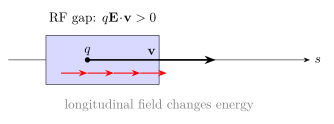
图 1 — RF 相位选对时,电场沿速度方向做正功;箭头表示瞬时场,不表示粒子持续受同向静电场。
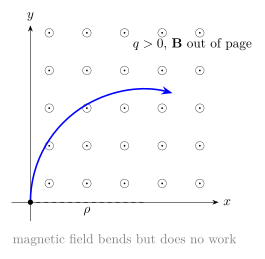
图 2 — 正电荷在出纸面磁场中的弯转;起点速度向上时 \(q\mathbf v\times\mathbf B\) 向右,恰好指向曲率中心,轨道半径编码 momentum。
2. Linear accelerators, cyclotrons, and synchrotrons / 直线加速器、回旋加速器与同步加速器
Knowledge ID: P11-U04-L01-K02
Linear accelerator(linac) 把 RF cavities 沿直线排列。粒子只通过一次,所以 final energy 近似是各 gap 的有效电压增益之和;没有弯转辐射,但更高能量通常意味着更长结构或更高 gradient。
Cyclotron 在均匀 \(B\) 中以两个 “dees” 反复跨 gap。非相对论极限下
\[\omega_c=\frac{|q|B}{m},\qquad f_c=\frac{|q|B}{2\pi m},\]
与半径无关,固定 RF frequency 可同步。随着 \(\gamma\) 增大,实际 revolution frequency 约为 \(|q|B/(2\pi\gamma m)\),粒子逐渐失步;synchrocyclotron 调频,isochronous cyclotron 调整磁场。
Synchrotron 固定主轨道半径,在加速 ramp 中同步改变 dipole field 与 RF frequency/phase。Dipoles 弯转,quadrupoles 以一横向聚焦、另一横向散焦;交替梯度 lattice 可在两个平面总体稳定。Reference particle 每圈按 synchronous phase 接受恰好所需的 energy increment,偏早或偏晚粒子在 longitudinal phase space 做 synchrotron oscillation。真实接受度有限,不能把“同步”理解成每个粒子都走同一条几何线。
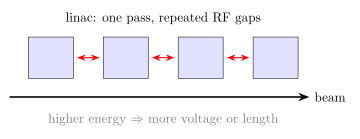
图 3 — 直线加速器的电压增益沿束线累加;图中腔体不按比例。
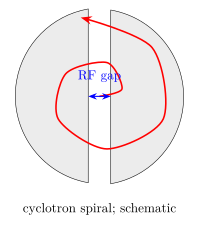
图 4 — 非相对论 cyclotron 在固定频率下每次跨 gap 加速、半径增大;高 \(\gamma\) 时失步是模型边界。
3. Fixed-target and collider experiments / 固定靶与对撞实验
Knowledge ID: P11-U04-L01-K03
反应的可用能量不是某个 beam particle 的 laboratory kinetic energy,而是总四动量的不变量
\[s=(p_1+p_2)^2c^2.\]
两个相同质量 \(m\) 的粒子,一粒静止、另一粒总能量 \(E_b\) 时
\[s=2m^2c^4+2mc^2E_b.\]
在 \(E_b\gg mc^2\) 下,\(\sqrt{s}\approx\sqrt{2mc^2E_b}\):能量大量成为 center-of-momentum 整体运动。对称 head-on collider 中,两束总能量均为 \(E_b\) 且 ultra-relativistic,则 \(\sqrt{s}\approx2E_b\),几乎全部可用于产生新质量与 final-state kinetic energy。
Fixed target 仍有重要优势:高 areal density、容易改变 target species、可得到高 interaction rate,并让 forward secondaries 形成二次束。Collider 则最大化 energy reach,但需要两束储存、聚焦和同步。比较实验必须同时写 \(\sqrt{s}\)、luminosity、species、polarization 与 detector acceptance,不能只比较 accelerator 的单粒子 energy。
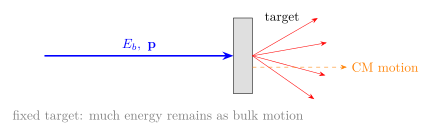
图 5 — 固定靶实验的总动量不为零;末态质心必须向前运动,因此 beam energy 不能全部转成新粒子静质量。
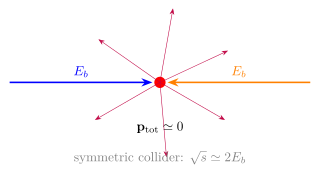
图 6 — 对称对撞在 laboratory 中近似就是 center-of-momentum frame,可用能量随 beam energy 线性增长。
4. Beam focusing, luminosity, and energy reach / 束流聚焦、亮度与能量前沿
Knowledge ID: P11-U04-L01-K04
束流不是单线,而是 transverse phase-space distribution。Quadrupole field 近轴形式可写为 \(B_y=Gx\)、\(B_x=Gy\)(符号随磁极约定);它在一个平面聚焦、另一个平面散焦。交替 F–D 元件像光学透镜列,控制 beta function 与 beam envelope。Liouville-type phase-space constraints 表明,单靠保守磁场不能任意压缩 emittance;source quality、cooling、radiation damping 与 collective effects 都重要。
对头碰、相互独立的 Gaussian bunches,理想 instantaneous luminosity 为
\[\mathcal L=\frac{f_{\mathrm{coll}}N_1N_2}{4\pi\sigma_x\sigma_y}.\]
过程发生率与 integrated yield 是
\[R=\mathcal L\sigma,\qquad N=\sigma\int\mathcal L(t)\,\mathrm dt.\]
因此 energy frontier 决定哪些 final states 运动学可达,luminosity frontier 决定稀有过程是否积累足够 events。减小 beam spot 会提高理想 \(\mathcal L\),但 beam-beam disruption、crossing angle、hourglass effect、instabilities、detector pileup 与 machine protection 给出反向约束。Luminosity 是 beam overlap density,不是 beam energy,也不是“每秒碰撞数”本身;后者还乘 cross section。
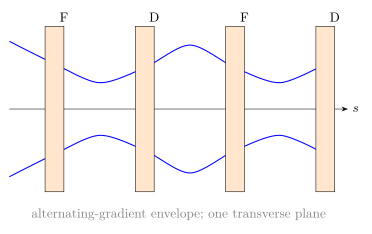
图 7 — 交替梯度 lattice 中束包络周期变化;这不是单个粒子轨迹,另一横向平面的相位相反。
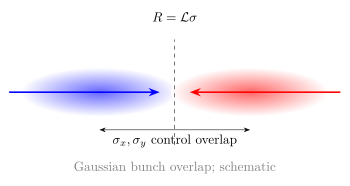
图 8 — Luminosity 来自单位时间的束团重叠;真实 bunch 是三维且可能有 crossing angle。
5. Synchrotron radiation limits and uses / 同步辐射的限制与应用
Knowledge ID: P11-U04-L01-K05
任何横向加速度的相对论带电粒子都会辐射。对 circular motion,重要标度为
\[P_{\mathrm{SR}}\propto\frac{q^2c}{4\pi\varepsilon_0}\frac{\gamma^4}{\rho^2},\]
而固定 beam energy 时 \(\gamma=E/(mc^2)\),所以 lighter particles 的损耗急剧更大。电子 storage ring 的每圈能损近似 \(U_0\propto E^4/\rho\);提高 radius 可缓解,RF 必须每圈补回 \(U_0\)。这解释了为什么极高能 electron–positron machines 常考虑 linac,而 proton rings 在同能量下辐射弱得多。
辐射并非纯粹“坏事”。Electron storage rings 利用其明亮、collimated、可调谐且有时间结构的光进行 X-ray diffraction、spectroscopy 与 imaging;radiation damping 还能缩小 transverse emittance,但 quantum photon emission 带来 excitation,与 damping 达到平衡。Critical frequency、polarization 与 brilliance 需要完整 lattice 和 electron energy 才能确定,不能由上面的 proportionality 单独预测。
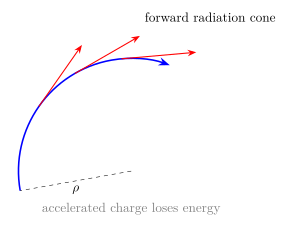
图 9 — 超相对论同步辐射集中在瞬时切线附近;RF 补偿能量,dipole 负责曲率。
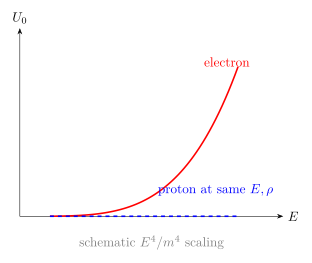
图 10 — 固定曲率半径与总能量时的质量标度示意;两曲线不按可视比例,proton 曲线实际远更低。
Worked Examples / 完整例题
Worked Example 1 — 由 rigidity 选择 dipole field
已知: 单电荷 proton momentum \(p=7.00\,\mathrm{TeV}/c\),有效弯转半径 \(\rho=2.80\times10^3\,\mathrm m\)。
研究对象与参考系: laboratory 中的 reference proton;\(\mathbf v\perp\mathbf B\)。
模型理由: 在 uniform dipole arc 上用 \(p=0.2998B\rho\);忽略 fringe field。
\[B=\frac{7000}{0.2998(2.80\times10^3)}=8.34\,\mathrm T.\]
检查: \(\mathrm{T\,m}\) 与 \(\mathrm{GeV}/c\) 的转换已含在 \(0.2998\) 中;更大 \(p\) 需更大 \(B\) 或 \(\rho\)。方向须另用 \(q\mathbf v\times\mathbf B\) 判断。三位有效数字为 \(8.34\,\mathrm T\)。
Worked Example 2 — Cyclotron frequency 与相对论边界
已知: proton 在 \(B=1.20\,\mathrm T\) 中,\(q=e=1.602\times10^{-19}\,\mathrm C\),\(m_p=1.673\times10^{-27}\,\mathrm{kg}\)。
系统与坐标: 匀强磁场垂直轨道;先用 nonrelativistic cyclotron model。
\[f_c=\frac{eB}{2\pi m_p} =\frac{(1.602\times10^{-19})(1.20)}{2\pi(1.673\times10^{-27})} =1.83\times10^7\,\mathrm{Hz}.\]
即 \(18.3\,\mathrm{MHz}\)。若 proton 达到 \(\gamma=1.10\),实际频率约降为 \(f_c/\gamma=16.6\,\mathrm{MHz}\)。合理性: 频率与 \(B\) 成正比;相对论质量效应使固定 RF 逐渐失步,正是简单 cyclotron 的能量边界。
Worked Example 3 — Fixed target 与 collider 的能量利用
已知: proton beam 总能量 \(E_b=1.00\,\mathrm{TeV}\),\(m_pc^2=0.938\,\mathrm{GeV}\)。比较静止 proton target 与两束各 \(1.00\,\mathrm{TeV}\) 的对称 collider。
参考系: 前者 laboratory target rest frame;后者 laboratory 即 CM frame。
固定靶:
\[\sqrt{s}=\sqrt{2m_p^2c^4+2m_pc^2E_b} =\sqrt{2(0.938)^2+2(0.938)(1000)}\,\mathrm{GeV} =43.3\,\mathrm{GeV}.\]
对撞:\(\sqrt{s}\simeq2E_b=2.00\,\mathrm{TeV}\)。检查: fixed-target 值远小于 beam energy,因为动量守恒迫使 final state 整体前进;collider 总动量近零。两位/三位有效数字分别给出 \(43.3\,\mathrm{GeV}\) 与 \(2.00\,\mathrm{TeV}\)。
Worked Example 4 — Luminosity 与 event rate
已知: \(N_1=N_2=1.00\times10^{11}\),\(f_{\mathrm{coll}}=3.00\times10^7\,\mathrm{s^{-1}}\),\(\sigma_x=16.0\,\mu\mathrm m\),\(\sigma_y=8.00\,\mu\mathrm m\);过程截面 \(\sigma=2.00\,\mathrm{pb}=2.00\times10^{-40}\,\mathrm{m^2}\)。
模型: head-on、独立 Gaussian、每 crossing 一个 bunch pair;忽略 geometric reduction。
\[\mathcal L=\frac{(3.00\times10^7)(1.00\times10^{11})^2} {4\pi(16.0\times10^{-6})(8.00\times10^{-6})} =1.87\times10^{38}\,\mathrm{m^{-2}s^{-1}}.\]
\[R=\mathcal L\sigma=(1.87\times10^{38})(2.00\times10^{-40}) =3.73\times10^{-2}\,\mathrm{s^{-1}}.\]
约每 \(26.8\,\mathrm s\) 一个 signal event。量纲检查: \(\mathrm{m^{-2}s^{-1}}\times\mathrm{m^2}=\mathrm{s^{-1}}\)。这只是 produced rate;trigger、acceptance 与 efficiency 会进一步降低 recorded yield。
Worked Example 5 — 电子环每圈同步辐射损耗
已知: electron beam energy \(E=3.00\,\mathrm{GeV}\),弯转半径 \(\rho=25.0\,\mathrm m\)。采用 PDG 近似 \(U_0[\mathrm{keV/turn}]=88.5E^4[\mathrm{GeV}]/\rho[\mathrm m]\)。
系统: reference electron 一整圈;RF 必须平均补回辐射能损。
\[U_0=88.5\frac{(3.00)^4}{25.0}\,\mathrm{keV} =287\,\mathrm{keV/turn}.\]
若提高到 \(6.00\,\mathrm{GeV}\)、半径不变,损耗乘 \(2^4=16\),为 \(4.59\,\mathrm{MeV/turn}\)。极限检查: \(E^4\) 标度十分陡峭;结果解释了高能 electron ring 的 RF-power 压力,也说明增大 \(\rho\) 可线性减轻每圈损耗。
Lesson synthesis / 全课综合
加速器建模可以压缩为五步:先用 \(q\mathbf E\) 记能量账,用 \(q\mathbf v\times\mathbf B\) 记方向账;再选择一次通过还是重复回转的 architecture;用 invariant \(s\) 判断 reaction energy,而非把 beam energy 当作可用能量;用 emittance、focusing 与 luminosity 判断 event yield;最后把 synchrotron radiation、collective effects、power 和 detector pileup 作为约束闭环。能量前沿回答“能否产生”,亮度前沿回答“能否看见足够多次”。
Formula-and-decision table / 公式与决策表
| Decision | Relation | Valid when | Principal limitation |
|---|---|---|---|
| energy gain | \(\mathrm dE/\mathrm dt=q\mathbf E\cdot\mathbf v\) | fields and phase specified | transit-time and RF phase |
| bending | \(p=\lvert q\rvert B\rho\) | local transverse uniform dipole | fringe fields and optics |
| cyclotron timing | \(f_c=\lvert q\rvert B/(2\pi m)\) | nonrelativistic uniform \(B\) | relativistic dephasing |
| fixed-target CM energy | \(s=2m^2c^4+2mc^2E_b\) | equal masses, target at rest | target motion and species |
| collider yield | \(N=\sigma\int\mathcal L\,dt\) | cross section and acceptance defined | efficiency and pileup |
| ideal luminosity | \(\mathcal L=fN_1N_2/(4\pi\sigma_x\sigma_y)\) | head-on Gaussian bunches | crossing/hourglass/beam-beam |
| electron-ring loss | \(U_0\propto E^4/\rho\) | ultra-relativistic circular motion | lattice-dependent prefactor |
Model boundaries / 模型边界
- Magnetic field changes momentum direction, not energy; curved electric fields or RF cavities may do work, so “环形机只用磁场”不成立。
- Cyclotron constant-frequency result is nonrelativistic. Synchrotron timing and field ramp replace that approximation at high energy。
- \(\sqrt{s}\simeq2E_b\) assumes symmetric ultra-relativistic head-on beams; unequal energies require full four-momentum addition。
- Gaussian luminosity omits crossing angle, bunch length, offset, disruption and time evolution;reported machine luminosity is measured/calibrated, not merely inferred from one formula。
- Event yield also needs branching fraction, geometric acceptance, reconstruction and selection efficiency。
- Synchrotron-radiation proportionalities describe scaling, not a full spectral or thermal-load calculation;quantum excitation and lattice optics matter。
Misconception clinic / 误区诊所
- “磁铁把粒子加速到更高能量。” 静态 magnetic force 与 velocity 垂直;RF electric field supplies energy。
- “1 TeV fixed-target 等于 1 TeV 可用来造新粒子。” 应计算 invariant \(\sqrt{s}\);大部分能量成为 CM bulk motion。
- “束流越细,luminosity 可以无限增大。” Emittance、beam-beam effects、instabilities、power、pileup 与 protection 共同限制。
- “Cyclotron 与 synchrotron 只是大小不同。” 前者经典固定频率依赖非相对论等时性;后者同步 ramp field/RF 并固定主轨道。
- “同步辐射只有损失。” 对 collider 是 power/energy limit,对 light source 与 radiation damping 又是核心功能。
Practice and retrieval / 练习与提取
- [K01·方向] 正电荷沿 \(+x\),磁场沿 \(+z\)。磁力方向是什么?磁场是否改变 kinetic energy?
- [K01·定量] 单电荷 \(3.00\,\mathrm{GeV}/c\) particle 在 \(1.50\,\mathrm T\) dipole 中的曲率半径是多少?
- [K02·比较] 为什么 ideal cyclotron 可用固定 RF frequency,而 synchrotron 要同步改变 machine parameters?
- [K02·边界] Linac 没有弯转同步辐射是否意味着无限能量?
- [K03·定量] \(100\,\mathrm{GeV}\) proton 打静止 proton,估算 \(\sqrt{s}\)。
- [K03·概念] 说出 fixed target 相对 collider 的两项实验优势。
- [K04·定量] 若两横向 rms beam size 都缩小为原来一半,其他量不变,ideal luminosity 变为多少倍?
- [K04·判断] Cross section 为零以外的有限值时,高 luminosity 是否保证发现?
- [K05·标度] 同一 electron ring 把 beam energy 提高 20%,\(U_0\) 约增至多少倍?
- [K01–K05·综合] 为一个新 collider 写四项必须同时报告的性能量,并说明各回答什么问题。
第 1 题答案
\(\mathbf v\times\mathbf B=\hat{\mathbf x}\times\hat{\mathbf z}=-\hat{\mathbf y}\),故力沿 \(-y\)。磁力功率 \(q(\mathbf v\times\mathbf B)\cdot\mathbf v=0\),不改 kinetic energy。
第 2 题答案
\(\rho=p/(0.2998B)=3.00/[0.2998(1.50)]=6.67\,\mathrm m\)。正负电荷半径相同、弯向相反。
第 3 题答案
非相对论 cyclotron 的 \(f=|q|B/(2\pi m)\) 与半径无关;高能时 \(\gamma\) 变化导致 revolution frequency 改变。Synchrotron 用 RF phase/frequency 与 dipole ramp 保持 reference orbit 和同步。
第 4 题答案
不意味着。长度、accelerating gradient、RF power、breakdown、beam loading、alignment 与 cost 仍限制能量;这里只是消除了主要的 circular bending radiation。
第 5 题答案
\(\sqrt{s}=\sqrt{2(0.938)^2+2(0.938)(100)}=13.8\,\mathrm{GeV}\)。不能写成 \(100.938\,\mathrm{GeV}\)。
第 6 题答案
可用厚靶获得高 rate、容易更换 nuclei/species、apparatus 简单且 forward secondaries 可形成二次束;这些优势不改变其较低 \(\sqrt{s}\)。
第 7 题答案
\(\mathcal L\propto1/(\sigma_x\sigma_y)\),两者各减半使分母变为 \(1/4\),所以理想 luminosity 变为 4 倍。
第 8 题答案
不保证。还需要足够 integrated luminosity、branching fraction、acceptance/efficiency、background discrimination 与 systematic control;发现是统计推断,不是单一 rate。
第 9 题答案
按 \(U_0\propto E^4\),倍率 \(1.20^4=2.07\)。这显示能损对能量非常敏感。
第 10 题答案
示例:beam species/energy 与 \(\sqrt{s}\) 回答运动学 reach;instantaneous/integrated luminosity 回答 rate/yield;emittance/beam size 回答 overlap 与 optics quality;synchrotron power、stored energy 或 pileup 回答 engineering/detector constraints。
Exit ticket / 离堂检验
- 某新闻稿称“固定靶获得 \(10\,\mathrm{TeV}\) collision energy”。写出你首先要求的 beam、target 与 invariant 信息,并说明为何。
- 用一张能量账与一张事件账区分 \(\Delta E=qV\)、\(\sqrt{s}\)、\(\mathcal L\) 和 \(N=\sigma\int\mathcal Ldt\)。
References and source notes / 参考资料与来源说明
以下链接均于 2026-08-30 实际打开并核对;正文重新组织,所有图均依据方程原创绘制。
- CERN — How an accelerator works — RF acceleration, dipole steering, quadrupole focusing, fixed target and collider architecture
- CERN — Accelerators — linac/ring comparison, energy and luminosity as accelerator performance axes
- CERN — Accelerating: Radiofrequency cavities — RF phase, bunching, superconducting cavities and repeated energy gain
- PDG 2022 — Accelerator Physics of Colliders — luminosity, phase-space optics, synchrotron radiation and collider limitations
- PDG 2016 — Accelerator Physics of Colliders — Gaussian bunch luminosity formula and integrated event yield
Source-to-content map
| Source | Used for | Knowledge ID / Section | Model boundary or convention |
|---|---|---|---|
| CERN accelerator overview | electric acceleration, magnetic steering and machine types | K01, K02, K03 | public overview; equations supplied and checked independently |
| CERN accelerator complex | energy/luminosity characteristics and linac/ring tradeoffs | K02–K04 | current machine examples are illustrative, not universal limits |
| CERN RF cavities | phase synchronization, bunches and repeated RF passages | K01, K02 | specific LHC values not assumed for all accelerators |
| PDG collider accelerator review | beam optics, luminosity and radiation loss | K04, K05 | ideal formulas require geometric and collective corrections |
| PDG luminosity review | Gaussian overlap and event-rate relation | K04 | head-on independent Gaussian bunch model |
复习与拓展
- 下一课 Particle Detectors 将把 beam energy 与 collision products 转化为 tracks、showers、timing 和 missing transverse momentum。
- 回链 Energy, Momentum, and Reactions:所有 energy-reach 比较都应从 four-momentum invariant 开始。
- 未来扩展:Courant–Snyder parameters、emittance、longitudinal buckets、beam–beam tune shift、plasma wakefield acceleration 与 machine protection。