
Learning objectives / 学习目标
学完本课后,你应能:
- 区分天球这一方向模型与真实三维空间,并识别 zenith、horizon、celestial poles、equator 与 ecliptic;
- 在声明观测地点、时刻、epoch 和方位角约定后,从赤经赤纬与 local sidereal time 求地平坐标;
- 用地球自转与公转分别解释 sidereal day、太阳日、季节和周日视运动,而不诉诸“天球真的旋转”;
- 从精确几何推导 small-angle relation,判断近似误差并在 radian、degree、arcminute、arcsecond 间转换;
- 从视差椭圆的半长轴估计距离,传播不确定度,并解释低信噪比时直接取倒数为何有偏。
Prerequisites / 先修知识
- 平面三角、球面上的大圆、弧度定义与反三角函数;
- 地球自转、公转、轴倾角与参考系;
- 参考系思想中的“坐标依赖于观测者,但可观测预测必须一致”;
- 一阶不确定度传播、周期函数和向量点积。
Scope and conventions / 范围与约定
- 天球是把视线方向投影到单位球面的几何账本,不是把所有天体放在同一物理半径上的宇宙模型。
- 方位角 \(A\) 从真北起向东增加;高度角 \(h\) 从理想几何地平向天顶增加。实际 near-horizon pointing 还需大气折射、地形和仪器模型。
- 赤经 \(\alpha\) 向东增加,赤纬 \(\delta\) 北正南负;hour angle 定义为 \(H=\mathrm{LST}-\alpha\),过中天后 \(H>0\)。
- 本课的简式忽略 precession、nutation、aberration、polar motion 与 atmospheric refraction;高精度天体测量必须声明 reference frame、equinox/epoch 与 time scale。
- 视差采用 annual parallax:\(p\) 是 1 AU 基线在目标处所张的半角;\(d(\mathrm{pc})=1/p(\mathrm{arcsec})\) 只在角度和单位定义一致时成立。
Notation and modeling contract / 符号与建模契约
| Symbol | Meaning | Unit / range |
|---|---|---|
| \(\phi\) | observer geodetic latitude in elementary model | rad or degree |
| \(A,h\) | azimuth and altitude | \(0\leq A<2\pi\), \(-\pi/2\leq h\leq\pi/2\) |
| \(\alpha,\delta\) | right ascension and declination | hour/angle; rad or degree |
| \(H\) | hour angle, \(H=\mathrm{LST}-\alpha\) | hour/angle |
| \(\theta\) | angular diameter or separation | rad unless stated |
| \(\ell,d\) | transverse physical size and distance | m |
| \(p\) | annual parallax | rad or arcsec |
| \(\varpi\) | measured catalog parallax estimator | angle |
角度进入三角函数和近似展开时统一转成 radian。赤经的 \(1\,\mathrm{h}=15^\circ\) 是角度记法,不是光传播时间。
1. Celestial sphere and angular coordinates / 天球与角坐标
Knowledge ID: P12-U01-L01-K01
对一个固定观测事件,望远镜记录的第一手几何量是 unit line-of-sight vector \(\hat{\mathbf n}\)。把所有可能的 \(\hat{\mathbf n}\) 端点画在单位球面上,就得到 celestial sphere。它压缩了径向距离信息,却保留角分离:
\[\cos\psi=\hat{\mathbf n}_1\cdot\hat{\mathbf n}_2.\]
局地铅垂向上定义 zenith,反向为 nadir;与铅垂垂直的大圆是 astronomical horizon。地球自转轴延伸到天球给出 north/south celestial poles;地球赤道面与天球相交为 celestial equator。地球轨道面投影为 ecliptic,它与天赤道的夹角近似等于地球 obliquity,约 \(23.4^\circ\)。这些对象都是方向或平面,不是发光的实体轨道。
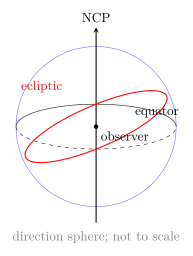
图 1 把天赤道与黄道画成两个大圆;红线的倾斜是坐标平面关系,不表示太阳在一个硬壳上运动。
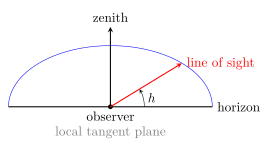
图 2 显示地平面由观测者位置决定;同一颗星在不同地点或时刻有不同 \(A,h\),却在短时间内近似保持同一 \(\alpha,\delta\)。
2. Altitude–azimuth and equatorial systems / 地平与赤道坐标系
Knowledge ID: P12-U01-L01-K02
Altitude–azimuth system 与局地地平固连,直接服务 telescope mount pointing;equatorial system 与天球赤道和春分点定义的参考方向联系,更适合 catalog。若已知纬度 \(\phi\)、赤纬 \(\delta\) 与 hour angle \(H\),球面三角给出:
\[\sin h=\sin\phi\sin\delta+\cos\phi\cos\delta\cos H,\]
\[\cos h\sin A=-\cos\delta\sin H,\]
\[\cos h\cos A=\sin\delta\cos\phi-\cos\delta\sin\phi\cos H.\]
计算 \(A\) 应使用 two-argument arctangent,让象限由最后两式同时确定。只用 \(\arccos\) 会丢失东西方向。当天体过中天 \(H=0\) 时,高度达到上中天分支的极值;若 \(\delta\) 与 \(\phi\) 使天体从不落下,则它是 circumpolar,但“拱极”仍取决于观测纬度。
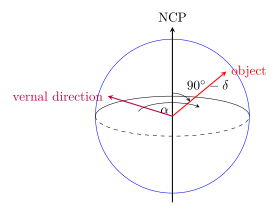
图 3 中赤纬是离开天赤道的纬度式角量,赤经沿天赤道向东量取;箭头不是天体的真实速度。
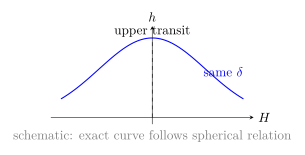
图 4 强调 \(h(H)\) 关于中天近似对称;真实曲线不是这里为突出极值所画的 Gaussian,定量计算必须用球面公式。
3. Sidereal time, seasons, and apparent sky motion / 恒星时、季节与天体视运动
Knowledge ID: P12-U01-L01-K03
Local sidereal time(LST)可操作地定义为此刻经过当地子午圈的赤经。因此:
\[H=\mathrm{LST}-\alpha.\]
目标在上中天时 \(H=0\),故 \(\mathrm{LST}=\alpha\)。一个 mean solar day 后,地球除自转外还沿公转轨道前进约 \(1^\circ\),必须再转约 \(1^\circ\) 才让太阳回到子午圈;因此 sidereal day 约比 mean solar day 短 4 min。精密换算需 UT1、经度、precession–nutation 模型,不能用固定“每天四分钟”累加做高精度指向。
季节来自地轴相对轨道法线的倾斜:它改变太阳赤纬、正午高度与日照时长。季节不是由地日距离的年度变化主导;南北半球相反季节已经直接否定这一常见解释。
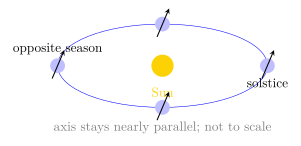
图 5 中四个地轴保持近似平行,展示“倾斜 + 公转”的因果结构;轨道偏心率未按比例绘制。
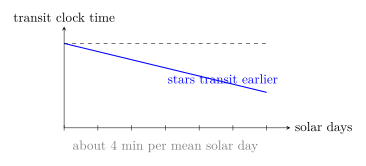
图 6 表示恒星每天按民用钟约提前四分钟过中天;直线仅是短期 mean relation,不包含 leap seconds 或 Earth-orientation corrections。
4. Angular size and small-angle distance / 角大小与小角距离
Knowledge ID: P12-U01-L01-K04
对垂直视线、中心距离为 \(d\)、直径为 \(\ell\) 的物体,精确角直径是:
\[\theta=2\arctan\left(\frac{\ell}{2d}\right).\]
当无量纲参数 \(\epsilon=\ell/(2d)\ll1\),利用 \(\arctan\epsilon=\epsilon-\epsilon^3/3+\cdots\):
\[\theta\simeq\frac{\ell}{d}.\]
这里 \(\theta\) 必须以 radian 代入。换算为 arcsecond:
\[\theta('')\simeq206265\frac{\ell}{d}.\]
若目标有明显倾斜、深度、非圆形边界,\(\ell\) 是 transverse projected size;不能把沿视线的真实长度直接代入。小角公式给出的是几何尺度,不自动补偿 lensing、expansion 或 cosmological angular-diameter distance。
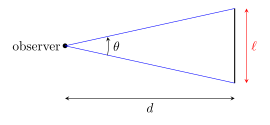
图 7 对应精确的等腰三角形;\(\ell/d\) 很小时两条视线夹角才可线性化。
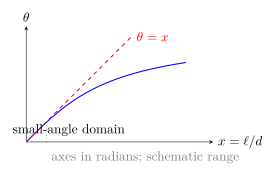
图 8 比较精确式 \(2\arctan(x/2)\) 与线性近似。随 \(x\) 增大,直线系统性高估角直径;近似误差不是随机测量误差。
5. Parallax and baseline measurement / 视差与基线测量
Knowledge ID: P12-U01-L01-K05
视差是 observer position 改变导致 foreground direction 相对 distant reference frame 的周期位移。以 1 AU 为半基线:
\[\tan p=\frac{1\,\mathrm{AU}}{d},\]
小角下 \(p\simeq1\,\mathrm{AU}/d\)。Parsec 的定义使:
\[d(\mathrm{pc})=\frac{1}{p('')}.\]
真实 astrometric time series 还包含 initial position、proper motion、annual parallax factors、可能的 binary orbit 与 instrument zero point:
\[\boldsymbol\theta(t)=\boldsymbol\theta_0+\boldsymbol\mu(t-t_0)+\varpi\,\mathbf P(t)+\boldsymbol\epsilon(t).\]
这说明视差不是任取两张半年间隔图像做一个位移差:目标在黄道上的位置决定 parallax ellipse 投影,proper motion 也必须同时拟合。若 \(\sigma_\varpi/\varpi\) 不小,\(d=1/\varpi\) 的非线性会产生偏斜、甚至测得负 \(\varpi\);负估计值可以是噪声下合法的无偏测量结果,却不能被解释为负距离。此时应在 measurement space 建 likelihood,并结合透明的 prior 推断距离。
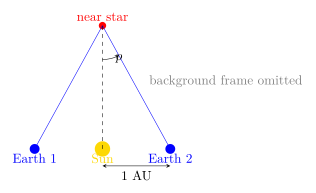
图 9 使用半基线定义 \(p\);两端观测的总角位移在最简几何中约为 \(2p\),不能把它直接当 catalog parallax。
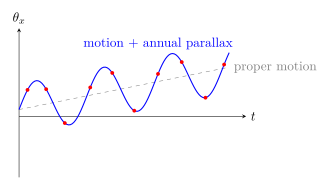
图 10 表示 proper motion 的线性趋势与 annual parallax 的周期项必须联合拟合;红点的 cadence 会影响参数相关性。
Worked Examples / 完整例题
Example 1 — 上中天高度与可见性
已知: 观测纬度 \(\phi=35.0^\circ\) N,恒星赤纬 \(\delta=+20.0^\circ\),正在上中天。求高度角,并判断是否经过天顶南侧。
研究对象与参考系: 地面观测者的理想地平系;忽略折射。取 \(H=0\)。
模型理由: catalog direction 在一夜内固定,球面坐标变换适用。
\[\sin h=\sin35.0^\circ\sin20.0^\circ+\cos35.0^\circ\cos20.0^\circ=\cos15.0^\circ.\]
所以 \(h=75.0^\circ\)。由于 \(\delta<\phi\) 且同为北纬,目标在天顶南侧过中天,方位角为 \(180^\circ\)。
单位与有效数字: 角度给到 \(0.1^\circ\)。
检查: 子午高度也可用 \(h=90^\circ-\lvert\phi-\delta\rvert=75^\circ\);若 \(\delta\to\phi\),应趋近天顶,极限正确。
Example 2 — 用 LST 安排观测
已知: 目标赤经 \(\alpha=8\,\mathrm h\,20\,\mathrm{min}\);某时刻当地恒星时为 \(7\,\mathrm h\,05\,\mathrm{min}\)。求 hour angle 及还需多少 sidereal time 到上中天。
系统与正方向: \(H=\mathrm{LST}-\alpha\),西正;时间赤经按 24 h 周期。
方程:
\[H=7\,\mathrm h\,05\,\mathrm{min}-8\,\mathrm h\,20\,\mathrm{min}=-1\,\mathrm h\,15\,\mathrm{min}.\]
目标在子午圈以东,还需 \(1\,\mathrm h\,15\,\mathrm{min}\) 恒星时到上中天。角量为 \(-18.75^\circ\)。
检查: 负 \(H\) 对应尚未过中天;当 LST 增至 \(\alpha\) 时 \(H=0\)。民用钟间隔略不同,但本题精度不要求 UT1 换算。
Example 3 — 小角尺度及近似误差
已知: 一团星云横向直径 \(\ell=2.50\,\mathrm{pc}\),距离 \(d=500\,\mathrm{pc}\)。求角直径,并估计小角近似的相对误差。
系统边界: 以星云投影边缘为横向尺度;无 lensing,Euclidean geometry。
模型: \(x=\ell/d=5.00\times10^{-3}\ll1\)。
\[\theta_{\mathrm{small}}=x=5.00\times10^{-3}\,\mathrm{rad}=0.286^\circ=17.2'.\]
精确式为 \(\theta=2\arctan(x/2)\)。展开给相对偏差约 \(x^2/12=2.08\times10^{-6}\),小角式高估约 \(0.000208\%\)。
量纲与合理性: pc 相消,角为无量纲;\(17.2'\) 约为满月典型 \(0.5^\circ\) 视直径的 \(0.57\) 倍,即略大于一半,数量级合理。
Example 4 — 视差距离与不确定度边界
已知: \(\varpi=(20.0\pm0.8)\,\mathrm{mas}\),先假定 zero point 已校正、误差近似 Gaussian。
研究对象: 单星的几何距离;measurement 在 parallax space。
模型理由: fractional error \(0.8/20.0=0.040\) 较小,可一阶传播。
\[d=\frac{1000}{20.0}\,\mathrm{pc}=50.0\,\mathrm{pc},\]
\[\sigma_d\simeq\frac{1000\sigma_\varpi}{\varpi^2}=\frac{1000(0.8)}{(20.0)^2}\,\mathrm{pc}=2.0\,\mathrm{pc}.\]
结果为 \(d=(50.0\pm2.0)\,\mathrm{pc}\)(一阶对称近似)。
检查: 相对误差仍为约 \(4\%\);若改成 \(\varpi=0.8\pm0.8\,\mathrm{mas}\),直接倒数与对称误差便不可靠,应拟合 likelihood/posterior,而不是报告 \(1.25\pm1.25\,\mathrm{kpc}\)。
Lesson synthesis / 课程综合
从一次观测到物理距离的可执行链条是:
- 声明 site、time scale、reference frame、epoch 与 azimuth convention;
- 把 catalog 的 \((\alpha,\delta)\) 与 LST 组合为 \(H\),再变换为可指向的 \((A,h)\);
- 用 detector 上的像素位置通过 astrometric calibration 得到角量;
- 只有在声明几何模型后,才用 small-angle relation 把角大小变成横向尺度;
- 若有时序基线,则把 position、proper motion、parallax 与噪声联合拟合;
- 在低信噪比下保留 measurement-space likelihood,不把非线性倒数当无偏测量。
Formula-and-decision table / 公式与决策表
| Need | Relation | Use when | Main limitation |
|---|---|---|---|
| angular separation | \(\cos\psi=\hat{\mathbf n}_1\cdot\hat{\mathbf n}_2\) | directions share one frame/epoch | coordinate frame mismatch |
| hour angle | \(H=\mathrm{LST}-\alpha\) | LST and RA use same equinox/frame | time/Earth-orientation precision |
| altitude | \(\sin h=\sin\phi\sin\delta+\cos\phi\cos\delta\cos H\) | spherical Earth, no refraction | horizon refraction and geodesy |
| angular diameter | \(\theta=2\arctan(\ell/2d)\) | transverse centered size | projection and cosmology |
| small angle | \(\theta\simeq\ell/d\) | \(\ell/d\ll1\), radians | nonlinear error grows as \((\ell/d)^2\) |
| parallax distance | \(d(\mathrm{pc})=1/p('')\) | geometric parallax, high S/N | zero point, selection, inverse bias |
Model boundaries / 模型边界
- Celestial sphere discards radial coordinate; angular coincidence does not imply physical association.
- Horizon coordinates require local gravity direction and time; atmospheric refraction becomes large and variable near the horizon.
- Simple equatorial formulas omit epoch transformations. Milliarcsecond astrometry needs relativistic aberration, solar-system ephemerides and calibrated reference frames.
- Small-angle formula is local Euclidean geometry. At cosmological distance the relevant quantity is angular-diameter distance, which is model-dependent and not generally monotonic with redshift.
- Parallax inversion is safe only as an approximation at high signal-to-noise. Catalog completeness, zero point and prior population affect distance inference.
Misconception clinic / 误区诊所
- “天球是一个真实球壳。” 它只是方向空间;同一方向可叠加不同距离的目标。
- “RA/Dec 对任何时代都永远不变。” 参考架、precession、proper motion 和 epoch 都会影响数值。
- “恒星日就是 24 h。” 24 h 通常指 mean solar day;恒星日约短四分钟。
- “冬季因为地球离太阳更远。” 地轴倾斜控制日照几何,且两半球季节相反。
- “角度很小就可以直接用 degree 代入 \(\ell/d\)。” 线性小角式必须使用 radian。
- “测得负视差就是负距离或坏数据。” 噪声可产生负估计;应在 parallax space 解释 likelihood。
Practice and retrieval / 练习与提取
- [K01 概念] 为什么 celestial sphere 能保留角分离却不能给出恒星距离?
- [K01 图像] 说明天赤道、黄道与地平圈各由什么平面定义,哪一个随观测地点改变?
- [K02 定量] 纬度 \(30^\circ\) N 的观测者看赤纬 \(-10^\circ\) 的目标上中天,忽略折射,求高度与南北方位。
- [K02 判断] 某目标 \(\alpha=5.0\,\mathrm h\),LST \(=7.0\,\mathrm h\)。目标位于子午圈东还是西?
- [K03 推导] 用地球每天公转约 \(360^\circ/365.25\) 估计恒星过中天每天提前多少民用分钟。
- [K03 边界] 为什么用“每天提前 4 min”不能替代专业望远镜的 pointing model?
- [K04 定量] 月球直径 \(3.47\times10^6\,\mathrm m\)、距离 \(3.84\times10^8\,\mathrm m\),用小角式求角直径,单位用 degree。
- [K04 反演] 星系角直径 \(40''\),距离 \(20\,\mathrm{Mpc}\);用 Euclidean small-angle model 求横向直径。
- [K05 定量] 一颗星视差 \(4.00\pm0.20\,\mathrm{mas}\),在一阶近似下求距离与不确定度。
- [综合建模] 一条天体位置序列同时显示线性漂移和一年周期。列出至少四个需拟合或校准的分量,并说明为什么两时刻相减不够。
Answer 1
天球把每条视线归一化为 \(\hat{\mathbf n}\);点积给角分离,但归一化消除了径向长度。因此 angular proximity 不等于 spatial proximity。
Answer 2
天赤道由地球赤道面定义,黄道由地球轨道面定义,二者约差 \(23.4^\circ\);地平圈由当地铅垂的垂直平面定义,随地点与局地重力方向改变。
Answer 3
上中天 \(h=90^\circ-\lvert30^\circ-(-10^\circ)\rvert=50^\circ\)。目标赤纬低于观测纬度,在南方过中天,\(A=180^\circ\)。
Answer 4
\(H=7.0-5.0=+2.0\,\mathrm h\)。按西正约定,目标已过中天,位于子午圈西侧。
Answer 5
每天需额外转约 \(0.986^\circ\) 才让太阳回中天。地球 \(15^\circ\) 对应 1 h,故 \(0.986^\circ\) 对应 \(3.94\,\mathrm{min}\);恒星约提前 \(3.94\,\mathrm{min}\)。
Answer 6
它是平均短期近似,不含 UT1 不规则、经度、precession–nutation、polar motion、refraction、mount flexure 与 clock calibration,误差会累积。
Answer 7
\[\theta\simeq\frac{3.47\times10^6}{3.84\times10^8}=9.04\times10^{-3}\,\mathrm{rad}=0.518^\circ.\] 与约半度的视直径一致。
Answer 8
\(40''=40/206265=1.939\times10^{-4}\,\mathrm{rad}\),故 \(\ell=d\theta=20\times10^6\,\mathrm{pc}\times1.939\times10^{-4}=3.88\times10^3\,\mathrm{pc}=3.88\,\mathrm{kpc}\)。该答案以 Euclidean distance 为前提。
Answer 9
\[d=1000/4.00=250\,\mathrm{pc},\qquad \sigma_d\simeq1000(0.20)/(4.00)^2=12.5\,\mathrm{pc}.\] 可报 \(d=(250\pm13)\,\mathrm{pc}\);相对误差约 \(5\%\)。
Answer 10
至少包含 reference position、proper motion、annual parallax factors、instrument/attitude zero point;还可能有 binary orbit、differential chromatic effects 和 correlated noise。两时刻相减不能分离线性与周期项,也不能完整采样视差椭圆。
Exit ticket / 课末检核
- 某 catalog 给出 \((\alpha,\delta)\) 和 parallax。写出从“今晚能否观测”到“估计横向尺度”的最短建模链,并为每一步注明需要的额外观测量。
- 用一句话分别解释:为什么天球模型有用、为什么 \(d=1/p\) 有用、以及为什么两者都可能被误用。
References and source notes / 参考资料与来源说明
- OpenStax, Astronomy 2e, 2.1 The Sky Above — 天球、地平、视运动与角度;accessed 2026-08-30.
- OpenStax, Astronomy 2e, 4.1 Earth and Sky — 赤经赤纬与天球参考圈;accessed 2026-08-30.
- U.S. Naval Observatory, Sidereal Time — LST、hour angle、UT1 与子午定义;accessed 2026-08-30.
- U.S. Naval Observatory, Computing Altitude and Azimuth from Greenwich Apparent Sidereal Time — 赤道到地平坐标变换与方位约定;accessed 2026-08-30.
- ESA Gaia, Parallax — annual parallax 基线、微小角测量与 Gaia 语境;accessed 2026-08-30.
- OpenStax, Astronomy 2e, 19.2 Surveying the Stars — parsec、三角视差与距离尺度;accessed 2026-08-30.
- C. A. L. Bailer-Jones, “Estimating Distances from Parallaxes,” PASP 127, 994–1009 (2015), publisher DOI and open manuscript — noisy/negative parallaxes、direct-inversion bias 与 likelihood–prior–posterior distance inference;accessed 2026-08-30.
所有图均依据本课方程重新设计和绘制,没有复制来源插图。来源中的简化图景在正文中加入了 reference-frame、epoch、低信噪比与大气折射边界。
Source-to-content map / 来源—内容映射
| Source | Used for | Knowledge ID / Section | Model boundary or convention |
|---|---|---|---|
| OpenStax 2.1 | celestial sphere, horizon, apparent motion | K01, K03 | sphere is directional, not physical |
| OpenStax 4.1 | RA/Dec and reference circles | K01, K02 | catalog frame must declare epoch |
| USNO Sidereal Time | LST, hour angle, UT1 | K02, K03 | apparent vs mean sidereal time |
| USNO Alt/Az | coordinate transformation | K02 | azimuth and refraction conventions |
| ESA Gaia Parallax | annual baseline and precision | K05 | measurement is an angular fit |
| OpenStax 19.2 | parsec and triangulation | K04, K05 | small-angle and baseline limits |
| Bailer-Jones 2015 | noisy/negative parallax and posterior distance inference | K05, Example 4, model boundaries | Gaussian-likelihood example; prior dependence must be exposed at low S/N |
复习与拓展
- 与下一课连接:parallax 给出距离后,才能把 flux 可靠地转换为 luminosity。
- 与望远镜课连接:角量精度受 PSF、pixel scale、atmosphere、calibration 和 selection function 共同限制。
- 后续可扩展:ICRS/GCRS、precession–nutation matrix、barycentric time、Bayesian parallax inference 与 astrometric binaries。