
Learning objectives / 学习目标
学完本课后,你应能:
- 从能量守恒推导各向同性源的 inverse-square law,并区分 flux、flux density、surface brightness 与 luminosity;
- 使用 Pogson magnitude relation 与 distance modulus,正确处理零点、波段和 extinction;
- 用 Planck spectrum、Wien displacement 与 Stefan–Boltzmann law 连接颜色、有效温度、半径与光度,并说明真实恒星为何偏离黑体;
- 从谱线识别原子/离子和 ionization conditions,用 Doppler shift 估计低速 radial velocity,并判断何时需相对论公式;
- 把 parallax、main-sequence fitting、standard candles 与更远尺度组织成校准链,传播共享 systematic uncertainty。
Prerequisites / 先修知识
- Coordinates, Time, and Angular Measurement 的视差、角量与 small-angle model;
- 波长、频率、光子能量 \(E=h\nu\),黑体辐射与 atomic transitions;
- 对数、比例关系、一阶误差传播与函数拟合;
- “观测量—instrument response—physical model”三层区分。
Scope and conventions / 范围与约定
- \(F\) 表示接收位置单位面积的 bolometric energy flux,单位 \(\mathrm{W\,m^{-2}}\);\(F_\nu\) 或 \(F_\lambda\) 是 spectral flux density,单位必须随自变量注明。
- \(L\) 是源在 source rest frame 的总辐射功率。\(F=L/(4\pi d^2)\) 需要 Euclidean geometry、无吸收并近似各向同性;beaming、dust 与 cosmological redshift 会改变关系。
- Magnitude 必须附 photometric band/system。Absolute magnitude \(M\) 定义为源放在 10 pc 时的 apparent magnitude;不是“没有单位的 luminosity”。
- Radial velocity 在本课以 \(v_r>0\) 表示远离;\(v_r\simeq cz\) 仅在 \(\lvert v_r\rvert\ll c\) 且 redshift 主要为 Doppler 时使用。
- Distance ladder 是重叠标定网络,不是每一级都独立、精确且无模型。
Notation and modeling contract / 符号与建模契约
| Symbol | Meaning | SI / convention |
|---|---|---|
| \(L\) | bolometric luminosity | W |
| \(F\) | received bolometric flux | \(\mathrm{W\,m^{-2}}\) |
| \(F_\nu,F_\lambda\) | spectral flux density | \(\mathrm{W\,m^{-2}\,Hz^{-1}}\), \(\mathrm{W\,m^{-3}}\) |
| \(m_X,M_X\) | apparent/absolute magnitude in band \(X\) | logarithmic |
| \(A_X\) | extinction in band \(X\) | mag |
| \(B_\lambda(T)\) | Planck spectral radiance | \(\mathrm{W\,m^{-3}\,sr^{-1}}\) |
| \(z\) | wavelength redshift | 1 |
| \(d\) | distance appropriate to relation | m or pc |
同一个字母 \(F\) 不同时表示 surface flux at a star 和 received flux;如需前者,写 \(F_\star=\sigma T_{\mathrm{eff}}^4\)。
1. Flux, luminosity, and inverse-square law / 流量、光度与平方反比律
Knowledge ID: P12-U01-L02-K01
Luminosity 是源每单位时间发出的总能量;flux 是接收面每单位面积每单位时间通过的能量。若源向所有方向均匀发射、传播中无能量损失,则同一功率穿过半径 \(d\) 的球面:
\[L=4\pi d^2F,\]
因此:
\[F=\frac{L}{4\pi d^2}.\]
平方反比来自面积随 \(d^2\) 扩张,不表示每个光子能量在静态 Euclidean 真空中随距离自行下降。若只测某个 filter,得到的是 band-integrated flux;要推 bolometric \(L\) 需 spectral energy distribution、bolometric correction、extinction 和 instrument response。
Spectral densities 满足同一小区间能流守恒:
\[F_\nu\,\lvert d\nu\rvert=F_\lambda\,\lvert d\lambda\rvert, \qquad F_\lambda=F_\nu\left\lvert\frac{d\nu}{d\lambda}\right\rvert =F_\nu\frac{c}{\lambda^2},\]
其中 \(d\nu=-(c/\lambda^2)d\lambda\);若使用 signed differentials,负号由积分限反转吸收。故 \(F_\nu\) 与 \(F_\lambda\) 的曲线峰值位置不必相同。不能在不写 Jacobian 的情况下把两者数值直接比较。
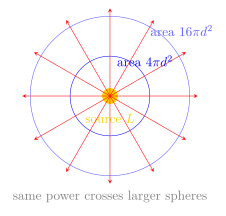
图 1 的外球半径是内球两倍、面积四倍,因此相同 \(L\) 给出四分之一 \(F\);二维圆只是三维球面的剖面示意。
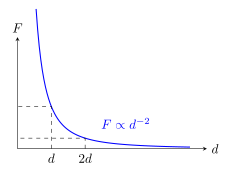
图 2 显示 doubling-distance test;曲线在 \(d=0\) 的发散提醒 point-source model 不能延伸进有限源内部。
2. Apparent and absolute magnitude / 视星等与绝对星等
Knowledge ID: P12-U01-L02-K02
现代 magnitude 将 flux ratio 编码为对数差:
\[m_1-m_2=-2.5\log_{10}\left(\frac{F_1}{F_2}\right).\]
Magnitude 越小表示 flux 越大;相差 5 mag 对应 flux 比 100。零点依 photometric system 而定(如 AB 或 Vega),所以只有在同一 band/system 下才能直接比较。
把同一源分别置于 \(d\) 与 10 pc,配合 inverse-square relation:
\[m_X-M_X=5\log_{10}\left(\frac{d}{10\,\mathrm{pc}}\right)+A_X.\]
\(\mu=m-M\) 称 distance modulus。在有 extinction 时,观测 \(m\) 同时包含距离变暗与尘埃吸收;若漏掉 \(A_X\),会高估距离。对 extended source,还需区分 integrated magnitude 与 surface brightness,aperture 和 background subtraction 都会改变测量值。
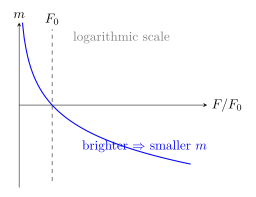
图 3 把 magnitude 反向刻度画成对数函数;负星等不代表负能流。
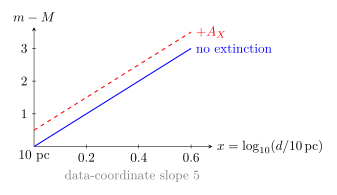
图 4 表示 extinction 把 distance-modulus relation 整体上移;若 \(A_X\) 随距离与方向变化,它并非简单常数。
3. Thermal spectra, color, and temperature / 热谱、颜色与温度
Knowledge ID: P12-U01-L02-K03
Planck spectral radiance 描述热平衡黑体:
\[B_\lambda(T)=\frac{2hc^2}{\lambda^5}\frac{1}{\exp\!\left(\frac{hc}{\lambda k_{\mathrm B}T}\right)-1}.\]
波长形式峰值满足 Wien displacement law:
\[\lambda_{\max}T=b,\]
而单位表面的 bolometric emergent flux 为 \(F_\star=\sigma T^4\)。若恒星近似半径 \(R\) 的球形黑体:
\[L=4\pi R^2\sigma T_{\mathrm{eff}}^4.\]
Broadband color 例如 \(m_B-m_V\) 是两个 response-weighted flux 的对数比,可用来估 effective temperature,但还依赖 metallicity、surface gravity、line blanketing、interstellar reddening 与 photometric calibration。真实 stellar atmosphere 不是理想黑体;\(T_{\mathrm{eff}}\) 的定义是产生相同 bolometric surface flux 的温度,而非每一层气体的单一实际温度。
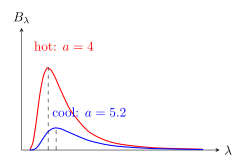
图 5 的全部坐标点由同一相对纵轴上的 Planck 形状 \(120[\lambda^5(\exp(a/\lambda)-1)]^{-1}\) 数值采样,其中 \(a=hc/(k_{\mathrm B}T)\);温度较高时 \(a\) 较小,因此红线峰更靠左、处处高于蓝线且总面积更大。坐标为相对尺度,不用于反推绝对辐亮度。
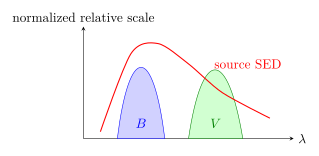
图 6 强调 filter measurement 是 SED 与 throughput 的加权积分;“在中心波长读一个点”通常不是准确 photometry。
4. Spectral lines, composition, and radial velocity / 谱线、成分与径向速度
Knowledge ID: P12-U01-L02-K04
Atomic transitions 给出 rest wavelengths;谱线的存在、强度、宽度和形状共同编码 abundance、temperature、ionization、density、pressure、magnetic field、rotation 与 turbulence。看到某元素的谱线说明相应离子和能级在形成区有合适 population,不等于 line depth 直接正比于总元素质量。
定义:
\[z=\frac{\lambda_{\mathrm{obs}}-\lambda_0}{\lambda_0}.\]
若纯视向相对运动且 \(\lvert v_r\rvert\ll c\):
\[v_r\simeq cz.\]
更一般的 special-relativistic longitudinal Doppler relation 为:
\[1+z=\sqrt{\frac{1+\beta}{1-\beta}},\qquad \beta=\frac{v_r}{c}.\]
实际 radial-velocity pipeline 还需 wavelength calibration、barycentric correction、template/cross-correlation 与 line-profile model。Cosmological redshift、gravitational redshift 和 gas bulk flow 不能自动解释成单一恒星的经典径向速度。
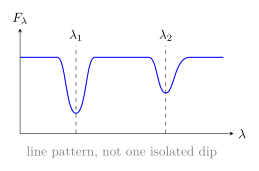
图 7 表示用多条 rest-line pattern 识别 species 比凭一条线可靠;line depths 同时受 atmosphere state 影响。
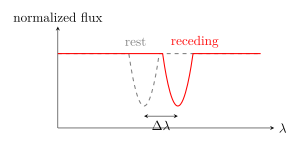
图 8 显示正 \(v_r\) 把整套谱线移向长波;若不同线位移不一致,应先检查 blends、calibration 或不同形成区。
5. Cosmic distance ladder / 宇宙距离阶梯
Knowledge ID: P12-U01-L02-K05
距离无法由 apparent brightness 单独决定,因为 faint source 可能本征暗或距离远。Distance ladder 以 geometric methods 为基座,用有重叠样本校准 luminosity indicators:
- radar/orbital geometry 建立 solar-system scale;
- trigonometric parallax 校准附近恒星;
- cluster/main-sequence fitting、eclipsing binaries、RR Lyrae、Cepheids 扩展 stellar/galactic scale;
- 标准化超新星、galaxy scaling relations 等扩展到更远宇宙;
- redshift-distance relations 在 cosmological model 中工作。
每一级输出不仅是距离,还应包括 zero point、intrinsic scatter、metallicity/crowding/extinction dependence 和 selection function。若两级共享同一 parallax zero point,它们的误差相关;不能把每级 systematic 当独立随机量平方相加。
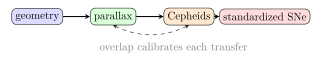
图 9 把阶梯画成有重叠验证的校准链;箭头表示 metrology traceability,不表示所有目标必须逐个经过每一级。
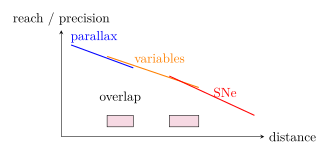
图 10 强调“更远”通常以降低单体信噪比、增加 population model 与 selection bias 为代价;重叠区用于交叉校准。
Worked Examples / 完整例题
Example 1 — 从 flux 求恒星 luminosity
已知: 一颗恒星距离 \(d=10.0\,\mathrm{pc}\),测得 bolometric flux \(F=3.20\times10^{-10}\,\mathrm{W\,m^{-2}}\);忽略 extinction,假设各向同性。
系统: 源的总辐射为系统输出;接收球面为边界。
模型与方程: \(L=4\pi d^2F\),\(1\,\mathrm{pc}=3.086\times10^{16}\,\mathrm m\)。
\[L=4\pi(10.0\times3.086\times10^{16}\,\mathrm m)^2(3.20\times10^{-10}\,\mathrm{W\,m^{-2}}) =3.83\times10^{26}\,\mathrm W.\]
检查: \(\mathrm{m^2}\) 与 \(\mathrm{m^{-2}}\) 相消,结果为 W;数量级约为太阳光度。若 flux 只是 \(V\) band,则不得称为 bolometric \(L\)。
Example 2 — Distance modulus、extinction 与方向性偏差
已知: 某 Cepheid 在 \(V\) band 有 \(m_V=15.20\)、校准 \(M_V=-4.00\),视线 extinction \(A_V=0.60\,\mathrm{mag}\)。
研究对象: 该星的 luminosity distance,在近邻 Euclidean relation 下。
方程:
\[5\log_{10}\left(\frac{d}{10\,\mathrm{pc}}\right)=m_V-M_V-A_V=18.60.\]
\[d=10\,\mathrm{pc}\times10^{18.60/5}=5.25\times10^4\,\mathrm{pc}=52.5\,\mathrm{kpc}.\]
检查: 若错误忽略 extinction,会得到 \(69.2\,\mathrm{kpc}\),距离被高估约 \(32\%\)。Magnitude 是对数量,\(A_V\) 直接相减而非把 0.60 当 flux fraction。
Example 3 — Wien 温度与模型边界
已知: 去红化后 continuum 的 \(B_\lambda\) 峰约在 \(\lambda_{\max}=500\,\mathrm{nm}\);取 \(b=2.898\times10^{-3}\,\mathrm{m\,K}\)。
系统与模型: 光球 continuum 近似单温黑体;峰以 wavelength density \(B_\lambda\) 定义。
\[T=\frac{b}{\lambda_{\max}}=\frac{2.898\times10^{-3}}{500\times10^{-9}}\,\mathrm K=5.80\times10^3\,\mathrm K.\]
检查: 可见光峰对应数千 K 合理。若峰来自 \(B_\nu\) 或 filter-weighted counts,峰位置定义不同;强 reddening 未校正会把温度低估。
Example 4 — 谱线 Doppler 速度
已知: H-alpha rest wavelength \(\lambda_0=656.28\,\mathrm{nm}\),校正 barycentric motion 后测得 \(\lambda_{\mathrm{obs}}=656.50\,\mathrm{nm}\)。
正方向: 红移、远离为正。
模型: \(\Delta\lambda/\lambda_0\ll1\),经典低速关系适用。
\[z=\frac{0.22}{656.28}=3.35\times10^{-4},\]
\[v_r\simeq cz=(2.998\times10^8)(3.35\times10^{-4})\,\mathrm{m\,s^{-1}}=1.01\times10^5\,\mathrm{m\,s^{-1}}.\]
即 \(v_r=+101\,\mathrm{km\,s^{-1}}\)(三位有效数字)。
检查: \(v/c=3.35\times10^{-4}\),相对论修正远小于本题精度;正号与红移一致。若对象是遥远星系,不能不加讨论就把所有 \(z\) 当局地 peculiar velocity。
Lesson synthesis / 课程综合
观测推断的核心不是“套一条公式”,而是逐层建立契约:
- detector counts 经 bias/dark/flat、throughput 和 standard source 变成 calibrated flux;
- 明确 band、zero point、aperture、extinction 与 source geometry;
- continuum shape 在 atmosphere model 下约束 temperature、reddening 和 angular size;
- line pattern 与 profile 约束 composition/state,line shift 在 velocity model 下给 \(v_r\);
- geometric distance 校准 luminosity indicators,再把 shared zero point 传入 distance ladder;
- 每个结论同时报告 statistical、systematic 与 model-dependent 部分。
Formula-and-decision table / 公式与决策表
| Need | Relation | Use when | Main limitation |
|---|---|---|---|
| luminosity from flux | \(L=4\pi d^2F\) | isotropic Euclidean, bolometric, transparent path | beaming, dust, cosmology |
| flux ratio | \(\Delta m=-2.5\log_{10}(F_1/F_2)\) | same band/system | zero point and color terms |
| distance modulus | \(m-M=5\log_{10}(d/10\,\mathrm{pc})+A\) | calibrated absolute magnitude | extinction and population dependence |
| thermal peak | \(\lambda_{\max}T=b\) | continuum close to \(B_\lambda\) | reddening, atmosphere, density convention |
| stellar luminosity | \(L=4\pi R^2\sigma T_{\mathrm{eff}}^4\) | spherical effective blackbody | limb darkening and atmosphere |
| Doppler estimate | \(v_r\simeq c\Delta\lambda/\lambda_0\) | low-speed Doppler | blends, calibration, non-Doppler redshift |
Model boundaries / 模型边界
- Inverse-square law needs the correct distance concept. In an expanding universe, bolometric flux uses luminosity distance and redshift factors.
- Magnitudes are system-specific response integrals; a numerical magnitude without a band/zero point is incomplete.
- Color temperature, effective temperature and local gas temperature are distinct model quantities.
- Line strength is not a direct abundance meter without radiative transfer, ionization balance and atmosphere parameters.
- Distance indicators have intrinsic scatter and population dependencies; sample cuts can produce Malmquist/Eddington-like bias.
- Shared calibration systematics make ladder rungs statistically correlated.
Misconception clinic / 误区诊所
- “Luminosity 和 brightness 是同一个量。” \(L\) 是源功率,\(F\) 是接收单位面积的功率,差一个距离与几何模型。
- “Magnitude 越大越亮。” 定义中有负号;较小 magnitude 对应较大 flux。
- “同样颜色一定同样温度。” reddening、metallicity、gravity 和 filter system 可造成 degeneracy。
- “看到氢线就能直接读出氢总含量。” line population 和 transfer conditions 同样重要。
- “所有 redshift 都等于 \(v/c\)。” 低速 Doppler 只是一个受限模型;宇宙学和引力红移需别的解释。
- “距离阶梯每级误差彼此独立。” 共享 parallax zero point、extinction law 或 population calibration 会产生 covariance。
Practice and retrieval / 练习与提取
- [K01 定量] 同光度源距离变为 3 倍,flux 变为多少?说明假设。
- [K01 概念] 为什么 \(F_\nu\) 与 \(F_\lambda\) 的峰值波长不能简单视为同一点?
- [K02 定量] 两星同 band flux 比 \(F_1/F_2=10\),求 \(m_1-m_2\)。
- [K02 定量] \(m-M=10.0\) 且 \(A=0\),求距离。
- [K03 定量] 黑体峰在 \(1.00\,\mathrm{\mu m}\),估温度。
- [K03 判断] 一个红色天体一定比蓝色天体冷吗?列出两个反例机制。
- [K04 定量] \(500.0\,\mathrm{nm}\) 谱线出现在 \(499.5\,\mathrm{nm}\),低速近似下求 \(v_r\) 与方向。
- [K04 概念] 为什么只用一条 absorption line 的深度不能直接得到元素 abundance?
- [K05 建模] 写出 parallax 校准 Cepheid、Cepheid 再校准超新星的两级逻辑,并指出一个共享 systematic。
- [综合] 某源偏暗且偏红。给出至少三种互相竞争的解释,以及区分它们所需的新数据。
Answer 1
在各向同性、透明、Euclidean propagation 下,\(F\propto d^{-2}\),所以新 flux 为原来的 \(1/9\)。
Answer 2
因为 \(F_\nu d\nu=F_\lambda\lvert d\lambda\rvert\) 且 \(\lvert d\nu/d\lambda\rvert=c/\lambda^2\);变量变换带 Jacobian,密度的峰不保持不变。
Answer 3
\[m_1-m_2=-2.5\log_{10}10=-2.5.\] 星 1 flux 更大,magnitude 小 2.5 mag。
Answer 4
\(10=5\log_{10}(d/10\,\mathrm{pc})\),故 \(d/10=10^2\),\(d=1000\,\mathrm{pc}=1.00\,\mathrm{kpc}\)。
Answer 5
\[T=\frac{2.898\times10^{-3}}{1.00\times10^{-6}}\,\mathrm K=2.90\times10^3\,\mathrm K.\] 这是 \(B_\lambda\) 黑体近似的 color temperature。
Answer 6
不一定。Interstellar reddening 可使本来较热的源变红;强 emission lines、metallicity 或 filter/redshift 也可改变 broadband color。需光谱与 extinction constraint。
Answer 7
\(z=(-0.5)/500.0=-1.00\times10^{-3}\),\(v_r\simeq-3.00\times10^5\,\mathrm{m\,s^{-1}}=-300\,\mathrm{km\,s^{-1}}\),负号表示接近。
Answer 8
Line depth 还依赖 excitation/ionization population、temperature、pressure、opacity、microturbulence、blending 和 continuum placement;abundance 必须在 atmosphere/radiative-transfer model 中联合推断。
Answer 9
Gaia-like parallax 给附近 Cepheid 的几何距离,配合 flux 得出 period–luminosity zero point;在同时含 Cepheid 与某类超新星的 host 中校准超新星 luminosity。共享 systematic 可是 parallax zero point、photometric zero point 或 extinction law。
Answer 10
可能是距离更远、intrinsic luminosity 较低、dust extinction/reddening、较低 temperature,或 redshift 把 SED 移入别的 band。需 parallax/redshift、multi-band photometry、spectrum、polarization/IR dust data 或 independent standard indicator。
Exit ticket / 课末检核
- 用一条带条件的方程链说明:如何从 calibrated spectrum 和 geometric distance 推断 \(T_{\mathrm{eff}}\)、\(R\)、\(L\) 与 \(v_r\)。
- 某 distance indicator 样本只保留 signal-to-noise 高的亮源。解释这一 cut 如何改变距离分布,并写出必须记录的 selection information。
References and source notes / 参考资料与来源说明
- OpenStax, Astronomy 2e, 5.1 The Behavior of Light — inverse-square propagation;accessed 2026-08-30.
- OpenStax, Astronomy 2e, 5.2 The Electromagnetic Spectrum — blackbody, Wien 与 Stefan–Boltzmann;accessed 2026-08-30.
- OpenStax, Astronomy 2e, 17.1 The Brightness of Stars — luminosity、apparent brightness 与 magnitude;accessed 2026-08-30.
- OpenStax, Astronomy 2e, 17.4 Using Spectra to Measure Stellar Radius, Composition, and Motion — spectrum、composition、Doppler 与 stellar radius;accessed 2026-08-30.
- ESA Gaia, Cosmic distances — parsec、astrometric precision 与距离校准;accessed 2026-08-30.
- OpenStax, Astronomy 2e, 19.4 The H–R Diagram and Cosmic Distances — luminosity classes 与 distance ladder;accessed 2026-08-30.
- OpenStax, Astronomy 2e, 26.4 The Extragalactic Distance Scale — Cepheids 与 extragalactic distance indicators;accessed 2026-08-30.
- D. G. Luttermoser, East Tennessee State University, Physics 4617/5617 Quantum Physics — Chapter I (ed. 5.1), university-hosted notes — exact \(B_\nu\)/\(B_\lambda\) Planck forms、units 与 signed/absolute frequency–wavelength Jacobian;accessed 2026-08-30.
所有 TikZ 均由方程重新设计;未复制来源图。来源使用 wavelength/flux/magnitude conventions 不完全一致,正文已统一为 SI、明确 band,并把 cosmological 和 atmosphere 边界单独列出。
Source-to-content map / 来源—内容映射
| Source | Used for | Knowledge ID / Section | Model boundary or convention |
|---|---|---|---|
| OpenStax 5.1 | inverse-square propagation | K01 | isotropic transparent geometry |
| OpenStax 5.2 | blackbody laws | K03 | \(B_\lambda\) peak and effective model |
| OpenStax 17.1 | luminosity, flux, magnitude | K01, K02 | apparent vs intrinsic quantity |
| OpenStax 17.4 | line diagnostics and motion | K03, K04 | atmosphere and Doppler limits |
| ESA Gaia Cosmic distances | geometric calibration | K05 | parallax precision and parsec |
| OpenStax 19.4, 26.4 | luminosity classes and ladder | K05 | overlap, population, revision |
| ETSU Quantum Physics notes | exact Planck forms and \(F_\nu\)–\(F_\lambda\) change of variable | K01, K03 | signed \(d\nu\) requires reversed limits or absolute bin widths; densities have different units |
复习与拓展
- 与前课连接:parallax 的 measurement likelihood 是 luminosity calibration 的输入,不应先粗暴倒数再丢失非 Gaussian 信息。
- 与下一课连接:所有 \(F\)、color 和 line profile 都由 telescope + atmosphere + instrument + detector response 卷积后获得。
- 后续可扩展:radiative transfer、K-correction、cosmological luminosity distance、standard-siren distances 与 hierarchical ladder inference。