
Learning objectives / 学习目标
- 计算 Schwarzschild radius、gravitational time 与 angular scale,区分 horizon、photon region、ISCO 与 shadow;
- 从 orbital binding energy 与 mass-flow rate 建立 \(L=\eta\dot Mc^2\),解释 disk temperature、Eddington scale 和效率的适用条件;
- 用 special-relativistic aberration/Doppler boosting 判断 superluminal motion 的表观性质,并说明 jet launching 仍需磁场与旋转;
- 比较 stellar-mass 与 supermassive black holes 的 dimensionless similarity 和绝对时间/温度差异;
- 把 dynamical mass、X-ray spectrum、variability、GW 与 horizon-scale interferometry 组成证据链,并识别替代解释和系统误差。
Prerequisites / 先修知识
- White Dwarfs and Neutron Stars 的 compactness 与 collapse endpoint;
- circular orbit 的 \(v^2=GM/r\)、binding energy、angular momentum;
- Lorentz factor、Doppler effect、diffraction/interferometry;
- thermal radiation、spectral line、mass continuity 与 magnetic field 的基本概念。
Scope and conventions / 范围与约定
- \(r_g=GM/c^2\) 是 gravitational radius;非旋转黑洞 Schwarzschild horizon \(r_s=2r_g\)。文献有时把 \(r_g\) 或 \(r_s\) 都称“Schwarzschild scale”,本课始终显式区分。
- Kerr spin parameter 写作 \(a_*=Jc/(GM^2)\),满足 \(\lvert a_*\rvert\le1\) 的经典 Kerr bound;不在本课推导完整 Kerr metric。
- Accretion efficiency \(\eta\) 是从 rest-mass inflow 到 escaping radiation 的净比例;outflow/advection/obscuration 会让观测 luminosity 不等于局部 dissipated power。
- Jet 图均为 schematic;apparent speed 是 sky-plane feature motion,不是物质违反 \(c\)。
- “Black-hole image”指经过 calibration、Fourier reconstruction 与 plasma/GR forward model 得到的 horizon-scale brightness distribution;不是拍到 horizon surface。
Notation and modeling contract / 符号与建模契约
| Symbol | Meaning | SI / convention |
|---|---|---|
| \(M,J,a_*\) | mass, angular momentum, dimensionless spin | kg, \(\mathrm{kg\,m^2\,s^{-1}}\), 1 |
| \(r_g,r_s\) | \(GM/c^2\), \(2GM/c^2\) | m |
| \(t_g\) | \(GM/c^3\) | s |
| \(\dot M\) | rest-mass inflow rate through stated surface | \(\mathrm{kg\,s^{-1}}\) |
| \(\eta\) | radiative efficiency | 1 |
| \(L_{\rm Edd}\) | electron-scattering Eddington luminosity | W |
| \(\beta,\Gamma\) | \(v/c\), Lorentz factor | 1 |
| \(\theta\) | jet-to-line-of-sight angle | rad |
| \(\delta\) | relativistic Doppler factor | 1 |
| \(u,v\) | interferometric spatial frequencies | wavelength units |
1. Event horizons and characteristic scales / 事件视界与特征尺度
Knowledge ID: P12-U04-L02-K01
Event horizon 是 causal boundary:在 classical general relativity 中,其内所有未来指向的 causal trajectories 都不能到达远方 observer。它不是 Newtonian escape-velocity formula 的材料表面;不过令 \(v_{\rm esc}=c\) 恰得到 Schwarzschild radius 的正确质量标度:
\[r_s=\frac{2GM}{c^2}=2.953\left(\frac{M}{M_\odot}\right)\,\mathrm{km}, \qquad t_g=\frac{GM}{c^3}=4.926\left(\frac{M}{M_\odot}\right)\,\mu\mathrm s.\]
非旋转情形还有 photon circular orbit \(r=3r_g\) 和 innermost stable circular orbit(ISCO)\(r=6r_g\)。Shadow 的临界 impact-parameter diameter 在理想 Schwarzschild、远方 observer 下约 \(2\sqrt{27}r_g\approx10.4r_g\);它大于 horizon diameter \(4r_g\)。旋转、inclination 与 emitting plasma 改变 brightness asymmetry 和精确轮廓。
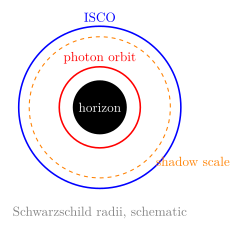
图 1 把四个常被混称“黑洞大小”的尺度拆开;圈线是坐标/光线结构,不是可见固体壳。
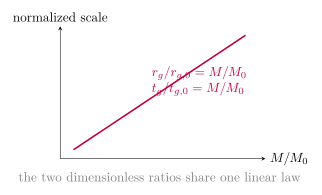
图 2 用无量纲比值表明 \(r_g\) 与 \(t_g\) 都严格正比于 \(M\);长度与时间本身仍不可放在同一有量纲纵轴比较。
2. Accretion disks and energy release / 吸积盘与能量释放
Knowledge ID: P12-U04-L02-K02
有 angular momentum 的气体不能径向直落,必须通过 turbulent/magnetic stress 向外输运 angular momentum,向内输运 mass,形成 accretion disk。Newtonian circular-orbit specific energy \(e=-GM/(2r)\) 显示内落可释放 binding energy;relativistic disk 的 inner boundary 与 efficiency 依 spin 和 stress prescription。
\[L=\eta\dot Mc^2.\]
Thin, optically thick disk 的局部 radiative flux(远离完整 relativistic correction)可写为:
\[F(r)=\frac{3GM\dot M}{8\pi r^3} \left[1-\left(\frac{r_{\rm in}}{r}\right)^{1/2}\right], \qquad \sigma T_{\rm eff}^4=F.\]
这说明内盘更热,且在相同 Eddington ratio 下 characteristic temperature roughly 随 \(M^{-1/4}\) 降低:stellar-mass black-hole disks 可在 X-ray band,SMBH disks 的 thermal peak 较低。
Electron-scattering Eddington luminosity 来自 outward radiation force 与 inward gravity 的 spherical steady balance:
\[L_{\rm Edd}=\frac{4\pi GMm_pc}{\sigma_T} \approx1.26\times10^{31}\left(\frac{M}{M_\odot}\right)\,\mathrm W.\]
它不是所有 geometry/composition 下不可超越的硬墙;beaming、inhomogeneity、opacity 与 short-lived flows 可产生 apparent/super-Eddington regimes。
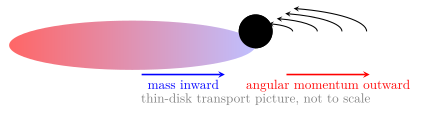
图 3 区分 mass flux 与 angular-momentum flux;“摩擦让气体停下”不是吸积盘机制的准确说法。
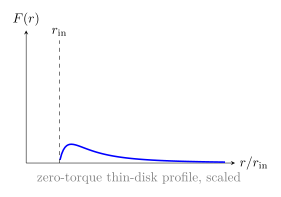
图 4 的 flux 在 inner boundary 条件下归零后出现峰值;不能用单调 \(r^{-3}\) 延伸到 horizon。
3. Relativistic jets / 相对论喷流
Knowledge ID: P12-U04-L02-K03
Jets 是沿 rotation axis 附近发出的 collimated plasma/outflow,跨越 stellar binaries 到 AGN。Observations 支持 magnetic fields、rotating disk 和可能的 black-hole spin 参与能量提取与 collimation,但“任何吸积盘都必有同样喷流”不成立;state、magnetic flux 和 environment 重要。
接近 line of sight 的 relativistic feature 具有 apparent transverse speed:
\[\beta_{\rm app}=\frac{\beta\sin\theta}{1-\beta\cos\theta}.\]
它可大于 1,因为后一个 photon 的发射点更靠近 observer,arrival-time interval 被压缩;局域物质速度仍 \(v<c\)。Doppler factor:
\[\delta=\frac{1}{\Gamma(1-\beta\cos\theta)}, \qquad \Gamma=(1-\beta^2)^{-1/2}.\]
Flux boosting 的指数依 source geometry 与 spectral index,故不能只凭 brightness ratio 无模型地读出 \(\Gamma\)。
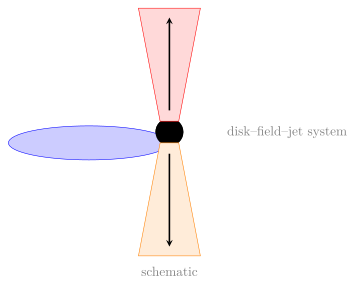
图 5 中双向结构表示 central engine symmetry;一侧观测上更亮可由 Doppler beaming 造成。
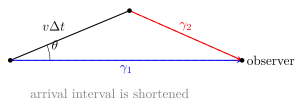
图 6 给出 apparent superluminal motion 的 light-travel-time geometry。
4. Stellar-mass versus supermassive black holes / 恒星级与超大质量黑洞
Knowledge ID: P12-U04-L02-K04
Stellar-mass black holes 通常来自 massive-star collapse 或 compact mergers;supermassive black holes(SMBH)位于 galaxies nuclei,通过 seed formation、accretion 和 mergers 增长。二者不应只按“大小”区分,还要按环境、feeding mode 与可观测时间尺度区分。
在相同 dimensionless radius \(r/r_g\) 和 Eddington ratio 下:
- length and variability times \(\propto M\);
- characteristic disk temperature roughly \(\propto M^{-1/4}\);
- \(L_{\rm Edd}\propto M\);
- density、cooling 与 magnetic-flux state 不一定严格自相似。
因此 X-ray binary 可在 days–months 改变 accretion state,AGN 对应演化可需 thousands–millions of years;但 rapid inner-disk variability 仍限制 emitting region \(R\lesssim c\Delta t\)。
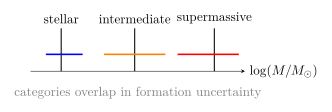
图 7 将 intermediate-mass range 标为过渡而非自然界的硬分箱。
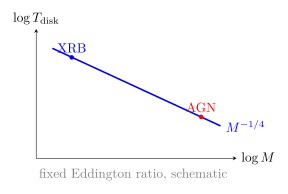
图 8 解释为什么同类 accretion physics 在不同 wavebands 出现。
5. Observational signatures and shadow imaging / 观测特征与黑洞阴影成像
Knowledge ID: P12-U04-L02-K05
任何单一 bright source 都不是黑洞证明。常用 evidence chain 包括:
- companion orbit 或 stellar/gas dynamics 给出 compact unseen mass;
- X-ray/UV/radio spectrum 与 rapid variability 限制 size 和 accretion state;
- absence of surface-like bursts、GW ringdown 或 relativistic orbital features 检验 compactness;
- very-long-baseline interferometry(VLBI)采样 complex visibilities,重建 horizon-scale brightness;
- 与 GR ray tracing 和 plasma models 比较 shadow diameter/asymmetry。
Interferometer 测的不是直接 pixels,而是 sky brightness 的 Fourier components:
\[V(u,v)=\iint I(l,m)e^{-2\pi i(ul+vm)}\,dl\,dm.\]
Sparse \(uv\) coverage、station gains、scattering 和 imaging regularization 都带来 uncertainty。EHT 的 M87* ring 与 shadow-scale feature 与约 \(6.5\times10^9M_\odot\) black-hole spacetime 相容;“看见红色甜甜圈”并非独立于 calibration/model 的直接 horizon photograph。
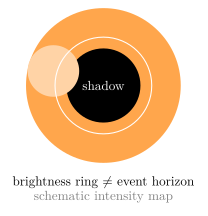
图 9 明确 brightness depression、photon ring family 与 horizon 不是同一 geometric object。

图 10 是 shadow inference pipeline;scientific claim 属于整条链而非最后一张图。
Worked Examples / 完整例题
Worked Example 1 — 恒星级黑洞的尺度
已知: 非旋转黑洞 \(M=10.0M_\odot\)。
研究对象与参考系: isolated Schwarzschild spacetime,由远方 stationary observer 定义 \(M\);SI。
模型理由: 忽略 spin,求 horizon radius 和 gravitational time。
\[r_s=2.953\frac{M}{M_\odot}\,\mathrm{km}=29.5\,\mathrm{km},\]
\[t_g=4.926\frac{M}{M_\odot}\,\mu\mathrm s=49.3\,\mu\mathrm s.\]
结果: \(r_s=29.5\,\mathrm{km}\),\(t_g=49.3\,\mu\mathrm s\)(3 s.f.)。
检查: 两者均随 \(M\) 线性;horizon diameter 是 \(59.1\,\mathrm{km}\),不要把 radius/diameter 混淆。
物理解释: millisecond variability 可来自数十个 \(t_g\) 的 inner flow,不意味着发光来自 horizon 内部。
Worked Example 2 — 吸积功率与 Eddington ratio
已知: \(M=10.0M_\odot\),\(\dot M=1.00\times10^{-8}M_\odot\,\mathrm{yr^{-1}}\),\(\eta=0.100\)。
系统边界: 由远处通过 disk 的 rest-mass inflow 到 escaping radiation;不计 jet/advection。
参考系: source rest frame。
换算与方程:
\[\dot M=\frac{1.00\times10^{-8}(1.9885\times10^{30})}{3.15576\times10^7} =6.30\times10^{14}\,\mathrm{kg\,s^{-1}}.\]
\[L=\eta\dot Mc^2=5.66\times10^{30}\,\mathrm W.\]
\[L_{\rm Edd}=1.26\times10^{32}\,\mathrm W, \qquad \lambda_{\rm Edd}=L/L_{\rm Edd}=0.0449.\]
结果: \(L=5.66\times10^{30}\,\mathrm W\),约 \(4.49\%\) Eddington。
检查: \(\dot Mc^2\) 单位 W;若 \(\eta\to0\),radiative output 趋零。
边界: 真实 \(\dot M\) 随 radius 可因 wind 改变,observed band luminosity 还需 bolometric correction。
Worked Example 3 — Apparent superluminal jet
已知: \(\beta=0.980\),jet 与 line of sight 夹角 \(\theta=15.0^\circ\)。
研究对象: moving emission pattern;observer frame。
坐标: line of sight 为纵向,sky plane 为横向。
方程:
\[\beta_{\rm app}=\frac{0.980\sin15^\circ}{1-0.980\cos15^\circ}=4.75.\]
\[\Gamma=(1-0.980^2)^{-1/2}=5.03, \qquad \delta=\frac{1}{5.03(1-0.980\cos15^\circ)}=3.72.\]
结果: apparent speed \(4.75c\),Doppler factor \(3.72\)。
检查: intrinsic \(v=0.980c<c\);\(\beta_{\rm app}>1\) 来自 arrival-time geometry。
解释: 亮度与时间间隔也被 Doppler altered,但转换指数需给 spectrum/geometry。
Worked Example 4 — M87* shadow 的角尺度
已知: \(M=6.50\times10^9M_\odot\),距离 \(D=16.8\,\mathrm{Mpc}\);取 Schwarzschild shadow diameter \(d_{\rm sh}=10.4r_g\)。
研究对象与模型: far-field small-angle model;忽略 spin/inclination/plasma scattering。
方程:
\[r_g=\frac{GM}{c^2}=9.60\times10^{12}\,\mathrm m, \qquad d_{\rm sh}=9.98\times10^{13}\,\mathrm m.\]
\[D=16.8(10^6)(3.0857\times10^{16})=5.18\times10^{23}\,\mathrm m,\]
\[\theta=\frac{d_{\rm sh}}{D}=1.93\times10^{-10}\,\mathrm{rad} =39.7\,\mu\mathrm{as}.\]
结果: 约 \(39.7\,\mu\mathrm{as}\)。
检查: angular diameter 与 \(M/D\) 成正比;microarcsecond scale 解释为何需要 Earth-sized VLBI baseline。
边界: measured ring diameter 与 shadow diameter 需 imaging/plasma forward model 连接,不能直接等同。
Lesson synthesis / 课程综合
黑洞 astrophysics 的可靠 workflow:先以 \(M,J\) 定 characteristic spacetime scales;再把 gas supply、angular momentum transport、radiative transfer 与 jet state 建成 forward model;最后把 time、spectrum、polarization、orbit、GW 和 visibility-domain data 联合检验。每一步都要区分“几何对象”“发光物质”“测量算子”。
Formula-and-decision table / 公式与决策表
| Need | Relation | Use when | Main limitation |
|---|---|---|---|
| horizon scale | \(r_s=2GM/c^2\) | Schwarzschild mass scale | spin and coordinates |
| causal time | \(t_g=GM/c^3\) | inner-flow variability scale | variability may occur farther out |
| accretion luminosity | \(L=\eta\dot Mc^2\) | stated flow boundary and efficiency | wind, advection, beaming |
| Eddington scale | \(4\pi GMm_pc/\sigma_T\) | ionized H, spherical steady balance | opacity and geometry |
| apparent jet speed | \(\beta\sin\theta/(1-\beta\cos\theta)\) | ballistic pattern, fixed \(\theta\) | acceleration and pattern speed |
| visibility | Fourier transform of \(I(l,m)\) | narrow-field interferometry | sparse sampling/calibration |
Model boundaries / 模型边界
- Newtonian escape-speed derivation is only a mnemonic for \(r_s\); horizon is a global GR causal concept.
- Thin disks require geometrical thinness, efficient cooling and approximate steady state; low/high accretion states can be radiatively inefficient or thick.
- Eddington luminosity depends on opacity and symmetry, and is not a universal instantaneous luminosity cap.
- Jet apparent features may not trace bulk plasma speed; Doppler inference is model dependent.
- Scaling by \(M\) is powerful but microphysics, magnetic flux and environment can break exact similarity.
- Image reconstruction from sparse visibilities is non-unique; robust statements require multiple algorithms and closure quantities.
Misconception clinic / 误区诊所
- “事件视界是一层黑色球壳。” 它是 causal boundary,不是有材料应力的 surface。
- “吸积物质在视界内摩擦发光。” 能到达远方的主要 radiation 由 horizon 外 plasma 产生。
- “Eddington limit 任何时候都绝不可超过。” 它来自特定 steady spherical opacity model。
- “喷流快于光证明相对论错误。” apparent transverse speed 可大于 \(c\),intrinsic local speed 不可。
- “SMBH 比 stellar BH 的物理完全不同。” dimensionless GR structure 相似,但 absolute time、temperature 与 feeding environment 不同。
- “EHT 图中黑区就是 horizon,亮环就是 photon orbit。” Observed brightness 是 plasma emission 经 lensing、sampling 和 reconstruction 后的结果。
Practice and retrieval / 练习与提取
- [K01 定量] 求 \(4.00\times10^6M_\odot\) 黑洞的 \(r_s\) 与 \(t_g\)。
- [K01 概念] 按半径由小到大排列 Schwarzschild horizon、photon orbit、ISCO 与 shadow radius。
- [K02 定量] \(\dot M=2.00\times10^{15}\,\mathrm{kg\,s^{-1}}\)、\(\eta=0.0600\) 时 \(L\) 为多少?
- [K02 边界] 为什么高 \(\dot M\) 不保证 \(L=\eta\dot Mc^2\) 按固定 \(\eta\) 增加?
- [K03 定量] \(\beta=0.90\)、\(\theta=30^\circ\) 时求 \(\beta_{\rm app}\)。
- [K03 判断] approaching jet 更亮是否单独证明它 intrinsically 更强?
- [K04 标度] 质量相差 \(10^7\) 的两黑洞在相同 \(r/r_g\) 上 orbital time ratio 是多少?
- [K04 图像] 为什么相同 Eddington ratio 的 stellar disk 比 SMBH disk 更热?
- [K05 定量] baseline \(B=1.00\times10^7\,\mathrm m\)、\(\lambda=1.30\,\mathrm{mm}\),估 \(\lambda/B\) angular scale(\(\mu\)as)。
- [综合] 列出确认一个 unseen compact object 是黑洞而非 neutron star 的互补证据链。
Answer 1
\(r_s=2.953(4.00\times10^6)=1.18\times10^7\,\mathrm{km}=1.18\times10^{10}\,\mathrm m\);\(t_g=4.926\,\mu\mathrm s(4.00\times10^6)=19.7\,\mathrm s\)。
Answer 2
半径:horizon \(2r_g\),photon orbit \(3r_g\),shadow radius \(\sqrt{27}r_g\approx5.20r_g\),ISCO \(6r_g\)。注意 shadow 是 impact-parameter scale,不是同一 spatial slice 上的材料圆。
Answer 3
\[L=0.0600(2.00\times10^{15})(2.9979\times10^8)^2=1.08\times10^{31}\,\mathrm W.\]
Answer 4
Photon trapping/advection、radiation-driven wind、geometrical thickening 与 changing inner boundary 可改变 escaping fraction;应明确 \(\dot M\) 在哪个 radius 测得。
Answer 5
\[\beta_{\rm app}=\frac{0.90\sin30^\circ}{1-0.90\cos30^\circ}=2.04.\]
Answer 6
不能。Relativistic Doppler boosting 可使 approaching side 更亮;还需 spectral index、angle、absorption、intrinsic symmetry 与 time delay。
Answer 7
\(t_g\propto M\),相同 dimensionless orbit 的时间也 \(\propto M\),故 ratio 为 \(10^7\)。
Answer 8
Thin-disk scaling 给 \(T\propto M^{-1/4}\);更小 \(M\) 的相同 dimensionless radius 对应更小 area,而单位 area flux/temperature 更高。
Answer 9
\[\theta\sim\frac{1.30\times10^{-3}}{1.00\times10^7}=1.30\times10^{-10}\,\mathrm{rad}=26.8\,\mu\mathrm{as}.\] 实际 beam 依 projected \(uv\) coverage 与 weighting。
Answer 10
可组合:binary dynamical mass 超过 credible neutron-star maximum、极小 emitting region/rapid variability、无 surface burst/thermal boundary-layer signature、relativistic disk/reflection constraints、GW inspiral–ringdown consistency、horizon-scale VLBI shadow/closure data;任何单项都需 systematics 与替代模型审计。
Exit ticket / 课末检核
- 解释为什么“shadow 比 horizon 大”并不矛盾,并指出观察者真正测到的量。
- 给出一个 \(L\) 很低但 \(\dot M\) 可能不低的 accretion scenario,并说明需要哪种观测区分。
References and source notes / 参考资料与来源说明
- OpenStax, Astronomy 2e, 24.5 Black Holes — horizon、curved spacetime 与 Schwarzschild black hole;accessed 2026-08-30.
- OpenStax, Astronomy 2e, 24.6 Evidence for Black Holes — binary dynamics、accretion disks 与 stellar/supermassive evidence;accessed 2026-08-30.
- OpenStax, Astronomy 2e, 27.2 Supermassive Black Holes: What Quasars Really Are — accretion energy、variability 与 AGN engine;accessed 2026-08-30.
- Event Horizon Telescope Collaboration, Astronomers Capture First Image of a Black Hole — M87* mass/distance context、VLBI array 与 shadow interpretation;accessed 2026-08-30.
- Event Horizon Telescope Collaboration, “First M87 Event Horizon Telescope Results. I. The Shadow of the Supermassive Black Hole,” ApJL 875, L1 (2019), DOI — calibrated data, imaging and shadow-scale inference;accessed 2026-08-30.
- NASA Science, Anatomy of a Black Hole — event horizon、accretion disk、corona、relativistic jets 与 black-hole shadow 的观测构型;accessed 2026-08-30.
- NASA Science, Black Holes — mass classes、formation channels 与 multiwavelength evidence;accessed 2026-08-30.
所有 TikZ 均为依据 equations 与 inference pipeline 原创的 schematic;未复制 EHT image 或官方 illustrations。
Source-to-content map / 来源—内容映射
| Source | Used for | Knowledge ID / Section | Model boundary or convention |
|---|---|---|---|
| OpenStax 24.5 | horizon and spacetime concepts | K01 | introductory Schwarzschild focus |
| OpenStax 24.6 | binary/accretion evidence and mass classes | K02, K04, K05 | compact mass inference needs inclination |
| OpenStax 27.2 | accretion energy and SMBH | K02, K04 | simple efficiency before full disk physics |
| EHT press release | array and M87* observational context | K05, Example 4 | public summary cross-checked with paper |
| EHT Collaboration I | shadow-scale inference | K01, K05 | sparse visibility and plasma-model dependence |
| NASA Science Anatomy | horizon、disk/corona、jets 与 shadow 的观测图景 | K01, K02, K04, K05 | 页面是结构示意;不能由单一波段图像唯一反演流体状态 |
| NASA Black Holes | formation and observational overview | K03, K04 | categories are empirical ranges, not hard boundaries |
复习与拓展
- 下一课:accretion state changes、tidal disruptions、GRBs 与 mergers 进入 time-domain/multi-messenger framework。
- Unit 12.5:SMBH accretion becomes AGN;jet/wind/radiation couples the nucleus to galaxy gas。
- 可扩展:Kerr metric、ISCO efficiency vs spin、Novikov–Thorne disks、magnetically arrested disks、GRMHD、closure phase and Bayesian image ensembles。