
Learning objectives / 学习目标
学完本课后,你应能:
- 从 Pauli exclusion principle 与 Fermi momentum 建立退化压的物理图景,说明它与温度的关系;
- 用量纲/标度推导白矮星的非相对论质量—半径关系,并解释 Chandrasekhar 极限为何出现;
- 区分“中子简并压”与真实 neutron-star equation of state(EOS)中的核力、组成和相对论效应;
- 用旋转能、磁偶极 braking 与 lighthouse geometry 分析 pulsar 的周期、周期导数和能量预算;
- 把 binary inspiral、kilonova heating 与 \(r\)-process abundance 联系起来,并说明多信使反演中的退化与模型边界。
Prerequisites / 先修知识
- Stellar Structure 中的 hydrostatic equilibrium、equation of state 与 virial theorem;
- Stellar Formation and Evolution 中的 core collapse 与 end states;
- Fermi–Dirac statistics 的定性认识、\(\Delta x\,\Delta p\gtrsim\hbar\)、special relativity 的 \(E^2=p^2c^2+m^2c^4\);
- angular momentum、rotational kinetic energy、magnetic dipole 与 inverse-square flux。
Scope and conventions / 范围与约定
- 默认 SI;天体质量同时可用 \(M_\odot=1.9885\times10^{30}\,\mathrm{kg}\),距离可用 km,但代入方程前统一单位。
- 白矮星标度先采用 cold、spherical、Newtonian、fully degenerate electron gas,离子主要提供质量;温度、磁场、rotation、Coulomb correction 作为边界。
- 中子星结构的定量精确解需要 general-relativistic Tolman–Oppenheimer–Volkoff equation;本课用 compactness 指示何时 Newtonian intuition 失效。
- “Pulsar”是观测类别而非独立物质相;beam 未扫过地球的旋转中子星不会被看成 radio pulsar。
- \(r\)-process 产额依 EOS、binary masses、neutrino transport 与核反应网络;GW170817 证明“中子星并合能产生重元素”,不等于其是所有重元素的唯一来源。
Notation and modeling contract / 符号与建模契约
| Symbol | Meaning | SI / convention |
|---|---|---|
| \(M,R,\rho\) | stellar mass, radius, mass density | kg, m, \(\mathrm{kg\,m^{-3}}\) |
| \(n_e,p_F\) | electron number density and Fermi momentum | \(\mathrm{m^{-3}}\), \(\mathrm{kg\,m\,s^{-1}}\) |
| \(\mu_e\) | mean baryonic mass per electron in units of \(m_u\) | 1 |
| \(K\) | polytropic constant in \(P=K\rho^\gamma\) | EOS-dependent |
| \(C\) | compactness \(GM/(Rc^2)\) | 1 |
| \(P_{\rm spin},\dot P\) | spin period and its time derivative | s, \(\mathrm{s\,s^{-1}}\) |
| \(I,\Omega\) | moment of inertia and angular speed | \(\mathrm{kg\,m^2}\), \(\mathrm{rad\,s^{-1}}\) |
| \(\mathcal M\) | binary chirp mass | kg |
| \(h\) | gravitational-wave strain | 1 |
本课用 \(P\) 表示 pressure 时会带下标或出现在 EOS 语境;用 \(P_{\rm spin}\) 表示周期,避免同符号混义。
1. Electron degeneracy pressure and white dwarfs / 电子简并压与白矮星
Knowledge ID: P12-U04-L01-K01
Fermion 的单粒子量子态不能被两个具有相同全部量子数的粒子占据。把电子压进体积 \(V\) 时,即使温度趋近零,也必须依次填充动量空间;最高占据动量是 Fermi momentum:
\[p_F=\hbar(3\pi^2n_e)^{1/3}, \qquad n_e=\frac{\rho}{\mu_e m_u}.\]
因此 degeneracy pressure 的来源不是 thermal collision,而是量子态占据。非相对论极限 \(p_F\ll m_ec\) 给出:
\[P_e=\frac{\hbar^2}{5m_e}(3\pi^2)^{2/3}n_e^{5/3} =K_{\rm NR}\rho^{5/3}.\]
极端相对论极限 \(p_F\gg m_ec\) 则有 \(P_e=K_{\rm R}\rho^{4/3}\)。这两个指数差异决定白矮星能否通过缩小半径增加足够快的压力来对抗引力。对冷的非相对论简并白矮星,比较典型 central pressure 标度 \(P_c\sim GM^2/R^4\) 与 \(P_e\sim(M/R^3)^{5/3}\),得到:
\[R\propto \mu_e^{-5/3}M^{-1/3}.\]
质量越大,半径反而越小。它不是普通固体的压缩,而是 higher density 提高 \(p_F\) 后的自洽平衡。
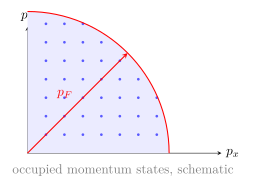
图 1 把“不可全挤进 \(p=0\)”画成填充的 momentum-space states;圆弧不是粒子轨迹。
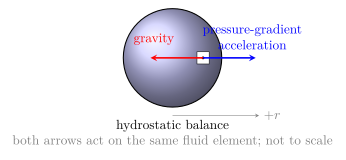
图 2 强调 equilibrium 是每个 fluid element 上 pressure-gradient force 与 gravity 的局域平衡,不是“向外总压”等于“向内总力”的两个孤立箭头。
2. Chandrasekhar mass limit / 钱德拉塞卡质量极限
Knowledge ID: P12-U04-L01-K02
随 \(M\) 增加,\(R\) 减小,电子逐渐进入 relativistic regime。若 \(P\propto\rho^{4/3}\),压力能与引力能对 \(R\) 具有相同的 \(R^{-1}\) 标度;缩小半径不再自动让压力“赢得更快”。完整 relativistic degenerate-electron calculation 给出极限的组成标度:
\[M_{\rm Ch}\simeq\frac{5.83}{\mu_e^2}M_\odot.\]
碳氧白矮星常有 \(\mu_e\simeq2\),于是理想值约 \(1.46M_\odot\);general-relativistic、Coulomb、finite-temperature、rotation 与 electron-capture corrections 会改变实际稳定边界。极限不是“电子简并压突然消失”,而是 relativistic EOS 软化后不存在相应的稳定冷白矮星序列。
白矮星接近极限时可能因 binary mass transfer 或 merger 触发 thermonuclear runaway,也可能在特定组成与电子俘获条件下 collapse;“超过 1.4 \(M_\odot\) 就必定同一种超新星”是错误的,演化路径取决于 composition、accretion rate 和 ignition geometry。
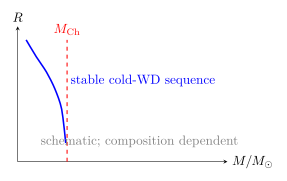
图 3 展示 relativistic calculation 下 \(R\) 向零延伸只是理想模型的极限趋势,不能把零半径当作真实天体。
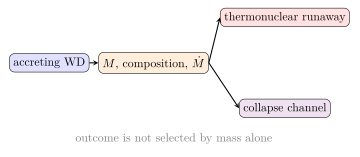
图 4 把极限与演化结果分开:质量是必要信息,但不是唯一 state variable。
3. Neutron degeneracy and nuclear-matter pressure / 中子简并与核物质压强
Knowledge ID: P12-U04-L01-K03
在 core collapse 中,电子俘获和 photodisintegration 降低电子支撑;密度接近 nuclear saturation density 时,物质主要由 neutrons 组成。中子也是 fermions,因此有 degeneracy pressure,但真实 neutron star 的压力还包含 strong-interaction contribution,且可能出现 hyperons、superfluid/superconducting components 或更高密度的 exotic phases。
用 compactness 判断相对论重要性:
\[C=\frac{GM}{Rc^2}.\]
典型 \(M=1.4M_\odot\)、\(R=12\,\mathrm{km}\) 给 \(C\approx0.17\),远非 \(C\ll1\)。因此结构必须由 TOV equation 控制:
\[\frac{dP}{dr}=-\frac{G\left[(\varepsilon+P)/c^2\right]\left(m+4\pi r^3P/c^2\right)}{r^2\left(1-2Gm/(rc^2)\right)}, \qquad \frac{dm}{dr}=4\pi r^2\frac{\varepsilon}{c^2}.\]
这里 \(\varepsilon\) 是 energy density,不应与 mass density 混用。给定 EOS \(P(\varepsilon)\) 和 central density,向外积分至 \(P=0\) 得 \(M,R\);一族 mass–radius curves 才能与 X-ray pulse profiles、tidal deformability 和最大质量约束比较。
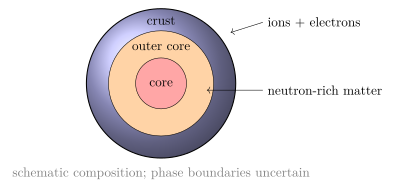
图 5 中层次是模型化的 radial composition;真实边界依 EOS 和 temperature。
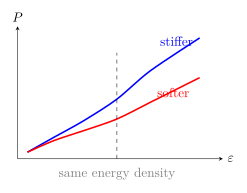
图 6 用 \(P(\varepsilon)\) 比较 stiff/soft EOS;“stiff”指同一 energy density 下 pressure 较高,并非材料日常硬度。
4. Pulsars and rotating magnetospheres / 脉冲星与旋转磁层
Knowledge ID: P12-U04-L01-K04
若 magnetic axis 与 rotation axis 不重合,磁层加速的 charged particles 和 radiation beams 随旋转扫过天空。地球位于 beam path 时观测到周期脉冲,这就是 lighthouse model。Light-cylinder radius 是共转速度达到 \(c\) 的尺度:
\[R_{\rm LC}=\frac{c}{\Omega}=\frac{cP_{\rm spin}}{2\pi}.\]
Rotational energy 为 \(E_{\rm rot}=I\Omega^2/2\)。若 \(P_{\rm spin}\) 缓慢增加,energy-loss rate 的大小为:
\[\dot E_{\rm loss}=4\pi^2I\frac{\dot P}{P_{\rm spin}^3}.\]
Characteristic age \(\tau_c=P/(2\dot P)\) 只在 magnetic-dipole-like braking、初始周期远小于当前周期、恒定 moment of inertia/field 等假设下近似真实年龄。Glitch、timing noise、binary acceleration 与 magnetospheric state changes 会破坏简单模型。
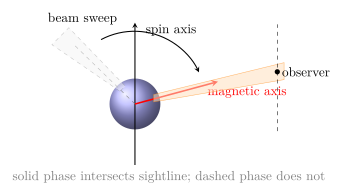
图 7 表明 pulse 是 viewing geometry 的选择效应,不是整颗星周期性“开关”。
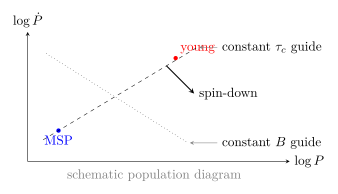
图 8 是 schematic \(P\)–\(\dot P\) plane;magnetic-dipole estimate 下 constant \(B\) guide 的 log–log slope 为 \(-1\),constant \(\tau_c=P/(2\dot P)\) guide 的 slope 为 \(+1\)。
5. Neutron-star mergers and heavy-element production / 中子星并合与重元素产生
Knowledge ID: P12-U04-L01-K05
Binary neutron stars 因 gravitational radiation 失去 orbital energy,frequency 与 amplitude 在 merger 前共同上升。Leading-order chirp 由 chirp mass 控制:
\[\mathcal M=\frac{(m_1m_2)^{3/5}}{(m_1+m_2)^{1/5}}, \qquad \dot f=\frac{96}{5}\pi^{8/3}\left(\frac{G\mathcal M}{c^3}\right)^{5/3}f^{11/3}.\]
Merger ejecta 极端 neutron-rich;快速中子俘获(\(r\)-process)比 beta decay 更快地把 nuclei 推向 neutron-rich side,随后 decay 回到 stability valley。Radioactive decay 加热膨胀 ejecta,产生 kilonova。低 opacity 的 lanthanide-poor ejecta 较早偏 blue,高 lanthanide abundance 提高 opacity 并让 emission 更晚、更 red;这是有多组分和视角依赖的简化框架。
GW170817 同时给出 gravitational waves、short gamma-ray burst 和跨波段 kilonova,建立了 binary-neutron-star merger 与 heavy-element nucleosynthesis 的直接联系。定量 abundance inventory 仍需 merger rate、ejecta mass distribution、nuclear masses/decay rates 与 selection effects。
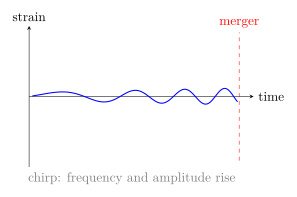
图 9 是 inspiral waveform 的 qualitative sketch;不用于参数估计。
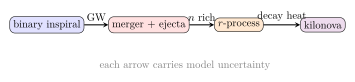
图 10 把观测链拆成不同推断层:GW 测 binary,光谱/光变测 ejecta,核网络连接到 abundance。
Worked Examples / 完整例题
Worked Example 1 — 电子何时接近相对论?
已知: 冷碳氧白矮星局部密度 \(\rho=1.00\times10^9\,\mathrm{kg\,m^{-3}}\),\(\mu_e=2.00\)。
研究对象与边界: 局部均匀、完全简并电子气;离子只计入质量。
坐标/参考系: 白矮星局域静止系;无方向投影。
模型理由: 先用 Fermi momentum 的无温度表达,计算 relativity parameter \(x=p_F/(m_ec)\)。
\[n_e=\frac{\rho}{\mu_em_u} =\frac{1.00\times10^9}{2.00(1.66054\times10^{-27})} =3.01\times10^{35}\,\mathrm{m^{-3}}.\]
\[p_F=\hbar(3\pi^2n_e)^{1/3}=2.19\times10^{-22}\,\mathrm{kg\,m\,s^{-1}}.\]
\[x=\frac{p_F}{m_ec}=0.801.\]
结果: \(x\approx0.80\),电子已处于过渡区,纯非相对论 EOS 只能给粗略估计。若误用 \(E_F=p_F^2/(2m_e)\) 得 \(164\,\mathrm{keV}\);这个值本身已提醒需要 relativistic energy relation。
检查: \(n_e\) 单位是 \(\mathrm{m^{-3}}\);\(p_F/(m_ec)\) 无量纲。密度提高时 \(x\propto\rho^{1/3}\),合理。
物理解释: Chandrasekhar limit 并非神秘额外力,而是大质量白矮星内部电子必然走向 relativistic EOS 的结果。
Worked Example 2 — 白矮星质量—半径标度
已知: 同组成两颗冷、nonrelativistic degenerate white dwarfs,第一颗 \(M_1=0.60M_\odot\)、\(R_1=8.50\times10^6\,\mathrm m\);第二颗 \(M_2=1.00M_\odot\)。
研究对象: 两个球对称 equilibrium sequences。
参考系与模型: stellar rest frame;使用 \(R\propto M^{-1/3}\),忽略 relativistic correction。
方程:
\[R_2=R_1\left(\frac{M_2}{M_1}\right)^{-1/3} =8.50\times10^6(1/0.60)^{-1/3} =7.17\times10^6\,\mathrm m.\]
结果: \(R_2=7.17\times10^6\,\mathrm m\)(3 s.f.)。
检查: 更大质量得到更小半径;量纲保留为 m。
边界检查: \(1.00M_\odot\) 已比 \(0.60M_\odot\) 更 relativistic,真实半径通常比这个简单标度预测得更小;不可把标度外推到 \(M_{\rm Ch}\) 并声称有限半径。
物理解释: mass-radius anti-correlation 是 degenerate-support 的关键可观测特征。
Worked Example 3 — Pulsar 能量账本
已知: \(P_{\rm spin}=0.0330\,\mathrm s\),\(\dot P=4.20\times10^{-13}\),取 \(I=1.40\times10^{38}\,\mathrm{kg\,m^2}\)。
研究对象与系统边界: 中子星的 rotational reservoir;外界辐射/particle wind 是能量流出。
参考系: pulsar barycentric timing frame;\(\dot P>0\) 表示 spin-down。
模型: 刚体近似,\(I\) 在时间尺度上不变。
\[\dot E_{\rm loss}=4\pi^2I\frac{\dot P}{P_{\rm spin}^3} =6.47\times10^{31}\,\mathrm W.\]
Characteristic age:
\[\tau_c=\frac{P}{2\dot P}=3.93\times10^{10}\,\mathrm s =1.25\times10^3\,\mathrm{yr}.\]
结果: spin-down power \(6.47\times10^{31}\,\mathrm W\),\(\tau_c\approx1.25\,\mathrm{kyr}\)。
检查: \(\dot E\) 单位 \(I/P^3=\mathrm{kg\,m^2\,s^{-3}}=\mathrm W\);\(\dot P>0\) 对应 rotational energy 减少。
物理解释: 若 nebular luminosity 小于该预算,rotation can power it;但 \(\tau_c\) 不是无需假设的“生日”。
Worked Example 4 — Inspiral 的 chirp mass
已知: \(m_1=1.40M_\odot\),\(m_2=1.30M_\odot\)。
研究对象与边界: quasi-circular binary,在 inspiral leading-order approximation;忽略 spins/eccentricity/tides。
参考系: binary center-of-mass source frame。
方程:
\[\mathcal M=\frac{(1.40\times1.30)^{3/5}}{(1.40+1.30)^{1/5}}M_\odot =1.17M_\odot.\]
在同一观测 frequency,\(\dot f\propto\mathcal M^{5/3}\)。与 \(1.00+1.00M_\odot\) binary(\(\mathcal M_0=0.871M_\odot\))比较:
\[\frac{\dot f}{\dot f_0}=\left(\frac{1.17}{0.871}\right)^{5/3}=1.63.\]
结果: \(\mathcal M=1.17M_\odot\),在相同 \(f\) 下 chirp 约快 \(1.63\) 倍。
检查: chirp mass 小于总质量且接近 individual masses;比值无量纲。
物理解释: Inspiral phase 对 \(\mathcal M\) 极敏感;individual masses 则与 mass ratio、spin 和 tides 更耦合。
Lesson synthesis / 课程综合
建模链可写成:
- 先由 density 决定 Fermi momentum 和 relativity regime;
- 把 microscopic EOS 放入 hydrostatic equilibrium,得到 mass–radius sequence;
- 识别 EOS softening 与 maximum stable mass,而不是背一个孤立的极限数;
- 用 rotation/magnetic geometry 解释 pulsar observables,并闭合 energy budget;
- 用 GW phase、EM light curves/spectra 与 nuclear network 分层反演 merger 与 nucleosynthesis。
核心统一线索是:观测到的是整体结构和辐射,想知道的是极端密度下的微观物理;中间必须经过一个写明假设的 forward model。
Formula-and-decision table / 公式与决策表
| Need | Relation | Use when | Main limitation |
|---|---|---|---|
| Fermi momentum | \(p_F=\hbar(3\pi^2n_e)^{1/3}\) | cold, fully degenerate electrons | finite \(T\), interactions |
| nonrelativistic degeneracy | \(P\propto\rho^{5/3}\) | \(p_F\ll m_ec\) | fails near high-mass WD core |
| relativistic degeneracy | \(P\propto\rho^{4/3}\) | \(p_F\gg m_ec\) | full structure and corrections needed |
| WD mass-radius | \(R\propto\mu_e^{-5/3}M^{-1/3}\) | low-mass cold WD scaling | not valid near \(M_{\rm Ch}\) |
| compactness | \(C=GM/(Rc^2)\) | decide GR importance | not a full structure model |
| pulsar spin-down | \(\dot E=4\pi^2I\dot P/P^3\) | stable \(I\), intrinsic \(\dot P\) | kinematic/binary corrections |
| chirp mass | \(\mathcal M=(m_1m_2)^{3/5}/(m_1+m_2)^{1/5}\) | quasi-circular inspiral | higher-order spin/tidal effects |
Model boundaries / 模型边界
- Cold-degenerate EOS needs \(T\ll T_F\); young/hot white dwarfs still have thermal envelopes and finite-temperature corrections.
- Chandrasekhar mass is composition-dependent and is not an observed universal threshold with zero uncertainty.
- Neutron degeneracy alone is not a sufficient neutron-star EOS; nuclear interactions and causality matter.
- Newtonian hydrostatic balance is inadequate at neutron-star compactness; TOV input must use energy density consistently.
- Magnetic-dipole braking and characteristic age are diagnostic approximations, not exact chronometers.
- Kilonova color is not a one-to-one “element meter”; geometry, thermalization, opacity atomic data and viewing angle are degenerate.
Misconception clinic / 误区诊所
- “退化压来自电子高速碰撞,所以温度降到零就消失。” 它来自 occupied quantum states;零温仍有 Fermi momentum。
- “白矮星越重越大,因为物质更多。” 在非相对论简并序列上恰相反,\(R\propto M^{-1/3}\)。
- “1.4 \(M_\odot\) 是任何白矮星都精确相同的爆炸按钮。” 组成、GR、rotation 与 accretion history 会改变边界和结局。
- “中子星只是一个巨大的纯中子球。” crust、charged fractions、nuclear interactions 和可能的 phase transitions 都重要。
- “Pulsar 每个周期真的整体变亮一次。” 稳定 beam 随 rotation 扫过 line of sight 即可产生 pulse。
- “观测到金就证明所有金都来自这一次并合。” 单事件说明 channel 可行;cosmic inventory 还需 rate 与 yield population integration。
Practice and retrieval / 练习与提取
- [K01 推导] 从 \(P_c\sim GM^2/R^4\) 和 \(P_e\propto(M/R^3)^{5/3}\) 推导 \(R\propto M^{-1/3}\)。
- [K01 定量] 若 \(\rho\) 增大 8 倍,\(p_F\) 和 nonrelativistic \(P_e\) 各增大几倍?
- [K02 概念] 为什么 \(\gamma=4/3\) 时收缩不能恢复越来越强的压力优势?
- [K02 判断] “测到 \(1.35M_\odot\) 的白矮星,所以它一定立即爆炸。”判断并说明缺失信息。
- [K03 定量] 求 \(M=1.40M_\odot\)、\(R=12.0\,\mathrm{km}\) 中子星的 compactness。
- [K03 模型] TOV equation 中为何出现 \(P/c^2\),这说明 pressure 在 GR 中扮演什么角色?
- [K04 定量] \(P=5.00\,\mathrm{ms}\) 的 pulsar,其 light-cylinder radius 是多少?
- [K04 判断] 观测不到 radio pulses 能否排除该处存在旋转中子星?
- [K05 定量] equal-mass \(1.40+1.40M_\odot\) binary 的 chirp mass 是多少?
- [综合] 设计一个同时约束 neutron-star EOS 与 \(r\)-process ejecta 的最小多信使观测清单。
Answer 1
\[\frac{GM^2}{R^4}\propto\left(\frac{M}{R^3}\right)^{5/3} \Rightarrow M^{1/3}R=\mathrm{constant} \Rightarrow R\propto M^{-1/3}.\]
Answer 2
\(p_F\propto\rho^{1/3}\),故增大 \(8^{1/3}=2\) 倍;\(P_e\propto\rho^{5/3}\),故增大 \(8^{5/3}=32\) 倍。
Answer 3
\(P\propto\rho^{4/3}\propto M^{4/3}R^{-4}\),与 \(P_c\propto M^2R^{-4}\) 对 \(R\) 都是 \(R^{-4}\);收缩不改变二者的相对 \(R\) scaling,质量项决定是否存在平衡。
Answer 4
不能。还需 composition、radius/temperature、rotation、magnetic field、binary mass-transfer rate 与 ignition state;\(1.35M_\odot\) 低于常见理想极限且实际边界不是单一精确数。
Answer 5
\[C=\frac{G(1.40M_\odot)}{(1.20\times10^4)c^2}=0.172.\] 该值不远小于 1,GR structure 必不可少。
Answer 6
在 GR 中 pressure contributes to stress-energy and therefore gravity;同时 pressure 的 inertia 也进入平衡。不能只把 \(\varepsilon/c^2\) 当 Newtonian density 后忽略 pressure terms。
Answer 7
\[R_{\rm LC}=\frac{cP}{2\pi}=\frac{(2.998\times10^8)(5.00\times10^{-3})}{2\pi}=2.39\times10^5\,\mathrm m.\]
Answer 8
不能。Beam 可能未扫过地球,source 可能越过 radio death line、被吸收或在其他 band 才可见;这是 geometry 与 sensitivity selection。
Answer 9
Equal masses 时 \(\mathcal M=m/2^{1/5}\),故 \(\mathcal M=1.40/2^{0.2}=1.22M_\odot\)(3 s.f.)。
Answer 10
至少需要 calibrated GW strain 与 detector response(masses、tides、distance/inclination)、rapid gamma-ray timing/localization、multi-band photometric light curves、time-series spectra、host redshift/extinction;再用一致的 EOS、radiative-transfer 与 nuclear-network priors 做联合 posterior,并报告 selection function。
Exit ticket / 课末检核
- 用一句话分别说明“白矮星极限质量”与“中子星最大质量”的共同逻辑和不同微观来源。
- 若某 kilonova 比模型更红,列出至少三种互相竞争的解释,并指出需要哪类数据破除退化。
References and source notes / 参考资料与来源说明
- OpenStax, Astronomy 2e, 23.1 The Death of Low-Mass Stars — 白矮星、退化支撑和质量—半径关系;accessed 2026-08-30.
- OpenStax, Astronomy 2e, 23.2 Evolution of Massive Stars: An Explosive Finish — core collapse、neutron-star formation 与极限的教学语境;accessed 2026-08-30.
- OpenStax, Astronomy 2e, 23.4 Pulsars and the Discovery of Neutron Stars — lighthouse model、spin-down energy 与观测证据;accessed 2026-08-30.
- NASA Science, Hubble: Stellar Explosions — white dwarfs、Type Ia supernovae 与 Chandrasekhar scale;accessed 2026-08-30.
- LIGO Scientific Collaboration, GW170817 detection page — binary-neutron-star inspiral、EM counterpart 与 primary publication links;accessed 2026-08-30.
- B. P. Abbott et al., “GW170817: Observation of Gravitational Waves from a Binary Neutron Star Inspiral,” Physical Review Letters 119, 161101 (2017), LIGO DCC record — chirp signal、source parameters 与数据产品;accessed 2026-08-30.
- B. P. Abbott et al., “Multi-messenger Observations of a Binary Neutron Star Merger,” ApJL 848, L12 (2017), LIGO science summary — GW/GRB/optical coincidence 与 kilonova context;accessed 2026-08-30.
- MIT OpenCourseWare 8.962, Lecture 20 — Spherical Compact Sources I — static spherical perfect-fluid model、mass function 与 TOV hydrostatic equation;accessed 2026-08-30.
所有 TikZ 均依据本课方程原创;未复制来源插图。EOS、mass limit 与 merger yields 的数值在正文中均注明模型层级。
Source-to-content map / 来源—内容映射
| Source | Used for | Knowledge ID / Section | Model boundary or convention |
|---|---|---|---|
| OpenStax 23.1 | electron degeneracy, WD sequence | K01, K02 | introductory stellar model, not precision EOS |
| OpenStax 23.2 | collapse and neutron-star endpoint | K02, K03 | approximate mass ranges |
| OpenStax 23.4 | pulsar lighthouse and energy | K04 | beaming selection emphasized |
| NASA Hubble stellar explosions | Chandrasekhar scale and Type Ia channel | K02 | mass alone does not specify progenitor path |
| LIGO GW170817 page/DCC | inspiral signal and source evidence | K05, Example 4 | detector-frame inference requires waveform model |
| LIGO multi-messenger summary | coincidence and kilonova | K05, Figure 10 | association is event-based; yields remain model dependent |
| MIT OCW 8.962 Lecture 20 | TOV equation and energy-density convention | K03 | static, spherical, isotropic perfect fluid in GR |
复习与拓展
- 下一课:若 compact object 没有稳定 material surface,event horizon 与 accretion observables 将取代 EOS surface signatures。
- 与 Unit 12.6 连接:binary-merger population、heavy-element chemical evolution 与 cosmological distance inference。
- 可扩展:Lane–Emden solutions、full TOV integration、causal EOS bounds、pulse-profile Bayesian inference、tidal Love numbers、radiative-transfer opacity tables。