
Learning objectives / 学习目标
- 按 physical engine 而非亮度名称区分 nova、thermonuclear/core-collapse supernova 与 long/short GRB;
- 用 power-law spectrum、rigidity 与 air-shower response 解释 cosmic-ray 能量、组成和来源方向为何难反演;
- 说明 neutrino 的弱相互作用如何同时带来穿透优势和小 detection probability,并比较 track/cascade topology;
- 从 quadrupole radiation、strain 和 matched filtering 理解 GW source inference 与 detector network localization;
- 建立 time–sky–distance coincidence likelihood,估 trials/background,解释 joint detection 与 non-detection 都能提供约束。
Prerequisites / 先修知识
- White Dwarfs and Neutron Stars 的 mergers、kilonova 与 chirp mass;
- Black Holes and Accretion 的 jets、beaming 与 variability;
- exponential decay、Poisson counts、probability density 与 Bayes theorem;
- charged-particle motion、Cherenkov radiation、interference 与 Fourier filtering。
Scope and conventions / 范围与约定
- “Transient”需相对 survey cadence 和 reference state 定义;同一 source 对秒级 trigger 是 burst,对年级 monitoring 也可能是 variable。
- GRB 的 \(T_{90}=2\,\mathrm s\) 分界是观测分类的常用近似,不是 progenitor 的无误判物理边界。
- Cosmic-ray energy \(E\) 指 primary reconstructed energy;air shower observables 需 hadronic-interaction model 才映射到 composition。
- Neutrino effective area 已包含 interaction probability、geometry、cuts 与 efficiency,绝不能与 detector geometric area互换。
- GW strain \(h=\Delta L/L\) 为 dimensionless;source distance、inclination、polarization 与 calibration covariance 必须进入 inference。
- Coincidence significance 必须预先定义 search window 或正确计入 trials,报告 false-alarm probability/rate,而非只说“几乎同时”。
Notation and modeling contract / 符号与建模契约
| Symbol | Meaning | SI / convention |
|---|---|---|
| \(F(t),L(t)\) | observed flux and source luminosity | \(\mathrm{W\,m^{-2}}\), W |
| \(E,Z,R_{\rm rig}\) | particle energy, charge number, rigidity | J/eV, 1, V |
| \(r_L\) | Larmor radius | m |
| \(\phi_\nu(E,\Omega,t)\) | differential neutrino number flux | \(\mathrm{m^{-2}\,s^{-1}\,sr^{-1}\,J^{-1}}\) |
| \(\Phi_\nu,A_{\rm eff}\) | neutrino fluence integrated over \(E,\Omega,t\); effective area | \(\mathrm{m^{-2}}\), \(\mathrm{m^2}\) |
| \(h\) | GW strain | 1 |
| \(\rho_{\rm SNR}\) | matched-filter signal-to-noise ratio | 1 |
| \(\Omega\) | sky direction | sr convention |
| \(\Delta t\) | stated coincidence half/full window | s |
| \(\Lambda\) | likelihood ratio/test statistic | 1 |
1. Novae, supernovae, and gamma-ray bursts / 新星、超新星与伽马暴
Knowledge ID: P12-U04-L03-K01
Nova 是 white dwarf surface 上 accreted hydrogen-rich layer 的 thermonuclear runaway;白矮星通常 survives,因此可 recur。Type Ia supernova 是 white dwarf 的 catastrophic thermonuclear disruption channel;core-collapse supernova 则来自 massive star iron core losing support,常留下 neutron star/black hole。三者不能按“nova、supernova 只是大小差一千倍”来理解。
Radioactive decay、shock interaction、magnetar spin-down 等可为 supernova light curve 提供不同 power source。以 \(^{56}\mathrm{Ni}\to{}^{56}\mathrm{Co}\to{}^{56}\mathrm{Fe}\) 为例,若完全 trapping,late luminosity 大致跟 decay rate;ejecta 变稀后 gamma leakage 使下降更快。
Long GRBs 与部分 stripped-envelope massive-star deaths 相联;short GRBs 多与 compact-object merger 相联。Prompt gamma emission 通常 beamed,故 isotropic-equivalent energy:
\[E_{\rm iso}=4\pi D_L^2\frac{S_\gamma}{1+z}\]
不是实际 jet energy;需 beaming correction 与 \(k\)-correction。Duration、spectrum、host、afterglow 和 associated supernova/kilonova 应联合分类。
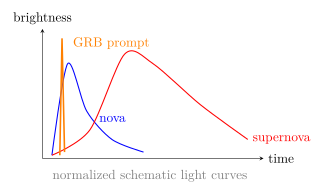
图 1 只比较 timescale/morphology;纵轴已归一化,不能据箭高比较真实 luminosity。
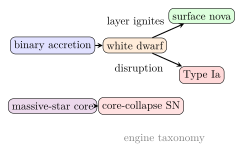
图 2 按 engine 分类,避免以历史命名代替 physical mechanism。
2. Cosmic rays / 宇宙线
Knowledge ID: P12-U04-L03-K02
Cosmic rays 是从 space 到达的 high-energy charged nuclei/electrons。Differential spectrum 近似分段 power law:
\[\frac{dN}{dE}\propto E^{-\gamma},\]
并在 knee、ankle、highest-energy suppression 等处改变 slope。能量越高 flux 越低,因此 direct satellite/balloon detection 向 ground-based extensive-air-shower arrays 过渡。
Charged primaries 在 magnetic field 中偏转;ultrarelativistic Larmor radius:
\[r_L=\frac{p}{ZeB}\simeq\frac{E}{Z e Bc}.\]
Direction retention 取决于 rigidity \(E/Z\)、field coherence 和 path length。Air shower 的 ground particles、fluorescence longitudinal profile、\(X_{\max}\) 与 muon content 可估 energy/composition,但依 atmospheric monitoring 和 hadronic model。
Diffusive shock acceleration 给 power laws 的重要机制图景;然而从 spectrum 到 source class 还需 anisotropy、secondary gamma/neutrino 和 chemical composition,不可把“有 shock”当唯一来源证明。
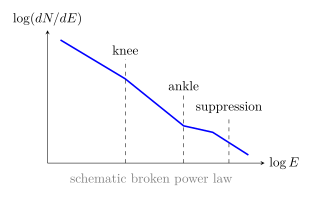
图 3 用 log–log slope 表示 power law;标记位置非按精确能量比例。
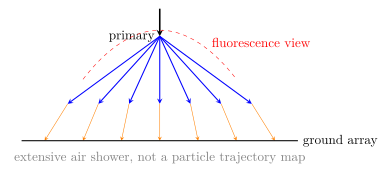
图 4 展示 surface 与 fluorescence hybrid measurement 的互补性。
3. Neutrino astronomy / 中微子天文学
Knowledge ID: P12-U04-L03-K03
Neutrinos 电中性、弱相互作用,能从 photon-opaque cores 逃逸并几乎不被 magnetic fields 偏转;代价是 interaction probability 极小,需要 gigaton-scale targets。Detector 观测的是 neutrino interaction 产生的 charged secondaries 的 Cherenkov light,而非 neutrino 本身。
Expected detected count 一般写成 response integral:
\[N_{\rm det}=\int dE\,d\Omega\,dt\, \phi_\nu(E,\Omega,t)A_{\rm eff}(E,\Omega,t).\]
若在窄能区/方向区内可把 response 视为常数,并已把 differential flux 对时间、能量和立体角积分为 fluence \(\Phi_\nu\),才可近似写成 \(N_{\rm det}\simeq\Phi_\nu A_{\rm eff}\)。
Muon tracks 常有较好 angular resolution、能量 containment 较差;cascades 的 deposited energy 较完整但方向通常较粗。Atmospheric muons/neutrinos 是主背景,up-going selection、starting-event veto 与 energy/zenith likelihood 互补。
Flavor oscillation、interaction cross sections、ice/water optical properties 与 detector calibration 都应进入 source inference。一个 high-energy event 与 blazar 方向重叠不是自动 discovery;要计 sky density、time window、energy prior 和 trials。
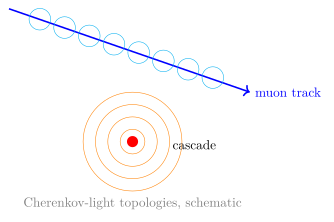
图 5 比较 track/cascade topologies;圆不是 sound waves。
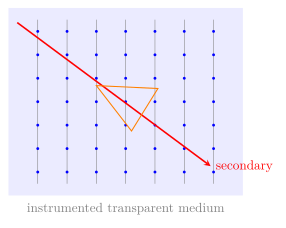
图 6 表明 cubic-kilometer detector 的“面积”必须通过 direction/energy-dependent \(A_{\rm eff}\) 描述。
4. Gravitational-wave astronomy / 引力波天文学
Knowledge ID: P12-U04-L03-K04
Time-varying mass quadrupole emits gravitational waves;spherical collapse alone没有 quadrupole radiation。Interferometer measures differential arm-length strain:
\[h(t)=\frac{\Delta L(t)}{L}.\]
Compact-binary inspiral waveform 的 phase evolution 编码 redshifted chirp mass、mass ratio、spin、tides;amplitude 与 luminosity distance、inclination、antenna pattern 退化。Matched filtering 以 waveform template 在 colored noise 中加权相关,network detector timing/amplitude/phase 用于 sky localization 与 polarization constraints。
Signal significance 通过 noise background(time slides 或 model)给 false-alarm rate;parameter posterior 又需 calibration uncertainty、waveform systematics 与 prior。Detection threshold 不是 universe 的物理边界,而是 pipeline/sensitivity 的 selection function。
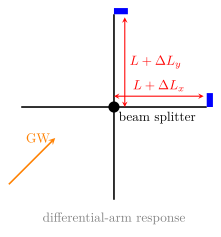
图 7 中 \(\Delta L\) 是极小 differential optical-path change,不是镜子宏观自由漂移。
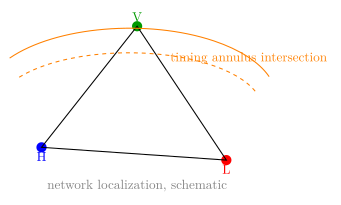
图 8 展示三站 arrival-time differences 将大圆环缩成交叠 sky region;实际 posterior 还含 antenna patterns。
5. Coincidence analysis across messengers / 多信使符合分析
Knowledge ID: P12-U04-L03-K05
同源 hypothesis \(H_s\) 要求不同 data streams 在 source time、sky position、distance/source parameters 上相容;background hypothesis \(H_b\) 允许独立产生。一个示意联合 likelihood ratio 是:
\[\Lambda=\frac{\int d\vartheta\,p(\vartheta) \prod_k p(d_k\mid\vartheta,H_s)} {\prod_k p(d_k\mid H_b)},\]
其中 \(\vartheta\) 可含 sky、distance、event time、inclination 和 source class。不能把各 pipeline 的“sigma”直接相加;需共享参数和 selection effects 的联合模型。
若两个独立 Poisson alert streams rates 为 \(r_1,r_2\),观察时长 \(T\),每个 event 使用 full coincidence width \(w\),稀疏极限 accidental pairs 期望约:
\[\mu_{\rm acc}\simeq r_1r_2wT.\]
再加入 sky overlap probability、energy ranking 可降背景,但若事后尝试许多 windows/source catalogs/bands,必须 trials-correct。GW170817 的强证据不是仅有 \(1.7\) s 延迟,而是 high-significance GW、gamma trigger、consistent sky、host/kilonova 和物理 coherent model 的结合。
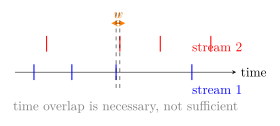
图 9 显示 window width 越大,signal acceptance 与 accidental background 同时增加。

图 10 给出 reproducible coincidence workflow;最后一步包含 upper limits,不只保存“成功配对”。
Worked Examples / 完整例题
Worked Example 1 — GRB 的 isotropic-equivalent energy
已知: gamma fluence \(S_\gamma=2.00\times10^{-5}\,\mathrm{J\,m^{-2}}\),\(D_L=1.00\,\mathrm{Gpc}\),\(z=0.200\);忽略 band \(k\)-correction。
研究对象/边界: prompt photons,source rest-frame energy;假设 isotropic-equivalent bookkeeping。
参考系: \(D_L\) 已包含 cosmological flux relation。
计算: \(D_L=3.0857\times10^{25}\,\mathrm m\),
\[E_{\rm iso}=\frac{4\pi D_L^2S_\gamma}{1+z} =1.99\times10^{47}\,\mathrm J.\]
若 top-hat jet half-angle \(\theta_j=0.100\,\mathrm{rad}\),假设两侧相同的对称 jets;虽然通常只观测到朝向我们的那一侧,总真实能量相对 \(E_{\rm iso}\) 的 beaming factor 为 \(f_b=2\Omega_j/(4\pi)=1-\cos\theta_j\approx\theta_j^2/2=0.00500\):
\[E_\gamma\approx f_bE_{\rm iso}=9.97\times10^{44}\,\mathrm J.\]
检查: beaming-corrected energy 更小;小角近似误差为 \(O(\theta_j^4)\)。
解释: \(E_{\rm iso}\) 是方便比较的 inferred quantity,不是 engine 真正各向同性释放。
Worked Example 2 — Cosmic-ray 的磁偏转尺度
已知: proton \(E=1.00\,\mathrm{PeV}=10^{15}\,\mathrm{eV}\),\(B=3.00\,\mu\mathrm G=3.00\times10^{-10}\,\mathrm T\)。
研究对象与参考系: ultrarelativistic proton in uniform field;取 velocity perpendicular to \(B\)。
模型: \(p\simeq E/c\)。
\[r_L=\frac{E}{eBc} =\frac{10^{15}(1.6022\times10^{-19})} {(1.6022\times10^{-19})(3.00\times10^{-10})(2.9979\times10^8)} =1.11\times10^{16}\,\mathrm m.\]
\[r_L=0.360\,\mathrm{pc}.\]
检查: \(r_L\propto E/(ZB)\);higher \(Z\) 更易偏转。
边界: Galactic field 非 uniform,实际传播是 coherent deflection 加 turbulence/diffusion。
解释: PeV proton 的 direction 在 Galactic path 上难保持,说明 source tracing 需要 rigidity 与 secondary messengers。
Worked Example 3 — Neutrino expected counts
已知: 短时 flare 在一个 narrow energy bin 的 neutrino fluence \(\Phi_\nu=2.00\times10^{-4}\,\mathrm{m^{-2}}\);该方向/能段 event-selection \(A_{\rm eff}=5.00\times10^4\,\mathrm{m^2}\),近似常数。
研究对象/系统边界: 已完成 trigger/cuts 的 detected event sample。
模型: 单 bin,忽略 energy dispersion。
\[N_{\rm det}=\Phi_\nu A_{\rm eff}=10.0.\]
Poisson zero-count probability:
\[P(0\mid\mu=10)=e^{-10}=4.54\times10^{-5}.\]
结果: 期望 10.0 events;若无背景且模型精确,零事件非常不相容。
检查: fluence × effective area 无量纲。
边界: 实际 \(A_{\rm eff}(E,\Omega)\) 强烈变化,必须积分,并加入 background/systematic uncertainty。
Worked Example 4 — Accidental coincidence budget
已知: gamma alerts \(r_\gamma=0.500\,\mathrm{day^{-1}}\),neutrino candidates \(r_\nu=10.0\,\mathrm{day^{-1}}\);观测 \(T=30.0\,\mathrm{day}\);每个 gamma 使用 \(\pm100\,\mathrm s\),full width \(w=200\,\mathrm s=2.3148\times10^{-3}\,\mathrm{day}\)。
研究对象: independent stationary Poisson backgrounds;只做时间符合。
方程:
\[\mu_{\rm acc}=r_\gamma r_\nu wT =(0.500)(10.0)(2.3148\times10^{-3})(30.0)=0.347.\]
至少一个 accidental pair 的概率:
\[P(N\ge1)=1-e^{-0.347}=0.293.\]
结果: 单靠 time window 出现至少一对的概率约 \(29.3\%\),并不显著。
检查: rates × width × time 无量纲;window 加倍则背景期望加倍。
物理解释: 加入 sky posterior、energy ranking 与 source model 才可能显著提升 evidence;事后调 window 要算 trials。
Lesson synthesis / 课程综合
多信使研究不是“多放几种望远镜图”,而是 response-aware statistical inference:每个 messenger 先独立完成 calibration、background 与 selection 建模,再在共同 source parameters 上联合。强结果来自互补信息:photons 定位/介质,cosmic rays 测 charged acceleration,neutrinos 指 hadronic opaque engines,GW 直接测 bulk compact dynamics。
Formula-and-decision table / 公式与决策表
| Need | Relation | Use when | Main limitation |
|---|---|---|---|
| GRB energy bookkeeping | \(E_{\rm iso}=4\pi D_L^2S/(1+z)\) | stated band and fluence | beaming and \(k\)-correction |
| CR rigidity scale | \(r_L\simeq E/(ZeBc)\) | ultrarelativistic uniform field | turbulent path and losses |
| neutrino counts | \(N=\int\Phi A_{\rm eff}\) | calibrated response | energy/direction dependence |
| GW strain | \(h=\Delta L/L\) | detector response basis | antenna/calibration/noise |
| accidental pairs | \(r_1r_2wT\) | rare independent Poisson streams | nonstationarity and overlap |
| joint evidence | likelihood ratio integrated over \(\vartheta\) | shared source model | priors, trials, selection |
Model boundaries / 模型边界
- Historical transient classes mix observed phenomenology and physical progenitors; borderline/peculiar events require multiple features.
- A single power law does not cover the full cosmic-ray spectrum; exposure and energy migration matter.
- Air-shower composition is hadronic-model dependent; \(X_{\max}\) is statistical, not a per-event exact mass label.
- Neutrino non-detection constrains fluence only through stated spectrum, direction and effective area.
- GW waveform templates have finite domains; eccentricity/precession/matter effects may be omitted or approximated.
- Coincidence windows and catalogs selected after seeing the data incur look-elsewhere effects.
Misconception clinic / 误区诊所
- “Nova 是小型 supernova。” Nova 多为 surface runaway 且 WD survives;supernova engine/endpoint different。
- “GRB 的 \(E_{\rm iso}\) 就是实际总能量。” Beaming 和 band/rest-frame corrections are essential。
- “Cosmic rays 从哪个方向来就指向哪个 source。” Charged particles are magnetically deflected according to rigidity。
- “Neutrino 穿透力强,所以容易探测。” 同一弱相互作用让 detector interaction probability 极低。
- “GW detector 是一支会随波抖动的天线。” 它测 laser phase 对 differential spacetime strain 的响应。
- “两个 alerts 相隔一秒就是同源。” 必须与 background rate、sky/distance overlap、search trials 和 physical delay model 比较。
Practice and retrieval / 练习与提取
- [K01 分类] 一颗 WD 每几十年增亮后恢复,最可能是哪类 engine?为何不是 Type Ia?
- [K01 定量] top-hat jet \(\theta_j=0.200\) rad 时小角近似 beaming fraction 是多少?
- [K02 定量] 同 \(E,B\) 下 iron nucleus(\(Z=26\))的 \(r_L\) 是 proton 的几分之一?
- [K02 方法] 为什么 hybrid surface+fluorescence events 能改善 cosmic-ray energy calibration?
- [K03 定量] fluence \(3\times10^{-5}\,\mathrm{m^{-2}}\)、\(A_{\rm eff}=2\times10^5\,\mathrm{m^2}\),求期望 count。
- [K03 比较] Track 与 cascade 各优先提供哪类信息?
- [K04 定量] \(L=4.00\,\mathrm{km}\)、\(h=1.00\times10^{-21}\),求 \(\Delta L\)。
- [K04 概念] 两台 GW detector 为何常给 sky annulus 而非一点?
- [K05 定量] 两 independent streams 各 \(1/\mathrm{day}\),\(T=100\) days,full window 60 s,求 accidental mean。
- [综合设计] 为 short GRB 建立 GW+gamma+optical+neutrino follow-up 与 null-result 保存方案。
Answer 1
Recurrent nova:accreted surface layer runaway 后 WD remains。Type Ia 通常 catastrophic disruption,不会同一 WD 周期复发。
Answer 2
\(f_b\approx\theta_j^2/2=0.200^2/2=0.0200\),约 2.00%。精确 \(1-\cos0.200=0.0199\)。
Answer 3
\(r_L\propto1/Z\),故为 proton 的 \(1/26\);若比较同 energy per nucleon 则需重新定义总 \(E\)。
Answer 4
Fluorescence longitudinal profile provides near-calorimetric energy on clear nights;surface array has high duty cycle. Hybrid events transfer calibration to shower-size estimator and cross-check geometry/atmosphere。
Answer 5
\(N=\Phi A_{\rm eff}=(3\times10^{-5})(2\times10^5)=6.0\) events。
Answer 6
Muon track 通常 direction better;cascade 的 contained deposited energy often better and all-flavor coverage broader。实际 performance depends on energy/geometry/cuts。
Answer 7
\[\Delta L=hL=(1.00\times10^{-21})(4.00\times10^3)=4.00\times10^{-18}\,\mathrm m.\]
Answer 8
One arrival-time difference fixes a constant path-delay locus on the sky, approximately an annulus; additional detector timing and antenna amplitude/phase break degeneracy。
Answer 9
\(w=60/86400=6.944\times10^{-4}\) day,故 \(\mu=(1)(1)(6.944\times10^{-4})(100)=0.0694\)。
Answer 10
Predefine latency/windows and data-quality vetoes;combine GW sky-distance map, gamma time/localization, optical tiling/host redshift, neutrino effective-area likelihood;record coverage, limiting flux, weather/downtime and non-detections;run time slides/injections and publish selection function/trials。
Exit ticket / 课末检核
- 给出一个“有时间符合但不支持同源”的例子和一个“没有检测也强约束物理”的例子。
- 解释为什么把 GW、gamma 与 neutrino 的三个 p-values 相乘通常不是合法联合分析。
References and source notes / 参考资料与来源说明
- OpenStax, Astronomy 2e, 23.3 Supernova Observations — supernova light curves、radioactive powering 与 SN 1987A multi-band evidence;accessed 2026-08-30.
- OpenStax, Astronomy 2e, 23.6 The Mystery of the Gamma-Ray Bursts — long/short GRB phenomenology、beaming 与 progenitors;accessed 2026-08-30.
- NASA Fermi, Investigating Gamma-Ray Bursts — GBM/LAT energy coverage、GRB classes 与 all-sky transient monitoring;accessed 2026-08-30.
- Pierre Auger Observatory, Open Data and energy-spectrum analysis — air showers、exposure、spectrum and hybrid calibration;accessed 2026-08-30.
- IceCube Collaboration, IceCube detector and Research Highlights — Cherenkov detection、effective response、astrophysical neutrinos 与 multi-messenger results;accessed 2026-08-30.
- LIGO Scientific Collaboration, GW170817 — GW trigger、gamma/optical counterparts、publication and data links;accessed 2026-08-30.
- LIGO Scientific Collaboration, The dawn of multi-messenger astrophysics — \(<2\) s GW–GRB delay、sky localization 与 follow-up sequence;accessed 2026-08-30.
- IceCube Collaboration, Public Data Releases — event selection、background/systematics and reproducible source-search data;accessed 2026-08-30.
所有 TikZ 为依据 timing、detector response 与 likelihood concepts 原创的教学 schematic;未复制 observatory figures。
Source-to-content map / 来源—内容映射
| Source | Used for | Knowledge ID / Section | Model boundary or convention |
|---|---|---|---|
| OpenStax 23.3 | SN observables and decay heating | K01 | pedagogical event examples |
| OpenStax 23.6 | GRB duration, beaming, progenitors | K01 | \(2\) s is phenomenological divider |
| NASA Fermi GRBs | gamma detector response and alerts | K01, K05 | field of view and band selection |
| Auger Open Data | CR showers, exposure, spectrum | K02, Example 2 | reconstructed primary is model dependent |
| IceCube detector/research | topology, background, source inference | K03 | \(A_{\rm eff}\) replaces geometry |
| LIGO GW170817 | strain source and multi-messenger event | K04, K05 | waveform/network selection |
| IceCube data releases | reproducible event samples | K03, K05 | cuts/calibration define sample |
复习与拓展
- 下一单元:transients trace stellar populations, star formation, AGN activity and chemical enrichment across galaxies。
- Unit 12.6:GW standard sirens、GRB populations、UHECR propagation and cosmic neutrinos become cosmological probes。
- 可扩展:inhomogeneous Poisson processes、marked point processes、hierarchical population likelihoods、real-time alert brokers、survival analysis and multimessenger selection functions。