
Learning objectives / 学习目标
- 用 disk–bulge/bar–stellar halo–dark halo 的结构和 age–metallicity–kinematics 描述 stellar populations;
- 从 rotation curve 推导 spherical enclosed-mass estimator,并指出 disk geometry、pressure support 和 noncircular motion 的修正;
- 区分 ISM 的 molecular、neutral、ionized 和 hot phases,说明 cooling/heating/pressure balance 与 tracer bias;
- 解释 differential rotation 的 winding problem、density-wave/transient-arm picture 与 gas compression/star formation 的联系;
- 综合 rotation curves、vertical dynamics、satellites、streams 与 lensing 证据,避免把任一 rotation-curve point 当作“直接看见暗物质”。
Prerequisites / 先修知识
- Circular orbit、Poisson equation 和 hydrostatic equilibrium 的基础;
- Stellar spectra、metallicity \([\mathrm{Fe/H}]\)、proper motion、radial velocity;
- Doppler shift、21-cm hyperfine line、molecular tracers 和 dust extinction;
- Probability distribution、measurement uncertainty 与 selection function。
Scope and conventions / 范围与约定
- 采用 Galactocentric cylindrical coordinates \((R,\phi,z)\);\(R\) 是距 Galactic center 的柱半径,不是 heliocentric distance。
- \(v_c(R)\) 是 gravitational potential 定义的 circular speed;观测 mean azimuthal velocity 可因 asymmetric drift 不等于 \(v_c\)。
- \(M(<R)=Rv_c^2/G\) 只在 spherical mass distribution 且 circular equilibrium 下精确;对薄盘是 useful estimator,不是 exact inversion。
- Metallicity 用 logarithmic abundance relative to Sun;“metal-rich”不等于 mass fraction mostly metals。
- ISM phase boundaries 是连续、多压和 time-dependent 的近似分类;tracer-to-mass conversion 如 \(X_{\rm CO}\) 依环境。
- 暗物质结论本课在 standard gravity framework 下表述;modified-gravity alternatives 需同时通过多尺度检验。
Notation and modeling contract / 符号与建模契约
| Symbol | Meaning | SI / astronomy convention |
|---|---|---|
| \(R,z,\phi\) | Galactocentric cylindrical coordinates | m, m, rad |
| \(v_c,\Omega\) | circular speed and angular speed \(v_c/R\) | \(\mathrm{m\,s^{-1}}\), \(\mathrm{s^{-1}}\) |
| \(M(<R)\) | enclosed mass in stated model | kg |
| \(\Sigma,\rho\) | surface and volume mass density | \(\mathrm{kg\,m^{-2}}\), \(\mathrm{kg\,m^{-3}}\) |
| \(\sigma_R,\sigma_z\) | velocity dispersions | \(\mathrm{m\,s^{-1}}\) |
| \([\mathrm{Fe/H}]\) | logarithmic iron abundance relative to Sun | dex |
| \(N_{\rm H}\) | hydrogen column density | \(\mathrm{m^{-2}}\) |
| \(\Sigma_{\rm SFR}\) | star-formation-rate surface density | \(M_\odot\,\mathrm{yr^{-1}\,kpc^{-2}}\) |
1. Galactic components and stellar populations / 星系组成与恒星族
Knowledge ID: P12-U05-L01-K01
Milky Way 是 barred spiral galaxy:thin disk 富含 gas、dust 和 young stars;thick disk 的 stellar scale height/velocity dispersion/age 较大;central bulge/bar 含密集 stars;stellar halo 是低密度、old、metal-poor population 与 globular clusters;更广的 dark halo 由 gravitational effects 定义。
Stellar population 不是只按位置命名,而是 age、chemical abundance 与 phase-space distribution 的联合概率。一个 star 的 \([\mathrm{Fe/H}]\):
\[[\mathrm{Fe/H}]=\log_{10}\left(\frac{N_{\rm Fe}}{N_{\rm H}}\right)_\star- \log_{10}\left(\frac{N_{\rm Fe}}{N_{\rm H}}\right)_\odot.\]
Gaia astrometry 加 radial velocities/abundances 能识别 disk heating、moving groups、streams 和 merger debris。Selection function 对 faint/red/crowded stars 不同,故 raw catalog density 不能直接等同真实 stellar density。
Vertical equilibrium 的简化 isothermal sheet 标度:
\[h_z\sim\frac{\sigma_z^2}{\pi G\Sigma_{\rm tot}},\]
说明更大的 velocity dispersion 或更小 restoring surface density 产生更厚 population;实际 multi-component disk 需 Jeans/Poisson 联立。
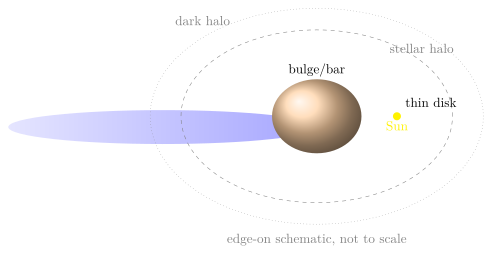
图 1 是 component geometry 的 edge-on schematic;halo ellipses 不表示 sharp physical edges。
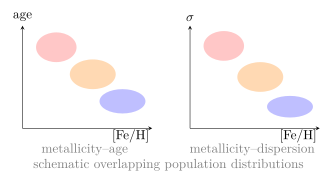
图 2 将 age 与 velocity dispersion 分成两个量纲独立的 panel;两者都与 metallicity 呈统计相关且 populations overlap,所以单一 metallicity cut 不能无误分类。
2. Rotation curves and enclosed mass / 旋转曲线与包围质量
Knowledge ID: P12-U05-L01-K02
Axisymmetric potential \(\Phi(R,z)\) 在 midplane 给 circular speed:
\[v_c^2(R)=R\left.\frac{\partial\Phi}{\partial R}\right|_{z=0}.\]
若质量 spherical:
\[v_c^2(R)=\frac{GM(<R)}{R}, \qquad M(<R)=\frac{Rv_c^2}{G}.\]
若大部分质量集中在中心,\(v_c\propto R^{-1/2}\);若 outer rotation curve flat,spherical estimator 给 \(M(<R)\propto R\)。Luminous disk 的 mass-to-light ratio、gas distribution 和 bulge together 预测 baryonic curve;残差常用 extended dark halo 解释。
Gas 也有 velocity dispersion、warps、bar/spiral streaming;stars 有 asymmetric drift。观测 line-of-sight velocity 必须反投影 inclination/solar motion,并报告 distance errors。Rotation curve 是 dynamical inference,不是直接称重仪读数。
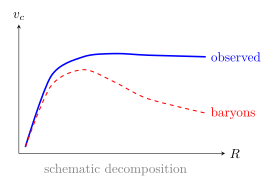
图 3 的“observed minus baryons”不是 linearly subtracting speeds;potential contributions add in \(v_c^2\)。
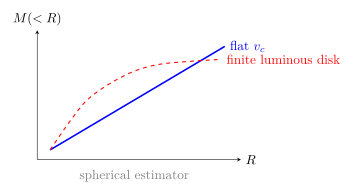
图 4 将 flat speed 转为 linearly growing enclosed-mass inference。
3. Interstellar medium / 星际介质
Knowledge ID: P12-U05-L01-K03
ISM 包含 molecular gas、cold/warm neutral medium、warm ionized medium、hot ionized plasma 与 dust/cosmic rays/magnetic fields。总体平均密度很低,但 filling factor 与 mass fraction 不同:hot gas 可占大 volume,cold clouds 占较多 mass 而 volume 小。
Common tracers:H I 21-cm line tracing neutral atomic hydrogen;CO rotational lines 间接 tracing H\(_2\);H-alpha tracing ionized recombination;X-rays tracing hot plasma;dust emission/extinction tracing column。每种 tracer 都有 optical depth、excitation、chemistry 与 conversion-factor selection。
Thermal pressure \(P=nk_BT\) 只是一部分;turbulence、magnetic and cosmic-ray pressure 可 comparable。Cooling rate 常写 \(\mathcal L=n_en_i\Lambda(T,Z)\),heating/cooling balance 可产生 multiple stable phases,但 shocks/feedback keep ISM dynamic。
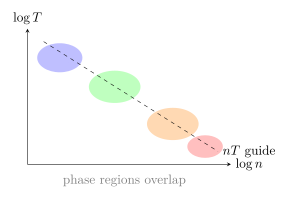
图 5 的 constant-\(nT\) guide 只代表 thermal pressure,真实 phases 还受非热压与 time dependence。

图 6 说明 CO/21-cm/dust map 不是 gas mass 的无模型照片。
4. Spiral structure and star formation / 旋臂结构与恒星形成
Knowledge ID: P12-U05-L01-K04
若 spiral arms 是固定 material arms,differential rotation 会快速 wind them tightly;这就是 winding problem。现代图景包含 quasi-stationary density-wave modes、bar-driven patterns、transient/recurrent arms 与 self-gravitating gas/stellar responses。Stars/gas 可穿过 pattern,pattern speed \(\Omega_p\) 不必等于 material \(\Omega(R)\)。
At corotation \(\Omega(R)=\Omega_p\);Lindblad resonances 还涉及 epicyclic frequency \(\kappa\)。Gas 进入 spiral potential 时可 compress/shock,形成 molecular clouds 和 young-star tracers,但 arms 并非“永远包含同一批 stars”。
Resolved/galaxy-averaged star formation 常用经验 Kennicutt–Schmidt-like relation:
\[\Sigma_{\rm SFR}=A\Sigma_{\rm gas}^{N},\]
或效率 per free-fall time \(\dot M_\star\sim\epsilon_{\rm ff}M_{\rm gas}/t_{\rm ff}\)。\(A,N,\epsilon\) depend on tracer, scale, gas phase and environment;不是 universal exact law。
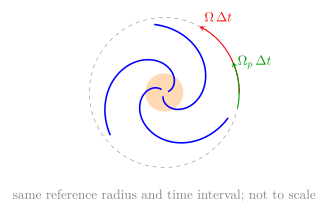
图 7 是 pattern/material distinction schematic;spiral 曲线不代表 individual stellar orbits。
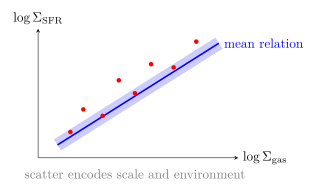
图 8 把 empirical scaling 的 intrinsic/measurement scatter 作为信息而非“坏点”。
5. Evidence for dark matter / 暗物质证据
Knowledge ID: P12-U05-L01-K05
Milky Way dark-matter inference 来自多尺度 consistency:outer rotation curve;local vertical force;satellite/stellar-halo kinematics;tidal streams;escape speed;microlensing bounds on compact objects;与 cosmological structure/CMB 的 shared matter density。每种 probe 有不同 baryonic/systematic degeneracies。
Density profiles 常以 spherical halo models 表示,例如 NFW:
\[\rho(r)=\frac{\rho_s}{(r/r_s)(1+r/r_s)^2},\]
但 inner cusp/core、triaxiality、baryonic contraction/feedback 和 disequilibrium 都会改变 inference。Profile 参数是模型摘要,不是 dark-matter particle identity。
Tidal stream 是 phase-space ruler:subhalos 可造成 density gaps/velocity kicks,global halo shape causes orbital precession;但 molecular clouds、bar/spiral perturbations 和 progenitor dynamics 也能制造 features。Evidence 应靠 cross-probe closure。
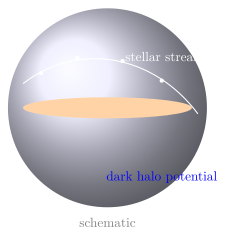
图 9 表示 stream responds to total potential;它不是 halo 物质本身的发光轨迹。

图 10 强调 dark halo inference 必须传播 luminous-mass 与 selection uncertainty。
Worked Examples / 完整例题
Worked Example 1 — Stellar population 的 scale height
已知: \(\sigma_z=20.0\,\mathrm{km\,s^{-1}}\),总 restoring surface density \(\Sigma_{\rm tot}=50.0M_\odot\,\mathrm{pc^{-2}}\)。
研究对象/边界: local isothermal tracer population,plane-parallel equilibrium;忽略 radial coupling。
坐标: \(z\) 垂直 Galactic plane,midplane \(z=0\)。
换算: \(\Sigma=50(1.9885\times10^{30})/(3.0857\times10^{16})^2=0.1044\,\mathrm{kg\,m^{-2}}\)。
\[h_z=\frac{(2.00\times10^4)^2}{\pi(6.6743\times10^{-11})(0.1044)} =1.83\times10^{19}\,\mathrm m=593\,\mathrm{pc}.\]
结果: \(h_z\approx593\,\mathrm{pc}\)。
检查: \(h_z\propto\sigma_z^2\);更 hot population 更厚。
边界: coefficient depends on adopted vertical profile and multi-component gravity;此为 scale estimate。
Worked Example 2 — Solar-radius enclosed-mass estimator
已知: \(R=8.20\,\mathrm{kpc}\),\(v_c=220\,\mathrm{km\,s^{-1}}\)。
研究对象与模型: spherical circular-equilibrium estimator;Galactocentric frame。
计算:
\[M(<R)=\frac{Rv_c^2}{G} =\frac{[8.20(3.0857\times10^{19})](2.20\times10^5)^2}{6.6743\times10^{-11}} =1.84\times10^{41}\,\mathrm{kg}.\]
\[M(<R)=9.23\times10^{10}M_\odot.\]
结果: spherical-equivalent enclosed mass \(9.23\times10^{10}M_\odot\)。
检查: \(M\) increases linearly with \(R\) for fixed flat \(v_c\)。
边界: Milky Way disk is flattened;do not interpret as exact spherical mass profile。
Worked Example 3 — 21-cm radial velocity
已知: rest frequency \(\nu_0=1420.406\,\mathrm{MHz}\),observed \(\nu=1419.906\,\mathrm{MHz}\);radio nonrelativistic convention \(v_r/c\approx(\nu_0-\nu)/\nu_0\)。
研究对象: emitting H I cloud relative to chosen local standard; positive receding。
计算:
\[v_r=(2.9979\times10^5\,\mathrm{km\,s^{-1}}) \frac{0.500}{1420.406}=105.5\,\mathrm{km\,s^{-1}}.\]
结果: \(v_r=+105.5\,\mathrm{km\,s^{-1}}\)(receding)。
检查: lower observed frequency means redshift/positive receding in the stated convention。
边界: Galactic kinematic distance can be double-valued and disturbed by noncircular motion。
Worked Example 4 — Gas depletion time
已知: \(\Sigma_{\rm gas}=10.0M_\odot\,\mathrm{pc^{-2}}\),\(\Sigma_{\rm SFR}=5.00\times10^{-3}M_\odot\,\mathrm{yr^{-1}\,kpc^{-2}}\)。
系统边界: fixed region,忽略 inflow/outflow/recycling;depletion time \(t_{\rm dep}=\Sigma_{\rm gas}/\Sigma_{\rm SFR}\)。
换算: \(10.0M_\odot\,\mathrm{pc^{-2}}=1.00\times10^7M_\odot\,\mathrm{kpc^{-2}}\)。
\[t_{\rm dep}=\frac{1.00\times10^7}{5.00\times10^{-3}}\,\mathrm{yr} =2.00\times10^9\,\mathrm{yr}.\]
结果: \(t_{\rm dep}=2.00\,\mathrm{Gyr}\)。
检查: surface-area units cancel;higher SFR gives shorter time。
解释: This is not cloud lifetime;it is population-average reservoir/use rate under stated boundary。
Lesson synthesis / 课程综合
Milky Way inference 的顺序是:定义 coordinates/reference motion → 处理 catalog selection/error → 将 stars/gas 分 population/tracer → 用 Jeans/orbit/gas models 求 total potential → 以 baryonic model 分解 → 用 streams/satellites/vertical/rotation probes 交叉检验 halo。Structure、ISM、spiral 和 star formation 都是 time-dependent components,不能把单张 map 当 equilibrium truth。
Formula-and-decision table / 公式与决策表
| Need | Relation | Use when | Main limitation |
|---|---|---|---|
| metallicity | logarithmic abundance ratio | calibrated stellar spectra | element/atmosphere systematics |
| vertical scale | \(h_z\sim\sigma_z^2/(\pi G\Sigma)\) | local isothermal sheet estimate | multiple components/non-equilibrium |
| circular speed | \(v_c^2=R\partial_R\Phi\) | axisymmetric midplane potential | bars/spirals/warps |
| enclosed mass | \(M=Rv_c^2/G\) | spherical circular model | flattened disk |
| Doppler velocity | \(v/c\simeq\Delta\nu/\nu\) | nonrelativistic stated convention | frame and optical/radio convention |
| depletion time | \(\Sigma_{\rm gas}/\Sigma_{\rm SFR}\) | fixed-area reservoir | inflow, outflow, recycling |
Model boundaries / 模型边界
- Gaia phase-space catalog is magnitude/color/crowding selected and has correlated astrometric errors。
- Steady Jeans analysis can be biased by bar, spiral, bending waves and merger disequilibrium。
- Spherical enclosed-mass estimator is not exact for the disk-dominated inner Galaxy。
- ISM tracers require opacity/excitation/abundance conversion; CO-dark H\(_2\) and optically thick H I matter。
- Spiral arms may be transient or multiple patterns; no single universal density-wave picture fits all radii/times。
- Dark-matter profile inference depends on baryonic mass and gravity law; particle identity requires non-gravitational or cosmological evidence。
Misconception clinic / 误区诊所
- “Thin disk、thick disk、halo 是互不重叠盒子。” 它们是 overlapping phase-space/chemistry distributions。
- “Rotation speed 直接给 enclosed mass,和形状无关。” \(Rv^2/G\) assumes spherical circular equilibrium。
- “21-cm brightness 直接就是 H I mass。” optical depth、spin temperature、beam and distance enter。
- “Spiral arms 由同一批 stars 永久组成。” pattern and material rotate differently;stars cross arms。
- “Star formation relation 是每朵 cloud 的确定性定律。” 它是 scale/tracer-dependent empirical population relation。
- “Flat rotation curve 单独决定暗物质粒子是什么。” 它 constrains total potential;particle nature remains open。
Practice and retrieval / 练习与提取
- [K01] \([\mathrm{Fe/H}]=-1.0\) 表示 iron-to-hydrogen ratio 是 solar 的多少?
- [K01] 若 \(\sigma_z\) 加倍且 \(\Sigma\) 不变,isothermal scale height 如何变?
- [K02] Flat \(v_c\) 下 \(R\) 从 10 kpc 到 20 kpc,spherical \(M(<R)\) ratio?
- [K02] 为什么 stellar mean rotation 常小于 circular speed?
- [K03] 比较 H I 21-cm、CO、H-alpha、X-ray 各主要追踪的 phase。
- [K03] 同 thermal pressure 下 \(T\) 高 100 倍的 phase,其 \(n\) 如何变?
- [K04] 写出 material-arm picture 的 winding problem。
- [K04] \(\Sigma_{\rm gas}\) 加倍且 \(N=1.4\),\(\Sigma_{\rm SFR}\) 变多少倍?
- [K05] 给出三项彼此系统误差不同的 Milky Way dark-matter probes。
- [综合] 设计一条从 Gaia+radio data 到 halo posterior 的 audit trail。
Answer 1
\(10^{-1}=0.10\) 倍 solar iron-to-hydrogen ratio;不是说 star 总金属质量恰为 solar 的 0.10。
Answer 2
\(h_z\propto\sigma_z^2\),故加倍 \(\sigma_z\) 使 \(h_z\) 增为 4 倍,限于同一 sheet model。
Answer 3
\(M\propto R\),所以 ratio \(20/10=2\)。
Answer 4
Random motions provide pressure support;radial density/dispersion gradients cause asymmetric drift, so mean azimuthal speed need not equal \(v_c\)。
Answer 5
H I 21-cm:neutral atomic;CO:molecular-gas proxy;H-alpha:warm ionized/recombination;X-ray:hot plasma。每项都有 excitation/opacity/selection boundaries。
Answer 6
\(P=nkT\) 固定时 \(n\propto1/T\),故 density 降至 \(1/100\);非热压存在时不可直接应用。
Answer 7
Differential rotation gives radius-dependent \(\Omega\),fixed material feature 会在少数 rotations 内越缠越紧,与普遍开放 spiral patterns 不符。
Answer 8
\(2^{1.4}=2.64\) 倍。
Answer 9
例如 outer gas rotation curve、local vertical stellar kinematics、satellite/stream orbits(也可加 escape speed/microlensing);它们对 baryons、disequilibrium、geometry 的敏感性不同。
Answer 10
记录 coordinate/solar-motion transform、catalog selection/parallax covariance、tracer population model、gas distance/conversion、nonaxisymmetric masks、Jeans/orbit likelihood、baryonic mass priors、halo profile/gravity alternatives、mock recovery and posterior predictive checks。
Exit ticket / 课末检核
- 解释为何同一 flat rotation curve 可由不同 disk–bulge–halo decompositions 拟合,并提出破除退化的数据。
- 一条 stellar stream 出现 gap。列出 dark subhalo 以外至少两种解释及 discriminating observables。
References and source notes / 参考资料与来源说明
- OpenStax, Astronomy 2e, 25.1 The Architecture of the Galaxy — disk、bulge、stellar halo、populations 与 dark halo;accessed 2026-08-30.
- OpenStax, Astronomy 2e, 25.2 Spiral Structure — 21-cm mapping、differential rotation、winding problem 与 spiral models;accessed 2026-08-30.
- OpenStax, Astronomy 2e, 25.3 The Mass of the Galaxy — rotation curve、mass inference 与 dark-matter evidence;accessed 2026-08-30.
- OpenStax, Astronomy 2e, 20.1 The Interstellar Medium — gas/dust inventory and ISM phases;accessed 2026-08-30.
- ESA Gaia, Composition, Formation and Evolution of the Galaxy — astrometry、kinematics、chemistry 与 Galactic archaeology design;accessed 2026-08-30.
- ESA Gaia, Taking the Galactic Census — survey selection and structural components;accessed 2026-08-30.
- OpenStax, Astronomy 2e, 25.6 The Formation of the Galaxy — collapse/merger histories and stellar-population evidence;accessed 2026-08-30.
所有 TikZ 均按动力学和 tracer-response equations 原创,component sizes 均标明 schematic。
Source-to-content map / 来源—内容映射
| Source | Used for | Knowledge ID / Section | Model boundary or convention |
|---|---|---|---|
| OpenStax 25.1 | Galactic components/populations | K01 | overlapping populations emphasized |
| OpenStax 25.2 | spiral structure and 21-cm map | K03, K04 | differential rotation not sufficient alone |
| OpenStax 25.3 | rotation curve and dark mass | K02, K05 | spherical estimator flagged |
| OpenStax 20.1 | ISM inventory/phases | K03 | phase classification approximate |
| ESA Gaia science report | astrometry and Galactic archaeology | K01, K02, K05 | survey selection and covariance |
| OpenStax 25.6 | formation/merger context | K01, K04 | multiple assembly channels |
复习与拓展
- 下一课将把 Milky Way 的 component/dynamics framework 推广到 morphology、scaling relations 与 AGN host galaxies。
- 与 Unit 12.6 连接:dark halo and galaxy bias are tracers of cosmological matter distribution。
- 可扩展:collisionless Boltzmann equation、Jeans actions、epicyclic theory、Toomre \(Q\)、radiative transfer、stream gap likelihoods。