
Learning objectives / 学习目标
- 用 Sérsic profile、color、kinematics、gas fraction 和 scaling relations 描述 galaxies,而不把 Hubble type 当 evolutionary sequence;
- 区分 hierarchical assembly、major/minor mergers、secular evolution、environmental quenching 与 progenitor bias;
- 由 Eddington ratio、radiative efficiency 和 duty cycle 连接 SMBH growth 与 observed luminosity;
- 用 AGN unification 的 orientation/obscuration 框架解释 quasar、Seyfert、radio galaxy/blazar 的共同核心与非统一差异;
- 比较 radiative/wind/jet feedback energy、momentum 与 gas binding/cooling,说明正/负反馈和 subgrid uncertainty。
Prerequisites / 先修知识
- The Milky Way and Galactic Dynamics 的 disk/bulge/halo、rotation curve 和 stellar populations;
- Black Holes and Accretion 的 \(L=\eta\dot Mc^2\)、Eddington luminosity、jets;
- Flux/luminosity、surface brightness、Doppler broadening、lookback time;
- Correlation、selection bias 与因果 inference 的基本区别。
Scope and conventions / 范围与约定
- Galaxy morphology 是 wavelength、resolution、surface-brightness limit 和 viewing angle dependent;本课不把 ellipse/spiral/irregular 当 immutable species。
- Stellar mass \(M_\star\) depends on IMF、stellar-population synthesis、dust and star-formation history;所有 scaling relations have scatter。
- “Merger”通常指 gravitationally interacting galaxies coalescing;stars rarely collide directly,gas shocks/dissipates。
- AGN luminosity 用 bolometric luminosity when evaluating Eddington ratio;single-band luminosity requires bolometric correction。
- Unification by orientation explains many differences but not all; accretion state、mass、host、magnetic flux and evolution also matter。
- Feedback “energy exceeds binding energy”是必要量级检查,不保证 coupling geometry/timescale 足以驱走 gas。
Notation and modeling contract / 符号与建模契约
| Symbol | Meaning | SI / convention |
|---|---|---|
| \(I(R),R_e,n\) | surface brightness, effective radius, Sérsic index | intensity, m/kpc, 1 |
| \(M_\star,L,v_{\rm rot},\sigma\) | stellar mass, luminosity, rotation speed, dispersion | kg/\(M_\odot\), W, \(\mathrm{m\,s^{-1}}\) |
| \(M_{\rm BH}\) | central black-hole mass | kg/\(M_\odot\) |
| \(\lambda_{\rm Edd}\) | \(L_{\rm bol}/L_{\rm Edd}\) | 1 |
| \(\eta\) | radiative efficiency | 1 |
| \(f_{\rm duty}\) | active duty fraction | 1 |
| \(\epsilon_f\) | feedback coupling efficiency | 1 |
| \(\dot E,\dot p\) | feedback energy/momentum flux | W, N |
1. Galaxy morphology and scaling relations / 星系形态与标度关系
Knowledge ID: P12-U05-L02-K01
Spiral/lenticular/elliptical/irregular labels summarize visible structure;quantitative description needs bulge-to-total ratio、Sérsic index、axis ratio、color、specific SFR、gas fraction and kinematics. Sérsic profile:
\[I(R)=I_e\exp\left\{-b_n\left[\left(\frac{R}{R_e}\right)^{1/n}-1\right]\right\}.\]
\(n\approx1\) resembles exponential disk,\(n\approx4\) a concentrated de Vaucouleurs-like spheroid;real galaxies can have bars、breaks、multiple components,so a one-component \(n\) is not a physical identity。
Scaling relations compress dynamical/formation information:disk Tully–Fisher-like \(L\propto v_{\rm rot}^\alpha\);elliptical Faber–Jackson-like \(L\propto\sigma^\gamma\);fundamental plane links \(R_e\)、surface brightness and \(\sigma\)。Slopes/scatter depend on band、mass、redshift and sample selection。
从物理图景看,形态不是贴在星系上的永久标签,而是不同物质成分和轨道族在投影面上的综合结果。冷气体耗散能量后容易形成旋转盘;恒星主要通过无碰撞引力重排,随机轨道占优时形成较“热”的球状成分;bar、dust lane 与 star-forming clumps 又会让同一星系在紫外、可见光和红外中呈现不同类型。因此分类前必须先声明波段、空间分辨率、面亮度阈值和倾角。
标度关系也不是“由一个量决定另一个量”的因果定律。Rotation speed 同时响应总势阱,luminosity 则依 stellar population、dust 与 mass-to-light ratio;二者相关反映 galaxy assembly 的统计规律。真正有诊断力的是斜率、零点、intrinsic scatter 以及 residuals 是否再与 size、gas fraction 或 environment 相关。
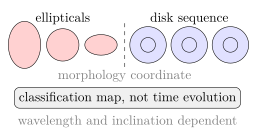
图 1 把 Hubble-like sequence 明确标为 classification map,不是 galaxy 必经的时间路线。
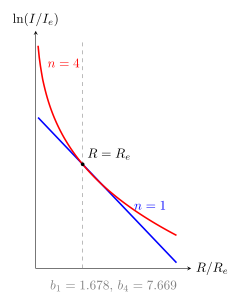
图 2 按 Sérsic normalization 绘制 \(\ln(I/I_e)\);两条曲线严格在 \((R/R_e,\ln I/I_e)=(1,0)\) 相交,且 \(n=4\) 同时具有更高中心浓度与更宽外翼。
2. Galaxy formation, mergers, and evolution / 星系形成、并合与演化
Knowledge ID: P12-U05-L02-K02
在 hierarchical picture 中 dark-matter halos grow by accretion/mergers,gas cools into potential wells、forms stars and is reheated/ejected by feedback。Galaxy stellar body need not mirror halo assembly one-to-one;gas cooling time、angular momentum、environment and feedback regulate baryons。
Major merger 可 destroy/rebuild disks、produce tidal tails/starburst and transform kinematics;minor mergers thicken disks/build halos;secular bars move angular momentum and gas。Ram-pressure stripping、strangulation and tidal processing in groups/clusters can quench satellites without a major merger。
看 distant galaxies 是 lookback snapshot,不是追踪同一个 object。Comparing redshift bins faces progenitor bias、surface-brightness dimming、morphological \(k\)-correction and mass completeness。可信 evolution result requires forward-modeled selection or number-density/progenitor matching。
在一次并合中,最先改变的往往不是恒星“相撞”,而是两个势阱对轨道的潮汐扭矩和气体的碰撞耗散。恒星可被抛入长 tidal tails,gas 则能失去角动量流向中心,引发 starburst 或 AGN;随后 violent relaxation 改写轨道分布。结果是否成为 elliptical、重新长出 disk,取决于 mass ratio、gas fraction、orbital geometry 和后续 gas accretion,不能由一张 merger image 唯一决定。
比较不同时代时还要区分“同一批对象随时间改变”和“样本成员发生替换”。例如某个高红移 blue galaxy 可能在低红移已 quench 而进入 red sample,另一些低质量对象后来才长到 selection threshold。若不把这种进出样本的概率放进 forward model,表面上的平均 size 或 color 演化可能主要是 selection 演化。
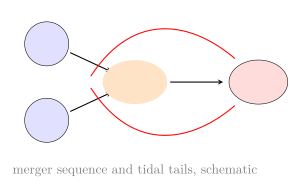
图 3 中 tidal tails carry orbital angular momentum;两盘变一椭圆只是 possible outcome,not universal。
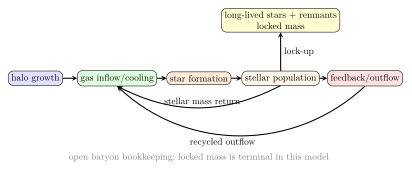
图 4 把 galaxy evolution 表成开放账本,不是单向“气体全变恒星”:star formation 先产生完整 stellar population;其中一部分成为 long-lived stars/remnants 的终端 locked reservoir,stellar mass return 则从尚未锁定的完整 population 回到 gas,feedback-driven outflow 还可经历更长时标的 recycle。
3. Supermassive black holes and accretion / 超大质量黑洞与吸积
Knowledge ID: P12-U05-L02-K03
Massive galaxies 普遍含 central SMBH;dynamical masses and correlations such as \(M_{\rm BH}\)–\(\sigma\) suggest co-assembly but do not by themselves prove feedback causation。SMBH grows mainly through accretion plus mergers;radiatively efficient growth obeys:
\[L=\eta\dot M_{\rm in}c^2, \qquad \dot M_{\rm BH}=(1-\eta)\dot M_{\rm in}.\]
Eddington ratio \(\lambda_{\rm Edd}=L_{\rm bol}/L_{\rm Edd}\) characterizes state;Salpeter-like e-folding time scales as \(t\propto[\eta/(1-\eta)]/\lambda_{\rm Edd}\)。Early massive quasars therefore constrain seed mass、duty cycle、efficiency and possible super-Eddington phases jointly。
Gas supply must lose angular momentum from kpc to sub-pc scales;bars/mergers/cloud torques can help,但 merger presence neither necessary nor sufficient for every AGN。Obscuration and variability make instantaneous luminosity a noisy tracer of long-term growth。
SMBH 的“供油”难点可以理解为角动量阶梯:星系尺度扰动只能把气体送到中央几百 parsec,nuclear spirals、cloud collisions、gravitational torques 和 magnetized disk stresses 还要继续工作,才能让少量物质跨过更小尺度。于是 host 中拥有大量冷气体并不保证当前 nucleus 明亮,反之一次短暂 bright phase 也不能代表长期平均 accretion rate。
Black-hole mass 是长期积分量,AGN luminosity 是快速变化量。研究共同演化时,应把 luminosity function、obscured fraction、Eddington-ratio distribution 与 duty cycle 联合起来,再同 local relic \(M_{\rm BH}\) density 比较;不能用某一瞬间的 \(L/M_\star\) 直接当作整段历史的增长比。
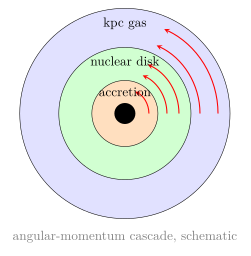
图 5 说明 fueling problem 跨越多尺度;外层有 gas 不等于它必到 horizon。
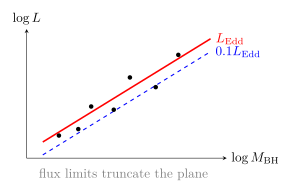
图 6 示意 mass–luminosity–Eddington ratio plane;observed sample edges depend on flux selection。
4. Quasars and active galactic nuclei / 类星体与活动星系核
Knowledge ID: P12-U05-L02-K04
AGN 是 host galaxy nucleus 中由 accreting SMBH powered 的 compact luminous source。Quasar 通常指 high-luminosity AGN;Seyfert、radio galaxy、blazar 等标签来自 luminosity、lines、radio loudness and orientation-related observables,边界并非完全统一。
Key signatures:nonstellar broad-band continuum、broad/narrow emission lines、rapid variability、high-ionization lines、compact radio/X-ray core、jets。Variability gives causal size \(R\lesssim c\Delta t/(1+z)\) absent relativistic beaming corrections。
Orientation unification:dusty torus may hide broad-line region;jet pointed toward us is Doppler boosted as blazar。Yet covering factor、accretion rate/state、black-hole mass、host and evolution create intrinsic diversity。Radio-loud/radio-quiet dichotomy and changing-look AGN show pure geometry is incomplete。
AGN 光谱的物理图景是多尺度再处理:inner disk 产生主要连续谱,hot corona 可 Compton upscatter 成 X-rays,broad-line clouds 在更外侧高速运动,dusty structure 吸收短波并在 infrared 重辐射,kiloparsec narrow-line gas 则响应 escaping ionizing radiation。不同视线遮住的层次不同,所以“看不见 broad line”既可能是 orientation,也可能是 intrinsic state 或 sensitivity 的结果。
图 7 的 torus 和双锥是信息组织图,不应想成刚性、光滑且永远轴对称的甜甜圈。Clumpy obscuration、warps 和 time-variable covering 会改变 classification;图 8 的 spectral components 也说明,测量 aperture 越大,host starlight contamination 越强,必须先做分解才估 bolometric luminosity。
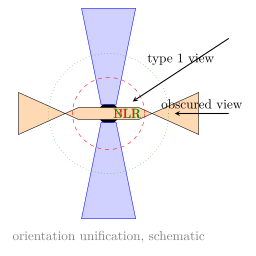
图 7 显示 torus/BLR/NLR/jet geometry;torus 不是 perfectly smooth rigid doughnut。
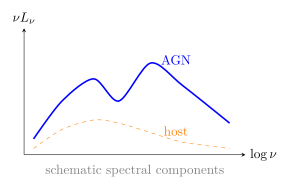
图 8 表明 host contamination 随 band/aperture 改变;AGN bolometric correction 不可从单点 universal extrapolate。
5. Feedback between galaxies and black holes / 星系与黑洞反馈
Knowledge ID: P12-U05-L02-K05
AGN radiation、disk winds and jets inject energy/momentum into interstellar/circumgalactic/intracluster gas。Feedback 可 suppress star formation(heat/expel/prevent cooling)也可 trigger localized collapse(compress clouds);net effect depends on coupling、timescale、phase structure and replenishment。
基本账本:
\[E_{\rm fb}=\epsilon_f\eta\Delta M_{\rm in}c^2, \qquad \dot p_{\rm rad}=\frac{L}{c}.\]
Compare with gas binding \(E_{\rm bind}\sim fGM_{\rm tot}M_g/R\) or virial scale \(\sim M_g\sigma^2\) and cooling \(L_{\rm cool}\)。Energy sufficient does not imply correct location/phase;narrow jet may escape, or inflate cavities and distribute heat through shocks/turbulence。
Observed correlations \(M_{\rm BH}\)–bulge properties、quenching around massive galaxies、X-ray cavities and molecular outflows motivate feedback,but correlations plus selection do not uniquely determine subgrid prescription。Simulations tune/validate feedback across stellar masses、gas fractions、entropy profiles and redshifts。
反馈的关键不是“黑洞能量很大”这一事实,而是能量或动量在什么半径、以什么相态、用多长时间耦合。Radiation 可能只加速 dust-bearing gas,fast wind 可在 shocks 中热化,radio jet 可穿透 disk 后在 halo/cluster gas 中膨胀 cavity。若能量主要沿低密度通道逸出,中央冷云仍可形成恒星;若反复加热 circumgalactic gas,则即使不立即吹走 disk,也能阻止长期冷却补给。
正反馈与负反馈并不互斥:同一 outflow 可清空 nucleus,同时压缩边缘 cloud;观测上需要 spatially resolved gas velocity、temperature、density、star-formation age 和 energy budget,而不是只比较 global AGN luminosity 与 global SFR。数值模型还要在不同质量和红移上同时重现 stellar mass function、gas fractions、black-hole demographics 与 ICM thermodynamics,才算跨尺度闭合。
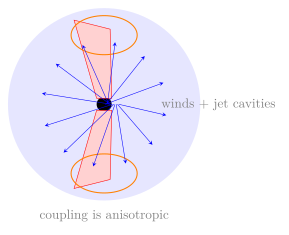
图 9 展示 radiative/wind 与 collimated jet 的不同 coupling geometry。
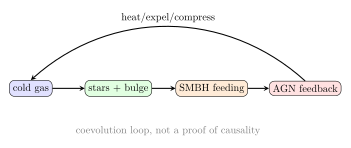
图 10 把 coevolution 表成 feedback loop,提示 simultaneous correlations can arise from shared gas supply。
Worked Examples / 完整例题
Worked Example 1 — 形态参数不是演化年龄
已知: projected axis ratio \(b/a=0.700\) 的 smooth elliptical candidate;历史 Hubble ellipticity class \(E_n\) uses \(n\approx10(1-b/a)\)。
研究对象/参考系: projected image plane;忽略 PSF and triaxial deprojection。
计算:
\[n=10(1-0.700)=3.00.\]
结果: projected class E3。
检查: \(b/a=1\) gives E0;more flattened gives larger \(n\)。
边界: This does not say “third evolutionary stage”;intrinsic triaxial shape and viewing angle are degenerate。
Worked Example 2 — Tully–Fisher scaling
已知: 同一 band/sample relation \(L\propto v_{\rm rot}^4\);galaxy A \(v_A=250\,\mathrm{km\,s^{-1}}\),B \(v_B=200\,\mathrm{km\,s^{-1}}\)。
研究对象: calibrated disk-galaxy population;inclination corrected。
计算:
\[\frac{L_A}{L_B}=\left(\frac{250}{200}\right)^4=2.44.\]
Magnitude difference:
\[M_A-M_B=-2.5\log_{10}(2.44)=-0.968\,\mathrm{mag}.\]
结果: A predicted 2.44 times luminous,about 0.97 mag brighter。
检查: faster rotation → larger luminosity in stated relation。
边界: scatter、band、gas fraction and selection mean this is statistical, not exact per galaxy。
Worked Example 3 — SMBH Eddington accretion scale
已知: \(M_{\rm BH}=1.00\times10^8M_\odot\),\(\eta=0.100\),\(L=L_{\rm Edd}\)。
系统边界: radiatively efficient inflow,\(\dot M_{\rm in}\) defined before radiation loss。
计算:
\[L_{\rm Edd}=1.26\times10^{39}\,\mathrm W,\]
\[\dot M_{\rm in}=\frac{L}{\eta c^2}=1.40\times10^{23}\,\mathrm{kg\,s^{-1}} =2.22M_\odot\,\mathrm{yr^{-1}}.\]
BH mass-growth rate \((1-\eta)\dot M_{\rm in}=2.00M_\odot\,\mathrm{yr^{-1}}\)。
检查: \(L\propto M\);efficiency higher at fixed \(L\) means lower inflow。
边界: opacity/geometry、duty cycle and obscured bolometric correction affect inference。
Worked Example 4 — Feedback 是否有足够能量?
已知: BH accretes \(\Delta M_{\rm in}=1.00\times10^8M_\odot\),\(\eta=0.100\),coupling \(\epsilon_f=0.00500\);host gas \(M_g=1.00\times10^{10}M_\odot\),velocity scale \(\sigma=200\,\mathrm{km\,s^{-1}}\)。
系统边界: compare coupled AGN energy with rough gas binding \(E_{\rm bind}\sim(3/2)M_g\sigma^2\)。
计算:
\[E_{\rm fb}=\epsilon_f\eta\Delta M_{\rm in}c^2 =8.94\times10^{51}\,\mathrm J.\]
\[E_{\rm bind}\sim\frac32(1.00\times10^{10}M_\odot)(2.00\times10^5)^2 =1.19\times10^{51}\,\mathrm J.\]
\[\frac{E_{\rm fb}}{E_{\rm bind}}\approx7.50.\]
结果: energy budget is sufficient in magnitude。
检查: both energies in J;ratio dimensionless。
边界/解释: 不能由 ratio>1 直接推出 gas 被驱走;coupling phase、cooling、direction、delivery timescale and replenishment determine outcome。
Lesson synthesis / 课程综合
从 galaxy image 到 evolution claim 的稳健流程:quantify morphology/kinematics → correct selection and wavelength → connect populations across redshift without assuming identity → model halo/gas/merger/secular channels → infer SMBH accretion with bolometric/obscuration/duty corrections → test feedback with energy, momentum, spatial coupling and independent gas/star-formation observables。
Formula-and-decision table / 公式与决策表
| Need | Relation | Use when | Main limitation |
|---|---|---|---|
| light concentration | Sérsic profile | resolved calibrated surface brightness | PSF, multi-components |
| disk scaling | \(L\propto v^\alpha\) | inclination-corrected selected population | band/scatter/evolution |
| SMBH luminosity | \(L=\eta\dot M_{\rm in}c^2\) | stated bolometric/radiative state | wind/advection |
| Eddington ratio | \(L_{\rm bol}/L_{\rm Edd}\) | BH mass and bolometric estimate | both have systematic errors |
| variability size | \(R\lesssim c\Delta t/(1+z)\) | causal source without beaming | Doppler factor |
| feedback budget | \(\epsilon_f\eta\Delta Mc^2\) | integrated coupling estimate | geometry/cooling/timing |
Model boundaries / 模型边界
- Morphology is projected and band dependent;Sérsic \(n\) is not a formation label。
- Galaxy samples across redshift suffer mass/surface-brightness completeness and progenitor bias。
- Merger simulations depend on gas fraction、orbit、feedback and resolution;one spectacular example is not a population rate。
- \(M_{\rm BH}\)–\(\sigma\) correlation alone cannot establish which variable caused the other。
- AGN orientation unification is incomplete for changing-look/state/radio-loud diversity。
- Feedback subgrid parameters summarize unresolved multi-phase coupling and must be validated beyond one scaling relation。
Misconception clinic / 误区诊所
- “Elliptical 会自然慢慢变成 spiral。” Hubble sequence is classification, not chronological track。
- “Galaxies collide means stars collide frequently。” Galactic volume is sparse;gravity/tides/gas shocks dominate。
- “每个 AGN 都由 major merger 触发。” Secular inflow and minor interactions also feed;gas delivery is multi-scale。
- “Quasar 是没有 host 的特殊 star。” 它是 luminous AGN in a host galaxy,point-like appearance due to compact brightness/distance。
- “Type 1/2 difference 全是 orientation。” Orientation explains much, but accretion state/evolution/covering factor add intrinsic diversity。
- “AGN energy 大于 binding energy 就一定 quench。” Energy must couple to the relevant gas before radiating/escaping and on the right timescale。
Practice and retrieval / 练习与提取
- [K01] \(b/a=0.50\) 对应历史 \(E_n\) 中哪一类?说明局限。
- [K01] \(L\propto v^4\) 时 speed 增 10%,luminosity 增加多少?
- [K02] 区分 major merger、minor merger 与 secular evolution 的一个可观测特征。
- [K02] 什么是 progenitor bias,为什么 red galaxies at two redshifts 可能不是同一 population?
- [K03] \(\eta=0.1\) 时 accreted rest mass 中多少 fraction 留进 BH(忽略 wind)?
- [K03] 为什么瞬时 low AGN luminosity 不证明 SMBH 从未显著增长?
- [K04] Rest-frame variability 1 day 的无 beaming size upper scale 是多少 AU?
- [K04] 用 unification 解释 blazar unusually bright/variable 的两项机制。
- [K05] \(L=10^{39}\,\mathrm W\) 的 radiation momentum flux \(L/c\) 为多少?
- [综合] 设计一个区分 merger-triggered quasar 与 secular AGN 的 matched-control study。
Answer 1
\(n=10(1-0.50)=5\),即 E5;仅是 projected axis ratio,不唯一给 intrinsic shape、kinematics or age。
Answer 2
\(1.1^4=1.464\),约增加 46.4%,限于同一 calibrated relation。
Answer 3
Major:comparable masses、strong tidal tails/kinematic destruction;minor:small companion streams/disk heating;secular:bar/spiral-driven central inflow without comparable companion。Features overlap,需 simulations/population context。
Answer 4
High-z selected red sample 的 descendants may leave/enter selection;new galaxies can quench into low-z red sample。直接比较 means may conflate population replacement with individual evolution。
Answer 5
\(1-\eta=0.9\),即 90% of inflow rest mass adds to BH in this ideal accounting;real winds reduce it further。
Answer 6
AGN varies and has finite duty cycle;past obscured/high state may dominate integrated growth。Need demographics/continuity or relic mass density。
Answer 7
\(R\lesssim c(86400\,\mathrm s)=2.59\times10^{13}\,\mathrm m=173\,\mathrm{AU}\);若 observed at redshift,first divide observed time by \(1+z\),and account Doppler beaming。
Answer 8
Jet nearly along line of sight gives Doppler flux boosting and time compression;torus line of sight is relatively unobscured。Intrinsic state still matters。
Answer 9
\[\dot p=L/c=10^{39}/(2.998\times10^8)=3.34\times10^{30}\,\mathrm N.\]
Answer 10
Match AGN/non-AGN in stellar mass、redshift、gas fraction、environment and imaging depth;use morphology/close pairs/kinematics with injection-calibrated disturbance completeness;control luminosity/obscuration/duty cycle and compare to mock merger timescales rather than raw disturbed fraction。
Exit ticket / 课末检核
- 同一 SMBH–bulge correlation 可由 feedback 还是 shared gas supply 产生?写出能区分的 time/spatial signatures。
- 某 AGN outflow kinetic energy 十倍于 gas binding energy,但 galaxy still forms stars。给出四个不矛盾解释。
References and source notes / 参考资料与来源说明
- OpenStax, Astronomy 2e, 26.2 Types of Galaxies — morphology、components and classification limits;accessed 2026-08-30.
- OpenStax, Astronomy 2e, 26.3 Properties of Galaxies — luminosity、mass-to-light、rotation and scaling context;accessed 2026-08-30.
- OpenStax, Astronomy 2e, 27.2 Supermassive Black Holes: What Quasars Really Are — compact AGN engine、accretion efficiency and variability;accessed 2026-08-30.
- OpenStax, Astronomy 2e, 27.3 Quasars as Probes of Evolution in the Universe — duty/fuel evolution and galaxy–BH influence;accessed 2026-08-30.
- OpenStax, Astronomy 2e, 28.2 Galaxy Mergers and Active Galactic Nuclei — mergers、starbursts、jets and AGN feedback;accessed 2026-08-30.
- OpenStax, Astronomy 2e, 28.5 The Formation and Evolution of Galaxies and Structure in the Universe — hierarchical growth and SMBH–host coevolution;accessed 2026-08-30.
- NASA Physics of the Cosmos, Supermassive Black Hole Feedback and Galaxy Evolution — jet/radiative feedback modes、hot gas and model needs;accessed 2026-08-30.
所有 TikZ 为按 profiles、selection and energy-budget equations 原创的 schematic;未复制 Hubble images or AGN artwork。
Source-to-content map / 来源—内容映射
| Source | Used for | Knowledge ID / Section | Model boundary or convention |
|---|---|---|---|
| OpenStax 26.2 | morphology classes | K01 | classification not evolution |
| OpenStax 26.3 | kinematics and scaling relations | K01 | scatter and dark mass |
| OpenStax 27.2 | SMBH accretion engine | K03, K04 | simple efficiency/causal size |
| OpenStax 27.3 | quasar demographics and coevolution | K03, K05 | fuel/duty-cycle interpretation |
| OpenStax 28.2 | merger and feedback pathways | K02, K05 | multiple channels, gas dependence |
| OpenStax 28.5 | hierarchical growth | K02 | population evolution, not deterministic track |
| NASA white paper | energy/momentum feedback and hot gas | K05, Example 4 | coupling/subgrid uncertainty |
复习与拓展
- 下一课把 galaxy-scale mass/gas/feedback 推到 groups、clusters、lensing and cosmic web。
- Unit 12.6:quasar/galaxy redshift distributions constrain expansion/structure only after selection and bias modeling。
- 可扩展:bulge–disk decomposition、fundamental plane、Soltan argument、AGN luminosity functions、radiation hydrodynamics、causal mediation analysis。