
Learning objectives / 学习目标
学完本课后,你应能:
- 用绝热膨胀解释 relativistic thermal bath 的 \(T\propto a^{-1}\),并识别熵释放造成的修正;
- 比较 microscopic rate \(\Gamma\) 与 expansion rate \(H\),区分 kinetic、chemical decoupling 和 freeze-out;
- 解释 neutron–proton freeze-out、deuterium bottleneck 与 primordial abundance 的因果链;
- 区分 recombination、photon decoupling、last scattering 与今日 CMB blackbody;
- 用 ionized fraction、optical depth 与 21-cm/galaxy probes 描述 patchy reionization,并陈述模型边界。
Prerequisites / 先修知识
- Expanding Universe 的 \(a(t)\)、\(1+z=a^{-1}\)、\(H=\dot a/a\) 和 radiation scaling;
- Maxwell–Boltzmann/Fermi–Dirac/Bose–Einstein equilibrium 的基本意义;
- reaction rate、cross section、number density 与 mean free time;
- binding energy、photoionization、blackbody spectrum 和 optical depth。
Scope and conventions / 范围与约定
- 采用 homogeneous FLRW background 与标准 hot Big Bang chronology;局域扰动在 reionization 部分才显式出现。
- 温度 \(T\) 以 K 表示;写 \(k_BT\) 时是能量。早期宇宙常令 \(k_B=c=\hbar=1\),本课只在 rate scaling 中说明该 convention,数值题恢复 SI。
- \(\Gamma\) 是每粒子的有效相互作用率,通常近似 \(n\langle\sigma v\rangle\);decoupling 的数量级条件为 \(\Gamma/H\sim1\)。
- recombination 指自由电子与核形成中性原子;photon decoupling 指 Thomson scattering optical depth 快速下降;两者相近但不完全同义。
- BBN 数值采用简化 analytic estimates 教学;精密 abundance 需要 reaction network、核反应率与统计推断。
Notation and modeling contract / 符号与建模契约
| Symbol | Meaning | SI / convention |
|---|---|---|
| \(T_\gamma\) | photon temperature | K |
| \(g_{*},g_{*s}\) | effective relativistic energy/entropy degrees of freedom | 1 |
| \(\Gamma\) | interaction rate per particle | \(\mathrm{s^{-1}}\) |
| \(H\) | expansion rate | \(\mathrm{s^{-1}}\) |
| \(\eta=n_b/n_\gamma\) | baryon-to-photon number ratio | 1 |
| \(Y_p\) | primordial helium-4 mass fraction | 1 |
| \(x_e=n_e/n_{\rm H}\) | free-electron fraction (specified convention) | 1 |
| \(\tau\) | integrated Thomson optical depth | 1 |
| \(z_*\) | effective last-scattering redshift | 1 |
1. Hot Big Bang model / 热大爆炸模型
Knowledge ID: P12-U06-L02-K01
hot Big Bang model 是“早期宇宙更热、更密,随后膨胀冷却”的可检验背景模型;它不是空间中的普通爆炸。对处于热平衡的 relativistic species:
\[\rho_r=\frac{\pi^2}{30}g_*\frac{(k_BT)^4}{\hbar^3c^5}\]
(上式把 \(\rho_r\) 写作 mass-equivalent density;若写能量密度则多一因子 \(c^2\))。当 entropy degrees of freedom 不变且共动熵守恒时:
\[s a^3=\mathrm{const},\qquad s\propto g_{*s}T^3,\qquad T\propto g_{*s}^{-1/3}a^{-1}.\]
若 \(g_{*s}\) 近似恒定,得到熟悉的 \(T\propto a^{-1}\)。粒子湮灭可把熵注入仍耦合的组分,因此不同 decoupled baths 可具有不同温度。
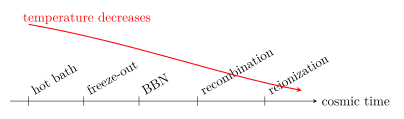
图 1 是因果时间线:事件由温度与 rate hierarchy 定义,不应把标签位置当精确年代比例。
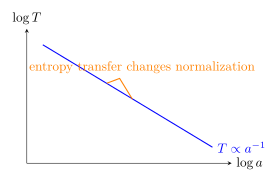
图 2 展示 \(g_{*s}\) 改变时并非一条无修正的直线。
2. Particle freeze-out and matter content / 粒子退耦与物质组成
Knowledge ID: P12-U06-L02-K02
平衡需要相互作用在一个 expansion time 内足够频繁:
\[\Gamma\sim n\langle\sigma v\rangle,\qquad \frac{\Gamma}{H}\gg1\ \text{(tightly coupled)},\qquad \frac{\Gamma}{H}\ll1\ \text{(decoupled)}.\]
随宇宙冷却,\(n\)、\(\sigma\) 与 \(v\) 变化;若 \(\Gamma\) 比 \(H\) 降得更快,会在 \(\Gamma/H\sim1\) 附近 freeze out。chemical freeze-out 冻结粒子数改变反应,kinetic decoupling 则冻结动量交换;两者通常不同时发生。relic abundance 由 Boltzmann equation 描述:
\[\dot n+3Hn=-\langle\sigma v\rangle\left(n^2-n_{\rm eq}^2\right).\]
这条方程不是“所有暗物质都是热遗迹”的证明;非热产生、freeze-in、asymmetry 等机制具有不同源项。
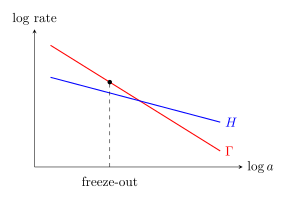
图 3 的交点是数量级判据;精确 freeze-out 需积分 Boltzmann equation。
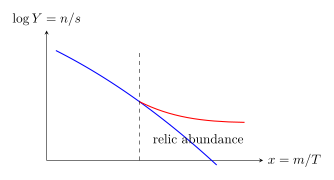
图 4 区分 equilibrium abundance 与冻结后的 comoving yield \(Y\)。
3. Primordial nucleosynthesis / 原初核合成
Knowledge ID: P12-U06-L02-K03
温度降到 MeV 量级时,弱反应不能再维持 neutron/proton ratio 的平衡。简化地:
\[\frac{n_n}{n_p}\simeq e^{-\Delta m c^2/(k_BT)}\]
在 weak freeze-out 后,游离中子继续 beta decay。虽然 deuterium binding energy 为 \(2.22\ \mathrm{MeV}\),高 photon-to-baryon ratio 意味着高能光子仍能 photodissociate deuterium;直到 \(T\sim0.1\ \mathrm{MeV}\) 左右,deuterium bottleneck 才打开,反应链迅速把多数幸存中子锁入 \(^4\mathrm{He}\)。若核合成开始时 \(r=n_n/n_p\),简单计数给:
\[Y_p\simeq\frac{2r}{1+r}.\]
精密 BBN 同时预测 D、\(^3\mathrm{He}\)、\(^4\mathrm{He}\)、\(^7\mathrm{Li}\),对 baryon density、expansion rate、neutron lifetime 与 reaction rates 敏感。
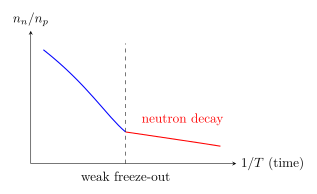
图 5 显示 equilibrium tracking 结束后仍有 beta decay,不能把 freeze-out ratio 直接当最终 helium input。
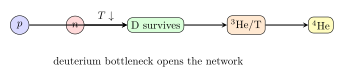
图 6 是 reaction-flow schematic,不表示只有一条核反应路径。
4. Recombination and cosmic microwave background / 复合与宇宙微波背景
Knowledge ID: P12-U06-L02-K04
氢在 Saha equilibrium 中的 ionization fraction 由温度与 baryon density 共同决定;实际 recombination 需要非平衡多能级原子计算。自由电子骤减使 photon mean free path 增大。optical depth:
\[\tau(t)=\int_t^{t_0}n_e\sigma_Tc\,dt',\]
因为上式把终点固定在 \(t_0\),所以 \(d\tau/dt=-n_e\sigma_Tc<0\)。因此 visibility function 应定义为
\[g(t)=-e^{-\tau}\frac{d\tau}{dt} =e^{-\tau}n_e\sigma_Tc\ge0,\]
它给出光子最后散射概率密度。CMB 不是从一个实物“壳”发出,而是我们过去光锥与有限厚度 last-scattering region 的交集。其今日平均温度约 \(2.7255\ \mathrm K\);温度各向异性、polarization 与 acoustic peaks 编码早期 baryon–photon plasma 和几何信息。
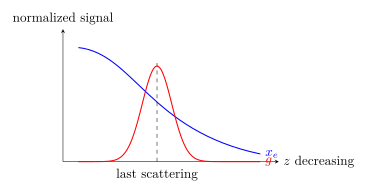
图 7 区分 ionization fraction 的下降与 visibility peak;“复合瞬间”是近似说法。
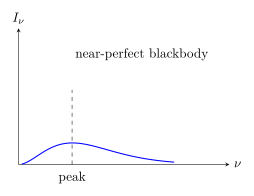
图 8 画出 Planck spectrum 的函数形状;绝对谱与微小各向异性是不同 observables。
5. Reionization and first structures / 再电离与第一代结构
Knowledge ID: P12-U06-L02-K05
recombination 后,多数 intergalactic hydrogen 中性,进入 cosmic dark ages。第一代恒星、星系及可能的 accreting black holes 产生 ionizing photons,形成逐渐长大、重叠的 H II bubbles;这是一种 patchy、延展的相变,而非全宇宙同一时刻切换。常用整体方程是:
\[\frac{dQ_{\rm HII}}{dt}=\frac{\dot n_{\rm ion}}{\bar n_{\rm H}}-\frac{Q_{\rm HII}}{t_{\rm rec}},\]
其中 \(Q_{\rm HII}\) 为 ionized volume filling factor,\(\dot n_{\rm ion}\) 依赖 source luminosity function 与 escape fraction,\(t_{\rm rec}\) 依赖 clumping 与温度。CMB large-scale polarization 约束 integrated optical depth;quasar spectra、galaxy damping wings 与 redshifted 21-cm signal 约束时间演化和空间结构。
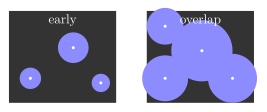
图 9 示意 inside-out bubble growth;真实 topology 取决于 sources、sinks 与 radiative transfer。
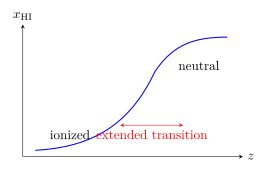
图 10 强调中性比例的演化具有宽度;不同 probes 对不同 redshift 和 weighting 敏感。
Worked examples / 完整例题
Worked Example 1 — 由今日 CMB 温度估算 recombination 温度
已知: \(T_0=2.7255\ \mathrm K\),取 \(z_*=1100\)。
系统: photon bath;采用 \(a_0=1\)。
模型: recombination 后 photons free-stream,且 \(T_\gamma\propto a^{-1}\)。
\[T_*=T_0(1+z_*)=2.7255\times1101=3.001\times10^3\ \mathrm K.\]
检查: redshift 越高温度越高;K 与无量纲因子相乘仍为 K。四位输入不意味着模型精确到 1 K,故物理解读写约 \(3000\ \mathrm K\)。
Worked Example 2 — Rate crossing 的简化 freeze-out
已知: 在 \(T\) 以 MeV 计的教学模型中,\(\Gamma=0.80T^5\ \mathrm{s^{-1}}\),\(H=0.68T^2\ \mathrm{s^{-1}}\)。
系统: radiation-dominated homogeneous bath;忽略 \(g_*\) 变化。
模型理由: 只求数量级 crossing,不把系数当精密 weak-interaction calculation。
\[\Gamma=H\Rightarrow0.80T_f^5=0.68T_f^2,\]
\[T_f=\left(\frac{0.68}{0.80}\right)^{1/3}=0.947\ \mathrm{MeV}.\]
在 \(T=1.50\ \mathrm{MeV}\),\(\Gamma/H=(0.80/0.68)T^3=3.97>1\),仍较好耦合;低于 \(T_f\) 后比值迅速小于 1。检查: 交点约 MeV,符合设定的数量级;系数已绑定“\(T\) 以 MeV 数值代入”的 convention,不能直接输入 K。
Worked Example 3 — 由 neutron/proton ratio 估算 helium fraction
已知: 核合成有效开始时 \(r=n_n/n_p=1/7\)。
系统: baryons;假定所有中子最终进入 \(^4\mathrm{He}\),忽略 D、\(^3\mathrm{He}\)、\(^7\mathrm{Li}\)。
模型: 两个中子配一个 helium nucleus,因此 helium mass 约为 \(4(n_n/2)=2n_n\) 个核子质量。
\[Y_p\simeq\frac{2n_n}{n_n+n_p}=\frac{2r}{1+r} =\frac{2/7}{8/7}=0.250.\]
检查: \(0<Y_p<1\);若 \(r\to0\),\(Y_p\to0\),极限正确。结果 \(25.0\%\) 是简化解释,不代替 reaction-network prediction。
Worked Example 4 — 由 baryon-to-photon ratio 估算今日 baryon 数密度
已知: \(\eta=6.10\times10^{-10}\),今日 \(n_{\gamma0}=411\ \mathrm{cm^{-3}}\)。
系统: 共动平均 baryon 与 photons。
模型: 采用 \(\eta=n_b/n_\gamma\),不区分 helium 对“核数”和“重子数”的影响,因为 \(n_b\) 计核子数。
\[n_{\gamma0}=411\times10^6=4.11\times10^8\ \mathrm{m^{-3}},\]
\[n_{b0}=\eta n_{\gamma0}=6.10\times10^{-10}\times4.11\times10^8 =2.51\times10^{-1}\ \mathrm{m^{-3}}.\]
检查: 一立方米平均约 \(0.25\) 个 baryon,数量虽小但空间均值合理;\(\mathrm{cm^{-3}}\) 到 \(\mathrm{m^{-3}}\) 应乘 \(10^6\),方向正确。三位有效数字。
Lesson synthesis / 全课整合
核心判断不是背年代,而是比较三类尺度:background cooling \(T(a)\)、microscopic rate \(\Gamma(T)\)、expansion \(H(T)\)。rate crossing 决定 composition 和 opacity 何时失去平衡;之后的 relic abundance、last-scattering photons 和 neutral fraction 成为可观测“化石”。
Formula-and-decision table / 公式与决策表
| Need | Relation | Use only when | Main caution |
|---|---|---|---|
| thermal cooling | \(T\propto g_{*s}^{-1/3}a^{-1}\) | adiabatic common bath | decoupled sectors have distinct \(T\) |
| coupling test | \(\Gamma/H\) | effective per-particle rate known | crossing is approximate |
| relic number | \(\dot n+3Hn=-\langle\sigma v\rangle(n^2-n_{eq}^2)\) | homogeneous mean density | other production adds source terms |
| helium estimate | \(Y_p\simeq2r/(1+r)\) | nearly all neutrons in helium-4 | precision BBN needs network |
| last scattering | \(g=-e^{-\tau}d\tau/dt=e^{-\tau}n_e\sigma_Tc\) | \(\tau(t)=\int_t^{t_0}n_e\sigma_Tc\,dt'\) | finite-width surface |
| reionization budget | \(\dot Q=\dot n_{ion}/\bar n_H-Q/t_{rec}\) | volume-averaged model | clumping and escape fraction uncertain |
Model boundaries / 模型边界
- Classical FLRW thermodynamics does not describe a quantum-gravity beginning or prove an initial singular state.
- Equilibrium formulas fail when \(\Gamma/H\lesssim1\); freeze-out needs Boltzmann kinetics.
- \(g_*\) and \(g_{*s}\) depend on temperature and particle content; treating them constant is local.
- One-zone BBN and reionization models suppress spatial fluctuations and radiative transfer.
- Recombination is not simple Saha equilibrium throughout; Lyman-\(\alpha\) trapping and two-photon processes matter.
- Current observational parameter values remain conditional on atomic/nuclear data, calibration and cosmological model.
Misconception clinic / 易错概念诊所
| Misconception | Correction |
|---|---|
| Big Bang 是物质从一点炸向外部空间 | 它描述整体尺度因子从更热更密状态演化 |
| \(T\propto a^{-1}\) 永远精确 | entropy degrees of freedom and decoupled sectors modify normalization |
| \(\Gamma=H\) 是瞬时开关 | freeze-out has finite width and may require kinetic integration |
| BBN 在结合能温度立刻开始 | high photon-to-baryon ratio creates deuterium bottleneck |
| recombination 与 last scattering 完全同一时刻 | ionization and visibility histories overlap but are not identical |
| reionization 让 CMB photons 首次自由传播 | CMB decoupled much earlier; reionization adds later optical depth |
Practice and retrieval / 练习与检索
- [K01] 若 \(a\) 增大 20 倍且 \(g_{*s}\) 不变,photon temperature 如何变化?
Answer 1
\(T\propto a^{-1}\),故降为原来的 \(1/20\)。
- [K01] 为什么 relativistic energy density 随 \(a^{-4}\) 而不是 \(a^{-3}\)?
Answer 2
number density 因体积稀释给 \(a^{-3}\),每个 photon 的能量又因 redshift 给 \(a^{-1}\),合计 \(a^{-4}\)。
- [K02] \(\Gamma/H=50\) 表示什么?能否由此断言 chemical equilibrium 一定成立?
Answer 3
指相关相互作用在一个 expansion time 内约发生 50 次;若该 rate 真正改变粒子数且反应网络无瓶颈,chemical equilibrium 可能成立,但仅动量交换 rate 大并不足以保证 chemical equilibrium。
- [K02] 若 radiation era 中 \(\Gamma\propto T^5\)、\(H\propto T^2\),随冷却 \(\Gamma/H\) 如何变?
Answer 4
\(\Gamma/H\propto T^3\),温度下降时比值下降,因而可能 decouple。
- [K03] 对 \(r=1/6\),用简化公式求 \(Y_p\)。
Answer 5
\(Y_p=2r/(1+r)=(2/6)/(7/6)=2/7=0.286\);这是忽略 freeze-out 后 neutron decay 的上限式估计。
- [K03] deuterium binding energy 大于 bottleneck 打开时的 \(k_BT\),为何不矛盾?
Answer 6
photons 比 baryons 多约十亿倍,Planck 高能尾仍含足够 photons 光致解离 D;必须降到远低于 binding energy 的温度,尾部才不足。
- [K04] 若 \(z_*=1090\),\(T_0=2.725\ \mathrm K\),估算 \(T_*\)。
Answer 7
\(T_*=2.725(1091)=2.97\times10^3\ \mathrm K\),约 \(3000\ \mathrm K\)。
- [K04] 为什么 last-scattering surface 有厚度?
Answer 8
\(n_e\) 与 optical depth 是连续变化的,visibility function 在有限时间/红移区间有宽峰,而非 delta function。
- [K05] reionization equation 中若 ionizing source 关闭,\(Q_{\rm HII}\) 怎样演化?
Answer 9
变为 \(dQ/dt=-Q/t_{rec}\),解为指数衰减 \(Q\propto e^{-t/t_{rec}}\)(若 \(t_{rec}\) 常数),表示 recombination 使 ionized fraction 回落。
- [综合] 列出 BBN、CMB、reionization 各自最直接的观测遗迹。
Answer 10
BBN:primordial light-element abundances;CMB:blackbody spectrum、anisotropy 与 polarization;reionization:CMB optical depth、quasar absorption/damping wings、early galaxies 与 21-cm signal。
Exit ticket / 迁移检验
给定某过程 \(\Gamma\propto T^n\) 与 radiation-era \(H\propto T^2\),说明 \(n>2\) 和 \(n<2\) 时随冷却的 decoupling 趋势,并指出仅由幂次还缺少什么信息。
Exit-ticket benchmark
\(\Gamma/H\propto T^{n-2}\):\(n>2\) 时随冷却下降,易从 coupled 走向 decoupled;\(n<2\) 时随冷却上升,可能 recouple。仍需 normalization、\(g_*(T)\)、thresholds 与实际 reaction network 才能求 crossing。
References and source notes / 参考资料与使用说明
以下直接来源均在 2026-08-30 实际打开核对:
本课所有 TikZ 均依据正文方程原创绘制,未复制来源插图。
- Particle Data Group, Big-Bang Cosmology, 2024 Review — thermal background、freeze-out 与 chronology。
- Particle Data Group, Big-Bang Nucleosynthesis, 2024 Review — weak freeze-out、deuterium bottleneck、light-element abundances。
- Particle Data Group, Cosmic Microwave Background, 2024 Review — recombination、visibility、CMB observables。
- NASA LAMBDA, Cosmic Microwave Background Radiation — photon decoupling 与 last scattering 的教学解释。
- NASA Webb, Early Universe — dark ages、first structures 与 reionization 的观测语境。
- NASA Webb, Cosmic Reionization — patchy ionized bubbles 与观测目标。
Source-to-content map
| Source | Used for | Knowledge ID / Section | Model boundary or convention |
|---|---|---|---|
| PDG Big-Bang Cosmology | \(T(a)\), rates and chronology | K01–K02 | standard FLRW particle content |
| PDG BBN | freeze-out and abundance network | K03, Worked 3 | analytic \(Y_p\) is only approximation |
| PDG CMB | optical depth, visibility and probes | K04 | parameter inference is model dependent |
| NASA LAMBDA CMB | transparent-universe intuition | K04 | educational times are approximate |
| NASA Webb Early Universe | first sources and reionization | K05 | active observations revise chronology |
| NASA Cosmic Reionization | bubble topology | K05, Fig. 9 | illustration not simulation output |
复习与拓展
- Lesson 12.6.3 将把 relics 作为 CMB、BBN、BAO 和 structure probes 输入 parameter inference。
- 与 Part XIII 的接口:recombination 前 baryon–photon medium 是带电 collective system,但宇宙学 perturbation 与实验室 plasma orderings 不同。
- 可扩展:Saha/Peebles recombination equation、full Boltzmann hierarchy 与 21-cm radiative transfer。