
Learning objectives / 学习目标
学完本课后,你应能:
- 把 rotation、lensing、cluster dynamics、CMB 与 structure growth 组织为跨尺度暗物质证据链,并区分现象与粒子候选;
- 用 acceleration equation 和 equation-of-state parameter \(w\) 判断何时加速,解释 \(\Lambda\) 与一般 dark energy 的差别;
- 说明 inflation 解决的 horizon/flatness 问题及量子涨落到 primordial power spectrum 的桥梁,同时指出模型依赖;
- 构建从 raw data、calibration、likelihood、prior 到 posterior/predictive check 的参数推断流程;
- 定量计算 tension metric,识别 correlated systematics、look-elsewhere、prior 与 model extension 对显著性的影响。
Prerequisites / 先修知识
- Expanding Universe 的 Friedmann equations、\(\Omega_i\) 与距离积分;
- Thermal History 的 CMB、BBN 和 recombination;
- Clusters and Cosmic Structure 的 rotation/lensing/structure evidence;
- Gaussian uncertainty、covariance、Bayes theorem 与 basic power spectrum。
Scope and conventions / 范围与约定
- baseline 为 spatially flat \(\Lambda\)CDM:GR、cold collisionless dark matter、cosmological constant、近 adiabatic Gaussian primordial perturbations 与标准辐射/中微子内容。
- \(\Omega_c\) 指 cold dark matter,\(\Omega_m\) 包含 baryons 和非相对论 matter;不可混用。
- dark energy 作为“加速来源”的总称;\(w=-1\) 对应 cosmological constant,但 \(w\ne-1\) 不自动证明新 scalar field。
- inflation 部分只到 background acceleration 与 scalar spectrum 参数,不推导量子场论细节。
- 数值为教学示例或来源中的特定分析;不把跨数据集结果混成“无模型的真值”。
- tension 是 model-conditional discrepancy,不等价于 discovery。
Notation and modeling contract / 符号与建模契约
| Symbol | Meaning | Convention |
|---|---|---|
| \(\Omega_c,\Omega_b,\Omega_\Lambda\) | cold-DM, baryon, vacuum density parameters | same epoch |
| \(w=p/(\rho c^2)\) | equation-of-state parameter | 1 |
| \(q=-\ddot a a/\dot a^2\) | deceleration parameter | \(q<0\) means acceleration |
| \(N=\ln(a_{\rm end}/a_{\rm start})\) | inflationary e-fold number | 1 |
| \(P_{\mathcal R}(k)\) | primordial curvature power spectrum | convention stated |
| \(\theta\) | parameter vector | model dependent |
| \(\mathcal L(D\mid\theta)\) | likelihood | probability density |
| \(C\) | data covariance matrix | observable-dependent |
1. Dark matter evidence and candidates / 暗物质证据与候选者
Knowledge ID: P12-U06-L03-K01
dark matter 是在指定 gravity theory 下,对不发出足够电磁辐射却贡献引力的组分的统称。证据来自不同尺度:galaxy rotation curves、stellar dynamics、cluster virial/X-ray/lensing masses、merging clusters、CMB acoustic pattern、matter power spectrum 与 structure formation。单条 rotation curve 可被 baryonic modeling 或 modified gravity 争论影响;跨尺度同时拟合才构成强约束。
候选包括 WIMPs、axions/axion-like particles、sterile neutrinos、primordial black holes 等;每类有不同 production、free-streaming、self-interaction 与 detection signatures。尚未确认某一候选,因此不能把“暗物质存在的天体物理证据”写成“某粒子已发现”。
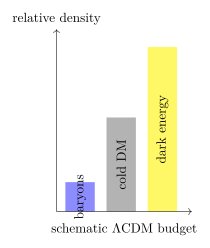
图 1 的柱高只表达组分层级,不替代某一数据组合的 posterior。
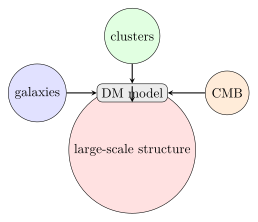
图 2 体现“evidence network”:不同 probes 的 systematics 应尽可能独立。
2. Accelerated expansion and dark energy / 加速膨胀与暗能量
Knowledge ID: P12-U06-L03-K02
忽略显式 \(\Lambda\) 而把组分写入总 \(\rho,p\),acceleration equation 为:
\[\frac{\ddot a}{a}=-\frac{4\pi G}{3}\sum_i\rho_i(1+3w_i).\]
因此主导组分若 \(w<-1/3\) 可使 \(\ddot a>0\)。cosmological constant 具有 \(w=-1\)、\(\rho_\Lambda=\) constant。一般 dark-energy parameterization 常写:
\[w(a)=w_0+w_a(1-a),\]
但它是现象学坐标,不是完整 microphysical theory。Type Ia supernovae 测 luminosity-distance shape;BAO 提供 standard-ruler combinations;CMB 锚定 early-universe scale;weak lensing 和 clustering 探测 growth。加速也可能在 modified gravity 中被模拟,因此背景距离与结构增长需联合检验。
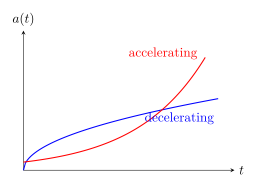
图 3 比较 \(\ddot a<0\) 与 \(\ddot a>0\);斜率 \(\dot a\) 增大才是加速定义。
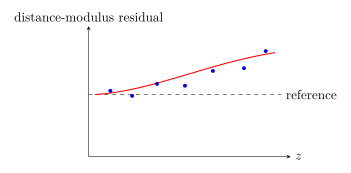
图 4 示意 supernova Hubble residual;calibration、dust、population evolution 与 selection 都进入 covariance。
3. Inflation and primordial perturbations / 暴胀与原初扰动
Knowledge ID: P12-U06-L03-K03
inflation 是早期一段 \(\ddot a>0\) 的 accelerated expansion。等价地,在常见缓变情形下 comoving Hubble radius \((aH)^{-1}\) 缩小,使曾处于因果联系的小尺度退出 Hubble radius,之后在 radiation/matter era 再进入。这为 large-scale uniformity、near-flatness 与 primordial perturbations 提供框架。
标量场模型的 slow-roll 示例:
\[3H\dot\phi\simeq-V'(\phi),\qquad H^2\simeq\frac{8\pi G}{3c^2}V(\phi).\]
primordial curvature spectrum 常参数化为:
\[\mathcal P_{\mathcal R}(k)=A_s\left(\frac{k}{k_*}\right)^{n_s-1}.\]
近 scale-invariant 表示 \(n_s\) 接近但不必严格等于 1。inflation 是模型族;具体 potential、reheating、tensor amplitude 和 non-Gaussianity 需观测区分。
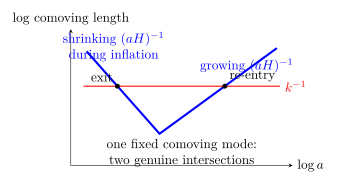
图 5 全部使用共动尺度:蓝线是 comoving Hubble radius \((aH)^{-1}\),红线是固定 comoving wavelength \(k^{-1}\),两个交点分别是 exit 与 re-entry。“超视界冻结”取决于 perturbation variable 和 approximation。
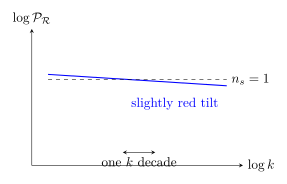
图 6 显示 \(n_s<1\) 的 red tilt;坐标与 power-spectrum convention 必须声明。
4. Cosmic-parameter inference and observational probes / 宇宙参数推断与观测探针
Knowledge ID: P12-U06-L03-K04
数据并不直接“读出 \(\Omega_m\)”。完整链是:instrument response 与 calibration → summary observable → covariance/likelihood → model prediction → prior → posterior:
\[p(\theta\mid D)=\frac{\mathcal L(D\mid\theta)\,\pi(\theta)}{p(D)}.\]
多 probes 的优势在于 degeneracy directions 不同。例如 CMB 紧约束 early physical densities 和 acoustic angular scale,BAO 测 \(D_M/r_d\)、\(D_H/r_d\) 等组合,SNe 测相对 luminosity distance,lensing/clustering 测 geometry 与 growth。若共享 calibration 或 sky sample,likelihood 不能简单相乘而忽略 cross-covariance。
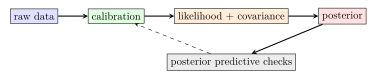
图 7 强调推断是可回查的循环,不是把拟合器输出当最终真理。
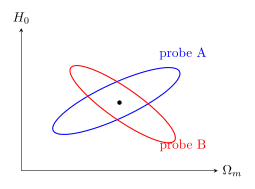
图 8 显示联合 probes 通过相交 degeneracies 提高约束,而不是每条单独测得同一参数。
5. Tensions, systematics, and model limits / 张力、系统误差与模型边界
Knowledge ID: P12-U06-L03-K05
若两项近似独立 Gaussian 测量给 \(x_1\pm\sigma_1\)、\(x_2\pm\sigma_2\),最简单 discrepancy metric 为:
\[T=\frac{\lvert x_1-x_2\rvert}{\sqrt{\sigma_1^2+\sigma_2^2}}.\]
但真实 tension analysis 还需处理 covariance、non-Gaussian posterior、prior volume、parameterization、data selection 与 look-elsewhere effect。systematic uncertainty 不是“把误差条加大一点”这么简单:可能产生 redshift-dependent bias、scale-dependent response 或跨 probes correlation。发现不一致后的顺序应是:复核 data provenance → blind calibration tests → alternative pipelines → posterior predictive checks → 明确 model extension 是否改善所有相关 observables,而非只修一个参数。
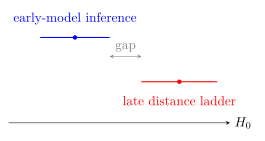
图 9 将 measurement interval 与 method label 并列;不能抹去两者不同的 model/calibration dependencies。
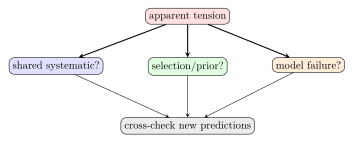
图 10 是 tension triage;新物理是假设之一,不是统计不一致的自动结论。
Worked examples / 完整例题
Worked Example 1 — 今日 cold-dark-matter 平均密度
已知: \(H_0=67.4\ \mathrm{km\,s^{-1}\,Mpc^{-1}}\),\(\Omega_c=0.265\)。
系统: flat \(\Lambda\)CDM 的今日 background;\(\Omega_c\) 不含 baryons。
模型: \(\rho_c=3H_0^2/(8\pi G)\)。
\[H_0=2.184\times10^{-18}\ \mathrm{s^{-1}},\]
\[\rho_{\rm crit,0}=8.53\times10^{-27}\ \mathrm{kg\,m^{-3}},\]
\[\rho_{c,0}^{\rm DM}=\Omega_c\rho_{\rm crit,0} =2.26\times10^{-27}\ \mathrm{kg\,m^{-3}}.\]
检查: 符号 \(\rho_c\) 易与 cold-DM 下标混淆,所以把 critical 写全;结果小于 critical density,比例恰为 0.265。三位有效数字。局域 halo density 可远高于 cosmic mean。
Worked Example 2 — 由组分估算 deceleration parameter
已知: flat matter+\(\Lambda\) model,\(\Omega_m=0.315\)、\(\Omega_\Lambda=0.685\)。
系统: 今日 homogeneous background;忽略 radiation。
模型: \(w_m=0\)、\(w_\Lambda=-1\)。
\[q_0=\frac12\sum_i\Omega_i(1+3w_i) =\frac12\Omega_m-\Omega_\Lambda =0.1575-0.685=-0.5275.\]
检查: \(q_0<0\) 表示 \(\ddot a>0\);若 \(\Omega_\Lambda\to0\),回到 matter-only \(q=1/2\)。输入三位有效数字,写 \(q_0\simeq-0.528\)。
Worked Example 3 — 60 e-folds 有多大?
已知: inflation duration \(N=60.0\)。
系统: background scale factor;定义 \(N=\ln(a_f/a_i)\)。
模型: 不假定恒定 \(H\),只用 e-fold 定义。
\[\frac{a_f}{a_i}=e^N=e^{60}=1.14\times10^{26}.\]
若某物理长度起初为 \(10^{-30}\ \mathrm m\) 且仅随 \(a\) 伸展,则结束时为 \(1.14\times10^{-4}\ \mathrm m\)。检查: \(N\) 无量纲;长度单位保持 m。此例仅展示 kinematics,不证明何种 potential 能产生 60 e-folds,也未包括 reheating 后膨胀。
Worked Example 4 — 简单 tension metric 与错误合并
已知: 两项假定独立 Gaussian 结果 \(H_A=67.4\pm0.5\)、\(H_B=73.0\pm1.0\ \mathrm{km\,s^{-1}\,Mpc^{-1}}\)。
系统: 共同参数 \(H_0\),暂忽略 shared systematics。
模型: 用独立 Gaussian discrepancy 作为诊断。
\[T=\frac{73.0-67.4}{\sqrt{0.5^2+1.0^2}} =\frac{5.6}{1.118}=5.01.\]
形式 inverse-variance average 为:
\[\bar H=\frac{67.4/0.5^2+73.0/1.0^2}{1/0.5^2+1/1.0^2} =68.52\ \mathrm{km\,s^{-1}\,Mpc^{-1}},\]
\[\sigma_{\bar H}=\left(\frac1{0.5^2}+\frac1{1.0^2}\right)^{-1/2}=0.447\ \mathrm{km\,s^{-1}\,Mpc^{-1}}.\]
检查与解释: 算术正确不代表应报告该均值;\(5.01\sigma\) 不一致使“共同真值且误差完整”的模型可疑,应先查 covariance、systematics 与 model dependence。
Lesson synthesis / 全课整合
现代宇宙学的结构不是“暗物质+暗能量+暴胀”的名词列表,而是:初始条件模型 → background/perturbation evolution → 多探针 observables → instrument/selection model → joint inference → predictive checks。每个异常都必须沿这条链定位。
Formula-and-decision table / 公式与决策表
| Need | Relation | Use only when | Main caution |
|---|---|---|---|
| acceleration sign | \(q=-\ddot aa/\dot a^2\) | smooth FLRW background | negative means acceleration |
| constant-\(w\) component | \(\rho\propto a^{-3(1+w)}\) | separately conserved constant \(w\) | phenomenological \(w\) may vary |
| inflation amount | \(N=\ln(a_f/a_i)\) | stated interval | required \(N\) depends on reheating |
| primordial tilt | \(\mathcal P=A_s(k/k_*)^{n_s-1}\) | stated pivot and convention | extrapolation far from data risky |
| Bayesian inference | posterior \(\propto\) likelihood \(\times\) prior | complete likelihood | posterior is model conditional |
| simple tension | \(T=\lvert\Delta x\rvert/\sqrt{\sigma_1^2+\sigma_2^2}\) | independent Gaussian measurements | correlations/non-Gaussianity matter |
Model boundaries / 模型边界
- Dark matter evidence is gravity-model dependent, though the cross-scale network strongly constrains alternatives.
- \(\Lambda\)CDM is an effective baseline, not a microscopic explanation of dark matter, vacuum energy or initial conditions.
- Inflationary predictions depend on field content, initial state, reheating and perturbation treatment.
- Bayesian evidence and parameter intervals depend on priors and likelihood completeness.
- Extending a model adds flexibility and incurs degeneracy/Occam costs; reduced tension alone is not validation.
- “Current tension” is time-dependent observational status; this note teaches methods and dates source checks explicitly.
Misconception clinic / 易错概念诊所
| Misconception | Correction |
|---|---|
| rotation curves have identified a WIMP | curves establish a mass discrepancy under gravity assumptions, not particle identity |
| dark energy is a repulsive force pushing galaxies | it is a background stress-energy/modified-gravity description affecting \(a(t)\) |
| inflation is the Big Bang itself | inflation is a proposed early accelerated phase plus exit/reheating, not the entire hot history |
| parameter error bars are raw-data facts | they follow model, likelihood, calibration and priors |
| \(5\sigma\) tension automatically means discovery | it may expose underestimated covariance, selection or model mismatch |
| adding parameters always improves theory | fit improves mechanically; predictive performance and evidence may not |
Practice and retrieval / 练习与检索
- [K01] 为什么 galaxy rotation curve alone 不足以确定 dark-matter particle mass?
Answer 1
Rotation constrains gravitational mass distribution;从 halo profile 到 particle mass 还需 production、phase-space、interaction 和 detection 模型,映射并不唯一。
- [K01] \(\Omega_c=0.26\) 与“局域暗物质密度”是否相同?
Answer 2
不同。\(\Omega_c\) 是宇宙平均密度相对 critical density;局域 halo density 是 collapsed structure 内的位置相关量。
- [K02] 单一主导组分 \(w=-2/3\) 时是否加速?
Answer 3
是。\(1+3w=1-2=-1<0\),在正密度下使 acceleration equation 的贡献为正。
- [K02] matter+\(\Lambda\) 中何时开始加速?写 density 条件。
Answer 4
\(\rho_m-2\rho_\Lambda<0\),即 \(\rho_m<2\rho_\Lambda\);因为 \(w_m=0\)、\(w_\Lambda=-1\)。
- [K03] \(N=50\) 与 \(N=60\) 的 expansion-factor 比是多少?
Answer 5
比为 \(e^{60}/e^{50}=e^{10}=2.20\times10^4\);e-fold 差 10 不是 20% 差异。
- [K03] \(n_s=1\) 表示什么?
Answer 6
在所用 dimensionless primordial spectrum convention 中各 logarithmic \(k\) interval 的 amplitude scale invariant;并非所有 observable power spectrum 都是水平线。
- [K04] 为什么 CMB+BAO 常比任一 probe 单独约束更紧?
Answer 7
它们对参数组合与 redshift 的敏感方向不同;联合 likelihood 可打破 degeneracy,但必须纳入 shared assumptions/covariance。
- [K04] prior 是否只是“主观附加物”,可在高精度分析中忽略?
Answer 8
不能一概而论。弱数据方向、边界、非线性参数变换和 model comparison 都可能对 prior 敏感,必须报告并做 robustness test。
- [K05] 两测量有共同 calibration offset 时,为何简单 tension 公式失效?
Answer 9
差值方差包含 covariance:\(\operatorname{Var}(x_1-x_2)=\sigma_1^2+\sigma_2^2-2\operatorname{Cov}(x_1,x_2)\);不能假定独立。
- [综合] 一个新模型只改善 \(H_0\) discrepancy,却破坏 BBN 和 CMB damping tail,是否优于 \(\Lambda\)CDM?
Answer 10
不能据此判断为优。必须用完整数据、参数惩罚与 posterior predictive checks;修复一个摘要参数却恶化其他可观测量通常不可接受。
Exit ticket / 迁移检验
为一项“新物理缓解 tension”的主张写出四项最小审核:原始数据、systematics、joint likelihood、new prediction。
Exit-ticket benchmark
核对 data provenance/blinding;检查独立与共享 systematics;用含 covariance 的 joint likelihood 比较 baseline/extension;找一个不是用来拟合 tension 的 out-of-sample prediction 并检验。
References and source notes / 参考资料与使用说明
以下权威直接来源在 2026-08-30 实际打开核对:
本课所有 TikZ 均依据正文方程原创绘制,未复制来源插图。
- Particle Data Group, Dark Matter, 2024 Review — 跨尺度证据、候选与限制。
- Particle Data Group, Dark Energy, 2024 Review — acceleration、\(w\)、distance/growth probes 与 systematics。
- Particle Data Group, Inflation, 2024 Review — e-folds、perturbation spectrum 与模型限制。
- Particle Data Group, Cosmological Parameters, 2024 Review — baseline parameters、joint inference 和 degeneracies。
- ESA, Planck and the Cosmic Microwave Background — CMB 参数约束与多探针框架。
- NASA LAMBDA, Hubble Constant — 不同方法的 \(H_0\) 测量与 disagreement 语境。
- Dark Energy Spectroscopic Instrument, First Cosmology Results — BAO mapping 与当前 observational program 示例。
Source-to-content map
| Source | Used for | Knowledge ID / Section | Model boundary or convention |
|---|---|---|---|
| PDG Dark Matter | evidence network and candidates | K01 | candidate not identified |
| PDG Dark Energy | acceleration and probes | K02, K05 | GR versus modified gravity |
| PDG Inflation | \(N\), spectrum, observables | K03 | inflation is a model family |
| PDG Cosmological Parameters | parameter inference | K04–K05 | conditional on priors/model/data |
| ESA Planck | CMB parameter context | K04 | standard six-parameter baseline |
| NASA LAMBDA \(H_0\) | method comparison | K05, Worked 4 | values evolve with analyses |
| DESI | BAO observational example | K02, K04 | release-specific pipeline/systematics |
复习与拓展
- Part XIII 从“几乎完全电离的宇宙介质”转向 plasma collective scales;微观 electromagnetic ordering 与宇宙学 background ordering 必须分别声明。
- 可扩展:full Boltzmann codes、Gaussian-process reconstructions、Bayesian evidence 与 simulation-based inference。
- 任何参数或 tension 数值更新时,保留方法论结构并重新核对 direct release,而不是只改摘要数字。