
Learning objectives / 学习目标
学完本课后,你应能:
- 定义 six-dimensional distribution \(f_s(\mathbf x,\mathbf v,t)\),正确求 density、flow、pressure tensor 与 current;
- 从 phase-space conservation 写出 Boltzmann/Vlasov equation,并沿 characteristics 解释 \(df_s/dt=0\);
- 推导 continuity 与 momentum moments,指出 hierarchy 为何必然需要 closure;
- 线性化一维 electrostatic Vlasov–Poisson system,解释 Landau contour、phase mixing 与无碰撞 damping 的能量流向;
- 使用 \(\omega-k_\parallel v_\parallel-n\Omega_s=0\) 判断 Landau/cyclotron resonance,并用 resonant slope 判断 damping 或 growth;
- 区分 linear Landau damping、collisional damping、particle trapping 与 nonlinear/quasilinear evolution。
Prerequisites / 先修知识
- Collisions and Transport 中 collision operator 与 local closure 的边界;
- probability density、Gaussian integral 与 ensemble average;
- partial derivative、integration by parts、Fourier ansatz \(\exp[i(kx-\omega t)]\);
- Plasma Fundamentals 中 \(\omega_{pe},\lambda_D\);
- complex frequency \(\omega=\omega_r+i\gamma\) 的 growth/damping convention。
Scope and conventions / 范围与约定
- \(f_s\) 按 number density normalization:\(\int f_s\,d^3v=n_s\),不是 probability-one normalization。
- 主要推导用 one-dimensional, unmagnetized, electrostatic perturbation;ions 可作为 immobile neutralizing background,何时采用会显式声明。
- Fourier convention 为 \(\exp[i(kx-\omega t)]\);因此 \(\gamma=\operatorname{Im}\omega<0\) 表示 temporal damping。
- Maxwellian 的 one-dimensional thermal spread 定义 \(v_{Ts}=\sqrt{k_BT_s/m_s}\),故 \(F_0\propto\exp[-v^2/(2v_T^2)]\)。
- Vlasov equation 忽略 binary collision operator,但保留由 \(f_s\) 通过 Maxwell equations 产生的 self-consistent mean fields;“collisionless”不等于“particles 不相互作用”。
Notation and modeling contract / 符号与建模契约
| Symbol | Meaning | SI / convention |
|---|---|---|
| \(f_s(\mathbf x,\mathbf v,t)\) | species distribution in phase space | \(\mathrm{s^3\,m^{-6}}\) |
| \(F_s(v)\) | one-dimensional reduced distribution | \(\mathrm{s\,m^{-4}}\) |
| \(n_s=\int f_s d^3v\) | number density | \(\mathrm{m^{-3}}\) |
| \(\mathbf u_s\) | species mean velocity | \(\mathrm{m\,s^{-1}}\) |
| \(\mathbf P_s\) | pressure tensor in species frame | Pa |
| \(C_s[f]\) | collision operator | same units as \(\partial_t f\) |
| \(v_\phi=\omega_r/k\) | phase velocity | \(\mathrm{m\,s^{-1}}\) |
| \(\gamma=\operatorname{Im}\omega\) | temporal rate | \(\mathrm{s^{-1}}\) |
1. Distribution functions in phase space / 相空间分布函数
Knowledge ID: P13-U02-L02-K01
1.1 分布函数不是一条轨道
\(f_s(\mathbf x,\mathbf v,t)\,d^3x\,d^3v\) 是期望落在 phase-space cell 内的 species-\(s\) 粒子数。它同时保存“在哪里”和“以什么速度经过”,因此同一 spatial density 可以对应 Maxwellian、beam、loss cone 或 energetic tail 等完全不同的 physics。
\[n_s(\mathbf x,t)=\int f_s\,d^3v, \qquad n_s\mathbf u_s=\int \mathbf v f_s\,d^3v.\]
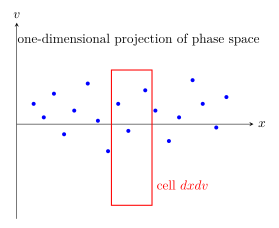
图 1 是 \(x\)–\(v\) projection;点云只是 sampling,连续 \(f\) 是 coarse-grained ensemble description。
1.2 Maxwellian 与 moments
一维 drifting Maxwellian:
\[F_M(v)=\frac{n}{\sqrt{2\pi}v_T} \exp\left[-\frac{(v-u)^2}{2v_T^2}\right], \qquad v_T^2=\frac{k_BT}{m}.\]
其 area 为 \(n\)、centroid 为 \(u\)、variance 为 \(v_T^2\)。但仅知这三个 moments 并不能证明 distribution 是 Maxwellian;那是额外 closure/equilibrium assumption。
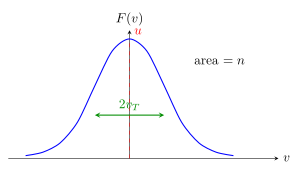
图 2 将 normalization、mean 与 spread 分开标记;横向宽度不是 full width at half maximum。
2. Vlasov and Boltzmann equations / Vlasov 与玻尔兹曼方程
Knowledge ID: P13-U02-L02-K02
2.1 Kinetic equation
species kinetic equation 是 phase-space conservation 加 collisions:
\[\frac{\partial f_s}{\partial t} +\mathbf v\cdot\nabla_x f_s +\frac{q_s}{m_s}(\mathbf E+\mathbf v\times\mathbf B)\cdot\nabla_v f_s =C_s[f].\]
右侧 \(C_s\) 可为 Boltzmann、Landau/Fokker–Planck 等 collision operator;合格 operator 必须遵守总 particle number、momentum 与 energy conservation。若 timescale 远短于 collision time,令 \(C_s=0\) 得 Vlasov equation:
\[\frac{df_s}{dt}=0\]
沿 mean-field particle characteristics 成立,其中
\[\dot{\mathbf x}=\mathbf v, \qquad \dot{\mathbf v}=\frac{q_s}{m_s}(\mathbf E+\mathbf v\times\mathbf B).\]
这表示 fine-grained phase-space density 沿 trajectory 保持,并不表示固定 spatial point 的 \(f\) 不变;phase-space shear 可产生越来越细的 filaments。
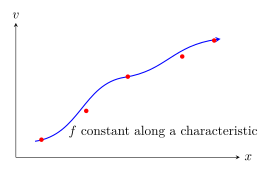
图 3 的 curve 是 phase-space characteristic,不是 physical-space orbit。
2.2 Self-consistency
Vlasov 必须与 Maxwell equations 闭合:
\[\rho_c=\sum_s q_s\int f_s\,d^3v, \qquad \mathbf J=\sum_s q_s\int \mathbf v f_s\,d^3v.\]
所以 collective interaction 通过 \(\rho_c,\mathbf J\to\mathbf E,\mathbf B\to f_s\) feedback 保留。test-particle calculation 若外加 fields 固定,则少了这一环,不能预测 plasma oscillation 或 instability。
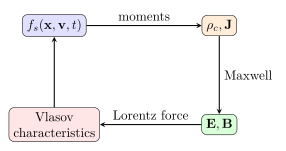
图 4 是 self-consistent loop;任一箭头被 external prescription 替代都会改变 model class。
3. Moments and fluid closure / 矩与流体闭合
Knowledge ID: P13-U02-L02-K03
对 kinetic equation 积分 \(d^3v\),并假定 \(f\) 在 \(\lvert\mathbf v\rvert\to\infty\) 足够快衰减,得到 continuity equation:
\[\frac{\partial n_s}{\partial t}+\nabla\cdot(n_s\mathbf u_s)=0.\]
乘 \(m_s\mathbf v\) 再积分得到 momentum equation:
\[m_sn_s\left(\frac{\partial}{\partial t}+\mathbf u_s\cdot\nabla\right)\mathbf u_s =q_sn_s(\mathbf E+\mathbf u_s\times\mathbf B) -\nabla\cdot\mathbf P_s+\mathbf R_s.\]
\(\mathbf R_s=\int m_s\mathbf v C_s\,d^3v\) 是 collisional momentum exchange。pressure tensor 定义于 species rest frame:
\[\mathbf P_s=m_s\int(\mathbf v-\mathbf u_s)(\mathbf v-\mathbf u_s)f_s\,d^3v.\]
energy equation 又包含 heat-flux third moment;每一阶 moment equation 引入更高一阶 unknown,形成 infinite hierarchy。closure 是用 cold, isothermal, adiabatic, collisional Chapman–Enskog、CGL 或 kinetic/nonlocal relation 结束 hierarchy 的额外 physics,不是代数步骤。
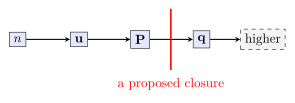
图 5 表示 moment hierarchy;红线的位置随选择的 fluid model 改变。
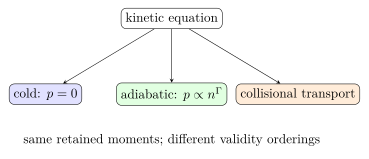
图 6 是 closure decision map;三个 boxes 不是互相等价的 approximations。
4. Landau damping / 朗道阻尼
Knowledge ID: P13-U02-L02-K04
4.1 Linearized Vlasov–Poisson response
取 electrons、fixed ions、\(f=f_0(v)+f_1(x,v,t)\),\(E=E_1\)。保留 first order:
\[\frac{\partial f_1}{\partial t}+v\frac{\partial f_1}{\partial x} -\frac{eE_1}{m_e}\frac{df_0}{dv}=0.\]
令 \(f_1,E_1\propto\exp[i(kx-\omega t)]\),则
\[f_1=+\frac{ieE_1}{m_e} \frac{df_0/dv}{\omega-kv}.\]
这里的正号由 \(1/(-i)=i\) 决定。再用 electron charge density 的 Poisson equation
\[ikE_1=-\frac{e}{\epsilon_0}\int_{-\infty}^{\infty}f_1\,dv\]
消去 \(E_1\),并将 \(\omega-kv=-k(v-\omega/k)\),得到 dielectric relation。若 \(F_0\) 按 \(\int F_0dv=n_0\) normalization:
\[\epsilon(k,\omega)=1- \frac{\omega_{pe}^2}{k^2n_0} \int_{-\infty}^{\infty} \frac{dF_0/dv}{v-\omega/k}\,dv=0.\]
denominator 在 \(v=v_\phi\) 有 pole。initial-value problem 的 causal analytic continuation 指定 Landau contour;不能把 integral 当普通 real principal value 后宣布 \(\gamma=0\)。
4.2 Physical picture: phase mixing and resonant energy transfer
比 wave 稍慢的 resonant particles 往往从 field 获得能量,比 wave 稍快的 particles 可能把能量交回 field。对 monotonic Maxwellian,在 \(v_\phi>0\) 处 \(dF_0/dv<0\),慢粒子更多,net energy 从 wave 流向 particles,所以 field amplitude 衰减。fine-grained \(f\) 仍 obey reversible Vlasov dynamics;damping 出现在 low-order field/moments,因为 phase mixing 把 coherent structure 搬到 increasingly fine velocity scales。
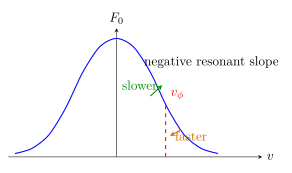
图 7 审计 particle imbalance;箭头示意 wave-frame energy exchange,不是 acceleration direction at every phase。
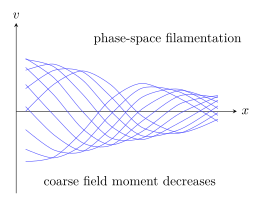
图 8 是 schematic phase mixing;线条表示 constant-phase structures,不是 separate species。
5. Velocity-space resonances / 速度空间共振
Knowledge ID: P13-U02-L02-K05
统一 resonance condition 为
\[\boxed{\omega-k_\parallel v_\parallel-n\Omega_s=0}, \qquad n=0,\pm1,\pm2,\ldots\]
- \(n=0\):Landau/transit-time class,particle 沿场相位与 wave 同步;
- \(n=\pm1\):fundamental cyclotron resonance;
- higher \(\lvert n\rvert\):harmonics,strength 取决于 finite Larmor radius 与 polarization;
- trapped particles 还可出现 bounce/precession resonance,需用相应 orbit frequencies。
resonance 是必要 kinematic match,不保证强 interaction;还要检查 wave polarization、field component、distribution slope 与 interaction time。linear damping 到足够 amplitude 时,particles 可在 wave potential 中 trapping,bounce frequency 与 \(\gamma\) 相当后 linear theory 失效。
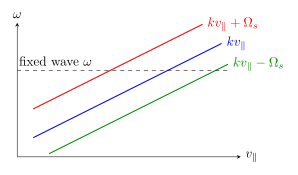
图 9 用 intersections 找 resonant velocities;\(\Omega_s\) 的 signed convention 必须与 polarization 一致。
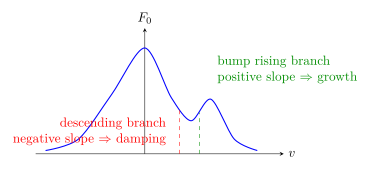
图 10 对比 Maxwellian-like negative slope 与 bump-on-tail positive slope;growth 的 free energy 来自 nonthermal population。
Worked examples / 完整例题
Worked Example 1 — Maxwellian normalization 与 moments
已知: \(F(v)=n(\sqrt{2\pi}v_T)^{-1}\exp[-(v-u)^2/(2v_T^2)]\)。
研究对象: one-dimensional velocity distribution;laboratory frame。
模型: integration range \((-\infty,\infty)\)。
令 \(w=(v-u)/v_T\),\(dv=v_Tdw\):
\[\int Fdv=\frac{n}{\sqrt{2\pi}}\int e^{-w^2/2}dw=n.\]
奇函数项消失:
\[\frac{1}{n}\int vFdv=u, \qquad \frac{1}{n}\int(v-u)^2Fdv=v_T^2.\]
检查: \(F\) units 为 \(n/v\);零阶积分为 \(\mathrm{m^{-3}}\)。若只知道前三个 moments,仍不能排除非 Gaussian distribution。
Worked Example 2 — Uniform electric field 中的 Vlasov characteristic
已知: one-dimensional constant \(E=50.0\ \mathrm{V\,m^{-1}}\),electron 初态 \(x_0=0\)、\(v_0=2.00\times10^6\ \mathrm{m\,s^{-1}}\),\(t=0.100\ \mathrm{ns}\)。
参考系与正方向: \(+x\) along \(\mathbf E\);electron \(q=-e\)。
模型: external uniform field,忽略 self-consistent change、relativity 与 collisions。
\[a=\frac{qE}{m_e}=-8.79\times10^{12}\ \mathrm{m\,s^{-2}}.\]
\[v=v_0+at =1.99912\times10^6\ \mathrm{m\,s^{-1}},\]
\[x=x_0+v_0t+\frac12at^2 =1.99956\times10^{-4}\ \mathrm m.\]
沿这一 characteristic,\(f(x,v,t)=f(x_0,v_0,0)\)。
检查: \(0.100\ \mathrm{ns}=1.00\times10^{-10}\ \mathrm s\),故 \(\Delta v=-8.79\times10^2\ \mathrm{m\,s^{-1}}\),与上式数量级一致;保留额外数字只为显示这段很小的变化。electron acceleration 逆 \(E\);在给定短时间内 \(v\) 仍为正。turning time 为
\[t_{\rm turn}=\frac{v_0}{\lvert a\rvert} =2.28\times10^{-7}\ \mathrm s =228\ \mathrm{ns}.\]
只有 \(t>t_{\rm turn}\) 时它才反向,不能继续口头称“向 \(+x\) 运动”。
Worked Example 3 — 同样 density/flow、不同 pressure
已知: 一维 symmetric cold beams,\(F(v)=\tfrac n2\delta(v-u_0)+\tfrac n2\delta(v+u_0)\),\(u_0=3.00\times10^5\ \mathrm{m\,s^{-1}}\);protons。
研究对象: combined distribution;mean frame。
模型: delta beams 仅作 moment audit,真实 beam 有 finite width。
\[\bar v=\frac{1}{n}\int vFdv=0,\]
\[P_{xx}=m_p\int v^2F\,dv=m_p n u_0^2 =150\ \mathrm{Pa}\]
若 \(n=1.00\times10^{18}\ \mathrm{m^{-3}}\)。相应 one-dimensional kinetic temperature:
\[k_BT_x=\frac{P_{xx}}{n}=m_p u_0^2=1.50\times10^{-16}\ \mathrm J=938\ \mathrm{eV}.\]
检查: mean flow 为零并不表示 particles 静止;两个 beams 储存大量 directed free energy,scalar Maxwellian closure 会掩盖 two-stream structure。
Worked Example 4 — Langmuir resonance scale
已知: unmagnetized electrons,\(n_e=1.00\times10^{16}\ \mathrm{m^{-3}}\),\(T_e=10.0\ \mathrm{eV}\),\(k\lambda_D=0.200\);fixed ions。
方向: \(k>0\);关注 positive phase velocity。
模型: warm-fluid real frequency \(\omega_r^2\simeq\omega_{pe}^2+3k^2v_T^2\),只用 kinetic slope 判断 damping sign。
\[\lambda_D=2.35\times10^{-4}\ \mathrm m, \qquad k=8.51\times10^2\ \mathrm{m^{-1}},\]
\[\omega_{pe}=5.64\times10^9\ \mathrm{s^{-1}}, \qquad \omega_r=\omega_{pe}\sqrt{1+3(k\lambda_D)^2} =5.97\times10^9\ \mathrm{s^{-1}}.\]
\[v_\phi=\frac{\omega_r}{k}=7.02\times10^6\ \mathrm{m\,s^{-1}}.\]
\(v_T=1.33\times10^6\ \mathrm{m\,s^{-1}}\),所以 \(v_\phi=5.29v_T\),resonant particles 位于 tenuous Maxwellian tail 且 \(dF_0/dv<0\):linear Landau damping 为负且较弱。
检查: \(\omega/k\) units 为 speed;本题未计算精确 \(\gamma\),避免混用 thermal-speed convention 的 prefactor。
Lesson synthesis / 全课整合
动理学建模流程:定义 \(f\) normalization → 声明 fields 是 external 还是 self-consistent → 比较 observation time 与 collision time 选择 Boltzmann/Vlasov → 需要宏观量时取 moments → 明确 closure 与小参数 → 对 waves 线性化并固定 Fourier convention → 找 \(v_\phi\) 或 cyclotron resonances → 检查 resonant slope、polarization 与 nonlinear trapping threshold。
Formula-and-decision table / 公式与决策表
| Need | Relation | Use only when | Main caution |
|---|---|---|---|
| density and flow | \(n=\int f d^3v\), \(n\mathbf u=\int\mathbf vf d^3v\) | stated normalization | \(f\) is not probability-one here |
| kinetic evolution | \(\partial_tf+\mathbf v\cdot\nabla f+\mathbf a\cdot\nabla_vf=C[f]\) | mean-field plus chosen collision model | operator must conserve invariants |
| collisionless characteristic | \(df/dt=0\) | \(\nu t\ll1\) | fine-grained, not fixed-\(x\) constancy |
| pressure tensor | \(\mathbf P=m\int\mathbf c\mathbf c f d^3v\) | \(\mathbf c=\mathbf v-\mathbf u\) | generally anisotropic |
| Landau resonance | \(v_\parallel=\omega_r/k_\parallel\) | linear electrostatic/transit interaction | pole needs causal contour |
| general resonance | \(\omega-k_\parallel v_\parallel-n\Omega_s=0\) | magnetized wave and consistent sign convention | kinematic match alone is insufficient |
Model boundaries / 模型边界
- Vlasov neglects binary collisions but not collective fields;for finite particle number, discreteness noise and correlations are beyond mean field。
- Linearization requires \(\lvert f_1\rvert\ll f_0\) and small field;particle trapping invalidates exponential damping/growth at later times。
- Landau damping is initial-value, analytic-continuation physics;a naive real-frequency normal-mode treatment misses it。
- Moment closure can fail even when density and temperature look smooth,especially near resonance, sheath, shock, loss cone or beam。
- Delta beams are mathematical limits;finite spread changes instability thresholds and growth rates。
- Quantum degeneracy、relativistic particles、strong coupling and radiation need different kinetic equations。
Misconception clinic / 易错概念诊所
| Misconception | Correction |
|---|---|
| collisionless means particles do not interact | they interact through self-consistent mean electromagnetic fields |
| \(df/dt=0\) means distribution is static | it is constant along characteristics while phase-space structure advects/shears |
| three moments uniquely determine \(f\) | only with an added family assumption such as Maxwellian |
| closure follows automatically from moment integration | each equation introduces a higher moment; closure adds physics |
| Landau damping dissipates energy by collisions | wave energy transfers collisionlessly to resonant fine-scale particle structure |
| all resonant particles gain energy | phase relative to the wave and distribution slope determine net exchange |
| positive bump always guarantees every mode grows | resonance, dielectric response and Penrose-like criteria must also be satisfied |
Practice and retrieval / 练习与检索
- [K01] 若 \(f\) units 为 \(\mathrm{s^3m^{-6}}\),为何积分 \(d^3v\) 后得到 \(\mathrm{m^{-3}}\)?
Answer 1
\(d^3v\) units 为 \(\mathrm{m^3s^{-3}}\),相乘后 \(\mathrm{s^3m^{-6}}\mathrm{m^3s^{-3}}=\mathrm{m^{-3}}\)。
- [K01] 两个 distributions 有相同 \(n,u,T\),它们是否一定有相同 wave response?
Answer 2
不一定;resonant response depends on local velocity-space slope and higher moments,beam/tail/loss-cone information 可不同。
- [K02] Vlasov characteristic 中 \(f\) 保持不变,为什么 spatial density 仍会变化?
Answer 3
不同 characteristics 穿过同一 spatial cell 的数量会变化;\(n=\int f\,d^3v\) 是 velocity projection,不是单条 characteristic 的值。
- [K02] 写出把 Vlasov system 闭合所需的两种 source moments。
Answer 4
charge density \(\rho_c=\sum_s q_s\int f_s d^3v\) 与 current \(\mathbf J=\sum_s q_s\int\mathbf vf_s d^3v\),再代入 Maxwell equations。
- [K03] 为什么 pressure 要用 \(\mathbf v-\mathbf u\) 而不是直接用 \(\mathbf v\)?
Answer 5
要从 random/thermal momentum flux 中剔除 bulk directed flow;直接用 \(\mathbf v\mathbf v\) 得到 total stress,含 \(mn\mathbf u\mathbf u\)。
- [K03] isothermal closure 与 adiabatic closure 的关键区别?
Answer 6
isothermal 假设 \(T\) 由快速 heat exchange 固定,\(p\propto n\);adiabatic 假设无热交换,\(p\propto n^\Gamma\)。两者适用 timescale 不同。
- [K04] 在本课 Fourier convention 下 \(\omega=10^6-i2\times10^4\ \mathrm{s^{-1}}\) 表示什么?
Answer 7
perturbation amplitude 含 \(e^{\gamma t}\),\(\gamma=-2\times10^4\ \mathrm{s^{-1}}\),所以 e-fold damping time 为 \(50\ \mu\mathrm s\)。
- [K04] Maxwellian 在正 \(v_\phi\) 处为何通常 Landau damp?
Answer 8
\(dF_0/dv<0\),略慢于 wave、可被加速的 particles 多于略快、把能量交还 wave 的 particles,net wave energy 流向 particles。
- [K05] \(\Omega_i=1.00\times10^5\ \mathrm{s^{-1}}\),且 \(\omega=5\Omega_i\)、\(k_\parallel=2.00\ \mathrm{m^{-1}}\),求 \(n=1\) ion cyclotron resonance 的 \(v_\parallel\)。
Answer 9
\(v_\parallel=(\omega-\Omega_i)/k_\parallel=(4.00\times10^5\ \mathrm{s^{-1}})/(2.00\ \mathrm{m^{-1}})=2.00\times10^5\ \mathrm{m\,s^{-1}}\)。分子是 angular-frequency difference,除以 inverse length 后量纲确为 speed。
- [综合] 某 wave 起初 exponential Landau damping,随后 amplitude oscillates 并停止按同一 \(\gamma\) 衰减。最先检查什么?
Answer 10
检查 resonant particle trapping:bounce frequency 是否已接近 linear damping rate,以及 distribution 是否在 resonance 附近 flatten;此时 linear fixed-\(f_0\) theory 失效。
Exit ticket / 迁移检验
解释为什么“取更多 moments”本身不能保证 fluid model 收敛到 kinetic truth,并提出一个能检验 closure 的量。
Exit-ticket benchmark
每一阶 moment equation 都耦合下一阶,截断必须有小参数或 constitutive relation;可比较 collision mean-free-path/gradient scale、wave phase speed 与 thermal speed,或直接把 kinetic 与 fluid dispersion/damping 对照。
References and source notes / 参考资料与使用说明
以下权威直接来源均在 2026-08-31 实际打开核对;公式 conventions 已在正文统一,图示全部原创。
- MIT OpenCourseWare 22.611J, Chapter 5 — Plasma Waves and Kinetic Theory — Vlasov linearization、two-stream context、Landau damping 与 wave kinetics。
- MIT OpenCourseWare 16.55, Lecture 8 — Kinetic Theory — phase-space distribution、Boltzmann/Vlasov description。
- Richard Fitzpatrick, UT Austin, Introduction to Plasma Fluid Theory — Vlasov versus kinetic equation and fluid motivation。
- Richard Fitzpatrick, UT Austin, Moments of Distribution Function — density、flow、pressure tensor、heat flux definitions。
- Richard Fitzpatrick, UT Austin, Fluid Closure — infinite hierarchy and closure classes。
- Richard Fitzpatrick, UT Austin, Landau Damping — causal pole treatment and collisionless damping。
- Richard Fitzpatrick, UT Austin, Velocity-Space Instabilities — resonant slope、Penrose condition and growth boundaries。
- Princeton Plasma Physics Laboratory, Basics of Plasma Kinetics and Landau Damping — Klimontovich/Vlasov hierarchy and kinetic resonance overview。
Source-to-content map
| Source | Used for | Knowledge ID / Section | Model boundary or convention |
|---|---|---|---|
| MIT 22.611J Ch. 5 | kinetic wave derivation | K02, K04–K05 | electrostatic linear response |
| MIT 16.55 L8 | distribution and kinetic equation | K01–K02 | mean-field and collision operator split |
| Fitzpatrick Introduction | Vlasov vs fluid economy | K02–K03 | collisionless mean-field limit |
| Fitzpatrick Moments | moment definitions | K01, K03 | species rest-frame pressure tensor |
| Fitzpatrick Closure | hierarchy logic | K03 | truncation vs asymptotic closure |
| Fitzpatrick Landau | causal analytic continuation | K04 | \(e^{i(kx-\omega t)}\) convention unified here |
| Fitzpatrick Instabilities | slope and Penrose boundary | K05 | non-Maxwellian velocity-space free energy |
| PPPL kinetics lecture | hierarchy and resonance overview | K02, K04–K05 | graduate extension, formulas re-expressed |
复习与拓展
- Lesson 13.2.3 将从 K03 moments 构造 two-fluid 与 single-fluid MHD,并明确丢失的 resonant physics。
- Lesson 13.3.1 将把 dielectric response 转为 Langmuir、ion-acoustic、electromagnetic 与 MHD dispersion branches。
- Lesson 13.3.2 将把 positive resonant slope、beam energy 与 spatial gradients连接到 instability growth and turbulent saturation。