
Learning objectives / 学习目标
学完本课后,你应能:
- 由双组分反应率 \(R_{12}=n_1n_2\langle\sigma v\rangle\) 区分截面、反应性与反应数率;
- 从热能库与损失功率定义 \(\tau_E\),解释 Lawson criterion 与 triple product 是能量平衡条件而非单一常数;
- 读取 tokamak 的 toroidal/poloidal fields、plasma current、safety factor 和 divertor 功能;
- 比较 stellarator、反场位形、镜机等方案的约束与稳态性取舍;
- 建立 ICF 的 ablation–compression–hot-spot–burn 时序与 \(\rho R\) 尺度;
- 用带系统边界的能量账本区分 \(Q_{\rm plasma}\)、target gain、engineering gain 与 net electric gain。
Prerequisites / 先修知识
- Plasma State and Characteristic Scales 中的 \(T,n,\lambda_D\) 与准中性;
- Single-Particle Motion 中的回旋、磁镜和导引中心;
- 核绑缚能、Maxwellian relative speed、功率与能量守恒;
- 基本磁流体、热力学和数量级估算。
Scope and conventions / 范围与约定
- 默认 SI;温度常以 energy temperature \(T\) 表示,数值用 keV,出现 \(k_{\rm B}T\) 时则明示。
- 对 D–T plasma,若无说明取 \(n_D=n_T=n_i/2\) 且准中性 \(n_e=n_D+n_T\).
- \(\langle\sigma v\rangle\) 是对相对速度分布平均后的 reactivity,其数值需反应数据;本课不从核力势求截面。
- 介绍 tokamak、stellarator 和 ICF 的物理地图,不展开详细 neoclassical transport、laser–plasma instability 或核材料辐照模拟。
- 任何 gain 前都必须声明系统边界;ITER 是物理/工程试验设备,不是发电站。
Notation and modeling contract / 符号与建模契约
| Symbol | Meaning | SI / convention |
|---|---|---|
| \(n_s\) | species \(s\) number density | \(\mathrm{m^{-3}}\) |
| \(\sigma(E)\) | fusion cross section | \(\mathrm{m^2}\) |
| \(\langle\sigma v\rangle\) | Maxwellian-averaged reactivity | \(\mathrm{m^3\,s^{-1}}\) |
| \(E_f\) | energy released per fusion reaction | J or MeV |
| \(W\) | plasma thermal energy | J |
| \(\tau_E=W/P_{\rm loss}\) | energy confinement time | s |
| \(Q=P_{\rm fus}/P_{\rm ext}\) | stated-boundary fusion gain | 1 |
| \(R_0,a\) | major and minor radii | m |
| \(B_t,B_p\) | toroidal and poloidal magnetic field | T |
| \(q(r)\) | tokamak safety factor | 1 |
| \(\rho R\) | ICF areal density | \(\mathrm{kg\,m^{-2}}\) or \(\mathrm{g\,cm^{-2}}\) |
1. Fusion reaction rates and Lawson criterion / 聚变反应率与劳森判据
Knowledge ID: P13-U04-L01-K01
轻核的质量亏损使终态绑缚能更低。对不同 reactants:
\[R_{12}=n_1n_2\langle\sigma v\rangle, \qquad p_f=R_{12}E_f.\]
对 identical reactants 要再乘 \(1/2\) 以避免 pair double counting。D–T 反应
\[{}^2\mathrm H+{}^3\mathrm H\rightarrow{}^4\mathrm{He}\,(3.5\ \mathrm{MeV})+n\,(14.1\ \mathrm{MeV})\]
的带电 alpha 可留在磁约束 plasma 中自加热,neutron 主要将能量交给 blanket/materials。但 Coulomb barrier 使 \(\sigma(E)\) 在低能时很小;热分布的高能尾与 tunneling 共同产生 Gamow window。
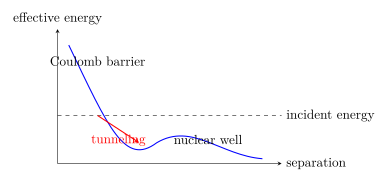
图 1 是反应坐标上的势垒示意;曲线不是某特定反应的定量核势。
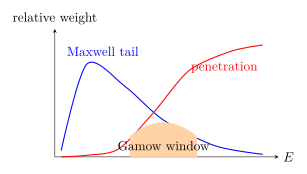
图 2 表示 reactivity 的主要能区是两个因子的乘积,不等于 \(kT\) 或势垒顶。
令 plasma thermal energy \(W\) 以总损失功率 \(P_{\rm loss}\) 流失:
\[\tau_E=\frac{W}{P_{\rm loss}}.\]
稳态点火条件需 alpha heating 不小于 transport+radiation losses。消去 volume 后得到与 \(nT\tau_E\) 有关的 Lawson/triple-product 条件。具体阈值依赖 fuel mix、\(T\)、impurities、损失模型和“点火/盈亏”定义,不能脱离这些条件背诵。
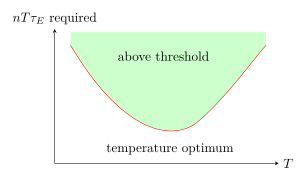
图 3 强调阈值是随温度变化的曲线,绿区只表示理想化的自加热一侧。
2. Magnetic confinement and tokamaks / 磁约束与托卡马克
Knowledge ID: P13-U04-L01-K02
带电粒子沿场线容易流动,单纯 toroidal field 会因 curvature/grad-\(B\) drift 造成 charge separation。tokamak 将外部线圈的 \(B_t\) 与 plasma current \(I_p\) 产生的 \(B_p\) 叠加,形成绕 torus 的 helical field lines 和 nested flux surfaces。在大纵横比近似中:
\[q(r)\simeq\frac{rB_t}{R_0B_p}.\]
\(q\) 是场线完成一次 poloidal turn 期间的 toroidal turns 尺度;\(q(r)\) profile 与 magnetic shear 影响 resonant modes 与 stability。它不是 electric charge \(q\),本课仅在 tokamak 语境中使用。
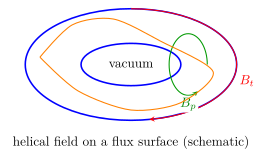
图 4 区分 toroidal/poloidal 分量;橙线是场线投影,不是粒子瞬时轨道。
tokamak 的中心螺线管像 transformer primary 一样感应 \(I_p\),因此纯 inductive current drive 天然是脉冲的。auxiliary current drive 和 bootstrap current 可延长脉冲。边缘的 divertor 将开口场线上的 heat/particles 导向专用 target,并排出 helium ash 和 impurities。
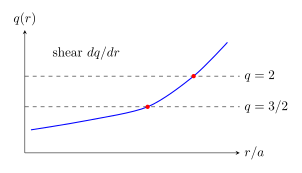
图 5 显示 rational surfaces 是 \(q(r)\) 与有理数线的交点;真实 profile 不必单调。
3. Stellarators and alternative magnetic configurations / 仿星器与其他磁位形
Knowledge ID: P13-U04-L01-K03
stellarator 用外部三维线圈直接产生 rotational transform,无需大的 transformer-driven plasma current,因此天然适合 steady-state,且减少 current-driven disruptions。代价是 three-dimensional neoclassical transport、coil complexity、error-field sensitivity 和组件空间约束;quasisymmetry 或 quasi-isodynamic optimization 尝试在三维几何中恢复有用的轨道对称。
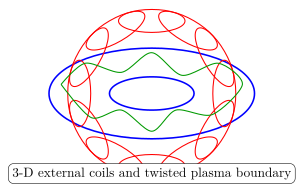
图 6 是 stellarator 的三维性示意;线圈与实际优化形状均不按比例。
其他位形包括 spherical tokamak、reversed-field pinch、field-reversed configuration、spheromak 与 open-ended mirror。它们在 aspect ratio、场由外部线圈还是 plasma current 产生、steady state、beta、end losses 与工程难度上有不同取舍。“alternative”不等于自动更优;必须比较相同目标下的 confinement, stability, exhaust, maintainability 与 recirculating power。
4. Inertial confinement / 惯性约束
Knowledge ID: P13-U04-L01-K04
ICF 不用磁场长时间困住燃料,而在极短脉冲中将小靶压缩到高密度和高温,使反应在 disassembly 前发生。indirect drive 用 hohlraum 将 laser 转成 x rays;direct drive 直接辐照 capsule。两者都依赖 ablation pressure 的 rocket effect、implosion symmetry、low adiabat 与 instability control。
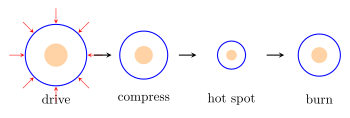
图 7 是 drive→compression→hot spot→burn 的时序,圆尺寸和持续时间不按比例。
常用 areal density \(\rho R\) 表征 alpha 能量沉积和燃料的“厚度”。对均匀 sphere,\(\rho R=\rho R_{\rm capsule}\);实际 implosion 有 shell/hot-spot gradients,应用 line-integrated density,不能把初始靶尺寸直接代入压缩态。
5. Heating, diagnostics, materials, and energy balance / 加热、诊断、材料与能量核算
Knowledge ID: P13-U04-L01-K05
magnetic-confinement plasma 先有 ohmic heating,但随温度上升 resistivity 降低,必须加 neutral beam injection、electron/ion cyclotron heating、lower-hybrid waves 等外部加热与 current drive。当 alpha heating 主导时进入 burning-plasma regime。
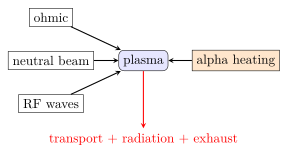
图 8 将加热渠道与损失渠道分开;箭头只表示能流方向。
诊断必须组成多观测量系统:magnetic probes/equilibrium reconstruction 给 shape/current,interferometry 给 line-integrated density,Thomson scattering 给 electron \(T,n\),spectroscopy 给 ions/impurities/flows,bolometry 给 radiated power,neutron diagnostics 给 fusion rate。单一诊断通常存在 line integration、calibration 或 inversion ambiguity,因此需 redundancy 和不确定度。
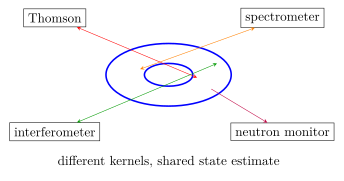
图 9 说明各诊断看到的是不同观测算子,并非四份相同的温度读数。
材料边界是物理系统的一部分:14.1 MeV neutrons 导致 displacement damage/transmutation,plasma-facing components 承受高 heat flux、sputtering 与 tritium retention,blanket 需吸热、屏蔽并可能用 lithium breeding tritium。因此 energy balance 至少分四层。首先,\(P_\alpha\) 是 \(P_f=P_n+P_\alpha\) 的一部分;它在等离子体内形成 self-heating 回路,不能在电站账本中再作为独立外源重复相加。若 \(P_{\rm aux,dep}=\eta_hP_{e,\rm recirc}\) 是实际沉积到等离子体的辅助功率,则一个显式的简化电站边界可写成
\[P_{\rm th}=\eta_{\rm cap}\left(P_f+P_{\rm aux,dep}\right), \qquad P_{e,\rm gross}=\eta_{\rm th}P_{\rm th},\]
\[P_{e,\rm net}=P_{e,\rm gross}-P_{e,\rm recirc}-P_{e,\rm other}.\]
这里 \(1-\eta_h\) 是 wall-plug 到等离子体之间的加热链损失,\(1-\eta_{\rm cap}\) 表示未被热循环回收的辐射、排气与结构热,\(P_{e,\rm other}\) 包含泵、低温、燃料循环等厂用电。真实 blanket 还可能有 neutron multiplication;若引入,必须把相应增益单独写入 \(\eta_{\rm cap}\) 或独立因子,不能藏在 \(P_f\) 中。常用 gain 指标则必须注明边界:
\[Q_{\rm plasma}=\frac{P_{\rm fus}}{P_{\rm aux\ to\ plasma}}, \qquad Q_{\rm eng}=\frac{P_{\rm electric,out}}{P_{\rm electric,recirc}}.\]
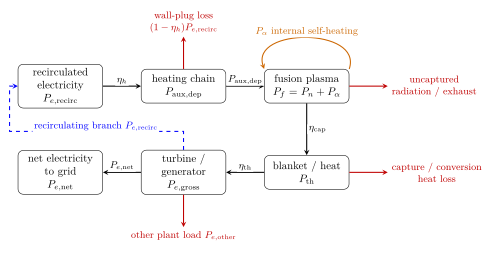
图 10 是闭合的分边界能量账本:橙色 \(P_\alpha\) 只在 plasma 内部自加热,黑色主链把辅助沉积功率与聚变功率都送入可回收热,红色箭头是明确的不可回收/厂用分支,蓝色虚线是电功率回流。只报 target/plasma gain 不能推出 net electricity。
Worked examples / 完整例题
Worked Example 1 — D–T reaction rate and power density
已知: 50–50 D–T plasma,\(n_i=1.00\times10^{20}\ \mathrm{m^{-3}}\),在指定温度下取表列 \(\langle\sigma v\rangle=1.10\times10^{-22}\ \mathrm{m^3\,s^{-1}}\),\(E_f=17.6\ \mathrm{MeV}\)。
系统: \(1.00\ \mathrm{m^3}\) 均匀 plasma;不把 neutron 沉积位置与 alpha 沉积位置混合。
模型: Maxwellian reactivity 已包含 velocity average,D/T 为不同 reactants。
\[n_D=n_T=5.00\times10^{19}\ \mathrm{m^{-3}},\]
\[R_{DT}=n_Dn_T\langle\sigma v\rangle =2.75\times10^{17}\ \mathrm{m^{-3}\,s^{-1}}.\]
\[E_f=17.6\times10^6(1.602\times10^{-19}) =2.82\times10^{-12}\ \mathrm J,\]
\[p_f=R_{DT}E_f=7.75\times10^5\ \mathrm{W\,m^{-3}}.\]
alpha fraction 为 \(3.5/17.6\),故 \(p_\alpha=1.54\times10^5\ \mathrm{W\,m^{-3}}\)。检查: \(n^2\langle\sigma v\rangle\) 给 \(\mathrm{m^{-3}s^{-1}}\);功率保留三位有效数字。物理上 total fusion power 不等于 plasma self-heating power。
Worked Example 2 — Confinement time and triple product
已知: \(n_e=n_i=1.00\times10^{20}\ \mathrm{m^{-3}}\),\(T_e=T_i=10.0\ \mathrm{keV}\),总损失功率密度 \(p_{\rm loss}=2.40\times10^5\ \mathrm{W\,m^{-3}}\)。
系统: 均匀体元,将 electron+ion thermal energy 都纳入 \(W\)。
模型: 两组分各为 ideal 3-D gas;temperature 以 energy 表示。
\[u=\frac32(n_eT_e+n_iT_i) =3(1.00\times10^{20})(10.0\times10^3)(1.602\times10^{-19}) =4.81\times10^5\ \mathrm{J\,m^{-3}}.\]
\[\tau_E=\frac{u}{p_{\rm loss}}=2.00\ \mathrm s, \qquad n_eT_{\rm keV}\tau_E=2.00\times10^{21}\ \mathrm{keV\,s\,m^{-3}}.\]
检查: \(\mathrm{J,m^{-3}}/(\mathrm{W,m^{-3}})=\mathrm s\)。这只是 measured triple product;是否点火还要与相同 fuel/temperature/loss convention 下的阈值比较。
Worked Example 3 — Tokamak safety factor estimate
已知: \(R_0=6.20\ \mathrm m\),\(r=2.00\ \mathrm m\),\(B_t=5.30\ \mathrm T\),\(B_p=0.700\ \mathrm T\)。
参考系: axisymmetric torus;\(toroidal\) 和 \(poloidal\) 方向按图 4。
模型: large-aspect-ratio circular approximation。
\[q(r)\simeq\frac{rB_t}{R_0B_p} =\frac{(2.00)(5.30)}{(6.20)(0.700)}=2.44.\]
检查: 所有量纲消去;若 \(B_p\to0\),\(q\to\infty\),表示场线几乎不做 poloidal winding。结果三位有效数字,不可代替 equilibrium reconstruction 中的真实 \(q\) profile。
Worked Example 4 — ICF areal density and target gain
已知: 某压缩 fuel region 的平均 \(\rho=400\ \mathrm{g\,cm^{-3}}\),\(R=35.0\ \mu\mathrm m\);入射到 target 的能量 \(E_{\rm in}=2.05\ \mathrm{MJ}\),fusion yield \(E_f=3.15\ \mathrm{MJ}\)。
系统: 第一问是 compressed fuel;第二问的边界是 target,不含 laser wall-plug loss。
模型: 均匀 sphere 估算 \(\rho R\)。
\[R=35.0\ \mu\mathrm m=3.50\times10^{-3}\ \mathrm{cm},\]
\[\rho R=(400)(3.50\times10^{-3})=1.40\ \mathrm{g\,cm^{-2}},\]
\[G_{\rm target}=\frac{E_f}{E_{\rm in}}=\frac{3.15}{2.05}=1.54.\]
检查: \(\rho R\) 是面密度,不是 volume density;target gain \(1\) 不意味设施或电网净能量 \(0\),因为没有纳入 laser efficiency、cryogenics 和 repetition-rate systems。
Lesson synthesis / 全课整合
受控聚变的建模链:指定 fuel 与 distribution → 用 \(\langle\sigma v\rangle\) 求 reaction power → 列出 alpha/neutron 能量去向 → 定义 confinement volume/time 与 \(P_{\rm loss}\) → 检验 Lawson/triple product → 选择 magnetic 或 inertial architecture → 加入 stability/exhaust/material/diagnostic constraints → 扩展到 wall-plug 与 net-electric 账本。
Formula-and-decision table / 公式与决策表
| Need | Relation | Use only when | Main caution |
|---|---|---|---|
| reaction rate | \(R_{12}=n_1n_2\langle\sigma v\rangle\) | different reactants, stated distributions | identical species need \(1/2\) |
| fusion power density | \(p_f=R_{12}E_f\) | energy per reaction specified | separate alpha and neutron channels |
| confinement time | \(\tau_E=W/P_{\rm loss}\) | system boundary fixed | not particle confinement time |
| triple product | \(nT\tau_E\) | same density and temperature convention | threshold is fuel/model dependent |
| tokamak pitch | \(q\simeq rB_t/(R_0B_p)\) | circular large-aspect estimate | not exact equilibrium \(q\) |
| ICF thickness | \(\rho R\) | compressed-state line density known | gradients matter |
| gain | \(Q=P_{\rm out}/P_{\rm in}\) | numerator/denominator named | never omit boundary |
Model boundaries / 模型边界
- Maxwellian reactivity 失效于 beam-target/nonthermal tails,此时应直接对 distribution functions 积分。
- Lawson criterion 是必要的 power-balance summary,不自动保证 MHD stability、ash removal、tritium breeding 或材料寿命。
- \(q\simeq rB_t/(R_0B_p)\) 忽略 shaping、finite aspect ratio 和 pressure/current profiles。
- stellarator 不需大 plasma current 不等于没有 instabilities 或 transport。
- ICF 的 uniform \(\rho R\) 是标度;真实 burn 需 radiation hydrodynamics、mix 与 instability models。
- plasma/target gain 不能与 net electric gain 混用;必须加热、低温系统、泵、燃料循环和 thermal conversion。
Misconception clinic / 易错概念诊所
| Misconception | Correction |
|---|---|
| 温度越高反应率必然越好 | reactivity、radiation 与 confinement 都随 \(T\) 变,存在有用温区 |
| Lawson 是所有反应的单一数值 | 它依赖 fuel、\(T\)、gain definition 和损失模型 |
| 磁场把粒子完全固定 | 粒子沿场运动并有 drifts/collisions/turbulence |
| stellarator 只是扭曲 tokamak | 其 rotational transform 主要由三维外部线圈产生 |
| ICF ignition 等于电站盈亏 | ignition/target gain 的边界远小于整个设施 |
| neutron 是 plasma self-heating 主体 | 磁约束 D–T 中主要是 charged alpha 自加热 |
Practice and retrieval / 练习与检索
- [K01] 对 \(n_D=n_T=n_i/2\),把 \(R_{DT}\) 写成 \(n_i\) 的函数。
Answer 1
\(R_{DT}=(n_i^2/4)\langle\sigma v\rangle\)。D/T 是不同 reactants,不再加 \(1/2\)。
- [K01] 在其他条件不变时,D 和 T 密度同时加倍,反应率如何变?
Answer 2
\(R\propto n_Dn_T\),故增为 4 倍;但实际 \(T,\tau_E\) 可随密度变,不得外推净功率。
- [K01] 为什么 \(\tau_E\) 不等于单个 ion 在 device 中的 residence time?
Answer 3
\(\tau_E=W/P_{\rm loss}\) 是能量库 e-folding 尺度;粒子、能量和动量可有不同输运时间。
- [K02] 若 \(r,R_0,B_t\) 不变而 \(B_p\) 加倍,大纵横比估算中 \(q\) 如何变?
Answer 4
\(q\propto1/B_p\),因此减半;场线 poloidal winding 增强。
- [K02] divertor 为什么不能被当成“一块普通壁”?
Answer 5
它专门接收 separatrix 外开口场线的粒子/热流,承受高 heat flux 并排出 ash/impurities,几何与材料都是设计约束。
- [K03] 列出 stellarator 的一项物理优点和一项工程代价。
Answer 6
例:外部线圈给 rotational transform,可 steady-state 且少 current-driven disruption;代价是 3-D coil/blanket/divertor 的优化、制造与维护复杂。
- [K04] \(\rho=300\ \mathrm{g\,cm^{-3}}\)、\(R=50\ \mu\mathrm m\),求 \(\rho R\)。
Answer 7
\(R=5.0\times10^{-3}\ \mathrm{cm}\),故 \(\rho R=1.5\ \mathrm{g\,cm^{-2}}\)。
- [K04] indirect drive 中 hohlraum 的主要物理作用是什么?
Answer 8
将 laser energy 转换为更接近各向均匀的 x-ray bath,用 ablation 驱动 capsule implosion;转换和漏失也降低 coupling efficiency。
- [K05] 为什么 Thomson scattering 与 interferometry 的 density 信息不应简单平均?
Answer 9
两者 measurement kernel 不同:前者可局域取 profile,后者常是 line integral;应在 forward model 中合并并传播 calibration/inversion uncertainty。
- [综合] 某报道只给出 \(Q_{\rm plasma}=10\),为什么不足以计算净发电功率?
Answer 10
缺少 heating wall-plug efficiency、neutron/thermal capture、turbine efficiency、magnets/cryogenics/pumps/fuel cycle 等 recirculating loads 及 availability;必须扩大系统边界。
Exit ticket / 迁移检验
对任一“聚变取得盈余”的叙述,写出你必须追问的三个定量边界。
Exit-ticket benchmark
至少包括:(1) output 是 total fusion、alpha heating、target yield 还是 electricity;(2) input 是 deposited auxiliary、laser-on-target 还是 wall-plug/recirculating;(3) 时间和体积是单脉冲、平均功率还是稳态,是否含 duty cycle。
References and source notes / 参考资料与使用说明
以下权威直接来源均在 2026-08-31 实际打开核对;本课 TikZ 均根据方程和器件逻辑原创绘制,未复制来源插图。
- IAEA, Experiences for Consideration in Fusion Power Plant Design Safety and Safety Assessment (IAEA-TECDOC-2076) — §2.1(pp. 13–14)的 D–T、Lawson/triple product 与系统层约束。
- ITER Organization, What is a tokamak? — tokamak field/current、加热和设备边界。
- ITER Organization, Diagnostics — magnetic、neutron、Thomson/interferometric、spectroscopic 与 bolometric diagnostics。
- EUROfusion, Stellarator — 外部 helical coils、steady-state 与 plasma-current 差别。
- Lawrence Livermore National Laboratory, How NIF Works — 192-beam indirect drive、hohlraum、ablation 与 implosion sequence。
- ITER Organization, Divertor — heat/ash exhaust 和 plasma-facing load。
Source-to-content map
| Source | Used for | Knowledge ID / Section | Model boundary or convention |
|---|---|---|---|
| IAEA TECDOC-2076 | triple product, fuels, plant boundary | K01, K05 | thresholds depend on goal and concept |
| ITER tokamak | \(B_t/B_p\), current, heating, machine status | K02, K05 | ITER does not generate electricity |
| ITER diagnostics | observation kernels and redundancy | K05 | reactor-like long-pulse environment |
| EUROfusion stellarator | external transform and steady state | K03 | concept comparison, not performance claim |
| LLNL NIF | indirect-drive sequence | K04 | target-scale boundary |
| ITER divertor | exhaust and material interface | K02, K05 | localized high heat/particle flux |
复习与拓展
- 与 Plasma Instabilities 连接:将 \(q\) profile、pressure gradients 与 MHD/microinstabilities 对应。
- 与 Feedback and Control 连接:用诊断、actuators 和状态估计组成 plasma control loop。
- 可扩展:Bosch–Hale reactivity fits、bootstrap current、gyrokinetic transport、ICF hydrodynamic instabilities、tritium breeding ratio 与 lifecycle energy analysis。