
Learning objectives / 学习目标
学完本课后,你应能:
- 从线弹性介质的体积与剪切响应解释 P wave、S wave 的偏振、速度与传播条件;
- 用 travel-time difference、ray bending、shadow zone 与 normal modes 说明地球内部结构如何被反演;
- 区分 absolute gravity、gravity anomaly、Bouguer correction 与 isostatic compensation,并完成数量级计算;
- 用 magnetic induction equation 与 magnetic Reynolds number 说明 self-excited geodynamo 的基本条件;
- 用 Fourier heat conduction、Rayleigh number 与 rheological timescale 连接地表热流、mantle convection 和 plate motion;
- 对每种反演结果指出非唯一性、空间分辨率、模型依赖与观测误差。
Prerequisites / 先修知识
- 纵波、横波、波速、折射与 Fourier analysis;
- 应力、应变、bulk modulus \(K\)、shear modulus \(\mu\);
- Newtonian gravity、potential field 与 density;
- Faraday induction、magnetic diffusion、热传导与 buoyancy;
- 线性代数中的 eigenvalue/eigenmode 与基础微分方程。
Scope and conventions / 范围与约定
- 地震学默认 Earth-centered spherical coordinates;局地图中 \(z\) 向下为正,走时 \(T\) 始终为正。
- gravity anomaly 用 \(\Delta g=g_{\mathrm{obs}}-g_{\mathrm{reference/corrected}}\);向下引力增加取正。\(1\ \mathrm{mGal}=10^{-5}\ \mathrm{m\,s^{-2}}\)。
- heat flux \(\mathbf q\) 的方向由高温指向低温;若深度 \(z\) 向下、温度随深度增加,则 \(q_z=-k\,dT/dz<0\),向上的热流大小为 \(q_{\rm up}=k\,dT/dz\)。
- geomagnetism 中 \(\eta_m\) 表示 magnetic diffusivity,不与机械 viscosity \(\eta\) 混用。
- 本课只建立 spherically averaged/reference-Earth 与一阶 anomaly 模型;不展开完整 tensor elasticity、anisotropic tomography、MHD numerical dynamo 或 plate-reconstruction algorithms。
Notation and modeling contract / 符号与建模契约
| Symbol | Meaning | SI / convention |
|---|---|---|
| \(\rho\) | mass density | \(\mathrm{kg\,m^{-3}}\) |
| \(K,\mu\) | bulk and shear moduli | Pa |
| \(v_P,v_S\) | compressional and shear-wave speed | \(\mathrm{m\,s^{-1}}\) |
| \(T\) | seismic travel time | s |
| \(p_r\) | seismic ray parameter | \(\mathrm{s\,rad^{-1}}\) or \(\mathrm{s\,m^{-1}}\) locally |
| \(\Delta g\) | gravity anomaly | \(\mathrm{m\,s^{-2}}\) or mGal |
| \(\mathbf B\) | magnetic flux density | T |
| \(\eta_m\) | magnetic diffusivity | \(\mathrm{m^2\,s^{-1}}\) |
| \(\mathbf q\) | conductive heat-flux vector | \(\mathrm{W\,m^{-2}}\) |
| \(q_z,q_{\rm up}\) | downward-positive heat-flux component; upward magnitude | \(\mathrm{W\,m^{-2}}\) |
| \(\kappa,\eta\) | thermal diffusivity; dynamic viscosity | \(\mathrm{m^2\,s^{-1}}\); \(\mathrm{Pa\,s}\) |
| \(Ra\) | Rayleigh number | 1 |
1. Seismic body and surface waves / 地震体波与面波
Knowledge ID: P14-U03-L01-K01
earthquake source 释放的 elastic disturbance 可在体内传播为 body waves,也可被自由表面约束为随深度衰减的 surface waves。在 homogeneous isotropic linear elastic solid 中:
\[v_P=\sqrt{\frac{K+\frac{4}{3}\mu}{\rho}},\]
\[v_S=\sqrt{\frac{\mu}{\rho}}.\]
P wave 的 particle motion 平行于传播方向,会造成体积应变;S wave 的 particle motion 垂直于传播方向,需要 shear restoring force。fluid 在静态极限不能承受剪切,即 \(\mu=0\),所以 \(v_S=0\);这并不表示 fluid 中不存在所有横向运动,而是没有相应的 elastic shear body wave。
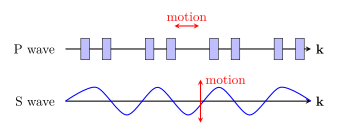
图 1 对比 polarization:箭头是介质质点位移,不是“波形沿该曲线行走”的轨迹。
在均匀各向同性半空间的基本模近地表,Rayleigh wave 通常呈 retrograde elliptical vertical–radial motion;分层介质中 polarization sense 可随 frequency 与 depth 改变。Love wave 具有 horizontal transverse motion。两类面波被困在近地表,振幅随深度减小,常因几何衰减较慢、持续时间较长而在远处造成显著 shaking。真实地壳分层使 surface-wave phase/group velocity 随 frequency 变化,即 dispersion;该频散正是反演浅部速度结构的信号。
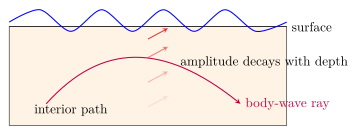
图 2 区分沿内部传播的 ray 与受表面束缚、随深度衰减的 wavefield;曲线均为 schematic,不按比例。
在 seismogram 上,通常先到 P,再到 S,随后是振幅较大、频散明显的 surface-wave train。arrival time 取决于 source origin time、path length 和沿途速度,因此一次到时不是“深度尺”,而是 forward model 与多个台站共同约束的观测量。
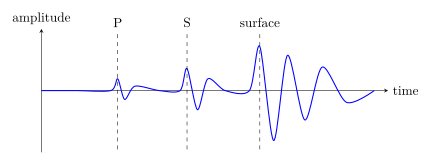
图 3 是理想化 seismogram;标记的是 phase arrival,不表示单一正弦波永不衰减。
2. Earth structure from travel times and normal modes / 由走时与简正模研究地球结构
Knowledge ID: P14-U03-L01-K02
给定 velocity model \(v(\mathbf r)\),ray approximation 下的 travel time 为
\[T=\int_{\Gamma}\frac{ds}{v(\mathbf r)}.\]
ray path \(\Gamma\) 本身也依赖 \(v\);在连续分层 Earth 中,ray parameter 在球对称模型里守恒。速度一般随深度上升,ray 被折回地表。abrupt interface 会产生 reflected/refracted phases;outer core 中 \(v_S=0\) 与 P-wave strong refraction 共同造成 shadow zones,成为 liquid outer core 的核心证据之一。
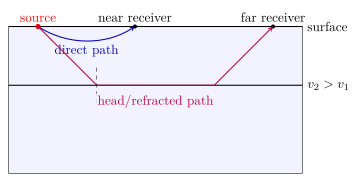
图 4 显示 direct 与 refracted arrivals 的竞争;跨越距离增大时,更快深层路径虽更长,却可能更早到达。
一组 observed travel times \(\mathbf d\) 与 model parameters \(\mathbf m\) 的 linearized inverse problem 可写为
\[\delta\mathbf d=\mathbf G\,\delta\mathbf m+\boldsymbol\epsilon.\]
\(\mathbf G\) 是 sensitivity kernel / design matrix,\(\boldsymbol\epsilon\) 含 picking error、source uncertainty 与未建模结构。由于有限台站覆盖、有限频带和 smoothing/regularization,tomographic image 不是内部的无损照片;颜色异常表示相对于 reference model 的波速差,并需通过 mineral physics 才能谨慎联系 temperature、composition 或 melt。
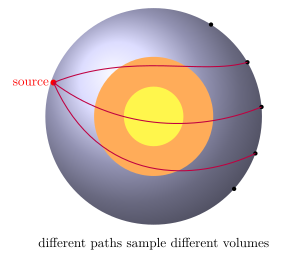
图 5 用多路径说明 tomography 的 coverage;未被 rays/Fresnel zones 采样的体积无法凭算法创造高分辨率。
大地震还会激发整颗 Earth 的 normal modes。小振幅自由振动满足抽象 eigenproblem
\[\mathcal L[\boldsymbol\xi_n]=-\omega_n^2\rho\boldsymbol\xi_n,\]
其中 displacement eigenfunction \(\boldsymbol\xi_n\) 与 eigenfrequency \(\omega_n\) 对 density、elasticity、rotation 与 attenuation 敏感。spheroidal modes 包含 radial motion,toroidal modes 主要为切向 shear;离散频谱提供与 travel times 不同、全局性的内部约束。
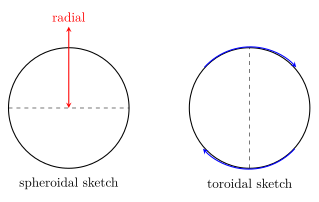
图 6 只示意两类 eigenfunction 的运动性质,不是某一具体 mode 的精确 node pattern。
3. Gravity anomalies and isostasy / 重力异常与均衡
Knowledge ID: P14-U03-L01-K03
measured \(g\) 同时含 latitude/rotation、elevation、terrain、tides、instrument drift 与 subsurface density distribution。只有在明确 reference field 和 corrections 后,residual 才称 gravity anomaly。对 density perturbation \(\delta\rho\),观测点 \(\mathbf r\) 的 anomaly vector 为
\[\Delta\mathbf g(\mathbf r)=G\int_V\delta\rho(\mathbf r') \frac{\mathbf r'-\mathbf r}{\lvert\mathbf r'-\mathbf r\rvert^3}\,dV'.\]
因此 potential-field inversion 是非唯一的:许多不同形状、深度与 density contrast 可产生相近 surface field。简单无限 horizontal slab 的垂直 anomaly 大小
\[\Delta g_z=2\pi G\,\Delta\rho\,t\]
与 slab 深度无关,是理想无限延伸的特殊结果;有限 body 的 amplitude 与 wavelength 才包含 depth information。
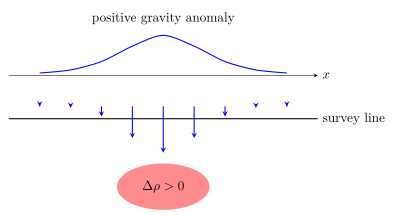
图 7 中 dense body 使向下 \(g\) 增大;上方曲线是 schematic,不能从单条峰形唯一确定 body geometry。
isostasy 是长波长、长期尺度上 lithosphere columns 在 compensation depth 附近趋于相等 pressure/mass loading 的近似。Airy model 假设 crust density \(\rho_c\) 近似恒定,以 thickness change 补偿 topography;高度 \(h\) 对应 root thickness
\[r=\frac{\rho_c}{\rho_m-\rho_c}h.\]
Pratt model 则以 lateral density variation 补偿。现实 lithosphere 有 finite elastic strength,短波长载荷可由 flexure 支撑,不能处处要求 local Airy balance。
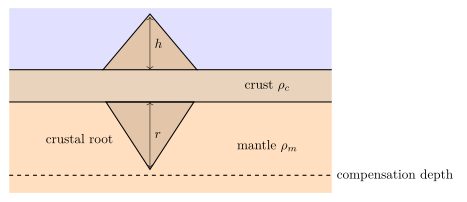
图 8 是 Airy end-member;mountain root 并不意味着所有山脉都完全 local-compensated。
4. Geomagnetism and dynamo action / 地磁与发电机作用
Knowledge ID: P14-U03-L01-K04
Earth magnetic field 可分为 main internal field、crustal field 与 magnetosphere/ionosphere 等 external fields。main field 在地表一阶近似为 tilted dipole,但随位置和时间有 non-dipole components、secular variation 与 polarity reversals。compass 指向 magnetic north 的说法也需区分 declination、inclination 与 geographic north。
conducting liquid outer core 中,motion advects and stretches magnetic field;Ohmic diffusion 则消散细尺度结构。忽略 displacement current 且采用均匀 diffusivity 时,induction equation 为
\[\frac{\partial\mathbf B}{\partial t} =\nabla\times(\mathbf u\times\mathbf B)+\eta_m\nabla^2\mathbf B,\]
\[Rm=\frac{UL}{\eta_m}.\]
\(Rm\gg1\) 意味 advection 在尺度 \(L\) 上快于 diffusion,但只是必要的 scaling condition,不保证任意 flow 都能 sustain dynamo。还需 electrical conductivity、three-dimensional time-dependent flow、energy source 与可克服 Ohmic losses 的 feedback;Cowling-type constraints 也说明纯 axisymmetric field/flow 不能维持简单 self-excited dynamo。
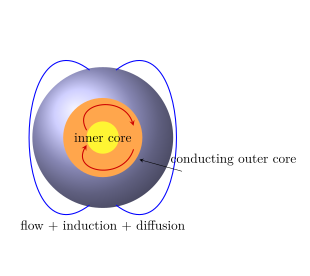
图 9 将 outer-core flow 与 global field lines 并置;流线和磁力线是不同对象,图为 schematic。
5. Heat flow, mantle convection, and plate motion / 热流、地幔对流与板块运动
Knowledge ID: P14-U03-L01-K05
Earth internal energy 来自 accretion/differentiation 的遗留热、radioactive decay、core crystallization 与 secular cooling。纯 conduction obeys Fourier law:
\[\mathbf q=-k\nabla T.\]
地表 borehole gradient 乘 conductivity 可估 conductive heat flux,但 groundwater advection、topography、climate history 和 heat production 会扰动 shallow gradient。mantle 在 seismic timescale 上是 elastic solid,却能在 millions-of-years timescale 发生 viscous creep;“solid”与“convecting”并不矛盾。
thermal buoyancy 能否克服 diffusion 与 viscosity 可由 Rayleigh number 衡量:
\[Ra=\frac{\rho g\alpha\Delta T d^3}{\kappa\eta}.\]
\(Ra\) 超过与 geometry/boundary conditions 有关的 critical value 时,convection 可发展。实际 mantle 还具有 temperature-dependent non-Newtonian rheology、phase changes、internal heating、composition 与 moving plates;一个均匀低黏度锅的 analogy 只能提供起点。
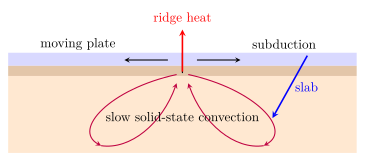
图 10 串联 ridge、plate motion、subduction 与 long-timescale circulation;它不宣称单一闭合 cell 对应每块 plate。
plate motion 是 slab pull、ridge/gravitational potential、basal tractions、transform resistance 与 mantle flow 耦合后的结果。GPS 给出当前 surface velocities,marine magnetic anomalies 和 hotspot/stratigraphic records 扩展地质时间,但不同 reference frames 与 plate deformation 需明确。常见口号“板块被传送带拖着走”会隐藏 plates 既是 thermal boundary layer、又会主动驱动/重组 mantle flow 的双向耦合。
Worked examples / 完整例题
Worked Example 1 — 从弹性常数计算 P、S 波速
已知: rock 的 \(K=50.0\ \mathrm{GPa}\)、\(\mu=30.0\ \mathrm{GPa}\)、\(\rho=2700\ \mathrm{kg\,m^{-3}}\)。
研究对象与边界: homogeneous isotropic, lossless rock volume;忽略 cracks、anisotropy 与 dispersion。
参考系/坐标: local Cartesian frame,传播方向取 \(+x\);速度报告大小。
模型理由: wavelength 远大于 grain scale,可用 continuum linear elasticity。
\[v_P=\sqrt{\frac{50.0\times10^9+\frac43(30.0\times10^9)}{2700}} =5.77\times10^3\ \mathrm{m\,s^{-1}},\]
\[v_S=\sqrt{\frac{30.0\times10^9}{2700}} =3.33\times10^3\ \mathrm{m\,s^{-1}}.\]
单位/有效数字: Pa divided by \(\mathrm{kg\,m^{-3}}\) gives \(\mathrm{m^2\,s^{-2}}\);结果取三位有效数字。
方向、极限与合理性: 两者为 speed;\(v_P>v_S\)。若 \(\mu\to0\),\(v_S\to0\),而 \(v_P\to\sqrt{K/\rho}\),符合 fluid limit。
物理解释: P wave 同时利用 bulk 与 shear stiffness,故通常先到;该数值不能直接用于 fractured, fluid-saturated anisotropic crust。
Worked Example 2 — 用 S–P 时间差估 epicentral distance
已知: 在 constant-velocity approximation 下 \(v_P=6.00\ \mathrm{km\,s^{-1}}\)、\(v_S=3.50\ \mathrm{km\,s^{-1}}\),某站测得 \(t_S-t_P=42.0\ \mathrm s\)。
研究对象与边界: source–station straight path;P、S 共用长度 \(d\),忽略 origin-time error 与 layered refraction。
参考系/坐标: 沿 ray path 的 arclength 为正。
模型理由: 是局地一阶定位公式,用于展示 differential time 消去 unknown origin time。
\[\Delta t=d\left(\frac1{v_S}-\frac1{v_P}\right),\]
\[d=\frac{42.0}{1/3.50-1/6.00}\ \mathrm{km} =3.53\times10^2\ \mathrm{km}.\]
单位/有效数字: seconds divided by \(\mathrm{s\,km^{-1}}\) gives km;\(d=353\ \mathrm{km}\)。
符号与合理性: \(v_P>v_S\) 使 denominator 正;对应 \(t_P=58.8\ \mathrm s\)、\(t_S=100.8\ \mathrm s\),差为 \(42.0\ \mathrm s\)。
物理解释: 单站只给 distance circle,不给方位;至少多个 station 与 realistic velocity model 才能定位 hypocenter。
Worked Example 3 — slab gravity anomaly 与 Airy root
已知: 无限水平 anomalous layer 的 \(\Delta\rho=300\ \mathrm{kg\,m^{-3}}\)、\(t=2.00\ \mathrm{km}\);另有 \(h=1.00\ \mathrm{km}\) mountain,\(\rho_c=2800\ \mathrm{kg\,m^{-3}}\)、\(\rho_m=3300\ \mathrm{kg\,m^{-3}}\)。
研究对象与边界: (a) infinite Bouguer slab;(b) local Airy column,到 compensation depth 比较 mass。
参考系/坐标: vertical downward \(g\) anomaly 为正;\(h,r\) 均取 positive magnitude。
模型理由: 两个 end-member 用于量级判断,不作为真实 3-D inversion。
\[\Delta g=2\pi(6.6743\times10^{-11})(300)(2000) =2.52\times10^{-4}\ \mathrm{m\,s^{-2}} =25.2\ \mathrm{mGal},\]
\[r=\frac{2800}{3300-2800}(1.00\ \mathrm{km})=5.60\ \mathrm{km}.\]
单位/有效数字: \(1\ \mathrm{mGal}=10^{-5}\ \mathrm{m\,s^{-2}}\);结果三位有效数字。
方向/极限检查: positive density contrast 给 positive anomaly;\(\rho_m-\rho_c\) 越小,同一 topography 需要越厚 root。
物理解释: \(25.2\ \mathrm{mGal}\) 是无限 slab 的上限式量级,\(5.60\ \mathrm{km}\) 是完全 local compensation;真实 data 要做 terrain、latitude、elevation 和 flexure corrections。
Worked Example 4 — dynamo scaling 与 conductive heat flow
已知: outer-core scale \(U=5.0\times10^{-4}\ \mathrm{m\,s^{-1}}\)、\(L=2.0\times10^6\ \mathrm m\)、\(\eta_m=1.0\ \mathrm{m^2\,s^{-1}}\);crustal \(k=3.0\ \mathrm{W\,m^{-1}\,K^{-1}}\)、\(dT/dz=25\ \mathrm{K\,km^{-1}}\)(\(z\) 向下)。
研究对象与边界: core induction scaling 与 shallow one-dimensional conductive column;不把两处能量预算混为同一系统。
参考系/坐标: core 用 characteristic magnitudes;crust \(+z\) 向下,因此 upward heat-flux magnitude 为 \(k,dT/dz\)。
模型理由: dimensionless competition 与 Fourier-law first estimate。
\[Rm=\frac{UL}{\eta_m} =\frac{(5.0\times10^{-4})(2.0\times10^6)}{1.0} =1.0\times10^3,\]
\[q_{\mathrm{up}}=k\frac{dT}{dz} =(3.0)\frac{25}{1000} =7.5\times10^{-2}\ \mathrm{W\,m^{-2}} =75\ \mathrm{mW\,m^{-2}}.\]
单位/有效数字: \(Rm\) dimensionless;\(q\) 取两位有效数字。
方向/极限检查: \(T\) downward-increasing makes \(\mathbf q=-k\nabla T\) point upward;若 \(U\to0\),\(Rm\to0\) and field diffuses。
物理解释: \(Rm\gg1\) permits flux advection but does not prove self-sustained dynamo;\(75\ \mathrm{mW\,m^{-2}}\) is plausible terrestrial order, yet groundwater or heat production can invalidate the simple gradient estimate。
Lesson synthesis / 全课综合
固体地球物理是一条 forward model → observation → inverse inference → resolution test 的链:
- 指定介质参数与控制方程:elasticity、gravity、induction、heat transport;
- 计算可观测量:waveform/arrival、\(g\)、\(\mathbf B\)、\(\mathbf q\);
- 做 instrument、geometry、reference field 与 nuisance-process corrections;
- 用多个独立数据集约束 model,显式报告 covariance、regularization 与 resolution;
- 将 property anomaly 转为 composition/temperature/dynamics 时,再加入 mineral physics、rheology 与 energy budget;
- 用新台站、新频带、时间变化或交叉观测检验 prediction。
seismic velocity、density、conductivity 和 viscosity 不是同一属性;多个 proxy 一致时推断更强,不一致时应优先寻找 scale、reference 与 model-boundary 差异,而非强行拼成单一故事。
Formula-and-decision table / 公式与决策表
| Question | Relation | Use when | Main limitation |
|---|---|---|---|
| P/S speeds? | \(v_P=\sqrt{(K+4\mu/3)/\rho}\), \(v_S=\sqrt{\mu/\rho}\) | isotropic linear elastic continuum | anisotropy, porosity, attenuation |
| Arrival time? | \(T=\int_\Gamma ds/v\) | ray/high-frequency approximation | finite-frequency sensitivity and path dependence |
| Linearized inversion? | \(\delta\mathbf d=\mathbf G\delta\mathbf m+\boldsymbol\epsilon\) | perturbations about reference model | non-uniqueness and regularization |
| Slab gravity? | \(\Delta g=2\pi G\Delta\rho t\) | laterally infinite slab | finite geometry changes amplitude/wavelength |
| Airy root? | \(r=\rho_c h/(\rho_m-\rho_c)\) | local, fully compensated columns | lithospheric flexure and lateral density |
| Dynamo competition? | \(Rm=UL/\eta_m\) | induction versus magnetic diffusion scaling | necessary, not sufficient for dynamo |
| Conductive heat? | \(\mathbf q=-k\nabla T\) | conduction-dominated continuum | advection, variable \(k\), heat sources |
| Convective onset? | \(Ra=\rho g\alpha\Delta T d^3/(\kappa\eta)\) | chosen layer/rheology/boundaries | mantle rheology is strongly nonuniform |
Model boundaries / 模型边界
- Continuum: grain/crack scale must be small relative to wavelength; attenuation and scattering may make \(v\) frequency-dependent.
- Ray theory: valid when wavelength is short relative to structural scale; finite-frequency tomography samples Fresnel volumes, not infinitesimal lines.
- Reference Earth: a 1-D model is an average, not a claim that Earth is exactly spherical or isotropic.
- Gravity inversion: surface potential fields are non-unique; density requires geological/seismic priors.
- Isostasy: local Airy/Pratt are end-members; elastic plate flexure matters for shorter wavelengths and young loads.
- Dynamo: \(Rm\) alone omits force balance, helicity, boundary heat flux and available power.
- Mantle flow: Boussinesq/constant-viscosity \(Ra\) is an entry model; compressibility, phase transitions, internal heating and non-Newtonian rheology matter.
- Plate kinematics: rigid plates are an approximation; diffuse boundaries and intraplate strain exist.
Misconception clinic / 误区诊所
- “S wave 不穿 outer core,所以 outer core 没有任何剪切运动。” 错。结论是静态 shear modulus 近零,不能支持 elastic S body wave;conducting fluid 仍可有 vortical flow。
- “tomography 的红色就是 magma,蓝色就是冷岩石。” 错。颜色先代表 relative velocity;temperature、composition、melt、anisotropy 和 water 均可改变速度。
- “gravity anomaly 峰下方物体的形状已唯一确定。” 错。potential-field inverse problem 非唯一,必须加入 depth/geometry priors 与其他数据。
- “高山一定有完全对应的局地 crustal root。” 错。flexural strength 与 dynamic support 可使 compensation regional or incomplete。
- “dipole bar magnet 在 core 里。” 错。dipole 是外部场的低阶表示;field 由 distributed electric currents in moving conductor 产生。
- “mantle 是固体,所以不能对流。” 错。seismic seconds 上 elastic,geological time 上 viscous creep;需声明 timescale。
- “对流传送带单向拖动被动板块。” 错。subducting plates themselves supply negative buoyancy and reshape mantle flow,力学双向耦合。
Practice and retrieval / 练习与检索
- [K01] 若两个 isotropic materials 有相同 \(\rho,K\),但 A 的 \(\mu\) 是 B 的四倍,比较 \(v_S\);能否只凭此断言 \(v_P\) 也恰为两倍?
Answer 1
\(v_{S,A}/v_{S,B}=\sqrt4=2\)。不能断言 \(v_P\) 两倍,因为 \(v_P^2=(K+4\mu/3)/\rho\) 还含不变的 \(K\);只有特定 \(K/\mu\) 才给某一比值。
- [K01] 为什么 Love wave 可存在于分层 solid crust,却不能作为 ideal fluid 的 elastic shear body wave?
Answer 2
Love wave 是受层状 solid shear rigidity 与 free surface 约束的 horizontal transverse surface mode;ideal fluid 的 \(\mu=0\),缺少 elastic shear restoring force,因此 \(v_S=0\)。
- [K02] \(v_P=8.0\ \mathrm{km\,s^{-1}}\)、\(v_S=4.5\ \mathrm{km\,s^{-1}}\),\(\Delta t=70\ \mathrm{s}\)。用 constant-speed model 求 distance。
Answer 3
\(d=\Delta t/(1/v_S-1/v_P)=70/(1/4.5-1/8.0)=720\ \mathrm{km}\)。这是 path-length estimate;layering 会改变结果。
- [K02] 为什么“更多 ray paths”仍不自动保证 high-resolution tomography?
Answer 4
paths 可能高度重合、方向单一或频带有限;source/receiver geometry、finite-frequency kernels、noise 与 regularization 都控制 independent resolution。应做 checkerboard/point-spread 或 posterior-resolution tests。
- [K03] \(\Delta\rho=-250\ \mathrm{kg\,m^{-3}}\)、\(t=1.5\ \mathrm{km}\) 的无限 slab 产生多大 anomaly?
Answer 5
\(\Delta g=2\pi G\Delta\rho t=-1.57\times10^{-4}\ \mathrm{m\,s^{-2}}=-15.7\ \mathrm{mGal}\)。负号表示相对 reference 的 mass deficit。
- [K03] Airy model 中 \(\rho_c=2700\)、\(\rho_m=3300\ \mathrm{kg\,m^{-3}}\),\(h=0.80\ \mathrm{km}\),求 root。
Answer 6
\(r=\rho_c h/(\rho_m-\rho_c)=2700(0.80)/600=3.60\ \mathrm{km}\)。若 lithosphere supports load flexurally,实际 local root 可不同。
- [K04] \(U=10^{-4}\ \mathrm{m\,s^{-1}}\)、\(L=10^6\ \mathrm m\)、\(\eta_m=2\ \mathrm{m^2\,s^{-1}}\),求 \(Rm\) 并解释。
Answer 7
\(Rm=UL/\eta_m=50\),advection 在该尺度强于 diffusion;但这不是 dynamo existence proof,flow geometry 与 power budget 仍关键。
- [K05] \(k=2.5\ \mathrm{W\,m^{-1}\,K^{-1}}\),向下温度梯度 \(30\ \mathrm{K\,km^{-1}}\),求 heat-flux vector 的方向和大小。
Answer 8
若 \(+z\) 向下,\(\nabla T=(0.030\ \mathrm{K\,m^{-1}})\hat{\mathbf z}\);\(\mathbf q=-0.075\hat{\mathbf z}\ \mathrm{W\,m^{-2}}\),即向上 \(75\ \mathrm{mW\,m^{-2}}\)。
- [K05] \(Ra\) 中 layer thickness \(d\) 加倍、其余不变,\(Ra\) 如何变化?这为何使 thick mantle 容易 convection?
Answer 9
\(Ra\propto d^3\),故增为 \(8Ra\)。厚层的 buoyant driving 累积更强、相对 diffusion 更慢;但真实 mantle 的 viscosity 与 temperature 也随深度变,不能只改 \(d\)。
- [综合] 某区域同时出现 low seismic velocity、negative gravity anomaly 与 high heat flow。提出一个假说,并列出至少两个不能排除的替代解释或检验。
Answer 10
假说:hot, thermally expanded/partly molten low-density mantle。替代:composition/water/anisotropy 造成 low velocity;shallow sedimentary basin 造成 negative gravity;groundwater or radiogenic crust 造成 high heat flow。可用 S/P ratios、attenuation、receiver functions、magnetotellurics、Bouguer/terrain corrections、heat-production samples 与 3-D coverage 检验。
Exit ticket / 迁移检验
一个新岛弧下方的 tomography 显示 inclined high-\(v_S\) body,gravity field 有长波 residual,volcanic front 处 heat flow 较高。写出一条从 observation 到 inference 的三步证据链,并指出一个不能仅凭这些数据回答的问题。
Exit-ticket benchmark
high-\(v_S\) inclined body 可与 cold subducting slab forward predictions 比较;gravity residual 检查 density/geometry and isostatic/flexural support;heat-flow pattern 检查 slab dehydration、magma and shallow hydrothermal corrections。三者联合支持 subduction-system model,但不能只凭这些 proxy 唯一确定 mantle composition、exact melt fraction 或瞬时 force balance;需 mineral physics、electrical conductivity、geochemistry 与 uncertainty analysis。
References and source notes / 参考资料与使用说明
以下权威直接来源均在 2026-08-31 实际打开并核对。正文重新组织,全部图依据方程原创绘制;未复制来源插图。
- U.S. Geological Survey, Seismographs — Keeping Track of Earthquakes — P/S/surface arrivals、station records 与 locating logic。
- U.S. Geological Survey, Earthquake Travel Times — travel-time curves、phases 与 reference-Earth calculation context。
- U.S. Geological Survey, Isostatic Residual Gravity and Crustal Geology of the United States — reference corrections、isostatic residual maps and interpretive limits。
- U.S. Geological Survey, Introduction to Geomagnetism — field components、main/external fields、secular variation and core origin。
- U.S. Geological Survey, Questions About Heat Flow and Geothermal Energy at Yellowstone — conductive/advective heat-flow interpretation and regional energy budget cautions。
- U.S. Geological Survey, This Dynamic Earth: The Story of Plate Tectonics — plate-boundary observations、seafloor spreading、subduction 与 global plate framework。
- MIT OpenCourseWare, 12.201 Essentials of Geophysics — Lecture Notes — Chapter 4 的 P/S waves、rays、surface-wave dispersion 与 free oscillations;Chapter 3 的 geomagnetic field/geodynamo;Chapter 5 的 heat flow and diffusion。
- MIT OpenCourseWare, 12.002 Concepts for Heat Convection — mantle adiabat、viscous deformation 与 Rayleigh-number scaling。
Source-to-content map
| Source | Used for | Knowledge ID / Section | Model boundary or convention |
|---|---|---|---|
| USGS Seismographs | arrival order, seismograms, station geometry | K01–K02 | education overview; quantitative elasticity is supplied by MIT 12.201 Chapter 4 |
| USGS Travel Times | phase travel-time curves and reference models | K02 | real paths are layered/spherical, not constant-speed lines |
| USGS Isostatic Residual Gravity | corrections, residual gravity and crustal interpretation | K03 | potential-field non-uniqueness retained |
| USGS Geomagnetism | field components, source regions, time variation | K04 | dipole is a low-order representation |
| USGS Yellowstone Heat Flow | heat-flow mechanisms and measurement caveats | K05 | local hydrothermal advection can dominate conduction |
| USGS Dynamic Earth | plate observations and global kinematics | K05 | descriptive plate framework, not a single-force model |
| MIT OCW 12.201 Chapter 4 | elastic P/S speeds, rays, dispersion, normal modes | K01–K02 | isotropic/reference-Earth derivations precede anisotropic 3-D inversion |
| MIT OCW 12.201 Chapter 3 | field decomposition, induction and geodynamo context | K04 | kinematic induction equation is not a complete nonlinear dynamo solution |
| MIT OCW 12.201 Chapter 5 | conductive heat flow, geothermal gradient and diffusion | K05 | conduction is a reference model; advection and internal heating may matter |
| MIT OCW 12.002 heat-convection notes | Rayleigh number and mantle-convection scaling | K05 | \(Ra\) threshold depends on geometry, boundary conditions, heating mode and rheology |
复习与拓展
- Atmosphere and Ocean 将把 rotation、stratification、waves、convection 与 inverse prediction 扩展到 fluid Earth。
- 可扩展:moment tensor、finite-frequency kernels、receiver functions、surface-wave dispersion inversion、Love numbers、magnetotellurics 与 viscoelastic postglacial rebound。
- 与 PART III/IV 的接口:elastic waves、gravity、rotation、heat transfer 与 MHD 在此成为同一 inverse-problem framework 的不同 forward operators。