
Learning objectives / 学习目标
学完本课后,你应能:
- 从截获圆盘与辐射球面推导 \(S_0/4\),建立 zero-dimensional planetary energy balance;
- 用 Stefan–Boltzmann law、planetary albedo 与 effective emission temperature 做数量级计算;
- 解释 greenhouse effect 是 wavelength-dependent absorption/emission 与 emission height 的结果,而不是违反第二定律的“额外能量”;
- 定义 effective radiative forcing、feedback parameter、climate sensitivity、transient response 与 Earth energy imbalance;
- 区分 forcing、feedback、internal variability、heat transport 和 ocean heat uptake;
- 说明 GCM 的守恒方程、grid、parameterization、ensemble、hindcast 与 detection-attribution 的证据逻辑。
Prerequisites / 先修知识
- 黑体辐射 \(F=\sigma T^4\)、Wien displacement 与光谱吸收;
- Energy Conversion and Storage 中的 flux、efficiency、time integration 与系统边界;
- 热容、latent heat、convection;
- 一阶微分方程、线性化、误差条与回归。
Scope and conventions / 范围与约定
- 默认从 top of atmosphere(TOA)向下的净辐射为正;全球平均能量库存变化率记为 \(N\),\(N>0\) 表示 Earth system 吸热。
- \(S_0\) 是轨道距离处、垂直于光线平面的 solar irradiance;全球平均入射是 \(S_0/4\),不是 \(S_0\)。
- planetary albedo \(\alpha_p\) 包括 clouds、aerosols、surface 和 atmospheric scattering 的综合反射;不要与局地 surface albedo 混同。
- 本课使用 gray/one-layer 与 linear feedback toy models 建立直觉;它们不替代 line-by-line radiative transfer 或 coupled GCM。
- IPCC AR6 采用 stable climate 的 net feedback parameter 通常为负的约定;部分教材用正 restoring coefficient,正文会显式转换。
Notation and modeling contract / 符号与建模契约
| Symbol | Meaning | SI / convention |
|---|---|---|
| \(S_0\) | stellar irradiance at orbit | \(\mathrm{W\,m^{-2}}\) |
| \(\alpha_p\) | planetary albedo | 1 |
| \(\sigma\) | Stefan–Boltzmann constant | \(\mathrm{W\,m^{-2}\,K^{-4}}\) |
| \(T_e\) | effective emission temperature | K |
| \(N\) | net downward TOA flux / heat uptake | \(\mathrm{W\,m^{-2}}\) |
| \(F\) | effective radiative forcing | \(\mathrm{W\,m^{-2}}\) |
| \(\alpha_f\) | net feedback parameter, stable if negative | \(\mathrm{W\,m^{-2}\,K^{-1}}\) |
| \(\lambda=-1/\alpha_f\) | positive sensitivity coefficient | \(\mathrm{K\,(W\,m^{-2})^{-1}}\) |
| \(C\) | effective heat capacity per area | \(\mathrm{J\,m^{-2}\,K^{-1}}\) |
1. Incoming solar and outgoing thermal radiation / 入射太阳辐射与出射热辐射
Knowledge ID: P14-U02-L02-K01
半径 \(R\) 的行星截获功率为 \(S_0\pi R^2\),但向整个表面积 \(4\pi R^2\) 平均,因此全球平均 incoming solar flux 为 \(S_0/4\)。吸收与出射平衡的最简模型:
\[\frac{(1-\alpha_p)S_0}{4}=\sigma T_e^4,\]
\[T_e=\left[\frac{(1-\alpha_p)S_0}{4\sigma}\right]^{1/4}.\]
\(T_e\) 是从空间观测到的总 outgoing longwave radiation(OLR)所对应的 effective temperature,不必等于 surface mean temperature。若 TOA absorbed solar radiation(ASR)大于 OLR,\(N=ASR-OLR>0\),能量累积在 ocean、land、atmosphere 和 cryosphere。
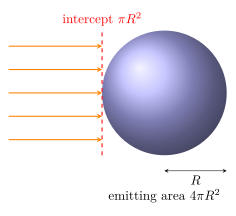
图 1 给出 factor-of-four 的几何来源;不是“夜侧没有能量”,而是时间—面积平均后的 bookkeeping。
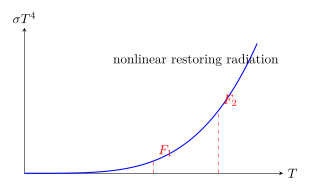
图 2 表明 OLR 的 Planck restoring 随 temperature 增长;真实 OLR 还取决于 atmospheric opacity 与 clouds。
2. Albedo and greenhouse effect / 反照率与温室效应
Knowledge ID: P14-U02-L02-K02
albedo 决定短波有多少被反射:\(ASR=(1-\alpha_p)S_0/4\)。若其他量不变,\(\alpha_p\) 增大使 \(T_e\) 降低。greenhouse gases 对 solar shortwave 相对透明,却在特定 infrared bands 吸收与再发射 surface thermal radiation;TOA 辐射有效来自较高、较冷的 emission levels。为恢复 OLR=ASR,surface–troposphere system 必须升温。
一个完全透明短波、完全吸收长波、单一大气层且 radiative equilibrium 的 toy model 给出:
\[\sigma T_a^4=\frac{(1-\alpha_p)S_0}{4},\]
\[\sigma T_s^4=\frac{(1-\alpha_p)S_0}{4}+\sigma T_a^4 =2\sigma T_a^4,\]
因此 \(T_s=2^{1/4}T_a\)。它只解释方向:真实 atmosphere 有连续温度剖面、部分光学厚度、convection、latent heat 与 spectral windows。
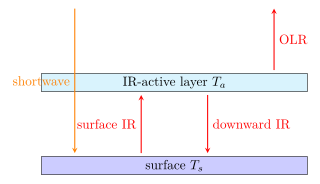
图 3 是 spectral energy-flow model;向下红外并非凭空加热,layer 同时向上辐射并满足能量守恒。
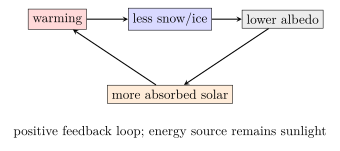
图 4 画出 ice–albedo feedback 的因果环;positive 指放大 initial change,不表示 energy conservation 被破坏。
3. Radiative forcing and climate sensitivity / 辐射强迫与气候敏感度
Knowledge ID: P14-U02-L02-K03
effective radiative forcing(ERF)是引入 driver 并容许 rapid adjustments 后、排除 surface-temperature response 的 TOA energy perturbation。在线性近似中:
\[N=F+\alpha_f\Delta T, \qquad \alpha_f<0\ \text{for a stable climate}.\]
平衡时 \(N=0\):
\[\Delta T_{eq}=-\frac{F}{\alpha_f}=\lambda F.\]
equilibrium climate sensitivity(ECS)特指 atmospheric \(\mathrm{CO_2}\) doubling 达平衡后的 global mean warming;transient climate response(TCR)对应规定的渐增实验,因 deep-ocean heat uptake 未完成而通常小于 ECS。\(F\) 不是瞬时地表加热率;同一 global-mean forcing 的 regional pattern 与 efficacy 也可能不同。
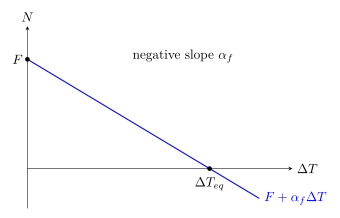
图 5 是 forcing–feedback line:warming 增强 outgoing response,直到净吸热降为零。
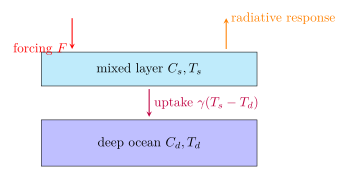
图 6 说明 transient response 有快 mixed-layer 与慢 deep-ocean time scales;海洋吸热延迟 surface equilibrium,但不消除最终 forcing。
4. Feedbacks, transport, and circulation / 反馈、输运与环流
Knowledge ID: P14-U02-L02-K04
feedback 是由 \(\Delta T\) 引发、继而改变 TOA radiation 的过程。Planck response 是主要 restoring term;water-vapor、surface-albedo 和多数 cloud response 可放大 warming,lapse-rate feedback 与具体 cloud regimes 需分开评估。不能把 water vapor 当作 independent forcing:其 atmospheric amount 很快受 temperature 与 circulation 控制,而 long-lived \(\mathrm{CO_2}\) 可作为外部 driver。
局地 TOA balance 不必处处为零。低纬净吸收、高纬净出射的差由 atmosphere 和 ocean transport 弥补:
\[\nabla_h\cdot\mathbf F_H=N_{\rm TOA},\]
其中 \(\mathbf F_H\) 包含 dry-static、latent 与 ocean heat transport。surface fluxes(radiative、sensible、latent、momentum)耦合 atmosphere–ocean,并驱动 Hadley cells、eddies、gyres 与 overturning。
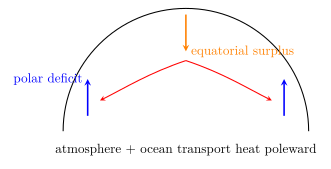
图 7 表示 regional imbalance drives transport;global integral of divergence vanishes,故全球平均仍由 TOA balance 控制。
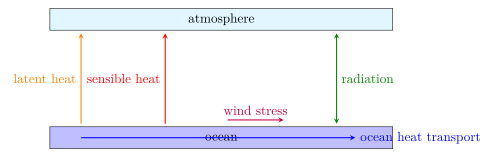
图 8 分开 heat、moisture 与 momentum flux;只有先声明箭头 sign,surface energy budget 才不会重复计数。
5. Climate models, uncertainty, and attribution / 气候模型、不确定度与归因
Knowledge ID: P14-U02-L02-K05
model hierarchy 从 zero-dimensional EBM、one-dimensional radiative-convective model 到 atmosphere–ocean GCM/Earth-system model。GCM 在三维 grid 上离散 mass、momentum、energy、water 与 tracer conservation;cloud microphysics、turbulence 与 convection 等 subgrid processes 以受物理与观测约束的 parameterization 表示。
uncertainty 至少分为:initial-condition/internal variability、forcing/scenario uncertainty、parameter/model structural uncertainty、observation uncertainty 和 numerical discretization。ensemble spread 只能表示被采样的部分,不能自动等同完整 truth interval。
detection 问“观测变化是否超出 internal variability”,attribution 问“哪组 causal forcings 最能解释其 magnitude 与 spatiotemporal fingerprint”。常见逻辑是比较 observations 与 natural-only、anthropogenic-only、all-forcing ensembles,同时核对独立变量(surface、ocean heat、vertical temperature、cryosphere)与物理机制。单个模型曲线贴近观测并不构成归因。
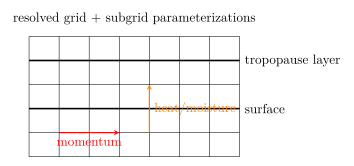
图 9 显示 model grid 交换 flux;格点越细计算越贵,仍有比 grid 更小的 processes 需要 closure。
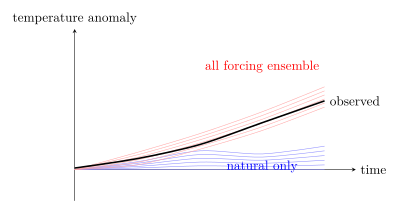
图 10 是 attribution logic 的 schematic:评价的是 ensembles 与 multi-variable fingerprints,不是让一条人为调节的线穿过所有观测点。
Worked examples / 完整例题
Worked Example 1 — Earth-like effective emission temperature
已知: \(S_0=1361\ \mathrm{W\,m^{-2}}\),\(\alpha_p=0.300\),\(\sigma=5.670\times10^{-8}\ \mathrm{W\,m^{-2}\,K^{-4}}\)。
系统边界: whole planet at TOA;steady global mean。
模型: uniform effective blackbody emission;不求 surface temperature。
\[ASR=\frac{(1-0.300)(1361)}4=238.2\ \mathrm{W\,m^{-2}},\]
\[T_e=\left(\frac{238.2}{5.670\times10^{-8}}\right)^{1/4}=254.6\ \mathrm K.\]
检查: \(\sigma T^4\) 单位为 flux;\(T_e\approx255\ \mathrm K\) 低于 mean surface temperature,差异来自 greenhouse atmosphere 与 vertical temperature structure。若 \(\alpha_p\to1\),\(T_e\to0\) 的 toy-model limit 成立。
Worked Example 2 — Albedo perturbation 的 radiative 与 temperature response
已知: 同上,将 albedo 从 \(0.300\) 增至 \(0.310\),暂假 greenhouse structure 不变。
边界与符号: downward TOA positive;\(\Delta\alpha_p=+0.010\)。
模型: instantaneous shortwave perturbation followed by new zero-dimensional equilibrium。
\[\Delta F_{SW}=-\frac{S_0}{4}\Delta\alpha_p =-3.40\ \mathrm{W\,m^{-2}}.\]
新平衡:
\[T_e'=\left[\frac{(1-0.310)1361}{4\sigma}\right]^{1/4}=253.7\ \mathrm K,\]
故 \(\Delta T_e=-0.9\ \mathrm K\)(两位有效数字)。检查: albedo 增大应冷却,sign 正确。真实 cloud/albedo change 会同时改变 longwave 与 feedback,不能把此值当 surface climate projection。
Worked Example 3 — CO2 doubling forcing、ECS 与 transient imbalance
已知: AR6-assessed doubled-\(\mathrm{CO_2}\) ERF central value \(F_{2x}=3.93\ \mathrm{W\,m^{-2}}\),取 net feedback parameter \(\alpha_f=-1.16\ \mathrm{W\,m^{-2}\,K^{-1}}\)。某 transient state 已升温 \(\Delta T=2.00\ \mathrm K\)。
系统: global TOA linear forcing–feedback model。
sign: \(N>0\) 表示 Earth heat uptake。
\[ECS=-\frac{F_{2x}}{\alpha_f} =\frac{3.93}{1.16}=3.39\ \mathrm K.\]
\[N=F_{2x}+\alpha_f\Delta T =3.93-1.16(2.00)=1.61\ \mathrm{W\,m^{-2}}.\]
检查: 在 \(\Delta T<ECS\) 时仍有正 imbalance;到 \(3.39\ \mathrm K\) 时 \(N=0\)。这是 central-value linear illustration,不传播 \(F\) 与 \(\alpha_f\) 的 uncertainty,也不代表某一年 temperature。
Worked Example 4 — Mixed-layer thermal response time
已知: ocean mixed-layer depth \(h=50.0\ \mathrm m\),\(\rho_w=1025\ \mathrm{kg\,m^{-3}}\),\(c_p=3990\ \mathrm{J\,kg^{-1}\,K^{-1}}\),restoring magnitude \(B=1.16\ \mathrm{W\,m^{-2}\,K^{-1}}\)。
系统: 单箱 EBM \(C\,dT/dt=F-BT\);无 deep-ocean exchange。
模型理由: 用于估计 fast surface time scale。
\[C=\rho_wc_ph=(1025)(3990)(50.0) =2.04\times10^8\ \mathrm{J\,m^{-2}\,K^{-1}},\]
\[\tau=\frac{C}{B}=1.76\times10^8\ \mathrm s=5.58\ \mathrm{yr}.\]
检查: \((\mathrm{J\,m^{-2}\,K^{-1}})/(\mathrm{J\,s^{-1}\,m^{-2}\,K^{-1}})=\mathrm s\)。加入 deep ocean、sea ice 和 spatial structure 会产生更长且多重 time scales。
Lesson synthesis / 全课整合
建模顺序:选 TOA 或 surface boundary → 用 geometry 得到 \(S_0/4\) → 分开 reflection、ASR 与 spectral OLR → 判断 \(N\) 的 sign → 把 driver 写成 \(F\)、response 写成 \(\alpha_f\Delta T\) → 加入 heat capacity/ocean uptake → 再分析 regional transport 与 feedback → 选择适当 model hierarchy → 用 ensembles、observations 和 fingerprints 评估 uncertainty 与 attribution。
Formula-and-decision table / 公式与决策表
| Need | Relation | Use only when | Main caution |
|---|---|---|---|
| global mean insolation | \(S_0/4\) | spherical area/time average | local noon flux differs |
| effective temperature | \([(1-\alpha_p)S_0/(4\sigma)]^{1/4}\) | gray TOA equilibrium | not surface temperature |
| TOA imbalance | \(N=ASR-OLR\) | consistent sign and averaging | regional \(N\) drives transport |
| linear response | \(N=F+\alpha_f\Delta T\) | small perturbation near a state | \(\alpha_f\) sign conventions vary |
| equilibrium sensitivity | \(-F/\alpha_f\) | equilibrium, linear feedback | transient ocean uptake omitted |
| one-box time scale | \(\tau=C/B\) | constant \(C,B\) | real system has multiple boxes |
| heat transport | \(\nabla_h\cdot\mathbf F_H=N_{TOA}\) | long-term regional budget | flux components must not be double counted |
Model boundaries / 模型边界
- \(S_0/4\) is a global/time average; tidally locked planets and seasonal extremes require spatial models。
- \(T_e\) is an emission metric; greenhouse warming depends on vertical lapse rate, opacity and convection。
- One-layer greenhouse model is gray and idealized; it cannot predict spectral windows, clouds or precipitation。
- Linear \(F+\alpha_f\Delta T\) assumes feedback approximately constant; feedbacks vary with state, pattern and time。
- ECS is an equilibrium metric under a specified \(\mathrm{CO_2}\) experiment, not a direct forecast for a calendar date。
- GCM parameterization is not arbitrary curve fitting; it is constrained closure, but structural uncertainty remains。
- Attribution is probabilistic and scale-dependent; event attribution and long-term global attribution answer different questions。
Misconception clinic / 易错概念诊所
| Misconception | Correction |
|---|---|
| Earth receives \(S_0\) everywhere | global mean is \(S_0/4\) because intercept and emitting areas differ |
| greenhouse gases reflect infrared like a mirror | they absorb and emit in spectral bands within a temperature profile |
| downward IR violates the second law | net heat still flows from warmer surface-system to colder space; all layers exchange radiation |
| water vapor makes CO2 irrelevant | water vapor is a fast feedback; long-lived CO2 can supply persistent forcing |
| positive feedback must run away | total feedback can remain restoring because negative Planck response dominates |
| model uncertainty means no physical conclusion | multiple models, observations, conservation laws and fingerprints constrain robust statements |
Practice and retrieval / 练习与检索
- [K01] 为什么行星截获功率是 \(S_0\pi R^2\),平均 flux 却除以 \(4\pi R^2\)?
Answer 1
光线看到的截面是圆盘 \(\pi R^2\),但长期能量由整个球面 \(4\pi R^2\) 接收/发射;二者比为 \(1/4\)。
- [K01] 若 \(S_0\) 增加 \(4\%\)、albedo 不变,\(T_e\) 约增多少百分比?
Answer 2
\(T_e\propto S_0^{1/4}\),small-change \(\Delta T/T\approx(1/4)(4\%)=1\%\);精确比为 \(1.04^{1/4}=1.00985\)。
- [K02] albedo \(0.25\) 表示什么?它等同地表反照率吗?
Answer 3
表示 TOA incoming solar 中 \(25\%\) 被 planet system 反射;包含 clouds、aerosols、atmosphere 与 surface,不等同某块地表的 albedo。
- [K02] one-layer toy model 中为何 atmosphere 同时向上和向下发射?
Answer 4
thermal emission 没有“只朝冷处”的单向规则;局地辐射近似各向发射。第二定律约束的是所有交换相加后的净热流与 entropy production。
- [K03] \(F=2.0\ \mathrm{W\,m^{-2}}\)、\(\alpha_f=-1.25\ \mathrm{W\,m^{-2}\,K^{-1}}\),求 equilibrium warming。
Answer 5
\(\Delta T_{eq}=-F/\alpha_f=1.60\ \mathrm K\)。若教材定义 \(B=-\alpha_f>0\),则写 \(F/B\)。
- [K03] 当 \(N>0\) 时,为什么 surface temperature 可以短期下降?
Answer 6
\(N\) 是 whole-system/global mean heat uptake;internal variability 可把 heat 重新分配到 deep ocean 或区域,使短期 surface metric 下降,同时总库存仍增加。
- [K04] 低纬 TOA 有正 \(N\)、高纬有负 \(N\),长期局地为何不无限升温/降温?
Answer 7
atmosphere 和 ocean 的 meridional heat transport 使 \(\nabla_h\cdot\mathbf F_H\) 平衡 regional radiative imbalance。
- [K04] 写出一个 positive 与一个 negative/restoring feedback,并说明 sign。
Answer 8
ice–albedo:warming→less ice→more ASR→更多 warming,positive;Planck:warming→OLR 增大→净吸热减少,negative/restoring。
- [K05] 为什么同一 GCM 要从略不同 initial conditions 跑 ensemble?
Answer 9
为采样 chaotic internal variability 和 initial-condition uncertainty;ensemble mean 提取 forced response,spread 描述被采样的不确定度。
- [综合] “自然因素也影响气候,所以无法归因”错在哪里?
Answer 10
attribution 正是同时模拟/观测 natural、anthropogenic 与 internal components,比较 magnitude、time evolution 和 spatial/vertical fingerprints;存在多因并不使因果贡献不可估计,但结论带 uncertainty 与尺度限定。
Exit ticket / 迁移检验
一颗无大气行星的 \(S_0\) 与 \(\alpha_p\) 已知。先算 \(T_e\);随后加入 infrared-active atmosphere。列出哪三个新增物理量/过程决定 surface temperature 不再等于 \(T_e\)。
Exit-ticket benchmark
先用 \([(1-\alpha_p)S_0/(4\sigma)]^{1/4}\) 得 \(T_e\)。加入大气后至少需 infrared optical depth/spectral absorption、vertical temperature/lapse-rate and convection、cloud and water-vapor feedback;还可加入 surface heat capacity 与 atmospheric/ocean transport。\(T_e\) 仍约束 TOA OLR,不直接给 surface temperature。
References and source notes / 参考资料与使用说明
以下权威直接来源均在 2026-08-31 实际浏览核对;IPCC 章节正文经官方章节检索结果读取,页面读取器对直接 PDF 返回 403,因此未声称已下载 PDF。所有图依据方程原创绘制。
- IPCC AR6 WGI, Chapter 7 — The Earth’s Energy Budget, Climate Feedbacks, and Climate Sensitivity — ERF、feedback、ECS/TCR 与 global energy budget assessment。
- NASA Earth Observatory, Climate and Earth’s Energy Budget — \(340\ \mathrm{W\,m^{-2}}\) TOA mean、reflection、surface/atmosphere flux 与 natural greenhouse effect。
- NASA CERES, Science — Earth’s Energy Budget and Model Evaluation — satellite TOA fluxes、regional transport、feedback observations and model evaluation。
- NASA GISS, Forcings in GISS Climate Models — forcing definitions、rapid adjustments、baseline and forcing uncertainty。
- NOAA GFDL, Climate Modeling — coupled components、grid、parameterization、ensembles、hindcast and uncertainty。
- NASA GISS, Caldwell et al. 2016 — Sources of Inter-model Spread in ECS — feedback covariance and cloud contribution to ECS spread。
Source-to-content map
| Source | Used for | Knowledge ID / Section | Model boundary or convention |
|---|---|---|---|
| IPCC AR6 Ch. 7 | \(N=F+\alpha_f\Delta T\), ERF, ECS/TCR, feedback assessment | K03–K05 | IPCC negative stable-feedback convention |
| NASA Earth budget | ASR/OLR and greenhouse energy flows | K01–K02 | observational global means; not a one-layer derivation |
| NASA CERES | regional imbalance, transport, EEI and feedback measurement | K01, K04–K05 | satellite record and observational uncertainty |
| NASA GISS forcing | forcing definitions and efficacy | K03, K05 | reference baseline and rapid-adjustment choices matter |
| NOAA GFDL models | GCM grid, parameterization, ensembles | K05 | model hierarchy and resolution limits |
| Caldwell et al. | ECS inter-model spread | K03, K05 | cloud/feedback covariance; not a single best-model claim |
复习与拓展
- Atmosphere and Ocean 将展开 hydrostatic/geostrophic balances、waves、ocean circulation 与 chaotic weather prediction。
- 可扩展:line-by-line radiative transfer、orbital climate、snowball/runaway greenhouse boundaries、carbon cycle 与 Bayesian attribution。
- 与 PART XII planetary physics 的接口:相同 TOA ledger 用于不同 albedo、stellar spectrum、rotation 与 atmosphere mass 的行星。