
Learning objectives / 学习目标
学完本课后,你应能:
- 从 energy deposition 定义 absorbed dose,区分 Gy、Sv、dose rate、fluence、stopping power 与相对生物效应;
- 比较 photon、electron 与 proton beam 的典型 depth–dose profile,并说明 beam energy、field geometry 与 tissue heterogeneity 的作用;
- 区分 GTV、CTV、PTV 与 organ at risk(OAR),阅读 cumulative dose–volume histogram(DVH),并解释 inverse planning 的目标函数;
- 用 linear–quadratic model 计算 survival fraction 与 biologically effective dose(BED),说明 fractionation 的条件与边界;
- 把 justification、optimization 与 dose limitation 正确应用于 occupational、public 和 medical exposure,避免把患者治疗剂量套用职业限值;
- 用 time–distance–shielding、attenuation、source control 与 monitoring 建 protection ledger;
- 区分 tissue reactions 与 stochastic effects,合成独立不确定度,并设计包含 calibration、commissioning、patient-specific check 与 incident learning 的 QA chain。
Prerequisites / 先修知识
- Medical Imaging 中的 X-ray attenuation、nuclear imaging、resolution–contrast–dose tradeoff;
- energy conservation、power、mass density 与 inverse-square geometry;
- exponential function、logarithm、probability and uncertainty;
- atomic/nuclear interactions、charged-particle energy loss 的定性概念;
- 读二维函数图、cumulative curve 与 multi-objective tradeoff。
Scope and conventions / 范围与约定
- 采用 SI;absorbed dose \(D\) 用 gray,\(1\ \mathrm{Gy}=1\ \mathrm{J\,kg^{-1}}\)。equivalent/effective dose 用 sievert(Sv),只在 radiation protection 的 weighting framework 中使用。
- patient coordinate 取 \(z\) 沿 central beam axis 向体内为正;横向坐标为 \(x,y\)。所有 depth–dose 图均为 schematic,不能替代 commissioned beam data。
- 外照射采用 water-equivalent reference 和 finite field;真实 planning 必须处理 CT-to-density calibration、heterogeneity、motion、setup 和 algorithm limits。
- radiobiology 以 clonogenic survival 的 linear–quadratic toy model 为主;不将它扩展到所有 dose-per-fraction、所有组织或全部临床 endpoints。
- 本课讨论物理与安全框架,不提供患者个体化医疗建议、处方或监管限值;具体限值、QA tolerance 和 clinical protocol 以当地法规及经授权机构文件为准。
Notation and modeling contract / 符号与建模契约
| Symbol | Meaning | SI / convention |
|---|---|---|
| \(D\) | absorbed dose, \(d\bar\varepsilon/dm\) | Gy |
| \(\dot D\) | absorbed-dose rate | \(\mathrm{Gy\,s^{-1}}\) |
| \(\Phi\) | particle fluence | \(\mathrm{m^{-2}}\) |
| \(S_{\mathrm{col}}/\rho\) | collision mass stopping power | \(\mathrm{J\,m^2\,kg^{-1}}\) or customary \(\mathrm{MeV\,cm^2\,g^{-1}}\) |
| \(d,n\) | dose per fraction and number of fractions | Gy; 1 |
| \(\alpha,\beta\) | LQ radiosensitivity coefficients | \(\mathrm{Gy^{-1}}\); \(\mathrm{Gy^{-2}}\) |
| \(\alpha/\beta\) | fractionation-sensitivity ratio | Gy |
| \(BED\) | biologically effective dose in the LQ model | Gy with tissue label |
| \(H_T,E\) | equivalent dose to tissue and effective dose | Sv |
| \(\mu\) | narrow-beam linear attenuation coefficient | \(\mathrm{m^{-1}}\) |
| \(u_c\) | combined standard uncertainty | same unit as measurand or relative 1 |
1. Dose deposition and treatment beams / 剂量沉积与治疗射束
Knowledge ID: P14-U04-L03-K01
1.1 从随机相互作用到 absorbed dose
电离辐射把能量以 ionization、excitation、bremsstrahlung、nuclear interaction 及 secondary-particle transport 的形式传给物质。对足够小但仍可作统计平均的质量元 \(dm\),absorbed dose 定义为
\[D=\frac{d\bar\varepsilon}{dm}.\]
\(D\) 是能量每质量的局域平均,不是“粒子数”、不是单个细胞必然收到的能量,也不直接等于 biological outcome。dose rate 为 \(\dot D=dD/dt\)。对窄能谱带电粒子,且辐射损失、逸出次级粒子与局域能量沉积可忽略或已由平衡条件处理时,可用 collision mass stopping power 建立一阶联系
\[D\approx\Phi\left(\frac{S_{\mathrm{col}}}{\rho}\right),\]
但临床剂量计算必须追踪 secondary particles、field geometry 与 heterogeneous media,不能把上式当 universal planning algorithm。
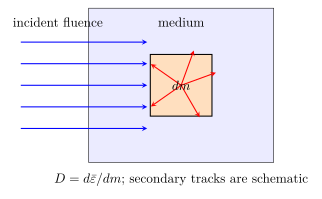
图 1 把 incident fluence、secondary tracks 与 scoring mass 分开;红色轨迹只表示能量传递路径,不是按比例的细胞损伤图。
1.2 photon、electron 与 proton depth–dose
megavoltage photon beam 先产生高能 electrons,再由 electrons 沉积大部分能量;因此 surface 后常出现 build-up region,到 \(d_{max}\) 后随 attenuation、scatter 与 geometry 下降。electron beam 具有较有限的 practical range,适于相对浅表目标,但有 bremsstrahlung tail。proton beam 在路径末端 stopping power 上升,形成 Bragg peak;多个能量层叠成 spread-out Bragg peak(SOBP)。range 对 tissue composition、CT calibration 与 anatomy change 敏感。
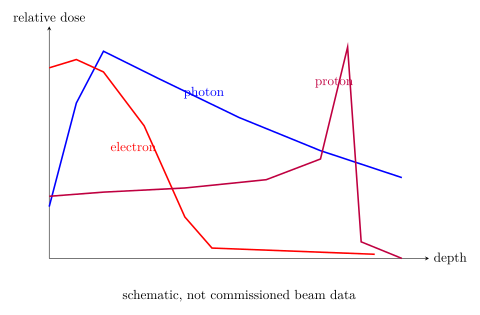
图 2 比较三种 normalized depth–dose 图景;横纵坐标未给真实刻度,不能据此选择患者 beam energy。
1.3 几何整形与叠加
单束通常同时照射 entrance path、target 与 exit path。多角度 conformal beams、intensity modulation、arc delivery 或 scanned particle spots 利用线性 dose superposition 把高剂量集中在 target;但每束的 low-to-moderate dose bath、leakage 与 setup sensitivity 仍需核算。若 beamlet \(j\) 的权重为 \(w_j\),voxel \(i\) 的物理剂量可写为
\[D_i=\sum_j A_{ij}w_j,\]
其中 \(A_{ij}\) 是经 commissioning 验证的 dose-influence matrix。\(A_{ij}\) 不是纯几何常数,它依赖 energy spectrum、patient density、scatter 和 calculation model。
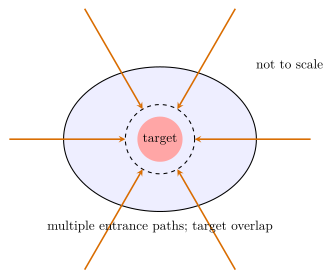
图 3 展示多方向射束的叠加逻辑;患者轮廓、target 与 beam width 均为 schematic。
2. Treatment planning and tissue response / 治疗计划与组织响应
Knowledge ID: P14-U04-L03-K02
2.1 从 anatomy 到 optimization problem
GTV 是可见/可检出的 gross tumour;CTV 把怀疑的 microscopic spread 纳入;PTV 在 CTV 周围编码 internal motion 与 setup uncertainty 的 planning margin;OAR 是需要限制剂量的正常组织。margin 是 uncertainty management,不是“肿瘤长大后的额外组织”,也不能用固定圆环代替 site-specific motion analysis。
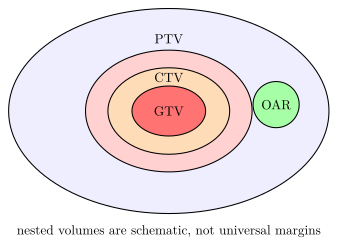
图 4 强调 target volumes 的逻辑嵌套与 OAR 的空间竞争。真实 structures 不必同心、光滑或互不重叠。
inverse planning 通过 nonnegative beam weights \(w_j\) 最小化多目标 penalty,例如
\[F(\mathbf w)= \sum_{i\in PTV}a_i\bigl(D_i-D_{Rx}\bigr)^2 +\sum_{i\in OAR}b_i\bigl[\max(0,D_i-D_i^{lim})\bigr]^2.\]
这是 decision model:权重 \(a_i,b_i\) 与 constraints 体现 clinical priorities。最小 \(F\) 不等于“最安全且最好”;必须由 radiation oncologist、physicist 与 multidisciplinary team 审核 anatomy、dose distribution、DVH、deliverability 与 robustness。
2.2 DVH:压缩信息而非完整几何
cumulative DVH 读作“至少接受剂量 \(D\) 的体积分数”。它适合比较 target coverage 和 OAR dose-volume constraints,却丢失空间位置:两个三维 dose maps 可有相同 DVH 而 hot spot 位于不同解剖区域。
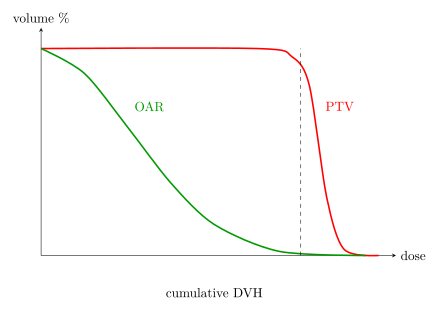
图 5 的 PTV curve 靠近 prescription dose,而 OAR curve 尽量左移;它不显示 OAR 中高剂量 voxels 的具体位置。
2.3 fractionation 与 linear–quadratic model
对单次 fraction dose \(d\),LQ model 的 clonogenic survival 为
\[S(d)=e^{-(\alpha d+\beta d^2)}.\]
若 \(n\) 次 fractions 之间完全修复、每次同剂量且 repopulation/redistribution/reoxygenation 暂忽略,总 survival 为
\[S_n=e^{-n(\alpha d+\beta d^2)}.\]
把 biological effect 除以 \(\alpha\) 得
\[BED=nd\left(1+\frac{d}{\alpha/\beta}\right).\]
低 \(\alpha/\beta\) 的 late-responding tissue 对 fraction size 更敏感。BED 只在同一 endpoint、同一 \(\alpha/\beta\)、LQ assumptions 与相似 overall-time context 下比较;不能把不同器官的 BED 数字直接排序成绝对风险。
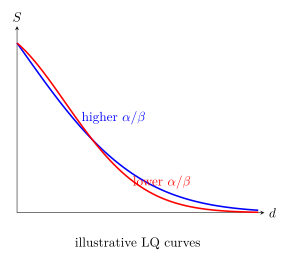
图 6 比较两组 illustrative LQ parameters。曲线不是临床组织参数表;高 dose per fraction 时 extrapolation uncertainty 增大。
3. Radiation protection principles / 辐射防护原则
Knowledge ID: P14-U04-L03-K03
3.1 protection system:先分类 exposure
ICRP/IAEA framework 的核心是:
- justification:引入或继续某 exposure situation 的决定应产生净收益;
- optimization:在约束之下,考虑技术、经济和社会因素,把 protection 做到合理可达到的最佳水平(常表述为 ALARA);
- dose limitation:对 planned occupational/public exposure 施加个人限值。
关键例外:对已经 justified 的患者 medical exposure,不把职业/公众 dose limit 套到治疗靶区,因为那可能阻止所需治疗;重点是恰当处方、optimization 与 accident prevention。工作人员、公众、carers/comforters、research volunteers 的规则与患者不同,必须先分类再计算。
3.2 time–distance–shielding 是控制工具,不是三句口号
点状 isotropic source、无 attenuation/scatter 的几何极限给出
\[\dot D(r)=\dot D(r_0)\left(\frac{r_0}{r}\right)^2.\]
作业剂量近似为 dose rate、停留时间与 occupancy 的积分;扩大距离常有效,但 extended source、near field、room scatter 与 beam leakage 会破坏简单 inverse-square scaling。
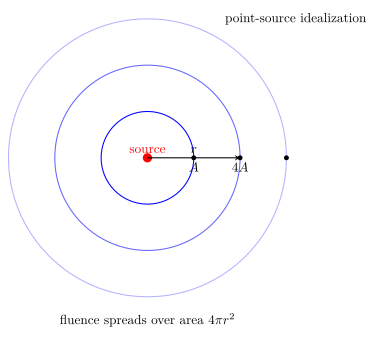
图 7 用 spherical-area scaling 解释 inverse-square law;图中 circles 是球面的二维投影。
窄束单能 photon attenuation 的 first model 是
\[I(x)=I_0e^{-\mu x},\qquad HVL=\frac{\ln2}{\mu}.\]
shielding design 还必须计入 broad-beam buildup、secondary radiation、penetrations、workload、use factor、occupancy、skyshine 与 material composition。对 neutrons 或 high-energy beams,单一 photon \(\mu\) 模型尤其不足。
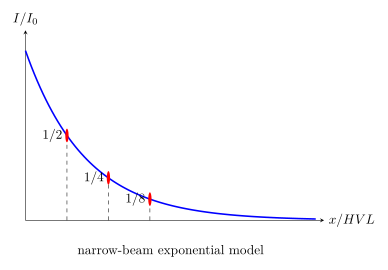
图 8 显示每增加一个 HVL,unscattered intensity 再减半;实际 barrier transmission 需 beam-specific data。
monitoring 包括 area monitors、personal dosimeters、survey meters、contamination control(若有 unsealed sources)、interlocks 与 records。dosimeter 是验证控制是否有效的工具,不能替代 source containment、engineered barriers 与 safe procedures。
4. Risk, optimization, and quality assurance / 风险、优化与质量保证
Knowledge ID: P14-U04-L03-K04
4.1 tissue reaction、stochastic risk 与不可见的不确定度
Tissue reactions(旧称 deterministic effects)通常有 threshold-like behavior,超过后 severity 随 dose 增加;stochastic effects 主要以发生概率随 dose 增加来表述,个体是否发生不可由 effective dose 确定预测。effective dose 是 population-averaged protection quantity,不是患者个体 cancer prognosis,也不是 radiotherapy target response metric。
低剂量风险模型包含 epidemiological、dosimetric、transport、age/sex/population transfer 与 dose-rate uncertainties。optimization 不能只追逐最小可测 dose;还要比较替代方案、资源、安全文化、equity 与 residual risk,并记录 assumptions。
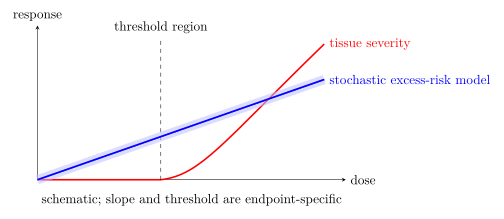
图 9 区分 probability model 与 severity response;蓝色宽带提醒风险斜率并非无不确定度的个人预测。
4.2 QA 是闭环、可追溯且相互独立
radiotherapy QA 从 specification/acceptance 开始,经 beam calibration、TPS commissioning、imaging and data transfer、plan review、independent dose/MU check、patient-specific measurement、image-guided setup、delivery log、chart review 到 incident learning。单项“机器输出正确”不能证明整个 chain 正确,因为错误可能来自 patient identity、contour、coordinate、unit、data transfer、software configuration 或 workflow。
独立不确定度分量 \(u_i\) 可先用 root-sum-square 合成:
\[u_c=\sqrt{\sum_i u_i^2}.\]
若分量 correlated,必须加入 covariance terms;若 quantity 非线性或 distribution 非 Gaussian,宜用 sensitivity analysis 或 Monte Carlo propagation。tolerance 不是 uncertainty 的同义词:uncertainty 描述 measurand knowledge,tolerance 是 action threshold。
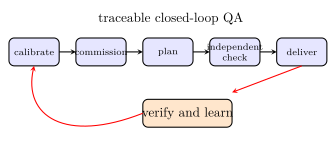
图 10 强调 QA 的反馈与独立检查。若同一错误数据库同时驱动 primary calculation 与“check”,两者不是真正独立。
Worked examples / 完整例题
Worked Example 1 — deposited energy 到 absorbed dose
已知: 一个 calibration phantom 的 \(m=0.250\ \mathrm{kg}\) scoring volume 中,某次 irradiation 平均沉积能量 \(\bar\varepsilon=2.00\ \mathrm{mJ}\)。求 absorbed dose。
研究对象与边界: scoring volume 内的平均 energy deposition;假设 reported energy 已扣除离开该 volume 的 transport,且 mass 均匀定义。
参考系/坐标: 无方向性;\(D\) 为 scalar field 在该 volume 的平均。
模型理由: 直接应用 absorbed-dose definition。
\[D=\frac{\bar\varepsilon}{m} =\frac{2.00\times10^{-3}\ \mathrm J}{0.250\ \mathrm{kg}} =8.00\times10^{-3}\ \mathrm{J\,kg^{-1}} =8.00\ \mathrm{mGy}.\]
单位/有效数字: \(\mathrm{J\,kg^{-1}}=\mathrm{Gy}\);三位有效数字。
方向与符号检查: deposited energy 与 mass 均为正,dose 非负;无 vector direction。
极限/合理性: 若相同能量分布在两倍 mass 中,average dose 减半;结果不说明 microscopic cell-to-cell fluctuation。
物理解释: 这是物理吸收剂量;不能未经 radiation/tissue weighting 就称作 \(8.00\ \mathrm{mSv}\)。
Worked Example 2 — two plans 的 fractionation comparison
已知: Plan A 为 \(30\times2.00\ \mathrm{Gy}=60.0\ \mathrm{Gy}\);Plan B 为 \(5\times8.00\ \mathrm{Gy}=40.0\ \mathrm{Gy}\)。对某 endpoint 取 \(\alpha/\beta=10.0\ \mathrm{Gy}\),求 LQ BED。
研究对象与边界: 同一 tissue endpoint;假设 fractions 间 complete repair,忽略 overall-time、repopulation 与 high-dose LQ extrapolation error。
参考系/坐标: 无空间方向;比较每个 fraction 内均匀 target dose 的 idealization。
模型理由: BED 用来比较 fraction-size effect,而不是只比 total physical dose。
\[BED_A=(30)(2.00)\left(1+\frac{2.00}{10.0}\right) =72.0\ \mathrm{Gy}_{10},\]
\[BED_B=(5)(8.00)\left(1+\frac{8.00}{10.0}\right) =72.0\ \mathrm{Gy}_{10}.\]
单位/有效数字: bracket dimensionless;结果三位有效数字,subscript 10 标明 assumed \(\alpha/\beta\)。
符号/合理性: 两个 BED 为正;Plan B total dose 更低但 quadratic term 更大。
极限检查: \(d\ll\alpha/\beta\) 时 \(BED\to nd\);此时 Plan B 的 \(d/(\alpha/\beta)=0.800\) 不小。
物理解释: 对该假定 endpoint 两者 LQ BED 相同,不代表 clinical equivalence;OAR、spatial dose、tumour biology 与 high-dose uncertainty 仍不同。
Worked Example 3 — distance、occupancy 与 shielding ledger
已知: 某 point-source idealization 在 \(r_0=1.00\ \mathrm m\) 处 dose rate 为 \(1.00\ \mathrm{mSv\,h^{-1}}\)。工作位置 \(r=3.00\ \mathrm m\),occupancy \(T=0.250\),barrier 为 \(2.00\) HVL。求 occupancy-averaged dose-rate contribution。
研究对象与边界: isotropic point source、narrow-beam attenuation;忽略 scatter、leakage、extended-source geometry。
参考系/坐标: \(r\) 从 source outward;dose rate 为 scalar。
模型理由: 依次应用 inverse-square、HVL transmission 与 time fraction,保持每个控制因子可审计。
\[\dot D(3.00\ \mathrm m) =(1.00)\left(\frac{1.00}{3.00}\right)^2 =0.111\ \mathrm{mSv\,h^{-1}},\]
\[B=2^{-2.00}=0.250,\]
\[\langle\dot D\rangle =(0.111)(0.250)(0.250) =6.94\times10^{-3}\ \mathrm{mSv\,h^{-1}} =6.94\ \mu\mathrm{Sv\,h^{-1}}.\]
单位/有效数字: geometry、transmission、occupancy 均 dimensionless;三位有效数字。
方向/符号检查: 所有 factors 小于等于 1,所以结果小于 reference dose rate。
极限检查: \(r\to\infty\) 或 HVL 数增加时 ideal contribution 趋零;实际 background/scatter 不随此式必然趋零。
物理解释: 该数不是合规结论;design 还需 workload、use factor、其他 sources、survey 与当地监管 criteria。
Worked Example 4 — uncertainty budget 与 QA action
已知: reference dosimetry、setup reproducibility 与 independent detector 的相对 standard uncertainties 分别为 \(1.50\%\)、\(2.00\%\)、\(1.00\%\),先假设独立;某 measured/expected dose ratio 为 \(0.940\)。
研究对象与边界: 一个 patient-specific comparison 的 simplified uncertainty budget;不把 tolerance 预设为 uncertainty。
参考系/坐标: ratio 无方向;deviation 以 expected 值为 reference。
模型理由: independent Gaussian components 可 RSS 合成;随后把 observed discrepancy 与 \(u_c\) 比较以触发调查,而非自动“校正”患者计划。
\[u_c=\sqrt{(1.50\%)^2+(2.00\%)^2+(1.00\%)^2} =2.69\%.\]
observed deviation 为
\[\Delta=0.940-1=-0.060=-6.00\%, \qquad \frac{\lvert\Delta\rvert}{u_c}=2.23.\]
单位/有效数字: relative quantities dimensionless;\(u_c=2.69\%\)、ratio 取三位有效数字。
方向与符号检查: negative deviation 表示 measurement 低于 expected;绝对标准化差为正。
极限/合理性: correlated components 会改变 \(u_c\);单次 \(2.23u_c\) 不是错误来源的证明。
物理解释: 结果足以按 local QA protocol 检查 detector setup、calibration、plan transfer、geometry、dose algorithm 与 delivery log;不得仅用一个 scaling factor 掩盖原因。
Lesson synthesis / 全课综合
一个可审计的 radiotherapy/health-physics workflow 是:
- 定义 quantity 与 system: 是 absorbed dose、equivalent/effective dose、dose rate 还是 risk;对象是 target、OAR、worker、public 还是 patient;
- 建立 transport model: 声明 beam type、energy、geometry、material、secondary transport 与 reference medium;
- 建立 anatomy–uncertainty model: contour GTV/CTV/PTV/OAR,列 motion、setup、density 与 algorithm limits;
- 优化但不隐藏 tradeoff: 检查 3-D distribution、DVH、robustness 与 deliverability;记录 objective/constraint 的选择;
- 加入 tissue model: 只有 assumptions 合理时才用 LQ/BED 比较;physical dose 与 biological inference 分开报告;
- 按 exposure category 做 protection: justification、optimization、limits/constraints/reference levels 不可混用;
- 闭环 QA: traceable calibration → commissioning → independent checks → delivery verification → monitoring/incident learning;
- 报告 uncertainty 与 boundary: 数字、单位、confidence、correlation、tolerance、model inadequacy 分开。
Formula-and-decision table / 公式与决策表
| Question | Relation | Use when | Main limitation |
|---|---|---|---|
| Energy per mass? | \(D=d\bar\varepsilon/dm\) | absorbed energy and scoring mass defined | spatial/microscopic heterogeneity |
| Fluence estimate? | \(D\approx\Phi(S_{\mathrm{col}}/\rho)\) | narrow-spectrum charged particles with local-deposition or equilibrium approximation | radiative loss, escaping secondaries and mixed spectra |
| Beamlet superposition? | \(D_i=\sum_jA_{ij}w_j\) | linear physical dose influence model | \(A_{ij}\) must be commissioned for patient/beam model |
| Fraction survival? | \(S=e^{-(\alpha d+\beta d^2)}\) | selected clonogenic endpoint, LQ regime | high dose, time and biology variations |
| Fractionation comparison? | \(BED=nd[1+d/(\alpha/\beta)]\) | same endpoint and assumptions | not a universal clinical-equivalence metric |
| Point-source distance? | \(\dot D\propto r^{-2}\) | far-field point source, little scatter | extended source and room scatter |
| Narrow-beam shield? | \(I=I_0e^{-\mu x}\) | monoenergetic narrow photons | buildup, secondary radiation, broad spectra |
| Half-value layer? | \(HVL=\ln2/\mu\) | exponential model valid | material and beam-quality specific |
| Combine independent uncertainty? | \(u_c=(\sum_i u_i^2)^{1/2}\) | uncorrelated standard components | covariance/non-Gaussian terms omitted |
Model boundaries / 模型边界
- Absorbed dose: macroscopic average; equal Gy does not guarantee equal microscopic track structure or biological effect.
- Water equivalence: central for calibration, but lung, bone, metal and interfaces require validated heterogeneity transport.
- Depth–dose sketches: normalized teaching curves; no energy, field size or machine data are encoded.
- LQ/BED: endpoint- and parameter-dependent; repair, repopulation, reoxygenation, overall time and high-dose uncertainty matter.
- DVH: loses spatial information and temporal fractionation; never review DVH alone.
- Inverse planning: finds an optimum of the stated objective, not a unique objectively “best” treatment.
- Inverse-square/exponential shielding: first estimates only; broad-beam buildup, leakage, neutrons and penetrations require engineered calculations and survey.
- Effective dose: protection quantity for populations/reference persons; not patient-specific radiotherapy risk or target dose.
- Dose limits: apply according to exposure category and jurisdiction; patient treatment exposure is managed by justification, optimization and accident prevention.
- QA tolerance: action level set by clinical/regulatory risk, not derived solely from measurement uncertainty.
Misconception clinic / 误区诊所
- “1 Gy 就等于 1 Sv。” 错。Gy 是 energy per mass;Sv incorporates radiation/tissue weighting for protection purposes。数量、对象和用途不同。
- “proton 在入口完全没有剂量。” 错。proton 有 entrance dose;Bragg peak 表示接近 range 末端的增强,不是零入口。
- “多束相交只照肿瘤。” 错。每束都有 entrance path,可能还有 exit/leakage;优化的是空间分布与 tradeoff。
- “PTV 是肿瘤的一部分。” 错。PTV 是 geometric planning construct,用来覆盖 motion/setup uncertainty。
- “相同 BED 就一定临床等效。” 错。BED 依赖 endpoint、parameters、time、spatial dose 与 LQ validity。
- “患者也必须低于职业 dose limit。” 错。患者 medical exposure 的治疗目的不同;套用限值可能阻止 justified care。
- “ALARA 意味 dose 必须不计代价趋零。” 错。optimization 是在 constraints 下考虑可行性、资源、风险与社会因素的持续决策。
- “两套软件算得一样就是 independent check。” 若共享同一 beam model、data transfer 或 configuration error,common-mode failure 仍可能存在。
- “低剂量风险线是一位患者的确定命运。” 错。它是有 uncertainty 的 population risk model,不预测某个个体必然发生事件。
Practice and retrieval / 练习与检索
- [K01] \(4.50\ \mathrm{mJ}\) 平均沉积在 \(0.300\ \mathrm{kg}\) 中,求 absorbed dose,并说明为何不能直接写成 Sv。
Answer 1
\(D=(4.50\times10^{-3})/0.300=1.50\times10^{-2}\ \mathrm{Gy}=15.0\ \mathrm{mGy}\)。Sv 需要特定 protection weighting 和 exposure context;本题只给 energy per mass。
- [K01] 解释 megavoltage photon depth–dose 的 build-up region,并指出它不等于“表面绝对零剂量”。
Answer 2
photon 先产生 secondary electrons,electron fluence 向下游建立,使 dose 在浅层上升到 \(d_{max}\);surface 仍可受 contaminant electrons、backscatter 与 photon interactions 影响,所以不为绝对零。
- [K01] 为什么 proton range uncertainty 可能把 distal falloff 推入 OAR?列出两个来源。
Answer 3
distal position 由 integrated stopping power 决定。CT-to-stopping-power calibration error、anatomy/motion change、metal/artifact、beam energy/range calibration 都可改变 water-equivalent path length。
- [K02] 区分 GTV、CTV 与 PTV;哪一个主要编码 setup/motion uncertainty?
Answer 4
GTV 是可见 gross tumour;CTV 加入可能 microscopic disease;PTV 从 CTV 出发编码 internal/setup uncertainty。主要编码 setup/motion uncertainty 的是 PTV。
- [K02] 一条 cumulative DVH 在 \(D=30\ \mathrm{Gy}\) 时为 \(25\%\)。准确解释这个点,并说出 DVH 丢失的一类信息。
Answer 5
该 structure 的 \(25\%\) 体积接受至少 \(30\ \mathrm{Gy}\)。DVH 不告诉这些 voxels 的三维位置,也不显示 hot spot 是否连成特定解剖区域。
- [K02] 对 \(n=20\)、\(d=2.50\ \mathrm{Gy}\)、\(\alpha/\beta=5.00\ \mathrm{Gy}\),求 BED。
Answer 6
\(BED=(20)(2.50)[1+2.50/5.00]=75.0\ \mathrm{Gy}_5\)。结论假设同一 endpoint、complete repair 且 LQ model 适用。
- [K03] 点源在 \(2.00\ \mathrm m\) 处为 \(80.0\ \mu\mathrm{Sv\,h^{-1}}\);理想情况下 \(4.00\ \mathrm m\) 处是多少?为什么现场仍需 survey?
Answer 7
\(80.0(2/4)^2=20.0\ \mu\mathrm{Sv\,h^{-1}}\)。extended source、scatter、shield penetrations 与其他 sources 可破坏理想 scaling,故需 survey 验证。
- [K03] 某 barrier 为 \(3\) HVL,narrow-beam transmission 是多少?若有 broad-beam buildup,实际 transmission 相对该数通常可能怎样?
Answer 8
ideal transmission \(2^{-3}=0.125\)。broad-beam scatter/buildup 可使 detector 接收的总量高于简单 uncollided exponential prediction,必须用 beam-specific design data。
- [K04] \(u_1=1.0\%\)、\(u_2=1.5\%\)、\(u_3=2.0\%\) 且独立,求 \(u_c\);若 \(u_2,u_3\) positive correlated,RSS 会偏高还是偏低?
Answer 9
\(u_c=\sqrt{1.0^2+1.5^2+2.0^2}\%=2.69\%\)。positive covariance 增加总 variance,所以忽略它的 RSS 会偏低。
- [综合 K01–K04] patient-specific check failure 后,为什么不能立刻把所有 monitor units 乘一个 correction factor?给出至少四个应查接口。
Answer 10
scaling 会掩盖 root cause 且可能破坏其他 fields。应查 patient/plan identity、detector calibration/setup、CT density and contours、beam model/TPS configuration、data transfer/units、machine output and delivery log,并按 protocol 独立复测与记录。
Exit ticket / 迁移检验
一个新高能 beam 已通过 output spot-check,团队准备首次治疗。写出最少六项仍必须完成或确认的 evidence,并分别标注其对应 K01–K04。
Exit-ticket benchmark
K01:traceable absorbed-dose calibration、depth/field/output/heterogeneity beam data;K02:TPS commissioning、target/OAR review、DVH/3-D/robustness and deliverability;K03:room shielding survey、interlocks、area/personal monitoring and exposure categorization;K04:independent dose/MU check、patient-specific measurement、setup verification、uncertainty/action levels、incident response。单一 output spot-check 只覆盖整个 chain 的一个节点。
References and source notes / 参考资料与使用说明
以下权威直接来源均在 2026-08-31 实际打开并核对。正文重新组织,所有图根据方程原创绘制,未复制来源图像。
- IAEA, Radiation Oncology Physics: A Handbook for Teachers and Students — treatment beams、clinical target volumes、3-D planning、DVH、radiobiology 与 TPS/QA 框架。
- IAEA, TRS-398: Absorbed Dose Determination in External Beam Radiotherapy — absorbed dose to water、ionization-chamber calibration、beam quality 与 traceability。
- NIST, ESTAR, PSTAR and ASTAR Introduction — electron、proton、helium stopping powers and ranges 的 reference database scope。
- ICRP, Publication 103 — The 2007 Recommendations — justification、optimization、dose limitation 与 protection quantities。
- ICRP, Publication 105 — Radiological Protection in Medicine — medical exposure、patient dose limits 的不适用性与 accident prevention emphasis。
- IAEA, GSR Part 3 — International Basic Safety Standards — occupational/public/medical exposure categories、protection and safety requirements。
- IAEA, TECDOC-1583 — Commissioning of Radiotherapy Treatment Planning Systems — acceptance、commissioning、test cases 与 ongoing treatment-planning QA。
Source-to-content map
| Source | Used for | Knowledge ID / Section | Model boundary or convention |
|---|---|---|---|
| IAEA Radiation Oncology Physics | beams, volumes, planning, DVH, radiobiology, QA chain | K01, K02, K04 | textbook framework; actual clinical values require commissioned/local protocols |
| IAEA TRS-398 | absorbed dose to water and traceable calibration | K01, K04 | reference dosimetry is not patient 3-D dose by itself |
| NIST STAR | stopping-power/range meaning for charged particles | K01 | tabulated homogeneous-material transport; patient range needs full planning model |
| ICRP 103 | protection quantities and three principles | K03, K04 | recommendations require jurisdiction-specific implementation |
| ICRP 105 | medical exposure and patient-specific protection logic | K03 | patient therapeutic exposure is not managed by occupational/public limits |
| IAEA GSR Part 3 | exposure categories, safety requirements and monitoring context | K03, K04 | national regulations and authorized practice remain controlling |
| IAEA TECDOC-1583 | TPS commissioning and independent QA | K04 | sample tests do not replace complete risk-based local QA programme |
复习与拓展
- Emergence and Collective Dynamics 将把本课的 multi-scale interaction、feedback、threshold、uncertainty 与 collective response 推向一般复杂系统框架。
- 可扩展:Boltzmann transport、Monte Carlo dose calculation、cavity theory、IMRT/VMAT optimization、proton robust optimization、microdosimetry、NTCP/TCP、RBE variability、brachytherapy dosimetry 与 image-guided adaptive therapy。
- 与 Medical Imaging 的接口:planning CT/MRI/PET 提供 anatomy/function,但 imaging uncertainty 会进入 contour、density、registration 与 dose calculation;更多图像不自动等于更小总 uncertainty。