
Learning objectives / 学习目标
学完本课后,你应能:
- 从 microscopic state、update rule、interaction topology、noise 与 boundary conditions 定义 agent model,并构造可检验的 macroscopic order parameter;
- 解释 emergence 不违反微观定律,却可能需要新的 collective variables、symmetry 与 effective equations;
- 对 reaction–diffusion state 作 Fourier-mode linear stability analysis,区分 homogeneous stability 与 finite-wavenumber instability;
- 建立 Kuramoto phase model,用 complex order parameter 量化 incoherence、partial synchronization 与 locking;
- 区分 equilibrium critical point、absorbing-state transition 与 self-organized criticality,识别 finite-size cutoff 和 power-law overclaim;
- 从 agent conservation 推导 continuum continuity equation,说明 closure、coarse-graining、noise 与 validation 的责任边界;
- 用 multiple observables、system-size scaling、perturbation response 与 out-of-sample prediction 审查“涌现”主张。
Prerequisites / 先修知识
- phase space、dynamical system、fixed point、eigenvalue 与 linear stability;
- probability distribution、mean、variance、correlation、log–log plot;
- diffusion equation、Fourier mode \(e^{i\mathbf k\cdot\mathbf x}\)、gradient/divergence;
- equilibrium order parameter 与 symmetry breaking 的基本概念;
- Radiation Therapy and Health Physics 中的 multi-scale model、uncertainty、threshold 与 validation chain。
Scope and conventions / 范围与约定
- microscopic time 可离散为 \(t=0,1,2,\ldots\),也可连续;必须声明 synchronous/asynchronous update,因为它能改变 collective state。
- 二维位置为 \(\mathbf x_i\),heading 为 \(\theta_i\),unit direction \(\hat{\mathbf e}(\theta_i)=(\cos\theta_i,\sin\theta_i)\)。
- \(N\) 为 agents/oscillators 数量;thermodynamic-limit statement 必须与 finite-\(N\) evidence 分开。
- reaction–diffusion fields \(\mathbf q(\mathbf x,t)\) 是 coarse-grained concentrations;concentration 非负,diffusion coefficients 非负。
- nonequilibrium system 与 environment 交换能量/物质/信息;不假设 Boltzmann distribution 或 detailed balance。
- 所有图均为原创 schematic;未声明按比例者不得用于抽取 exponent 或 threshold。
Notation and modeling contract / 符号与建模契约
| Symbol | Meaning | Unit / convention |
|---|---|---|
| \(\mathbf x_i,\theta_i\) | agent position and heading | m; rad |
| \(v_0\) | agent speed | \(\mathrm{m\,s^{-1}}\) or model unit |
| \(\eta\) | angular-noise amplitude | rad or dimensionless model unit |
| \(\phi\) | polarization order parameter | 1, \(0\le\phi\le1\) |
| \(\mathbf q\) | vector of continuum fields | model dependent |
| \(\mathbf J\) | reaction Jacobian at base state | \(\mathrm{s^{-1}}\) |
| \(\sigma(k)\) | growth rate of mode \(k\) | \(\mathrm{s^{-1}}\) |
| \(\theta_i,\omega_i\) | oscillator phase and natural angular frequency | rad; \(\mathrm{rad\,s^{-1}}\) |
| \(K\) | phase-coupling strength | \(\mathrm{s^{-1}}\) |
| \(r\) | Kuramoto coherence magnitude | 1, \(0\le r\le1\) |
| \(s,\tau\) | avalanche size and size exponent | model unit; 1 |
| \(\rho,\mathbf v\) | coarse-grained number density and velocity | \(\mathrm{m^{-d}}\); \(\mathrm{m\,s^{-1}}\) |
1. Microscopic rules and macroscopic behavior / 微观规则与宏观行为
Knowledge ID: P14-U05-L01-K01
1.1 emergence 需要一条可复现的 micro-to-macro map
Emergence 指许多自由度相互作用后,macroscopic observables 表现出在单个自由度层级不适合或不明显的规律。它不是“无法解释”,而是要求明确四层:microstate、dynamics、coarse-graining、observable。若缺一层,“复杂行为”只是一段描述。
Vicsek-type minimal model 的一个版本为
\[\theta_i(t+\Delta t)= \arg\!\left[\sum_{j\in\mathcal N_i}e^{i\theta_j(t)}\right]+\xi_i(t),\]
\[\mathbf x_i(t+\Delta t)=\mathbf x_i(t)+v_0\Delta t\,\hat{\mathbf e}[\theta_i(t+\Delta t)],\]
其中 \(\mathcal N_i\) 是 metric 或 topological neighborhood,\(\xi_i\) 是 angular noise。单个 agent 只做 local alignment;global direction 由 rotational symmetry spontaneous breaking 选出。
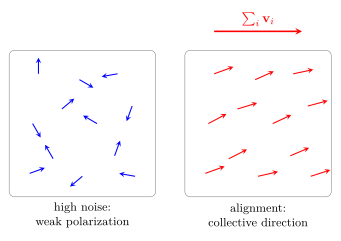
图 1 对比 same-agent count 下的 disordered 与 polarized state;箭头方向是 schematic realization,不代表动力学轨迹。
1.2 order parameter、symmetry 与 finite-size evidence
polar order parameter 定义为
\[\phi=\frac{1}{Nv_0}\left\lvert\sum_{i=1}^N\mathbf v_i\right\rvert =\frac1N\left\lvert\sum_{i=1}^Ne^{i\theta_i}\right\rvert.\]
完全同向时 \(\phi=1\);独立均匀 headings 的 finite sample 通常不是严格 0,而有 \(O(N^{-1/2})\) fluctuation。声称 phase transition 需研究 \(N\)、density、noise、boundary、initial condition、correlation time 和 hysteresis,而非只展示一张 flock snapshot。
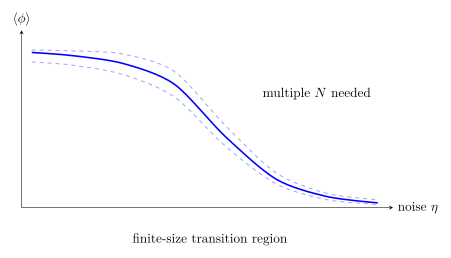
图 2 展示 order–disorder crossover/transition 的观测方式。虚线只表示 possible finite-size variation,不声明 universality class。
2. Self-organization and pattern formation / 自组织与图样形成
Knowledge ID: P14-U05-L01-K02
2.1 self-organization 需要 throughput 与 feedback
Self-organization 是 system 在无 central controller 的情况下,通过 local dynamics、feedback、transport 与 dissipation 形成 persistent organization。它通常需要 free-energy/chemical/mechanical throughput;因此 pattern 的“自发”不等于 closed system 无代价地产生低熵。
reaction–diffusion system 写为
\[\frac{\partial\mathbf q}{\partial t} =\mathbf R(\mathbf q)+\mathbf D\nabla^2\mathbf q.\]
local reactions 提供 activation/inhibition,diffusion 传播并选择空间尺度。Turing mechanism 的核心悖论是:homogeneous fixed point 对 homogeneous perturbation 稳定,却可因 unequal diffusion 对 finite-\(k\) perturbation 不稳定。
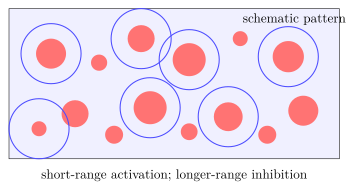
图 3 用 red domains 与 blue inhibition ranges 表示 local positive/longer-range negative feedback;不是实际 concentration map。
2.2 linear stability 与 selected wavelength
令 homogeneous fixed point 为 \(\mathbf q_*\),\(\mathbf R(\mathbf q_*)=0\)。小扰动 \(\delta\mathbf q=\mathbf a e^{\sigma t+i\mathbf k\cdot\mathbf x}\) 满足
\[\sigma\mathbf a=(\mathbf J-k^2\mathbf D)\mathbf a, \qquad \mathbf J=\left.\frac{\partial\mathbf R}{\partial\mathbf q}\right|_{\mathbf q_*}.\]
若 \(k=0\) 的所有 eigenvalues real parts 均负,而某有限 band 的 \(k\) 有 \(\operatorname{Re}\sigma(k)>0\),uniform state 发生 diffusion-driven instability。fastest-growing \(k_*\) 给 linear onset wavelength \(\lambda_*=2\pi/k_*\);nonlinear saturation 决定最终 amplitude、defects 和 pattern selection。
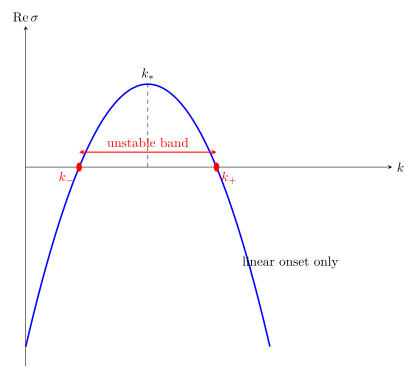
图 4 显示 finite-wavenumber instability 的 dispersion relation;曲线系教学函数,不代表某一化学体系。
3. Synchronization and coupled populations / 同步与耦合群体
Knowledge ID: P14-U05-L01-K03
3.1 phase reduction 与 Kuramoto order parameter
稳定 limit-cycle oscillator 在 weak coupling 下可把高维 state 约化为 phase。all-to-all sinusoidal Kuramoto model 为
\[\dot\theta_i=\omega_i+ \frac{K}{N}\sum_{j=1}^N\sin(\theta_j-\theta_i).\]
定义 complex order parameter
\[re^{i\psi}=\frac1N\sum_{j=1}^Ne^{i\theta_j}.\]
则每个 oscillator 看见 mean field:
\[\dot\theta_i=\omega_i+Kr\sin(\psi-\theta_i).\]
\(r\approx0\) 表示 phases dispersed,\(r\approx1\) 表示 phase coherence;frequency locking、phase locking 与 identical phase 必须区分。有限 \(N\) 的 incoherent \(r\) 也有 fluctuation。
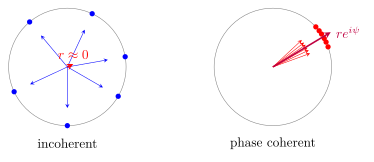
图 5 把 individual phasors 与 vector mean 分开;圆不是 physical orbit,而是 phase circle。
3.2 onset、locking 与 coupled populations
对于 symmetric unimodal natural-frequency density \(g(\omega)\) 的 ideal infinite population,incoherent state 的 onset 常由 \(g(0)\) 控制;经典 Kuramoto result 为 \(K_c=2/[\pi g(0)]\)。例如 half-width \(\Delta\) 的 Lorentzian 有 \(K_c=2\Delta\)。finite size、network topology、delay、noise、higher harmonics 与 heterogeneous coupling 都会移动或改变 transition。
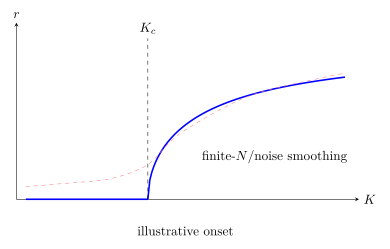
图 6 对比 ideal sharp onset 与 finite/noisy smoothing;实线函数只是 mean-field-like illustration。
两个或多个 populations 可有 intra-group coupling \(K_{aa}\)、inter-group coupling \(K_{ab}\),产生 cluster synchronization、phase lag、chimera-like coexistence 或 switching。观察到相同 frequency 不足以推断 direct coupling;共同 forcing 也能产生 coherence,需 perturbation 或 causal model 区分。
4. Criticality outside equilibrium / 非平衡临界性
Knowledge ID: P14-U05-L01-K04
4.1 absorbing transition 与 self-organized criticality 不同
nonequilibrium transition 可由 activity order parameter \(a\) 描述。Absorbing state 一旦到达,在无外部 drive/noise 时便无法自行离开;控制参数跨过临界值时,steady activity 可从 \(a=0\) 变为 \(a>0\)。这需要 tuning 一个控制参数,与 equilibrium transition 类似地可有 correlation length、time 和 universality,但没有 free-energy requirement。
Self-organized criticality(SOC) 的典型机制包含 slow drive、threshold redistribution、fast relaxation、dissipation 与 time-scale separation。system 通过 dynamics 接近 marginally stable state,不显式由实验者精细调节传统控制参数。不是所有 driven dissipative system 都 SOC,也不是所有 power law 都证明 SOC。
avalanche size distribution 常测试
\[P(s;L)=s^{-\tau}f\!\left(\frac{s}{s_c(L)}\right), \qquad s_c(L)\propto L^{D_s}.\]
finite-size cutoff \(s_c\) 随 system size 移动是关键 evidence。还应检验 duration、spatial correlation、exponent relations、driving-rate dependence 与 alternative heavy-tail models。
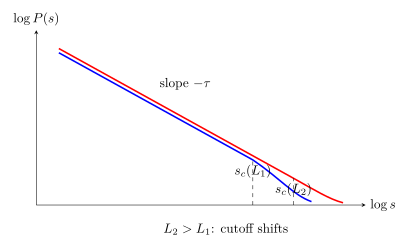
图 7 展示 finite-size scaling 应有的 cutoff shift;一段直线本身不足以判定 power law 或 criticality。
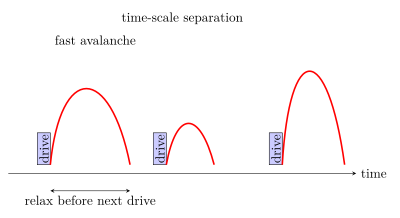
图 8 把 slow drive 与 fast relaxation 分开;若 drive 在 avalanche 未结束时持续注入,SOC ensemble 与 exponent 可能改变。
4.2 criticality audit
可靠 criticality claim 至少回答:order/activity parameter 是什么?control/drive 是什么?steady state 是否达到?correlation length/time 如何随 size 改变?exponents 是否由客观模型比较得到?cutoff 是否随 \(L\) 移动?measurement threshold、missing small events、temporal binning 与 correlated sampling 会不会制造直线?
5. Agent-based and continuum descriptions / 主体与连续描述
Knowledge ID: P14-U05-L01-K05
5.1 两种描述回答不同问题
agent-based model(ABM)保留 identity、local rule、heterogeneity、discrete event 与 fluctuations,适合测试 microscopic hypotheses;代价是 parameter identifiability、finite-size noise 与计算成本。continuum model 用 density、polarization、stress 或 concentration fields 表示 coarse-grained state,适合 stability、waves、boundaries 和 asymptotic scaling;代价是 closure assumptions 和 lost individual information。
若 agents 不 birth/death 且跨边界计数守恒,对任意 control volume \(V\):
\[\frac{d}{dt}\int_V\rho\,dV =-\oint_{\partial V}\rho\mathbf v\cdot\hat{\mathbf n}\,dA,\]
局域形式为
\[\frac{\partial\rho}{\partial t}+\nabla\cdot(\rho\mathbf v)=0.\]
这条 continuity equation 可由 bookkeeping 得到,但不闭合:还需 \(\mathbf v\) 或 polarization 的 evolution equation。Toner–Tu-type active-fluid equation 会包含 self-advection、alignment/order terms、pressure-like density gradients、diffusion/viscosity-like terms 与 noise;coefficients 必须由 micro model、symmetry、data 或 calibration 获得。
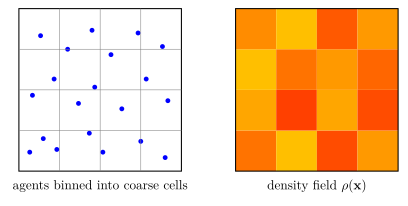
图 9 显示 one coarse-graining choice;改变 bin size 会改变 noise、resolution 与 apparent gradients。
5.2 bridge、closure 与 validation
micro-to-continuum bridge 需要 scale separation:coarse cell 内 agents 足够多以定义 local average,但 cell 又小于 macroscopic variation scale。令 interaction scale \(\ell_{int}\)、coarse scale \(\ell_c\)、pattern scale \(L\),理想 hierarchy 是
\[\ell_{int}\ll\ell_c\ll L.\]
若没有中间窗口,例如 sparse network、strong heterogeneity、long-range memory 或 few-agent system,local continuum closure 可能失败。一个合格 bridge 应用同一 parameter set 同时比较 distribution、correlation、response、boundary effect 与 scaling,不仅匹配 mean curve。
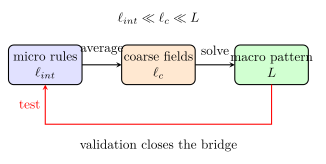
图 10 把 coarse-graining 与 validation 画成闭环;箭头不是“宏观原因反向创造微观定律”。
Worked examples / 完整例题
Worked Example 1 — 从四个 agents 计算 polarization
已知: 四个等速 agents,\(v_0=2.00\ \mathrm{m\,s^{-1}}\);headings 为 \(0,0,\pi/2,\pi/2\)。求 \(\phi\) 与 collective direction。
研究对象与边界: 这四个 agents 构成 closed observation set;只计算 instantaneous kinematic order,不推断 interaction cause。
参考系/坐标: \(+x\) right,\(+y\) up;angles 从 \(+x\) counterclockwise。
模型理由: polarization 是 normalized vector sum。
\[\sum_i\mathbf v_i =(2+2)\hat{\mathbf x}+(2+2)\hat{\mathbf y} =(4.00,4.00)\ \mathrm{m\,s^{-1}},\]
\[\phi=\frac{\sqrt{4.00^2+4.00^2}}{(4)(2.00)} =\frac{\sqrt2}{2}=0.707.\]
collective direction 为 \(\psi=\tan^{-1}(4/4)=45.0^\circ\)。
单位/有效数字: numerator/denominator 都是 velocity,\(\phi\) dimensionless;三位有效数字。
方向检查: equal \(x,y\) components 必在 first quadrant 的 \(45^\circ\)。
极限/合理性: 全部同向 gives \(\phi=1\);two opposite pairs gives \(0\)。
物理解释: \(0.707\) 表示 partial polarization,不证明 agents 由 alignment rule 产生;common forcing 也可给相同 snapshot。
Worked Example 2 — finite-\(k\) growth band 与 pattern scale
已知: 某 linearized continuum model 的 dominant growth rate 为 \(\sigma(k)=0.400\ \mathrm{s^{-1}}-(0.250\ \mathrm{m^2\,s^{-1}})(k-2.00\ \mathrm{m^{-1}})^2\)。求 unstable band、fastest mode 与 e-folding time。
研究对象与边界: infinite/periodic one-dimensional linear onset;忽略 discrete allowed modes 与 nonlinear saturation。
参考系/坐标: \(x\) 为空间坐标,perturbation \(\propto e^{\sigma t+ikx}\);\(k\ge0\)。
模型理由: \(\sigma>0\) 的 Fourier modes grow。
\[0.400-0.250(k-2.00)^2>0 \quad\Rightarrow\quad \lvert k-2.00\rvert<\sqrt{1.60}=1.265,\]
故
\[0.735<k<3.265\ \mathrm{m^{-1}}.\]
fastest mode 是 \(k_*=2.00\ \mathrm{m^{-1}}\),
\[\lambda_*=\frac{2\pi}{k_*}=3.14\ \mathrm m, \qquad t_e=\frac1{\sigma(k_*)}=2.50\ \mathrm s.\]
单位/有效数字: \(k^{-1}\) gives m;\(\sigma^{-1}\) gives s;三位有效数字。
符号/极限检查: band 外 \(\sigma<0\),扰动衰减;\(k=k_*\) 对称地最大。
物理解释: \(3.14\) m 是 onset wavelength;最终 nonlinear pattern 可 coarsen、lock to boundaries 或 form defects。
Worked Example 3 — 两个 phase oscillators 的 locking
已知: 两 oscillators 的 natural-frequency difference \(\Delta\omega=1.00\ \mathrm{rad\,s^{-1}}\),symmetric sinusoidal coupling 使 phase difference obey \(\dot\Delta=\Delta\omega-K\sin\Delta\),\(K=2.00\ \mathrm{s^{-1}}\)。求 locked phase lag 并检验 stability。
研究对象与边界: two-oscillator phase reduction;weak coupling、no delay/noise。
参考系/坐标: \(\Delta=\theta_1-\theta_2\),positive 表示 oscillator 1 leads。
模型理由: locking fixed point 满足 \(\dot\Delta=0\)。
\[\sin\Delta_*=\frac{\Delta\omega}{K}=0.500, \qquad \Delta_*=30.0^\circ\]
另有 \(150^\circ\) branch。linearization slope 为
\[\left.\frac{d\dot\Delta}{d\Delta}\right|_{\Delta_*} =-K\cos\Delta_*.\]
在 \(30.0^\circ\),slope \(=-(2.00)(0.866)=-1.73\ \mathrm{s^{-1}}<0\),stable;\(150^\circ\) 时 slope \(0\),unstable。
单位/有效数字: ratio \(\Delta\omega/K\) dimensionless;phase 三位有效数字。
极限/合理性: 若 \(K<\lvert\Delta\omega\rvert\),无 fixed phase lag;不能 frequency-lock。
物理解释: stable locking 允许 constant nonzero phase lag;同步不要求两 phases 完全相等。
Worked Example 4 — agent flux 到 continuum conservation
已知: 二维 corridor 中 coarse-grained number density \(\rho=200\ \mathrm{m^{-2}}\),agents 平均以 \(v_x=0.0200\ \mathrm{m\,s^{-1}}\) 穿过长度(截线宽度)\(W=0.500\ \mathrm m\),且沿截线均匀。求 number flux rate。
研究对象与边界: 穿过固定 control boundary 的 agents;无 birth/death,velocity normal to boundary。
参考系/坐标: boundary normal 为 \(+x\);positive flux outward。
模型理由: continuum current density \(\mathbf j=\rho\mathbf v\),二维 boundary flux \(\dot N=\int\mathbf j\cdot\hat{\mathbf n}\,dl\)。
\[j_x=\rho v_x=(200)(0.0200)=4.00\ \mathrm{m^{-1}\,s^{-1}},\]
\[\dot N=j_xW=(4.00)(0.500)=2.00\ \mathrm{s^{-1}}.\]
单位/有效数字: \(\mathrm{m^{-2}}\,\mathrm{m\,s^{-1}}\,\mathrm m=\mathrm{s^{-1}}\);三位有效数字。
方向检查: \(v_x>0\) so outward flux positive。
极限/合理性: \(v_x=0\) 或 \(W=0\) gives zero flux;discrete observations over short windows fluctuate around \(2.00\ \mathrm{s^{-1}}\)。
物理解释: continuum flux predicts average count rate,不能 recover individual crossing intervals or identities。
Lesson synthesis / 全课综合
研究 collective dynamics 可用以下 evidence ladder:
- micro specification: state、rule、interaction range/topology、noise、update timing、drive/dissipation、boundary;
- macro observable: order parameter、pattern spectrum、phase coherence、activity、avalanche distribution 或 fields;
- mechanism test: linear stability、symmetry、conservation、feedback 与 perturbation response;
- scale test: vary \(N,L\), coarse-graining, resolution and observation time;寻找 finite-size cutoff/collapse,而非只看 snapshot;
- model bridge: 从 ABM 形成 moments/fields,明确 closure 与 unresolved fluctuations;
- alternative models: common forcing versus coupling、lognormal versus power law、transient versus steady state;
- validation: 同时预测 mean、distribution、correlation、response、boundary effect and scaling;
- boundary report: 说明 inference 仅在哪个 drive/noise/density/topology/scale regime 有效。
涌现并不取消 reduction:micro rules 仍约束所有 trajectories;它强调在 large-\(N\)、long-time 与 coarse-scale 上,symmetry、conservation、instability 与 universality 可能比 individual detail 更有 predictive power。
Formula-and-decision table / 公式与决策表
| Question | Relation | Use when | Main limitation |
|---|---|---|---|
| Polar order? | \(\phi=N^{-1}\lvert\sum_ie^{i\theta_i}\rvert\) | headings/speeds comparable | finite-\(N\) baseline and heterogeneous speed |
| Local alignment update? | \(\theta_i' =\arg\sum_{j\in\mathcal N_i}e^{i\theta_j}+\xi_i\) | specified synchronous Vicsek-type model | topology, timing and noise convention matter |
| Reaction–diffusion field? | \(\partial_t\mathbf q=\mathbf R+\mathbf D\nabla^2\mathbf q\) | local reactions and Fickian diffusion | delay, advection, discreteness and nonlocality |
| Mode growth? | \(\sigma\mathbf a=(\mathbf J-k^2\mathbf D)\mathbf a\) | small perturbation near homogeneous fixed point | only linear onset |
| Phase coupling? | \(\dot\theta_i=\omega_i+(K/N)\sum_j\sin(\theta_j-\theta_i)\) | weakly coupled limit cycles | strong coupling, amplitude and delay omitted |
| Phase coherence? | \(re^{i\psi}=N^{-1}\sum_je^{i\theta_j}\) | global phase population | cluster states can hide in one scalar \(r\) |
| Avalanche scaling? | \(P(s;L)=s^{-\tau}f[s/s_c(L)]\) | stationary events and finite-size series | detection/binning and alternative tails |
| Number conservation? | \(\partial_t\rho+\nabla\cdot(\rho\mathbf v)=0\) | no birth/death/source | requires closure for \(\mathbf v\) |
| Scale separation? | \(\ell_{int}\ll\ell_c\ll L\) | local continuum coarse-graining | may not exist in sparse/nonlocal systems |
Model boundaries / 模型边界
- Vicsek-type rule: minimal symmetry model, not a literal universal animal law; metric/topological neighborhood and update convention can change results.
- Order parameter: a scalar compresses state; bands, vortices or clusters may share the same \(\phi\) or \(r\).
- Reaction–diffusion: assumes local Markovian reaction and Fickian diffusion; advection, mechanics, stochastic chemistry and growing domains require extensions.
- Linear stability: predicts onset mode, not nonlinear amplitude, selected defect density or long-time coarsening.
- Kuramoto phase reduction: valid near stable limit cycles under weak coupling; amplitude death, strong forcing and delay need larger state space.
- Mean-field \(K_c\): infinite all-to-all result; finite networks, frequency correlations and noise change onset.
- SOC: requires mechanism/evidence beyond a power-law fit; drive rate and dissipation boundary matter.
- Power laws: finite dynamic range and selection bias can imitate scaling; compare likelihoods and cutoffs.
- Continuum closure: loses identity and high-order correlations; coefficient fitting cannot repair a wrong symmetry or conservation law.
- Universality: concerns selected long-scale properties, not equality of every microscopic detail or parameter.
Misconception clinic / 误区诊所
- “emergence 意味宏观规律不受微观定律约束。” 错。宏观 effective law 是 coarse-grained consequence;它可新颖但不能产生被 microdynamics 禁止的 trajectory。
- “规则简单就必然产生简单行为。” 错。feedback、many-body interaction、nonlinearity 与 boundaries 可放大 small differences。
- “有漂亮图样就叫 self-organization。” 不充分。需说明 throughput、feedback、steady/transient state、order measure 与 perturbation response。
- “diffusion 只会抹平,所以不能造图样。” 单一 passive scalar 会抹平;coupled reaction–diffusion 中 unequal diffusion 可 destabilize homogeneous state。
- “同步就是 phases 永远完全相等。” frequency locking 可有 constant phase lag,partial synchronization 也可只有部分 population locking。
- “\(r=0\) 表示每个 oscillator 都不同。” finite-\(N\) 中 \(r\) 通常不严格为 0;cluster phases 还可能 vector-cancel。
- “log–log 直线证明 SOC。” 错。需 finite-size cutoff、mechanism、stationarity、alternative distributions 与 exponent relations。
- “continuum 比 ABM 更真实。” 二者保留的信息不同;真实性由可检验预测与适用尺度决定。
- “匹配平均值就完成 validation。” 错。错误模型可拟合 mean;还需 variance、correlation、response、boundary and scaling tests。
Practice and retrieval / 练习与检索
- [K01] \(N=4\) headings 为 \(0,\pi/2,\pi,3\pi/2\),求 \(\phi\);有限 precision 下为何可能不完全为零?
Answer 1
四个 unit phasors vector sum 为零,理想 \(\phi=0\)。floating-point、measurement noise、unequal speeds 或 angle errors 可给 small residual;需报告 uncertainty/finite-size baseline。
- [K01] 两次 simulation 的 \(\phi\) 相同,但一次形成 single flock,另一次形成两个反向 unequal clusters。为什么 \(\phi\) 不足以区分?
Answer 2
\(\phi\) 只保留 first angular moment magnitude,丢失 spatial and multimodal structure。需加 density map、cluster distribution、angular histogram/correlation。
- [K02] 若所有 \(k=0\) eigenvalues stable,但 \(k=3\ \mathrm{m^{-1}}\) 的 eigenvalue real part 为 \(0.20\ \mathrm{s^{-1}}\),该 mode 的 amplitude 经过 \(5.00\) s 放大多少?
Answer 3
linear amplitude factor \(e^{\sigma t}=e^{(0.20)(5.00)}=e=2.72\)。只适用于 perturbation small、base state and coefficients fixed 的 onset regime。
- [K02] fastest mode \(k_*=4.00\ \mathrm{mm^{-1}}\),求 onset wavelength。
Answer 4
\(\lambda_*=2\pi/k_*=1.57\ \mathrm{mm}\)。boundary quantization 和 nonlinear coarsening 可改变 final spacing。
- [K03] 三 oscillators phases 为 \(0,2\pi/3,4\pi/3\),求 \(r\);这是否必然是无相互作用?
Answer 5
phasor sum 为零,故 \(r=0\)。不必然无 interaction;稳定 three-cluster state 也可恰好 vector-cancel,需要 higher angular moments/perturbation 检验。
- [K03] two-oscillator equation 中 \(\lvert\Delta\omega\rvert=3.0\ \mathrm{s^{-1}}\)、\(K=2.0\ \mathrm{s^{-1}}\)。能否 fixed phase-lock?
Answer 6
不能,因为 fixed point 要求 \(\lvert\sin\Delta_*\rvert=\lvert\Delta\omega\rvert/K=1.5>1\)。phase 会 drift,虽可能有 modulation。
- [K04] 数据在一个 decade 上近似直线,但增大 \(L\) 后 upper cutoff 不移动。为什么这削弱 critical finite-size scaling claim?
Answer 7
critical scaling 预期 \(s_c(L)\propto L^{D_s}\);不移动提示 measurement ceiling、fixed physical scale、noncritical tail 或 size range insufficient,应比较 alternative models。
- [K04] slow-drive SOC simulation 在前一 avalanche 未结束时继续 drive,哪个核心假设被破坏?可能造成什么偏差?
Answer 8
drive–relax time-scale separation 被破坏。events 会 overlap,size/duration definition、exponents、cutoff 与 stationary state 都可能改变。
- [K05] 一维 steady continuum 中 \(\rho v=J\) constant。若 density 加倍且 no source,mean speed 如何变化?
Answer 9
\(v=J/\rho\),所以 speed 减半。该结论来自 steady flux conservation;若 sources、cross-section 或 lateral flow 变化则不成立。
- [综合] 某团队声称“局域规则产生 universal flocking”,只给 \(N=200\) 的一张有序图。列出至少五项补充检验。
Answer 10
vary \(N\) and box size、density/noise、initial/boundary/update rule;定义 \(\phi\) and finite-\(N\) baseline;测 correlation/time and susceptibility/hysteresis;测试 perturbation response;比较 metric/topological alternatives;做 finite-size scaling and independent seeds;检验 continuum prediction beyond fitted mean。
Exit ticket / 迁移检验
同一 driven population 同时出现 spatial stripes、global phase coherence 与 heavy-tailed bursts。提出一个最小分析计划,判断三者是同一 instability 的不同观测,还是三个不同机制。
Exit-ticket benchmark
定义 density/polarization field、phase \(r\)、activity/avalanche event;做 cross-correlation and lead–lag;分别改变 drive、noise、density、coupling、domain size;linearize continuum 查 stripe \(k_*\);检验 locking threshold;对 bursts 做 stationarity/finite-size cutoff and alternative tails;用 perturbations 看关闭某 coupling 是否同时消除三种 signal。只有 shared parameter scaling、temporal causality and one validated model 同时成立,才支持共同机制。
References and source notes / 参考资料与使用说明
以下权威直接来源均在 2026-08-31 实际打开并核对。正文为重新组织的教学推导,全部图根据方程原创绘制。
- Vicsek et al., APS, Novel Type of Phase Transition in a System of Self-Driven Particles — local alignment、noise、polarization order parameter 与 nonequilibrium flocking transition。
- MIT OpenCourseWare, 18.354J Nonlinear Dynamics II — Continuum Systems Lecture Notes — reaction–diffusion fields、linear stability、pattern formation and continuum methods。
- Turing, Royal Society article copy hosted by MIT, The Chemical Basis of Morphogenesis — homogeneous state 的 diffusion-driven instability 与 morphogen pattern concept。
- Acebrón et al., APS, The Kuramoto Model: A Simple Paradigm for Synchronization Phenomena — phase reduction、order parameter、critical coupling 与 coupled-population variants。
- Bak, Tang and Wiesenfeld, APS full text, Self-Organized Criticality: An Explanation of 1/f Noise — slow perturbation、threshold cascade、scale-free clusters and avalanche distributions。
- Toner and Tu, APS, Long-Range Order in a Two-Dimensional Dynamical Model: How Birds Fly Together — symmetry-based continuum dynamics for polar active matter and micro-to-hydrodynamic universality。
Source-to-content map
| Source | Used for | Knowledge ID / Section | Model boundary or convention |
|---|---|---|---|
| Vicsek et al. | local alignment update, polarization, finite-size transition evidence | K01 | minimal off-lattice model; not a literal universal organism rule |
| MIT OCW 18.354J | reaction–diffusion equation, mode stability, nonlinear pattern context | K02, K05 | continuum assumptions and linear/nonlinear distinction stated |
| Turing 1952 | diffusion-driven morphogen instability | K02 | mechanism is a model class, not proof for every biological pattern |
| Acebrón et al. | Kuramoto equation, complex order parameter, onset and variants | K03 | weak-coupling phase description; topology/noise/delay alter result |
| Bak–Tang–Wiesenfeld | SOC mechanism, minimally stable state, cascade scaling | K04 | original model motivates tests; one power law alone is insufficient |
| Toner–Tu | coarse-grained polar active-fluid description | K01, K05 | symmetry/effective theory does not determine every coefficient or finite system |
复习与拓展
- Networks and Information Flow 将把本课的 neighborhood \(\mathcal N_i\)、coupling 与 propagation 显式编码为 graph topology,研究 paths、clustering、contagion、robustness 与 information measures。
- 可扩展:bifurcation theory、amplitude equations、Swift–Hohenberg model、chimera states、directed percolation、renormalization group、kinetic equations、BBGKY/moment closure、active nematics 与 data-driven equation discovery。
- 与 Radiation Therapy and Health Physics 的接口:tissue response、QA incidents 与 risk systems 也可能有 thresholds and cascades,但不得因观察 heavy tail 就直接宣称 SOC;mechanism and exposure-specific evidence 必须独立建立。