
Learning objectives / 学习目标
完成本课后,你应能:
- 从局域守恒律与 Fick's first law 推导扩散方程,并解释扩散长度的平方根时间标度。
- 把 Fourier heat conduction 写成能量输运问题,区分 thermal conductivity 与 thermal diffusivity。
- 把 Newtonian viscosity 解释为横向动量通量,判断剪切应力方向并计算 Couette flow。
- 区分 mechanical mobility 与 electrical mobility,推导并使用两种形式的 Einstein relation。
- 对输运模型检查系统边界、参考系、符号、量纲、线性响应区间与连续介质假设。
Prerequisites / 先修知识
- 随机游走与均方位移将给出扩散的微观来源;本课先从连续介质层面建立方程。
- 能量、热与功以及 熵产生。
- 一维与三维 gradient、divergence、控制体积守恒和二阶偏微分方程。
- 电流密度、漂移速度、热力学温度和 Boltzmann constant。
Scope and conventions / 范围与约定
- 采用实验室惯性参考系和 SI;除特别说明外,介质静止、均匀、各向同性。
- \(c\) 表示 number concentration 或 amount concentration;每道题会声明单位。粒子通量 \(\mathbf J_N\) 的正方向由坐标轴定义。
- Heat flux \(\mathbf q\) 指单位面积、单位时间穿过的能量,方向从高温到低温。
- 黏性部分采用 Newtonian, incompressible, laminar continuum。明确区分 Cauchy viscous stress 与守恒式中的分子动量通量:对法向 \(+y\) 的面,\(\sigma'_{xy}=\eta\,\partial_yv_x\);沿 \(+y\) 输运的 \(+x\) 动量通量则为 \(J_y^{(p_x)}=-\sigma'_{xy}\)。
- 线性本构式只在局域梯度足够小、系数可视为局域状态函数时使用。湍流、弹道输运、强场、非局域记忆和非牛顿流体不在本课主模型内。
Notation and modeling contract / 符号与建模契约
| Symbol | Meaning | SI unit |
|---|---|---|
| \(c\) | particle or amount concentration | \(\mathrm{m^{-3}}\) or \(\mathrm{mol\,m^{-3}}\) |
| \(\mathbf J_N\) | particle/amount flux density | \(\mathrm{m^{-2}s^{-1}}\) or \(\mathrm{mol\,m^{-2}s^{-1}}\) |
| \(D\) | diffusion coefficient | \(\mathrm{m^2\,s^{-1}}\) |
| \(\mathbf q\) | heat-flux density | \(\mathrm{W\,m^{-2}}\) |
| \(k\) | thermal conductivity | \(\mathrm{W\,m^{-1}K^{-1}}\) |
| \(\alpha_{\mathrm{th}}\) | thermal diffusivity \(k/(\rho c_p)\) | \(\mathrm{m^2\,s^{-1}}\) |
| \(\eta\) | dynamic viscosity | \(\mathrm{Pa\,s}\) |
| \(\nu\) | kinematic viscosity \(\eta/\rho\) | \(\mathrm{m^2\,s^{-1}}\) |
| \(\sigma'_{xy}\) | viscous Cauchy stress: \(+x\) traction on a \(+y\) face | \(\mathrm{Pa}\) |
| \(J_y^{(p_x)}\) | molecular flux of \(+x\) momentum along \(+y\) | \(\mathrm{Pa}\) |
| \(b\) | mechanical mobility, \(v_d/F\) | \(\mathrm{m\,N^{-1}s^{-1}}\) |
| \(\mu_q\) | electrical mobility, \(v_d/E\) | \(\mathrm{m^2\,V^{-1}s^{-1}}\) |
| \(\sigma_e\) | electrical conductivity | \(\mathrm{S\,m^{-1}}\) |
Knowledge 1 — Diffusion equation and Fick's laws / 扩散方程与菲克定律
Knowledge ID: P03-U08-L01-K01
1.1 通量响应浓度梯度
Diffusion 是微观随机运动造成的净粒子输运。若介质各向同性、偏离均匀状态不大,Fick's first law 为
\[\boxed{\mathbf J_N=-D\nabla c.}\]
负号不是额外规则,而是方向信息:通量指向浓度降低最快的方向。\(D>0\) 保证孤立系统的浓度不均匀趋于减小。
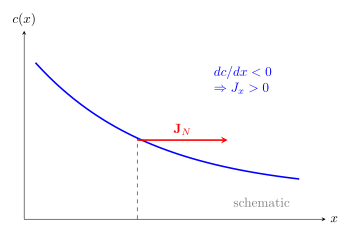
图 1:浓度沿 \(+x\) 下降时,Fick 通量沿 \(+x\);曲线与箭头是示意,不按比例。
1.2 守恒律把 first law 变成 diffusion equation
对没有体源的组分,局域守恒式是
\[\frac{\partial c}{\partial t}+\nabla\cdot\mathbf J_N=0.\]
代入 Fick 定律,若 \(D\) 为常数,
\[\boxed{\frac{\partial c}{\partial t}=D\nabla^2c.}\]
若 \(D=D(c,\mathbf r,T)\),则正确形式是 \(\partial c/\partial t=\nabla\cdot(D\nabla c)\),一般不能把 \(D\) 直接移到 Laplacian 外。
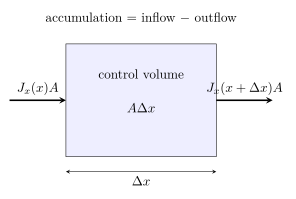
图 2:对薄控制体积做粒子数账本,取 \(\Delta x\to0\) 即得到连续性方程。
在无限一维空间中,从 \(x=0\) 出发的归一化 probability density 为
\[P(x,t)=\frac{1}{\sqrt{4\pi Dt}} \exp\left(-\frac{x^2}{4Dt}\right),\]
且 \(\int_{-\infty}^{\infty}P\,dx=1\)、\(\langle x^2\rangle=2Dt\)。若一维线密度的总粒子数为 \(N\),则 \(\lambda(x,t)=NP(x,t)\),单位为 \(\mathrm{m^{-1}}\);它不是三维体积浓度 \(c\)。因此典型扩散长度 \(\ell_D\sim\sqrt{Dt}\),到达长度 \(L\) 的时间量级是 \(L^2/D\),不是 \(L/D\)。
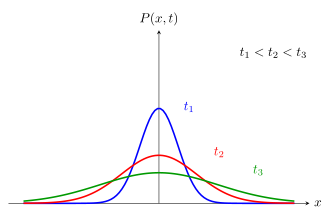
图 3:三条 Gaussian 均按单位面积归一化;概率守恒时峰值下降而宽度按 \(\sqrt{t}\) 增长。
Worked Example 1 — 薄膜中的稳态扩散
已知: 厚度 \(L=2.00\ \mathrm{mm}\) 的平板膜,两侧 amount concentration 分别为 \(c_L=2.00\ \mathrm{mol\,m^{-3}}\)、\(c_R=0.500\ \mathrm{mol\,m^{-3}}\);\(D=1.20\times10^{-9}\ \mathrm{m^2\,s^{-1}}\),面积 \(A=4.00\ \mathrm{cm^2}\)。求从左向右的稳态通量、摩尔流率和一小时输运量。
研究对象与边界: 膜内组分;两侧浓度库恒定,膜内无反应。
参考系与坐标: 实验室系,\(+x\) 从左指向右。
模型理由: 一维、稳态、常 \(D\),故浓度线性。
\[\frac{dc}{dx}=\frac{c_R-c_L}{L} =\frac{0.500-2.00}{2.00\times10^{-3}} =-750\ \mathrm{mol\,m^{-4}}.\]
\[J_x=-D\frac{dc}{dx} =9.00\times10^{-7}\ \mathrm{mol\,m^{-2}s^{-1}}.\]
面积换算为 \(A=4.00\times10^{-4}\ \mathrm{m^2}\),所以
\[\dot n=J_xA=3.60\times10^{-10}\ \mathrm{mol\,s^{-1}},\]
\[\Delta n=\dot n(3600\ \mathrm s) =1.30\times10^{-6}\ \mathrm{mol}.\]
检查: 通量为正,确实从高浓度流向低浓度;\(D(dc/dx)\) 的单位为 \(\mathrm{mol\,m^{-2}s^{-1}}\)。若 \(L\) 加倍,稳态通量减半,极限合理。结果取三位有效数字。
Knowledge 2 — Thermal conduction as transport / 热传导的输运观点
Knowledge ID: P03-U08-L01-K02
2.1 Fourier law 与能量守恒
在各向同性介质的局域线性响应区,
\[\boxed{\mathbf q=-k\nabla T.}\]
对无对流、无体热源的均匀介质,内能账本给
\[\rho c_p\frac{\partial T}{\partial t}=-\nabla\cdot\mathbf q,\]
因此
\[\boxed{\frac{\partial T}{\partial t} =\alpha_{\mathrm{th}}\nabla^2T,\qquad \alpha_{\mathrm{th}}=\frac{k}{\rho c_p}.}\]
\(k\) 衡量给定梯度产生多大热通量;\(\alpha_{\mathrm{th}}\) 衡量温度扰动扩散多快。二者维度不同,不能互换。
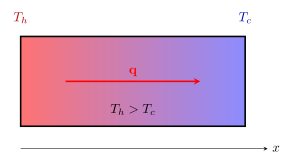
图 4:\(\nabla T\) 指向升温最快方向,而热通量沿其反向;色彩只编码温度。
2.2 三种输运的数学同构
粒子、内能和切向动量都满足“局域密度的变化 = 通量散度的负值”。在线性近似下,通量与相应梯度成正比。
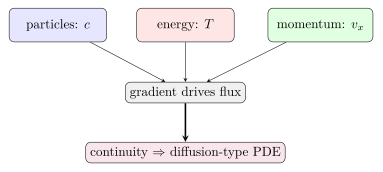
图 5:扩散、导热和黏性共享数学骨架,但被输运的守恒量和系数单位不同。
Worked Example 2 — 平板的稳态导热
已知: 厚度 \(L=1.00\ \mathrm{cm}\)、面积 \(A=2.00\times10^{-2}\ \mathrm{m^2}\) 的均匀板,\(k=0.800\ \mathrm{W\,m^{-1}K^{-1}}\);两面保持 \(350\ \mathrm K\) 与 \(300\ \mathrm K\)。求稳态热流率。
系统边界: 板为系统,侧面绝热;两面是理想恒温库。
参考系与坐标: 实验室系,\(+x\) 从热面指向冷面。
模型理由: 一维、稳态、常 \(k\)、无体热源,故 \(T(x)\) 线性。
\[\frac{dT}{dx}=\frac{300-350}{0.0100} =-5.00\times10^3\ \mathrm{K\,m^{-1}}.\]
\[q_x=-k\frac{dT}{dx} =4.00\times10^3\ \mathrm{W\,m^{-2}}.\]
\[\boxed{\dot Q=q_xA=80.0\ \mathrm W}\]
方向为 \(+x\)。检查: \(kA\Delta T/L\) 的单位为 W;温差为零时热流归零,厚度加倍时热流减半。结果为三位有效数字。
Knowledge 3 — Viscosity and momentum transport / 黏性与动量输运
Knowledge ID: P03-U08-L01-K03
3.1 Newtonian viscosity 是横向动量通量
设流速沿 \(x\),但随 \(y\) 改变。分子跨越不同 \(y\) 层时携带 \(x\)-momentum,使快层向慢层传递切向动量。对 Newtonian fluid,先以 Cauchy stress convention 写
\[\boxed{\sigma'_{xy}=\eta\frac{\partial v_x}{\partial y}}.\]
\(\sigma'_{xy}\) 表示法向为 \(+y\) 的面上沿 \(+x\) 的 viscous traction。若把同一过程写成“沿 \(+y\) 输运的 \(+x\) 动量”的非对流守恒通量,则
\[\boxed{J_y^{(p_x)}=-\sigma'_{xy}=-\eta\frac{\partial v_x}{\partial y}}.\]
两者相差负号,是因为 Cauchy stress 作为边界 traction 进入控制体动量账本,而通量以穿出 \(+y\) 面为正。若只求阻力大小,可用 \(\lvert\sigma'_{xy}\rvert=\eta\lvert dv_x/dy\rvert\)。
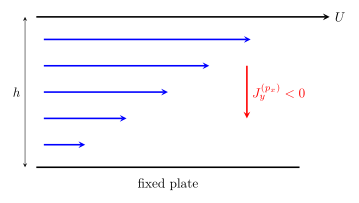
图 6:Couette flow 中上板拖动流体;黏性把 \(x\) 动量沿 \(-y\) 传向慢层。
对不可压、常 \(\eta\) 且无压强梯度的一维非稳态剪切,
\[\frac{\partial v_x}{\partial t} =\nu\frac{\partial^2v_x}{\partial y^2}, \qquad \nu=\frac{\eta}{\rho}.\]
因此 \(\nu\) 是 momentum diffusivity;\(\eta\) 给出 viscous stress 对速度梯度的响应,而守恒式中的非对流动量通量带相反号。
3.2 边界条件决定速度剖面
圆管充分发展层流在 no-slip 边界下形成抛物线速度剖面;若 Reynolds number 大、入口未发展或流体非牛顿,不能套用该图。
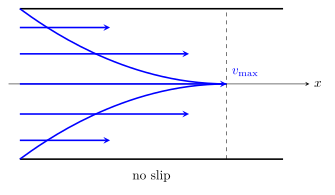
图 7:Newtonian 圆管充分发展层流的速度在壁面为零、轴线上最大;示意图未按管径比例。
Worked Example 3 — Couette flow 的剪切力与耗散功率
已知: 两平行板间距 \(h=1.00\ \mathrm{mm}\),面积 \(A=1.00\times10^{-2}\ \mathrm{m^2}\);下板静止,上板以 \(U=0.200\ \mathrm{m\,s^{-1}}\) 匀速运动。流体 \(\eta=1.00\times10^{-3}\ \mathrm{Pa\,s}\)。
研究对象: 板间 Newtonian fluid;求流体对上板阻力的大小。
参考系与坐标: 下板实验室系,\(+x\) 沿上板速度,\(+y\) 向上。
模型理由: 稳态、无压强梯度、no slip,故 \(v_x=Uy/h\)。
\[\frac{dv_x}{dy}=\frac{U}{h} =\frac{0.200}{1.00\times10^{-3}} =200\ \mathrm{s^{-1}}.\]
\[\lvert\sigma'_{xy}\rvert=\eta\frac{U}{h} =0.200\ \mathrm{Pa}.\]
\[\boxed{F=\lvert\sigma'_{xy}\rvert A=2.00\times10^{-3}\ \mathrm N.}\]
维持匀速所需机械功率为
\[\boxed{P=FU=4.00\times10^{-4}\ \mathrm W.}\]
流体对上板的力沿 \(-x\)。检查: \(\mathrm{Pa\,s}\times\mathrm{s^{-1}}=\mathrm{Pa}\);\(h\to\infty\) 时剪切趋零,合理。输入三位有效数字。
Knowledge 4 — Mobility, conductivity, and Einstein relations / 迁移率、电导率与爱因斯坦关系
Knowledge ID: P03-U08-L01-K04
4.1 漂移与扩散是同一粒子群的两种响应
对弱恒力 \(\mathbf F\),mechanical mobility 定义为
\[\mathbf v_d=b\mathbf F.\]
热平衡与 detailed balance 要求
\[\boxed{D=bk_BT.}\]
对带电粒子,常把 electrical mobility 定义为速度大小与电场大小之比,\(\mu_q=v_d/E=\lvert q\rvert b\),于是
\[\boxed{D=\mu_q\frac{k_BT}{\lvert q\rvert}.}\]
两式中的 mobility 单位不同;漏掉 \(\lvert q\rvert\) 是常见错误。
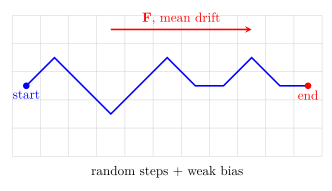
图 8:单条轨迹仍然曲折,但外力使许多轨迹的平均位移出现漂移。
4.2 电导率来自载流子数密度与迁移率
单一载流子种类的 conventional current density 为
\[\mathbf j=\sigma_e\mathbf E, \qquad \boxed{\sigma_e=n\lvert q\rvert\mu_q.}\]
若浓度也不均匀,粒子通量同时含 drift 与 diffusion。符号必须以带符号电荷和 conventional current 的定义统一,不能只凭电子速度箭头猜电流方向。
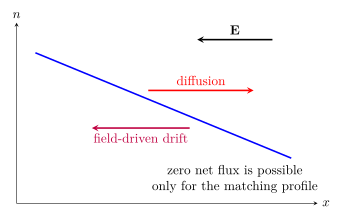
图 9:在平衡漂移—扩散问题中,两项可相消;箭头方向取正载流子示意。
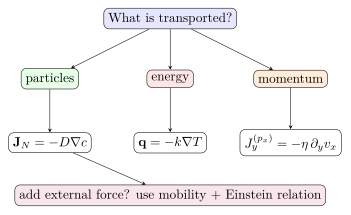
图 10:输运建模决策树先确认守恒量,再选本构式;外力存在时还要加入漂移项。
Worked Example 4 — 由 electrical mobility 求扩散与电导
已知: 正载流子在 \(T=300\ \mathrm K\) 时有 \(\mu_q=0.120\ \mathrm{m^2\,V^{-1}s^{-1}}\),数密度 \(n=2.00\times10^{21}\ \mathrm{m^{-3}}\),电荷 \(q=e\)。求 \(D\)、\(\sigma_e\),以及 \(E=100\ \mathrm{V\,m^{-1}}\) 时的漂移速度和电流密度。
系统与参考系: 均匀材料中的单一正载流子,晶格实验室系。
方向: \(\mathbf E\) 定义为正方向;正载流子漂移同向。
模型理由: 非简并、低场、局域热平衡,使用 Einstein 与 Ohmic linear response。
取 exact SI constants \(k_B=1.380649\times10^{-23}\ \mathrm{J\,K^{-1}}\)、\(e=1.602176634\times10^{-19}\ \mathrm C\),
\[D=\mu_q\frac{k_BT}{e} =(0.120)\frac{(1.380649\times10^{-23})(300)} {1.602176634\times10^{-19}} =3.10\times10^{-3}\ \mathrm{m^2\,s^{-1}}.\]
\[\sigma_e=ne\mu_q =(2.00\times10^{21})(1.602176634\times10^{-19})(0.120) =38.5\ \mathrm{S\,m^{-1}}.\]
\[v_d=\mu_qE=12.0\ \mathrm{m\,s^{-1}}, \qquad j=\sigma_eE=3.85\times10^3\ \mathrm{A\,m^{-2}}.\]
检查: \(k_BT/e\) 的单位是 V,因此 \(\mu_q(k_BT/e)\) 给 \(\mathrm{m^2\,s^{-1}}\);同时 \(j=nev_d\) 得相同结果。若载流子为电子,速度反向但 conventional current 与 \(\mathbf E\) 同向。结果取三位有效数字。
Lesson synthesis / 全课整合
四种输运的共同结构是:
- 先选系统、参考系与被输运的 extensive quantity;
- 用控制体积写 continuity/balance equation;
- 在声明的线性、局域、连续介质近似下写 constitutive law;
- 合并得到 evolution equation,再施加初始与边界条件;
- 检查通量方向、系数量纲、守恒积分、耗散正号与极限行为。
Fick、Fourier 与 Newtonian viscosity 不是同一个定律,但它们都把通量连接到驱动力梯度。Einstein relation 更进一步,把平衡涨落强度 \(D\) 与外力下的耗散响应 mobility 联系起来,为下一课的 fluctuation–dissipation viewpoint 铺路。
Formula-and-decision table / 公式—决策表
| Task | Relation | Use only when | Key caution |
|---|---|---|---|
| particle flux | \(\mathbf J_N=-D\nabla c\) | local isotropic linear response | specify concentration unit |
| diffusion evolution | \(\partial_t c=D\nabla^2c\) | constant \(D\), no source or advection | otherwise retain divergence form |
| heat flux | \(\mathbf q=-k\nabla T\) | local Fourier regime | \(k\) is not diffusivity |
| temperature evolution | \(\partial_tT=\alpha_{\mathrm{th}}\nabla^2T\) | uniform \(\rho,c_p,k\), no source/advection | \(\alpha_{\mathrm{th}}=k/(\rho c_p)\) |
| Newtonian shear | \(\sigma'_{xy}=\eta\,\partial_yv_x\) and \(J_y^{(p_x)}=-\sigma'_{xy}\) | Newtonian laminar continuum | never mix traction and conservative-flux signs |
| momentum diffusion | \(\partial_tv_x=\nu\partial_y^2v_x\) | simple shear, constant properties | \(\nu=\eta/\rho\) |
| mechanical Einstein | \(D=bk_BT\) | equilibrium, weak force, Markovian local response | \(b\) uses force, not electric field |
| electrical Einstein | \(D=\mu_qk_BT/\lvert q\rvert\) | nondegenerate low-field carrier | quantum/degenerate corrections possible |
| one-carrier conductivity | \(\sigma_e=n\lvert q\rvert\mu_q\) | independent single carrier type | sum signed current contributions carefully |
Model boundaries / 模型边界
- Continuum equations require observation scales large compared with mean free path and correlation length; ballistic nanoscale transport can be nonlocal.
- Constant-coefficient diffusion is invalid when \(D\) depends strongly on concentration, temperature, phase or direction.
- Fourier law predicts instantaneous mathematical tails; on ultrashort scales a finite-relaxation-time model may be needed.
- Newtonian viscosity excludes shear-thinning, viscoelastic and yield-stress fluids; Poiseuille additionally requires incompressible fully developed laminar flow and no slip.
- Classical Einstein relation assumes thermal equilibrium and low-field linear response; degenerate quantum carriers and hot-carrier transport need modified statistics.
- Turbulent eddy diffusivity is an effective closure, not the molecular \(D\), \(k\), or \(\nu\) defined here.
Misconception clinic / 易错概念诊所
- “负号表示通量一定为负。” 错;负号表示通量与梯度反向,分量正负取决于坐标。
- “扩散速度是 \(D/L\),所以粒子都以这个速度运动。” 错;\(D/L\) 只是尺度估计,微观热速度远大于净扩散漂移。
- “thermal conductivity 越大,温度变化一定越快。” 不完整;变化速率由 \(\alpha_{\mathrm{th}}=k/(\rho c_p)\) 决定。
- “黏性力就是动量消失。” 错;总动量守恒,黏性把动量跨层输运,并把有序机械能耗散为内能。
- “两种 mobility 都可直接代入 \(D=\mu k_BT\)。” 错;electrical mobility 需要除以 \(\lvert q\rvert\)。
- “电子漂移向左,所以 conventional current 也向左。” 错;负电荷使 conventional current 与电子速度反向。
Practice and retrieval / 练习与检索
1. Fick 方向判断(K01)
一维中 \(dc/dx=+4.0\ \mathrm{mol\,m^{-4}}\)、\(D>0\)。\(J_x\) 指向哪里?
Answer
\(J_x=-D\,dc/dx<0\),所以通量沿 \(-x\)。这不是“扩散系数为负”,而是梯度与通量反向。
2. 扩散时间尺度(K01)
\(D=2.0\times10^{-10}\ \mathrm{m^2\,s^{-1}}\) 时,扩散跨越 \(L=20\ \mathrm{\mu m}\) 的量级时间是多少?
Answer
\(t\sim L^2/D=(20\times10^{-6})^2/(2.0\times10^{-10})=2.0\ \mathrm s\)。具体数值因几何和边界条件而含数量级为一的因子。
3. 变系数方程(K01)
若 \(D=D(c)\),为什么不能一般写成 \(\partial_t c=D\nabla^2c\)?
Answer
守恒给 \(\partial_tc=\nabla\cdot(D\nabla c)=D\nabla^2c+(\nabla D)\cdot(\nabla c)\);后一项通常不为零。
4. 导热方向(K02)
温度场 \(T(x)=300+20x\ \mathrm K\),\(x\) 用 m、\(k=0.50\ \mathrm{W\,m^{-1}K^{-1}}\)。求 \(q_x\)。
Answer
\(dT/dx=20\ \mathrm{K\,m^{-1}}\),故 \(q_x=-10\ \mathrm{W\,m^{-2}}\),沿 \(-x\)。
5. Conductivity 与 diffusivity(K02)
材料 \(k=4.0\ \mathrm{W\,m^{-1}K^{-1}}\)、\(\rho=2000\ \mathrm{kg\,m^{-3}}\)、\(c_p=800\ \mathrm{J\,kg^{-1}K^{-1}}\)。求 \(\alpha_{\mathrm{th}}\)。
Answer
\(\alpha_{\mathrm{th}}=k/(\rho c_p)=4.0/(2000\times800)=2.5\times10^{-6}\ \mathrm{m^2\,s^{-1}}\)。
6. 剪切应力(K03)
油的 \(\eta=0.080\ \mathrm{Pa\,s}\),速度梯度大小 \(15\ \mathrm{s^{-1}}\)。剪切应力大小是多少?
Answer
\(\lvert\sigma'_{xy}\rvert=\eta\lvert dv/dy\rvert=(0.080)(15)=1.2\ \mathrm{Pa}\);对应的分子动量通量大小相同、符号依声明的 \(+y\) 方向取反。
7. Momentum diffusivity(K03)
同一流体密度 \(800\ \mathrm{kg\,m^{-3}}\),求 \(\nu\)。
Answer
\(\nu=\eta/\rho=0.080/800=1.0\times10^{-4}\ \mathrm{m^2\,s^{-1}}\)。
8. Mechanical Einstein relation(K04)
粒子的 \(b=2.0\times10^8\ \mathrm{m\,N^{-1}s^{-1}}\),\(T=300\ \mathrm K\)。求 \(D\)。
Answer
\(D=bk_BT=(2.0\times10^8)(1.380649\times10^{-23})(300)=8.3\times10^{-13}\ \mathrm{m^2\,s^{-1}}\)。
9. 多载流子电导(K04)
电子与空穴各有 \(n_e,n_h\) 和 mobility \(\mu_e,\mu_h\)。写出总 conductivity。
Answer
conventional current contributions 同向相加,\(\sigma_e=e(n_e\mu_e+n_h\mu_h)\);不能因电子电荷为负而把 conductivity 项相减。
10. 模型审计(K01–K04)
实验在纳米薄膜中观察到热脉冲传播距离与 \(t\) 近似成正比,而不是 \(\sqrt t\)。指出至少两个需要检查的 Fourier-model 前提。
Answer
应检查 mean free path 是否与膜厚同量级、脉冲时间是否短于碰撞松弛时间、边界散射是否主导、是否存在声子弹道输运或温度定义失去局域平衡。此时不能把偏差简单归咎于 \(k\) 数值不准。
Exit ticket / 课末检验
- 对一个未知输运问题,写出从“选守恒量”到“确定 PDE 与边界条件”的五步流程,并说明负号来自哪里。
- 比较 \(D\)、\(\alpha_{\mathrm{th}}\)、\(\nu\) 的共同单位与不同物理含义;再说明 Einstein relation 为什么是下一课 fluctuation–dissipation relation 的原型。
References and source notes / 参考资料与来源说明
- MIT OCW 3.205, Kinetics Lecture 2 — Mass Diffusion and Heat Conduction — Fick laws、continuity form、Fourier analogy 与变系数边界。
- MIT OCW 3.091SC, Session 24 — Diffusion — 扩散剖面、随机跳跃、稳态与瞬态图景。
- MIT OCW 2.57, Complete Lecture Notes — Nano-to-Macro Transport Processes — heat、momentum、mass and charge transport 的统一框架及 Einstein relation。
- MIT OCW 10.626, Lecture 21 — Transport in Solids and Concentrated Solutions — mobility、chemical driving force 与 \(D=bk_BT\)。
- MIT OCW 6.641, Lecture 7 — Drift-Diffusion Conduction — electrical mobility、current density 与 electrical Einstein relation。
- OpenStax University Physics Volume 1, 14.7 Viscosity and Turbulence — viscosity、laminar profile 与 Poiseuille model boundary。
- NIST CODATA Values of the Fundamental Physical Constants — \(k_B\)、\(e\) 与 SI constant convention。
以上直接来源均于 2026-08-25 实际打开并核对到具体课程页面、讲义或官方数据库。正文采用统一 SI 与本文符号;所有示意图依据方程原创绘制,没有复制来源插图。
Source-to-content map
| Source | Used for | Knowledge ID / Section | Model boundary or convention |
|---|---|---|---|
| MIT 3.205 Lecture 2 | Fick and Fourier constitutive laws | K01, K02 | constant-coefficient linear regime explicitly separated |
| MIT 3.091 Session 24 | diffusion profiles and microscopic picture | K01 | continuum profile distinguished from atomic jumps |
| MIT 2.57 notes | unified transport and momentum diffusion | K02, K03, K04 | nano/ballistic limitations retained |
| MIT 10.626 Lecture 21 | mechanical mobility and Einstein relation | K01, K04 | thermodynamic factor matters in concentrated media |
| MIT 6.641 Lecture 7 | charged-carrier drift diffusion | K04 | low-field, nondegenerate form used |
| OpenStax 14.7 | viscosity and laminar-flow example | K03 | Newtonian, incompressible, laminar assumptions |
| NIST CODATA | numerical constants and SI | Worked Example 4 | exact defining constants used |
复习与拓展
- 下一课从 random walk、Langevin 和 Fokker–Planck 方程推导 \(D\) 与概率通量。
- Irreversible thermodynamics 将把 \(\nabla T\)、\(\nabla(\mu/T)\) 等写成 thermodynamic forces,并处理交叉输运。
- Electromagnetism 中 drift–diffusion 会与 Poisson equation 联立;solid-state physics 会讨论 degenerate carriers 和 band-dependent mobility。
- Fluid mechanics 将从 Navier–Stokes equation 系统推导 momentum diffusion、boundary layers 与 Reynolds-number boundary。