
Learning objectives / 学习目标
- 从电场投影推出 Malus 定律,并区分已线偏振光与非偏振光的第一片偏振片。
- 用介电各向异性解释 ordinary/extraordinary eigenpolarizations、optic axis 与 double refraction。
- 由 \(\delta=2\pi\Delta n d/\lambda_0\) 设计 quarter-wave 与 half-wave plate,并判断输出偏振态。
- 在明确的 phasor、basis 与 rotation convention 下连乘 Jones matrices。
- 从强度测量重建 Stokes vector、degree of polarization 与 Poincaré sphere 位置,并说明 Jones 与 Stokes–Mueller 的互补边界。
Prerequisites / 先修知识
- Polarization States 中的线、圆、椭圆偏振与 Brewster angle。
- 复振幅、相对相位、时间平均强度。
- 二维旋转矩阵、矩阵乘法顺序与 ensemble/time average。
Scope and conventions / 范围与约定
- 光沿 \(+z\) 传播,横向 basis 为 \((\hat{\mathbf x},\hat{\mathbf y})\);复场采用 \(\operatorname{Re}[\tilde{\mathbf E}e^{i(kz-\omega t)}]\)。
- Jones vector 写 \((E_x,E_y)^{\mathsf T}\);共同非零复因子不改变归一化偏振态,共同 phase 不可观测。
- 定义 \(\mathbf e_+=(1,i)^{\mathsf T}/\sqrt2\) 的 \(S_3>0\),\(\mathbf e_-=(1,-i)^{\mathsf T}/\sqrt2\) 的 \(S_3<0\)。左右旋名称会随观察方向与时间约定改变,本课优先用 \(\pm S_3\) 避免歧义。
- 器件方位角 \(\alpha\) 从 \(+x\) 朝 \(+y\) 逆时针量;旋转矩阵定义为 \(R(\alpha)=\begin{pmatrix}\cos\alpha&-\sin\alpha\\\sin\alpha&\cos\alpha\end{pmatrix}\)。
- 波片本征 basis 取 fast axis 为第一分量、slow axis 为第二分量;去掉共同相位后 \(J_\delta=\operatorname{diag}(1,e^{i\delta})\)。
- Stokes 定义采用 \(S_3=-2\operatorname{Im}\langle E_xE_y^*\rangle\),与上述 phasor convention 配套。
- 理想元件忽略有限 extinction ratio、吸收、反射、空间不均匀、色散与 depolarization,除非另行说明。
Notation and modeling contract / 符号与建模契约
| Symbol | Meaning | SI unit |
|---|---|---|
| \(I_0,I\) | incident and transmitted irradiance | \(\mathrm{W\,m^{-2}}\) |
| \(\alpha,\beta\) | device-axis and input-linear-polarization angles | rad or degree |
| \(n_o,n_e\) | principal ordinary and extraordinary indices | 1 |
| \(n_f,n_s\) | effective fast- and slow-axis indices | 1 |
| \(d\) | plate thickness | m |
| \(\delta\) | slow-minus-fast phase retardance | rad |
| \(\mathbf J\) | Jones vector or Jones matrix, by context | field amplitude or 1 |
| \(S_0,S_1,S_2,S_3\) | Stokes parameters | common irradiance scale |
| \(P\) | degree of polarization | 1 |
Knowledge 1 — Ideal polarizers and Malus's law / 理想偏振片与马吕斯定律
Knowledge ID: P05-U06-L02-K01
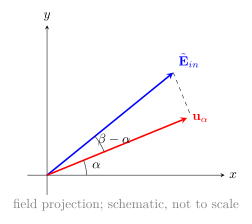
理想线偏振片的 transmission axis 为单位向量
\[\mathbf u_\alpha= \begin{pmatrix}\cos\alpha\\\sin\alpha\end{pmatrix}.\]
它保留输入电场在该轴上的投影:
\[\tilde{\mathbf E}_{out} =\mathbf u_\alpha (\mathbf u_\alpha^{\mathsf T}\tilde{\mathbf E}_{in}).\]
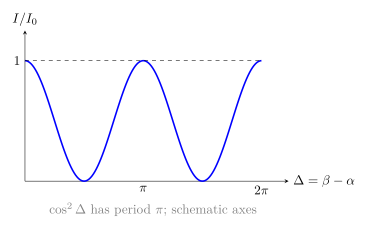
若输入为沿 \(\beta\) 的线偏振光,振幅投影因子为 \(\cos(\beta-\alpha)\);强度正比于振幅模平方,因此
\[\boxed{I=I_0\cos^2(\beta-\alpha)}.\]
这就是 Malus's law。
非偏振光不是某个未知但固定的 Jones vector;它的横向方向在平均时间内随机变化。第一片理想偏振片平均透过一半:
\[I_1=\frac{I_{unpol}}2.\]
从这片之后,光已沿其轴线偏振,第二片 analyzer 才用 Malus 定律。若输入部分偏振,应使用 Stokes/Mueller 或 coherency matrix,而不是把“平均角度”塞进 \(\cos^2\)。
Knowledge 2 — Birefringence and optical axes / 双折射与光轴
Knowledge ID: P05-U06-L02-K02
各向异性晶体的极化响应不能用单一标量 \(\epsilon\) 表示,而需 dielectric tensor:
\[\mathbf D=\boldsymbol\epsilon\mathbf E.\]
在 uniaxial crystal 的主轴系中,可写
\[\boldsymbol\epsilon= \operatorname{diag}(\epsilon_o,\epsilon_o,\epsilon_e), \qquad n_o^2=\frac{\epsilon_o}{\epsilon_0}, \quad n_e^2=\frac{\epsilon_e}{\epsilon_0}\]
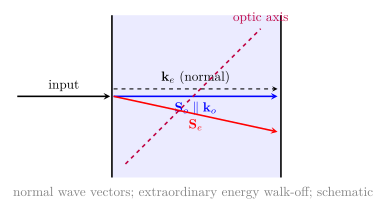
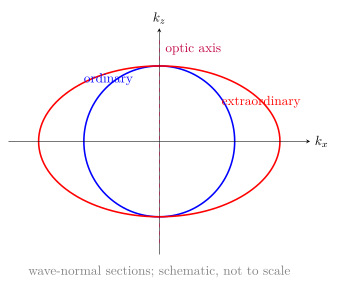
(假定非磁)。给定传播方向通常有两个正交 eigenpolarizations:ordinary wave 的主折射率为 \(n_o\);extraordinary wave 的有效折射率随波矢与 crystallographic optic axis 的夹角变化。沿 optic axis 传播时两个相速度简并,不发生双折射分裂。
必须区分三个概念:
- crystallographic optic axis:沿该传播方向本征折射率简并。
- wave plate 的 fast/slow axes:给定切割与传播方向下,横向两个本征偏振的器件轴。
- extraordinary wave 的 \(\mathbf k\) 与能流 \(\mathbf S\):一般不平行,可出现 spatial walk-off。
因此“光轴就是慢轴”不是普适句子;器件数据表必须说明切割、传播方向和波长。
Knowledge 3 — Quarter- and half-wave plates / 四分之一与半波片
Knowledge ID: P05-U06-L02-K03
波片不理想地“旋转所有偏振”;它让 fast/slow eigencomponents 积累不同相位。真空波长 \(\lambda_0\)、厚度 \(d\) 下,若 \(n_s>n_f\),slow-minus-fast retardance 为
\[\boxed{\delta=(k_s-k_f)d =\frac{2\pi}{\lambda_0}(n_s-n_f)d}.\]
去掉共同相位,在 fast/slow basis 中
\[J_\delta= \begin{pmatrix}1&0\\0&e^{i\delta}\end{pmatrix}.\]
Quarter-wave plate (QWP) 满足 \(\delta=\pi/2\) modulo \(2\pi\);half-wave plate (HWP) 满足 \(\delta=\pi\) modulo \(2\pi\)。所谓 zero-order thickness 分别为
\[d_{Q}=\frac{\lambda_0}{4\lvert n_s-n_f\rvert}, \qquad d_{H}=\frac{\lambda_0}{2\lvert n_s-n_f\rvert}.\]
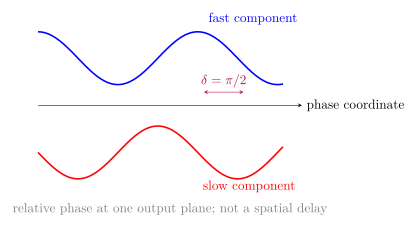
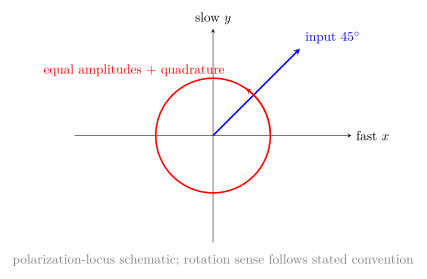
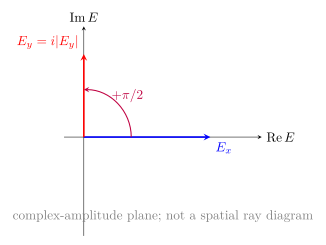
若线偏振与 QWP 两轴成 \(45^\circ\),两分量等幅;QWP 加上 \(\pm\pi/2\) 相位差,输出为 circular polarization。若分量不等幅,输出一般为 elliptical。HWP 则把相对相位反转 \(\pi\);其 fast axis 在 \(\alpha\)、输入线偏振角为 \(\beta\) 时,输出线偏振角为
\[\boxed{\beta_{out}=2\alpha-\beta}\]
(直线方向按 modulo \(\pi\) 理解)。
真实 retardance 随 \(\lambda_0\)、温度和入射角变化;multiple-order plate 虽较厚易制造,却通常更 chromatic。宽带系统使用 achromatic compound retarders 或 Fresnel rhomb。
Knowledge 4 — Jones vectors and matrices / 琼斯矢量与矩阵
Knowledge ID: P05-U06-L02-K04
状态、器件与 basis rotation
完全偏振、准单色的确定性场写成
\[\mathbf E_J= \begin{pmatrix}E_x\\E_y\end{pmatrix}.\]
常见归一化状态包括
\[\mathbf e_x=\begin{pmatrix}1\\0\end{pmatrix}, \quad \mathbf e_{45}=\frac1{\sqrt2}\begin{pmatrix}1\\1\end{pmatrix}, \quad \mathbf e_+=\frac1{\sqrt2}\begin{pmatrix}1\\i\end{pmatrix}.\]
整体相位 \(e^{i\phi}\) 不改变单束偏振,但相对相位 \(\arg E_y-\arg E_x\) 决定 polarization ellipse。
理想线偏振片的 Jones matrix 是投影算符
\[P(\alpha)=\mathbf u_\alpha\mathbf u_\alpha^{\mathsf T} =\begin{pmatrix} \cos^2\alpha&\cos\alpha\sin\alpha\\ \cos\alpha\sin\alpha&\sin^2\alpha \end{pmatrix}.\]
若元件在自身轴系中的矩阵为 \(J_0\),把其轴转到实验室角 \(\alpha\):
\[\boxed{J(\alpha)=R(\alpha)J_0R(-\alpha)}.\]
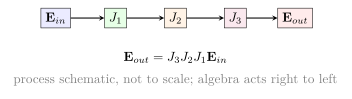
光依次遇到 \(J_1,J_2,J_3\) 时
\[\boxed{\mathbf E_{out}=J_3J_2J_1\mathbf E_{in}}.\]
最先遇到的矩阵在最右;旋转矩阵的正负号必须与 basis 定义一起使用。
Jones 的适用边界
Jones calculus 追踪相干复场,适合 fully polarized、deterministic、nondepolarizing optical train。它不能用单个二维矢量表示 unpolarized 或 partially polarized light,也不能描述把同一输入随机变成多种输出的 depolarizer。此时用 coherency matrix、Stokes vector 与 Mueller matrix。Jones 仍可描述有损但不退偏的 diattenuator;“有吸收”不等于“必退偏”。
Knowledge 5 — Stokes parameters and Poincaré sphere / 斯托克斯参数与庞加莱球
Knowledge ID: P05-U06-L02-K05
从可测强度定义 Stokes vector
对可能随时间随机变化的横向场,定义
\[S_0=\langle\lvert E_x\rvert^2+\lvert E_y\rvert^2\rangle,\]
\[S_1=\langle\lvert E_x\rvert^2-\lvert E_y\rvert^2\rangle,\]
\[S_2=2\operatorname{Re}\langle E_xE_y^*\rangle, \qquad S_3=-2\operatorname{Im}\langle E_xE_y^*\rangle.\]
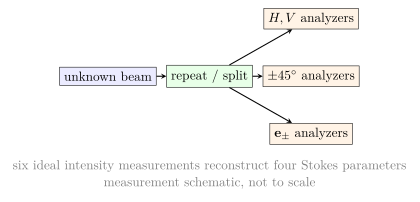
实验上可用互补 analyzer intensities:
\[S_0=I_H+I_V, \quad S_1=I_H-I_V,\]
\[S_2=I_{+45}-I_{-45}, \quad S_3=I_+-I_-.\]
这里 \(I_\pm\) 分别是投影到 \(\mathbf e_\pm\) 的强度。
物理可实现状态满足
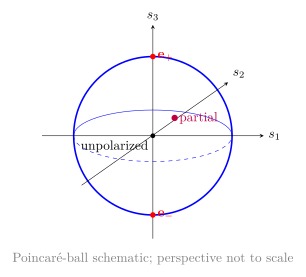
\[S_1^2+S_2^2+S_3^2\le S_0^2.\]
degree of polarization 为
\[\boxed{P=\frac{\sqrt{S_1^2+S_2^2+S_3^2}}{S_0}}, \qquad 0\le P\le1.\]
归一化坐标 \((s_1,s_2,s_3)=(S_1,S_2,S_3)/S_0\) 构成 Poincaré ball:fully polarized states 在单位球面,partially polarized states 在内部,理想 unpolarized state 在原点。赤道是 linear states,南北极是本课定义的 \(\mathbf e_-\) 与 \(\mathbf e_+\)。
Stokes parameters保留两正交分量的二阶相干统计,能描述偏振椭圆与部分偏振;但不保留相对某个独立 reference beam 的 absolute optical phase,不能替代 Jones field 去预测任意相干干涉。Mueller matrix 以 \(4\times4\) 实矩阵作用于 Stokes vector,并能描述 depolarization;nondepolarizing Jones system 可转换为相应 Mueller system,反向并非总成立。
Worked Examples / 完整例题
Worked Example 1 — Unpolarized light through two polarizers
非偏振光强 \(I_0=12.0\,\mathrm{W\,m^{-2}}\) 依次通过理想 polarizer 与相对第一片转过 \(35.0^\circ\) 的 analyzer。求输出强度。
研究对象: 非偏振入射光与两片理想偏振片。
参考系/系统: 器件静止,忽略反射吸收。
坐标: 第一片轴定义 \(0^\circ\),第二片轴 \(35.0^\circ\)。
模型: 第一片对非偏振光取统计平均,第二片用 Malus law。
\[I_1=\frac{I_0}{2}=6.00\,\mathrm{W\,m^{-2}}.\]
\[I_2=I_1\cos^235.0^\circ =(6.00)(0.6710)=4.03\,\mathrm{W\,m^{-2}}.\]
检查: \(0<I_2<I_1<I_0\);\(\mathrm{W\,m^{-2}}\) 单位正确;若两轴平行则应得 \(I_0/2\)。三位有效数字。
Worked Example 2 — Zero-order quarter-wave plate thickness
在 \(\lambda_0=632.8\,\mathrm{nm}\),某晶体给有效 birefringence \(\lvert n_s-n_f\rvert=0.00900\)。求 zero-order QWP 与 HWP 厚度。
研究对象: 正入射均匀双折射薄片。
参考系/系统: 晶体静止,波长是真空波长。
坐标: 两横向本征轴为 fast/slow。
模型: 单色、无吸收、忽略界面相位。
\[d_Q=\frac{632.8\times10^{-9}}{4(0.00900)} =1.758\times10^{-5}\,\mathrm m =17.6\,\mu\mathrm m.\]
\[d_H=2d_Q=35.2\,\mu\mathrm m.\]
检查: 厚度已由 m 转写为 \(\mu\mathrm m\),量纲为长度;\(\Delta n\to0\) 时所需厚度发散。HWP retardance 是 QWP 的两倍,厚度亦两倍;结果按三位有效数字报告。
Worked Example 3 — HWP rotation followed by an analyzer
水平线偏振单位强度光先通过 fast axis 位于 \(\alpha=22.5^\circ\) 的 ideal HWP,再通过水平 analyzer。求 HWP 后偏振方向与最终强度。
研究对象: fully polarized coherent field。
参考系/系统: 光沿 \(+z\);实验室 \(x\) 水平。
坐标: 输入 \(\beta=0^\circ\),HWP axis \(\alpha=22.5^\circ\)。
模型: 理想无损 HWP 与理想线偏振片。
HWP 把线偏振方向变为
\[\beta_{out}=2\alpha-\beta =45.0^\circ.\]
水平 analyzer 对 \(45.0^\circ\) 输入给
\[\frac{I_{final}}{I_{in}}=\cos^245.0^\circ=0.500.\]
检查: 强度比无量纲并按三位有效数字报告;HWP 本身无损,不改总强度,损失来自 analyzer 投影。把 \(\alpha\to0\) 时输出仍水平且 analyzer 全透。
Worked Example 4 — Reconstructing a partial Stokes state
同一束光的互补 analyzer measurements 为 \(I_H=7.00\)、\(I_V=3.00\)、\(I_{+45}=8.00\)、\(I_{-45}=2.00\)、\(I_+=5.00\)、\(I_-=5.00\,\mathrm{W\,m^{-2}}\)。求 Stokes vector 与 degree of polarization。
研究对象: 可能部分偏振的稳定光束。
参考系/系统: 所有 analyzer 使用同一实验室 basis。
坐标: \(S_3\) 依本课 \(\mathbf e_\pm\) 定义。
模型: 理想 analyzer,测量对同一统计状态取平均。
各互补对的和均为 \(10.0\,\mathrm{W\,m^{-2}}\),相互一致。于是
\[\mathbf S= \begin{pmatrix}S_0\\S_1\\S_2\\S_3\end{pmatrix} =\begin{pmatrix}10.0\\4.00\\6.00\\0\end{pmatrix} \mathrm{W\,m^{-2}}.\]
\[P=\frac{\sqrt{4.00^2+6.00^2}}{10.0} =0.721.\]
偏振部分为线偏振,其方位角
\[\psi=\frac12\operatorname{atan2}(S_2,S_1) =28.2^\circ.\]
检查: \(P<1\),状态位于 Poincaré ball 内部;\(S_3=0\) 与无净 circular component 一致;强度单位一致。三位有效数字。
Lesson synthesis / 本课综合
偏振器件先按物理作用分类:polarizer 做 field projection,birefringent plate 做 eigencomponent phase retardation,depolarizer 改变统计混合。对已知线偏振强度可用 Malus;对完全偏振的相干复场与确定性非退偏器件用 Jones;对非偏振、部分偏振和强度型 polarimetry 用 Stokes–Mueller。无论哪套形式,都必须先固定 phasor、basis、旋向和元件角度约定,再按实际遇到顺序连乘。
Formula-and-decision table / 公式与决策表
| Need | Formula / representation | Conditions | Main caution |
|---|---|---|---|
| linear analyzer intensity | \(I=I_0\cos^2(\beta-\alpha)\) | fully linearly polarized input | first polarizer on unpolarized light gives \(I_0/2\) |
| plate retardance | \(\delta=2\pi(n_s-n_f)d/\lambda_0\) | eigenaxes fixed, monochromatic | sign and common phase conventions matter |
| QWP / HWP | \(\delta=\pi/2\) or \(\pi\) modulo \(2\pi\) | specified wavelength and incidence | QWP gives circular only for equal input amplitudes |
| rotated Jones element | \(J(\alpha)=R(\alpha)J_0R(-\alpha)\) | stated active rotation convention | do not swap rotation signs |
| device chain | \(\mathbf E_{out}=J_N\cdots J_1\mathbf E_{in}\) | fully polarized, deterministic system | first device is rightmost |
| degree of polarization | \(P=\sqrt{S_1^2+S_2^2+S_3^2}/S_0\) | stationary Stokes statistics | \(P=0\) is not a Jones state |
| Poincaré location | \((s_1,s_2,s_3)=\mathbf S_{1:3}/S_0\) | normalized Stokes vector | partial states lie inside sphere |
Model boundaries / 模型边界
- Ideal polarizer 忽略 finite extinction ratio、插入损耗与 Fresnel reflection。
- Malus law 的简单形式不直接处理部分偏振;一般 analyzer intensity 应从 Stokes/Mueller 求。
- Uniaxial \(n_o,n_e\) 只是主值;extraordinary effective index 随传播方向变化,且 \(\mathbf k\) 与 \(\mathbf S\) 可不平行。
- Wave-plate retardance 随波长、温度和入射角变化;标称 QWP 只在设计条件精确为 \(\pi/2\)。
- Jones calculus 不表示 unpolarized、partial polarization 或 depolarization,但可表示非退偏吸收元件。
- Stokes vector 不保留相对独立 reference 的绝对光学相位;Mueller calculus 不能替代完整 coherent-field interference calculation。
- Poincaré sphere 上的南北极标签依赖 phasor、观察方向与 handedness convention;必须随文声明。
Misconception clinic / 误区诊所
- “非偏振光就是每一时刻都沿 \(45^\circ\)。” 非偏振是统计相关消失,不是某个固定 Jones vector;第一片理想偏振片透过平均一半。
- “QWP 总把线偏振变成圆偏振。” 只有输入在两本征轴上的幅度相等且 retardance 为奇数个 \(\pi/2\) 时才是圆偏振。
- “optic axis、fast axis、slow axis 是三个同义词。” 它们分别描述晶体简并传播方向与器件横向本征轴,必须看切割和传播方向。
- “Jones matrices 按光前进顺序从左向右写。” 对列向量,最先作用的矩阵在最右。
- “Stokes 只适用于非相干光。” Stokes 可描述 fully 或 partially polarized light;它描述二阶偏振统计,但不保存与独立 reference 的全部 coherent phase。
Practice and retrieval / 练习与提取
- K01 计算: 强度 \(I_0\) 的非偏振光通过两片夹角 \(45^\circ\) 的理想偏振片,输出是多少?
Answer
第一片给 \(I_0/2\),第二片再乘 \(\cos^245^\circ=1/2\),故 \[I_{out}=I_0/4.\]
- K01 反求角度: 已线偏振光经 analyzer 后强度为原来的 \(25.0\%\)。最小轴夹角是多少?
Answer
\(\cos^2\Delta=0.250\),故最小 \(\Delta=60.0^\circ\);线偏振轴按 modulo \(180^\circ\) 等价。
- K02 概念: 为什么沿 uniaxial crystal 的 optic axis 传播不出现两个不同相速度?
Answer
该方向上两个横向 eigenpolarizations 的折射率简并,wave-normal surfaces 相交,因此没有相位双折射分裂。
- K02 边界: extraordinary wave 的波矢方向能否总当作能量流方向?
Answer
不能。各向异性介质中 \(\mathbf k\) 与 Poynting vector \(\mathbf S\) 一般不平行,可有 spatial walk-off。
- K03 计算: \(\lambda_0=500\,\mathrm{nm}\)、\(\Delta n=0.0100\) 的 zero-order HWP 厚度是多少?
Answer
\[d_H=\frac{500\times10^{-9}}{2(0.0100)} =25.0\,\mu\mathrm m.\]
- K03 方向: HWP fast axis 在 \(30^\circ\),输入线偏振在 \(10^\circ\)。输出方向是多少?
Answer
\[\beta_{out}=2(30^\circ)-10^\circ=50^\circ\] ,按 modulo \(180^\circ\) 理解。
- K04 顺序: 光依次通过 \(0^\circ\) polarizer、\(45^\circ\) QWP、\(90^\circ\) analyzer,写 Jones chain。
Answer
本题定义 \(Q(\alpha)\) 为 fast/slow retardance \(\delta=\pi/2\) 的 rotated QWP: \[Q(\alpha)=R(\alpha) \begin{pmatrix}1&0\\0&i\end{pmatrix} R(-\alpha).\] \[\mathbf E_{out}=P(90^\circ)Q(45^\circ)P(0^\circ)\mathbf E_{in}.\] 最先遇到的 \(P(0^\circ)\) 在最右。
- K04 适用性: 能否用归一化 Jones vector \((1,0)^{\mathsf T}\) 表示“强度未知的完全非偏振光”?
Answer
不能;该矢量表示完全水平线偏振。非偏振需用 coherency matrix 或 \((S_0,0,0,0)^{\mathsf T}\)。
- K05 状态: 强度 \(I\) 的水平线偏振与本课 \(\mathbf e_+\) 状态分别有什么 Stokes vector?
Answer
水平线偏振为 \[(S_0,S_1,S_2,S_3)=(I,I,0,0).\] 本课 \(\mathbf e_+=(1,i)^{\mathsf T}/\sqrt2\) 为 \[(S_0,S_1,S_2,S_3)=(I,0,0,I).\]
- K05 计算: 某状态 \(\mathbf S=(20,6,8,0)\,\mathrm{W\,m^{-2}}\)。求 \(P\) 并判断 Poincaré ball 位置。
Answer
\[P=\frac{\sqrt{6^2+8^2}}{20}=0.500.\] 它在半径 \(0.500\) 的球内点,不在 fully polarized 的单位球面。
Exit ticket / 离堂检核
- 对一个“非偏振光 → polarizer → rotated QWP → analyzer”的系统,分别指出哪一步能用 Malus、哪一步需 Jones、若器件退偏又应切换到什么形式。
- 写出本课 \(S_3\) 定义,证明 \((1,i)^{\mathsf T}/\sqrt2\) 位于 Poincaré sphere 的 \(+s_3\) 极,并解释为何不直接称它为“右旋”更安全。
References and source notes / 参考资料与来源说明
Source-to-content map
| Source | Used for | Knowledge ID / section | Model boundary or convention |
|---|---|---|---|
| OpenStax University Physics Vol. 3, 1.7 Polarization | Malus law, first polarizer on unpolarized light, device context | K01 | introductory intensity model; ideal polarizers |
| MIT OCW 2.71, Lecture 22: Polarization | Jones vectors/matrices, polarizer projection, birefringence | K02, K04 | fully polarized complex field; stated phasor convention |
| Purdue Physics 422, Lecture 33: Quarter-Wave Plates | retardance, QWP thickness and real-device wavelength/angle limits | K03 | effective birefringence for the chosen cut and direction |
| Purdue Physics 422, Lecture 32: Stokes, Mueller and Jones Calculus | Jones device chains, Mueller mapping and convention warnings | K04–K05 | this lesson refines the scope: Stokes also covers fully polarized states |
| NIST SCATMECH, Common Polarization Elements and States | standard Jones/Mueller elements and Jones/Stokes state mapping | K04–K05 | software conventions must be checked before numerical use |
| NIST SCATMECH, StokesVector | Stokes-vector representation and polarization metrics | K05 | handedness and component ordering are convention-dependent |
| University of Arizona OPTI 501, Electromagnetic Waves syllabus/topic map | crystal eigenpolarizations, waveplates, Jones, coherency, Stokes and Poincaré scope | K02–K05 | advanced EM framework; topics used as cross-checks |
资料和链接实际打开核对日期:2026-08-28。所有图均按本文 convention 与方程原创绘制;例题与练习独立复算。
复习与拓展
- Polarization States:由横向场分量、反射、散射与 Brewster angle 产生偏振。
- Coherence and Interferometry:Jones field 与 mutual coherence 的连接。
- Laser Principles:laser cavity、gain anisotropy 与偏振选择。
- Polarimetry / ellipsometry:由 Mueller matrix 反演材料 diattenuation、retardance 与 depolarization。
- Quantum optics:Jones basis 对应单光子 polarization qubit,但 classical Stokes statistics 不等同完整量子态层析。